Daily reading
Lent
Double · April 2 · Sanctoral
April 2, 2025
From Dom Guéranger’s The Liturgical Year.
A Double leads the weekday.Rubric
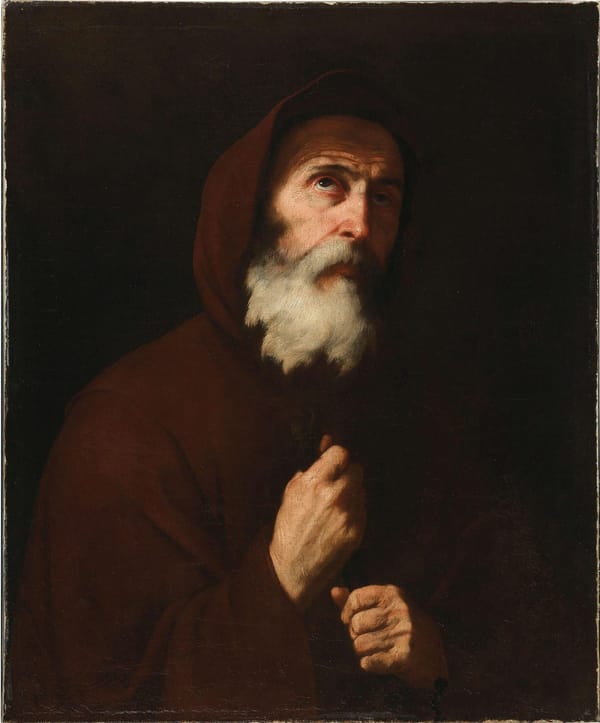 |
April 2: St. Francis of Paula
The founder of a religious Order, whose distinguishing characteristics were humility and penance, comes before us to-day; it is Francis of Paula. Let us study his virtues and beg his intercession. His whole life was one of great innocence; and yet we find him embracing, from his earliest youth, mortifications which, nowadays, would not be expected from the very worst sinners. How was it that he could do so much? and we, who have so often sinned, do so little? The claims of divine justice are as strong now as ever they were; for God never changes, nor can the offence we have committed against Him by our sins be pardoned, unless we make atonement. The saints punished themselves, with life-long and austere penances, for the slightest sins; and the Church can scarcely induce us to observe the law of Lent, though it is now reduced to the lowest degree of severity.
What is the cause of this want of the spirit of expiation and penance? It is that our faith is weak, and our love of God is cold, because our thoughts and affections are so set upon this present life, that we seldom if ever consider things in the light of eternity. How many of us are like the king of France, who having obtained permission from the Pope that St. Francis of Paula should come and live near him, threw himself at the saint's feet, and besought him to obtain of God, that he, the king, might have a long life! Louis XI. had led a most wicked life; but bis anxiety was, not to do penance for his sins, but to obtain, by the saint's prayers, a prolongation of a career which had been little better than a storing up of wrath for the day of wrath. We, too, love this present life; we love it to excess. The laws of fasting and abstinence are broken, not because the obeying them would endanger life, or even seriously injure health—for where either of these is to be feared, the Church does not enforce her lenten penances—but people dispense themselves from fasting and abstinence, because the spirit of immortification renders every privation intolerable, and every interruption of an easy comfortable life insupportable. They have strength enough for any fatigue that business or pleasure calls for; but the moment there is question of observing those laws which the Church has instituted for the interest of the body as well as of the soul, all seems impossible; the conscience gets accustomed to these annual transgressions, and ends by persuading the sinner that he may be saved without doing penance.
St. Francis of Paula was of a very different way of thinking and acting. The Church gives us the following abridged account of his life:
Apostle of penance: thy life was always that of a saint, and we are sinners: yet do we presume, during these days, to beg thy powerful intercession, in order to obtain of God that this holy season may not pass without having produced within us a true spirit of penance, which may give us a reasonable hope of receiving His pardon. We admire the wondrous works which filled thy life—a life that resembled, in duration, that of the patriarchs, and prolonged the privilege the world enjoyed of having such a saint to teach and edify it. Now that thou art enjoying in heaven the fruits of thy labours on earth, think upon us, and hearken to the prayers addressed to thee by the faithful. Gain for us the spirit of compunction, which will add earnestness to our works of penance. Bless and preserve the Order thou hast founded. Thy holy relics have been destroyed by the fury of heretics; avenge the injury thus offered to thy name, by praying for the conversion of heretics and sinners, and drawing down upon the world those heavenly graces, which will revive among us the fervour of the ages of faith.
Wednesday of the Fourth Week of Lent: Feria of the Great Scrutiny
This day is called the ‘Feria of the great scrutiny,’ because in the Church of Rome, after the necessary inquiries and examinations, the list of the catechumens, who were to receive Baptism, was closed. The Station was held in the basilica of St. Paul outside the walls, both because of the size of the building, and also in order to honour the apostle of the Gentiles by offering him these new recruits, which the Church was about to make from paganism. The reader will be interested and edified by a description of this ceremony.
The faithful and the aspirants to Baptism being assembled in the basilica, about the hour of noon, the names of these latter were written down, and an acolyte arranged them in order before the people, placing the men on the right, and the women on the left. A priest then recited over each of them the prayer which made them catechumens, for it is by anticipation that we have hitherto given them this name. He signed their foreheads with the sign of the cross and imposed his hand upon their heads. He then blessed the salt, which signifies wisdom, and each of them tasted it.
After these preliminary ceremonies, they were made to go out of the church, and remained under the exterior portico, until such time as they were called back. As soon as they had left (the assembly of the faithful remaining in the church) the Introit was begun. It is taken from the words of the Prophet Ezechiel, wherein God tells us that He will gather His elect from all nations, and pour upon them a clean water, that shall cleanse them from their sins. The acolyte then read out the names of the catechumens, and they were brought into the church by the porter. They were arranged as before, and the sponsors stood near them. The pontiff then sang the Collect; after which, at the intimation given by the deacon, each sponsor made the sign of the cross on the forehead of the catechumen, for whom he or she was responsible. Acolytes followed, and pronounced the exorcisms over each of the elect, beginning with the men.
A lector next read the lesson from the Prophet Ezechiel, which we give in its proper place. It was followed by a Gradual, composed of these words of David:
Come, children, hearken to me; I will teach you the fear of the Lord. Come ye to Him, and be enlightened; and your faces shall not be confounded.
In the Collect, which followed this lesson, the Church prayed that the faithful might receive the fruits of their lenten fast; and immediately a second lesson was read, from the Prophet Isaias, in which is foretold the remission of sins to be granted to those who shall be cleansed in the mysterious laver of Baptism.
A second Gradual gave these words from the royal psalmist:
Blessed is the nation whose God is the Lord; the people whom He hath chosen for His inheritance.
During the reading of these two lessons, and the chanting of the two Graduals, the mysterious ceremony of opening the ears was being gone through. A priest went to each catechumen, and touching his ears, said: Ephpheta, that is, be thou opened. This rite (which was an imitation of what our Saviour did to the deaf and dumb man mentioned in the Gospel)* was intended to prepare the catechumens to receive the revelation of the mysteries, which, up to that time, had been shown them only under the veil of allegory. The first initiation made to them was regarding the holy Gospels.
Reading of the Holy Gospels
As soon as the second Gradual was finished, there were seen coming from the secretarium, preceded by lights and incense, four deacons, each of them carrying one of the four Gospels. They advanced towards the sanctuary, and placed the sacred volumes on the altar, one on each corner. The bishop, or, if he wished it, a priest, addressed to the catechumens the following allocution, which we find still in the Gelasian sacramentary:
Being about to open to you the Gospels, that is, the history of the acts of God, it firstly behoves us, dearly beloved children, to tell you what the Gospels are, whence they come, whose words they contain, why they are four in number, and who wrote them; in fine, who are the four men who were announced by the holy Spirit, and foretold by the prophet. Unless we were to explain to you these several particulars, we should leave your minds confused; and whereas you have come to-day that your ears may be opened, it would be unseemly in us to begin by bewildering your minds. Gospel literally means good tidings, because it tells us of Jesus Christ, our Lord. The Gospel came from him, in order to proclaim and show that he, who spoke by the prophets, has now come in the flesh, as it is written: ‘I myself that spoke, lo, I am here.’ Having briefly to explain to you what the Gospel is, and who are the four men foretold by the prophet, we now give you their names, following the order of the figures under which they are designated. The Prophet Ezechiel says: ‘And as for the likenese of their faces, there was the face of a man and the face of a lion on the right side of ail the four: and the face of an ox on the left side of all the four: and the face of an eagle over all the four.’ These four figures are, as we know, those of tho evangelists, whose names are Matthew, Mark, Luke, and John.
After this discourse, a deacon, ascending the ambo, thus addressed the catechumens:
Be silent: hear attentively!
Then, opening the Gospel of St. Matthew, which he had previously taken from the altar, he read the beginning, as far as the twenty-first verse.
These verses having been read, a priest spoke as follows:
Dearly beloved children, we wish to hold you no longer in suspense: therefore, we expound to you the figure of each evangelist. Matthew has the figure of a man, because, at the commencement of his book, he gives the genealogy of the Saviour; for he begins with these words: The book of the generation of Jesus Christy the son of David, the son of Abraham. You see, then, that it is not without reason, that to Matthew has been assigned the figure of the man, since he begins with the human birth of the Saviour.
Again the deacon from the ambo:
Be silent: hear attentively!
He then read the beginning of St. Mark’s Gospel, as far as the eighth verse. After which, the priest spoke as follows:
The evangelist Mark has the figure of the lion, because he begins with the desert, saying: A voice of one crying in the desert: Prepare ye the way of the Lord; or again, because the Saviour now reigns, and is invincible. This type of the lion is frequently mentioned in the Scriptures, and is the application of those words; ‘Juda is a lion’s whelp: to the prey, my son, thou art gone up: resting, thou hast couched as a lion, and as a lioness: who shall rouse him?
The deacon, having repeated his injunction, next read the beginning of the Gospel according to St. Luke, as far as the seventeenth verse; after which the priest said:
The evangelist Luke has the figure of the ox, which reminds us that the Saviour was offered in sacrifice. This evangelist begins by speaking of Zachary and Elizabeth, from whom, in their old age, was born John the Baptist.
The deacon having announced, in the same solemn manner, the Gospel of St. John, of which he read the first fourteen verses, the priest thus continued his instruction:
John has the figure of the eagle, because he soars aloft in the high places. It is he that says: In the beginning was the Word, and the Word was with Ood, and the Word was God. The same was in the beginning with God. David also, speaking of the person of Christ, thus expresses himself: ‘Thy youth shall be renewed like the eagle’s’; because our Lord Jesus Christ, having risen from the dead, ascended into heaven. Thus, dearly beloved children, the Church that has begotten you, and still bears you in her womb, exults at the thought of the new increase to be given to the Christian law, when, on the venerable day of Easter, you are to be born again in the waters of Baptism, and to receive, as all the saints, from Christ our Lord, the gift of the childhood of faith.
Traditio Symboli
The manifestation of the four evangelists was followed by the ceremony called the giving of the Symbol (Traditio Symboli). It consisted in giving to the catechumens the Apostles’ Creed (or Symbol), and in subsequent ages, that of Nicæa, or, as we call it, the Nicene Creed. The following allocution was first made by a priest:
Being now admitted to receive the Sacrament of Baptism, and become new creatures in the Holy Ghost, it behoves you, dearly beloved children, to conceive at once in your hearts the faith whereby you are to be justified: it behoves you, having your minds henceforth changed by the habit of truth, to draw nigh to God, who is the light of your souls. Receive, therefore, the secret of the evangelical Symbol, which was inspired by the Lord, and drawn up by the apostles. Its words are few, but great are the mysteries it contains: for the Holy Ghost, who dictated this formula to the first masters of the Church, has here expressed the faith that saves us, with great precision of words, in order that the truths you have to believe and unceasingly meditate on might neither surpass your understanding, nor escape your memory. Be, then, attentive, that you may learn this Symbol; and what, having ourselves received, we hand down to you, that same write, not on corruptible things, but on the tablets of your heart. Now, the confession of faith, which you have received, begins thus.
One of the catechumens was then told to come forward, and the priest addressed the following question to the acolyte who accompanied him:
In what language do these confess our Lord Jesus Christ?
The acolyte answered:
In Greek.
It should be remembered, that under the emperors, the use of the Greek language was almost as general in Rome as that of the Latin. The priest then said to the acolyte:
Make known to them the faith they believe.
Here the acolyte, holding his hand over the catechumen’s head, pronounced the Creed in Greek, in a solemn tone. One of the female catechumens, whose language was the Greek, was then brought forward, and the acolyte repeated the Creed in the same manner. The priest then said:
Dearly beloved children, you have heard the Symbol in Greek; hear it now in Latin.
Accordingly, two catechumens, who spoke the Latin language, were brought forward, first a man, and then a woman. The acolyte recited the Creed in Latin before each of them, and loud enough for all the others to hear. The giving of the Symbol thus completed, the priest made the following allocution:
This is the compendium of our faith, dearly beloved children, and these are the words of the Symbol, drawn up, not according to the conceits of human wisdom, but according to the thoughts of God. There is no one but can understand and remember them. There it is, that is expressed the one and coequal power of God the Father and the Son; there, that is shown to us the only-begotten Son of God, born, according to the flesh, of the Virgin Mary, by the operation of the Holy Ghost; there, that are related his crucifixion, his burial, and his resurrection on the third day; there, that is proclaimed his ascension above the heavens, his sitting at the right hand of the majesty of the Father, and his future coming to judge the living and the dead; there, that is announced the Holy Ghost, who has the same divinity as the Father and the Son; there, in fine, that are taught the vocation of the Church, the forgiveness of sins, and the resurrection of the flesh. You, therefore, put off the old man, my learly beloved children, that you may be reformed according to the new; once carnal, you begin now to be spiritual; once of earth, now of heaven. Believe, with firm and unshaken faith, that the Resurrection which was accomplished in Christ will likewise be accomplished in you; and that this miracle, which has been achieved in him who is our Head, will be repeated in all them that are members of his body. The Sacrament of Baptism, which you are soon to receive, is the visible expression of this hope; for in it is represented both a death and a resurrection; there the old man is left, there the new man is assumed. The sinner descends into the water, and comes out justified. He, that had dragged us into death, is cast off; and he is received who restored us to life, and who, by the grace that he will give you, will make you children of God, not by the flesh, but by the virtue of the Holy Ghost. It is your duty, therefore, to keep this short formula in your hearts, so as to make use of the confession it contains, as a help to you on all occasions. The power of this armour is invincible against all the attacks of the enemy; it should be worn by the true soldiera of Christ. Let the devil, who tempts mail without ceasing, find you ever armed with this Symbol. Triumph over the adversary, whom you have just renounced. By God’s grace, preserve incorruptible and unsullied, even to the end, the grace he is about to give you; that thus, he in whom you are soon to receive the forgiveness of your sins, may bring you to the glory of the Resurrection. Thus, then, dearly beloved children, you know the Symbol of the Catholic faith; carefully learn it, not changing one word. God’s mercy is powerful; may it bring you to the faith of the Baptism to which you aspire; and may it lead us, who this day reveal to you the mysteries, to the heavenly kingdom together with you; through the same Jesus Christ, our Lord, who liveth and reigneth, for ever and ever. Amen.
The Lord's Prayer
The giving of the Symbol was followed by another gift: the Lord’s Prayer. The deacon first made the announcement; he urged the catechumens to silence and attention; and then a priest delivered the following allocution:
Our Lord and Saviour Jesus Christ, among his other saving precepts, gave to his disciples, on that day when they asked him how they ought to pray, this form of prayer, which we are about to repeat to you, and explain in all its fulness. Let your charity, therefore, now hear how the Saviour taught his disciples to pray to God the Father almighty. ‘When thou shalt pray,’ said he, ‘enter into thy chamber; and having shut the door, pray to thy Father.’ Here, by chamber, he means not a room, but the interior of the heart, which is known to God alone. By saying that we ought to adore God after having shut the door, he signifies that we ought to shut out, with a spiritual key, all bad thoughts from our heart, and speak to God, though our lips may be closed, in purity of soul. What our God hears, is not the sound of our words, but our faith. Let our heart, then, be shut, with the key of faith, against the craft of the enemy; let it not be opened save to that God, whose temple we know it is; and the Lord, dwelling thus in our heart, will be propitious and grant our prayers. The prayer taught us by the Word, the Wisdom of God, Christ our Lord, is this:
OUR FATHER, WHO ART IN HEAVEN
Observe these words, how full they are of holy liberty and confidence. Live, therefore, in such manner, that you may be children of God, and brethren of Christ. Of what rashness would he be guilty who dared to call God his Father, yet proved himself to be degenerate by opposing God’s will! Dearly beloved children, show yourselves to be worthy of the divine adoption; for it is written; ‘To them that believe in his name, he gave power to be made the eons of God.
HALLOWED BE THY NAME
It is not that God, who is ever holy, needs to be hallowed by us; but what we here ask, is that his name be sanctified in us: so that we, who have been made holy by the Baptism he has given us, may persevere in the new being we have received from him.
THY KINGDOM COME
Our God whose kingdom is for ever, does he not always reign? Yes, undoubtedly: but what we ask for, when we say, Thy kingdom come, is the coming of that kingdom which he has promised us, and which Christ has merited for us by his Blood and Passion.
THY WILL BE DONE ON EARTH AS IT IS IN HEAVEN
That is to say: May thy will be in such manner fulfilled, that what thou wiliest in heaven, may be faithfully accomplished by us who are on earth.
GIVE US THIS DAY OUR DAILY BREAD
We mean, by this, our spiritual food; for Christ is our bread, as he said; ‘I am the living Bread that came down from heaven.’ We say our daily bread, because we ought unceasingly to ask to be made free from sin, in order that we may be made worthy of the heavenly nourishment.
AND FORGIVE US OUR TRESPASSES, AS WE FORGIVE THEM THAT TRESPASS AGAINST US
These words signify that we cannot merit the forgiveness of our sins, unless we first forgive what others do against us. Thus it is that our Lord says in the Gospel: ‘If you will not forgive men their offences, neither will your Father forgive you your offences.
AND LEAD US NOT INTO TEMPTATION
That is: suffer us not to be led into it by the tempter, by the author of evil. For the Scripture says: ‘God is not the tempter of evil things.’ It is the devil that tempts us; and that we may overcome him, the Lord says to us: ‘Watch and pray, that ye enter not into temptation.
BUT DELIVER US FROM EVIL
These words refer to that which is said by the apostle: ‘We know not what we should pray for.’ We should beseech the one only and omnipotent God, that the evils which we cannot avoid because of human weakness, we may avoid in virtue of that help which will mercifully be granted us by our Lord Jesus Christ, who, being God, liveth and reignoth in the unity of the Holy Ghost, for ever and ever.
After this allocution, the deacon said:
Observe order and silence, and lend an attentive ear!
The priest then continued, in these words:
You have just heard, dearly beloved children, the mysteries of the Lord’s Prayer: see, therefore, that you fix them in your hearts, both coming in and going out, that you may become perfect, asking and receiving the mercy of God. The Lord our God is mighty, and will lead you, who are on the way to faith, to the laver of the water of regeneration. May he mercifully grant that we, who have delivered unto you the mysteries of the Catholic faith, may be brought, together with you, to the kingdom of heaven: who liveth and reigneth with God the Father, in the unity of the Holy Ghost, for ever and ever.
After the Gospel, in which was related the cure of the man that was born blind, the deacon, as usual, commanded all the catechumens to leave the church. They were taken out by their sponsors; but these returned, in order to assist at Mass with the rest of the faithful. At the Offertory, they came up to the altar, and gave the names of their spiritual children; which names, as also those of the sponsors themselves, were read by the bishop in the Canon. Towards the end of Mass, the catechumens were brought back into the church, and were told on what day they were to present themselves for examination on the Symbol and the other instructions they had that day received.
The imposing ceremony, which we have thus briefly described, was not confined to this day: it was repeated as often as needed; that is, according to the number of the catechumens, and the time required for gaining information regarding their conduct and the preparation they were making for Baptism. In the Church of Rome, these scrutinies were held seven times, as we have already remarked; but the one of to-day was the most numerous and solemn; each of the seven terminated with the ceremony we have been describing.
Collect
First Lesson
Cap. xxxvi.Hæc dicit Dominus Deus: Sanctificabo nomen meum magnum, quod pollutum est inter gentes, quod polluistis in medio earum: ut sciant gentes quia ego Dominus, cum sanctificatus fuero in vobis coram eis. Tollam quipped vos de gentibus, et congregabo vos de universis terris, et adducam vos in terrain vestram. Et effundam super vos aquam mundam, et mundabimini ab omnibus inquinamentis vestris, et ab universis idolis vestris mundabo vos. Et dabo vobis cor novum, et spiritum novum ponam in medio vestri: et auferam cor lapideum de carne vestra, et dabo vobis cor carneum. Et Spiritum meum ponam in medio vestri: et faciam ut in præceptis meis ambuletis, et judicia mea custodiatis, et operemini. Et habitabitis in terra quam dedi patribus vestris: et eritis mihi in populum, et ego ero vobis in Deum: dicit Dominus omnipotens.
Ch. xxxvi.Thus saith the Lord God: I will sanctify my great name, which was profaned among the Gentiles, which you have profaned in the midst of them; that the Gentiles may know that I am the Lord, saith the Lord of hosts, when I shall be sanctified in you before their eyes. For I will take you from among the Gentiles, and will gather you together out of all the countries, and will bring you into your own land. And I will pour upon you clean water, and you shall be cleansed from all your filthiness, and I will cleanse you from all your idols. And I will give you a new heart, and put a new spirit within you; and I will take away the stony heart out of your flesh, and will give you a heart of flesh. And I will put my Spirit in the midst of you, and I will cause you to walk in my commandments, and to keep my judgments, and do them. And you shall dwell in the land which I gave to your fathers, and you shall be my people, and I will be your God, saith the Lord almighty.
These magnificent promises, which are to be fulfilled in favour of the Jewish people, as soon as God’s justice shall have been satisfied, are to be realized firstly, in our catechumens. These are they that have been gathered together from all the countries of the Gentile world, in order that they may be brought into their own land, the Church. A few days hence there will be poured upon them that clean water, which shall cleanse them from all the defilements of their past idolatry; they shall receive a new heart, and a new spirit; they shall be God’s people for ever.
Second Lesson
Cap. i.Hæc dicit Dominus Deus: Lavamini, mundi estote, auferte malum cogitationum vestrarum ab oculis meis: quiescite agere perverse, discite benefacere: quærite judicium, subvenite oppresso, judicate pupillo, defendite viduam. Et venite, et arguite me, dicit Dominus. Si fuerint peccata vestra ut coccinum, quasi nix dealbabuntur: et si fuerint rubra quasi vermiculus, velut lana alba erunt. Si volueritis, et audieritis me, bona terræ comedetis: dicit Dominus omnipotens.
Ch. i.Thus saith the Lord God: Wash yourselves, be clean, take away the evil of your devices from my eyes: cease to do perversely, learn to do well: seek judgment, relieve the oppressed, judge for the fatherless, defend the widow. And then come and accuse me, saith the Lord: if your sins be as the scarlet, they shall be made as white as snow: and if they be red as crimson, they shall be white as wool. If you be willing, and will hearken to me, you shall eat the good things of the land, saith the Lord almighty.
It is to her penitents that the Church addresses these grand words of Isaias. There is a baptism also prepared for them; a laborious baptism indeed, but still, one that has power to cleanse their souls from all their defilements, if only they receive it with sincere contrition, and be resolved to make atonement for the evil they have committed. What could be stronger than the language used by God, in making His promise of forgiveness? He compares the change He will make, in the soul of a repentant sinner, to that of scarlet and crimson become white as snow. The unjust is to be made just; darkness is to be turned into light; the slave of satan is to become the child of God. Let us rejoice with our glad mother, the holy Church; and redoubling the fervour of our prayer and penance, let us induce our Lord to grant that, on the great Easter feast, the number of conversions may surpass our hopes.
Gospel
Cap. ix.In illo tempore: Præteriens Jesus vidit hominem cæcum a nativitate: et interrogaverunt eum discipuli ejus: Rabbi, quis peccavit, hie, aut parentes ejus, ut cæcus nasceretur? Responds Jesus: Neque hic peccavit, neque parentes ejus: sed ut manifestentur opera Dei in illo. Me oportet operari opera ejus, qui misit me, donee dies est: venit nox, quando nemo potest operari. Quamdiu sum in mundo, lux sum mundi. Hæc cum dixisset, exspuit in terram, et fecit lutum ex sputo, et linivit lutum super oculos ejus, et dixit ei: Vade, lava in natatoria Siloe (quod interpretatur Missus). Abiit ergo, et lavit, et venit videns. Itaque vicini, et qui viderant cum prius, quia mendicus erat, dicebant: Nonne hic est, qui sedebat, et mendicabat? Alii dicebant: Quia hic est; alii autem: Nequaquam, sed similis est ei. Ule vero dicebat: Quia ego sum. Dicebant ergo ei: Quomodo aperti sunt tibi oculi? Respondit: Illo homo qui dicitur Jesus, lutum fecit et unxit oculos meoe, et dixit mihi: Vade ad natatoria Siloe, et lava. Et abii, lavi, et video. Et dixerunt ei: Ubi est ille? Ait: Nescio. Adducunt eum ad pharisæos, qui cæcus fuerat. Erat autem Sabbatum quando lutum fecit Jesus, et aperuit oculos ejus. Iterum ergo interrogabant eum pharisæi quomodo vidisset. Ille autem dixit eis: Lutum mihi posuit super oculos, et lavi, et video. Dicebant ergo ex pharisæis quidam: Non est hic homo a Deo, qui sabbatum non custodit. Alii autem dicebant: Quomodo potest homo peccator hæc signa facere? Et schisma erat inter eos. Dicunt ergo caeco iterum: Tu quid dicis de illo, qui aperuit oculos tuos? Ille autem dixit: Quia propheta est. Non crediderunt ergo Judæi de illo, quia cæcus fuisset et vidisset, donee vocaverunt parentes ejus, qui viderat: et interrogaverunt eos, dicentes: Hic est filius vester, quem vos dicitis quia cæcus natus est? Quomodo ergo nunc videt? Responderunt eis parentes ejus, et dixerunt: Scimus quia hic est filius noster, et quia cæcus natus est: quomodo autem mine videat, nescimus: aut quis ejus aperuit oculos, nos nescimus, ipsum interrógate: ætatem håbet; ipse de se loquatur. Hæc dixerunt parentes ejus, quoniam timebant Judæo: jam enim conspira ve rant Judæi, ut si qui eum confiteretur esse Christum, extra synagogam fieret: propterea parentes ejus dixerunt: Quia ætatem håbet, ipsum interrogate. Vocaverunt ergo rursum hominem, qui fuerat cæcus, et dixerunt ei: Da gloriam Deo. Nos scimus quia hio homo peccator est. Dixit ergo eis ille: Si peccator est, nescio: unum scio, quia cæcus cum essem, modo video. Dixerunt ergo illi: Quid fecit tibi? quomodo aperuit tibi oculos? Respondit eis: Dixi vobis jam, et audistis: quid iterum vultis audire? numquid et vos vultis discipuli ejus fieri? Maledixerunt ergo ei, et dixenint: Tu discipulus illius sis: nos autem Moysi, discipuli sumue. Nos scimus quia Moysi locutus est Deus: hunc autem nescimus unde sit. Respondit ille homo, et dixit eis: In hoc enim mirabile est, quia vos nescitis unde sit, et aperuit meos oculos: scimus autem quia peccatores Deus non audit: sed si quis Dei cultor est, et voluntatem ejus facit, hunc exaudit. A sæculo non est auditum, quia quis aperuit oculos cæci nati. Nisi esset hio a Deo, non poterat facere quidquam. Responderunt et dixerunt ei: In peccatis natus es totus, et tu doces nos? Et ejecerunt eum foras. Audivit Jesus quia ejecerunt eum foras; et cum invenisset eum, dixit ei: Tu credis in Filium Dei T Respondit ille, et dixit: Quis est, Domine, ut credam in eum? Et dixit ei Jesus: Et vidisti eum: et qui loquitur tecum, ipse est. At ille ait: Credo, Domine. (Here all kneel.) Et procidens. adoravit eum.
Ch. ix.At that time: Jesus passing by, saw a man who was blind from his birth; and his disciples asked him: Rabbi, who hath sinned, this man, or his parents, that he should be born blind? Jesus answered: Neither hath this man sinned, nor his parents; but that the works of God should be made manifest in him. I must work the works of him that sent me, whilst it is day: the night cometh when no man can work. As long as I am in the world, I am the light of the world. When he had said these things, he spat on the ground, and made clay of the spittle, and spread the clay upon his eyes, and said to him: Go, wash in the pool of Siloe, which is interpreted, Sent. He went therefore, and washed, and he came seeing. The neighbours, therefore, and they who had seen him before, that he was a beggar, said: Is not this he that sat and begged? Some said: This is he; but others said: No, but he is like him. But he said: I am he. They said therefore to him: How were thine eyes opened? He answered: That man that is called Jesus, made clay, and anointed mine eyes, and said to me: Go to the pool of Siloe, and wash. And I went, I washed, and I see. And they said to him: Where is he? He saith: I know not. They bring him that had been blind to the pharisees. Now it was the Sabbath, when Jesus made the clay, and opened his eyes. Again therefore the pharisees asked him, how he had received his sight. But he said to them: He put clay upon my eyes, and I washed, and I see. Some therefore of the pharisees said: This man is not of God, who keepeth not the Sabbath. But others said: How can a man that is a sinner do such miracles? And there was a division among them. They say therefore to the blind man again: What sayest thou of him that hath opened thy eyes? And he said: He is a prophet. The Jews then did not believe concerning him, that he had been blind, and had received his sight, until they called the parents of him that had received his sight, and asked them, saying: Is this your son, who you say was born blind? How then doth he now see? His parents answered them, and said: We know that this is our son, and that he was born blind, but how he now seeth we know not, or who hath opened his eyes we know not; ask himself; he is of age, let him speak for himself. These Things his parents said, because they feared the Jews; for the Jews had already agreed among themselves, that if any man should confess him to be Christ, he should be put out of the synagogue. Therefore did his parents say: He is of age, ask him. They therefore called the man again that had been blind, and said to him: Give glory to God; we know that this man is a sinner. He said therefore to them: If he be a sinner, I know not; one thing I know, that whereas I was blind now I see. They said then to him: What did he to thee? How did he open thy eyes? He answered them: I have told you already, and you have heard, why would you hear it again? will you also become his disciples? They reviled him, therefore, and said: Be thou his disciple: but we are the disciples of Moses. We know that God spoke to Moses; but as to this man, we know not from whence he is. The man answered and said to them j Why, herein is a wonderful thing, that you know not from whence he is, and he hath opened my eyes. Now we know that God doth not hear sinners: but if a man be a server of God, and doth his will, him he heareth. From the beginning of the world it hath not been heard, that any man hath opened the eyes of one born blind. Unless this man were of God, he could not do anything. They answered and said to him: Thou wast wholly born in sins, and dost thou teach us? And they cast him out. Jesus heard that they had cast him out; and when he had found him, he said to him: Dost thou believe in the Son of God? He answered, and said: Who is he, Lord, that I may believe in him? And Jesus said to him: Thou hast both seen him and it is he that talketh with thee. And he said: I believe, Lord. (Here all kneel.) And falling down, he adored him.
In the early ages of the Church, Baptism was frequently called illumination, because this Sacrament confers supernatural faith, whereby man is enlightened with the divine light. It is on this account, that the history of the cure of the man born blind was read on this day, for it is the figure of man’s being enlightened by Christ. This subject is frequently met with in the paintings in the catacombs, and on the bas-reliefs of the ancient Christian monuments.
We are all born blind; Jesus, by the mystery of His Incarnation, figured by this clay which represents our flesh, has merited for us the gift of sight; but in order that we may receive it, we must go to the pool of Him that is divinely Sent, and we must be washed in the water of Baptism. Then shall we be enlightened with the very light of God, and the darkness of reason will disappear. The humble obedience of the blind man, who executes, with the utmost simplicity, all that our Saviour commands him, is an image of our catechumens, who listen with all docility to the teachings of the Church, for they, too, wish to receive their sight. The blind man of the Gospel is, by the cure of his eyes, a type of what the grace of Christ works in us by Baptism. Let us listen to the conclusion of our Gospel, and we shall find that he is, also, a model for those who are spiritually blind, yet would wish to be healed.
Our Saviour asks him, as the Church asked us on the day of our Baptism: Dost thou believe in the Son of God? The blind man, ardently desiring to believe, answers eagerly: Who is He, Lord, that I may believe in Him? Faith brings the weak reason of man into union with the sovereign wisdom of God, and puts us in possession of His eternal truth. No sooner has Jesus declared Himself to be God, than this simplehearted man falls down and adores Him: he that from being blind is blessed with bodily sight is now a Christian! What a lesson was here for our catechumens! At the same time, this history showed them, and reminds us, of the frightful perversity of Jesus’ enemies. He, the pre-eminently Just Man, is shortly to be put to death, and it is by the shedding of His Blood that He is to merit for us, and for all mankind, the cure of that blindness in which we were all born, and which our own personal sins have tended to increase. Glory, then, love, and gratitude be to our divine Physician, who, by uniting Himself to our human nature, has prepared the ointment, whereby our eyes are cured of their infirmity, and strengthened to gaze, for all eternity, on the brightness of the Godhead!
The Mozarabic liturgy offers us this fine Preface, or Illation, which is suggested by to-day’s Gospel.
Illatio
(Dominica II. Quadragesimæ)
* St. Mark vii. 32-34. ↩︎
April 2 (the Same Day, in Some Dioceses): St. Mary of Egypt, Penitent
One of the most striking examples of penance ever witnessed, is this day proposed for our consideration: Mary, the sinner and penitent of Egypt, comes to animate us to persevere in our lenten exercises. Like Magdalene and Margaret of Cortona, she had sinned grievously; like them she repented, atoned for her guilt, and is now the associate of angels. Let us adore the omnipotence of our God, who thus changed a vessel of dishonour into one of honour; let us lovingly contemplate the riches of His mercy, and hope for our own participation in them. At the same time, let us remember that pardon is not granted save where there is repentance; and that repentance is not genuine, unless it produce an abiding spirit and deeds of penance. Mary of Egypt had the misfortune to lead a life of sin for seventeen years; but her penance lasted forty: and what kind of penance must hers have been, living alone in a desert, under a scorching sun, without the slightest human consolation, and amidst every sort of privation! The pledge of pardon—the holy Communion —which we received so soon after our sins, was not granted to Mary, till she had done penance for nearly half a century. That pledge of Jesus' forgiveness, which He has given us in the Sacrament of His love, and which was communicated to us so promptly, was withheld from this admirable penitent, so that she received it for the second time only at the moment when death was on the point of separating her soul from her body which was worn out by austerities! Let us humble ourselves at such a comparison; let us think with fear on this great truth—that God’s justice will require an exact account of all the graces He has heaped upon us; and with this thought, let us rouse ourselves to a determination to merit, by the sincerity of our repentance, a place near the humble penitent of the desert.
We take the lessons of the Office of St. Mary of Egypt from the ancient Roman-French breviaries:
In praise of our incomparable penitent, we offer to the reader the following beautiful sequence, taken from the ancient missals of Germany:
Sequence
In amplexum Salomonis
Nostri transit filia;
Ex abjecta fit electa,
Ex rugosa fit formosa,
Ex lebete phiala.
Ad dilectum quam conduxit
Pacia nectens fædera;
Matre Dei mediante,
Peccatrici, Christo dante,
Sunt dimissa scelera.
Pervenit in Jerusalem,
Nuptura Pacifico;
Hinc excluso adultero
Maritatur Sponso vero
Ornata mirifico.
Dum laborat, mox redire
Necdum digna cogitur;
Ad cor suum revertitur,
Fletu culpa submergitur,
Fletu culpa teritur.
Leviathan conteritur,
Mundus, caro vincitur,
Domus patris postponitur,
Vultus mentis componitur,
Decor camis spernitur.
Tuia ornata tympanis,
Lauda quondam sterilis,
Gaude, plaude, casta, munda,
Virtutum prole fœcunda,
Vitis meri fertilis.
Umbilicus est præcisus
Tuus continentia;
Aquis lotam, pulchram totam
Te salivit, te condivit
Sponsi sapientia.
Intus tota delibuta
Oleo lætitiæ;
Croco rubene charitatis;
Bysso cincta castitatis,
Zona pudicitiæ.
Dum superna contemplaris,
Mutatis affectibus;
Vestiris discoloribus,
Cubile vernat floribus,
Fragat aromatibus.
Decoravit et amavit
Sic te Christi gratia,
Memor semper peccatorum,
Et cunctorum populorum,
Plaude nunc in gloria.
to the espousals with Jesus,
our true Solomon.
She that was abject, is made a chosen one;
she that was deformed, is made fair;
the vessel of dishonour is made one of honour.
and leading her to her beloved Son,
has knit the bond of peace.
The Mother of God interceded;
Christ forgave;
the sinner’s sins are pardoned.
came to Jerusalem,
to be espoused to the King of peace;
leaving her false lover,
she is united to the true Spouse,
honoured by the wonderful One.
but her unworthiness forbids it;
she is compelled to retire.
Then does she return to her own heart;
she weeps for her sins,
and her weeping blots them out.
tramples on Leviathan;
conquers the world and the flesh;
forgets her father’s house:
neglects the beauty of the body,
that her spirit may be made comely.
Thou, that once wast barren,
take up thy harp, and sing.
Exult and be joyful, for now thou art chaste and pure,
fruitful in virtue,
a vine that yields a precious fruit.
the shame of thy disorders
is effaced by the merit of thy purity.
The wisdom of thy heavenly Spouse has given thee,
cleansed and all fair,
the incorruption of his grace.
thou wast anointed with the oil of gladness.
The scarlet of charity,
the lily of chastity,
the girdle of modesty
—all were upon thee.
for thy affections were changed
from earthly to heavenly things.
Thy vesture was of every richest hue,
and thy couch was decked with flowers,
sweeter than those of spring.
in that Christ so loved thee,
and beautified thee with grace.
Be mindful of us sinners;
pray for all mankind;
feast now in thy eternal glory!
Thou wilt sing for all eternity, O Mary, the mercies of the Lord, who changed thee from a sinner into so glorious a saint; we join thee in thy praises, and we give Him thanks for having shown us so evidently, in thy person, that a true penitent, whatever and how great soever may have been his sins, may not only avoid eternal torments, but merit everlasting bliss. How light must now appear to thee, O Mary, that forty years’ penance, the very thought of which terrifies us! How short a time, when compared with eternity! How insignificant its austerity, if we think of hell! And how rich must its reward seem to thee, now that thou art face to face with infinite Beauty! We, too, are sinners; dare we say that we are penitents? Aid our weakness, O Mary! Thou wast made known to the world at the close of thy hidden life, in order that Christians might learn from thee the grievousness of sin, of which they make so little account; the justice of God, of which they are so apt to form so false an idea; ¿md the goodness of that Father, whom they cease not to offend. Pray for us, O Mary, that we may profit by the instructions given to us so profusely during this holy season. Pray that our conversion may be complete; that we may leave our pride and our cowardice; that we may appreciate the grace of reconciliation with our Maker; and, lastly, that we may ever approach to the holy Table with compunction and love such as thou hadst, when, in thy last happy Communion, Jesus gave Himself to thee in His Sacrament, and then took thee to Himself in the kingdom of everlasting rest and joy.
| Previous Tuesday of the Fourth Week of Lent | Next Wednesday of the Fourth Week of Lent: Feria of the Great Scrutiny |