Daily reading
Passiontide
Greater Double · Movable from Easter · Temporal
April 11, 2025
From Dom Guéranger’s The Liturgical Year.

|
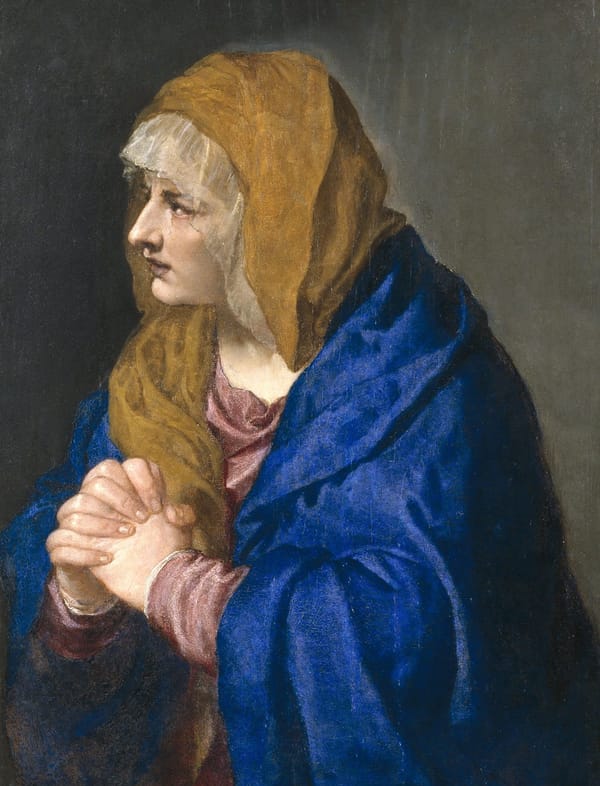
Friday in Passion Week: The Seven Dolours of the Blessed Virgin
The Station, at Rome, is in the church of Saint Stephen on Monte Celio. By a sort of prophetic presentiment, this church of the great proto-martyr was chosen as the place where the faithful were to assemble on the Friday of Passion-week, which was to be, at a future time, the feast consecrated to the Queen of martyrs.
Collect
Epistle
Cap. xvii.In diebus illis, dixit Jeremias: Domine, omnes qui te derelinquunt, confundentur: recedentes a te in terra scribentur: quoniam dereliquerunt venam aquarum viventium, Dnminum. Sana me, Domine, et sanabor: salvum me fac, et salvus ero: quoniam laus mea tu es. Ecce ipsi dicunt ad me: Ubi est verbum Domini? veniat. Et ego non sum turbatus, te Pastorem sequens: et diem hominis non desideravi, tu scis. Quod egressum est de labile meis, rectum in conspectu tuo fuit. Non sis tu mihi formidini; spes mea tu in die afflictionis. Confundantur qui me persequuntur, et non confundar ego: paveant illi, et non paveam ego: induc super eos diem afflictionis, et duplici contritione contere eos, Domine Deus noster.
Ch. xvii.In those days, Jeremias said: O Lord, all that forsake thee shall be confounded: they that depart from thee, shall be written in the earth, (as on sand, from which their names shall soon he effaced,) because they have forsaken the Lord, the vein of living waters. Heal me, O Lord, and I shall be healed, save me and I shall be saved: for thou art my praise. Behold they say to me: where is the word of the Lord? let it come. And I am not troubled, following thee for my pastor, and I have not desired the day of man, thou knowest. That which went out of my lips, hath been right in thy sight. Be not thou a terror unto me; thou art my hope in the day of affliction. Let them be confounded that persecute me, and let not me be confounded: let them be afraid, and let not me be afraid: bring upon them the day of affliction, and with a double destruction destroy them, O Lord our God.
Jeremias is one of the most striking figures of the Messias persecuted by the Jews. It is on this account, that the Church selects from this prophet so many of her lessons during these two weeks that are sacred to the Passion. In the passage chosen for to-day’s Epistle, we have the complaint addressed to God by this just man against those that persecute him; and it is in the name of Christ that he speaks. He says: They have forsaken the Lord, the vein of living waters. How forcibly do these words describe the malice, both of the Jews that crucified, and of sinners that still crucify, Jesus our Lord! As to the Jews, they had forgotten the rock, whence came to them the living water which quenched their thirst in the desert; or, if they have not forgotten the history of this mysterious rock, they refuse to take it as a type of the Messias.
And yet, they hear this Jesus crying out to them in the streets of Jerusalem, and saying: 'If any man thirst, let him come to Me, and drink.’1 His virtues, His teachings. His miracles, the prophecies that are fulfilled in His person, all claim their confidence in Him; they should believe every word He says. But they are deaf to His invitation; and how many Christians imitate them in their obduracy! How many there are, who once drank at the vein of living waters, and afterwards turned away, to seek to quench their thirst in the muddy waters of the world, which can only make them thirst the more! Let them tremble at the punishment that came upon the Jews; for, unless they return to the Lord their God, they must fall into those devouring and eternal flames, where even a drop of water is refused. Jesus, by the mouth of His prophet, tells the Jews that the day of affliction shall overtake them; and when, later on, He comes to them Himself, He forewarns them, that the tribulation which is to fall on Jerusalem, in punishment for her deicide, shall be so great that such hath not been from the beginning of the world until now, neither shall be.2 But if God so rigorously avenged the Blood of His Son against a city that was so long a place of the habitation of His glory, and against a people that He had preferred to all others, will He spare the sinner who, in spite of the Church’s entreaties, continues obstinate in his evil ways? Jerusalem had filled up the measure of her iniquities; we, also, have a measure of sin, beyond which the justice of God will not permit us to go. Let us sin no more: let us fill up that other measure, the measure of good works. Let us pray for those sinners who are to pass these days of grace without being converted; let us pray that this divine Blood, which is to be so generously given to them, but which they are about again to trample upon, may again spare them.
Gospel
Cap. xi.In illo tempore: Collegerunt pontifices et pharisæi concilium ad versus Jesum, et dicebant: Quid facimus, quia hic homo multa signa facit? Si dimittimus eum sic, omnes credent in eum; et venient Romani, et tollent nostrum locum et gentem. Unus autem ex ipsis, Caiphas nomine, cum esset pontifex anni illius, dixit eis: Vos nescitis quidquam, nec cogitatis quia expedit vobis ut unus moriatur homo pro populo, et non tota gens pereat. Hoc autem a semetipso non dixit; sed cum esset pontifex anni illius prophetavit, quod Jesus moriturus erat pro gente; et non tantum pro gente sed ut filios Dei, qui erant dispersi, congregaret in unum. Ab illo ergo die cogitaverunt ut interficerent eum. Jesus ergo jam non in palam ambulabat apud Judæos, sed abiit in regionem juxta desertum, in civitatem quæ dicitur Ephrem, et ibi morabatur cum discipulis suis.
Ch. xi.At that time: The chief priests and pharisees gathered a council against Jesus, and said: What do we, for this man doth many miracles? If we let him alone so, all men will believe in him; and the Romans will come, and take away our place and nation. But one of them, named Caiphas, being the high-priest that year, said to them: You know nothing, neither do you consider that it is expedient for you that one man should die for the people, and that the whole nation perish not. And this he spoke not of himself; but being the high-priest of that year, he prophesied that Jesus should die for the nation; and not only for the nation, but to gather together in one the children of God, that were dispersed. From that day therefore they devised to put him to death. Wherefore Jesus walked no more openly among the Jews, but he went into a country near the desert, unto a city that is called Ephrem, and there he abode with his disciples.
Jesus is more than ever in danger of losing His life! The council of the nation assembles to devise a plan for His destruction. Listen to these men, slaves of that vilest of passions, jealousy. They do not deny the miracles of Jesus; therefore they are in a condition to pass judgment upon Him, and the judgment ought to be favourable. But they have not assembled to examine if He be or be not the Messias; it is to discuss the best plan for putting Him to death. And what argument will they bring forward to palliate the evident murder they contemplate? Political interests—their country’s good. They argue thus: ‘If Jesus be longer allowed to appear in public and work miracles, Judea will rise up in rebellion against the Romans, who now govern us, and will proclaim Jesus to bo King; Rome will never allow us, the weakest of her tributaries, to insult her with impunity, and, in in order to avenge the outrage offered to the Capitol, her armies will come and exterminate us.’ Senseless counsellors! If Jesus had come that He might be King after this world’s fashion, all the powers of the earth could not have prevented it. Again—how is it that these chief priests and pharisees, who know the Scriptures by heart, never once think of that prophecy of Daniel, which foretells that, in seventy weeks of years after the going forth of the decree for the rebuilding of the temple, the Christ shall be slain, and the people that shall deny Him shall cease to be His: moreover, that, after this crime, a people led on by a commander shall come and destroy Jerusalem; the abomination of desolation shall enter the holy place, the temple shall be destroyed, and the desolation shall last even to the end.3 How comes it, that this prophecy is lost sight of? Surely, if they thought of it, they would not put Christ to death; for, by putting Him to death, they ruin their country.
But to return to the council. The high-priest, who governed the Synagogue during the last days of the Mosaic Law, is a worthless man, by name Caiphas; he presides over the council. He puts on the sacred ephod, and he prophesies; his prophecy is from God, and is true. Let us not be astonished: the veil of the temple is not yet rent asunder; the covenant between God and Juda is not yet broken. Caiphas is a bloodthirsty man, a coward, a sacrilegious wretch; still, he is high-priest, and God speaks by his mouth. Let us hearken to this second Balaam: Jesus shall die for the nation, and not only for the nation, but to gather in one the children of God, that were dispersed. Thus, the Synagogue is near her end, and is compelled to prophesy the birth of the Church, and that this birth is to be by the shedding of Jesus’ Blood. Here and there throughout the world, there are children of God who serve Him among the Gentiles, as did the centurion Cornelius; but there is no visible bond of union among them. The time is at hand, when the great and only city of God is to appear on the mountain, and all nations shall flow unto it.4 As soon as the Blood of the new Testament shall have been shed, and the Conqueror of death shall have risen from the grave, the day of Pentecost willconvoke, not the Jews to the temple of Jerusalem, but all nations to the Church of Jesus Christ. By that time, Caiphas will have forgotten the prophecy he uttered; he will have ordered his servants to piece together the veil of the Holy of holies, which was torn in two at the moment of Jesus’ death; but this veil will serve no purpose, for the Holy of holies will be no longer there: a clean oblation will be offered up in every place, the Sacrifice of the new Law;5 and scarcely shall the avengers of Jesus’ death have appeared on Mount Olivet, than a voice will be heard in the sanctuary of the repudiated temple, saying: ‘Let us go out from this place!’
THE SEVEN DOLOURS OF OUR LADY
This Friday of Passion-week is consecrated in a special manner, to the sufferings which the holy Mother of God endured at the foot of the cross. The whole of next week is fully taken up with the celebration of the mysteries of Jesus’ Passion; and although the remembrance of Mary’s share in those sufferings is often brought before the faithful during Holy Week, yet, the thought of what her Son, our divine Redeemer, goes through for our salvation, so absorbs our attention and love, that it is not then possible to honour, as it deserves, the sublime mystery of the Mother’s com-passion.
It was but fitting, therefore, that one day in the year should be set apart for this sacred duty: and what day could be more appropriate than the Friday of this week, which, though sacred to the Passion, admits the celebration of saints’ feasts, as we have already noticed? As far back as the fifteenth century (that is, in the year 1423), we find the pious archbishop of Cologne, Theodoric, prescribing this feast to be kept by his people.6 It was gradually introduced, and with the knowledge of the holy See, into several other countries; and at length, in the last century, Pope Benedict XIII, by a decree dated August 22, 1727, ordered it to be kept in the whole Church under the name of the Feast of the Seven Dolours of the Blessed Virgin Mary, for, up to this time, it had gone under various names. We will explain the title thus given to it, as also the first origin of the devotion of the Seven Dolours, when our Liturgical Year brings us to the third Sunday of September, the second feast of Mary’s Dolours. What the Church proposes to her children’s devotion for this Friday of Passion-week, is that one special dolour of Mary—her standing at the foot of the cross. Among the various titles given to this feast before it was extended by the holy See to the whole Church, we may mention, Our Lady of Pity, the Compassion of our Lady, and the one that was so popular throughout France, Notre Dame de la Pamoison. These few historical observations prove that this feast was dear to the devotion of the people, even before it received the solemn sanction of the Church.
That we may clearly understand the object of this feast, and spend it, as the Church would have us do, in paying due honour to the Mother of God and of men, we must recall to our minds this great truth: that God, in the designs of His infinite wisdom, has willed that Mary should have a share in the work of the world’s redemption. The mystery of the present feast is one of the applications of this divine law, a law which reveals to us the whole magnificence of God’s plan; it is, also, one of the many realizations of the prophecy, that satan’s pride was to be crushed by a woman. In the work of our redemption there are three interventions of Mary; that is, she was thrice called upon to take part in what God Himself did. The first of these was in the Incarnation of the Word, who would not take flesh in her virginal womb until she had given her consent to become His Mother; and this she gave by that solemn Fiat which blessed the world with a Saviour. The second was in the sacrifice which Jesus consummated on Calvary, where she was present that she might take part in the expiatory offering. The third was on the day of Pentecost, when she received the Holy Ghost, as did the apostles, in order that she might effectively labour in the establishment of the Church. We have already explained, on the feast of the Annunciation, the share Mary had in that wonderful mystery of the Incarnation, which God wrought for His own glory and for man’s redemption and sanctification. On the feast of Pentecost we shall speak of the Church commencing and progressing under the active influence of the Mother of God. To-day we must show what part she took in the mystery of her Son’s Passion; we must tell the sufferings, the Dolours, she endured at the foot of the cross, and the claims she thereby won to our filial gratitude.
On the fortieth day after the birth of our Emmanuel, we followed to the temple the happy Mother carrying her divine Babe in her arms. A venerable old man was there, waiting to receive her Child; and, when he had Him in his arms, he proclaimed Him to be the Light of the Gentiles, and the glory of Israel. But, turning to the Mother, he spoke to her these heart-rending words: ‘Behold! this Child is set to be a sign that shall be contradicted, and a sword shall pierce thine own soul.’ This prophecy of sorrow for the Mother told us that the holy joys of Christmas were over, and that the season of trial, for both Jesus and Mary, had begun. It had, indeed, begun; for, from the night of the flight into Egypt, up to this present day, when the malice of the Jews is plotting the great crime, what else has the life of our Jesus been, but the bearing of humiliation, insult, persecution, and ingratitude? And if so, what has the Mother gone through? what ceaseless anxiety? what endless anguish of heart? But let us pass by all her other sufferings, and come to the morning of the great Friday.
Mary knows that, on the previous night, her Son has been betrayed by one of His disciples, that is, by one that Jesus had numbered among His intimate friends; she herself had often given him proofs of her maternal affection. After a cruel Agony, her Son has been manacled as a malefactor, and led by armed men to Caiphas, His worst enemy. Thence, they have dragged Him before the Roman governor, whose sanction the chief priests and scribes must have before they can put Jesus to death. Mary is in Jerusalem; Magdalene, and the other holy women, the friends of Jesus, are with her; but they cannot prevent her from hearing the loud shouts of the people, and if they could, how is such a heart as hers to be slow in its forebodings? The report spreads rapidly through the city that the Roman governor is being urged to sentence Jesus to be crucified. Whilst the entire populace is on the move towards Calvary, shouting out their blasphemous insults at her Jesus, will His Mother keep away, she that bore Him in her womb, and fed Him at her breast? Shall His enemies be eager to glut their eyes with the cruel sight, and His own Mother be afraid to be near Him?
The air resounded with the yells of the mob. Joseph of Arimathea, the noble counseller, was not there, neither was the learned Nicodemus; they kept at home, grieving over what was done. The crowd that went before and after the divine Victim was made up of wretches without hearts, saving only a few who were seen to weep as they went along; they were women; Jesus saw them, and spoke to them. And if these women from mere sentiments of veneration, or, at most, of gratitude, thus testified their compassion, would Mary do less? Could she bear to be elsewhere than close to her Jesus? Our motive for insisting so much upon this point is that we may show our detestation of that school of modern rationalism, which, regardless of the instincts of a mother’s heart and of all tradition, has dared to call in question the meeting of Jesus and Mary on the way to Calvary. These systematic contradictors are too prudent to deny that Mary was present when Jesus was crucified; the Gospel is too explicit: Mary stood near the cross:7 but they would persuade us that, whilst the daughters of Jerusalem courageously walked after Jesus, Mary went up to Calvary by some secret path! What a heartless insult to the love of the incomparable Mother.
No; Mary, who is, by excellence, the valiant woman,8 was with Jesus as He carried His cross. And who could describe her anguish and her love, as her eye met that of her Son tottering under His heavy load? Who could tell the affection and the resignation of the look He gave her in return? Who could depict the eager and respectful tenderness wherewith Magdalene and the other holy women grouped around this Mother, as she followed her Jesus up to Calvary, there to see Him crucified and die? The distance between the fourth and the tenth Station of the Dolorous Way is long: it is marked with Jesus’ Blood, and with His Mother’s tears.
Jesus and Mary have reached the summit of the hill that is to be the altar of the holiest and most cruel Sacrifice: but the divine decree permits not the Mother as yet to approach her Son. When the Victim is ready, then she that is to offer Him shall come forward. Meanwhile, they nail her Jesus to the cross; and each blow of the hammer is a wound to Mary’s heart. When, at last, she is permitted to approach, accompanied by the beloved disciple (who has made amends for his cowardly flight), and the disconsolate Magdalene and the other holy women, what unutterable anguish must have filled the soul of this Mother, when raising up her eyes, she sees the mangled Body of her Son, stretched upon the cross, with His face all covered with blood, and His head wreathed with a crown of thorns!
Here, then, is this King of Israel, of whom the angel had told her such glorious things in his prophecy! Here is that Son of hers, whom she has loved both as her God and as the fruit of her own womb! And who are they that have reduced Him to this pitiable state? Men—for whose sake rather than for her own, she conceived Him, gave Him birth, and nourished Him! Oh! if by one of those miracles, which His heavenly Father could so easily work, He might be again restored to her! If that divine justice, which He has taken upon Himself to appease, would be satisfied with what He has already suffered I But no: He must die; He must breathe forth His blessed Soul after a long and cruel agony.
Mary then is at the foot of the cross, there to witness the death of her Son. He is soon to be separated from her. In three hours’ time, all that will be left her of this beloved Jesus will be a lifeless Body, wounded from head to foot. Our words are too cold for such a scene as this: let us listen to those of St Bernard, which the Church has inserted in her Matins of this feast. ‘O blessed Mother! a sword of sorrow pierced thy soul, and we may well call thee more than martyr, for the intensity of thy compassion surpassed all that a bodily passion could produce. Could any sword have made thee smart so much as that word which pierced thy heart, reaching unto the division of the soul and the spirit: “Woman! behold thy Son!” What an exchange! John for Jesus! the servant, for the Lord! the disciple for the Master! the son of Zebedee, for the Son of God! a mere man, for the very God! How must thy most loving heart have been pierced with the sound of those words, when even ours, that are hard as stone and steel, break down as we think of them! Ah! my brethren, be not surprised when you are told that Mary was a martyr in her soul. Let him alone be surprised, who has forgotten that St. Paul counts it as one of the greatest sins of the Gentiles, that they were without affection. Who could say that of Mary? God forbid it be said of us, the servants of Mary!’9
Amid the shouts and insults vociferated by the enemies of Jesus, Mary’s quick ear has heard these words, which tell her, that the only son she is hence forth to have on earth is one of adoption. Her maternal joys of Bethlehem and Nazareth are all gone; they make her present sorrow the bitterer; she was the Mother of a God, and men have taken Him from her! Her last and fondest look at her Jesus, her own dearest Jesus, tells her that He is suffering a burning thirst, and she cannot give Him to drink! His eyes grow dim; His head droops; all is consummated!
Mary cannot leave the cross; love brought her thither; love keeps her there, whatever may happen! A soldier advances near that hallowed spot; she sees him lift up his spear, and thrust it through the breast of the sacred Corpse. ‘Ah,’ cries out St. Bernard, ‘that thrust is through thy soul, O blessed Mother! It could but open His side, but it pierced thy very soul. His Soul was not there; thine was, and could not but be so.’10 The undaunted Mother keeps close to the Body of her Son. She watches them as they take it down from the cross; and when, at last, the friends of Jesus, with all the respect due to both Mother and Son, enable her to embrace it, she raises it upon her lap, and He that once lay upon her knees receiving the homage of the eastern kings, now lies there cold, mangled, bleeding, dead! And as she looks upon the wounds of the divine Victim, she gives them the highest honour in the power of creatures: she kisses them, she bathes them with her tears, she adores them, but oh! with what intensity of grief!
The hour is far advanced; and before sunset, He, Jesus, the author of life, must be buried. The Mother puts the whole vehemence of her love into a last kiss, and oppressed with a bitterness great as is the sea,11 she makes over this adorable Body to them that have to embalm and then lay it on the sepulchral slab. The sepulchre is closed; and Mary, accompanied by John, her adopted son, and Magdalene, and the holy women, and the two disciples that have presided over the burial, returns sorrowing to the deicide city.
Now, in all this, there is another mystery besides that of Mary’s sufferings. Her dolours at the foot of the cross include and imply a truth, which we must not pass by, or we shall not understand the full beauty of to-day’s feast. Why would God have her assist in person at such a scene as this of Calvary? Why was not she, as well as Joseph, taken out of this world before this terrible day of Jesus’ death? Because God had assigned her a great office for that day, and it was to be under the tree of the cross that she, the second Eve, was to discharge her office. As the heavenly Father had waited for her consent before He sent His Son into the world: so, likewise, He called for her obedience and devotedness, when the hour came for that Son to be offered up in sacrifice for the world’s redemption. Was not Jesus hers? her Child? her own and dearest treasure? And yet, God gave Him not to her, until she had consented to become His Mother; in like manner, He would not take Him from her, unless she gave Him back.
But see what this involved, see what a struggle it entailed upon this most loving heart! It is the injustice, the cruelty, of men that rob her of her Son; how can she, His Mother, ratify, by her consent, the death of Him, whom she loved with a twofold love, as her Son, and as her God? But, on the other hand, if Jesus be not put to death, the human race is left a prey to satan, sin is not atoned for, and all the honours and joys of her being Mother of God are of no use or blessing to us. This Virgin of Nazareth, this noblest heart, this purest creature, whose affections were never blunted with the selfishness which so easily makes its way into souls that have been wounded by original sin, what will she do? Her devotedness to mankind, her conformity with the will of her Son who so vehemently desires the world’s salvation, lead her, a second time, to pronounce the solemn Fiat: she consents to the immolation of her Son. It is not God’s justice that takes Him from her; it is she herself that gives Him up. But, in return, she is raised to a degree of greatness, which her humility could never have suspected was to be hers: an ineffable union is made to exist between the two offerings, that of the Incarnate Word, and that of Mary; the Blood of the divine Victim, and the tears of the Mother, flow together for the redemption of mankind.
We can now understand the conduct and the courage of this Mother of sorrows. Unlike that other mother, of whom the Scripture speaks—the unhappy Agar, who after having sought in vain how she might quench the thirst of her Ismael in the desert, withdrew from him that she might not see him die—Mary no sooner hears that Jesus is condemned to death, than she rises, hastens to Him, and follows Him to the place where He is to die. And what is her attitude at the foot of His cross? Does her matchless grief overpower her? Does she swoon? or fall? No: the Evangelist says: ‘There stood by the cross of Jesus, His Mother.’12 The sacrificing priest stands, when offering at the altar; Mary stood for such a sacrifice as hers was to be. St. Ambrose, whose affectionate heart and profound appreciation of the mysteries of religion have revealed to us so many precious traits of Mary’s character, thus speaks of her position at the foot of the cross: ‘She stood opposite the cross, gazing with maternal love on the wounds of her Son; and thus she stood, not waiting for her Jesus to die, but for the world to be saved.’13
Thus, this Mother of sorrows, when standing on Calvary, blessed us who deserved but maledictions; she loved us; she sacrificed her Son for our salvation. In spite of all the feelings of her maternal heart, she gave back to the eternal Father the divine treasure He had entrusted to her keeping. The sword pierced through and through her soul, but we were saved; and she, though a mere creature, co-operated with her Son in the work of our salvation. Can we wonder, after this, that Jesus chose this moment for making her the Mother of men, in the person of John the evangelist, who represented us? Never had Mary’s heart loved us as she did then; from that time forward, therefore, let this second Eve be the true Mother of the living!14 The sword, by piercing her immaculate heart, has given us admission there. For time and eternity, Mary will extend to us the love she has borne for her Son, for she has just heard Him saying to her that we are her children. He is our Lord, for He has redeemed us; she is our Lady, for she generously co-operated in our redemption.
Animated by this confidence, O Mother of sorrows! we come before thee, on this feast of thy dolours, to offer thee our filial love. Jesus, the blessed Fruit of thy womb, filled thee with joy as thou gavest Him birth; we, thy adopted children, entered into thy heart by the cruel piercing of the sword of suffering. And yet, O Mary! love us, for thou didst co-operate with our divine Redeemer in saving us. How can we not trust in the love of thy generous heart, when we know that, for our salvation, thou didst unite thyself to the Sacrifice of thy Jesus? What proofs hast thou unceasingly given us of thy maternal tenderness, O Queen of mercy! O refuge of sinners! O untiring advocate for us in all our miseries! Deign, sweet Mother, to watch over us, during these days of grace. Give us to feel and relish the Passion of thy Son. It was consummated in thy presence; thine own share in it was magnificent! Oh! make us enter into all its mysteries, that so our souls, redeemed by the Blood of thy Son, and helped by thy tears, may be thoroughly converted to the Lord, and persevere, henceforward, faithful in His service.
Let us now recite the devout Complaint, whereby the Church unites herself with Mary’s Dolours.
Sequence
Juxta crucem lacrymosa,
Dum pendebat Filius.
Contristatam et dolentem,
Pertransivit gladius.
Fuit illa benedicta
Mater Unigeniti!
Pia Mater, dum videbat
Nati pænas inclyti.
Matrem Christi si videret
In tanto supplicio?
Christi Matrem contemplari
Dolentem cum Filio?
Vidit Jesum in tormentis,
Et flagellis subditum.
Moriendo desolatum,
Dum emisit spiritum.
Me sentire vim doloris
Fac ut tecum lugeam.
In amando Christum Deum,
Ut sibi complaceam.
Crucifixi fige plagas
Cordi meo valide.
Tam dignati pro me pati,
Pænas mecum divide.
Crucifixo condolere,
Donec ego vixero.
Et me tibi sociare
In planctu desidero.
Mihi jam non sis amara:
Fac me tecum plangere.
Passionis fac consortem,
Et plagas recolere.
Fac me cruce inebriari,
Et cruore Filii.
Per te, Virgo, sim defensus,
In die judicii.
Da per Matrem me venire
Ad palmam victoriæ.
Fac ut animæ donetur
Paradisi gloria.
hung her Son, the sorrowing
Mother stood and wept.
that sighed, and mourned,
and grieved.
was that blessed Mother
of an only Son!
and mourned at seeing
her divine Son suffer.
to see Jesus’ Mother
in such suffering?
the Mother and the Son in sorrow,
and not join his own with theirs?
tormented and scourged
for the sins of his people.
as he breathed forth
his soul and died.
make me feel the force of sorrow;
make me weep with thee!
with the love of Jesus my God,
that so I may content his heart.
deeply stamp the wounds
of the Crucified upon my heart.
for it is for me he graciously deigned
to be wounded and to suffer.
make me compassionate with thee our crucified Jesus,
as long as life shall last.
to stand nigh the cross with thee,
and be a sharer in thy grief.
be not displeased at my prayer:
make me weep with thee.
make me a partner of his Passion,
an adorer of his Wounds.
make me to be inebriated with the cross
and Blood of thy Son.
let me be defended by thee, O Virgin,
on the day of judgment!
let me, by thy Mother’s aid,
come to my crown of victory.
oh! give to my soul
the reward of heaven’s glory.
Let us recite the concluding stanzas of the Greek hymn in honour of the holy cross.
Hymn (Feria IV. mediæ Septimanæ)
- St. John vii. 37. ↩︎
- St. Matt. xxiv. 21. ↩︎
- Dan. ix. 25-27. ↩︎
- Is. ii. 2. ↩︎
- Malach. i. 11. ↩︎
- Labb. Concil. t. xii. p. 365. ↩︎
- St. John xix. 25. ↩︎
- Prov. xxxi. 10. ↩︎
- Sermon on the twelve stars. ↩︎
- Sermon on the twelve stars. ↩︎
- Lam. i. 4, ii. 13. ↩︎
- St. John xix. 25. ↩︎
- In Lucam cap. xxiii. ↩︎
- Gen. iii. 20. ↩︎
April 11: St. Leo the Great, Pope and Doctor of the Church
 |
ONE of the grandest Saints in the Church’s Calendar is brought before us to-day. Leo, the Pontiff and Doctor, rises on the Paschal horizon, and calls for our admiration and love. As his name implies, he is the Lion of Holy Church; thus representing, in his own person, one of the most glorious of our Lord’s titles. There have been thirteen Popes who have had this name, and five of the number are enrolled in the catalogue of Saints; but not one of them has so honoured the name as he whose feast we keep to-day: hence he is called ‘Leo the Great.’
He deserved the appellation by what he did for maintaining the faith regarding the sublime mystery of the Incarnation. The Church had triumphed over the heresies that had attacked the dogma of the Trinity, when the gates of hell sought to prevail against the dogma of God having been made Man. Nestorius, a bishop of Constantinople, impiously taught that there were two distinct Persons in Christ the Person of the Divine Word, and the Person of Man. The Council of Ephesus condemned this doctrine, which, by denying the unity of Person in Christ, destroyed the true notion of the Redemption. A new heresy, the very opposite of that of Nestorianism, but equally subversive of Christianity, soon followed. The monk Eutyches maintained that in the Incarnation the human nature was absorbed by the Divine. The error was propagated with frightful rapidity. There was needed a clear and authoritative exposition of the great dogma, which is the foundation of all our hopes. Leo arose, and, from the Apostolic Chair, on which the Holy Ghost had placed him, proclaimed with matchless eloquence and precision the formula of the ancient faith—ancient indeed, and ever the same, yet ever acquiring greater and fresher brightness. A cry of admiration was raised at the General Council of Chalcedon, which had been convened for the purpose of condemning the errors of Eutyches. ' Peter,' exclaimed the Fathers, ‘Peter has spoken by the mouth of Leo!’ As we shall see further on, the Eastern Church has kept up the enthusiasm thus excited by the magnificent teachings given by Leo to the whole world.
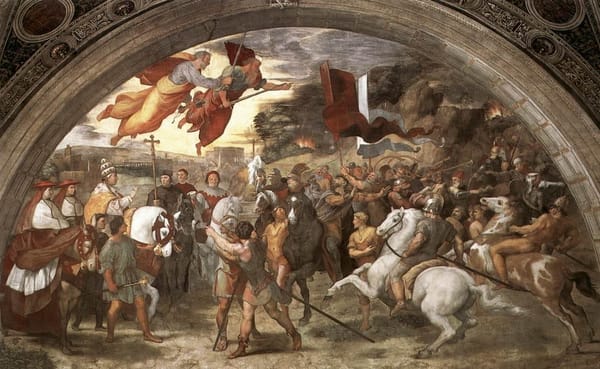
The barbarian hordes were invading the West; the Empire was little more than a ruin: and Attila, ‘the Scourge of God,’ was marching on towards Rome. Leo's majestic bearing repelled the invasion, as his word had checked the ravages of heresy. The haughty king of the Huns, before whose armies the strongest citadels had fallen, granted an audience to the Pontiff on the banks of the Mincio, and promised to spare Rome. The calm and dignity of Leo—who thus unarmed confronted the most formidable enemy of the Empire, and exposed his life for his flock—awed the barbarian, who afterwards told his people that, during the interview, he saw a venerable person standing in an attitude of defence, by the side of Rome’s intercessor: it was the Apostle St Peter. Attila not only admired, he feared the Pontiff. It was truly a sublime spectacle, and one that was full of meaning—a priest, with no arms save those of his character and virtues, forcing a king, such as Attila, to do homage to a devotedness which he could ill understand, and recognize by submission the influence of a power which had heaven on its side. Leo, singlehanded and at once, did what it took the whole of Europe several ages to accomplish in later times.
That the aureole of Leo’s glory might be complete, the Holy Ghost gifted him with an eloquence which, on account of its majesty and richness, might deservedly be called papal. The Latin language had at that time lost its ancient vigour; but we frequently come across passages in the writings of our Saint which remind us of the golden age.
In exposing the dogmas of our holy faith, he uses a style so dignified and so impregnated with the savour of sacred antiquity, that it seems made for the subject. He has several admirable sermons on the Resurrection; and speaking of the present season of the liturgical year, he says: ‘The days that intervened between our Lord's Resurrection and Ascension were not days on which nothing was done: on the contrary, great were the sacraments then confirmed, and great were the mysteries that were revealed.'1
Let us now read the sketch of the Saint’s life given by the Church in the Matins of the feast.
The Greek Church, in her Memea, has an office in honour of St Leo: we take from it the following stanzas. As they were composed before the Schism, they show us that the ancient Church of Constantinople believed the supremacy of the Roman Pontiff, and that it is not the Latins that have changed the faith. The Greeks keep the Feast of St Leo on February 18.
Hymn (Die XVIII Februarii)
Glory be to thee, O Jesus, Lion of the Tribe of Juda! that hast raised up in thy Church a Lion to defend her in those dark times, when holy Faith was most exposed to danger. Thou didst charge Peter to confirm his brethren2 and we have seen Leo, in whom Peter lived, fulfil his office with sovereign authority. We have heard the acclamation of the holy Council, which, in admiration at the heavenly teachings of Leo, proclaimed the signal favour thou didst confer on thy flock, when thou badest Peter feed both sheep and lambs.
O holy Pontiff Leo! thou worthily didst represent Peter in his Chair, whence thy apostolic teaching ceased not to flow, ever beautiful in its truth and majesty. The Church of thine own day honoured thee as the great teacher of faith; and the Church of every succeeding age has recognized thee as one of the most learned Doctors and preachers of the divine word. From thy throne in heaven, where now thou reignest, pour forth upon us the understanding of the great mystery, which thou wast called on to defend. Under thy inspired pen, this mystery grows clear; we see how sublimely it harmonizes with all other mysteries; and faith delights at gaining so close a view of the divine object of its belief. Oh! strengthen this faith within us. The Incarnate Word is blasphemed in our own times; avenge his glory, by sending us men of thy zeal and learning.
Thou didst triumph over barbarian invaders: Attila acknowledged the influence of thy sanctity and eloquence, by withdrawing his troops from the Christian land they infested. In these our days, there have risen up new barbarians—civilized barbarians, who would persuade us that religion should be eliminated from education. and that the State, in its laws and institutions, should simply ignore our Lord Jesus Christ, the King to whom all power has been given, not only in heaven but on earth also.3 Oh! help us by thy powerful intercession, for our danger is very great. Many are seduced, and have fallen into apostasy, whilst flattering themselves that they are still Christians. Pray that the light that is left within us may not be extinguished, and that the public scandals which now exist may be brought to an end. Attila was but a pagan; our modem statesmen and governments are, or at least call themselves, Christians: have pity cn them, and gain for them light to see the precipice to which they are hurrying society.
These days of Paschal Time remind thee, O holy Pontiff! of the Easters thou didst once spend here on earth, when, surrounded by the neophytes, thou gavest them the nourishment of thy magnificent discourses: pray for the faithful, who have this Easter risen to a new life with Christ. What they most need is a fuller and better knowledge of this their Saviour, in order that they may cling more closely to him, and persevere in his holy service. Thy prayers must obtain for them this knowledge; by thy prayers thou must teach them what he is both in his Divine and Human Nature: that as God he is their Last End, and their Judge after death; as Man, their Brother, their Redeemer, their Model. Bless, O Leo! and help the Pontiff who is now thy successor on the Chair of Peter. Show now thy love for that Rome whose sacred and eternal destinies were so frequently the subject of thy glowing and heavenly eloquence.
| Previous Thursday in Passion Week | Next April 11: St. Leo the Great, Pope and Doctor of the Church |