Daily reading
Semidouble · Movable from Easter · Temporal
April 23, 2025
From Dom Guéranger’s The Liturgical Year.
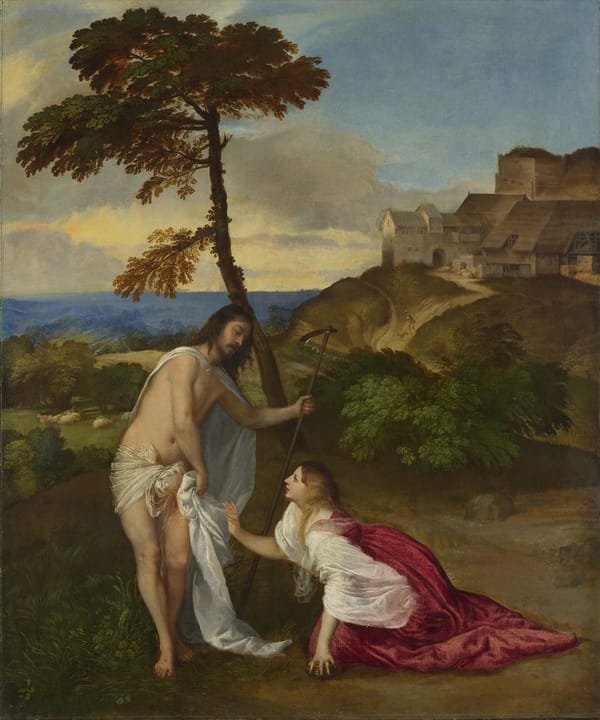
Wednesday in Easter Week (and the Blessing of the Agnus Dei)
Including:
THE Hebrew word Pasch signifies passage, and we explained yesterday how this great day first became sacred by reason of the Lord's Passover. But there is another meaning which attaches to the word, as we learn from the early Fathers and the Jewish rabbins. The Pasch is, moreover, the passage of the Israelites from Egypt to the Promised Land. These three great facts really happened on one and the same night: the banquet of the lamb, the death of the firstborn of the Egyptians, and the departure from Egypt. Let us, to-day, consider how this third figure is a further development of our Easter mystery.
The day of Israel's setting forth from Egypt for his predestined country of the Promised Land is the most important in his whole history; but both the departure itself, and the circumstances that attended it, were types of future realities to be fulfilled in the Christian Pasch. The people of God were delivered from an idolatrous and tyrannical country: in our Pasch, they who are now our neophytes have courageously emancipated themselves from the slavish sway of Satan, and have solemnly renounced the pomps and works of this haughty Pharaoh.
On their road to the Promised Land, the Israelites had to pass through a sea of water; their doing so was a necessity, both for their protection against Pharaoh's army which was pursuing them, and for their entrance into the land of milk and honey. Our neophytes, too, after renouncing the tyrant who had enslaved them, had to go through that same saving element of water, in order to escape their fierce enemies; it carried them safe into the land of their hopes, and stood as a rampart to defend them against invasion.
By the goodness of God, that water, which is an obstacle to man's pursuing his way, was turned into an ally for Israel's march; the laws it had from nature were suspended, and it became the saviour of God's people. In like manner, the sacred font—which, as the Church told us on the feast of the Epiphany, is made an instrument of divine grace—has become the refuge and fortress of our happy neophytes; their passing through its waters has put them out of reach of the tyrant's grasp.
Having reached the opposite shore, the Israelites see Pharaoh and his army, their shields and their chariots, buried in the sea. When our neophytes looked at the holy font, from which they had risen to the life of grace, they rejoiced to see the tomb where their sins, enemies worse than Pharaoh and his minions, lay buried for ever.
Then did the Israelites march cheerfully on towards the land that God had promised to give them. During the journey, they will have God as their teacher and lawgiver; they will have their thirst quenched by fountains springing up from a rock in the desert; they will be fed on manna sent each day from heaven. Our neophytes, too, will run on unfettered to the heavenly country, their Promised Land. They will go through the desert of this world, uninjured by its miseries and dangers, for the divine lawgiver will teach them, not amidst thunder and lightning, as he did when he gave his law to the Israelites, but with persuasive words of gentlest love, spoken with that sweet manner which set on fire the hearts of the two disciples of Emmaus. Springs of water shall refresh them at every turn, yea, of that living water which Jesus, a few weeks back, told the Samaritan woman should be given to them that adore him in spirit and in truth. And, lastly, a heavenly Manna shall be their food, strengthening and delighting them—a Manna far better than that of old, for it will give them immortality.
So that our Pasch means all this: it is a passing through water to the Land of Promise, but with a reality and truth which the Israelites had only under the veil of types, sublime indeed and divine, but mere types. Let then our Passover from the death of original sin to the life of grace, by holy Baptism, be a great feast-day with us. This may not be the anniversary of our Baptism: it matters not; let us fervently celebrate our exodus from the Egypt of the world into the Christian Church; let us, with glad and grateful hearts, renew our baptismal vows, which made our God so liberal in his gifts to us; let us renounce Satan, and all his works, and all his pomps.
The Apostle of the Gentiles tells us of another mystery of the waters of Baptism; it gives completion to all we have been saying, and equally forms part of our Pasch. He teaches us that we were hidden beneath this water, as was Christ in his tomb; and that we then died, and were buried, together with him.1 It was the death of our life of sin: that we might live to God, we had to die to sin. When we think of the holy font where we were regenerated, let us call it the tomb, wherein we buried the Old Man, who was to have no resurrection. Baptism by immersion—which was the ancient mode of administering the Sacrament, and is still used in some countries—was expressive of this spiritual burial: the neophyte was made to disappear beneath the water: he was dead to his former life, as our buried Jesus was to his mortal life. But, as our Redeemer did not remain in the tomb, but rose again to a new life, so likewise, says the Apostle,2 they who are baptized, rise again with him when they come from the font; they bear on them the pledges of immortality and glory, and are the true and living members of that Head, who dieth now no more. Here again is our Pasch, our passage from death to life.
At Rome, the Station is in the basilica of St Laurence outside the Walls. It is looked upon as the most important of the many churches built by Rome in honour of her favourite martyr, whose body lies under the high altar, Hither were the neophytes led to-day, that they might learn, from the example of so brave and generous a soldier of Christ, how courageous they should be in confessing their faith, and how faithful in living up to their baptismal vows. For several centuries, the reception of Baptism was a preparation for martyrdom; but at all times it is an enlisting in the service of Christ, which we cannot leave without incurring the guilt and penalty of traitors.
Mass
The Introit is composed of those words, which the Son of God will speak to his elect, at the last Judgement, when calling them into his kingdom. The Church applies them to the neophytes, and thus raises up their thoughts to that eternal happiness, the remembrance of which supported the martyrs in their sufferings.
Introit
Ps. Cantate Domino canticum novum: cantate Domino omnis terra.℣. Gloria Patri.
Venite.
Ps. Sing to the Lord a new song: sing to the Lord all the earth.℣. Glory, etc.
Come, etc.
In the Collect, the Church reminds her children that the feasts of the holy Liturgy are a means of our coming to the eternal feasts of heaven. It is with this truth and hope before us that we have drawn up our Liturgical Year. We must, therefore, so celebrate our Easter of time as to deserve to be admitted into the joys of the eternal Easter.
Collect
To this the Church, during this week, adds one or other of the following Collects:
Against the persecutors of the Church
For the Pope
Epistle
Cap. iii.In diebus illis: Aperiens Petrus os suum, dixit: Viri Israelitæ, et qui timetis Deum, audite: Deus Abraham, et Deus Isaac, et Deus Jacob, Deus patrum nostrorum glorificavit Filium suum Jesum, quem vos quidem tradidistis, et negastis ante faciem Pilati, judicante illo dimitti. Vos autem sanctum et justum negastis, et petistis virum homicidam donari vobis: auotorem vero vitæ interfecistis, quem Deus suscitavit a mortuis, cujus nos testes sumus. Et nunc fratres, scio quia per ignorantiam fecistis, sicut et principes vestri. Deus autem, quæ prænuntiavit per os omnium prophetarum, pati Christum suum, sic rmplevit. Pœnitemini igitur, et convertimini, ut deleantur peccata vestra.
Ch. iii.In those days: Peter opening his mouth, said: You men of Israel, and you who fear God, give ear. The God of Abraham, and the God of Isaac, and the God of Jacob, the God of our fathers, hath glorified his Son Jesus, whom you indeed delivered up and denied before the face of Pilate, when he judged he should be released. But you denied the Holy One and the Just, and desired a murderer to be granted unto you. But the Author of life you killed, whom God hath raised from the dead, of which we are witnesses. And now, brethren, I know that you did it through ignorance, as did also your rulers. But those things which God before had showed by the mouth of all the prophets, that his Christ should suffer, he hath so fulfilled. Repent, therefore, and be converted, that your sins may be blotted out.
To-day, again, we have the prince of the Apostles proclaiming in Jerusalem the Resurrection of the Man-God. On this occasion, he was accompanied by St John, and had just worked his first miracle, of curing the lame man, near one of the gates of the temple. The people had crowded round the two Apostles, and St Peter preached to them; it was the second time he had spoken in public. His first sermon brought three thousand to receive Baptism; the one of to-day, five thousand. Truly did the Apostle exercise on these two occasions his office of fisher of men, which our Lord gave him when he first called him to be his disciple. Let us admire the charity wherewith St Peter bids the Jews acknowledge Jesus as their Messias. These are the very men who have denied him; and yet the Apostle, by partially excusing their crime on the score of ignorance, encourages them to hope for pardon. They clamoured for the death of Jesus in the days of his voluntary weakness and humiliation; let them, now that he is glorified, acknowledge him as their Messias and King, and their sin shall be forgiven. In a word, let them humble themselves and they shall be saved. Thus did God call unto himself those who were of a good will, and an upright heart; thus does he also in these our days. There were some in Jerusalem who corresponded to the call; but the far greater number refused to follow it. It is the same now. Let us earnestly beseech our Lord that the nets of his fishermen may be filled, and the Paschal banquet be crowded with guests.
Gradual
The Sequence, Victimœ Paschali, p. 145.
Gospel
Cap. xxi.In illo tempore: Manifestavit se iterum Jesus discipulis ad mare Tiberiadis. Manifestavit autem sic. Erant simul Simon Petrus, et Thomas, qui dicitur Didymus, et Nathanael, qui erat a Cana Galilææ, et filii Zebedæi, et alii ex discipulis ejus duo. Dicit eis Simon Petrus: Vado piscari. Dicunt ei: Venimus et nos tecum. Et exierunt, et ascenderunt in navim: et illa nocte nihil prendiderunt. Mane autem facto, stetit Jesus in littore: non tamen cognoverunt discipuli quia Jesus est. Dixit ergo eis Jesus: Pueri, numquid pulmentarium habetis? Responderunt ei: Non. Dicit eis: Mittite in dexteram navigii rete, et invenietis. Miserunt ergo: et jam non valebant illud trahere præ multitudine piscium. Dixit ergo discipulus ille, quem diligebat Jesus, Petro: Dominus est. Simon Petrus cum audisset quia Dominus est, tunica succinxit se (erat enim nudus) et misit se in mare. Alii autem discipuli navigio venerunt (non enim longe erant a terra, sed quasi cubitis ducentis): trahentes rete piscium. Ut ergo descenderunt in terram, viderunt prunas positas, et piscem superpositum, et panem. Dicit eis Jesus: Afferte de piscibus quos prendidistis nunc. Ascendit Simon Petrus: et traxit rete in terram, plenum magnis piscibus centum quinquaginta tribus. Et cum tanti essent, non est scissum rete. Dicit eis Jesus: Venite, prandete. Et nemo audebat discumbentium interrogare eum: Tu quis es? scientes quia Dominus est. Et venit Jesus, et accipit panem, et dat eis, et piscem similiter. Hoc jam tertio manifestatus est discipulis suis cum resurrexisset a mortuis.
Ch. xxi.At that time: Jesus showed himself again to the disciples at the sea of Tiberias. And he showed himself after this manner. There were together Simon Peter, and Thomas, who is called Didymus, and Nathaniel, who was of Cana in Galilee, and the sons of Zebedee, and two others of his disciples. Simon Peter saith to them; I go a fishing. They say to him: We also come with thee. And they went forth, and entered into the ship; and that night they caught nothing. But when the morning was come, Jesus stood on the shore: yet the disciples knew not that it was Jesus. Jesus therefore said to them: Children, have you any meat? They answered him: No. He saith to them: Cast the net on the right side of the ship; and you shall find. They cast therefore: and now they are not able to draw it for the multitude of fishes. That disciple therefore whom Jesus loved said to Peter: It is the Lord. Simon Peter, when he heard that it was the Lord, girt his coat about him (for he was naked) and cast himself into the sea. But the other disciples came in the ship (for they were not far from the land, but as it were two hundred cubits) dragging the net with fishes. As soon then as they came to land, they saw hot coals lying, and a fish laid thereon, and bread. Jesus saith to them: Bring hither of the fishes which you have now caught. Simon Peter went up, and drew the net to land, full of great fishes, one hundred and fifty-three. And although there were so many, the net was not broken. Jesus saith to them: Come, and dine. And none of them who were at meat durst ask him: Who art thou? knowing that it was the Lord. And Jesus cometh and taketh bread, and giveth them, and fish in like manner. This is now the third time that Jesus was manifested to his disciples, after he was risen from the dead.
Jesus had shown himself to all his Apostles on the Sunday evening; he repeated his visit to them eight days after, as we shall see further on. The Gospel for to-day tells us of a third apparition, wherewith seven of the eleven were favoured. It took place on the shore of Lake Genesareth, which, on account of its size, was called the Sea of Tiberias. The seven are delighted beyond measure at seeing their divine Master; he treats them with affectionate familiarity, and provides them with a repast. John is the first to recognize Jesus; nor can we be surprised: his purity gives keen perception to the eye of his soul, as it is written: ‘Blessed are the clean of heart, for they shall see God.’3 Peter throws himself from the ship, that he may the more quickly reach his Lord. His natural impetuosity shows itself here as on so many other occasions; but in this impetuosity we see that he loved Jesus more than his fellowdisciples did. But let us attentively consider the other mysteries of our Gospel.
The seven disciples are fishing: it is the Church working out her apostolate. Peter is the master-fisherman; it belongs to him to decide when and where the nets are to be thrown. The other six Apostles unite with him in the work, and Jesus is with them all, looking upon their labour, and directing it, for whatever is procured by it is all for him. The fish are the faithful, for, as we have already had occasion to remark, the Christian was often called by this name in the early ages. It was the font, it was water, that gave him his Christian life. Yesterday, we were considering how the Israelites owed their safety to the waters of the Red Sea; and our Gospel for to-day speaks of a Passover, a passing from Genesareth’s waters to a banquet prepared by Jesus. There is a mystery, too, in the number of the fishes that are taken; but what it is that is signified by these hundred and fifty-three we shall perhaps never know, until the day of Judgement reveals the secret. They probably denote some divisions or portions of the human race, that are to be gradually led, by the apostolate of the Church, to the Gospel of Christ: but, once more, till God’s time comes, the book must remain sealed.
Having reached the shore, the Apostles surround their beloved Master, and lo! he has prepared them a repast: bread, and a fish lying on hot coals. This fish is not one of those they themselves have caught; they are to partake of it now that they have come from the water. The early Christians thus interpret the mystery: the fish represents Christ, who was made to suffer the cruel torments of the Passion, and whose love of us was the fire that consumed him; and he became the divine food of them that are regenerated by water. We have elsewhere remarked, that in the primitive Church, the Greek word for fish (Ichthus) was venerated as a sacred symbol, inasmuch as the letters of this word formed the initials of the titles of our Redeemer.4
But Jesus would unite, in the same repast, both the divine Fish, which is himself, and those other fishes, which represent all mankind, and have been drawn out of the water in Peter’s net. The Paschal feast has the power to effect, by love, an intimate and substantial union between the Food and the guests, between the Lamb of God and the other lambs who are his brethren, between the divine Fish and those others that he has associated with himself by the closest ties of fellowship. They, like him, have been offered in sacrifice; they follow him in suffering and in glory. Witness the great deacon Laurence, around whose tomb the faithful are now assembled. He was made like to his divine Master when he was burnt to death on his red-hot gridiron; he is now sharing with him in an eternal Pasch, the glories of Jesus' victory, and the joys of his infinite happiness.
The Offertory is formed from the words of the Psalm, which commemorate the manna that heaven gave to the Israelites, after they had passed through the Red Sea. But the new Manna is as far superior to the old, which nourished only the body, as our baptismal font, which washes away our sins, is grander than the mighty waves, which swallowed up Pharaoh and his army.
Offertory
In the Secret, the Church speaks in glowing terms of the heavenly Bread that feeds us and is the Victim of our Paschal Sacrifice.
Secret
To this, the Church, during this week, adds one or other of the following Secrets:
Against the persecutors of the Church
For the Pope
Our Lord says: ‘This is the Bread which cometh down from heaven; that if any man eat of it, he may not die.’5 In the Communion Anthem we have the Apostle telling us that Christ, rising from the dead, dieth now no more. These two texts tell us the effect produced in our souls by the holy Eucharist: we eat an immortal Food, and it communicates to us its own undying life.
Communion
In the Postcommunion, the Church prays for us, that we may receive the effects of the divine Food of which we have just partaken; she prays that it may purify us, and substitute the new principle (which is in our risen Jesus) for the old one that was in us.
Postcommunion
To this the Church, during this week, adds one or other of the following Postcommunions:
Against the persecutors of the Church
For the Pope
BLESSING OF THE AGnUS DEI
The Wednesday of Easter week is the day set apart, at Rome, for the blessing of the Agnus Dei. This ceremony is performed by the Pope, the first and every seventh year of his pontificate. The Agnus Dei are discs of wax, on which are stamped, on one side the image of the Lamb of God, and on the other that of some saint. The custom of blessing them at Eastertide is very ancient. We find traces of it in the Liturgy even so far back as the seventh century. When, in the year 1544, they opened at Rome the tomb of the Empress Mary (wife of Honorius, and daughter of Stilicho), who died before the middle of the fifth century, there was found in it an Agnus Dei, resembling those now blessed by the Pope.
It is therefore incorrect to state, as some authors have done, that the Agnus Dei originated at the time when the administration of Baptism at Easter fell into disuse, and that they were meant as symbols commemorative of the ancient rite. There is very little doubt that at Rome each neophyte used to receive an Agnus Dei from the Pope on Holy Saturday. We may, then, rightly conclude—and the conclusion is confirmed by the fact just mentioned regarding the tomb of the Empress Mary—that the solemn administration of Baptism and the blessing of the Agnus Dei were contemporaneous, at least for a certain period.
The Agnus Dei are made from the Paschal candle of the previous year; of course, a great quantity of other wax is added to it. Formerly, it was the custom to pour in some drops of the holy chrism. In the Middle Ages the wax was prepared and stamped by the subdeacons and acolytes of the Pope's palace; the Cistercian monks of the monastery of St Bernard, in Rome, have now that honour.
The ceremony takes place in one of the rooms of the pontifical palace. A large vase of holy water is prepared; and the Pope, standing near it, recites the following prayer:
O Lord God, almighty Father, Creator of the elements, preserver of mankind, author of grace and eternal salvation, who badest the rivers that flowed from Paradise to water the whole earth! O thou, whose only-begotten Son walked dry-shod on the waters, and in the same was baptized, who also gave forth from his most sacred side water mingled with Blood, and commanded his disciples to baptize all nations; be merciful unto us, and pour forth thy blessing upon us who celebrate all these wonders; that thus the creatures which we are about to plunge into this water may be blessed and sanctified by thee, and that the honour and veneration which shall be shown to them may draw down upon us, thy servants, the forgiveness of sins, pardon and grace, and finally life eternal together with thy saints and elect.
After this, the Pontiff pours balm and holy chrism into the water, beseeching God to sanctify it for the purpose to which it is now to be used. He then turns towards the baskets, which hold the waxen tablets, and recites this prayer:
O God, the author of all sanctification, whose goodness is ever with us; thou who, when Abraham, the father of our faith, was preparing to slay his son Isaac in obedience to thy commands, didst will him to consummate his sacrifice by offering up the ram that was entangled in the briers: thou who didst prescribe, through thy servant Moses, the yearly sacrifice of the spotless lambs; deign, we pray thee, to bless and sanctify, by the invocation of thy holy Name, these forms of wax, which bear the impress of the most innocent Lamb; that by their contact and presence, the faithful may be incited to pray, storms and tempests be driven away, and the wicked spirits put to flight by the virtue of the holy Cross hereon marked, before which every knee bends, and every tongue confesses that Jesus Christ, having conquered death on the gibbet of the Cross, now reigneth in the glory of God the Father. He it is who, when led to death as a sheep to slaughter, offered unto thee his Father the sacrifice of his own Body, that he might bring back the lost sheep that had been led astray by the devil's fraud, and carry it on his shoulders to the fold of heaven.
O almighty and eternal God, the institutor of the ceremonies and sacrifices of the law, who didst deign to turn away thine anger from sinful man as often as he offered victims of propitiation unto thee; who didst graciously accept the sacrifices made by Abel, Melchisedech, Abraham, Moses and Aaron which sacrifices were indeed but figures, yet by thy blessing were made holy and profitable to them that humbly offered them; grant, we beseech thee, that as the innocent Lamb, Jesus Christ thy Son, when immolated at thy will on the altar of the Cross, delivered our first parent from the power of the devil, so may these spotless lambs, which we present to thy divine Majesty for a blessing, be endued with power unto good. Deign to bless them, to sanctify them, to consecrate them, to give them the power to protect those who devoutly carry them against the malice of demons, against tempests, pestilence, sickness, fire, and enemies; and make them efficacious in protecting the mother and her child in the dangers of travail. Through Jesus Christ thy Son our Lord.
After these prayers, the Pope girds himself with a cloth, and sits near the vessel of holy water. The ministers bring him the Agnus Dei, which he plunges into the water, in imitation of the Baptism of the neophytes. The prelates who are present take them from the water, and place them upon tables covered with white linen. Then the Pontiff rises, and says the following prayer:
O Holy Spirit! who makest the waters fruitful, and usest them as the instrument of thy greatest mysteries; who didst take away their bitterness, and give them sweetness; and, sanctifying them by thy breathing, dost employ them for washing away all sins, by the invocation of the Holy Trinity; vouchsafe to bless, sanctify, and consecrate these lambs that have been cast into the holy water, and have imbibed of the balm and holy chrism. May they receive power from thee against the efforts of the devil’s malice; may they who wear them abide in safety; may they have nought to fear from danger; may the wickedness of men have no power to hurt them; and do thou mercifully be their strength and consolation.
Lord Jesus Christ, Son of the living God! who art the innocent Lamb, the Priest and the Victim; whom the prophets called the vine and the corner-stone; who didst redeem us by thy Blood, and with that same didst sign our hearts and foreheads, that the enemy, when passing our dwellings, might not wreak his anger upon us; who art the spotless Lamb offered in ceaseless sacrifice; who art the Paschal Lamb, become, under the sacramental species, the remedy and salvation of our souls; who guidest us across the sea of this present life to the resurrection and glory of eternity: deign, we beseech thee, to bless, sanctify, and consecrate these spotless lambs, which in thy honour we have formed out of virgin wax, and have impregnated with holy water, and sacred balm and chrism, intending hereby to commemorate thy being divinely conceived by the operation of the Holy Ghost. Protect those that wear them from fire, and lightning, and tempests, and every adversity; grant them to be a safeguard to mothers in the pains of childbirth, as thou didst assist thine own when she gave thee birth. And as thou heretofore didst save Susanna from her false accusers, and the blessed martyr and virgin Thecla from torture, and Peter from his prison chains; so now vouchsafe to deliver us from the dangers of this world, and give us to merit life eternal with thee.
The Agnus Dei are then respectfully taken, and kept for the solemn distribution to be made on the following Saturday. It is not difficult to see how this ceremony bears on the Pasch; the Paschal Lamb is frequently mentioned, and the plunging of these sacred images into the water is an evident allusion to the administration of Baptism, which, for so many centuries, was a prominent feature of the Easter Octave. The prayers, which we have somewhat abridged in our translation, are not of a very ancient date; still, the rite which accompanies them refers implicitly to Baptism. As we have already remarked, the custom of blessing the Agnus Dei was observed several centuries before the abolition of the solemn administration of Baptism at Easter; and is an additional proof of the fervent devotion wherewith the Church has ever honoured the mystery of the Lamb at Eastertide.
On account of their sublime symbolism, their being blessed by the Sovereign Pontiff, and the solemnity of their rite, the Agnus Dei are considered as one of the most venerated objects of Catholic piety. They are sent from the holy city to every part of the world. The faith of those who respectfully keep them in their houses, or wear them, has frequently been rewarded by miracles. During the pontificate of St Pius V. the Tiber overflowed its banks, and threatened destruction of several quarters of the city: an Agnus Dei was thrown into the river, and the water immediately receded. This miracle, which was witnessed by several thousands of the inhabitants, was brought forward in the process of the beatification of this great Pontiff.
On this the fourth day were created the sun, the glorious type of the Incarnate Word; the moon, the symbol of Mary's loveliness,6 and of the Church, which reflects the light of the Sun of justice; and the stars, which, by their number and beauty, are an image of the bright countless host of God's elect. Let us glorify the Son of God, the author of all these wondrous works of nature and grace; and with hearts full of gratitude towards him who has thus cheered us with all this magnificent light, let us unite in the prayer offered to him to-day by the Gothic Church of Spain.
Capitula
We take from the Missal of the same Church the following beautiful allocution, in which are celebrated the mysteries of the miraculous draught of fish, mentioned in to-day's Gospel:
Missa
Of all the sequences composed by Adam of St Victor, the following is the richest in its allusions to the types of the Old Testament, which refer to Christ’s victory over death. The chant to which it was sung was taken afterwards as the basis of that of the magnificent Lauda Sion.
Sequence
Ut sincere celebretur
Nova resurrectio:
Hujus mira vis diei
Legis testimonio.
Et Hebræos liberavit
De fornace ferrea:
Opus erat servitutis,
Lutum, later, palea.
Jam triumphi, jam salutis
Vox erumpat libera.
Dies nostri doloris terminus,
Dies salutifera.
Christus, finis promissorum,
Qui consummat omnia.
Hebetavit romphæam,
Amota custodia.
Pro quo vervex est occisus,
Vitæ signat gaudium.
Christus redit ad superna,
Post mortis supplicium.
Draco vorat, a draconis
Immunis malitia.
Hos serpentis liberat
Ænei præsentia.
Christi hamus et armilla:
In cavernam reguli
Manum mittit ablactatus;
Et sic fugit exturbatus
Vetus hostis sæculi.
Dum conscendit domum Dei,
Zelum calvi sentiunt:
David arreptitius,
Hircus emissarius
Et passer effugiunt.
Et de tribu sua spernit
Samson matrimonium;
Samson Gazæ seras pandit
Et asportans portas scandit
Montis supercilium.
Tractis portis diræ mortis,
Die surgit tertia;
Ad supernæ sinum matris
Tot revexit spolia.
Veri Jonæ signativum,
Post tres dies reddit vivum
De ventris angustia.
Dilatatur et excrescit;
Synagogæ flos marcescit,
Et floret Ecclesia.
Resurrexit Christus vere,
Et cum Christo surrexere
Multi testes gloriæ.
Vespertinum tergat fletum;
Quia vita vicit lethum:
Tempus est lætitiæ.
Jesu vitæ via trita,
Cujus morte mors sopita,
Ad paschalem nos invita
Mensam cum fiducia.
Vera vitis et fœcunda,
Tu nos pasce, tu nos munda,
Ut a morte nos secunda
Tua salvet gratia.
that we may celebrate, with sincerity,
the new Resurrection.
the day of wondrous power,
as the ancient Testament foretells.
and delivered
from the iron furnace the Israelites,
and made to work as slaves
in clay, and brick, and picking straw.
now let us give free scope
to our song of triumph and salvation.
the day that puts an end to our mourning:
the day of our salvation.
the end of all its promises is Christ,
for he consummates all things.
and removed the guard
(that forbade our entrance into Paradise).
and in whose stead the ram was slain,
was a figure of the joyful mystery that gives us life.
is Christ rising from the grave,
after being put to death.
that devours Pharaoh's serpents;
but he has none of the serpent’s wickedness.
he heals them that are bitten
by the fiery serpent.
to the serpent was taken,
and it tore the monster’s jaw.
Thus the weaned child could safely thrust his hand
into the den of the basilisk,
and the old enemy of mankind was put to flight.
when he ascended to the house of the Lord,
were made to feel the anger of him they named the bald:
David escaped from his enemy:
the scapegoat and the sparrow
were set free.
and scorns to take to himself a wife
from his own tribe;
he throws open the gates of Gaza,
and carries them
to the mountain top.
breaks down the gates of cruel death,
and rises on the third day;
and he carries his many spoils
to the bosom of the mother above.
and the figure of the true Jonas,
came forth alive
from the whale’s belly after three days.
and spreads, and ripens:
the flower of the Synagogue is faded,
the Church is in her bloom.
Christ rose again,
and with him
many witnesses of his glory.
dry up the evening tears:
for life has conquered death,
and it is the season of joy.
Jesus, our way!
whose death killed death!
bid us come, with confidence,
to the Paschal banquet.
O true and fruitful vine!,
feed us, cleanse us, save us,
by thy grace,
from the second death.
April 23: St. George, Martyr
|
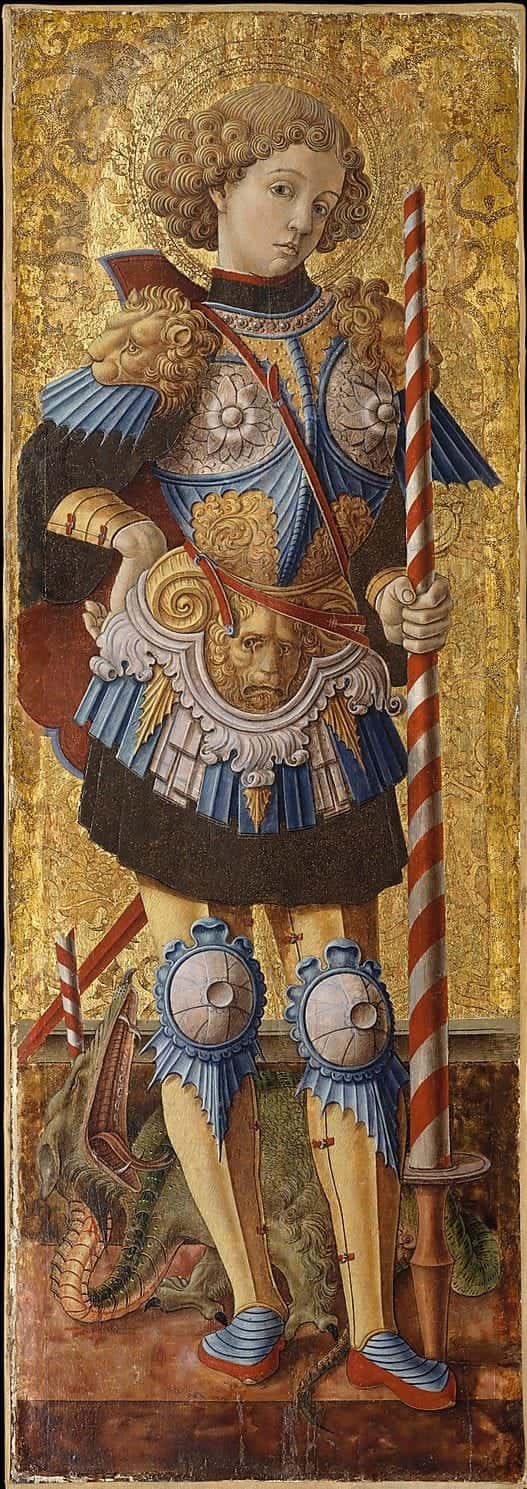
CLAD in his bright coat of mail, mounted on his war-steed, and spearing the dragon with his lance, George, the intrepid champion of our Risen Jesus, comes to gladden us today with his feast. From the East, where he is known as the great Martyr, devotion to St George soon spread in the Western Church, and our Christian armies have always loved and honoured him as one of their dearest patrons. His martyrdom took place in Paschal Time; and thus he stands before us as the guardian of the glorious sepulchre, just as Stephen, the Protomartyr, watches near the crib of the Infant God.
The Roman Liturgy gives no lessons on the life of St George; but, in their stead, reads to us a passage from St Cyprian on the sufferings of the martyrs. This derogation from the general rule dates from the fifth century. At a celebrated Council held in Rome in the year 496, Pope St Gelasius drew up, for the guidance of the faithful, a list of books which might or might not be read without danger. Among the number of those that were to be avoided, he mentioned the ‘Acts of St Georg,' as having been compiled by one who, besides being an ignorant man, was also a heretic. In. the East, however, there were other ' Acts ' of the holy martyr, totally different from those current in Rome; but they were not known in that city. The cultus of St George lost nothing, in the holy city, by this absence of a true legend. From a very early period, a church was built in his honour; it was one of those that were selected as Stations, and gave a Title to a Cardinal; it exists to this day, and it is called Saint George in Velabro (the Veil of Gold) .
The Bollandists were in possession of several copies of the forbidden ‘Acts '; they found them replete with absurd stories, and, of course, they rejected them. Father Papebroch has given us other and genuine ‘Acts ' written in Greek, and quoted by St Andrew of Crete. They bring out the admirable character of our martyr, who held an important post in the Roman army during the reign of the Emperor Diocletian. He was one of the first victims of the great persecution and suffered death at Nicomedia. Alexandra, the Emperor's wife, was so impressed at witnessing the Saint’s courage, that she professed herself a Christian, and shared the crown of martyrdom with the brave soldier of Christ.
As we have already said, devotion to St George dates from a very early period. St Gregory of Tours gives us several proofs of its having taken root in Gaul. St Clotilde had a singular confidence in the holy martyr, and dedicated to him the Church of her dear Abbey of Chelles. But this devotion became more general and more fervent during the Crusades, when the Christian armies witnessed the veneration in which St George was held by the Eastern Church, and heard the wonderful things that were told of his protection on the field of battle. The Byzantine historians have recorded several remarkable instances of the kind; and the Crusaders returned to their respective countries publishing their own experience of the victories gained through the Saint's intercession. The Republic of Genoa chose him for its patron; and Venice honoured him as its special protector, after St Mark. But nowhere was St George so enthusiastically loved as in England. Not only was it decreed in a Council held at Oxford, in the year 1222, that the feast of the Great Martyr should be observed as one of obligation; not only was devotion to the valiant soldier of Christ encouraged, throughout Great Britain, by the first Norman Kings; but there are documents anterior to the invasion of William the Conqueror, which prove that St George was invoked as the special patron of England even so far back as the ninth century. Edward III did but express the sentiment of the country when he put the Order of the Garter, which he instituted in 1330, under the patronage of the warrior Saint. In Germany, King Frederic III founded the Order of St George in the year 1468.
St George is usually represented as killing a dragon; and where the representation is complete, there is also given the figure of a princess, whom the Saint thus saves from being devoured by the monster. This favourite subject of both sacred and profane art is purely symbolical, and is of Byzantine origin. It signifies the victory won over the devil, by the martyr's courageous profession of faith; the princess represents Alexandra, who was converted by witnessing the Saint’s heroic patience under his sufferings. Neither the ' Acts ' of St George nor the hymns of the Greek Liturgy allude to the martyr's having slain a dragon and rescued a princess. It was not till after the fourteenth century that this fable was known in the West; and it arose from a material interpretation of the emblems with which the Greeks honoured St George, and which were introduced among us by the crusaders.
Although, as has been said, the Office of St George in the Roman Breviary has been taken from the Common of Martyrs in Paschal Time, the following historical lesson has recently been approved for the Dioceses of England:
Let us, in honour of our glorious patron, recite the following stanzas, taken from the Menæa of the Greek Church:
Hymn (Die XXIII Aprilis)
Thou, O George, art the glorious type of a Christian soldier. Whilst serving under an earthly monarch, thou didst not forget thy duty to the King of heaven. Thou didst shed thy blood for the faith of Christ; and he, in return, appointed thee protector of Christian armies. Be their defender in battle, and bless with victory them that fight in a just cause. Protect them under the shadow of thy standard; cover them with thy shield; make them the terror of their enemies. Our Lord is the God of Hosts; and he frequently uses war as the instrument of his designs, both of justice and mercy. They alone win true victory who have heaven on their side; and such soldiers, when on the battle-field, seem to the world to be doing the work of man, whereas it is the work of God they are furthering. Hence are they more generous, because more religious, than other men. The sacrifices they have to make, and the dangers they have to face, teach them unselfishness. What wonder, then, that soldiers have given so many martyrs to the Church!
But there is another warfare, in which we Christians are all enlisted, and of which St Paul speaks, when he says: Labour as a good soldier of Christ; for no man is crowned, save he that striveth lawfully.1 That we have thus to strive and fight during our life, the same Apostle assures us in these words: Take unto you the armour of God, that ye may be able to resist in the evil day, and to stand in all things perfect. Stand, therefore, having your loins girt about with truth, and having on the breastplate of justice, and your feet shod with the preparation of the Gospel of peace. In all things taking the shield of faith, wherewith ye may be able to extinguish all the fiery darts of the most wicked one. And take unto you the helmet of the hope of salvation, and the sword of the spirit, which is the word of God.2 We, then, are soldiers, as thou wast, O holy martyr! Before ascending into heaven, our divine leader wishes to review his troops; do thou present us to him. He has loaded us with honours, notwithstanding our past disloyalties; we must, henceforth, prove ourselves worthy of our position. In the Paschal Communion which we have received, we have a pledge of victory; how can we ever be so base as to permit ourselves to be conquered! Watch over us, O sainted warrior! Let thy prayers and example encourage us to fight against the dragon of hell. He dreads the armour we wear; for it is Jesus himself that prepared it for us, and tempered it in his own precious Blood: may we, like thee, present it to him whole and entire, when he calls us to our eternal rest!
There was a time when the whole Christian world loved and honoured thy memory with enthusiastic joy: but now, alas! this devotion has grown cold, and thy feast passes unnoticed by thousands. O holy martyr! avenge this ingratitude by imitating thy divine King, who maketh his sun to rise upon both good and bad; take pity on this world, perverted as it is by false doctrines, and tormented at this very time by the most terrible scourges. Have compassion on thy dear England, which has been seduced by the dragon of hell, and by him made the instrument for effecting his plots against the Lord and his Christ. Take up thy spear as of old; give the monster battle, and emancipate the isle of Saints from his slavish yoke. Heaven and earth join in this great prayer! In the name of our Risen Jesus, aid thine own and once devoted people to a glorious resurrection!
| Previous April 22: Sts. Soter and Caius, Popes and Martyrs | Next April 23: St. George, Martyr |