Daily reading
Paschal Time
Double · April 29 · Sanctoral
April 29, 2025
From Dom Guéranger’s The Liturgical Year.
A Double leads the weekday.Rubric
 |
April 29: St. Peter, Martyr
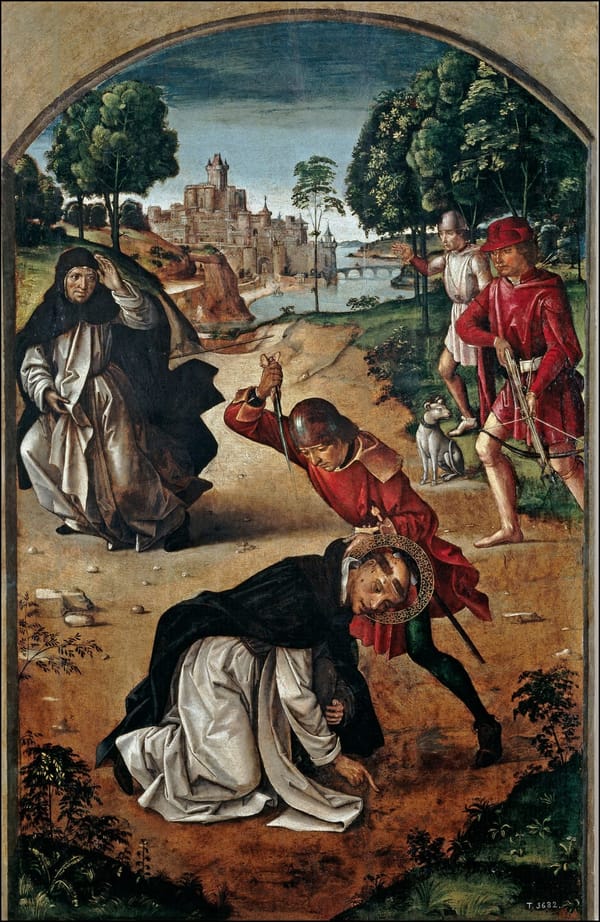
THE hero deputed this day by the Church to greet our Risen Lord was so valiant in the good fight that martyrdom is part of his name. He is known as Peter the Martyr; so that we cannot speak of him without raising the echo of victory. He was put to death by heretics, and is the grand tribute paid to our Redeemer by the thirteenth century. Never was there a triumph hailed with greater enthusiasm than this. The martyrdom of St Thomas of Canterbury excited the admiration of the faithful of the preceding century, for nothing was so dear to our forefathers as the liberty of the Church; the martyrdom of St Peter was celebrated with a like intensity of praise and joy. Let us hearken to the fervid eloquence of the great Pontiff, Innocent IV, who thus begins the Bull of the martyr's canonization: ‘The truth of the Christian faith, manifested, as it has been, by great and frequent miracles, is now beautified by the new merit of a new Saint. Lo! a combatant of these our own times comes, bringing us new and great and triumphant signs. The voice of his blood shed (for Christ) is heard, and the fame of his martyrdom is trumpeted, through the world. The land is not silent that sweateth with his blood; the country that produced so noble a warrior resounds with his praise; yea, the very sword that did the deed of parricide proclaims his glory . . . . Mother Church has great reason to rejoice, and abundant matter for gladness; she has cause to sing a new canticle to the Lord, and a hymn of fervent praise to her God; . . . the Christian people has cause to give forth devout songs to its Creator. A sweet fruit, gathered in the garden of faith, has been set upon the table of the eternal King: a grape-bunch taken from the vineyard of the Church has filled the royal cup with new wine . . . . The flourishing Order of Preachers has produced a red rose, whose sweetness is most grateful to the King; and from the Church here on earth there has been taken a stone, which, after being cut and polished, has deserved a place of honour in the temple of heaven.'1
Such was the language wherewith the supreme Pontiff spoke of the new martyr, and the people responded by celebrating his feast with extraordinary devotion. It was kept as were the ancient festivals, that is, all servile work was forbidden upon it. The churches served by the Fathers of the Dominican Order were crowded on his feast; and the faithful took little branches with them, that they might be blessed in memory of the triumph of Peter the Martyr. This custom is still observed; and the branches blessed by the Dominicans on this day are venerated as being a protection to the houses where they are kept.
How are we to account for all this fervent devotion of the people towards St Peter? It was because he died in defence of the faith; and nothing was so dear to the Christians of those days as faith: Peter had received the charge to seize all the heretics who at that time were causing great disturbance and scandal in the country round about Milan. They were called Cathari, but in reality were Manicheans; their teachings were detestable, and their lives most immoral. Peter fulfilled his duty with a firmness and equity which soon secured him the hatred of the heretics; and when he fell a victim to his holy courage, a cry of admiration and gratitude was heard throughout Christendom. Nothing could be more devoid of truth than the accusations brought by the enemies of the Church and their indiscreet abettors against the measures formerly decreed by the public law of Catholic nations, in order to foil the efforts made by evil-minded men to injure the true faith. In those times, no tribunal was so popular as that whose office it was to protect the faith, and to put down all them that attacked it. It was to the Order of St Dominic that this office was mainly entrusted; and well may they be proud of the honour of having so long held one so beneficial to the salvation of mankind. How many of its members have met with a glorious death in the exercise of their stem duty! St Peter is the first of the martyrs given by the Order for this, holy cause: his name, however, heads a long list of others who were his brethren in religion, his successors in the defence of the faith, and his followers to martyrdom. The coercive measures that were once, and successfully, used to defend the faithful from heretical teachers have long since ceased to be used: but for us Catholics, our judgement of them must surely be that of the Church. She bids us to-day honour as a martyr one of her Saints, who was put to death whilst resisting the wolves that threatened the sheep of Christ’s fold; should we not be guilty of disrespect to our Mother if we dared to condemn what she so highly approves? Far, then, be from us that cowardly truckling to the spirit of the age, which would make us ashamed of the courageous efforts made by our forefathers for the preservation of the faith! Far from us that childish readiness to believe the calumnies of Protestants against an institution which they naturally detest! Far from us that deplorable confusion of ideas which puts truth and error on an equality, and, from the fact that error can have no rights, concludes that truth can claim none!
The following is the account given us by the Church of the virtues and heroism of St Peter the Martyr:
The following Antiphons and Responsory are taken from the Dominican Breviary:
The victory was thine, O Peter! and thy zeal for the defence of our holy faith was rewarded. Thou didst ardently desire to shed thy blood for the holiest of causes, and by such a sacrifice to confirm the faithful of Christ in their religion. Our Lord satisfied thy desire; he would even have thy martyrdom be in the festive season of the Resurrection of our divine Lamb, that his glory might add lustre to the beauty of thy holocaust. When the death-blow fell upon thy venerable head, and thy generous blood was flowing from the wounds, thou didst write on the ground the first words of the creed, for whose holy truth thou wast giving thy life.
Protector of the Christian people! what other motive hadst thou, in all thy labours, but charity? What else but a desire to defend the weak from danger induced thee not only to preach against error, but to drive its teachers from the flock? How many simple souls, who were receiving divine truth from the teaching of the Church, have been deceived by the lying sophistry of heretical doctrine, and have lost the faith? Surely the Church would do her utmost to ward off such dangers from her children; she would do all she could to defend them from enemies, who were bent on destroying the glorious inheritance which had been handed down to them by millions of martyrs! She knew the strange tendency that often exists in the heart of fallen man to love error; whereas truth, though of itself unchanging, is not sure of its remaining firmly in the mind, unless it be defended by learning or by faith. As to learning, there are but few who possess it; and as to faith, error is ever conspiring against it, and, of course, with the appearance of truth. In the Christian ages it would have been deemed not only criminal, but absurd, to grant to error the liberty which is due only to truth; and they that were in authority considered it a duty to keep the weak from danger, by removing from them all occasions of a fall; just as the father of a family keeps his children from coming in contact with wicked companions who could easily impose on their inexperience, and lead them to evil under the name of good.
Obtain for us, O holy martyr, a keen appreciation of the precious gift of faith—that element which keeps us in the way of salvation. May we zealously do everything that lies in our power to preserve it, both in ourselves and in them that are under our care. The love of this holy faith has grown cold in so many hearts; and frequent intercourse with heretics or free-thinkers has made them think and speak of matters of faith in a very loose way. Pray for them, O Peter, that they may recover that fearless love of the truths of religion which should be one of the chief traits of the Christian character. If they be living in a country where the modem system is introduced of treating all religions alike—that is, of giving equal rights to error and to truth—let them be all the more courageous in professing the truth, and detesting the errors opposed to the truth. Pray for us, O holy martyr, that there may be enkindled within us an ardent love of that faith without which it is impossible to please God.2 Pray that we may become all earnestness in this duty, which is of vital importance to salvation; that thus our faith may daily gain strength within us, till at length we shall merit to see in heaven what we have believed unhesitatingly on earth.
Tuesday of the Second Week after Easter
WHAT are these wounds in the midst of thy hand?1 Such was the exclamation of the Prophet Zacharias, who lived five hundred years before the Birth of our Emmanuel: and we are almost forced to use it, now that we behold the Wounds that shine so brightly in the glorified Body of our Risen Lord. His hands and feet bear the mark of the nails, and his side that of the spear; the Wounds are as visible and as deep as when he was first taken down from the Cross. Put in thy finger hither, said Jesus, holding out his wounded hands to Thomas; put thy hand into my Side!2
We assisted at this wonderful interview on Sunday last—the incredulity of the disciple was made an occasion for the most incontestable proof of the Resurrection: but it also taught us that, when our Lord rose from the tomb, he retained in his glorified Flesh the stigmata of his Passion. Consequently, he will retain them for ever, inasmuch as no change can have further place in his Person. What he was the moment after his Resurrection, that will he be for all eternity. But we are not to suppose that these sacred stigmata, which tell of his humiliation on Calvary, are in the slightest degree a lessening of his glory. He retains them because he wishes to do so; and he wishes it, because these Wounds, far from attesting defeat or weakness, proclaim his irresistible power and triumph. He has conquered death; the Wounds received in the combat are the record of his victory. He will enter heaven on the day of his Ascension, and the rays of light which beam from his Wounds will dazzle the eyes of even the angels. In like manner, as the holy Fathers tell us,3 his martyrs who have imitated him in vanquishing death will also shine with special brightness in those parts of their bodies where they were tortured.
And is not our Risen Jesus to exercise, from his throne in heaven, that sublime mediatorship for which he assumed our human nature? Is he not to be ever disarming the anger of his Father justly irritated by our sins? Is he not to make perpetual intercession for us, and obtain for mankind the graces necessary for salvation? Divine Justice must be satisfied; and what would become of poor sinners, were it not that the Man-God, by showing the precious Wounds on his Body, stays the thunderbolts of heaven, and makes mercy preponderate over judgement?4 O sacred Wounds! the handiwork of our sins, and now our protection! we shed bitter tears when we first beheld you on Calvary; but we now adore you as the five glories of our Emmanuel! Hail most precious Wounds! our hope and our defence!
And yet the day will come when these sacred stigmata, which are now the object of the angels’ admiration, will be again shown to mankind, and many will look upon them with fear; for, as the Prophet says: They shall look upon him whom they have pierced.5 These men, who, during life, heeded neither the sufferings of the Passion, nor the joys of the Resurrection, but rather despised and insulted them, will have treasured up for themselves the most terrible vengeance; for could it be that a God could be crucified, and rise again, and both to no purpose? We can understand how sinners will say, on that last day: Fall upon us, ye mountains! and ye hills, cover us!6—‘hide us from the sight of these Wounds, which now dart upon us the lightnings of angry justice!’
O sacred Wounds of our Risen Jesus! be a source of mercy and joy, on that dread day, to all them that spent the Easters of their earthly pilgrimage in rising to a holy life! Happy the disciples who were privileged to gaze upon you during these forty days! and happy we, if we venerate and love you! Let us here borrow the devout words of St Bernard:7 ‘Where can I that am weak find security and rest, but in the Wounds of Jesus? The greater is his power to. save, the surer am I in my dwelling there. The world howls at me, the body weighs me down, the devil sets snares to take me: but I fall not, for I am on the firm rock. I have sinned a grievous sin; my conscience will throw me into trouble, but not into despair, for I will remember the Wounds of my Lord. Yes, he was wounded for our iniquities!8 What I have not of mine own I take to myself from the Heart of my Jesus, for it is overflowing with mercy. Neither are there wanting outlets, through which it may flow—they have pierced his hands and feet9 and with a spear they have opened his side, enabling me, through these chinks, to suck honey out of the rock, and oil out of the hardest stone,10 that is, to taste and see how sweet is the Lord.11 He thought thoughts of peace,12 and I knew it not, for who hath known the mind of the Lord? or who hath been his counsellor?13 But the nail that wounded is the key that opened to me to see the design of the Lord. I looked through the aperture, and what saw I? The nail and Wound both told me that truly God was in Christ reconciling the world to himself.14 The iron pierced his soul,15 and reached even to his heart, so that henceforth he cannot but know how to compassionate with me in my infirmities. The secret of his heart is revealed by the Wounds of his Body; the great mystery of mercy is revealed—the bowels of the mercy of our God, in which the Orient from on high hath visited us.16 What, O Lord, could more clearly show me than do thy Wounds, that thou art sweet and mild, and plenteous in mercy?’17
Let us express our Paschal joy, to-day, in the words of a charming sequence of the eleventh century. We have taken it from a missal of the Abbey of Murbach:
Sequence
Ecclesia Christi canat,
Ob quam patrem matremque deserens,
Se vestiit natura,
Et synagogam respuit.
Tuo sacro latere
Sacramenta manarunt illius;
Conservatur in salo saeculi.
Sed portas offracturus,
Hanc etiam hostibus Illius Eruiturus,
Tyranno Goliath, Quem lapillo
Prosternis unico.
Amoena, Christe,
Ludit in pace
Omnis Ecclesia tute in horto;
Resurgens, Christe,
Hortum florentis
Paradisi tuis Obstructum
Diu, reseras, Domine,
Rex regum.
a canticle to her Beloved,
who out of love for her, left father and mother,
clad himself with our nature,
and cast off the Synagogue.
O Christ,
flowed from thy sacred Side.
on the wood of thy Cross.
but thou didst break its gates:
and, to deliver her from her enemies,
the tyrant Goliath, and with a single stone
didst lay him low.
under the shade
of the pleasant Vine,
enjoys peace,
and safely lives in the garden.
By thy Resurrection,
O Lord, King of kings,
thou openest the long-closed garden
of thy flowery Paradise.
- Zach. xiii 6. ↩︎
- St John xx 27. ↩︎
- St Augustine De Civitate Dei, Lib. xxii, Cap. xxix. St Ambrose In Lucam, Lib. x. ↩︎
- St James ii 13. ↩︎
- Zach. xii 12. ↩︎
- St Luke xxiii 30. ↩︎
- In Cantica, Serm. lxi ↩︎
- Isa. liii 5. ↩︎
- Ps. xxi 17. ↩︎
- Deut. xxxii 13. ↩︎
- Ps. xxxiii 9. ↩︎
- Jer. xxix 11. ↩︎
- Rom. xi 34. ↩︎
- 2 Cor. v 19. ↩︎
- Ps. civ 18. ↩︎
- St Luke i 78. ↩︎
- Ps. lxxxv 5. ↩︎
| Previous April 28 (the Same Day): St. Vitalis, Martyr | Next Tuesday of the Second Week after Easter |