Daily reading
Paschal Time
Double · April 30 · Sanctoral
April 30, 2025
From Dom Guéranger’s The Liturgical Year.
A Double leads the weekday.Rubric
 |
April 30: St. Catherine of Siena, Virgin
THE Dominican Order, which yesterday presented a rose to our Risen Jesus, now offers him a lily of surpassing beauty. Catharine of Siena follows Peter the Martyr: it is a coincidence willed by Providence, to give fresh beauty to this season of grandest mysteries. Our divine King deserves everything we can offer him; and our hearts are never so eager to give him every possible tribute of homage as during these last days of his sojourn among us. See how nature is all flower and fragrance at this loveliest of her seasons! The spiritual world harmonizes with the visible, and now yields her noblest and richest works in honour of our Lord, the author of grace.
How grand is the Saint whose feast comes to gladden us to-day! She is one of the most favoured of the holy Spouses of the Incarnate Word. She was his, wholly and unreservedly, almost from her very childhood. Though thus consecrated to him by the vow of holy virginity, she had a mission given to her by divine Providence which required her living in the world. But God would have her to be one of the glories of the religious state; he therefore inspired her to join the Third Order of St Dominic. Accordingly, she wore the habit, and fervently practised during her whole life the holy exercises of a Tertiary.
From the very commencement, there was something heavenly about this admirable servant of God, which we fancy existing in an angel who had been sent from heaven to live in a human body. Her longing after God gave one an idea of the vehemence wherewith the blessed embrace the Sovereign Good on their first entrance into heaven. In vain did the body threaten to impede the soaring of this earthly seraph; she subdued it by penance, and made it obedient to the spirit. Her body seemed to be transformed, so as to have no life of its own, but only that of the soul. The Blessed Sacrament was frequently the only food she took for weeks together. So complete was her union with Christ that she received the impress of the sacred stigmata, and with them the most excruciating pain.
And yet in the midst of all these supernatural favours, Catharine felt the keenest interest in the necessities of others. Her zeal for their spiritual advantage was intense, whilst her compassion for them in their corporal sufferings was that of a most loving mother. God had given her the gift of miracles, and she was lavish in using it for the benefit of her fellow-creatures. Sickness and death itself were obedient to her command; and the prodigies witnessed at the beginning of the Church were again wrought by the humble Saint of Siena.
Her communings with God began when she was quite a child, and her ecstasies were almost without interruption. She frequently saw our Risen Jesus, who never left her without having honoured her either with a great consolation or with a heavy cross. A profound knowledge of the mysteries of our holy faith was another of the extraordinary graces bestowed upon her. So eminent indeed was the heavenly wisdom granted her by God that she, who had received no education, used to dictate the most sublime writings, wherein she treats of spiritual things with a clearness and eloquence to which human genius could never attain, and with a certain indescribable unction which no reader can resist.
But God would not permit such a treasure as this to lie buried in a little town of Italy. The Saints are the supports of the Church; and though their influence be generally hidden, yet at times it is open and visible, and men then learn what are the instruments which God uses for imparting blessings to a world that would seem to deserve little else besides chastisement. The great question, at the close of the fourteenth century, was the restoration to the Holy City of the privilege of having within its walls the Vicar of Christ, who for sixty years had been absent from his see. One saintly soul, by merits and prayers, known to heaven alone, might have brought about this happy event after which the whole Church was longing; but God would have it done by a visible agency, and in the most public manner. In the name of the widowed Rome—in the name of her own and the Church's Spouse—Catharine crossed the Alps, and sought an interview with the Pontiff, who had not so much as seen Rome. The prophetess respectfully reminded him of his duty; and in proof of her mission being from God, she told him of a secret which was known to himself alone. Gregory XI could no longer resist; and the Eternal City welcomed its Pastor and Father. But at the Pontiff's death, a frightful schism, the forerunner of greater evils to follow, broke out in the Church. Catharine, even to her last hour, was untiring in her endeavours to quell the storm. Having lived the same number of years as our Saviour had done, she breathed forth her most pure soul into the hands of her God, and went to continue in heaven her ministry of intercession for the Church she had loved so much on earth, and for souls redeemed in the precious Blood of her divine Spouse.
Our Risen Jesus, who took her to her eternal reward during the season of Easter, granted her whilst she was living on earth a favour which we mention here as being appropriate to the mystery we are now celebrating. He one day appeared to her, having with him his blessed Mother. Mary Magdalen—she that announced the Resurrection to the Apostles—accompanied the Son and the Mother. Catharine's heart was overpowered with emotion at this visit. After looking for some time upon Jesus and his holy Mother, her eyes rested on Magdalen, whose happiness she both saw and envied. Jesus spoke these words to her: ‘My beloved! I give her to thee, to be thy mother. Address thyself to her, henceforth, with all confidence. I give her special charge of thee.' From that day forward, Catharine had the most filial love for Magdalen, and called her by no other name than that of mother.
Let us now read the beautiful, but too brief, account of our Saint’s life, as given in the Liturgy.
Her learning was not acquired, but infused. Theologians proposed to her the most difficult questions of divinity, and received satisfactory answers. No one ever approached her, who did not go away a better man. She reconciled many that were at deadly enmity with one another. She visited Pope Gregory the Eleventh, who was then at Avignon, in order to bring about the reconciliation of the Florentines, who were under an interdict on account of their having formed a league against the Holy See. She told the Pontiff that there had been revealed to her the vow which he, Gregory, had made of going to Rome a vow which was known to God alone. It was through her entreaty that the Pope began to plan measures for taking possession of his See of Rome, which he did soon after. Such was the esteem in which she was held by Gregory, and by Urban the Sixth, his successor, that she was sent by them on several embassies. At length, after a life spent in the exercise of the sublimest virtues, and after gaining great reputation on account of her prophecies and many miracles, she passed hence to her divine Spouse, when she was about the age of three and thirty. She was canonized by Pius the Second.
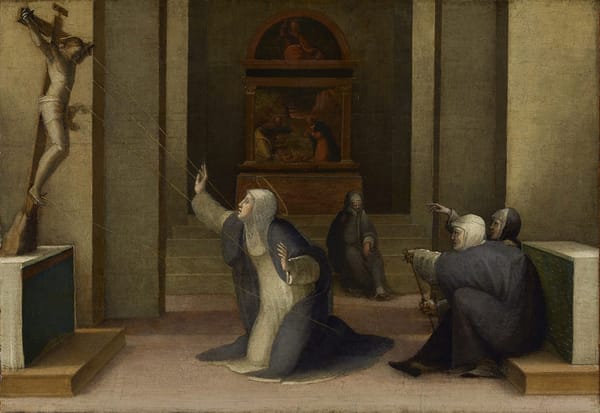
Being once at Pisa, on a Sunday, and having received the Bread of heaven, she was rapt in an ecstasy. She saw our crucified Lord approaching her. He was encircled with a great light, and from his five Wounds there came rays, which fell upon the five corresponding parts of Catharine's body. Being aware of the favour bestowed upon her, she besought our Lord that the stigmata might not be visible. The rays immediately changed from the colour of blood into that of gold, and passed, under the form of a bright light, to the hands, feet and heart of the Saint. So violent was the pain left by the wounds, that it seemed to her as though she must soon have died, had not God diminished it. Thus our most loving Lord added favour to favour, by permitting her to feel the smart of the wounds, and yet removing their appearance. The servant of God related what had happened to her to Raymund, her confessor. Hence, when the devotion of the faithful gave a representation of this miracle, they painted, on the pictures of St Catharine, bright rays coming from the five stigmata she received.***Her learning was not acquired, but infused. Theologians proposed to her the most difficult questions of divinity, and received satisfactory answers. No one ever approached her, who did not go away a better man. She reconciled many that were at deadly enmity with one another. She visited Pope Gregory the Eleventh, who was then at Avignon, in order to bring about the reconciliation of the Florentines, who were under an interdict on account of their having formed a league against the Holy See. She told the Pontiff that there had been revealed to her the vow which he, Gregory, had made of going to Rome a vow which was known to God alone. It was through her entreaty that the Pope began to plan measures for taking possession of his See of Rome, which he did soon after. Such was the esteem in which she was held by Gregory, and by Urban the Sixth, his successor, that she was sent by them on several embassies. At length, after a life spent in the exercise of the sublimest virtues, and after gaining great reputation on account of her prophecies and many miracles, she passed hence to her divine Spouse, when she was about the age of three and thirty. She was canonized by Pius the Second.
Pope Pius II, one of the glories of Siena, composed the two following hymns in honour of his saintly and illustrious fellow-citizen. They form part of the Office of St Catharine of Siena in the Dominican Breviary.
Hymn
Pope Pius II, one of the glories of Siena, composed the two following hymns in honour of his saintly and illustrious fellow-citizen. They form part of the Office of St Catharine of Siena in the Dominican Breviary.
Hymn
Quæ tu is læti, Catharina, sacris,
Hoc quidem pacto modulamur omnes,
Perfer Olympo.
Annuas nobis veniam, praecamur:
Non sumus tanti ingenii, fatemur,
Optima virgo.
Virginis laudes Quis in orbe toto
Fœminæ invictæ peritura numquam
Carmina pandet?
Moribus praestans, sapiens abunde;
Temperans, fortis, pia, justa, prudens,
Æthera scandis.
Quo nequit dici sanctius per orbem?
Vulnerum formam miserata Christi,
Exprimis ipsa.
Et malis cunctis penitus refertæ,
Fortiter spernens pretiosa quæque,
Sidera adisti.
Filio magni Genitoris almo,
Spiritum Sanctum veneremur, et sit
Laus tamen una.
these canticles of praise, which we,
gladdened by thy feast,
sing thus in thine honour.
pardon us, we beseech thee.
Nay, we own, O glorious Saint!
that we are not equal to the task we have undertaken.
Is there, in the wide world, a poet that could write an ode
immortal enough for this heroine,
whom no enemy could vanquish?
thou wast rich in virtue and wisdom;
and with the riches of thy temperance, fortitude,
piety, justice and prudence, thou didst ascend into heaven.
which were never surpassed in this world?
Thy compassion for the sufferings of Christ
stamped thee with the impress of his wounds.
of this short, mournful, and miserable life,
which abounds with every evil,
thou didst mount to heaven.
to the Son ever blessed of the Eternal Father!
let us give glory to the Holy Ghost!
to the Three, one equal praise!
Hymn
Jure censeris, quoniam triumphos
Ipsa cœlorum, probitate mira,
Nacta refulges.
Et simul munus probitatis almæ
Accipis cœlo, cumulata cunctis
Denique rebus.
Orbis exemplar, pietate plenum
Praedicatorum venerata Patrem,
Ordine fulges.
Nullus omatus, nitor ecce nullus
Corporis, semper fugiens iniqua
Crimina vitæ.
Quam pie flagris cruor hinc et inde
Fluxerat rivis! hominumque demum
Crimina flebas.
Orbe terrarum cruciantur omnes:
Quotque vel curis agitantur ipsi
Undique diris.
Si tuæ laudes repetantur omnes:
Tu quidem longe pietate cunctis
Inclyta præstas.
Et duces iras posuere sævas:
Hi necem diram populo minata
Sæpe Senensi.
Viribus summis operam dedisti:
Litteræ doctæ, lepidæque
Claris Urbibus exstant.
Niteris rectum suadere cunctis:
Sic ais: Tan tum probitas beatos
Efficit omnes.
Fortiter temnens, nihil extimescens,
Præmium nostræ vocitare vitæ
Sæpe solebas.
Quo sacros artus cineresque busto
Linqueres, cœlos aditura flentes
Ipsa docebas.
Hostiam libans, lacrymis obortis,
Dixeras cunctis documenta vitæ,
Voce suprema.
Filio magni Genitoris almo
Spiritum Sanctum veneremur, et sit
Laus tamen una.
thy praise, O Catharine!
for, by thy wondrous virtues, thou hast received
a triumphant welcome from heaven itself.
where thou art enriched with all good things,
that thou hast received the reward of thy holy life,
and the recompense of thy grand virtue.
that perfect model of every virtue;
thou didst enter his Order
and art one of its brightest glories.
none had charms for thee.
Thou couldst not brook sin,
the injustice offered to God by his creature.
and to atone for the sins of men,
oft didst thou severely scourge thyself till thine innocent blood
would flow in streams on the ground.
no matter where they might be, or what their misfortune.
Thy sympathy was ever ready for them, too,
that were a prey to care.
were we to tell all thy praises, O Catharine!
whose sanctity far surpassed
that of other mortals.
who were threatening
the people of Siena with death,
withdrew at thy word.
to the study of sacred things:
and thy letters, teeming with wisdom and elegance,
are still treasured in some of our richest cities.
and persuading all to follow what was right.
Thus didst thou speak to them:
'Virtue alone can make man happy.'
for the dread claims of death,
which thou wast wont to call
the recompense of life.
to leave thy sacred body to the tomb,
and ascend into heaven, thou gavest lessons of consolation
to them that stood weeping around thee.
and received amidst abundant tears of devotion the saving Host,
thou gavest thy last instructions
to all how to lead a holy life.
to the Son ever blessed of the Eternal Father!
let us give glory to the Holy Ghost!
to the Three, one equal praise!
Holy Church, filled as she now is with the joy of her Jesus’ Resurrection, addresses herself to thee, O Catharine, who followest the Lamb whithersoever he goeth1 Living in this exile, where it is only at intervals that she enjoys his presence, she says to thee: Hast thou seen him whom my soul loveth?2 Thou art his Spouse; so is she: but there are no evils, no separation, for thee; whereas for her, the enjoyment is at rare and brief periods, and, even so there are clouds that dim the lovely light. What a life was thine, O Catharine! uniting in itself the keenest compassion for the sufferings of Jesus, and an intense happiness by the share he gave thee of his glorified life. We might take thee as our guide both to the mournful mysteries of Calvary, and to the glad splendours of the Resurrection. It is these latter that we are now respectfully celebrating: oh! speak to us of our Risen Jesus. Is it not he that gave thee the nuptial ring, with its matchless diamond set amidst four precious gems? The bright rays which gleam from thy stigmata tell us that when he espoused thee to himself thou sawest him all resplendent with the beauty of his glorious Wounds. Daughter of Magdalen! like her, thou art a messenger of the Resurrection; and when thy last Pasch comes—the Pasch of thy thirty-third year—thou takest thy way to heaven, to keep it for eternity. O zealous lover of souls! love them more than ever, now that thou art in the palace of the King, our God. We too are in the Pasch, in the new life; intercede for us, that the life of Jesus may never die within us, but that we may strengthen its power by loving him with an ardour like thine own.
Obtain for us, great Saint, something of the filial devotedness for holy Mother Church which prompted thee to do such glorious things! Her sorrows and her joys were thine; for there can be no love for Jesus where there is none for his Spouse: and is it not through her that he gives us all his gifts? Oh, yes! we too wish to love this mother of ours; we will never be ashamed to own ourselves as her children! we will defend her against her enemes; we will do everything that lies in our power to win others to acknowledge, love, and be devoted to her.
Our God used thee as his instrument, O humble virgin, for bringing back the Roman Pontiff to his See. Thou wast stronger than the powers of this earth, which would fain have prolonged an absence disastrous to the Church. The relics of Peter in the Vatican, of Paul on the Ostian Way, of Lawrence and Sebastian, of Cecily and Agnes, exulted in their glorious tombs when Gregory entered with triumph into the Holy City. It was through thee, O Catharine, that a ruinous captivity of seventy years’ duration was brought on that day to a close, and that Rome recovered her glory and her life. In these our days, hell has changed its plan of destruction! men have deprived its Pontiff-King of the city which was chosen by Peter as the See where the Vicar of Christ should reign to the end of the world. Is this design of God, this design which was so dear to thee, O Catharine!—is it now to be frustrated? Oh! beseech him to end this sacrilege speedily. Come to our aid!—and though thy divine Spouse, in his just anger, permits us to suffer these humiliations, pray that at least they may be shortened.
Pray, too, for unhappy Italy, which was so dear to thee, and which is so justly proud of its Saint of Siena. Impiety and heresy are now permitted to run wild through the land; the name of thy Spouse is blasphemed; the people are taught to love error, and to hate what they had hitherto venerated; the Church is insulted and robbed; faith has long since been weakened, but now its very existence is imperilled. Intercede for thy unfortunate country, dear Saint! oh! surely, it is time to come to her assistance, and rescue her from the hands of her enemies. The whole Church hopes that thou mayest effect the deliverance of this her illustrious province: delay not, but calm the storm which seems to threaten a universal wreck!
Wednesday of the Second Week after Easter
WE are not to suppose that because the sacred Humanity of our Risen Jesus is resplendent with glory and majesty, it is therefore less accessible to mortals. His kindness and condescension are the same as before; nay, he seems to have become more affectionate than ever, and more desirous to be with the children of men. Surely we have not forgotten what happened during the joyous octave of the Pascli! His affectionate greeting to the holy Women, when on their way to the sepulchre; his appearing to Magdalen under the form of a gardener; his conversation with the two disciples of Emmaus, and the means he took to make them recognize him; his showing himself, on the Sunday evening, to the Ten, greeting them with his Peace be to you, allowing them to touch him, and even condescending to eat with them; his amiably bidding Thomas, on the eighth day, convince himself of the reality of the Resurrection by feeling the Wounds; his meeting his disciples at the Lake of Genesareth, blessing their fishing, and providing them with a repast on the bank—all this is proof of the tender love and intimacy wherewith our Saviour treated his creatures during the forty days after his Resurrection.
As to his visits to his blessed Mother, we shall have another occasion for speaking of them; to-day we will consider him in the midst of his disciples. So frequently is he with them, that St Luke calls it an appearing to them for forty days.1 The apostolic college is reduced to eleven; for the place of the traitor Judas is not to be filled up till after our Lord’s Ascension, immediately before the descent of the Holy Ghost. How beautiful in their simplicity are these future messengers of the Good Tidings to mankind!2 A short while ago they were weak and hesitating in their faith; they forgot all they had seen and heard; they fled from their Master in the hour of trial. As he had foretold it to them, they were scandalized at his humiliations and death. The news of his Resurrection made little impression upon them; they even disbelieved it. And yet they found him so affectionate, so gentle in his reproaches, that they soon resumed the confidence and intimacy they had had with him during his mortal life. Peter, who had been the most unfaithful, as well as the most presumptuous, of all, has now regained his position of the most honoured of the Apostles, and, in a few days hence, is to receive a special proof of Jesus’ having forgotten his past disloyalty. He and his fellow Apostles can think of nothing now but Jesus. When he is with them they feast on the beauty and glory of his appearance. His words are dearer to them than ever, for they understand them better, now that they have been enlightened by the mysteries of the Passion and Resurrection. They eagerly listen to all that he says, and he says more than formerly, because he is so soon to leave them. They know that the day will soon come when they will no longer be able to hear his voice; they, therefore, treasure up his words as though they were his last will, and how could they better fit themselves for the mission he has entrusted to them? It is true they do not, as yet, fully enter into all the mysteries they are to preach to the world—they could not even remember so many sublime things—but Jesus tells them that he will soon send upon them the Holy Ghost, who will not only give them courage, but will also bless them with spiritual understanding, and will enable them to remember all that he, Jesus, has taught them.3
Nor must we forget the holy women, those faithful companions of Jesus, who followed him up to Calvary, and were the first to be rewarded with the joys of the Resurrection. Their divine Master could not overlook them now: he praises their devotedness, he encourages them; he takes every opportunity of repaying them. Heretofore, as the Gospel tells us,4 they provided him with food; now that he needs no earthly nourishment he feasts them with his dear presence; they see him, they hear his words; the very thought that he is soon to be taken from them makes these happy days doubly precious to them. They are the venerable mothers of the Christian people; they are our illustrious ancestors in the Faith; and on the day of the descent of the Holy Ghost, we shall find them with the Apostles in the Cenacle receiving the Tongues of Fire. Woman is to be represented on that glorious occasion, when the Church is to be made manifest before the world; the women of Calvary and the sepulchre are chosen for this office, and right well do they deserve to share in the bright joys of Pentecost.
Let us recite the following sequence in honour of our dear Jesus, who passes these forty days with his Apostles and the holy women. It was composed by Adam of St Victor:
Sequence
Lux succedit tenebris,
Morti resurrectio;
Lætis cedant tristia,
Cum sit major gloria
Quam prima confusio;
Umbram fugat veritas,
Vetustatem novitas,
Luctum consolatio.
Quod praeit in capite,
Membra sperent singula.
Pascha novum Christus est,
Qui pro nobis passus est,
Agnus, sine macula.
Prædam Christus eruit.
Quod Samson praecinuit.
Dum leonem lacerat.
David, fortis viribus,
A leonis unguibus
Et ab ursi faucibus
Gregem patris liberat.
Samson, Christum figuravit,
Cujus mors victoria.
Samson dictus Sol eorum:
Christus lux est electorum Quos illustrat gratia.
Botrus fluit in dilectae penetrai Ecclesiae.
Musto gaudent debriari
Gentium primitiae.
In regales transit usus:
Saccus fit soccus gratiæ,
Caro victrix miseriae.
Dei regnum perdiderunt;
Sed non deletur penitus
Cain, in signum positus.
Lapis iste nunc electus,
In trophæum stat erectus et in caput anguli.
Novam creat creaturam,
Tenens in se ligaturam
Capiti gloria,
Membrisque concordia!
Light follows darkness,
and resurrection death.
Sorrow gives place to joy,
for our glory is greater than
was our former shame.
Truth dispels the shadow;
the new what was old;
and consolation mourning.
Let the members hope to have
what now their Head enjoys.
Our new Pasch is Christ
—the spotless Lamb
that was slain for us.
from the enemy that surrounded us.
It is the victory prefigured by Samson,
when he tore the lion to pieces;
and by the powerful David,
when he rescued his father’s flock
from the lion’s grasp
and the bear's jaw.
he was a type of Christ, whose death was a victory.
Samson signifies their Sun:
so is Christ the Light of his elect,
for he makes his grace shine upon them.
the vine-stream flows into the store-house of the beloved Church.
and the first-fruits of the Gentiles
drink their fill and are glad.
is made a robe for kings:
that garment is the Flesh that triumphed over suffering,
and became an ornament of grace.
because they put the King to death;
they are not utterly destroyed,
for, like Cain, they are set as a sign.
is now the chosen one,
set up as a trophy, and made the chief corner-stone.
he creates us new creatures;
he unites in himself the two peoples (Jew and Gentile).
to our head!
and to the members peace!
| Previous Tuesday of the Second Week after Easter | Next Wednesday of the Second Week after Easter |