Daily reading
Paschal Time
Double of the II Class · May 1 · Sanctoral
May 1, 2025
From Dom Guéranger’s The Liturgical Year.
A Double of the II Class leads the weekday.Rubric

|
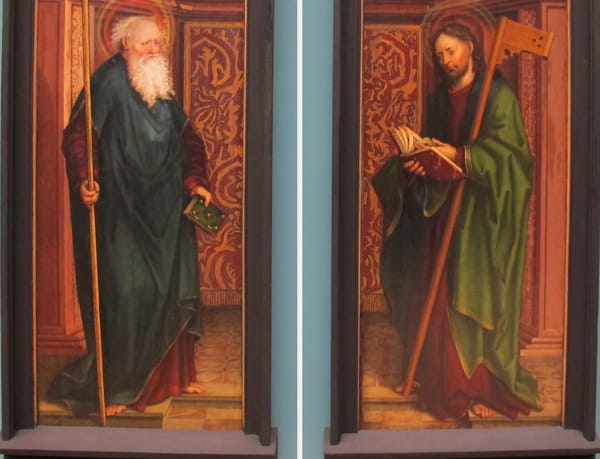
May 11 [May 1]: Sts. Philip and James the Less, Apostles
[This feast day, previously kept on May 1, was moved to May 11 when the feast of St. Joseph the Worker was established on May 1. The Solemnity of St. Joseph, which was replaced by St. Joseph the Work, was originally celebrated on the Third Sunday after Easter, as it was in the time of Dom Guéranger, whose article on that feast can be found here.-Ed.]
From Dom Guéranger's The Liturgical Year.
TWO of the favoured witnesses of our beloved Jesus' Resurrection come before us on this first day of May. Philip and James are here, bearing testimony to us that their Master is truly risen from the dead, that they have seen him, that they have touched him, that they have conversed with him,1 during these forty days. And, that we may have no doubt as to the truth of their testimony, they hold in their hands the instruments of the martyrdom they underwent for asserting that Jesus, after having suffered death, came to life again and rose from the grave. Philip is leaning upon the cross to which he was fastened, as Jesus had been; James is holding the club wherewith he was struck dead.
Philip preached the Gospel in the two Phrygias, and his martyrdom took place at Hierapolis. He was married when he was called by our Saviour; and we learn from writers of the second century that he had three daughters, remarkable for their great piety, one of whom lived at Ephesus, where she was justly revered as one of the glories of that early Church.
James is better known than Philip. He is called, in the sacred Scripture, Brother of the Lord,2 on account of the close relationship that existed between his own mother and the blessed Mother of Jesus. He claims our veneration during Paschal Time, inasmuch as he was favoured with a special visit from our Risen Lord, as we learn from St Paul.3 There can be no doubt but that he had done something to deserve this mark of Jesus’ predilection. St Jerome and St Epiphanius tell us that our Saviour, when ascending into heaven, recommended to St James’s care the Church of Jerusalem, and that he was accordingly appointed the first bishop of that city. The Christians of Jerusalem, in the fourth century, had possession of the chair on which St James used to sit when he assisted at the assemblies of the faithful. St Epiphanius also tells us that the holy Apostle used to wear a lamina of gold upon his forehead as the badge of his dignity. His garment was a tunic made of linen.
He was held in such high repute for virtue that the people of Jerusalem called him ' The Just and when the time of the siege came, instead of attributing the frightful punishment they then endured to the deicide they or their fathers had .committed, they would have it to be a consequence of the murder of James, who, when dying, prayed for his people. The admirable Epistle he has left us bears testimony to the gentleness and uprightness of his character. He there teaches us, with the eloquence of an inspired writer, that works must accompany our faith if we would be just with that justice which makes us like our Risen Lord.
The bodies of SS Philip and James repose in the Basilica of the Holy Apostles at Rome. These relics are counted as one of the richest treasures of the Holy City, and there is reason to believe that this first of May is the real anniversary of their translation. For a long period the Church of Rome kept special feasts in honour of four only of the Apostles: SS Peter and Paul, St John the Evangelist, and St Andrew (Peter’s brother): the rest were united in the solemnity of June 29, and a vestige of this is still to be found in the office of that day, as we shall see later on. The reception of the bodies of SS Philip and James, which were brought from the East somewhere about the sixth century, gave rise to the institution of to-day's feast; and this led gradually to the insertion into the Calendar of special feasts for the other Apostles and Evangelists.
Let us now read the brief account given of St Philip in the Liturgy.
The Breviary then gives the two following Lessons upon St James:
The Greek Church celebrates the memory of these two Apostles on distinct days, which are the anniversaries of their martyrdom. The following stanzas are from the hymn in honour of St Philip:
Hymn (Die XIV Novembris)
Let us now make a selection from the Menæa in honour of St James, whose memory is so affectionately cherished by the Eastern Churches:
Hymn (Die XXIII Octobris)
Holy Apostles! you saw our Risen Jesus in all his glory. He said to you on the evening of that great Sunday: Peace be to you! He appeared to you during the forty days following, that he might make you certain of his Resurrection. Great indeed must have been your joy at seeing once more that dear Master, who had admitted you into the number of his chosen Twelve; and his return made your love of him more than ever fervent. We address ourselves to you as our special patrons during this holy season, and most earnestly do we beseech you to teach us how to know and love the great mystery of our Lord’s Resurrection. May our hearts glow with Paschal joy, and may we never lose the new life that our Jesus has now given unto us.
Thou, O Philip! wast devoted to him, even from the first day of his calling thee. Scarcely hadst thou come to know him as the Messias, than thou didst announce the great tidings to thy friend Nathanael. Jesus treated thee with affectionate familiarity. When about to work the great miracle of the multiplication of the loaves, it was to thee that he addressed himself, and said to thee: Whence shall we buy bread, that these may eat?4 A few days before the Passion of thy divine Master, some of the Gentiles wished to see this great Prophet, of whom they had heard such wonderful things, and it was to thee that they applied. How fervently didst thou not ask him, at the Last Supper, to show thee the Father! Thy soul longed for the divine light; and when the rays of the Holy Ghost had inflamed thy spirit, nothing could daunt thy courage. As a reward of thy labours, Jesus gave thee to share with him the honours of the Cross. O holy Apostle! intercede for us, that we may imitate thy devotedness to Jesus; and that, when he deigns to send us the Cross, we may reverence and love it.
We also honour thy love of Jesus, O thou that art called the brother of the Lord, on whose venerable features was stamped the likeness of our Redeemer. If, like the rest of the Apostles, thou didst abandon him in his Passion, thy repentance was speedy and earnest, for thou wast the first, after Peter, to whom he appeared after his Resurrection. We affectionately congratulate thee, O James, for the honour thus conferred upon thee; do thou, in return, obtain for us that we may taste and see how sweet is our Risen Lord.5 Thy ambition was to give him every possible proof of thy gratitude; and the last testimony thou didst bear, in the faithless city, to the divinity of thy dear Master (when the Jews took thee to the top of the Temple) opened to thee, by martyrdom, the way that was to unite thee to him for eternity. Pray for us, O thou generous Apostle, that we also may confess his holy Name with the firmness which befits his disciples; and that we may ever be brave and loyal in proclaiming his rights as King over all creatures.
O holy Apostles! we beseech you to unite your prayers, and intercede for the Churches of the East, to which you preached the Gospel. Have compassion on Jerusalem, the dupe of schism and heresy; obtain her purification and her liberty; and rid her Holy Places of the sacrileges that have so long polluted them. Lead back the Christians of Asia Minor to union with the fold governed by the one supreme pastor. And lastly, pray for Rome, the city where your bodies repose, awaiting their glorious Resurrection. In return for the long hospitality she has given you, shield her with your protection; and permit not that the city of Peter, your venerable Head, should be deprived of its grandest glory—the presence of the Vicar of Christ.
Thursday of the Second Week after Easter
THE Apostles and holy women are not the only ones to enjoy the presence of our Risen Jesus: a countless people of the just made perfect claim and have the happiness of seeing and reverencing the sacred humanity of their beloved King. The magnificence of the Resurrection has caused us somewhat to forget those venerable captives of Limbo, with whom the soul of our Redeemer spent the hours that elapsed between his Death and Resurrection. They were the friends of God, and were awaiting in Abraham's bosom (as the Scripture expresses it) the dawning of light eternal. From the hour of None (three o'clock) of the great Friday till the daybreak of Sunday, the soul of our Emmanuel abode with these holy prisoners, who were thus put in possession of infinite happiness. But when the hour of his triumph came, how was the Conqueror of Death to leave behind him these souls whom he had enfranchised by his Death and Resurrection? At the moment fixed by the eternal decree, Jesus' Soul passes from Limbo to the sepulchre, and is reunited to his Body; but he is accompanied by a jubilant choir of other souls—the souls of the long-imprisoned Saints.
On the day of the Ascension, they will form his court, and rise together with him; but Heaven’s gate is not yet open, and they must needs wait for these forty days to pass, during which our Redeemer will organize his Church. They are invisible to the eyes of men, but they dwell in the space above this lowly earth, where once they passed their days, and merited an eternal recompense. Adam again sees the land which he had tilled in the sweat of his brow; Abel is in admiration at the power of the divine Blood, which has sued for mercy, whereas his prayed but for vengeance;1 Noe looks upon this globe, and finds it covered with an immense multitude of men, all of whom are descendants of his three sons; Abraham, the father of believers, Isaac also, and Jacob, hail the happy moment when is to be fulfilled the promise which was made to them, that all generations should be blessed in him who was to be bom of their race; Moses recognizes his people, in whose midst the Messias (whom he had announced,2 and who is greater than he),3 has found so few followers and so many enemies; Job, who represents the elect among the Gentiles, is filled with joy at seeing his Redeemer living,4 in whom he had hoped in all his trials; David, fired with holy enthusiasm, is preparing canticles for heaven, grander far than those he has left us, to be sung in praise of the Incarnate God, who has espoused our human nature; Isaias and the other Prophets behold the literal fulfilment of all they had foretold; in a word, this countless army of saints, formed from the elect of all times and countries, is grieved at finding the earth a slave to the worship of false gods; they beseech our Lord, with all the earnestness of prayer, that he would hasten the time for the preaching of the Gospel, which is to rouse from their sleep them that are seated in the shadow of death.
As the elect, when they rise from their graves on the last day, will ascend through the air to meet Christ5 as eagles who gather together wheresoever the body may be;6 so now these holy souls cluster around their divine Deliverer. He is their attraction; seeing him, speaking with him, is truly a heaven on earth to them. Jesus indulges these Blessed of his Father, who are soon to possess the Kingdom prepared for them from the foundation of the world;7 he allows them to follow and accompany him; and thus does he pass the days which are to be spent before that glorious one of his triumphant Ascension.
What must not have been the happiness of the faithful and chaste Joseph in being thus near his adopted Son—his Creator? with what affection must he not have looked upon his virginal Spouse, who has been made, at the foot of the Cross, the Mother of men! Who could describe the delight wherewith Anne and Joachim gaze upon their daughter, the august Mother whom all generations shall call ‘blessed’?8 And John, the Precursor—how must he not have exulted at seeing her, at whose voice he was sanctified in his Mother’s womb, and who has given to the world the Lamb that taketh all sin away! How affectionately must not these ransomed souls have looked upon the Apostles, those future conquerors of the world, who are now being prepared for the combat by their divine Master! It is through them that the earth once brought to the knowledge of the true God will be ever sending up elect ones to heaven until time shall give place to eternity.
Let us to-day honour these hidden but august witnesses of what God's mercy is preparing for the world’s salvation. We shall soon see them ascending to heaven, of which they will take possession in the name of mankind, that has been redeemed by Christ. Let us not forget how, on their way from Limbo to Heaven, they rested with Jesus for forty days on this earth of ours, where they themselves had once lived and merited an eternal crown. Their visit brought a blessing with it; and their departure was the signal for us to follow them—it opened the way to the blissful home, which is one day to be ours!
The following sequence, taken from the Cluny Missal of 1523, is appropriate to the reflections we have just been making:
Sequence
Concio cantica,
Organa subnectens
Hypodorica.
Deo tartarea
Rumpenti, decanta
Nunc symphonia.
Resurgens, gaudia
Mundo gestat colenda.
Mirantes perdita
Cocyti confinia,
Intrante illo
Vita beata.
Tremescit daemonum
Plebs valida.
Fletuum alta:
Repagula
Quis sic audax fregerit,
Mirantur nunc fortia.
Redit cum turma
Gloriosa,
Et timida
Refovet discipulorum corda.
Hujus trophæa
Admirantes,
Flagitamus nunc
Voce decliva.
Mereamur pretiosa
Colere ut pascha:
In qua sacrata
Prae fulgore contueri
Lucis exordia.
O holy choir,
mourning,
but full of hope.
to the divine King,
who has broken down
the gates of hell.
and rising from the tomb,
brings festive joy to the world.
wonder
at the strange event.
he is Eternal Life,
and they see his power.
of demons
tremble with fear,
and weep,
asking each other,
who this may be that dares to break
the massive bolts.
our Lord returns to earth,
surrounded by a glorious troop;
and hastens to console
the timid hearts of his disciples.
who celebrate
his noble victory,
beseech him
in humble prayer,
to celebrate the great Pasch,
in the choir of Virgins.
sanctified by light,
to see
the Source of Light.
| Previous Wednesday of the Second Week after Easter | Next Thursday of the Second Week after Easter |