Daily reading
Paschal Time
Greater Double · May 6 · Sanctoral
May 6, 2025
From Dom Guéranger’s The Liturgical Year.
A Greater Double leads the weekday.Rubric

|
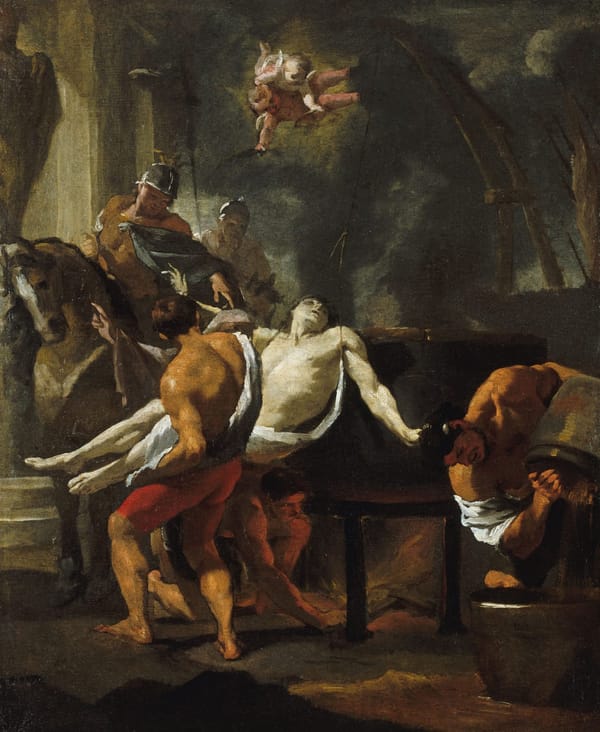
May 6: St. John before the Latin Gate
THE beloved Disciple John, whom we saw standing near the crib of the Babe of Bethlehem, comes before us again to-day; and this time he pays his delighted homage to the glorious Conqueror of death and hell. Like Philip and James, he is clad in the scarlet robe of martyrdom. The month of May, so rich in Saints, was to be graced with the palm of St John.
Salome one day presented her two sons to Jesus, and with a mother’s ambition asked him to grant them the highest places in his kingdom. The Saviour, in his reply, spoke of the chalice which he himself had to drink, and foretold that these two disciples would also drink of it. The elder, James the Great, was the first to give his Master this proof of his love; we shall celebrate his victory when the sun is in Leo: it was to-day that John, the younger brother, offered his life in testimony of Jesus’ divinity.
But the martyrdom of such an Apostle called for a scene worthy the event. Asia Minor, which his zeal had evangelized, was not a sufficiently glorious land for such a combat. Rome, whither Peter had transferred his Chair and where he died on his cross, and where Paul had bowed down his venerable head beneath the sword, Rome alone deserved the honour of seeing the beloved disciple march on to martyrdom, with that dignity and sweetness which are the characteristics of this veteran of the Apostolic College.
Domitian was then Emperor—a tyrant over Rome and the world. Whether it were that John undertook this journey of his own free choice, and from a wish to visit the Mother Church, or that he was led thither bound with chains, in obedience to an imperial edict—John, the august founder of the seven Churches of Asia Minor, appeared before the tribunal of pagan Rome. He was convicted of having propagated, in a vast province of the Empire, the worship of a Jew who had been crucified under Pontius Pilate. He was a superstitious and rebellious old man, and it was time to rid Asia of his presence. He was therefore sentenced to an ignominious and cruel death. He had somehow escaped Nero’s power: but he should not elude the vengeance of Caesar Domitian!
A huge cauldron of boiling oil is prepared in front of the Latin Gate. The sentence orders that the preacher of Christ be plunged into this bath. The hour is come for the second son of Salome to partake of his Master’s chalice. John’s heart leaps with joy at the thought that he—the most dear to Jesus, and yet the only Apostle that has not suffered death for him—is at last permitted to give him this earnest of his love. After cruelly scourging him, the executioners seize the old man, and throw him into the cauldron; but, lo! the boiling liquid has lost all its heat; the Apostle feels no scalding; on the contrary, when they take him out again he feels all the vigour of his youthful years restored to him. The Praetor’s cruelty is foiled, and John, a martyr in desire, is to be left to the Church for some few years longer. An imperial decree banishes him to the niggled Isle of Patmos, where God reveals to him the future of the Church, even to the end of time.
The Church of Rome, which counts among her most glorious memories the abode and martyrdom of St John, has marked with a Basilica the spot where the Apostle bore his noble testimony to the Christian faith. This Basilica stands near the Latin Gate, and gives a title to one of the Cardinals.
In honour of the great Apostle of love, we give the following Sequence, composed by Adam of Saint-Victor:
Sequence
Summum regem gloriæ
Videns mentis acie
Non repulsa,
Angelis parificat,
Spiritu qui indicat
Cœli summa.
Hic est potus recumbentis
Supra pectus Domini;
Hic expugnat vires ignis
Et ferventis olei.
Tormenti sævitia,
Quod martyr quis fiat
Et pœnas non sentiat.
O custos Virginis
Per quam mundo gloria,
Ex quo sunt, in quo sunt,
Per quem sunt omnia,
Per te det suffragia!
Christum, a quo diligeris,
Interpellans et exorans,
Nos ei concilia.
Tu qui collis, due ad montem;
Præsta Sponsum ad videndum,
Virgo totus gratia.
where the King of glory
is seen by the soul's
unfettered gaze,
and equality with the angels, to
John, whose revelations have made known
to men the mysteries of heaven.
that spring up to life eternal,
when he leaned on his Lord's breast.
have made him shine as a bright light in the Church.
He quenched the heat of the boiling oil.
for him are cruel beyond measure;
yet do they wonder within themselves,
how a man can be a martyr and feel no pain.
O guardian of the Virgin
by whom the world received him
who is its glory!
pray for us to Jesus, from whom, and in whom,
and by whom are all things.
by thine intercession and prayers,
render Jesus, by whom thou wast loved,
propitious unto us.
O thou that art a hill, lead us to the mountain!
O thou whom grace made wholly pure,
pray for us that we may see the Beloved.
We are delighted to meet thee again, dear disciple of our Risen Jesus! The first time we saw thee was at Bethlehem, where thou wast standing near the Expected of Nations, the promised Saviour, who was sweetly sleeping in his crib. We then thought of all thy glorious titles: Apostle, Evangelist, Prophet, highsoaring Eagle, Virgin, Doctor of charity, and above all, Jesus' Beloved Disciple. To-day we greet thee as martyr; for if the ardour of thy love quenched the fire prepared for thy torture, thy devotion to Christ had honestly and willingly accepted the chalice of which he spoke to thee in thy younger years. During these days of Paschal Time, which are passing so rapidly, we behold thee ever close to this divine Master, who treats thee with every mark of affection. Who could be surprised at his special love for thee? Wast thou not the only one of all the disciples who stood at the foot of the Cross? Was it not to thee that he gave the care of his Mother, making her thine? Wast thou not present when his Heart was opened on the Cross by a spear? When, on the morning of the great Sunday, thou didst repair with Peter to the Tomb, wast thou not, by thy faith, the first of all the disciples to honour Jesus' Resurrection? Oh, yes! thou hast a right to all the special love wherewith Jesus treats thee; but pray to him for us, O blessed Apostle!
We ought to love him for all the favours he has bestowed upon us; and yet we are tepid in his love—we humbly confess it. Thou hast taught us to know the infant Jesus, thou hast described to us the crucified Jesus; show us now the Risen Jesus, that we may keep close to him during these last few days of his sojourn on earth. And when he has ascended into heaven, procure us brave hearts, that like thee we may be prepared to drink the chalice of trials which he has destined for us.
Rome was the scene of thy glorious confession, O holy Apostle! She is most dear to thee; join, then, with Peter and Paul in protecting her. If the palm of martyrdom be in thy hand as well as the pen of the Evangelist, remember it was at the Latin Gate that thou didst obtain it. It was in the East that thou didst pass the greater part of thy life; but the West claims the honour of counting thee as one of her grandest martyrs. Bless our Churches, reanimate our faith, rekindle our love, and deliver us from the Antichrists against whom thou didst warn the faithful of thine own times, and who are causing such ravages among us. Adopted son of Mary! thou art now enjoying the sight of thy Mother's glory: present to her the prayers we are offering to her during this month, which is consecrated to her, and obtain for us the petitions which we presume to make to her.
Tuesday of the Third Week after Easter
THE Church, which our Risen Jesus is organizing during these days, and which is to be spread throughout the whole world, is a true and complete society. It must, consequently, have within it the power to govern, and be able, by the obedience of its subjects, to maintain order and peace. As we have already seen, our Saviour supplied this want by establishing a shepherd of both sheep and lambs, a Vicar of his own divine authority: yet Peter, after all, is but a man; and however sublime his authority, he cannot exercise it directly and personally over each member of the flock. The new society has need, therefore, of magistrates of a lower rank, who, as Bossuet so well expresses it, ‘are to be sheep with regard to Peter, and shepherds with regard to the people.’1
Jesus has provided for everything; he has chosen twelve men, whom he calls his Apostles, and to them he is about to entrust the magistracy of his Church. By his having made Peter the head, and, as it were, his second self, he does not intend the rest of the Twelve to have no share in the great work he has come from heaven to achieve. Far from this, he destines them to be the pillars of the building, of which he has already made Peter the foundation. They are twelve in number, as heretofore were the children of Jacob; for the ancient people was, in everything, a figure of the new. Before ascending into heaven, Jesus gives them power to teach in every part of the world, and appoints them pastors of the faithful in every place wheresoever they may happen to be. They are all on an equality, save with regard to Peter; and the very fact of these wonderful depositaries of Christ’s power being subject to Peter, is one of the clearest indications of the extraordinary authority committed to him by our Lord.
This unlimited delegation of pastoral power given to all the Twelve, was intended as a means of the solemn promulgation of the Gospel; but it was to cease at their deaths, save in the case of Peter, for his successor was alone to enjoy the apostolic power in its fullest extent. With this one exception, no lawful pastor has ever been allowed to exercise an unlimited territorial authority. And yet, by creating the college of the Apostles, our Redeemer founded that sacred and venerable dignity which we call the episcopacy. Although bishops have not inherited either the universal jurisdiction, or the personal infallibility in teaching, of the Apostles, yet do they really hold, in the Church, the place of the Apostles. Jesus puts into their hands, through the ministry of Peter’s successor, the keys of spiritual power; and these they use, that is, they therewith open and shut, throughout the whole extent of the territory placed under their jurisdiction.
How magnificent is this episcopal magistracy! See those thrones, whereon are seated the pontiffs of the whole Christian world! They hold the pastoral staff, the symbol of their power to govern their respective flocks. Go where you will, you will find the Church, and a bishop busily engaged in governing the flock entrusted to his charge. And when you reflect that all these pastors are brethren, that they all govern their flocks in the name of the same common Lord, and that all are united in obedience to one head—you will understand how the Church, wherein is exercised such an authority as this, has everything that constitutes a complete society.
Under the bishops, we find other subordinate magistrates in the Church; the reason of their being appointed is self-evident. Placed over a territory of greater or less extent, the bishop stands in need of co-operators who may represent his authority, and exercise it in his name and under his orders, wheresoever he himself cannot personally do so. These are priests, who have the care of souls. They correspond to the seventy-two disciples chosen by our Saviour, from whose number he selected the twelve Apostles. Thus he completed the government of the Church. By means of this Hierarchy, everything works in the most admirable harmony: authority is derived from the one supreme Head; thence it flows to the bishops; and these delegate it to the lower ranks of the clergy.
We are now at the very season of the year when the spiritual jurisdiction, which Jesus had promised to communicate to men, emanates from his own divine power. He thus solemnly confers it: All power is given to me in heaven and in earth: going, therefore, teach ye all nations!2 He communicates a portion of his own power to the pastors of his Church: it is an emanation of his own authority in heaven and on earth: and that we may have no doubts as to the source whence it flows, he says to them during these his last days on earth: As the Father hath sent me, I also send you.3
So that the Father has sent the Son, and the Son sends the pastors of the Church: nor will this mission ever be interrupted, so long as the world lasts. Peter will ever institute the bishops; the bishops will ever delegate a portion of their own authority to the priests who have the charge of souls. No human power shall ever be able to intercept this transmission, or have power to set up as pastors them that have not partaken of it. Cæsar (we mean mere temporal sovereignty) shall govern the state; but he shall not have power to create a single pastor, for Cæsar has no share in the sacred hierarchy, out of which the Church recognizes but subjects. He may command, as King or Emperor, in temporal matters; but he must obey, and as submissively as the last and poorest of the faithful, the pastor who has to govern him in what regards his soul. There will be times when Cæsar will be jealous of this superhuman power; he will strive to intercept it: but it will elude his grasp, for it is a purely spiritual power. At other times, he will despise and persecute them that are invested with this power; nay, he will occasionally attempt to exercise it himself; but his efforts will be as vain as they will be wicked, for this power, which emanates from Christ, cannot be confiscated nor interrupted; it is the salvation of the world, and on the last day the Church will have to restore it intact to him who deigned to entrust it to her before ascending to his Father.
Once more, to the praise of our dearest King! The great Fulbert of Chartres offers us the following hymn, which was adopted by the ancient Roman-French Liturgy.
Hymn
Novam mellis dulcedinem
Promat, colens cum sobriis
Paschale festum gaudiis.
Dracone surgens obruto,
Dum voce viva personat,
A morte functos excitat.
Praedam refudit tartarus:
Captivitate libera
Jesum sequuntur agmina.
Et dignus amplitudine,
Soli polique patriam
Unam facit rempublicam.
Regem precemur milites,
Ut in suo clarissimo
Nos ordinet palatio.
Patri supremo gloria,
Honorque sit cum Filio
Et Spiritu Paraclito.
bring forth the new sweetness of its honey;
and celebrate, with holy joy,
the paschal feast.
crushes the dragon, and rises from the tomb:
with a loud voice
he commands the dead to live.
gives back its prey;
and throngs of ransomed captives
follow Jesus.
he is worthy of all power;
he makes earth and heaven
be one kingdom.
let us humbly sing his praise,
and beseech him to admit us
into his palace of heaven above.
be to the Eternal Father,
and to the Son,
and to the Holy Paraclete.
| Previous Monday of the Third Week after Easter | Next Tuesday of the Third Week after Easter |