Daily reading
Paschal Time
Double · May 7 · Sanctoral
May 7, 2025
From Dom Guéranger’s The Liturgical Year.
A Double leads the weekday.Rubric
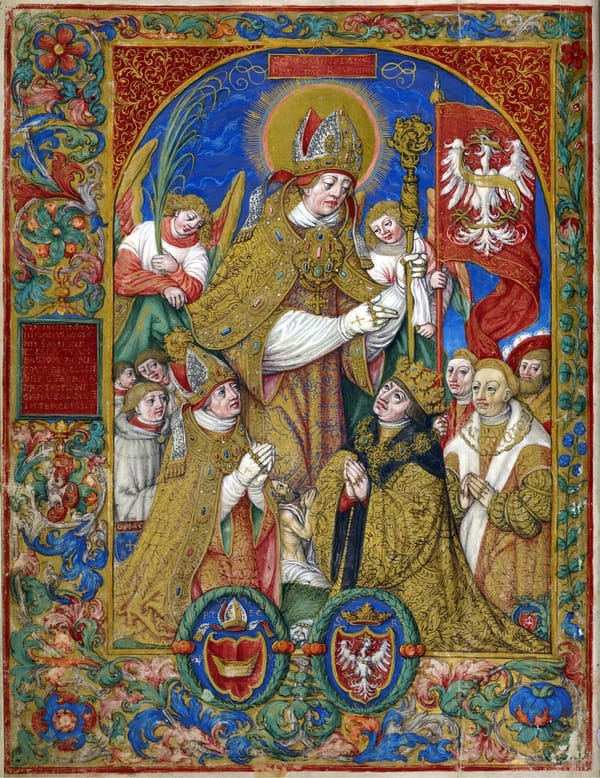 |
May 7: St. Stanislaus, Bishop and Martyr
THE eleventh century, the century of contest between the priests of the Church and Barbarism, gives to-day another martyr to our Risen Jesus. It is Stanislaus, beloved by noble Poland as one of her chief protectors. He was slain at the altar by a Christian prince whom he had reproved for his crimes. The blood of the courageous Pontiff was mingled with that of our Redeemer in the same sacrifice. What an invincible energy there is in these lambs whom Jesus has sent amidst the wolves!1 They seem to be straightway changed into lions, as Jesus himself was at his Resurrection. There is not a century that has not had its martyrs: some for the faith, others for the unity of the Church, others for her liberty, others for justice, others for charity, and others, like our great Saint of to-day, for the maintenance of morals. The nineteenth century, too, has had its martyrs; scarcely a year elapses without our hearing of some who have been added to the bright list in the far East. At the commencement of the eighteenth century there was little probability of its providing such an abundant harvest of martyrdom as it did. Of one thing we are quite sure: whatever persecutions may arise in the future, the Spirit of fortitude will not be wanting to the champions of truth. Martyrdom is one of the Church's characteristics and it has never failed her. The Apostles who are very close to Jesus during these days preceding his Ascension drank the chalice which he drank; and only yesterday we were honouring the martyrdom of the favourite disciple—yes, even he had to tread the path prepared for all.
Holy Church tells us, in the account we now subjoin, how the saintly bishop of Cracow was offered the glorious chalice, and how courageously he accepted it.
Thou wast powerful in word and work, O Stanislaus! and our Lord rewarded thee with a martyr’s crown. From thy throne of glory, cast a look of pity upon us; obtain for us from God that gift of fortitude which was so prominent in thee, and which we so much need in order to surmount the obstacles which impede our progress. Our Risen Lord must have no cowards among his soldiers. He took by assault the kingdom into which he is about to enter; and he tells us plainly that if we would follow him thither, we must prepare to use violence.2 Brave soldier of the living God! obtain for us brave hearts. We need them for our combat—whether that be one of open violence for the faith or unity of the Church, or one which is to be fought with the invisible enemies of our salvation. Thou wast indeed a good shepherd, for the presence of the world neither made thee flee nor fear; ask our heavenly Father to send us shepherds like thee. Succour Holy Church, for she has to contend with enemies in every part of the world. Convert her persecutors, as thou didst convert Boleslaus; he was thy murderer, but thy martyrdom won mercy for him. Remember thy dear Poland, which honours thee with such fervent devotion. Be with her now that she has regained her rank among nations. During the severe triads which her sins drew down upon her, she maintained the sacred link of Catholic Faith and unity; she was patient and faithful; our Risen Jesus has had pity on her, and rewarded her patience and fidelity by granting her a share in his own Resurrection.
Wednesday of the Third Week after Easter
THERE is nothing on earth so grand, nothing so exalted, as the princes of the Church—the pastors, appointed by the Son of God—who are to follow on, in unbroken succession, to the end of time: but let us not suppose that the subjects of this vast empire, called the Church, are devoid of dignity and greatness. The Christian people, in which both prince and beggar are equally subjects, is superior to every other, in intellectual and moral worth. It carries civilization with it, wheresoever it goes, for it carries with it the true notion of God and of the supernatural end of man. Barbarism recedes; pagan institutions, how ancient soever they may be, are forced to give way. Even Greece and Rome laid down their own laws to adopt those of the Christian code—the code which was based on the Gospel. So, too, in our own times, the mere sight of a Christian army, though composed of but a few thousand men, struck terror into the heart of an immense empire of the East: its ruler who counts four hundred million subjects, and calls himself the ‘Son of the Celestial Empire, was so overcome by fear that without offering the slightest resistance he fled from his palaces and capital. Yes, this is the superiority given by baptism to Christian nations; for it would be absurd to attribute this superiority to our civilization, seeing that civilization itself is but a consequence of baptism.
But if the outward bearing of the Christian people be such as to exercise an influence on even infidels, what must not be that dignity which faith teaches us is its inheritance? The Apostle St Peter—the universal shepherd, into whose hands the divine Shepherd placed the keys—thus describes the flock entrusted to his care: You are a chosen generation, a kingly priesthood, a holy nation, a purchased people; that you may declare his virtues, who hath called you out of darkness into his marvellous light.1 So, indeed, it is; divine truth is entrusted to this people, and its light can never be extinguished among them. When the teaching authority has, with its infallibility, to proclaim a solemn definition in doctrinal matters, it first appeals to the faith of the Christian people; and the sentence declares that to be the truth which has been believed ‘everywhere, always, and by all.’2 Amidst the Christian people there exists that strangest phenomenon under heaven, union of mind; whereby there is one common faith amidst nations the most opposite to each other in every other respect. Let them be as hostile to one another as you please; in matters of faith, in submission to their pastors, they are all one and the same great family. The most admirable, at times the most heroic virtues are to be found amidst this people, for Jesus has given it a large share of that element of holiness wherewith his grace has enriched human nature.
Observe, too, how affectionately it is protected and honoured by its pastors! Every pastor, no matter what may be his rank in the Church, is bound, in virtue of his office, to lay down his life for his sheep, if called upon to do it. The sacrifice is not even counted as an act of heroism; it is a strict duty. Shame and curse upon the pastor who flees through cowardice! The Redeemer stigmatizes such a one with the name of hireling. Hence it is, that during these last eighteen hundred years, there have been so many thousands of pastors who have given their lives for their flocks. One or other of their names are to be found in every page of the Church’s history. The list is headed by St Peter, who was crucified like his divine Master; it continues down to the Bishops of Cochin-China, Tonkin, and Corea, whose recent martyrdoms attest that the pastor has not ceased to consider himself as a victim for his flock. Thus, before confiding his lambs and sheep to Peter, Jesus asks him if he have greater love than the rest. If Peter love his Master, he will love his Master’s lambs and sheep; he will love them even to laying down his life for them. For this reason, after entrusting him with the care of the whole flock, our Saviour tells Peter that he is to die a martyr. Happy is that people whose rulers only exercise their authority on condition of being ready to die for these their Master’s sheep!
If one of these should evince in his life the marks which denote sanctity, and this so far as to deserve to be proposed to the faithful as a model and intercessor, you will not only see the priest whose word calls down the Son of God upon the altar, not only the bishop whose sacred hands wield the pastoral staff, but the very Vicar of Christ, humbly kneeling before the tomb or statue of the Servant of God, how poor or despised soever he or she may have been on this earth. This sacred hierarchy testifies the same sentiments of respect for the sheep of Christ on every occasion. Thus in a baptized babe, that knows not how to utter a single word, that is not counted among the citizens of the state, that, like a tender flower, may perhaps have faded before the close of day, yet does the pastor recognize in it a worthy member of the Body of Christ, the Church; he reverences it as a being that is enriched with gifts so sublime as to be an object of heaven’s love, and a source of blessing to all around it. When the Faithful are assembled in the house of God, and the sacred oblations and altar have been thurified, the Celebrant, as the representative of Christ, and any others of the clergy who may be in the sanctuary, are also honoured with the same mysterious tribute of homage: but the incense is to go beyond the sanctuary. The thurifer advances towards the people, and in the name of the Church, gives them the same honour as that just given to the pontiff and the clergy; for the faithful people are also members of Christ. Again: when the corpse of a Christian, even though he may have been the poorest of the poor, is carried into the house of God, observe what honour is paid to his mortal remains! On this occasion, also, the incense is made to express the affectionate homage wherewith the Church honours the Christian character of her children. O Christian people! how truly we may say of thee what Moses said of Israel: There is no other nation so great as thou!3
It is our Risen Jesus that has procured us all this honour: let us express our love and gratitude in this canticle of the ancient Missal of Saint Gall.
Sequence
Unquam præevalet, regum summe,
Typica majestatis tuae Promere?
Qui Parenti supremo
Deitate coaequalis,
Omnia potestate pari disponis;
In Patre callebas Sophia;
Per quam facta sunt omnia,
Quæque profert
Triplex machina.
Qui cernens immersos esse barathro,
Tua quos adornat imago,
Propter nos factus es homo,
Ut nos solveres Sanguine tuo.
Isaac parentis nostri immolatio,
Mactabatur aries
Pro quo Domino.
Joseph prænotavit
Venditus in Ægypto,
Nunc daturus typicos victus populo.
Infernum fracturus,
Cum Samson vir invictus
Leonem suffocavit,
Et portas hostiles Disrupit.
Illius flos virgæ,
Quam fudit radix Jesse
Generosa germine,
Quod sunt præconati Prophetae.
O Redemptor, ceu sub umbra primitus,
Quæ nos verius
Te monstrante cernimus.
Tu cuncta procul fugas nubila,
Terrae reddens tui vultus Lumina.
Quæ morte tua
Fuscabatur tremula.
Cuncta ornantur
Elementa sereno,
Quia redisti victor Barathro.
Hinc et nos, o socii,
Mente Dominum
Sincera et humili
Simul laudemus
Carmine tali:
Criminum nos cœno,
Haud pepercit proprio
Propter nosmet Filio.
Pro nobis qui factus est homo,
Ut solvens nos tartaro
Redderet paradiso.
Ævo omni.
can worthily celebrate
the mysteries wrought by thy majesty?
God co-equal with the Father, Eternal,
thou rulest all things
with the selfsame power as his.
when thou wast,
in the bosom of the Father,
the Wisdom whereby all things were made,
yea all that compose this triple world.
Seeing that they who were adorned with thy image
had fallen into an abyss of misery,
thou wast made man for our sakes,
that by thy Blood thou mightest rescue us.
was the sacrifice of our father Isaac;
in whose stead
a ram was immolated unto the Lord.
was prefigured by Joseph sold into Egypt,
where he fed the people
with mysterytelling food.
was foreshadowed
by the invincible Samson
slaying a lion
and breaking his enemies’ gates.
Flower of the Branch
that nobly grew
from Jesse's root,
as sang the Prophets of old.
were shown, in a shadow, to our Fathers;
thou hast shown them to us in their truth.
Thou dispellest all clouds,
and makest the light of thy countenance
to shine once more on the earth,
that had been thrown into darkness
and fear by thy death.
in beauteous light,
because thou hast returned
in victory from the tomb.
Let us, then, brethren,
with upright
and humble hearts,
unite in praising
thus our God:
who, to raise us from the mire of our sins,
spared not his own Son,
for our sake.
who to ransom us from hell,
and restore us to heaven,
was made Man for our sake.
for ever.
| Previous Tuesday of the Third Week after Easter | Next Wednesday of the Third Week after Easter |