Daily reading
Paschal Time
Double · May 9 · Sanctoral
May 9, 2025
From Dom Guéranger’s The Liturgical Year.
A Double leads the weekday.Rubric
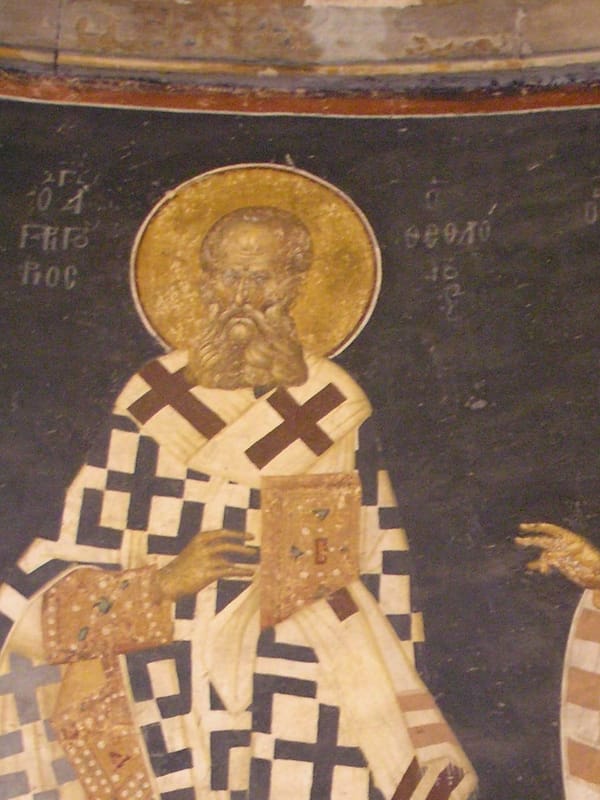 |
May 9: St. Gregory Nazianzen, Bishop, and Doctor of the Church
SIDE by side with Athanasius, another Doctor of the Church comes forward at this glad season to offer to the Risen Jesus the tribute of his learning and eloquence. It is Gregory of Nazianzum, the friend of Basil, the great orator, the admirable poet, whose style combines energy of thought with a remarkable richness and ease of expression; the one of all the Gregories who has merited and received the glorious name of Theologian, on account of the soundness of his teachings, the sublimity of his ideas, and the magnificence of his diction. Holy Church exults at being able to offer us so grand a Saint during Easter Time, for no one has spoken more eloquently than he on the Mystery of the Pasch. Let us listen to the commencement of his second Sermon for Easter; and then judge for ourselves:
I will stand upon my watch, says the admirable Prophet Habacuc.1 I, also on this day, will imitate him; I will stand on the power and knowledge granted me by the favour of the Holy Ghost, that I may consider and know what is to be seen, and what will be told unto me. And I stood and I watched: and lo! a man ascended to the clouds; and he was of exceeding high stature, and his face was the face of an angel, and his garment was dazzling as a flash of lightning. And he lifted up his hand towards the East, and cried out with a loud voice. His voice was as the voice of a trumpet, and around him stood, as it were, a multitude of the heavenly host, and he said: "To-day is salvation given to both the visible and the invisible world. Christ hath risen from the dead: do ye also rise. Christ hath returned to himself: do ye also return. Christ hath freed himself from the tomb: be ye set free from the bonds of sin. The gates of hell are opened, and death is crushed; the old Adam is laid aside, and the new one is created. Oh! if there be a new creature formed in Christ, be ye made new!”
Thus did he speak. Then did the other angels repeat the hymn they first sang when Christ was born on this earth, and appeared to us men: Glory be to God in the highest, and peace on earth to men of good will! I join my voice with them, and speak these things to you: oh! that I could have an angel’s voice, to make myself heard throughout the whole earth!
It is the Pasch of the Lord! the Pasch!—in honour of the Trinity, I say it a third time: the Pasch! This is our Feast of feasts, our Solemnity of solemnities. It is as far above all the rest, not only of those which are human and earthly, but of those even which belong to Christ and are celebrated on his account—yea, it as far surpasses them all as the sun surpasses the stars. Commencing with yesterday, how grand was the day with its torches and lights! . . . But how grander and brighter is all on this morning! Yesterday’s light was but the harbinger of the great Light that was to rise; it was but a foretaste of the joy that was to be given to us. But to-day we are celebrating the Resurrection itself, not merely in hope, but as actually come to pass, and drawing the whole earth to itself.2
This is a sample of the fervour and eloquence wherewith our Saint preached the mysteries of faith. He was a man of retirement and contemplation. The troubles of the world in which he had been compelled to live damped his spirits; the duplicity and wickedness of men fretted his noble heart; and leaving to another the perilous honour of the see of Constantinople, which he had reluctantly accepted a very short time previously, he retired to his dear solitude, there to enjoy his God and the study of holy things. And yet, during the short period of his episcopal government, notwithstanding all the obstacles that stood in his way, he confirmed the faith that had been shaken, and left behind him a light which continued even to the time when St John Chrysostom was chosen to fill the troubled Chair of Byzantium.
The holy Liturgy thus speaks to us of the virtues and actions of this great Saint:
The Greek Church, in her Menæa, gives the following magnificent encomium of St Gregory Nazianzen:
Hymn (Die XXV Januarii)
We salute thee, O glorious Doctor of the Church, on whom both East and West have conferred the title of Theologian! Illumined by the rays of the glorious Trinity, thou gavest us to share in the light thus imparted to thee—and a brighter was never granted to mortal eye. In thee was verified that saying of our Saviour: Blessed are the clean of heart, for they shall see God.3 The purity of thy soul prepared thee to receive the divine light, and thy inspired pen has transmitted to thy fellow-men something of thine own soul's enraptured knowledge. Obtain for us the gift of faith, which puts the creature in communication with its God; obtain for us the gift of understanding, which makes the creature relish what it believes. The object of all thy labours was to guard the faithful against the seductive wiles of heresy, by putting before them the magnificence of the divine dogmas. Oh! pray for us, that we may avoid the snares of false doctrines, and have our eye ever fixed on the ineffable light of the mysteries of faith; for, as St Peter tells us, it is as a lamp in a dark place, that shineth until the day dawn, and until the day-star arise in our hearts.4
There now seems to be a gleam of hope for the East, that has been, for so many long ages, a prey to error and slavery. Great changes are preparing for the unfortunate Byzantium, and politicians are studying how to profit by the crisis, and make her the prey of their respective Governments. Canst thou forget the city of which thou wast once the pastor, and where thy name is still held in veneration? Oh! help her to throw off the shackles of schism and heresy. Her being a slave to the infidel is the punishment of her having revolted against the Vicar of Christ! this yoke seems about to be broken; pray, O Gregory, that the more dangerous and humiliating one of error and schism may also be broken. A movement of return to the truth has already begun to show itself. Whole provinces are awakening to a knowledge of their misery, and are casting a look of hope towards the common Mother of all Churches, who opens her arms to receive them. Aid this long-desired conversion by thy prayers. Both East and West honour thee as one of the sublimest preachers of divine Truth; obtain by thy powerful intercession that East and West may be once more united in the one fold, and under the one shepherd, before our Risen Jesus returns to our earth to separate the cockle from the good seed, and lead back to heaven the Church, his Spouse and our Mother, out of whose pale there is no salvation.
Help us, during this season, to contemplate the glories of our Risen Lord. Oh! for something of the holy enthusiasm for this Pasch, which inebriated thee with its joys and inspired thee with such glowing eloquence! Jesus, the Conqueror of Death, was the object of thy fervent affections even from thy childhood; and when old age came, thy heart still beat with love for him. Pray for us, that we too may persevere in his service; that his divine mysteries may ever be our grandest joy; that this year’s Pasch may ever abide in our souls; that the renovation it has brought us may be visible throughout our lives; and that it may, each year as it returns, find us attentive and eager to receive its graces, until the eternal Easter comes with its endless joy!
Friday of the Third Week after Easter
CHURCH of Jesus! that wast promised by him to the earth during the days of his mortal life; that camest forth from his sacred Side when wounded by the spear upon the Cross; that wast organized and perfected by him during the last days of his sojourn here below; we lovingly greet thee as our mother; thou art the Spouse of our Redeemer, and it is through thee that we were born to him. It is thou that gavest us life by baptism; it is thou that givest us the word, which enlightens us; it is thou that ministerest to us the helps, whereby we are led, through our earthly pilgrimage, to heaven; it is thou that governest us, in the spiritual order, by thy holy ordinances.
Under thy maternal care we are safe; we have nothing to fear. What can error do against us? Thou art the pillar and ground of the truth!1 What effect can the revolutions of our earthly habitation have upon us? We know, that if everything else should fail us, thou wilt ever be with us. It was during these very days which precede the Ascension, that our Lord Jesus said to his Apostles, and through them, to their successors: Behold! I am with you all days, even to the consummation of the world.2 What a promise of duration was this! If we consult the history of these last eighteen hundred years, it will tell us that this promise has never once been broken. The gates of hell have risen up against thee innumerable times; but they have never prevailed against thee, no, not for one single moment!
And thus it is, O Church! that being founded on Christ thy Spouse, thou givest us a share in thine own divine immutability! Established as we are in thee, there is not a truth which the eye of our faith cannot see; there is not a blessing which, despite our weakness, we may not make our own; there is no object shown us by hope, which we may not attain. Thou holdest us in thine arms; and from the height whereto thou raisest us, we see the mysteries of time and the secrets of eternity. Our eye admiringly follows thee, whether we consider thee as militant on earth, suffering in thy dear ones who are in the temporary state of expiation, or triumphant in heaven. Thou art with us in our exile, and already art thou, in millions of thy children, heiress of the eternal kingdom. Keep us near thee, nay, within thee, O thou our Mother, who art the beloved Spouse of our Lord. To whom shall we go but to thee? Is it not to thee, and to thee alone, that he has entrusted the words of eternal life?
How much they are to be pitied, O Church! who do not know thee! And yet, if they are seeking God with all their heart, they will, one day, know thee. How much they are to be pitied who once knew thee, and afterwards, in their pride and ingratitude, denied thee! And yet no one ever fell into such misery, unless he first voluntarily shut his eyes against the light that was within him. How much they are to be pitied who know thee, and still live enjoying what thou givest thy children, and who yet take side with thine enemies in insulting and betraying thee! They are men whose character is shallowness of mind; they speak their opinions as though they were oracles; they have contracted the flippant effrontery of our age: and to hear them speak of thee, one would suppose that they look on thee as a human institution, which they may approve or blame according to their humour.
Instead of revering whatsoever thou hast taught regarding thyself and thy rights; instead of revering what thou hast ordained, regulated, and practised; these Catholics, whose sympathies are all with thine enemies, would have thee conform thy teachings and conduct with the so-called Progress of the times. The whole world is given to thee as thine inheritance; and yet these insolent children would have thee be content with what they think proper to assign to thee. Thou, the Mother of mankind, must be under their wise care! It is from them thou must, henceforth, learn how best to fulfil thy mission! Godless men, adorers of what they called the rights of man, dared, a century back, to expel thee from political life, which up till then thou hadst kept in harmony with its divine Master. These men have left disciples, who would have thee withdraw from everything that regards the outward world, and look on as a mere stranger. Thou must no longer exercise the rights given thee by the Son of God over both soul and body; this royalty of thine is out of date, and thou must be satisfied to enjoy the liberty which, in virtue of the law of Progress, is granted alike to error and to truth. The wise and powerful ones of this world have dethroned the Vicar of thy Spouse after a thousand years' reign; and instead of resenting such a project with holy indignation, as tending to the destruction of the last bulwark of Christendom—there are many among us who approve of it, and this on principles which are, it is true, in favour with rationalistic politicians, but which are formally condemned by thy teachings, thy acts, nay, by thy very existence. How short-sighted are such Catholics as these, who hope to make thee acceptable to the world by giving thee the semblance of a human institution! The world is too shrewd: it knows thee to be essentially supernatural, and this is what it never can tolerate.
Wiser and more Christian by far are they who, detesting such profane theories, have, like devoted Machabees, drawn the sword against thine enemies, O Church of Christ! and even in an age like this, when faith has grown weak, have so well understood their Christian duty as to die in thy defence, and, by so dying, to win the crown of martyrdom. Yes, it is our duty to confess thee: to disguise thee is to belie thee. Thou art one of the articles of our Creed: 'I believe the holy Catholic Church.' Thou hast been known these nineteen hundred years; and shall men now pretend that thou must conform to the world’s capricious views? This cannot be. Jesus made thee be like himself—a sign of contradiction:3 and as such we must receive thee. We must listen to thy protestations against false principles and practices, and not attempt to remodel thee. Only God has power to give his Church a form other than that he has already given her.
Blessed are they who share thy lot, dear Church of our Redeemer! In these unchristian times thou art unpopular. Thou wast so in ages long gone by, when men could not become thy children save at the risk of being despised. It is the same now, and we are resolved to espouse thy cause. We confess thee to be our mother, inaccessible to the changes of this world. Whether honoured or persecuted, thou continuest thy mission here below. Thus will it be until the time comes when this earth, which was created to be thy kingdom, shall see thee ascend to heaven, and flee from a world which will deserve the severest chastisements of God’s anger, because of its having despised and rejected thee.
In honour of the divine Spouse of our Mother, let us sing this paschal canticle, taken from the ancient Missals of Flanders.
Sequence
Alleluia, votis, voce solemnia
Celebrando paschalia.
Congaudeat turma,
Sacro fonte nivea,
Spernens Phlegethontis undas.
Aptemus fibras
Arte musica;
Voce sonora
Modificantes
Prorsus neumata
Voce satis tinnula.
Factus nostra ob remedia,
Crucis tulit robora;
Maneret, subiit lethalia.
Passus praelibare pocula.
Transfixus clavis et lancea.
Descendit ad ima Tartara.
Revehit potens ampla ovando trophæa.
Ac resumpta carne,
Resurgit victor
Die hodierna.
Ipsi canamus odas.
Redit æterna,
Et cœli clara
Nobis patescit aula.
Alleluia! and by its prayers and hymns,
celebrate the Paschal solemnity.
share in the common joy;
it comes, white as snow, from the sacred font,
having been rescued from the waters of the stream of hell.
string our harps
to tune;
And sing,
whilst going through
the many-varied modes,
with voices sweet and ringing.
has become the Victim of our salvation,
and has carried the wood of his Cross.
that we might have eternal life.
the bitter cup of gall.
with the nails and spear.
he descended into the depths below.
and brought back, in power and triumph, the richest trophies.
his Soul was reunited to his Body;
and this is the day
of his glorious Resurrection.
to him our lays of joy.
and heaven’s bright gate
thrown open to us
by him.
| Previous Thursday of the Third Week after Easter | Next Friday of the Third Week after Easter |