Daily reading
Paschal Time
Double of the I Class · Movable from Easter · Temporal
May 11, 2025
From Dom Guéranger’s The Liturgical Year.
A Double of the I Class leads; Sts. Philip and James the Less, Apostles are commemorated.Rubric

|
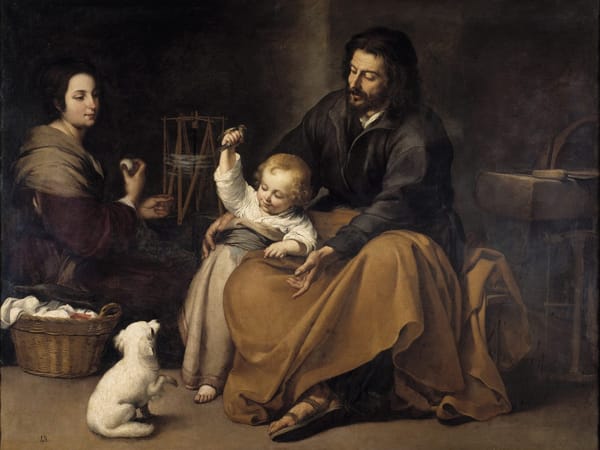
The Solemnity of Saint Joseph, Spouse of the B. V. Mary, Patron of the Universal Church
THE Easter mysteries are superseded to-day by a special subject, which is offered for our consideration. The holy Church invites us to spend this day in honouring the Spouse of Mary, the Foster-Father of the Son of God. And yet, as we offered him the yearly tribute of our devotion on March 19, it is not, properly speaking, his feast that we are to celebrate to-day. It is a solemn expression of gratitude offered to Joseph, the Protector of the Faithful, the refuge and support of all that invoke him with confidence. The innumerable favours he has bestowed upon the world entitle him to this additional homage. With a view to her children's interests, the Church would, on this day, excite their confidence in this powerful and everready helper.
Devotion to St Joseph was reserved for these latter times. Though based on the Gospel, it was not to be developed in the early ages of the Church. It is not that the faithful were in any way checked from showing honour to him who had been called to take so important a part in the mystery of the Incarnation; but divine Providence had its hidden reasons for retarding the liturgical homage to be paid, each year, to the Spouse of Mary. As on other occasions, so here also; the East preceded the West in the special cultus of St Joseph: but in the fifteenth century the whole Latin Church adopted it, and since that time it has gradually gained the affections of the faithful. We have treated of the glories of St Joseph on March 19; the present feast has its own special object, which we will at once proceed to explain.
The goodness of God and our Redeemer's fidelity to his promises have ever kept pace with the necessities of the world; so that in every age appropriate and special aid has been given to the world for its maintaining the supernatural life. An uninterrupted succession of seasonable grace has been the result of this merciful dispensation, and each generation has had given to it a special motive for confidence in its Redeemer. Dating from the thirteenth century, when, as the Church herself assures us, the world began to grow cold,1 each epoch has had thrown open to it a new source of graces. First of all came the feast of the most Blessed Sacrament, with its successive developments of Processions, Expositions, Benedictions and the Forty Hours. After this followed the devotion to the Holy Name of Jesus (of which St Bernardine of Siena was the chief propagator) and that of Via Crucis or Stations of the Cross. with its wonderful fruit of compunction. The practice of frequent Communion was revived in the sixteenth century, owing principally to the influence of St Ignatius and the Society founded by him. In the seventeenth was promulgated the devotion to the Sacred Heart of Jesus, which was firmly established in the following century. In the nineteenth, devotion to the Holy Mother of God made such progress as to form one of the leading supernatural characteristics of the period. The Rosary and Scapular, which had been handed down to us in previous ages, regained their place in the affections of the people; pilgrimages to the sanctuaries of the Mother of God, which had been interrupted by the influence of Jansenism and rationalism, were renewed; the Archconfraternity of the Sacred Heart of Mary spread throughout the whole world; numerous miracles were wrought in reward for the fervent faith of individuals; in a word, the nineteenth century witnessed the triumph of the Immaculate Conception—a triumph which had been looked forward to for many previous ages.
Now devotion to Mary could never go on increasing as it has done, without bringing with it a fervent devotion to St Joseph. We cannot separate Mary and Joseph, were it only for their having such close connection with the mystery of the Incarnation—Mary, as being the Mother of the Son of God; and Joseph, as being guardian of the Virgin’s spotless honour, and Foster-Father of the divine Babe. A special veneration for St Joseph was the result of increased devotion to Mary. Nor is this reverence for Mary's Spouse to be considered only as a just homage paid to his admirable prerogatives: it is, moreover, a fresh and exhaustless source of help to the world, for Joseph has been made our protector by the Son of God himself. Hearken to the inspired words of the Church’s Liturgy: ‘Thou, O Joseph! art the delight of the blessed, the sure hope of our life, and the pillar of the world.’2 Extraordinary as is this power, need we be surprised at its being given to a man like Joseph, whose connections with the Son of God on earth were so far above those of all other men? Jesus deigned to be subject to Joseph here below; now that he is in heaven, he would glorify the creature to whom he consigned the guardianship of his own childhood and the honour of his Mother. He has given him a power which is above our calculations. Hence it is, that the Church invites us on this day to have recourse, with unreserved confidence, to this all-powerful protector. The world we live in is filled with miseries which would make stronger hearts than ours quake with fear; but let us invoke St Joseph with faith, and we shall be protected. In all our necessities, whether of soul or body—in all the trials and anxieties we may have to go through—let us have recourse to St Joseph, and we shall not be disappointed. The king of Egypt said to his people when they were suffering from famine: Go to Joseph!3 the King of Heaven says the same to us: the faithful guardian of Mary has greater influence with God than Jacob's son had with Pharaoh.
As usual, God revealed this new spiritual aid to a privileged soul, that she might be the instrument of its propagation. It was thus that were instituted several feasts, such as those of Corpus Christi, and of the Sacred Heart of Jesus. In the sixteenth century St Teresa (whose writings were to have a world-wide circulation) was instructed by heaven as to the efficacy of devotion to St Joseph: she has spoken of it in the Life (written by herself) of Teresa of Jesus. When we remember that it was by the Carmelite Order (brought into the Western Church in the thirteenth century) that this devotion was established among us, we cannot be surprised that God should have chosen St Teresa, who was the reformer of that Order, to propagate the same devotion in this part of the world. The holy solitaries of Mount Carmel—devoted as they had been, for so many centuries, to the love of Mary—were not slow in feeling the connection that exists between the honour paid to the Mother of God and that which is due to her virginal Spouse. The more we understand St Joseph’s office, the clearer will be our knowledge of the divine mystery of the Incarnation. As when the Son of God assumed our human nature, he would have a Mother; so also would he give to his Mother a protector. Jesus, Mary and Joseph—these are the three whom the ineffable mystery is continually bringing before our minds.
The words of St Teresa are as follows: 'I took for my patron and lord the glorious St Joseph, and recommended myself earnestly to him. I saw clearly . . . that he rendered me greater services than I knew how to ask for. I cannot call to mind that I have ever asked him at any time for anything which he has not granted: and I am filled with amazement, when I consider the great favours which God hath given me through this blessed Saint, the dangers from which he hath delivered me, both of body and soul. To other Saints, our Lord seems to have given grace to succour men in some special necessity; but to this glorious Saint, I know by experience, to help us in all: and our Lord would have us understand that, as he was himself subject to him upon earth—for St Joseph having the title of father, and being his guardian, could command him—so now in heaven he performs all his petitions. I have asked others to recommend themselves to St Joseph, and they too know this by experience; and there are many who are now of late devout to him, having had experience of this truth.'4
We might quote several other equally clear and fervent words from the writings of this seraphic virgin. The faithful could not remain indifferent to such teaching as this. The seed thus sown produced its fruit; slowly, it is true, but surely. Even in the first half of the seventeenth century, there prevailed amidst the devout clients of St Joseph a presentiment that the day would come when the Church, through her Liturgy, would urge the faithful to have recourse to him as their powerful Protector. In a book published in the year 1645, we find these almost prophetic words: ‘O thou bright sun, thou father of our days! speed thy onward course, and give us that happy day, whereon are to be fulfilled the prophecies of the saints. They have said, that in the latter ages of the world, the glories of St Joseph will be brought to light; that God will draw aside the veil, which has hitherto prevented us from seeing the wondrous sanctuary of Joseph's soul; that the Holy Ghost will inspire the faithful to proclaim the praises of this admirable Saint, and to build monasteries, churches and altars in his honour; that, throughout the entire kingdom of the Church militant, he shall be considered as the special protector, for he was the protector of the very Founder of that kingdom, namely, our Lord Jesus Christ; that the Sovereign Pontiffs will, by a secret impulse from heaven, ordain that the feast of this great Patriarch be solemnly celebrated through the length and breadth of the spiritual domain of St Peter; that the most learned men of the world will use their talents in studying the divine gifts hidden in St Joseph, and that they will find in him treasures of grace incomparably more precious and plentiful than were possessed by even the choicest of the elect of the Old Testament, during the whole four thousand years of its duration.'5
These ardent wishes have been fulfilled. It is now more than a century ago that the Carmelites sought and obtained the approbation of the Holy See for an Office in honour of the Patronage of St Joseph. A great number of dioceses obtained permission to use it. A Sunday was selected for the celebration of this new feast, in order that the faithful might be, in a way, compelled to keep it; for the Feast of St Joseph in March is not a day of obligation in all lands, and, as it always falls during Lent, it cannot be kept on a Sunday, since the Sundays of Lent exclude a feast of that rite. That the new feast might not be attended with the same risk of being unnoticed, it was put upon a Sunday —the third Sunday after Easter, that thus the consolations of such a solemnity might be blended with the Paschal joys. The new feast went on gradually spreading from one diocese to another; till at last, there was unexpectedly issued an Apostolic Decree, dated September 10, 1847, which ordered it to be kept throughout Christendom. The Church was on the eve of severe trials; and her glorious Pontiff, Pius IX, by a sacred instinct, was prompted to draw down on the flock entrusted to him the powerful protection of St Joseph, who assuredly has never had greater miseries and dangers to avert from the world, than those which threaten the present age.
Let us, then, henceforth have confidence in the patronage of St Joseph. He is the father of the faithful, and it is God's will that he, more than any other saint, should have power to apply to us the blessings of the mystery of the Incarnation—the great mystery whereof he, after Mary, was the chief earthly minister.
In the Greek Liturgy this third Sunday after Easter is called the Sunday of the Paralytic, because a special commemoration is made of the miracle wrought by our Saviour at the Probatica.
The Roman Church begins to-day, in her Office of Matins, the Book of St John's Apocalypse.
Mass
On this feast, dedicated to St Joseph as Protector of the Faithful, the Church, in the Introit of the Mass, speaks to us of the confidence we should have in the protection of God; she uses the words of the royal Prophet, and would have us make them our own. Now Si Joseph is the minister of this divine protection, and God promises it to us, if we address ourselves to this his incomparable servant.
Introit
Ps. Qui regis Israel, intende: qui deducis velut ovem Joseph, ℣. Gloria Patri.
Adjutor.
Ps. Give ear, O thou that rulest Israel: thou that leadest Joseph like a sheep. ℣. Glory, etc.
The Lord, etc.
In the Collect, the Church lays stress upon God's choosing St Joseph as Mary's Spouse, and teaches us that one of the consequences of this choice was our having a protector who will be ready to assist us by his all-powerful intercession, as often as we pray to him.
Collect
If this feast be kept on the Sunday, a commemoration of the third Sunday after Easter is then made, by this Collect:
Epistle
Cap. xlix.Filius accrescens Joseph, filius accrescens et decorus aspectu: filiae discurrerunt super murum. Sed exasperaverunt eum, et jurgati sunt, invideruntque illi habentes jacula. Sedit in forti arcus ejus, et dissoluta sunt vincula brachiorum et manuum illius per manus potentis Jacob: inde pastor egressus est lapis Israel. Deus patris tui erit adjutor tuus, et omnipotens benedicet tibi benedictionibus cœli desuper. Benedictionibus abyssi jacentis deorsum, benedictionibus uberum et vulvae. Benedictiones patris tui confortatae sunt benedictionibus patrum ejus: donec veniret desiderium collium aeternorum: fiant in capite Joseph, et in vertice Nazaræi inter fratres suos.
Ch. xlix.Joseph is a growing son, a growing son and comely to behold: the daughters run to and fro upon the wall. But they that held darts, provoked him, and quarrelled with him, and envied him. His bow rested upon the strong, and the bands of his arms and his hands were loosed, by the hands of the mighty one of Jacob: thence he came forth a Shepherd, the stone of Israel. The God of thy father shall be thy helper, and the Almighty shall bless thee with the blessings of heaven above, with the blessings of the deep that lieth beneath, with the blessings of the breasts and of the womb. The blessings of thy father are strengthened with the blessings of his fathers: until the Desire of the everlasting hills shall come: may they be upon the head of Joseph, and upon the crown of the Nazarite among his brethren.
This magnificent prophecy of the dying Jacob, wherein he makes known to his son Joseph the glorious destiny which awaits himself and his children, is most appropriate to this feast; it reminds us of the beautiful comparison drawn by St Bernard between the two Josephs. We refer our readers to March 19, where they will find the passage to which we allude, and in which we are told that the first Joseph was a type of the second. After prophesying what was to happen to his ten eldest sons, the Patriarch Jacob speaks, with marked partiality, concerning the son of Rachel. After speaking of his comeliness, he alludes to the persecution he received from his brothers, and to the wondrous ways whereby God delivered him out of their hands, and exalted him to glory and power. The words he uses may well be applied to the second Joseph, the Spouse of Mary, and the Protector of the Faithful; for who better deserves the title of Shepherd and Stone (i.e., strength) of Israel? We are all of us his family: he affectionately watches over us: and in our troubles we may rely upon him with all confidence, as our staunch unfailing defender. St Joseph's inheritance is the Church, sanctified and made fruitful by the ceaseless blessing of the Waters of Baptism; it is in the Church that he exercises his beneficent power upon all who confide in him. Jacob promised the most lavish blessings upon the first Joseph; and these blessings were to last till the Saviour, thedesire of the everlasting hills should come, when the second Joseph would begin his ministry—a ministry of help and protection, which would continue till the second coming of the Son of God. Finally, if the first Joseph be spoken of, in this prophecy, as a Nazarite (that is, one consecrated to God) and as a Saint among his Brethren, the second Joseph is to fulfil the prediction still more literally; for not only will his sanctity surpass that of Jacob’s son, but his very home will be Nazareth. In that city he will dwell with Mary; to that city he will return after the exile in Egypt; in that city he will terminate his holy career; in a word, Jesus, the Eternal Word, shall be called a Nazarite,6 because he is to live in that city with his Foster-Father.
In the first Alleluia-Versicle, we have St Joseph speaking to us; he encourages us to have recourse to him, and promises us untiring protection. In the second the Church prays for her children, that they may have the grace to imitate the purity of Mary’s Spouse: her prayer is addressed to him.
Alleluia. ℣. Fac nos innocuam, Joseph, decurrere vitam, sitque tuo semper tuta patrocinio. Alleluia.
Alleluia. ℣. Obtain for us, O Joseph, to lead an innocent life; and may it ever be safe through thy Patronage. Alleluia.
Gospel
Cap. iii.In illo tempore: Factum est autem cum baptizaretur omnis populus, et Jesu baptizato et orante, apertum est cœlum: et descendit Spiritus Sanctus corporali specie sicut columba in ipsum: et vox de coelo facta est: Tu es Filius meus dilectus, in te complacui mihi. Et ipse Jesus erat incipiens quasi annorum triginta, ut putabatur, filius Joseph.
Ch. iii.At that time: It came to pass, when all the people were baptized, that Jesus also being baptized, and praying, heaven was opened: and the Holy Ghost descended in a bodily shape, as a dove, upon him: and a voice came from heaven: Thou art my beloved Son; in thee I am well pleased. And Jesus himself was beginning about the age of thirty years: being, as it was supposed, the son of Joseph.
Being, as it was supposed, the Son of Joseph! Jesus’ filial affection for his Mother, his jealousy for the honour of the purest of Virgins, led him to treat Joseph as his father, and to allow himself to be called the Son of Joseph! Joseph heard the Son of God call him ‘father.’ He had charge of, he laboured for the maintenance of the Son of the Eternal Father. He was the head of the Holy Family at Nazareth, and Jesus recognized his authority. The plan of the Mystery of the Incarnation required that these relations should exist between the Creator and the Creature. As the Son of God, now that he is seated at the right hand of the Eternal Father, has kept our human nature indissolubly united with his divine Person; so likewise has he retained the feelings he had, when here on earth, for Mary and Joseph. With regard to Mary, his love for her, as his Mother, has but increased; and as to Joseph, it is impossible to suppose that the affection and respect he had for him have now ceased to exist in the Heart of the Man-God. No mortal was ever on such terms of intimacy and familiarity with Jesus as Joseph was. Jesus was grateful to Joseph for the paternal care he received from him; what more natural than to believe that Jesus now repays him with special honours and power in heaven? It is the belief of the Church; it is the conviction of the faithful; it is the motive which suggested the present feast.
The words of the Offertory are taken from Psalm 147. Jerusalem, that is, the Church, is bidden to rejoice, because of the means of defence which God has given her against her enemies. One of the greatest of the blessings thus conferred upon her is St Joseph's Protection.
Offertory
In the Secret, the Church prays that we may imitate the Carpenter of Nazareth in his detachment from earthly things.
Secret
Then a commemoration of the Third Sunday after Easter is made, if required, by the following Secret:
Secret
The proper Preface that follows has recently been granted by the Holy See for use in all Masses of St Joseph:
Preface
The Communion-Anthem is a sentence taken from St Matthew’s Gospel, wherein we find the glorious title of our holy Protector: Joseph, the husband of Mary; and the still more glorious one of Mary: Of whom was bom Jesus.
Communion
Holy Church prays, in the Post communion, that St Joseph, who is our Protector during this present life, may intercede for us in what concerns our eternal welfare.
Postcommunion
The priest then adds, if need be, this commemoration of the Third Sunday after Easter:
Postcommunion
The following Gospel of the Third Sunday after Easter is read at the end of Mass.
Cap. xvi.In illo tempore: Dixit Jesus discipulis suis: Modicum, et jam non videbitis me, et iterum modicum, et videbitis me: quia vado ad Patrem. Dixerunt ergo ex discipulis ejus ad invicem: Quid est hoc, quod dicit nobis: Modicum, et non videbitis me, et iterum modicum, et videbitis me, et quia vado ad Patrem? Dicebant ergo: Quid est hoc, quod dicit, Modicum? nescimus quid loquitur. Cognovit autem Jesus, quia volebant eum interrogare, et dixit eis: De hoc quæritis inter vos, quia dixi, Modicum, et non videbitis me: et iterum modicum, et videbitis me? Amen, amen dico vobis: quia plorabitis, et flebitis vos, mundus autem gaudebit: vos vero contristabimini, sed tristitia vestra vertetur in gaudium. Mulier cum parit, tristitiam habet, quia venit hora ejus: cum autem pepererit puerum, jam non meminit pressurae propter gaudium: quia natus est homo in mundum. Et vos igitur nunc quidem tristitiam habetis; iterum autem videbo vos, et gaudebit cor vestrum: et gaudium vestrum nemo tollet a vobis.
Ch. xvi.At that time: Jesus said to his disciples: A little while, and now you shall not see me: and again a little while, and you shall see me; because I go to the Father. Then some of his disciples said one to another: What is this he saith to us: A little while, and you shall not see me: and again a little while, and you shall see me, and because I go to the Father? They said therefore: What is this that he saith: A little while? we know not what he speaketh. And Jesus knew that they had a mind to ask him; and he said to them: Of this do you inquire among yourselves, because I said: a little while, and you shall not see me; and again, a little while, and you shall see me? Amen, amen, I say to you, that you shall lament and weep, but the world shall rejoice: and you shall be made sorrowful, but your sorrow shall be turned into joy. A woman when she is in labour, hath sorrow, because her hour is come: but when she hath brought forth the child, she remembereth no more the anguish, for joy that a man is bom into the world. So also you now indeed have sorrow but I will see you again, and your heart shall rejoice; and your joy no man shall take from you.
Vespers
Psalm, Dixit Dominus, page 82
Psalm, Confitebor, page 83
Psalm, Beatus vir, page 84
Psalm, Laudate pueri, page 85
Psalm 116
Quoniam confirmata est super nos misericordia ejus: * et veritas Domini manet in æternum.
For his mercy is confirmed upon us: and the truth of the Lord remaineth for ever.
Capitulum (Gen. xlix)
Hymn7
Te cuncti resonent christiadum chori,
Qui clarus meritis junctus es inclytæ
Casto fœdere Virgini.
Admirans, dubio tangeris anxius,
Afflatu superi Flaminis Angelus
Conceptum puerum docet.
Ægypti profugum tu sequeris plagas:
Amissum Solymis quæris, et invenis,
Miscens gaudia fletibus.
Palmamque emeritos gloria suscipit;
Tu vivens, Superis par, frueris Deo,
Mira sorte beatior.
Da Joseph meritis sidera scandere:
Ut tandem liceat nos tibi perpetim
Gratum promere canticum.
May the choirs of Christendom resound with thy name,
for great are thy merits,
who wast united by a chaste alliance to the holy Virgin.
a cruel doubt afflicts thy heart;
but an Angel visits thee, telling thee that she had conceived
of the Holy Ghost the Child she bore in her womb.
and go with the little fugitive to Egypt’s distant land.
When he was lost in Jerusalem, thou didst seek after him;
and having found him, thy tears were mingled with joy.
has crowned their life; they receive their glory when they have won the palm:
but thou, by a strangely happy lot, hadst, even during life, what the blessed have
in heaven —thou hadst the sweet society of thy God.
and may the intercession of Joseph aid us to reach heaven;
that there we may sing to thee
our eternal hymn of grateful love.
Antiphon of the Magnificat
A commemoration is then made of the Third Sunday after Easter, if necessary, by the following Antiphon, Versicle, and Prayer:
Many ages passed away, and thy glories had not been made known to the world; but even then, thou wast one of mankind's most powerful intercessors. Most affectionately didst thou fulfil thy office as head of the great human family, whereof the Incarnate Word was a member. Nations and individuals experienced the benefit of thy prayers; but there was not the public acknowledgement of thy favours—there was not the homage of gratitude, which is now offered to thee. The more perfect knowledge of thy glories, and the honour paid to thee as the Protector of mankind—these were reserved for our own unhappy times, when the state of the world is such as to require help beyond that which was granted to former ages. We come before thee, O Joseph! to honour the unlimited power of thine intercession, and the love thou bearest for all the children of the Church, the Brethren of Jesus.
Thou, O Mary! art pleased at seeing us honour him, whom thou didst so tenderly love. Never are our prayers so welcome to thee as when they are presented to thee by his hands. The union formed by heaven between thyself and Joseph will last for all eternity; and the unbounded love thou hast for Jesus is an additional motive for thee to love him who was the FosterFather of thy Child, and the guardian of thy Virginity. O Joseph! we also are the children of Mary, thy Spouse; treat us as such, bless us, watch over us, and receive the prayers which, now more than ever, the Church encourages us to present to thee.
Thou art ‘the pillar of the world'—columen mundi; thou art one of the foundations whereon it rests; because of thy merits and prayers, our Lord has patience with it, in spite of the iniquities which defile it. How truly may we say of these our times: There is now no saint; truths are decayed from among the children of men!8 How powerful then must not thine intercession be, to avert the indignation of God, and induce him to show us his mercy! Grow not weary of thy labour, O thou universal Protector! The Church of thy Jesus comes before thee on this day, beseeching thee to persevere in thy task of love. See this world of ours, now it is become one great volcano of danger by the boasted liberty granted to sin and heresy! Delay not thine aid, but quickly procure for us what will give us security and peace.
Whatever may be our necessities, thou art willing and able to assist us. We may be the poorest and last among the children of the Church; it matters not: thou lovest us with all the affectionate compassion of a Father. What a joy is not this to our hearts, O Joseph! We will therefore turn to thee in our spiritual wants. We will beg thee to assist us in gaining the virtues whereof we stand in need, in the battles we have to fight against the enemies of our souls, and in the sacrifices which duty asks at our hands. Make us worthy to be called thy children, O thou Father of the Faithful! Nor is thy power limited to what regards our eternal welfare; daily experience shows us how readily thou canst procure for us the blessing of God upon our temporal interests, provided they are in accordance with his divine will. Hence it is that we hope for thy protection and aid in what concerns our worldly prospects. The house of Nazareth was confided to thy care; deign to give counsel and help to all them that make thee the patron of all that regards their earthly well-being.
Glorious Guardian of the Holy Family! the family of Christendom is placed under thy special patronage; watch over it in these troubled times. Hear the prayers of them that seek thine aid, when about to choose the partner who is to share with them the joys and the sorrows of this world, and help them to prepare for their passage to eternity. Maintain between husbands and wives that mutual respect which is the safeguard of their fidelity to each other. Obtain for them the pledge of heaven’s blessings. Fill them with such reverence for the holy state to which they have been called, that they may never deserve the reproach given by St Paul to certain married people of that day, whom he compares to heathens, who know not God.9
Grant us, also, O Joseph, another favour. There is one moment of our lives which is the most important of all, since eternity depends upon it: it is the moment of our death. And yet we feel our fear abated by the thought that God’s mercy has made thee the special patron of the dying. Thou hast been entrusted with the office of making death happy and holy to those who invoke thee. To whom could such a prerogative have been given more appropriately than to thee, O Joseph! whose admirable death was one of the sublimest spectacles ever witnessed by angels or by men, for Jesus and Mary were by thy side as thou didst breathe forth thy soul. Be, then, our helper at that awful hour of our death. We hope to have Mary’s protection, for we daily pray to her that she would aid us at the hour of our death; but we know that Mary is pleased at our having confidence in thee, and that where thou art, she also is sure to be. Encouraged by thy fatherly love, O Joseph! we will calmly await the coming of our last hour; for if we are careful in recommending it to thee, thou wilt not fail to take it under thy protection.
The gladness of to-day’s feast has been united with the Paschal joy: still, it is but just that the latter should have its own expression apart. We will therefore end the day by offering to our Risen Lord the following Preface: it is taken from the ancient Gothic Missal, published by Dom Mabillon.
Contestatio
(Indie Sabbato, octava Paschœ)
- Frigescente mundo. Collect for the Feast of the Stigmata of St Francis. ↩︎
- Cœlitum, Joseph, decus atque nostræ Certa spes vitæ, columenque mundi. (Hymn for Lauds of the Feast of the Solemnity of St Joseph.) ↩︎
- Gen. xli 55. ↩︎
- The Life of St Teresa (translated by David Lewis, 1870), p. 34. ↩︎
- La gioire de Saint-Joseph, par le P. Jean Jacquinot, de la Compagnie de Jesus. Dijon, 1645. ↩︎
- St Matt ii 23. ↩︎
- In the Monastic Rite, it is preceded by this Responsory: ℟. breve. Constituit eum dominum domus suae, * Alleluia, alleluia. Constituit ℣. Et principem omnis possessionis suæ. * Alleluia. Gloria Patri. Constituit. ↩︎
- Ps. xi 2. ↩︎
- 1 Thess. iv 5. ↩︎
May 11 [May 1]: Sts. Philip and James the Less, Apostles
|
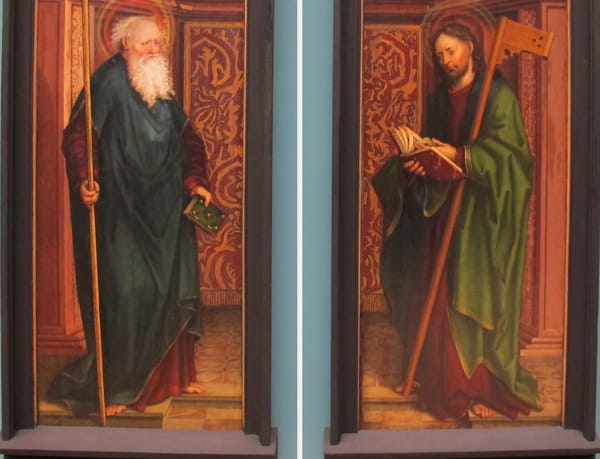
[This feast day, previously kept on May 1, was moved to May 11 when the feast of St. Joseph the Worker was established on May 1. The Solemnity of St. Joseph, which was replaced by St. Joseph the Work, was originally celebrated on the Third Sunday after Easter, as it was in the time of Dom Guéranger, whose article on that feast can be found here.-Ed.]
From Dom Guéranger's The Liturgical Year.
TWO of the favoured witnesses of our beloved Jesus' Resurrection come before us on this first day of May. Philip and James are here, bearing testimony to us that their Master is truly risen from the dead, that they have seen him, that they have touched him, that they have conversed with him,1 during these forty days. And, that we may have no doubt as to the truth of their testimony, they hold in their hands the instruments of the martyrdom they underwent for asserting that Jesus, after having suffered death, came to life again and rose from the grave. Philip is leaning upon the cross to which he was fastened, as Jesus had been; James is holding the club wherewith he was struck dead.
Philip preached the Gospel in the two Phrygias, and his martyrdom took place at Hierapolis. He was married when he was called by our Saviour; and we learn from writers of the second century that he had three daughters, remarkable for their great piety, one of whom lived at Ephesus, where she was justly revered as one of the glories of that early Church.
James is better known than Philip. He is called, in the sacred Scripture, Brother of the Lord,2 on account of the close relationship that existed between his own mother and the blessed Mother of Jesus. He claims our veneration during Paschal Time, inasmuch as he was favoured with a special visit from our Risen Lord, as we learn from St Paul.3 There can be no doubt but that he had done something to deserve this mark of Jesus’ predilection. St Jerome and St Epiphanius tell us that our Saviour, when ascending into heaven, recommended to St James’s care the Church of Jerusalem, and that he was accordingly appointed the first bishop of that city. The Christians of Jerusalem, in the fourth century, had possession of the chair on which St James used to sit when he assisted at the assemblies of the faithful. St Epiphanius also tells us that the holy Apostle used to wear a lamina of gold upon his forehead as the badge of his dignity. His garment was a tunic made of linen.
He was held in such high repute for virtue that the people of Jerusalem called him ' The Just and when the time of the siege came, instead of attributing the frightful punishment they then endured to the deicide they or their fathers had .committed, they would have it to be a consequence of the murder of James, who, when dying, prayed for his people. The admirable Epistle he has left us bears testimony to the gentleness and uprightness of his character. He there teaches us, with the eloquence of an inspired writer, that works must accompany our faith if we would be just with that justice which makes us like our Risen Lord.
The bodies of SS Philip and James repose in the Basilica of the Holy Apostles at Rome. These relics are counted as one of the richest treasures of the Holy City, and there is reason to believe that this first of May is the real anniversary of their translation. For a long period the Church of Rome kept special feasts in honour of four only of the Apostles: SS Peter and Paul, St John the Evangelist, and St Andrew (Peter’s brother): the rest were united in the solemnity of June 29, and a vestige of this is still to be found in the office of that day, as we shall see later on. The reception of the bodies of SS Philip and James, which were brought from the East somewhere about the sixth century, gave rise to the institution of to-day's feast; and this led gradually to the insertion into the Calendar of special feasts for the other Apostles and Evangelists.
Let us now read the brief account given of St Philip in the Liturgy.
The Breviary then gives the two following Lessons upon St James:
The Greek Church celebrates the memory of these two Apostles on distinct days, which are the anniversaries of their martyrdom. The following stanzas are from the hymn in honour of St Philip:
Hymn (Die XIV Novembris)
Let us now make a selection from the Menæa in honour of St James, whose memory is so affectionately cherished by the Eastern Churches:
Hymn (Die XXIII Octobris)
Holy Apostles! you saw our Risen Jesus in all his glory. He said to you on the evening of that great Sunday: Peace be to you! He appeared to you during the forty days following, that he might make you certain of his Resurrection. Great indeed must have been your joy at seeing once more that dear Master, who had admitted you into the number of his chosen Twelve; and his return made your love of him more than ever fervent. We address ourselves to you as our special patrons during this holy season, and most earnestly do we beseech you to teach us how to know and love the great mystery of our Lord’s Resurrection. May our hearts glow with Paschal joy, and may we never lose the new life that our Jesus has now given unto us.
Thou, O Philip! wast devoted to him, even from the first day of his calling thee. Scarcely hadst thou come to know him as the Messias, than thou didst announce the great tidings to thy friend Nathanael. Jesus treated thee with affectionate familiarity. When about to work the great miracle of the multiplication of the loaves, it was to thee that he addressed himself, and said to thee: Whence shall we buy bread, that these may eat?4 A few days before the Passion of thy divine Master, some of the Gentiles wished to see this great Prophet, of whom they had heard such wonderful things, and it was to thee that they applied. How fervently didst thou not ask him, at the Last Supper, to show thee the Father! Thy soul longed for the divine light; and when the rays of the Holy Ghost had inflamed thy spirit, nothing could daunt thy courage. As a reward of thy labours, Jesus gave thee to share with him the honours of the Cross. O holy Apostle! intercede for us, that we may imitate thy devotedness to Jesus; and that, when he deigns to send us the Cross, we may reverence and love it.
We also honour thy love of Jesus, O thou that art called the brother of the Lord, on whose venerable features was stamped the likeness of our Redeemer. If, like the rest of the Apostles, thou didst abandon him in his Passion, thy repentance was speedy and earnest, for thou wast the first, after Peter, to whom he appeared after his Resurrection. We affectionately congratulate thee, O James, for the honour thus conferred upon thee; do thou, in return, obtain for us that we may taste and see how sweet is our Risen Lord.5 Thy ambition was to give him every possible proof of thy gratitude; and the last testimony thou didst bear, in the faithless city, to the divinity of thy dear Master (when the Jews took thee to the top of the Temple) opened to thee, by martyrdom, the way that was to unite thee to him for eternity. Pray for us, O thou generous Apostle, that we also may confess his holy Name with the firmness which befits his disciples; and that we may ever be brave and loyal in proclaiming his rights as King over all creatures.
O holy Apostles! we beseech you to unite your prayers, and intercede for the Churches of the East, to which you preached the Gospel. Have compassion on Jerusalem, the dupe of schism and heresy; obtain her purification and her liberty; and rid her Holy Places of the sacrileges that have so long polluted them. Lead back the Christians of Asia Minor to union with the fold governed by the one supreme pastor. And lastly, pray for Rome, the city where your bodies repose, awaiting their glorious Resurrection. In return for the long hospitality she has given you, shield her with your protection; and permit not that the city of Peter, your venerable Head, should be deprived of its grandest glory—the presence of the Vicar of Christ.
| Previous May 10: St. Antoninus, Bishop and Confessor | Next May 11 [May 1]: Sts. Philip and James the Less, Apostles |