Daily reading
Semidouble · Movable from Easter · Temporal
May 12, 2025
From Dom Guéranger’s The Liturgical Year.
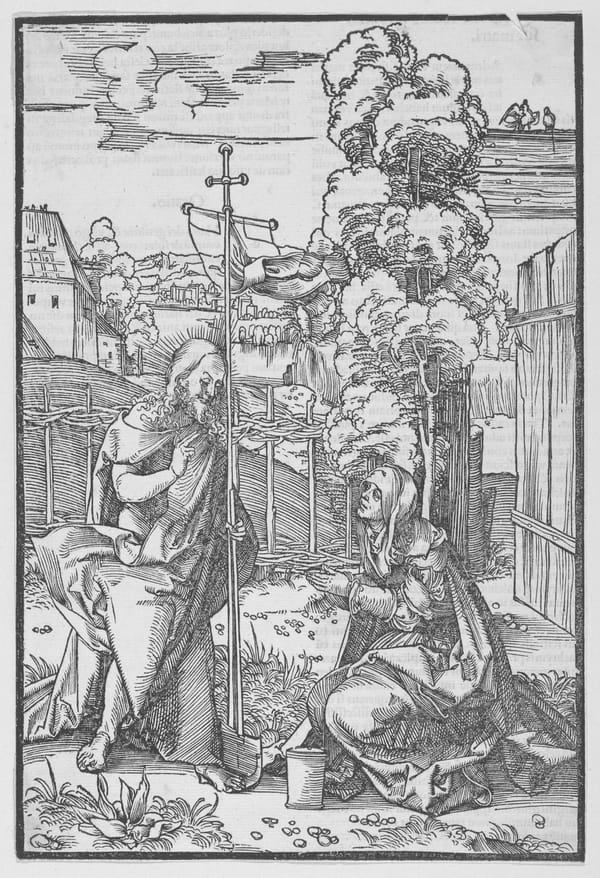
Monday of the Fourth Week after Easter
OUR Risen Jesus is not satisfied with establishing his Church and constituting the hierarchy which is to govern it in his name to the end of time; he also confides in his disciples his divine word, that is, the truths he is come to reveal to mankind, into which truths he has given them an insight during the three years preceding his Passion. The word of God, which is also called revelation, is, together with grace, the most precious gift that heaven could bestow upon us. It is by the word of God that we know the mysteries of his divine essence, the plan according to which he framed the creation, the supernatural end he destined for such of his creatures as he endowed with understanding and free-will, the sublime work of redemption by the Incarnation of the Second Person of the Blessed Trinity—in a word, the means whereby we are to honour and serve him, and attain the end for which we were made.
From the very commencement of the world, God revealed his word to man; later on, he spoke by the prophets; but when the fulness of time came, he sent upon the earth his Only Begotten Son, that he might complete this first revelation. We have seen how, for three years, Jesus has been teaching men, and how, in order that he might make them the more easily understand his words, he has stooped to their littleness. Though his teaching was of the sublimest possible character, yet did he make it so intelligible that no instruction could be compared to his in clearness. It was for this reason that he made use of simple parables, whereby he conveyed his divine truths to the mind of his hearers. His Apostles and disciples, who were afterwards to preach his Gospel to the world, received from him frequent special instructions; although, until the accomplishment of the mysteries of his Death and Resurrection, they were slow in understanding his teaching. Since his Resurrection, they are better able to appreciate his instructions, for not only are his words more telling now that he is in the glory of his triumph over death, but the minds of his hearers have become more enlightened by the extraordinary events that have occurred. If he could say to them at the Last Supper: I will not now call you servants; but I have called you my friends: because all things whatsoever I have heard from my Father, I have made known unto you;1 how must he not treat them now that he has repeated to them the whole of his teaching, given them the whole word of God, and is on the eve of sending the Holy Spirit upon them, in order to perfect their understanding, and give them power to preach the Gospel to the entire world?
O holy word of God! O holy revelation! through thee are we admitted into divine mysteries, which human reason could never reach. We love thee, and are resolved to be submissive to thee. It is thou that givest rise to the grand virtue, without which it is impossible to please God;2 the virtue which commences the work of man's salvation, and without which this work could neither be continued nor finished. This virtue is faith. It makes our reason bow down to the word of God. There comes from its divine obscurity a light far more glorious than are all the conclusions of reason, how great soever may be their evidence. This virtue is to be the bond of union in the new society which our Lord is now organizing. To become a member of this society, man must begin by believing; that he may continue to be a member, he must never, not even for one moment, waver in his faith. We shall soon be hearing our Lord saying these words: He that believeth and is baptized shall be saved; but he that believeth not shall be condemned.3 The more clearly to express the necessity of faith, the members of the Church are to be called by the beautiful name of the faithful: they who do not believe are to be called infidels.
Faith, then, being the first link of the supernatural union between man and God, it follows that this union ceases when faith is broken, that is, denied; and that he who, after having once been thus united to God, breaks the link by rejecting the word of God, and substituting error in its place, commits one of the greatest of crimes. Such a one will be called a heretic, that is, one who separates himself; and the faithful will tremble at his apostasy. Even were his rebellion to the revealed word to fall upon only one article, still he commits enormous blasphemy; for he either separates himself from God as being a deceiver, or he implies that his own created, weak, and limited reason is superior to eternal and infinite Truth.
As time goes on, heresies will rise up, each attacking some dogma or other; so that scarcely one truth will be left unassailed; but all this will serve for little else than to bring out the revelation purer and brighter than before. There will, however, come a time, and that time is our own, when heresy will not confine itself to some one particular article of faith; but will proclaim the total independence of reason, and declare revelation to be a forgery. This impious system will give itself the high-sounding name of rationalism, and these are to be its leading doctrines: Christ's mission a failure and his teaching false; his Church an insult to man's dignity; the eighteen centuries of Christian civilization a popular illusion! The followers of this school, the so-called philosophers of modem times, would have subverted all society, had not God come to its assistance, and fulfilled the promise he made, of never allowing his revealed word to be taken away from mankind, nor the Church, to whom he confided his word, to be destroyed.
Others go not so far as this. They do not pretend to deny the benefits conferred on the world by the Christian religion; the facts of history are too evident to be contested: still, as they will not submit their reason to the mysteries revealed by God, they have a way peculiar to themselves for eliminating the clement of faith from this world. As every revealed truth, and every miracle confirmatory of divine interposition, is disagreeable to them, they attribute to natural causes every fact which bears testimony to the Son of God being present among us. They do not insult religion, they simply pass it by; they hold that the supernatural serves no purpose; people, they say, have taken appearances for realities. The laws of history and common sense count for nothing. Agreeably to their system, which they call naturalism, they deny what they cannot explain; they maintain that the people of the past eighteen centuries have been deceived, and that the Creator cannot suspend the laws of nature, just as the rationalists teach that there is nothing above reason.
Are reason and nature, then, to be obstacles to our Redeemer’s love for mankind? Thanks be to his infinite power, he would not have it so! As to reason, he repairs and perfects her by faith; and he suspends the laws of nature, that we may cheerfully believe the word whose truth is guaranteed by the testimony of miracles. Jesus is truly risen; let reason and nature rejoice; for he has ennobled and sanctified them by the glad mystery.
Let us proclaim the triumph of the Redeemer whom we adore. Let us make our own this sequence of the Cluny Missal of 1523.
Sequence
Leo de tribu Juda.
Mors vicit mortem,
Et mors nostra est vita.
Mira bella, et stupenda satis
Inter oves victoria.
Ut moriens superaret fortem
Cum callida versutia.
Domum ejus ingressus
Est Rex aeternus,
Et averni confregit vasa.
Drachmam secum quæ perierat
Asportavit, et patefecit regni claustra.
Paradisi porta
Quæ clausa fuerat
Per lignum vetitum
Et lethale in primaevo.
Quam clauserat Eva conditori,
Clauseratque cunctis
Postmodum natis
De stirpe sua.
Quæ commisit protoplastus,
Reseravit dextra per stirpis materiam.
Susceperat mors indemnem,
Quem tenere numquam potuerat propter culpam.
Dum ambiit illicita.
Quæ tenebat juste
Perdidit acquisita.
Ampliare voluerat in secessu,
Et remansit evacuata.
Hic verus est agnus legalis
Qui multis se manifestavit figuris,
Tandem se hostiam pro mundo
Dedit Patri ut redimeret membra sua.
Hic lapis est angularis,
Quem reprobaverunt aedificantes.
Jam factus est in caput anguli
Super omnes in excelso.
Regnum ejus magnum
Et potestas ejus prima per sæcula.
the Lion of the Tribe of Juda, hath conquered.
Death hath conquered death;
and that Death is our Life.
Strange was the war, and stupendous the victory
that was seen by the flock of Christ.
When he, by his Death,
vanquished the strong and crafty enemy.
The Eternal King
forced the enemy’s house,
and broke the armour of hell.
He brought back the groat that was lost,
and opened the gates of heaven.
Heaven’s gate,
that had been shut, at the beginning of the world,
by the forbidden fruit,
which brought death;
The gate, which Eve had closed
against him from whom she had been formed
and against all the children
that were to be born of her race;
Yea, what our first parent thus sinfully closed,
was thrown open by the right hand of the God that assumed our flesh.
Death laid hands on him
on whom it had no claim because he was free from sin;
And by thus coveting
what was not its own,
it lost what it hitherto had justly held.
By wishing to add to its prey,
it was made to yield up what it had devoured.
Christ is the true Lamb,
that was foretold in the Law under manifold figures,
and who, at length, offered himself to the Father
as a Victim for the world's redemption.
This is the Corner-Stone,
rejected by the builders.
He is now the Head of the Corner,
set high above all the rest.
His kingdom is great, and his power supreme:
they are for ever and ever.
May 12: Sts. Nereus and Achilleus, Martyrs, and St. Flavia Domitilla, Virgin and Martyr
|
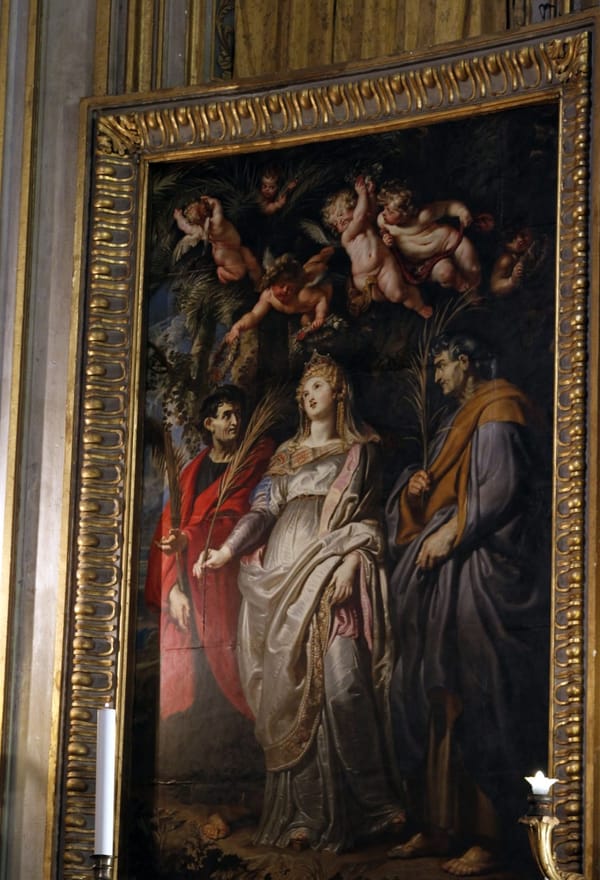
SO far in our Paschal season, the choir of Virgin martyrs has not yet offered to Jesus its crown of roses and lilies. It does so to-day, by presenting to him the noble Flavia Domitilla, the fairest flower of Rome, that was cut down by the sword of martyrdom in the first age of the Christian faith. It was under the persecution of Domitian—during which John the Evangelist was condemned to be burned alive in the cauldron of boiling oil—that Flavia Domitilla was honoured with banishment and death for the sake of our Redeemer, whom she had chosen for her Spouse. She was of the imperial family, being a niece of Flavius Clemens, who adorned the consular dignity by martyrdom. She was one of the Christians belonging to the court of the Emperor Domitian, who show us how rapidly the religion of the poor and humble made its way to the highest classes of Roman life. A few years previous to this, St Paul sent to the Christians of Philippi the greetings of the Christians of Nero's palace.1 There is still extant, not far from Rome, on the Ardeatine Way, the magnificent subterranean cemetery which Flavia Domitilla ordered to be dug on her prædium, and in which were buried the two martyrs, Nereus and Achilleus, whom the Church honours to-day together with the noble virgin who owes her crown to them.
Nereus and Achilleus were in Domitilla’s service.2 Hearing them one day speaking of the merit of virginity, she there and then bade farewell to all worldly pleasures, and aspired to the honour of being the Spouse of Christ. She received the veil of consecrated virgins from the hands of Pope St Clement: Nereus and Achilleus had been baptized by St Peter himself. What glorious reminiscences for one day!
The bodies of these three Saints reposed, for several centuries, in the Basilica, called the Fasciola, on the Appian Way; and we have a Homily which St Gregory the Great preached in this Church on their feast. The holy Pontiff dwelt on the vanity of the earth’s goods; he encouraged his audience to despise them by the example of the three martyrs whose relics lay under the very altar around which they were that day assembled.
These Saints, [said he] before whose tomb we are now standing, trampled with contempt of soul on the world and its flowers. Life was then long, health was uninterrupted, riches were abundant, parents were blessed with many children; and yet, though the world was so flourishing in itself, it had long been a withered thing in their hearts.3
Later on, in the thirteenth century, the Fasciola having been almost reduced to ruins by the disasters that had befallen Rome, the bodies of the three Saints were translated to the Church of St Adrian, in the Forum. There they remained till the close of the sixteenth century, when the great Baronius, who had been raised to the Cardinalate, with the title of Saints Nereus and Achilleus, resolved to repair the Church that was thus entrusted to his care. Through his munificence, the naves were restored; the history of the three martyrs was painted on the walls; the marble pulpit, from which St Gregory preached the Homily, was brought back, and the Homily itself was graven, from beginning to end, on the back; and the Confession was enriched with mosaics and precious marbles, preparatory to its receiving the sacred relics, of which it had been deprived for three hundred years.
Baronius felt that it was high time to put an end to the long exile of the holy martyrs, whose honour was now so specially dear to him. He organized a formal triumph for their return. Christian Rome excels in the art of blending together the forms of classic antiquity and the sentiments inspired by faith. The chariot, bearing a superb canopy, under which lay the relics of the three martyrs, was first led to the Capitol. On reaching the top of the clivus Capitolinus, the eye met two inscriptions, placed parallel with each other. On one were these words: ' To Saint Fla via Domitilla, Virgin and Martyr of Rome, the Capitol, purified from the wicked worship of demons, and restored more perfectly than by Flavius Vespasian and Domitian, Emperors, kinsmen of the Christian Virgin.' On the other: ‘The Senate and People of Rome to Saint Flavia Domitilla, Virgin and Martyr of Rome, who, by allowing herself to be put to death by fire for the faith of Christ, brought greater glory to Rome than did her kinsmen, the Emperors Flavius Vespasian and Domitian, when, at their own expense, they restored the Capitol, that had twice suffered from fire.'
The reliquaries of the martyrs were then placed on an altar that had been erected near the equestrian statue of Marcus Aurelius. After being venerated by the faithful, they were replaced on the chariot, which descended by the opposite side of the Capitol. The procession soon reached the triumphal arch of Septimius Severus, on which were hung these two inscriptions:
To the holy Martyrs Flavia Domitilla, Nereus and Achilleus, the best of citizens, the Senate and People of Rome, for their having honoured the Roman name by their glorious death, and won peace for the Roman commonwealth by shedding their blood.
To Flavia Domitilla, Nereus and Achilleus, the invincible Martyrs of Christ Jesus, the Senate and People of Rome, for their having honoured the City by the noble testimony they bore to the Christian Faith.
Following the Via Sacra, the procession was soon in front of the triumphal arch of Titus, the monument of God’s victory over the deicide nation. On one side were inscribed these words: 'This triumphal arch, formerly dedicated and raised to the Emperor Titus Flavius Vespasian, for having brought the rebellious Judea under the yoke of the Roman people, is now, by the Senate and People of Rome, more auspiciously dedicated and consecrated to Flavia Domitilla, kinswoman of the same Titus, for having, by her death, increased and furthered the Christian Religion.'
On the other side of the arch was the following inscription: ‘To Flavia Domitilla, Virgin and Martyr of Rome, kinswoman of the Emperor Titus Flavius Vespasian, the Senate and People of Rome, for her having, by shedding her blood and laying down her life for the Faith, rendered a more glorious homage to the death of Christ than did the said Titus, when by divine inspiration he destroyed Jerusalem, to avenge that same death.'
Leaving on the left the Coliseum, the hallowed ground whereon so many martyrs had fought the battle of faith, they passed under the triumphal arch of Constantine, which so eloquently speaks of the victory of Christianity, both in Rome and the Empire, and which still bears on it the name of the Gens Flavia, of which the first Christian Emperor was a member. The two following inscriptions were attached to the arch:
To Flavia Domitilla, Nereus and Achilleus, the Senate and People of Rome. On this sacred way, whereon so many Roman Emperors received triumphal honours for having brought various provinces into subjection to the Roman People, these martyrs receive to-day a more glorious triumph, for that they con quered, by a greater courage, the conquerors themselves.
To Flavia Domitilla, the Senate and People of Rome. Twelve Emperors, her kinsmen, conferred honour on the Gens Flavia and on Rome herself by their deeds of fame; but she, by sacrificing all human honours and life itself for Christ's sake, rendered greater service to both family and City than they.
The procession then continued its route along the Appian Way, and at length reached the Basilica. Baronius, assisted by a great number of Cardinals, received the precious relics, and took them with great respect to the Confession of the High Altar. Meanwhile the choir sang this Antiphon of the Pontifical: * Enter, ye Saints of God! for a dwelling hath been prepared for you by the Lord. The faithful people have followed you on your way, that ye may intercede for them with the majesty of the Lord. Alleluia!'
The following is the account of our three martyrs as given in the Liturgy:
How grand was the triumph which Rome gave to you, O holy martyrs, so many centuries after your glorious deaths! How true it is that there is no glory here on earth which can bear comparison with that of the saints! Where are now those twelve Emperors, thy kinsmen, O Domitilla? Who cares for their remains? Who even cherishes their memory? One of them was sur~ named ‘the delight of mankind '; and now how many there are who have never heard of his existence! Another, the last of the twelve, had the glory of proclaiming the victory won by the Cross over the Roman Empire; Christian Rome honours and loves his name; but the homage of religious devotion is not given to him, but to thee, O Domitilla, and to the two martyrs whose names are now associated with thine.
Who does not recognize the power of Jesus' Resurrection in the love and enthusiasm wherewith a whole people welcome your holy relics, O martyrs of the living God? Fifteen hundred years had elapsed; and yet your lifeless remains were greeted with a transport of joy, as though you yourselves were there, and living. It was because we Christians know that Jesus, who is the first-born of the dead,4 has risen from the grave; and that you, like him, are one day to rise in glory. Therefore do the faithful honour by anticipation the immortality which, at a future period, is to be given to your bodies, once slain for Jesus' sake; they already see by faith the future brightness which is to be imparted to your flesh; and thus they proclaim the dignity which the Redemption has given to man, to whom death is now but a transition to true life, and the tomb but a resting-place where the body is consigned, as seed to the earth, to be restored in a hundredfold of richer beauty.
Happy they who, as the prophecy says, have washed their robes and have made them white in the Blood of the Lamb!5 But happier they, says Holy Church, who, after being thus purified, have mingled their own blood with that of the divine Victim! for by so doing they have filled up in their flesh those things that are wanting of the sufferings of Christ.6 Hence, their intercession is powerful, and we should address our prayers to them with love and confidence. Befriend us, then, O holy martyrs Nereus, Achilleus, and Domitilla! Obtain for us an ardent love for our Risen Jesus; perseverance in the new life which he has conferred upon us; detachment from the things of this world, and a determined resolution to trample them beneath our feet, should they become a danger to our eternal salvation. Pray for us, that we may be courageous in resisting our spiritual enemies, ever ready to defend our holy faith, and earnest in our endeavours to gain that kingdom which is to be borne away by violence.7 Be the defenders of the holy Roman Church, which fervently celebrates your memory each year. You, Nereus and Achilleus, were converts of Peter; and thou, Domitilla, wast the spiritual daughter of Clement, Peter's successor; protect the Pontiff who now governs the Church—the Pontiff, in whom Peter still lives—the Pontiff, the successor of Clement. Dispel the storms which are threatening the Cross on the Capitol, and pray for the inhabitants of Rome, that they may be staunch to the faith.
- Phil, iv 22. ↩︎
- The Acts of these two Saints—which were drawn up long after their martyrdom, and on which were formed the Lessons of to-day’s Office—call them “eunuchs”: but it is a mistake of the compiler, who belongs to the fifth or sixth century. The introduction of eunuchs into the Imperial Court, and into the Roman families, is of a later date than the reign of Domitian. ↩︎
- Homil. xxviii in Evang. ↩︎
- Apoc. i 5. ↩︎
- Ibid. vii 14. ↩︎
- Coloss. i 24. ↩︎
- St Matt. xi 12. ↩︎
May 12 (the Same Day): St. Pancras, Martyr
A FOURTH martyr claims our veneration on this twelfth day of May. Like the three others, he culled his palm at Rome. But whilst they died for the faith at the very commencement of the Christian era, Pancras was not called to the glorious combat till the persecution under Diocletian—the last and greatest effort of pagan Rome against the Church. Our young hero was only fourteen years of age; but he was old enough to be a brave martyr, and he has been honoured by a commemoration in Paschal Time. The venerable Church in the Holy City which is dedicated to him, and which gives a title to one of the Cardinals, was built on the site of the cemetery where his body was buried. The following commemoration is made of him in the Matins of this feast:
Divine grace, which called thee to the crown of martyrdom, selected thee, O Pancras, from the distant land of Phrygia, and led thee to the capital of the empire—the centre of every vice and every error of paganism. Thy name, like those of millions of others who were better known to the world, had else been quite forgotten. But now, though thy earthly career was soon ended, the name of Pancras is loved and venerated throughout the whole earth: it is breathed at the altar, in the prayers which accompany the sacrifice of the Lamb. How camest thou, dear youthful martyr, by this celebrity, which will last to the end of the world? It was because, having imitated Jesus' Death by suffering and shedding thy blood for his name, thou hast been made a sharer in the glory of his immortality. In return for the honour we pay thee, deign to aid us by thy protection. Speak of us to Jesus, who is our divine Master, as he was thine. In this vale of our exile, we sing our Alleluia for his Resurrection, which has filled us with hope; obtain for us, by thy prayers, that we may sing Alleluia with thee in heaven, where it will be eternal, and be prompted, not by the gladness of hope, but by the bliss of possession.
| Previous May 11 [May 1]: Sts. Philip and James the Less, Apostles | Next May 12: Sts. Nereus and Achilleus, Martyrs, and St. Flavia Domitilla, Virgin and Martyr |