Daily reading
Paschal Time
Double · May 17 · Sanctoral
May 17, 2025
From Dom Guéranger’s The Liturgical Year.
A Double leads the weekday.Rubric
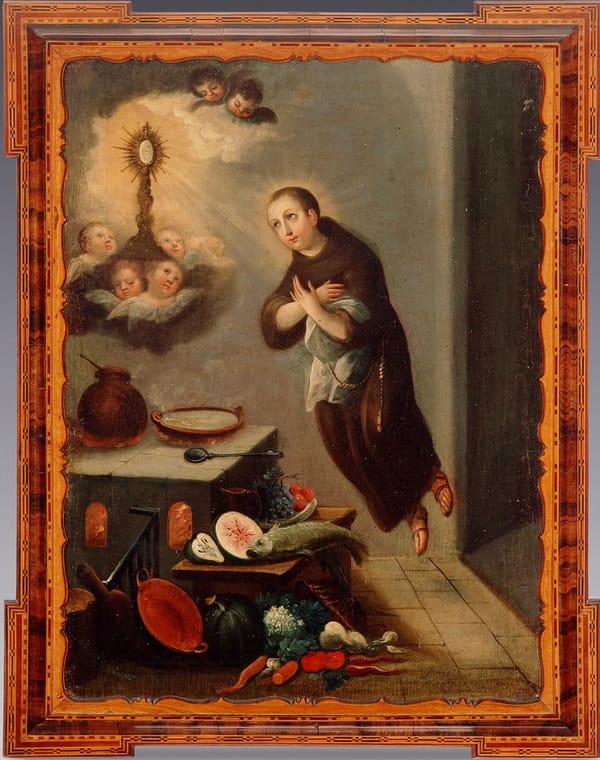 |
May 17: St. Paschal Baylon, Confessor
THE Seraph of Assisi was sure to depute some of his children to pay their court to his Risen Master. The one he sends to-day is the humblest and most obscure of men; another will follow, three days hence, powerful in word and work, and holding a palm in his hands, as a most devoted preacher of the Gospel. Paschal Baylon was a simple peasant. He was a shepherd-boy; and it was in tending his flock that he found the Lord Jesus. He had a great love for contemplation. Forests and fields spoke to him of their great Creator; and, in order that he might be the more closely united with him, he resolved to seek him in the highest paths of perfection. He was ambitious to imitate the humble, poor and suffering life of the Man-God; the Franciscan Cloister offered him the opportunity of satisfying this desire and he flew to it. On that blessed soil, he grew to be one of heaven's choicest plants, and the whole earth has now heard the name of the humble lay-brother of a little convent in Spain. Holy Church brings him before us to-day enraptured in the contemplation of Jesus' Resurrection. He had trod the path of humiliation and the cross; it was but just that he should share in his Master's triumph. It was of him, and of such as he, that this divine Saviour spoke, when he said: Ye are they that have continued with me in my temptations; and I dispose to you, as my Father hath disposed to me, a kingdom; that ye may eat and drink at my table in my kingdom, and may sit upon thrones, judging the twelve tribes of Israel.1
The account given by the Liturgy of the angelic life of this illustrious son of St Francis is as follows:
Heaven opened to receive thee, O Paschal! Even when here below, the fervour of thy contemplation often gave thee a foretaste of the delights of eternal bliss; but now every veil is drawn aside, and thou art face to face with him whom thou didst so ardently desire to possess. Thou hast no further need to unite thyself with him by humiliation and suffering; thou enjoyest his own glory, his own happiness, his own triumph, and he will have thee enjoy it for all eternity. Deign to cast an eye of pity on us, who have not thy eagerness to walk in our Redeemer’s footsteps, and who, as yet, have but the hope of being united to him for eternity. Gain for us courage. Gain for us that love which leads straight to Jesus, which surmounts every obstacle of flesh and blood, and gives to man an admirable resemblance to his divine Model. The pledge of this happy transformation has been given to us by our being permitted to partake of the Paschal Mystery; may it be perfected by our fidelity in keeping close to our divine conqueror and Lord! Though he leave us some time further in this vale of tears, his eye is ever upon us, he longs to see us persevere in our loyalty to him. Yet a little while, and we shall see him! Behold! says he, I come quickly; hold fast that which thou hast. Behold! I stand at the gate and knock. If any man shall hear my voice, and open to me the door, I will come in to him, and will sup with him, and he with me.2 Thus will the Pasch of time be changed into the Pasch of eternity. Pray for us, O Paschal, that like thee, we may hold fast that which, by the grace of our Risen Jesus, we already possess.
Saturday of the Fourth Week after Easter
SATURDAY brings us once more to the dear Mother of our Jesus. Last Saturday, when closing our week’s considerations upon the establishment of the Church, we reverently drew a parallel between these two Mothers—Mary and the Church. During the present week, we have been considering how our Saviour confided his doctrine—that is, the object of our faith—to his Apostles; let us devote this last day to a loving remembrance of the dogmas which Jesus revealed to them regarding the dignity and office of her whom he chose for his own and our Mother.
Holy Church teaches us several truths concerning Mary; and these truths are the object of our faith, on the same ground as the other articles contained in the Catholic Creed. Now they could not be the object of our faith, except inasmuch as they were revealed by the lips of our divine Lord himself. The Church of our days has received them from the Church of past ages, just as this last named received them from the Apostles, to whom Jesus first confided them. There has been no new revelation since our Saviour’s Ascension; consequently, the manifestation of all the dogmas transmitted to the Church, and promulgated by her to the world, dates from the teaching given by Jesus to his Apostles. It is on this account that we believe them with theological faith—a faith which can only be given to truths directly revealed by God to man.
How beautiful is the affection here shown by the Son of God to his Mother! He revealed to his Apostles the impenetrable secrets of the divine Essence, the Trinity in Unity, the eternal generation of the Word in the Father's bosom, the eternal procession of the Holy Ghost from the Father and the Son, the union of the two Natures in one Person in the Incarnate Word, the Redemption of the world by the Blood of the Man-God, the restoration of fallen man and his elevation to a supernatural state by grace. But this same Jesus also reveals the prerogatives of his dearest Mother; and we are to believe them with the same faith as we do the dogmas which relate to God himself! Jesus, the Wisdom of the Father, the Conqueror of death, has revealed to us Mary's dignity with the same lips that taught us what he himself is: we believe the two revelations with equal faith because both come from him.
Jesus said to his Apostles, and they, under the guidance of the Holy Ghost, communicated his teaching to the Church:’Mary, my Mother, is a daughter of Adam and Eve; but the stain of original sin was not upon her. The decree that every human being should be conceived in sin was suspended in her regard. She was full of grace from the first moment of her Conception. Jeremiasand John the Baptist were sanctified in their mother’s womb; Mary was Immaculate from the first moment of her existence.’
Jesus also said to his Apostles, and commanded them to repeat his words to the Church:’ Mary is truly Mother of God, and must be honoured as such by all creatures; for she truly conceived me and gave me birth, according to my human nature, which forms but one Person with my divine nature.’
Jesus also said to his Apostles, and commanded them to repeat his words to the Church:’ Mary, my Mother, conceived me in her chaste womb without ceasing to be a Virgin, and she gave me birth without her Virginity suffering any injury.’
Thus, Mary’s Immaculate Conception which prepared her for her sublime office, her divine Maternity and her perpetual Virginity, are three dogmas of our faith, which were revealed to the Apostles directly by our Lord. Holy Church merely repeats them after the Apostles, just as the Apostles repeated them after hearing them from their divine Master.
But did not Jesus reveal other prerogatives of his august Mother—prerogatives which are consequences of the three magnificent gifts just mentioned? Let us ask the Church what she believes on this subject, and what she teaches, both by her doctrinal utterance, and by her equally infallible practice. Every development, which is produced in her by the action of the Holy Ghost, is based upon the word of God, which was spoken at the beginning. Thus it is impossible to doubt but that our Saviour made known to his Apostles his intention of raising his blessed Mother to the dignity of Queen of the universe, of Mediatrix of men, of Mother of grace, of Co-operatrix of our Redemption. Had she not, by the three unparalleled gifts just mentioned, already been raised above all other creatures? Yes, we cannot doubt it; these glories of the Mother of God were known, revered, and loved by the Apostles; and we, who have received from the Church these same sublime and consoling truths, we too prize and love our knowledge. Should we not be offering violence to every noble feeling of our nature, were we to believe that Jesus ascended into heaven, without having made known to the world the glories of his Mother, whom he loved both as her Son and her God!
What must have been thy sentiments, O Mary, thou most humble of creatures, when Jesus unveiled thy glories to the disciples? They already reverenced thee, but they could never have known the grand gifts bestowed on thee by God, unless that God himself had revealed them. What glorious things were said of thee, O City of God!1 If thy humility was troubled when the archangel called thee full of grace, and blessed among women; how must thou not have shrunk from the homage paid thee by the Apostles, when they were first told that thou wast the Mother of God, the ever spotless Virgin, Immaculate from thy very conception! But no, blessed Mother! thou canst not shun the honours that are richly thy due. The prophecy spoken by thyself, in Zachary’s house, must be fulfilled: All generations shall call thee Blessed!2 The time is at hand; a few days hence, the preaching of the Gospel will have commenced. Thy name, thy ministry, thy glories are an essential part of the Creed which is to be carried throughout the world. Up to this time, thou hast been shrouded in a veil of mystery; that veil must now be drawn aside —Jesus will have it so—and thou must be known as Mother of the God, who, when he came to save us, disdained not to assume our human nature in thy chaste womb. Dearest Mother! Queen of angels and men! suffer us to unite our fervent homage with that which the Apostolic College gave thee, when Jesus first revealed to them thy glories!
Let us, in honour of the blessed Mother, recite this sequence of the Cluny Missal of 1523. It is a graceful imitation of the Victimœ Paschali.
Sequence
Intonent Christiani.
Tua per suffragia
Reconcilientur peccatores.
A fermento veteri,
Victimae paschalis perceptores.
Virgo clemens et pia,
Et gloria frui resurgentis.
Christo reconcilia,
Es Genitrix Verbi Dei facta.
Et hominem natum, resurrexisse glorificatum.
A mortuis vere;
Conserva Mater nos et tuere.
their hymns of praise.
let sinners be reconciled to God
by thy prayers.
by thy intercession,
cleansed from the old leaven.
thou merciful and loving Virgin!
and Risen Christ.
by thy holy prayers,
Mother of the Word of God!
who was born of thee hath risen again in glory.
Do thou, O Mother!
preserve and defend us.
| Previous May 16 (the Same Day): St. John Nepomucen, Martyr | Next Saturday of the Fourth Week after Easter |