Daily reading
Semidouble · Movable from Easter · Temporal
May 20, 2025
From Dom Guéranger’s The Liturgical Year.
Tuesday of the Fifth Week after Easter
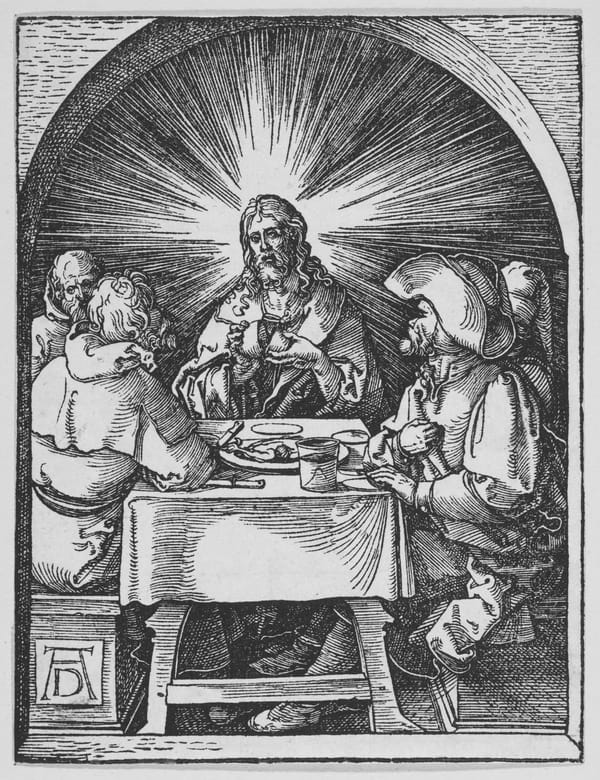
THE third sacrament—the Holy Eucharist—is so intimately connected with our Redeemer's Passion that its institution could not be deferred till the Resurrection had taken place. On Maundy Thursday, we honoured the solemn act whereby our Jesus prepared for the morrow’s sacrifice, by instituting the mystery of his Body and Blood, which are really immolated in the Eucharistic Supper. The Apostles were not only admitted, as all future generations were to be, to partake of the divine Food, which giveth life to the world,1 but they moreover received power from Jesus, the Priest for ever,2 to do what he himself had just done. The great Mystery was inaugurated; the new priesthood was instituted: and now that Jesus is risen from the dead, he makes known to his Apostles the whole importance of the gift bestowed upon mankind at the Last Supper; he bids them begin the exercise of the sublime power conferred on them, as soon as the Holy Ghost, by descending upon the earth, shall give to the Church the signal for her using the prerogatives wherewith she has been endowed; and, finally, he teaches how they are to perform this special function of their Priesthood.
At the Last Supper, the Apostles were still carnal-minded men. They were taken up with the sad event that was about to happen, and overcome with grief at their divine Master telling them that that was the last Pasch he was to keep with them. They were not, therefore, in a fit state to appreciate what it was that Jesus had done for them, when he uttered those words: Take ye and eat; this is my Body. Drink ye all of this; for this is my Blood. Still less did they understand the greatness of the power they received, of doing what their Lord himself had just done in their presence. Now that Jesus is risen from the grave, he unfolds all these mysteries to them. The sacrament of the Eucharist was not instituted during these days, but it was made known, explained, and glorified by its divine institutor: and this circumstance gives a fresh lustre to the sacred season we are now going through.
Of all the sacraments, there is not one that can be compared in dignity to that of the Eucharist. The others give grace; this gives us the very Author of grace. The others are only sacraments; this is both a sacrament and a sacrifice. We will endeavour to explain it in all its magnificence, when we come to the bright feast of Corpus Christi. Let us for the present pay the tribute of our loving adoration to our Jesus, the Living Bread, that giveth life to the world.3 Let us acknowledge his immense love for his sheep. He seems to be on the point of leaving them that he may return to his Father, and yet his love retains him amongst them by means of this august mystery, wherein he is truly though invisibly present.
Be thou blessed, then, O Son of the Eternal Father! who, even in the days of the ancient covenant, didst assure us that thy delights are to be with the children of men.4 Thou provest it now by this wonderful sacrament, which reconciles thy two announcements, apparently so contradictory: thy leaving us, and thy abiding ever in our midst.
Be thou blessed for having provided for the nourishment of our souls as well as for that of our bodies. At Christmas we welcomed thy birth at Bethlehem, which signifies a House of Bread. Thou wast both the Saviour who was born for us, and the Food that came down from heaven to nourish our souls.
Be thou blessed, who, not satisfied with working the greatest of wonders at the Last Supper, by changing bread into thy Body and wine into thy Blood, hast also willed that this same miracle should be renewed, everywhere and to the end of time, for the support and consolation of our souls.
Be thou blessed in that thou hast put no limits to our longing after this Bread of Life. On the contrary, thou biddest us make it our daily Bread, and this in order that we may not faint in the way of this our exile.
Be thou blessed for the generosity wherewith, out of thy desire to communicate thyself unto us, thou hast exposed thyself to the blasphemies of heretics, to the sacrileges of bad Christians, and to the indifference of the tepid.
Be thou blessed, O divine Lamb, who enrichest the new Pasch by the shedding of thy Blood, and invitest the new Israel to a banquet where thy sacred Body is offered as nourishment to thy faithful; there do they receive life at its very source, and share in the ineffable joys of thy Resurrection.
Be thou blessed, O Jesus, for having instituted, in the Holy Eucharist, not only the greatest of the sacraments, but also a sacrifice which surpasses all others; a sacrifice whereby we are enabled to offer to the divine Majesty the only homage that is worthy of him, give him thanks in keeping with his favours to us, make him a superabundant atonement for our sins, and finally beg and obtain from him all the graces of which we stand in need.
Be thou blessed, O Emmanuel, who, having promised to give us this heavenly Food, didst fulfil thy promise on the eve of thy Passion, and gavest us this adorable sacrament as the testament of thy love. In the interval between thy Resurrection and Ascension, thou didst reveal to thine Apostles the excellency of thy gift, that so we might receive it with becoming faith.
We offer thee, dear Jesus, this homage of our faith. We confess that in this august Mystery the bread is changed into thy Body, and the wine into thy Blood: and we believe it, because thou hast said it, and because thou canst do all things.
In praise of our Paschal Lamb, who gives himself to us to be our nourishment, let us recite the following beautiful canticle, composed by Notker for the Church of Saint Gall.
Sequence
Esu potuque dignas,
Praebeant omnes se Christianae animae.
Ipse summus Pontifex.
Ejus illita sacrosancto cruore, tuta a clade Canopica,
In mari rubro sunt obruti.
Pedes tutentur adversus viperas;
Contra canes jugiter manu bajulent;
Quo de barathro victor rediit.
Ornatibus Christo consurgens, fideles admonet,
Cum eo victuros.
to partake of the Paschal Lamb,
by holy lives.
for their sakes, as an oblation to the Father.
of the Lamb; they are protected from the slaughter that fell upon Egypt,
were engulfed in the Red Sea.
let them protect their feet against vipers;
to defend themselves against dogs;
whereby he rose again victorious from the tomb.
rises together with Christ. She teaches us,
are to share in Jesus’ victory.
May 20: St. Bernardine of Siena, Confessor
|
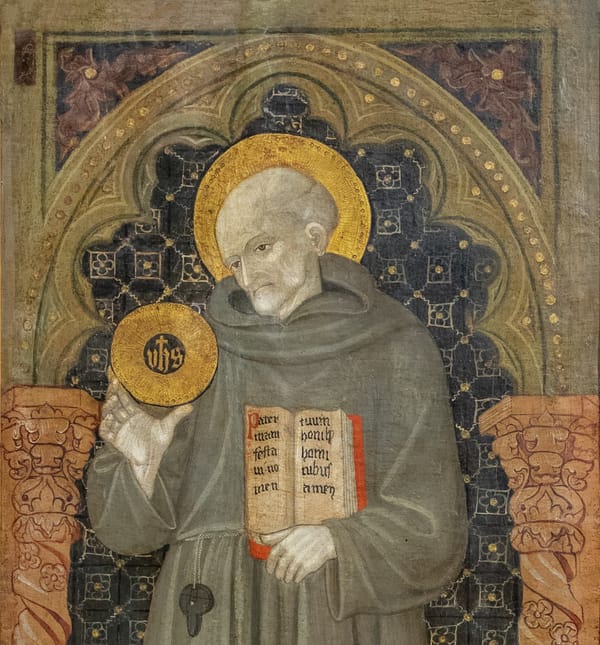
IN that season of the liturgical year when we were kneeling in love and prayer around the crib of the Infant Jesus, one day was devoted to the celebration of the glory and sweetness of his Name. Holy Church was full of joy when she pronounced the dear Name chosen from all eternity by her heavenly Spouse; and mankind found consolation in the thought that the great God who might so justly have bid us call him the Just and the Avenger, willed us henceforth to call him the Saviour. The devout Bemardine of Siena, whose feast we keep to-day, stood then before us, holding in his hands this ever blessed Name, surrounded with rays. He urged the whole earth to venerate with love and confidence the sacred name which expresses the whole economy of our salvation. The Church, ever attentive to what is for the good of her children, adopted the beautiful device. She encouraged them to receive it from the Saint, as a shield that would protect them against the darts of the evil spirit, and as an additional means of reminding ourselves of the exceeding charity wherewith God has loved this world of ours. And finally, when the loveliness of the holy Name of Jesus had won all Christian hearts, she instituted in its honour one of the most beautiful solemnities of Christmastide.
Bemardine, the worthy son of St Francis of Assisi, returns to us on this twentieth day of May, and the sweet flower of the holy Name is, of course, in his hand. But it is not now the prophetic appellation of the newborn Babe; it is not the endearing Name, respectfully and lovingly whispered by the Virgin-Mother over the crib; it is the Name whose sound has gone through the whole creation, it is the trophy of the grandest of victories, it is the fulfilment of all that was prophesied. The Name of Jesus was a promise to mankind of a Saviour; Jesus has saved mankind, by dying and rising again; he is now Jesus in the full sense of the word. Go where you will, and you hear this Name—the Name that has united men into the one great family of the Church.
The chief priests of the Synagogue strove to stifle the Name of Jesus, for it was even then winning men’s hearts. They forbade the Apostles to teach in this Name; and it was on this occasion that Peter uttered the words which embody the whole energy of the Church: We ought to obey God rather than men.1 The Synagogue might as well have tried to stay the course of the sun. So too, when the mighty power of the Roman Empire set itself against the triumphant progress of this Name, and would annul the decree that every knee should bow at its sound,2 its attempt was a complete failure, and at the end of three centuries the Name of Jesus was heard and loved in every city and hamlet of the Empire.
Armed with this sacred motto, Bernardine traversed the towns of Italy, which at that period (the fifteenth century) were at enmity with each other, and not unfrequently torn with domestic strifes. The Name of Jesus, which he carried in his hand, became as a rainbow of reconciliation; and wheresoever he set it up, there every knee bowed down, every vindictive heart was appeased, and sinners hastened to the sacrament of pardon. The three letters (I H S) which represent this Name, became familiar to the faithful; they were everywhere to be seen carved, or engraven, or painted; and the Catholic world thus gained a new form whereby to express its adoration and love of its Saviour.
Bernardine was a preacher of inspired eloquence. He was also a distinguished master in the science of sacred things, as is proved by the writings he has left us. We regret not being able, from want of space, to give our readers his words on the greatness of the Paschal mystery; but we cannot withhold from them what he says regarding the apparition of Jesus to his Blessed Mother after the Resurrection. They will be rejoiced at finding unity of doctrine on this interesting subject existing between the Franciscan school, represented by St Bemardine, and the school of St Dominic, whose testimony we have already given on the Feast of St Vincent Ferrer.
'From the fact of there being no mention made in the Gospel of the visit wherewith Christ consoled his Mother after his Resurrection, we are not to conclude that this most merciful Jesus, the source of all grace and consolation, who was so anxious to gladden his disciples by his presence, forgot his Mother, who he knew had drunk so deeply of the bitterness of his Passion. But it has pleased divine Providence that the Gospel should be silent on this subject; and this for three reasons.
‘In the first place, because of the firmness of Mary's faith. The confidence which the Virgin-Mother had of her Son's rising again had never faltered, not even by the slightest doubt. This we can readily believe, if we reflect on the special grace wherewith she was filled, she the Mother of the Man-God, the Queen of angels, and the Mistress of the world. To a truly enlightened mind, the silence of the Scripture on this subject says more than any affirmation could have done. We have learned to know something of Mary by the visit she received from the angel, when the Holy Ghost overshadowed her. We met her again at the foot of the Cross, where she, the Mother of Sorrows, stood nigh her dying Son. If then the Apostle could say: As ye are partakers of the sufferings, so shall ye he also of the consolation:3 what share must not the Virgin-Mother have had in the joys of the Resurrection? We should hold it as a certain truth that her most sweet Jesus, after his Resurrection, consoled her first of all. The holy Roman Church would seem to express this, by celebrating at Saint Mary Major's the Station of Easter Sunday. Moreover, if from the silence of the Evan-gelists you would conclude that our Risen Lord did not appear to her first, you must go farther, and say that he did not appear to her at all, inasmuch as these same Evangelists, when relating the several apparitions, do not mention a single one as made to her. Now, such a conclusion as this would savour of impiety.
'In the second place, the silence of the Gospel is explained by the incredulity of men. The object of the Holy Spirit, when dictating the Gospels, was to describe such apparitions as would remove all doubt from carnalminded men with regard to the Resurrection of Christ. The fact of Mary's being his Mother would have weakened her testimony, at least in their eyes. For this reason she was not brought forward as a witness, though most assuredly there never was or will be any creature (the humanity of her Son alone excepted) whose assertion better deserved the confidence of every truly pious soul. But the text of the Gospel was not to adduce any testimonies, save such as might be offered to the whole world. As to Jesus' apparition to his Mother, the Holy Ghost has left it to be believed by those that are enlightened by his light.
'In the third place, this silence is explained by the sublime nature of the apparition itself. The Gospel says nothing regarding the Mother of Christ after the Resurrection; and the reason is, that her interviews with her Son were so sublime and ineffable that no words could have described them. There are two sorts of visions: one is merely corporal, and feeble in proportion; the other is mainly in the soul, and is granted only to such as have been transformed. Say, if you will, that Magdalen was the first to have the merely corporal vision, provided that you admit that the Blessed Virgin saw, previously to Magdalen, and in a far sublimer way, her Risen Jesus, that she recognized him, and enjoyed his sweet embraces in her soul, more even than in her body.'4
Let us now read the Life of our Saint, as given, though too briefly, in the Lessons of to-day's Office:
How beautiful, O Bernardine, are the rays that form the aureole round the Name of Jesus! How soft their light on that eighth day after his birth, when he received this Name! But how dazzling, now that this Jesus achieves our salvation, not only by humiliation and suffering, but by the triumph of his Resurrection! Thou comest to us, O Bernardine, in the midst of the Paschal glory of the Name of Jesus. This Name, for which thou didst so lovingly and zealously labour, gives thee to share in its immortal victory. Now therefore, pour forth upon us, even more abundantly than when thou wast here on earth, the treasures of love, admiration and hope, of which this divine Name is the source, and cleanse the eyes of our soul, that we may one day be enabled to join thee in contemplating its beauty and magnificence.
Apostle of peace! Italy, whose factions were so often quelled by thee, may well number thee among her protectors. Behold her now a prey to the enemies of Jesus, rebellious against the Church of God, and abandoned to her fate. Oh! forget not that she is thy native land, that she was obedient to thy preaching, and that thy memory was long most dear to her. Intercede in her favour; deliver her from her oppressors; and show that when earthly armies fail, the host of heaven can always save both cities and countries.
Illustrious son of the great patriarch of Assisi! the seraphic Order venerates thee as one of its main supports. Thou didst reanimate it to its primitive observance; continue now from heaven to protect the work thou didst commence here on earth. The Order of St Francis is one of the grandest consolations of holy Mother Church; make this Order for ever flourish, protect it in its trials, give it increase in proportion to the necessities of the faithful; for thou art the second Father of this venerable family, and thy prayers are powerful with the Redeemer, whose glorious Name thou didst confess upon earth.
| Previous May 19 (the Same Day): St. Pudentiana, Virgin | Next May 20: St. Bernardine of Siena, Confessor |