Daily reading
Paschal Time
Double · May 27 · Sanctoral
May 27, 2025
From Dom Guéranger’s The Liturgical Year.
 |
May 27: St. Bede the Venerable, Confessor and Doctor of the Church
THE blessing given by our Lord as he ascended into heaven has revealed its power in the most distant pagan lands, and during these days the liturgical cycle bears witness to a concentration of graces upon the west of Europe.
The band of missionaries begged of Pope Eleutherius by the British king Lucius has been followed by the apostolate of Augustine, the envoy of Gregory the Great, and to-day, as though impatient to justify the lavish generosity of heaven, England brings forward her illustrious son, the Venerable Bede. This humble monk, whose whole life was spent in the praise of God, sought his divine Master in nature and in history, but above all in holy Scripture, which he studied with a loving attention and fidelity to tradition. He who was ever a disciple of the ancients, takes his place to-day among his masters as a Father and Doctor of the Church.
He thus sums up his own life: 'I am a priest of the monastery of the blessed Apostles Peter and Paul. I was bom on their land, and ever since my seventh year I have always lived in their house, obserying the Rule, singing day by day in their church, and making it my delight to learn, to teach or to write. Since I was made a priest, I have written commentaries on the holy Scripture for myself and my brethren, using the words of our venerated Fathers and following their method of interpretation. And now, good Jesus, I beseech thee, thou who hast given me in thy mercy to drink of the sweetness of thy word, grant me now to attain to the source, the fount of wisdom, and to gaze upon thee for ever and ever.’*
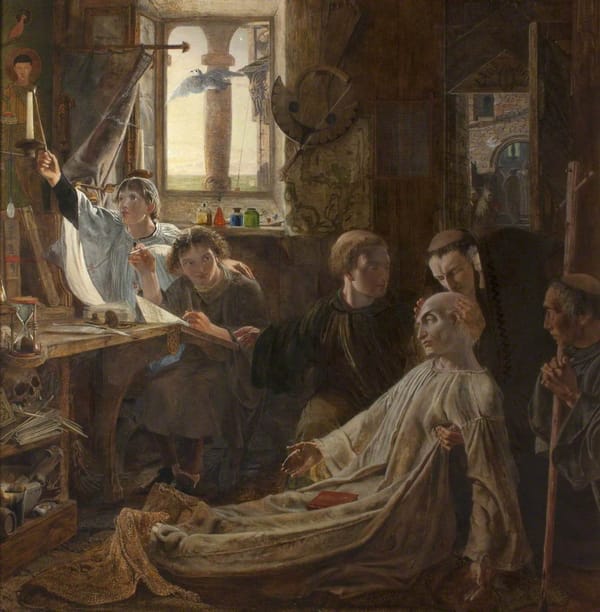
The holy death of the servant of God was one of the most precious lessons he left to his disciples. His last sickness lasted fifty days, and he spent them, like the rest of his life, in singing the psalms and in teaching. As the Feast of the Ascension drew near, he repeated over and over again with tears of joy the Antiphon: ‘O king of glory, who hast ascended triumphantly above the heavens, leave us not orphans, but send us the promise of the Father, the Spirit of truth.’ He said to his disciples in the words of St Ambrose: ‘I have not lived in such a sort as to be ashamed to live with you, but I am not afraid to die, for we have a good Master.’ Then, returning to his translation of the Gospel of St John and a work, which he had begun, on St Isidore, he would say: ‘I do not wish my disciples to be hindered after my death by error nor to lose the fruit of their studies.’
On the Tuesday before the Ascension he grew worse, and it was evident that the end was near. He was full of joy and spent the day in dictating and the night in prayers of thanksgiving. The dawn of Wednesday morning found him urging his disciples to hurry on their work. At the hour of Terce they left him to take part in the procession made on that day with the relics of the saints. One of them, a child, who stayed with him, said: 'Dear master, there is but one chapter left; hast thou strength for it?’ ‘It is easy,' he answered with a smile; ‘take thy pen, cut it and write—but make haste.' At the hour of None, he sent for the priests of the monastery and gave them little presents, begging them to remember him at the altar. All wept. But he was full of joy, saying: ‘It is time for me, if it so please my Creator, to return to him who made me out of nothing, when as yet I was not. My sweet Judge has well ordered my life, and now the time of dissolution is at hand. I desire to be dissolved and to be with Christ. Yea, my soul longs to see Christ my king in his beauty.’
So did he pass this last day. Then came the touching dialogue with Wibert, the child mentioned above. ‘Dear master, there is yet one sentence more.' 'Write quickly.' After a moment: ‘It is finished,’ said the child. 'Thou sayest well,' replied the blessed man. ‘It is finished. Take my head in thy hands and support me over against the Oratory, for it is a great joy to me to see myself over against that holy place where I have so often prayed.’ They had laid him on the floor of his cell. He said: ‘Glory be to the Father, and to the Son, and to the Holy Ghost,’ and when he had named the Holy Ghost, he yielded up his soul.
The following account of this holy monk is given in the Breviary:
‘Glory be to the Father, and to the Son, and to the Holy Ghost’ is the hymn of eternity. Before the creation of the angels and of man, God, in the concert of the three divine Persons, sufficed for his own praise, and this praise was adequate, infinite and perfect, like the divinity. This was the only praise worthy of God. However magnificently the world may hymn its Creator in the thousand voices of nature, its praise is always below the divine Object. But, in the designs of God, creation was one day to send up to heaven an echo of that melody which is threefold and yet one, for the Word was to take flesh, through the operation of the Holy Ghost, in the womb of Mary, and was to be Son of Man as truly as he is Son of God. Then the canticle of creation fully and perfectly re-echoed the adorable harmonies once known only to the blessed Trinity. Since that day a man who has understanding finds his perfection in such conformity to the Son of Mary, that he may be one with the Son of God in the divine concert wherein God is glorified.
This, O Bede, was thy life, for understanding was given thee. It was fitting that thy last breath should be spent in that song of love which had filled thy mortal life, and that thus thou shouldst enter at once into a glorious and blessed eternity. May we profit by that supreme lesson, which sums up all the teaching of thy grand and simple life!
Glory be to the almighty and merciful Trinity! These words form the close of the cycle of the mysteries which terminate at this time in the glorification of the Father, our sovereign Lord, by the triumph of the Son our Redeemer, and the inauguration of the reign of the Holy Ghost, our sanctifier. How splendid were the triumph of the Son and the reign of the Holy Ghost in the Isle of Saints in the days when Albion, twice given by Rome to Christ, shone like a priceless jewel in the diadem of the Spouse! O thou who wast the teacher of the English in the days of their fidelity, do not disappoint the hopes of the supreme Pontiff who has in our days extended thy cult to the Universal Church; but rekindle in the hearts of thy countrymen their former love for the Mother of all mankind.
* Bede, Hist, Eccl. cap. ult. ↩︎
Rogation Days: Tuesday
To-day, again, the great Litany, the supplication, is heard from the house of the Lord: the solemn procession re-appears in the streets of the city, and in the quiet lanes of the country. Let us take our share in this sacred rite; let us blend our voice with that of our mother, and join the cry that pierces the clouds: Kyrie eleison! Lord have mercy on us! Let us think, for a moment, of the countless sins that are being committed, day and night; and let us sue for mercy. In the days of Noe, all flesh had corrupted its way;1 but men thought not of asking for mercy. The flood came, and destroyed them all,2 says our Saviour. Had they prayed, had they begged God’s pardon, the hand of His justice would have been stayed, and the flood-gates of heaven would not have been opened.3 The day is to come, when not water as heretofore, but fire, is suddenly to be enkindled by the divine wrath, and is to burn the whole earth. It shall burn even the foundations of the mountains;4 it shall devour sinners, who will be resting then, as they were in the days of Noe, in a false security.
Persecuted by her enemies, decimated by the martyrdom of her children, afflicted by numerous apostasies from the faith, and deprived of every human aid, the Church will know that the terrible chastisement is at hand, for prayer will then be as rare as faith. Let us, therefore, pray; that thus the day of wrath may be put off, the Christian life regain something of its ancient vigour, and the end of the world not be in our times. There are even yet Catholics in every part of the world; but their number has visibly decreased. Heresy is now in possession of whole countries, that were once faithful to the Church. In others, where heresy has not triumphed, religious indifference has left the majority of men with nothing of Catholicity but the name, seeing that they neglect even their most essential obligations without remorse. Among many of those who fulfil the precepts of the Church, truths are diminished.5 The old honesty of faith has been superseded by loose ideas and half- formed convictions. A man is popular in proportion to the concessions he makes in favour of principles condemned by the Church. The sentiments and actions of the saints, the conduct and teaching of the Church, are taxed with exaggeration, and decried as being unsuited to the period. The search after comforts has become a serious study; the thirst for earthly goods is a noble passion; independence is an idol to which everything must be sacrificed; submission is a humiliation which must be got rid of, or, where that cannot be, it must not be publicly acknowledged. Finally, there is sensualism, which, like an impure atmosphere, so impregnates every class of society, that one would suppose there was a league formed to abolish the cross of Christ from the minds of men.
What miseries must not follow from this systematic setting aside of the conditions imposed by God upon His creatures? If the Gospel be the word of infinite Truth, how can men oppose it without drawing down upon themselves the severest chastisements? Would that these chastisements might work the salvation of them that have provoked them! Let us humble ourselves before the sovereign holiness of our God, and confess our guilt. The sins of men are increasing both in number and in enormity. The picture we have just drawn is sad enough; what would it have been, had we added such abominations as these, which we purposely excluded: downright impiety; corrupt doctrines, which are being actively propagated throughout the world; dealings with satan, which threaten to degrade our age to the level of pagan times; the conspiracy organized against order, justice, and religion, by secret societies? Oh! let us unite our prayer with that of holy Church, and say to our God: From Thy wraths deliver us, O Lord!
The Rogation days were instituted for another end besides this of averting the divine anger. We must beg our heavenly Father to bless the fruits of the earth; we must beseech Him, with all the earnestness of public prayer, to give us our daily bread. ‘The eyes of all,’ says the psalmist, ‘hope in Thee, O Lord! and Thou givest them food in due season. Thou openest Thy hand, and fillest with blessing every living creature.'6 In accordance with the consoling doctrine conveyed by these words, the Church prays to God, that He would, this year, give to all living creatures on earth the food they stand in need of. She acknowledges that we are not worthy of the favour, for we are sinners. Let us unite with her in this humble confession; but, at the same time, let us join her in beseeching our Lord to make mercy triumph over justice. How easily could He frustrate the self-conceited hopes, and the clever systems of men! They own that all depends on the weather; and on whom does that depend? They cannot do without God. True, they seldom speak of Him, and He permits Himself to be forgotten by them; but 'He neither sleepeth nor slumbereth, that keepeth Israel.’7 He has but to withold His blessing, and all their progress in agricultural science, whereby they boast to have made famine an impossibility, is of no effect. Some unknown disease comes upon a vegetable; it causes distress among the people, and endangers the social order of a world that has secularized itself from the Christian law, and would at once perish, but for the mercy of the God it affects to ignore.
If, then, our heavenly Father deign, this year, to bless the fruits of the earth, we may say, in all truth, that He gives food to them that forget and blaspheme Him, as well as to them that make Him the great object of their thoughts and of their service. Men of no religion will profit by the blessing, but they will not acknowledge it to be His; they will proclaim more loudly than ever, that nature’s laws are now so well regulated by modern science, that she cannot help going on well! God will be silent, and will feed the men who thus insult Him. But why does He not speak? Why does He not make His wrath felt? Because His Church has prayed; because He has found the ten just men,8 that is, the few for whose sake He mercifully consents to spare the world. He therefore permits these learned economists, whom He could so easily disconcert, to go on talking and writing. Thanks to this His patience, some of them will grow tired of their impious absurdity; an unexpected circumstance will open their eyes to the truth, and they will, one day, join us both in faith and in prayer. Others will go deeper and deeper into blasphemy; they will go on to the last, defying God’s justice, and fulfilling in themselves that terrible saying of holy Scripture: ‘The Lord hath made all things for Himself; the wicked also for the evil day.’9
We, who glory in the simplicity of our faith, who acknowledge that we have all from God and nothing from ourselves, who confess that we are sinners and undeserving of His gifts, will ask Him, during these three days, to give us the food we require; we will say to Him, with holy Church: That Thou vouchsafe to give and preserve the fruits of the earth: We beseech Thee, hear us! May He have pity on us in our necessities! Next year, we will return to Him with the same earnest request. We will march, under the standard of the cross, through the same roads, making the air resound with the same litanies. We will do this with all the greater confidence, at the thought that our holy mother is marshalling her children in every part of Christendom, in this solemn and suppliant procession. For thirteen hundred years has our God been accustomed to receive the petitions of His faithful people, at this season of the year; He shall have the same homage from us; nay, we will endeavour, by the fervour of our prayer, to make amends for the indifference and ignorance which are combining to do away with old Catholic customs, which our forefathers prized and loved.
The Mass is the same as yesterday’s, page 144.
We offer our readers the following prayer, taken from the ancient Gallican liturgy, and composed at a period when the observance of the Rogation days was in its first fervour.
Prayer (Contestatio)
May 27 (the Same Day): St. John I, Pope and Martyr
THE palm of martyrdom was won by this holy Pope, not in a victory over a pagan persecutor, but in battling for the Church’s liberty against a Christian king. But this king was a heretic, and therefore an enemy of every Pontiff that was zealous for the triumph of the true faith. The state of Christ’s Vicar here on earth is a state of combat; and it frequently happens that a Pope is veritably a martyr, without having shed his blood. St John I, whom we honour to-day, was not slain by the sword; a loathsome dungeon was the instrument of his martyrdom; but there are many Popes who are now in heaven with him, martyrs like himself, who never even passed a day in prison or in chains: the Vatican was their Calvary. They conquered, yet fell in the struggle with so little appearance of victory, that heaven had to take up the defence of their reputation, as was the case with that angelic Pontiff of the eighteenth century, Clement XIII.
The Saint of to-day teaches us, by his conduct, what should be the sentiment of every worthy member of the Church. He teaches us that we should never make a compromise with heresy, nor approve the measures taken by worldly policy for securing what it calls the rights of heresy. If the past ages, aided by the religious indifference of Governments, have introduced the toleration of all religions, or even the principle that ‘all religions are to be treated alike by the state,’ let us, if we will, put up with this latitudinarianism, and be glad to see that the Church, in virtue of it, is guaranteed from legal persecution; but as Catholics, we can never look upon it as an absolute good. Whatever may be the circumstances in which Providence has placed us, we are bound to conform our views to the principles of our holy faith, and to the infallible teaching and practice of the Church—out of which, there is but contradiction, danger and infidelity.
The holy Liturgy thus extols the virtues and courage of our Saint:
Thy fair palm, O holy Pontiff, was the reward of proclaiming the spotless holiness of the Church of Christ. She is the glorious Church, as St Paul calls her, having neither spot nor wrinkle;1 and, for that very reason she can never consent to yield to heresy any of the inheritance given her by her divine Lord. Nowadays, men form their calculations on the interests of this passing world, and are resolved to regulate society independently of the rights of the Son of God, from whom proceeds all social order, as well as all truth. They have deprived the Church of her external constitution and influence; and at the same time, they give encouragement to the sects that have rebelled against her. O holy Pontiff, teach us to realize what divine truth is, and how error can never create prescription against her rights. Then shall we submit to the unhappy necessities handed down to us by the fatal triumph of heresy, without accepting, as a sign of progress, the principle and law that ‘all religions are on an equality.’ In thy prison, brave martyr, thou didst proclaim the rights of the one only Church; preserve us, who are living during that revolt which was foretold by the Apostle,2 from those cowardly compromises, dangerous prejudices, and culpable want of solid instruction, which are the ruin of so many souls; and may our last words, on leaving this world, be those that were taught us by our Jesus himself: Heavenly Father! Hallowed be thy Name! May thy Kingdom come!
| Previous May 26 (the Same Day): St. Eleutherius, Pope and Martyr | Next Rogation Days: Tuesday |