Daily reading
Paschal Time
Double · Movable from Easter · Temporal
May 30, 2025
From Dom Guéranger’s The Liturgical Year.
 |
Friday within the Octave of the Ascension
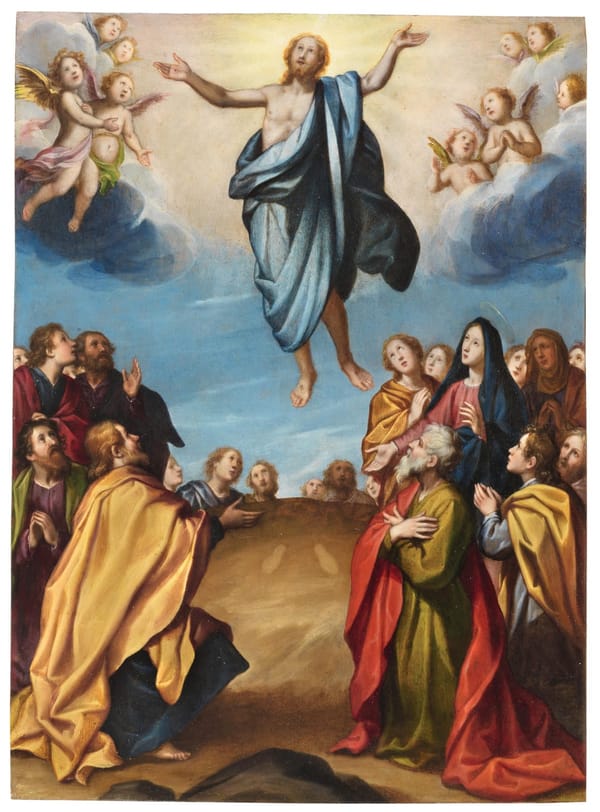
The feast of the Ascension shows us the work of God in its completion. Hence it is that the Church, in her daily offering of the holy sacrifice, thus addresses the eternal Father: the words occur immediately after the consecration, and contain the motives of her confidence in the divine mercy: ‘Wherefore, O Lord, we Thy servants, as also Thy holy people, calling to mind the blessed Passion of Christ Thy Son our Lord, His Resurrection from the dead, and His admirable Ascension into heaven, offer unto Thy most excellent Majesty a pure, holy, and unspotted Host.’ It is not enough for man to hope in the merits of his Redeemer’s Passion, which cleansed him from his sins; it is not enough for him to add to the commemoration of the Passion that of the Resurrection, whereby our Redeemer conquered death; man is not saved, he is not reinstated, except by uniting these two mysteries with a third: the Ascension of the same Jesus who was crucified and rose again. During the forty days of His glorified life on earth, Jesus was still an exile; and, like Him, we also are exiles until such time as the gate of heaven, which has been closed for four thousand years, shall be thrown open, both for Him and for us.
God, in His infinite goodness, made man for a nobler end than that of being mere lord of creation; He gave him a higher destiny than that of knowing such truths as his natural powers could grasp, and of practising virtues that were within the reach of his moral capabilities, and of paying to his Creator an imperfect worship. In His omnipotence and love, He gave to this frail creature an end far above his nature. Though inferior to the angel, and uniting in himself the two natures of matter and spirit, man was created to the same end as the angel. Both were to dwell for eternity in heaven; both were to be eternally happy in the face-to-face vision of God, that is, in the closest union with the sovereign Good. Grace—that wondrous and divine power—was to fit them for the supernatural end prepared for them by the gratuitous goodness of their Creator. This was the design which God had decreed from all eternity: to raise up to Himself these creatures that He had drawn out of nothingness, and to enrich them, agreeably to their sublime destiny, with the treasures of His love and His light.
We know the history of the fallen angels. They revolted against the commandment given them by God as a test of their fidelity, and as a condition of their being admitted into eternal happiness. Rebels were found in each of the choirs. They fell; but the fall and its punishment were personal, and injured none but the actual transgressors. The angels who remained faithful were at once rewarded with the beatific vision and possession of the sovereign Good. Thus did God vouchsafe to make created beings partake in His own infinite happiness: the first elect were the good angels of the nine choirs.
Man was created after the angels; he too fell, and his sin severed the link which united him with God. The human race was, at that time, represented by one man and woman; when they fell, all fell. The gate of heaven was then shut against mankind, for the fall of Adam and Eve implicated us their children; neither could they transmit to us an inheritance which they themselves had lost. Instead of a quick and happy passage through this world, and then a glorious ascension into heaven, we were to have a life short indeed but full of misery, a grave, and corruption. As to our soul, even had she aspired to the supernatural happiness for which she was created, she could never have attained to it. Man had preferred earth for his portion, and the earth was given to him; but this only for a few short years, after which others would take his place, disappear in their turn, and so on to the end, as long as it should please God to perpetuate this fallen portion of His creation.
Yes, it is thus we deserved to be treated; but our merciful Creator had compassion upon us. He hated sin; but He had created us that He might make us partakers of His own glory, and He would not have His design frustrated. The earth was not to be an abode for man to be merely born, live a few days, and then die. When the fulness of time should come, there was to appear in the world a Man, not indeed the first of a new creation, but one like ourselves and of our own race, or, as the apostle expresses it, ‘made of a woman.’1 This Man, who was to be heavenly and yet of earth, would share our misfortunes with us; He would die like us; He would be buried like us; but, on the third day, He would rise again, and men would see Him resplendent with glory and immortality. What a joy for us, who have within us ‘the answer of death,’ to see such a victory gained by One, who is one of ourselves, ‘flesh of our flesh!’
Thus were the divine intentions to be realized in our regard. Our earth presents to our Creator a new Adam. He cannot stay here, for He has conquered death; He must ascend to heaven, and if her gates be closed, she must open them and receive Him. ‘Lift up your gates, O ye princes! and be ye lifted up, O eternal gates! and the King of glory shall enter in!'2 Oh that He would take us thither with Him, for He is our brother, and He assures us that His ‘delight is to be with the children of men’!3 But what a joy it is for us to see our Jesus ascend to heaven! He is the holiest, the purest, the loveliest, of our race; He is the Son of a spotless Mother: let Him go and represent us in the kingdom of our inheritance. It is our own earth that sends Him; she is no longer a desert, now that she has produced such a flower, and such a fruit, for heaven. A flood of light poured into this lowly vale of tears, when the gates of heaven were raised up to receive Him. ‘Be Thou exalted, O Lord, in Thine own strength! and we, who are still on the earth, will sing and praise Thy power ’!4 Receive, O eternal Father, the brother whom we send to Thee; sinners though we are, this brother of ours is infinitely holy and perfect. Where is the curse that once fastened on our earth?’The earth hath given her fruit’!5 And if we may presume so far as to see in Him the first-fruits of a future harvest to be gathered into Thy house, may we not rejoice in the thought that the Ascension of our Jesus was the day whereon Thy primal work was restored to Thee?
Let us, to-day, borrow from the Armenian Church one of her sweetest hymns. Let us unite with her in sharing in the joy felt by the holy angels, when they saw the God-Man rising from earth, and taking possession of the highest throne in heaven.
May 30: St. Felix I, Pope and Martyr
THE holy Popes of the primitive ages of the Church abound during these last days of our Paschal season. To-day we have Felix I, a martyr of the persecution under Aurelian, in the third century. His Acts have been lost, with the exception of this one detail: that he proclaimed a dogma of the Incarnation, with admirable precision, in a letter addressed to the Church of Alexandria, a passage of which was read with much applause at the two (Ecumenical Councils of Ephesus and Chalcedon.
We also learn from a law he passed for those troubled times of the Church, that this holy Pontiff was zealous in procuring for the martyrs the honour that is due to them. He decreed that the Holy Sacrifice should be offered up on their tombs. The Church still keeps this law in mind by requiring that all altars, whether fixed or portable, must have, amongst the relics that are placed in them, a portion of some belonging to the martyrs. We shall have to speak of this custom in a future volume.
The Liturgy gives us this short notice regarding the holy Pontiff:
Thou, O holy Pontiff, didst imitate thy divine Master in his death, for thou gavest thy life for thy sheep. Like him, too, thou art to rise from thy tomb, and thy happy soul shall be reunited to its body, which suffered death in testimony of the truth thou proclaimedst at Rome. Jesus is the first-born of the dead;* thou didst follow him in his Passion, thou shalt follow him in his Resurrection. Thy body was laid in those venerable vaults, which the piety of early Christians honoured with the appellation of Cemeteries—a word which signifies a place wherein to sleep. Thou, O Felix, wilt awaken on that great day whereon the Pasch is to receive its last and perfect fulfilment: pray that we also may then share with thee in that happy resurrection. Obtain for us that we may be faithful to the graces received in this year's Easter; and prepare us for the visit of the Holy Ghost, who is soon to descend upon us, that he may give stability to the work that has been achieved in our souls by our merciful Saviour.
* Apoc. i 5. ↩︎
June 1 [May 31]: St. Angela de Merici, Virgin
 |
[This feast day, previously kept on May 31, was moved to June 1 when the feast of the Queenship of Mary was established on May 31.-Ed.]
From Dom Guéranger's The Liturgical Year.
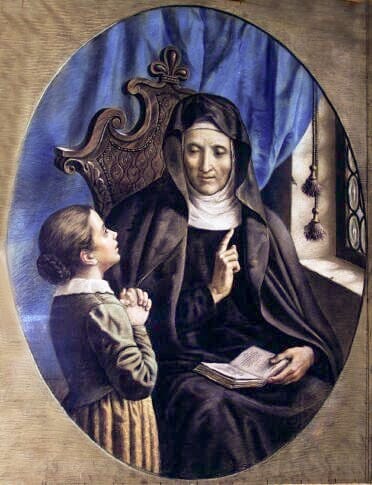
THIS last day of May, which is honoured by the virginal triumph of Aurelia Petronilla, in the first age of the Church, is also fragrant with the lilies that wreathe the brow of Angela de Merici. The sixteenth century, which, a few days back, offered to our Risen Lord the seraphic Magdalen de Pazzi, now presents him with this second fruit of heroic sanctity. Angela realized the whole meaning of her beautiful name. She possessed the purity of the blessed spirits in a mortal body, and she imitated their celestial energy by the vigorous practice of every virtue. This heroine of grace trampled beneath her feet everything that could impede her heavenward march. Gifted at an early age with the highest contemplation, she bravely travelled to Palestine, there to venerate the footsteps of her divine Spouse Jesus. After this, she visited the New Jerusalem, Rome, and offered up her fervent prayers at the Confession of St Peter. She then returned to her life of seclusion, and founded a Religious Order which is, and will be to the end of time, one of the glories and aids of Holy Church.
The thought of the great St Ursula and her virginal legion made a deep impression on Angela’s soul, and she too would form to our Lord an army of valiant women. Ursula confronted the barbarian host; Angela would give battle to the world and to its seductions, which are so dangerous to young girls. God blessed her with victory. As a trophy of her combats, she can point to the countless generations of young people whom her Order has saved during the last three centuries, by giving them a solid Christian education.
The Liturgy thus speaks of the virtues and actions of St Angela:
Thou didst fight the battles of our Lord, O Angela, and thy holy labours merited for thee a glorious rest in the mansions of eternal bliss. An insatiable zeal for the honour of Jesus whom thou hadst chosen as thy Spouse, and an ardent charity for the creatures redeemed by his precious Blood were the characteristics of thy whole life. This love of thy neighbour made thee the mother of a countless progeny; for who can number the young children that have been educated, in sound doctrine and piety, by thy daughters? Thou didst powerfully contribute to the welfare of Christian society, by thus preparing so many for the duties of domestic life; and how many other Congregations, in imitation of thy Ursulines, have taken up the same admirable work, and have brought consolation to the Church, and happiness to the world? The sovereign Pontiff has ordered that thy feast should be kept throughout the whole Church. He declared, in issuing this decree, that he wished to put under thy maternal protection the young girls who are nowadays exposed to such fearful dangers by the enemies of Christ and his Church. They have formed the project of undermining the faith of women, that so their good influence may be destroyed in their families. Disconcert these impious plans, O Angela! Protect thy sex; nourish within it the sentiment of the dignity of Christian woman, and society may still be saved.
We turn to thee, O Spouse of Christ, and ask for fervour in the liturgical year, wherein we are made to follow in the path that was so dear to thee. Thy devotion in following the divine Mysteries which are successively brought before us, led thee to visit the Holy Land. Thou didst long to see Nazareth and Bethlehem, to traverse Galilee and Judea, to give thanks in the Cenacle, to weep on Calvary, and to adore the glorious Sepulchre. Deign to bless our feeble desires and efforts to tread in these same holy paths. We have still to follow thee to Mount Olivet, whence our Redeemer ascended into heaven; we have to return to the Cenacle, which the Holy Ghost is preparing to light up with his divine Fire. Obtain for us, O Angela, that we may follow thee to these hallowed spots, which made thee quit thy country and undertake a long and perilous pilgrimage. Oh! prepare our hearts for the sublime Mysteries which are to crown our Paschal season.
May 30 (the Same Day): St. Ferdinand III, King of Castile and Confessor
DURING the season consecrated to the mystery of our Emmanuel's Birth, we saw standing near his crib the blessed Emperor Charlemagne. Crowned with the imperial diadem, and with a sword in his fearless hand, he seemed to be watching over the Babe, whose first worshippers were shepherds. And now near the glorious Sepulchre, which was first visited by Magdalene and her companions, we perceive a king—Ferdinand the Victorious—wearing a crown, and keeping guard with his valiant sword, the terror of the Saracen.
Catholic Spain is personified in her Ferdinand. His mother Berengaria was sister to Blanche, the mother of St Louis of France. In order to form ‘the Catholic Kingdom,’ there was needed one of our Lord's Apostles, St James the Great; there was needed a formidable trial, the Saracen invasion, which deluged the Peninsula; there was needed a chivalrous resistance, which lasted eight hundred years, and by which Spain regained her glory and her freedom. St Ferdinand is the worthy representative of the brave heroes who drove out the Moors from their fatherland and made her what she is: but he had the virtues of a saint, as well as the courage of a soldier.
His life was one of exploits, and each was a victory. Cordova, the city of the Caliphs, was conquered by this warrior Saint. At once its Alhambra ceased to be a palace of Mahometan effeminacy and crime. Its splendid Mosque was consecrated to the divine service, and afterwards became the Cathedral of the City. The followers of Mahomet had robbed the Church of St James at Compostella of its bells, and had them brought in triumph to Cordova; Ferdinand ordered them to be carried thither again, on the backs of the Moors.
After a siege of sixteen months, Seville also fell into Ferdinand's hands. Its fortifications consisted of a double wall, with a hundred and sixty-six towers. The Christian army was weak in numbers; the Saracens fought with incredible courage, and had the advantages of position and tactics on their part: but the Crescent was to be eclipsed by the Cross. Ferdinand gave the Saracens a month to evacuate the city and territory. Three hundred thousand withdrew to Xeres, and a hundred thousand passed over into Africa. The brave Moorish General, when taking his last look at the city, wept, and said to his officers: ‘None but a Saint could, with such a small force, have made himself master of so strong and well-manned a place.’
We will not enumerate the other victories gained by our Saint. The Moors foresaw that the result would be their total expulsion from the Peninsula. But this was not all that Ferdinand proposed: he even intended to invade Africa, and thus crush the Mussulman power for ever. The noble project was prevented by his death, which took place in the fifty-third year of his age.
He always looked upon himself as the humble instrument of God’s designs, and zealously laboured to accomplish them. Though most austere towards himself, he was a father in his compassion for his people, and was one day heard to say: ‘I am more afraid of the curse of one poor woman, than of all the Saracen armies together.’ He richly endowed the churches which he built in Spain. His devotion to the holy Mother of God was most tender, and he used to call her his Lady: in return, Mary procured him victory in all his battles, and kept away all pestilence and famine from the country during his entire reign, which, as the contemporary chroniclers observe, was an evident miracle, considering the circumstances of the age and period. The life of our Saint was one of happiness and success, whereas the life of that other admirable king, St Louis of France, was one of almost uninterrupted misfortune; as though God would give to the world, in these two Saints, a model of courage in adversity, and an example of humility in prosperity. They form unitedly a complete picture of what human life is, regenerated as it has now been by our Jesus, in whom we adore both the humiliations of the Cross and the glories of the Resurrection. What happy times were those, when God chose kings whereby to teach mankind such sublime lessons!
One feels curious to know how such a man, such a king, as Ferdinand, would take death when it came upon him. When it came, he was in his fifty-fourth year. The time approached for his receiving the Holy Viaticum. As soon as the priest entered the room with the blessed Sacrament, the holy king got out of bed, prostrated himself in adoration, and, humbly putting a cord round his neck, received the Sacred Host. This done, and feeling that he was on the verge of eternity, he ordered his attendants to remove from him every sign of royalty, and called his sons round his bed. Addressing himself to the eldest, who was Alphonsus the Good, he entrusted him with the care of his brothers, and reminded him of the duties he owed to his subjects and soldiers; he then added these words: ‘My son, thou seest what armies, and possessions, and subjects thou hast, more than any other Christian king; make a proper use of these advantages; and as thou hast the power, be good and do good. Thou art now master of the country which the Moors took, in times past, from king Rodriguez. If thou keep the kingdom in the state wherein I now leave it to thee, thou wilt be, as I have been, a good king, which thou wilt not be, if thou allowest any portion of it to be lost.’
As his end drew nigh, the dying king was favoured with an apparition from heaven. He thanked God for granting him that consolation, and then asked for the blessed candle; but before taking it in his hand, he raised up his eyes to heaven, and said: 'Thou, O Lord, hast given me the kingdom, which I should not otherwise have had; thou hast given me more honour and power than I deserved; receive my thanks! I give thee back this kingdom, which I have increased as far as I was able; I also commend my soul into thy hands!' He then asked pardon of the bystanders, begging them to overlook any offence that he might have committed against them. The whole court was present, and, with tears, asked the Saint to forgive them.
The holy king then took the blessed candle into his hands, and raising it up towards heaven, said: ‘Lord Jesus Christ! my Redeemer! naked I came from my mother’s womb, and naked I return to the earth. Lord, receive my soul! and, through the merits of thy most holy Passion, deign to admit it among those of thy servants!’ Having said this, he gave back the candle, and asked the bishops and priests, who were present, to recite the Litanies; which being ended he bade them sing the Te Deum. When the hymn was finished, he bowed down his head, closed his eyes, and calmly expired.
Thus died those men, whose glorious works were the result of their faith, and who looked on themselves as only sent into this world that they might serve Christ and labour to propagate his kingdom. It was to them that Europe owed its highest glory; they made the Gospel its first law, and based its constitution on the Canons of the Church. It is now governed by a very different standard; it is paying dearly for the change, and is drifting rapidly to dissolution and ruin.
The following are the Lessons used in the Office of St Ferdinand:
By delivering thy people from the yoke of the infidel, thou, O Ferdinand, didst imitate our Risen Jesus, who rescued us from death and restored us to the life we had lost. Thy conquests were not like those of this world’s conquerors, who have no other aim than to satisfy their own and their people’s pride. Thy ambition was to deliver thy people from an oppression which had weighed heavily on them for long ages. Thy object was to save them from the danger of apostasy, which they incurred by being under the Moorish yoke. O Champion of Christ! it was for his dear sake that thou didst lay siege to the Saracen cities. His banner was thine; and thy first anxiety was to spread his kingdom. He, in return, blessed thee in all thy battles, and made thee ever victorious.
Thy mission, O Ferdinand, was to form for our God a nation, which has been honoured by Holy Church above all others with the glorious name of the 'Catholic Kingdom.’ Happy Spain, for by her perseverance and courage she broke the Mussulman yoke, that still weighs down the other countries which it made its prey! Happy Spain, for she repelled the invasion of Protestantism, and, by this, preserved the faith, which both saves souls and constitutes a nation’s strongest power! Pray for thy country, O saintly king! False doctrines and treacherous influences are now rife within her, and many of her children have been led astray. Never permit her to injure, by cowardly compromise, that holy faith which has hitherto been her grandest glory and safeguard. Frustrate the secret plots which are working to undermine her Catholicity. Keep up within her her old hatred of heresy, and maintain her in the rank she holds among Catholic nations. Unity in faith and worship may still save her from the abyss into which so many other countries have fallen. O holy king! save once more the land that God entrusted to thy keeping, and which thou didst restore to him with such humble gratitude, when thou wast about to change thine earthly for a heavenly crown. Thou art still her beloved protector; hasten, then, to her aid!
May 30 (the Same Day): St. Joan of Arc, Virgin
WHILE the angelic hosts acclaim the Incarnate Word as he takes possession of his eternal throne, a virgin at the head of the armies of earth re-echoes the praises of heaven. She was a child of the countryside, pious, gentle, and utterly ignorant, especially of the art of war, but Michael the soldier of God trained her with the aid of the Virgin Martyrs Catharine and Margaret, and suddenly, like a challenge thrown to modem naturalism in the broad daylight of history, she made her appearance, at the age of seventeen, as an incomparable warrior. Her victories, her personal influence and strategical genius equal those of the most famous captains of any times. But she surpasses them all in heroism, in her childlike simplicity, virginal purity, and faith in her Lord Jesus, the Son of St Mary, for whom she died—even greater at the stake at Rouen than in the days of her triumph. ‘De par le Roi du ciel’ (‘By order of the King of heaven’) was the motto on her banner. By order of the King of heaven, her sovereign liege, in whose royal service she is day by day, she calls upon cities to return, to their lawful obedience. By order of the King of heaven she intimates to the English that she has been sent to drive them out of France. ‘For,’ as she declared to the Dauphin's representative, 'the kingdom does not appertain to the Dauphin, but to my Lord. But it is the will of my Lord that the Dauphin should be made king and should hold the kingdom in commendam.’ ‘And who is thy Lord?’ asked Baudricourt. ‘My Lord is the King of heaven.’
To Charles she said: ‘I am called Joan the Maid, and through me does the King of heaven give you to understand that you shall be viceregent of the King of heaven who is king of France.' To the Duke of Burgundy, who was then in alliance with the enemy, she said: 'I tell you by order of the King of heaven, that all who make war on the said holy kingdom, make war on the King Jesus, the King of heaven and of all the earth.'
Joan came into the world on the feast of the glorious Epiphany, which manifested the divine Child to the world as the Lord of lords. It was during these days of his Ascension, when he takes his seat at the right hand of his Father, that she began her campaigns in 1428, achieved her greatest triumph in 1429, and closed her warlike career in 1430.
She died May 30, 1431, the eve of the Feast of Corpus Christi—a worthy consummation for a life like hers, a supreme consecration for her cause. As her soul rose from the flames to join Michael and his hosts and the Virgin Martyrs at the court of the immortal King of Ages, she left the Church on earth prostrate before Christ the King, the Ruler of the Nations, who, as it were, holds his royal assizes where he is glorified in the mystery of faith.
The following account of her life is given by the Church:
O King of Glory, who dost to-day ascend above the heights of heaven, thou didst drink of the torrent in the way and therefore dost thou now lift up thy head. Thy ancestor David prophesied it, thine Apostle proclaimed it. Thou didst humble thyself unto death, even the death of the cross, and therefore has God the Father exalted thee on this day, therefore does every knee bow at thy name, in heaven, on earth, and under the earth. It was becoming that the law of the Head should be the law also of all those who were to be called to share his glory. Before all the ages, in the great Counsel of which, as the Church sings on Christmas Day, thou wert the Angel, the conditions of definitive victory and eternal success were thus laid down.
The Gospel tells us that the hour would come for the disciples of Jesus to give testimony and that men would think to serve God by putting them to death. Joan, like Jesus, was questioned, judged and condemned with all the legal forms and imposing ceremonial of orthodoxy. But, O ye enemies of Joan and of France, ye thought yourselves her executioners, and ye were offering her in sacrifice. France was saved, for God accepted the virginal victim. Her passing mission became a permanent patronage, and the deliverer of her country on earth has become her immortal protectress in heaven.
| Previous May 29: St. Mary Magdalen de Pazzi, Virgin | Next May 30: St. Felix I, Pope and Martyr |