Daily reading
Semidouble · Movable from Easter · Temporal
May 31, 2025
From Dom Guéranger’s The Liturgical Year.
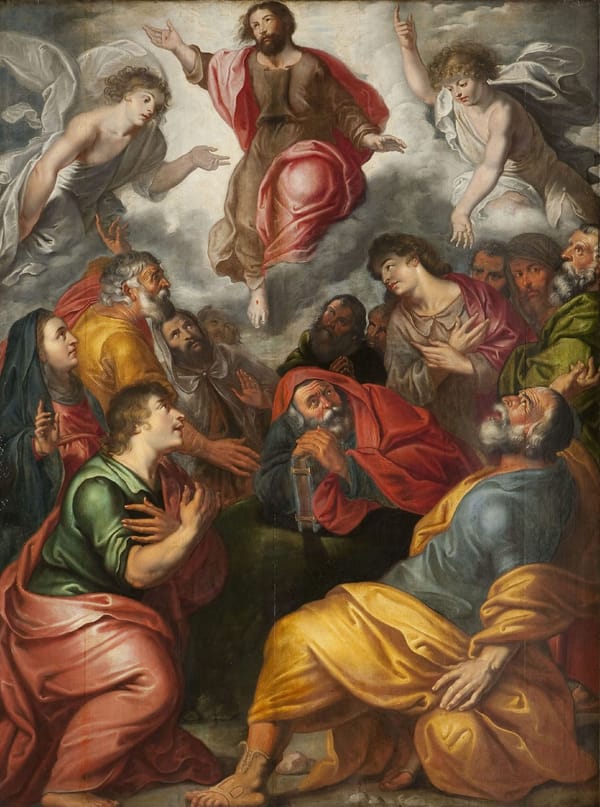
Saturday within the Octave of the Ascension
Jesus, then, the Man who dwelt on the earth and was perfect in all holiness, has ascended into heaven. This earth, accursed of God as it was, has produced the fairest fruit of heaven; and heaven with its gates shut against our race, has had to open them for the entrance of a Son of Adam. It is the mystery of the Ascension; but it is only a part, and it behoves us to know the mystery in its fulness. Let us give ear to the apostle of the Gentiles: ‘God who is rich in mercy, through His exceeding charity wherewith He loved us even when we were dead in sins, hath quickened us together with Christ: and hath raised us up together with Him, and hath made us sit in the heavenly places together with Him.’1 We have celebrated the Pasch of our Saviour’s Resurrection as our own resurrection; we must, agreeably to the apostle’s teaching, celebrate also His Ascension as our own. Let us weigh well the expression: ‘God hath made us sit in the heavenly places together with Christ.’ So then in the Ascension, it is not Jesus alone who ascends into heaven; we ascend thither with Him. It is not He alone that is enthroned there in glory; we are enthroned through and together with Him.
That we may the better understand this truth, let us remember that the Son of God did not assume our human nature with a view to the exclusive glorification of the Flesh which He united to His own divine Person. He came to be our Head. We, consequently, are His members; and where He is, we also are to be; at least, such is His intention, as He implied at the last Supper, when He said: ‘Father! I will that where I am, they also whom Thou hast given Me may be with Me, that they may see My glory which Thou hast given Me.’2 And what is the glory given to Him by His Father? Let us hearken to the royal prophet, who, speaking of the future Ascension, says: ‘The Lord said to my Lord: Sit Thou at My right hand!’3
It is, then, on the very throne of the eternal Father, it is at His right hand, that we shall see Him whom the apostle calls our forerunner.4 We shall be united with Jesus, as members to our Head; so that His glory will be ours; we shall be kings, with His kingship; He will make us partake of all that He Himself has, for He tells us that we are His joint-heirs.5
From this it follows that the august mystery of the Ascension, which began on the day of Jesus’ entrance into heaven, will continue, until His mystical body has received its completion by the ascension of the last of the elect. Look at that countless host of holy souls who were the earliest companions of His triumph: foremost are our first parents; then the patriarchs, the prophets, and the just of every generation of the preceding four thousand years! They had been imprisoned in limbo, but He liberated them, gave them of His own brightness, and made them His partners in the glory of His Ascension. They were His trophy; they formed His court, as He passed from earth to heaven. Well did we exclaim in the words of holy David: ‘Sing to God, ye kingdoms of the earth! Sing ye to the Lord. Sing ye to God, who mounteth above the heaven of heavens, towards the east.’6
The angels were ready to receive our Emmanuel; and then began that sublime dialogue, which the royal psalmist was permitted to hear and prophesy. The glad countless legion of the holy souls, who escorted the divine conqueror, cried out to the guardians of the heavenly Jerusalem: ‘Lift up your gates, O ye princes! Be ye lifted up, O eternal gates! and the King of glory shall enter in.’ The faithful angels replied: ‘Who is this King of glory?’ ‘It is the Lord,’ responded the elect of earth: ‘It is the Lord who is strong and mighty; the Lord mighty in battle.’ Well might they say this of our Jesus, who had vanquished satan, death and hell, and brought themselves to the city’s gate as a sample of His stupendous conquest. The angels repeated their question; the saints re-echoed their reply; the eternal gates were thrown open, and the King and His courtiers entered into heaven.7
The gates, then, are opened to receive our Redeemer, and opened He would have them remain for us to follow Him. Admirable Ascension! oh, let us linger in its contemplation! Jesus inaugurates the grand mystery by His own entrance into heaven, and then perpetuates it by the ascension of His elect of each successive generation. There is a ceaseless procession up to heaven; for some happy souls are ever finishing their purification in purgatory, while some still happier ones are winging their rapid flight direct from this earthly vale of sorrows. Hail, then, O glorious mystery! fruit of the flowers of so many mysteries; term, fulfilment, perfection of our Creator’s decree! Alas! thou hadst a long interruption by Adam’s sin; but Jesus’ triumph restored thy reign on earth, and this earth shall live in thy beauty and grace till that word shall be uttered by the angel: ‘Time shall be no more!’8 O mystery of joy and hope, be thou accomplished in me!
Permit us, then, O Jesus, to apply to ourselves what Thou saidst to Thine apostles: ‘I go to prepare a place for you!’9 This has been Thy aim in all Thou hast done for us: Thou camest into this world to open heaven for us. Thy holy bride, the Church, bids us fix our eyes on heaven; she points to its opened gates, and shows us the bright track through which is passing up from earth an unbroken line of souls. We are still in exile; but the eye of our faith sees Thee in that land above, Thee the Son of Man throned at the right hand of the Ancient of days.10 How are we to reach Thee, dear Jesus? We cannot, as Thou didst, ascend by our own power: Thou must needs fulfil Thy promise, and our desire, of drawing us to Thyself.11 It was the object after which Thy blessed Mother also sighed, when Thou didst leave her on earth; she longed for the blissful hour of Thy taking her to Thyself, and awaited Thy call with faith, labouring meanwhile for Thy glory, and living with Thee, though not seeing Thee. Give us to imitate the faith and love of this Thy Mother, that so we may apply to ourselves those words of Thine apostle: ‘We are already saved, by hope.’12 Yes, we shall be so, if Thou send us, according to Thy promise, the holy Spirit whom we so ardently desire to receive; for He is to confirm within us all that Thy mysteries have produced in our souls; He is to be to us a pledge of our future glorious ascension.
In presenting our petitions this day to heaven, let us take, as addressed to ourselves, the sublime instructions given by the Gothic Church of Spain, on the Ascension feast, to her children.
Missa
May 31: St. Petronilla
THOUGH the Church makes but a simple commemoration of this illustrious virgin in the office of this day, we will not fail to offer her the homage of our devout veneration. On the twelfth of this month we kept the feast of the noble virgin and martyr, Flavia Domitilla; it is probable that Aurelia Petronilla was also of the imperial family of the Flavii. The early traditions of the Church speak of her as being the spiritual daughter of the Prince of the Apostles; and though she did not, like Domitilla, lay down her life for the faith, yet she offered to Jesus that next richest gift, her virginity. The same venerable authorities tell us also that a Roman Patrician, by name Flaccus, having asked her in marriage, she requested three days for consideration, during which she confidently besought the aid of her divine Spouse. Flaccus presented himself on the third day, but found the palace in mourning, and her family busy in preparing the funeral obsequies of the young virgin, who had taken her flight to heaven, as a dove that is startled by an intruder’s approach.
In the eighth century, the holy Pope Paul I had the body of Petronilla taken from the cemetery of Domitilla, on the Ardeatine Way. Her relics were found in a marble sarcophagus, the lid of which was adorned, at each corner, with a dolphin. The Pope had them enshrined in a little church, which he built near the south side of the Vatican Basilica. This church was destroyed in the sixteenth century, in consequence of the alterations needed for the building of the new Basilica of St Peter; and the relics of St Petronilla were translated to one of its altars on the west side. It was but just that she should await her glorious resurrection under the shadow of the great Apostle who had initiated her in the faith, and prepared her for her eternal nuptials with the Lamb.
Thy triumph, O Petronilla, is one of our Easter joys. We lovingly venerate thy blessed memory. Thou didst disdain the pleasures and honours of the world, and thy virginal name is one of the first on the list of the Church of Rome, which was thy mother. Aid her now by thy prayers. Protect those who seek thine intercession, and teach us how to celebrate, with holy enthusiasm, the solemnities that are soon to gladden us.
| Previous May 30 (the Same Day): St. Joan of Arc, Virgin | Next May 31: St. Petronilla |