Daily reading
Semidouble · Movable from Easter · Temporal
June 2, 2025
From Dom Guéranger’s The Liturgical Year.
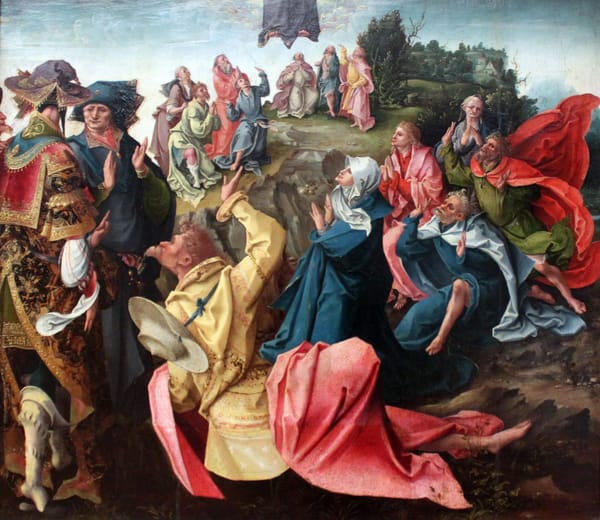
Monday within the Octave of the Ascension
The kingship over men is not the only diadem given to our Emmanuel at His Ascension. The apostle expressly tells us that He is, moreover, ‘the Head of all principality and power.’1 Noble indeed is man; hut nobler far are the glorious choirs of the angelic hierarchy. We have already seen that in the great trial, whereby God tested the love of His angels, many rebelled and were oast into hell; the rest, who were faithful, entered at once into the possession of their sovereign good, and began round the throne of God their ceaseless hymns of adoration, love, and thanksgiving.
But a portion of their happiness was reserved till the fulfilment of one of God’s decrees. Laden as they are with the most magnificent gifts, they await another; it is to be the completion of their joy and glory. God revealed to them, at the first instant of their coming into existence, that He intended to create other beings, of a nature inferior to their own; and that of these beings, who were to be composed of body and soul, there should be one, whom the eternal Word would unite to Himself in unity of Person. It was also revealed to them, that this human Nature, (for whose glory and for God’s, all things were made), was to be the first-born of every creature;2 that all angels and men would have to bend the knee before Him; that after suffering countless humiliations on earth, He would be exalted in heaven; and finally that the time would be, when the whole hierarchy of heaven, the Principalities and Powers, yea, even the Cherubim and Seraphim, would have Him placed over them as their King.
The angels, then, as well as men, looked forward to the coming of Jesus. The angels awaited Him that was to confer upon them their final perfection, give them unity under Himself as their head, and bring them into closer union with God by the union of the divine and created Natures in His own Person. As to us men, we awaited Him as our Redeemer and our mediator: as our Redeemer, because sin had closed heaven against us, and we needed one that would restore us to our inheritance; as our mediator, because it was the eternal decree of God to communicate His own glory to the human race by union with Himself. Whilst, therefore, the just ones on earth, who lived before the Incarnation, were pleasing to God by their faith in this future Redeemer and mediator, the angels in heaven were offering to the divine Majesty the homage of their proffered service of this Man-God, their future King, who, in virtue of the eternal decree, was ever present to the Ancient of days.3
At length the fulness of time came,4 and God, as the apostle expresses it, ‘brought into the world His first-begotten’,5 the prototype of creation. The first to adore the new-born King were not men, but the angels, as the same apostle assures us.6 The royal prophet hed foretold that it would be so.7 And was it not just? These blessed spirits had preceded us in their longings, not indeed for a Redeemer,—for they had never sinned,—but for a mediator, who was to be the link of their closer union with infinite beauty, the object of their eternal delight; in a word, who was to fill up the void there seemed to be even in heaven, by taking the place destined for Him.
Then was accomplished that act of adoration of the Man-God, which was demanded of the angels at the first moment of their creation, and which, according to its being complied with or refused, decided the eternal lot of these noble creatures. With what love did the faithful angels adore Jesus, the Word made Flesh, when they beheld Him in His Mother’s arms at Bethlehem! With what transports of joy did they announce to the shepherds, and to us through them, the glad tidings of the birth of our common King!
As long as He lived upon this earth and submitted to every humiliation and suffering in order to redeem us from sin and make us worthy to become His members, the blessed spirits ceased not to contemplate and adore Him. The Ascension came; and from that day forward, it is on the throne prepared at the Father’s right hand that they behold and adore their Lord and King. At the solemn moment of Jesus’ Ascension, a strange joy was felt in each choir of the heavenly hierarchy, from the burning Seraphim to the Angels who are nearest to our own human nature. The actual possession of a good, whose very expectation had filled them with delight, produced an additional happiness in those already infinitely happy spirits. They fixed their enraptured gaze on Jesus’ beauty, and were lost in astonishment at seeing how Flesh could so reflect the plenitude of grace that dwelt in that human Nature as to outshine their own brightness. And now, by looking on this Nature (which, though inferior to their own, is divinized by its union with the eternal Word), they see into further depths of the uncreated sea of light. Their love is more burning, their zeal is more impetuous, their hymns are more angelic; for, as the Church says of them, the Angels and Archangels, the Powers and Dominations, the Cherubim and Seraphim, praise the majesty of the Father through His Son Jesus Christ: per quem majestatem tuam laudant angeli.
Add to this the joy these heavenly spirits must have experienced at seeing the immense multitude that accompanied Jesus from earth to heaven. These, according to their respective merits, were divided among the various choirs, and placed on thrones left vacant by the fallen angels. Their bodies, are not yet united to their souls; but is not their flesh already glorified in that of Jesus? When the time fixed for the general resurrection comes, the trumpet of the great archangel will be heard,8 and then these happy souls will again put on their ancient vesture, the mortal made immortal. Then will the holy angels, with fraternal enthusiasm, recognize in Adam’s features a likeness of Jesus, and in those of Eve a likeness of Mary, and the resemblance will even be greater than it was when our first parents were innocent and happy in the garden of Eden. Come quickly, O thou glorious day, whereon the bright mystery of the Ascension is to receive its final completion, and the two choirs of angels and men are to be made one in love and praise under the one Head, Christ Jesus!
It is St. Ambrose who is to help us to-day, by the following beautiful hymn, to celebrate the mystery of the triumph of our human nature in Jesus. The hymn is inserted in the breviary of Milan.
Hymn
Sacratus illuxit dies
Quo Christus, mundi spes, Deus,
Conscendit cœlos arduos.
Propriam ad sedem remeans,
Gavisa sunt cœli regna,
Reditu Unigeniti.
Mundi perempto principe,
Patris præsentat vultibus
Victricis carnis gloriam.
Et spem fecit credentibus,
Aperiens paradisum,
Quem protoplastus clauserat.
Quod partus nostræ Virginis,
Post sputa, flagra, post crucem,
Paternæ sedi jungitur.
Nostræ salutis vindici,
Nostrum quod corpus vexerit
Sublimem ad cœli regiam.
Commune manens gaudium,
Illis quod se præsentavit,
Nobis quod se non abstulit.
Christum exspectare nos decet,
Vitaque tali vivere,
Quae possit cœlos scandere.
Qui scandis super sidera,
Cum Patre et sancto Spiritu
In sempiterna saecula.
hath shone upon us: the day whereon Christ our God,
the hope of the world,
ascended to the highest heavens.
returning to his rightful throne,
the kingdom of heaven rejoiced,
for it was the return of the Only-begotten of the Father.
Having defeated the prince of this world,
Jesus presents to his Father the Flesh
that had won the glorious victory.
and opening the gate of heaven,
which our first parent had closed against us,
he inspired believers with hope.
that the Son of our Virgin-Mother,
after being spit upon, and scourged, and crucified,
was placed upon his Father’s throne!
and wrought our salvation,
for that he took our flesh
and made it dwell in the heavenly courts above.
between the angels and us;
they rejoice because he offered himself to their delighted gaze;
we, because he ceased not to be our Brother.
by the practice of virtues of which he has set us the example,
to await our union with Christ,
and so to live as to merit our ascension into heaven.
who ascendest above the stars!
and to the Father, and to the Holy Ghost,
for everlasting ages.
We may use this prayer of the Mozarabic breviary wherewith to close the day.
June 2: Sts. Marcellinus, Peter, and Erasmus, Martyrs
THE glory of martyrdom illumines this day with a profusion rarely met with in the cycle; and already we seem to descry the rosy dawn of that brightest day of this month, on which Peter and Paul will consummate in their blood their own splendid confession. Italy and Gaul, Rome and Lyons concur in forming a legion of heroes in the service of heaven. For to-day Lyons, the illustrious daughter of Rome, is keeping the special festival of a whole phalanx of warriors, headed by the veteran chief, St Pothinus, disciple of St Polycarp, who, in the second century, levied the brave recruits of his battalion on the banks of the Rhone.1 But to the mother Church are due the first honours. Let us, then, hail Marcellinus, together with the numerous progeny begotten by his fruitful priesthood, and rendered worthy by the Holy Ghost to share in his triumph. Let us hail, likewise, the exorcist, Peter, leading to the sacred font a long line of pagans whom he won over to Christ by proving to them the weakness of the demons.
When Christianity appeared on earth, Satan was visibly the prince of this world. To him was every altar reared; to his empire were all laws and customs subservient. From the depths of their famous temples, the demon chiefs directed the political affairs of the cities that came to consult their oracles; under divers names the lowest of the fallen angels found honour and influence at the domestic hearth; others had functions assigned to them, in forests, on mountains, at fountains, or on sea, occupying, in opposition to God, this world that had been created by him for his glory, but which Satan, through man’s connivance, had conquered. Four thousand years of abandonment on the part of heaven permitted the usurper to consolidate his conquest; and a strong defence had been planned in preparation for the day on which the lawful King should offer to re-enter on his rights.
The coming of the Word made Flesh was the signal for the assertion of the divine claim. The prince of this world, personally vanquished by the Son of God, understood well enough that he must needs return to the depths of hell. But the countless powers of darkness constituted by him would maintain the struggle through the length of ages, and dispute their position inch by inch. Driven from towns by the abjurations of holy Church and the triumph of martyrs, the infernal legions would fain marshal their ranks in the wilderness; there, under the leadership of an Anthony or a Pachomius, the soldiers of Christ must wage against them ceaseless and terrific battle. In the west, Benedict, the patriarch of monks, finds altars to the demons, and even demons themselves, on the heights of Cassino as late as the sixth century. Even in the seventh, they are found contending against St Gall for possession of the woods, lakes and rocks of what we now call Switzerland; and at last they are heard uttering mournful complaint, because, driven from the haunts of men, even such desolate spots as these are denied them. Verily, in the divine mind, the vocation of a monk to the desert has for itsend, not only flight from the world and its concerns, but likewise the pursuit of demons into their last entrenchments.
We have dwelt upon these considerations because their importance is extreme, and because this subject is now systematically ignored. True Christians firmly believe, now as formerly, in the spiritual combat which the soul has to sustain against hell, in the secrecy of conscience; but too many have no scruple in rejecting, as if belonging to the domain of the imagination, whatever is related of the public combats maintained by our fathers against the demons. The excuse for such Christians is, no doubt, the fact that they live in a land where this external war was ended centuries ago by the social victory of Christendom. But the Holy Ghost has declared that the old serpent, bound up for a thousand years, is at last to be again unchained for a while.2 If we be nearing this fatal epoch, it is high time to look about us; we shall be ill prepared for waging the old battles, if we persist in our ignorance, and in branding with the name of legend the best attested facts in the history of our ancestors. After all, what is history, since the revolt of Lucifer, but a picture of the war that is being waged between God and Satan? Now if Satan has, by divine permission, invaded the exterior world as well as that of souls, must not the struggle to cast him out3 be a hand to hand fight, an exterior and visible encounter?
‘The Word,’ says St Justin, ‘was made Flesh for two ends: to save believers, and to drive away demons.’4 So also, the expulsion of demons from the places they occupy in this material world, and specially in the noblest part thereof, the bodies of men, appears in the Gospel to have been one of the chief characteristics of our Saviour’s power. Again, when on quitting the earth he sent his apostles to continue his work amidst the nations, this is the very thing he singled out as a primary sign of the mission they were to fulfil.5 The world of that day made no mistake about it. Soon enough had the pagans to witness the cessation of the ancient oracles in every place;6 and the cause of a phenomenon of such import to the ancient religion was evident to all: the very demons themselves were not backward in ascribing to the Christians their enforced silence. As regards this power of Christianity against hell, the apologists of the second and third centuries appeal on the subject to public testimony, without fear of contradiction. ‘Before the eyes of everyone,’ says St Justin to the emperors, ‘ the Christians drive out demons in the name of Jesus Christ, not only in Rome, but in the whole universe.᾽7 The gods of Olympus beheld themselves shamefully unmasked, in the presence of their confused adorers, and Tertullian might well challenge the magistrates of the empire thus: ‘Let one of those men who declare themselves to be under the power of the gods, be brought before your tribunals: at the command of the first comer amongst us, the spirit whereby they are possessed will be constrained to confess what he is; if he avow not himself a demon and no god, fearing to lie to a Christian, at once shed the blood of this Christian blasphemer. But no; it is the terror they have of Christ that forces them to take flight at the mere touch or even the breath of one of his servants.᾽8
Baptism sufficed to give man such power as this; and this was the real meaning of our Lord’s promise, when speaking not only of the heads of the Church, but of all who would believe in him, he said: ‘In my name they shall cast out devils.᾽9 At an early date, however, the Church, organizing the holy war, constituted among her sons one special Order having for its direct mission the pursuit of Satan on every point of this visible world. The exorcists were, by this delegation, invested with a power that accelerates the downfall of the prince of this world; and to render this defeat more odious and humiliating the Church raised no higher than to the rank of inferior clergy an Order so terrible to hell. Lucifer had aimed at being equal to the Most High;10 hurled down from heaven, he flattered himself in his folly that he would be able to supplant God upon the earth: and lo! the charge of defeating him here is confided not to angels, his equals by nature, but to men, and even to the least of this credulous race which for long ages he had seen prostrate before him! Their hand of flesh constrains him, spirit though he be, to come off his throne; at their word he must needs cast away his vain adornments, he must unmask himself; the water they bless rekindles within him his eternal tortures; of the prince of this world and his pomps nought remains but mere Satan, the ugly-faced apostate, the condemned criminal wincing in the dust at the feet of the sons of men, or fleeing like a dry leaf before the breath of their mouth.
The archangel Michael recognizes, in these sons of Adam, the worthy allies of the faithful angels he led forward to victory. But amid those who continue the mighty battle begun on the heights of heaven,11 the exorcist Peter comes before us to-day radiant with matchless splendour. The triumph of martyrdom has been added to his victories won over Satan's cohorts. None better than he drove hell back; for, chasing the demons out of men’s bodies, he moreover made conquest of their souls. The priest Marcellinus, the companion of his victories and martyrdom, is likewise his associate in glory. The Church wishes that these two names, so formidable to the spirits of darkness, should shine in one same aureole here below as in heaven. Daily does she render them the most solemn homage in her power by naming them both, on the diptych of the holy Sacrifice, together with the apostles and her first sons. Such was the importance of the mission they fulfilled and the renown of their final combat, that their bodies, translated to the Via Latina, became the nucleus of an illustrious cemetery. In the age of peace, that came soon after their glorious confession, the Christians vied with one another in obtaining sepulture near these soldiers of Christ, whose protection they craved. Constantine the Great, the vanquisher of idolatry, deposited at their sacred feet the remains of his mother, St Helena, who had herself become a terror to the demons by her discovery of the true Cross. A celebrated inscription was composed in their honour by St Damasus, who in childhood had learned the details of their martyrdom from their executioner himself after his conversion; this inscription, near their tomb, completed the monuments of that catacomb wherein Christian art had multiplied its richest teachings.
To the memory of Saints Marcellinus and Peter is joined, in the liturgy of to-day, the name of a holy bishop and martyr, formerly well known to the faithful. If the acts of his life which have reached us are not free from all reproach from a critical point of view, the favours obtained by the intercession of St Erasmus or Elmo wafted his name over the whole of Christendom, as is attested by the numberless forms this name assumed in various countries of the west during the middle ages. He holds a place in the group of saints styled auxiliatores or helpers, whose cultus is widespread particularly in Germany and Italy. Mariners look upon him as their patron, because of a certain miraculous voyage related in his life; one of the tortures to which he was subjected during his martyrdom has caused him to be invoked for colic. Nor should we forget to mention here how great a veneration St Benedict, the patriarch of western monks, had for St Erasmus; when he quitted the Campagna for his solitude on the banks of the Anio, he marked his principal station between Subiaco and Monte Cassino, by building a church and monastery at Veroli under the invocation of this holy martyr; he dedicated another in Rome itself to St Erasmus.
Let us now read the few lines devoted by the Church to the memory of our three Saints.
Holy martyrs, you all confessed Jesus Christ, in the midst of the most terrific storm ever raised by the demon against the Church. Though all three in different grades of the hierarchy, you were alike guides of the Christian people, drawing them by thousands in your train, into the arena of martyrdom, and, by still more numerous conversions, filling up the void made in earth's chosen band by the departure of your victorious companions to heaven. Wherefore the Church this day joins her grateful homage here below, with the congratulation that rings through the Church triumphant. Be propitious, as of yore, in alleviating the ills that overwhelm mankind in this vale of tears. The excess of man's misery is that he seems to have forgotten how to call on such powerful protectors in his hour of need. Revive your memory, in our midst, by new benefits to our race.
As thou, O Erasmus, wast formerly protected by heaven, do thou now, in thy turn, succour those who are a prey to the tempest-tossed sea. In thy last hour of bitter anguish, thou didst suffer thine executioners to tear thy very bowels; lend a kindly aid to such as call upon thy name when racked by pains which bear some resemblance, though but faint, to what thou didst endure for Christ.
Peter and Marcellinus, linked one to another both in toil and in glory, cast gentle eyes upon us: one glance of yours would make all hell to tremble, and would drive far from us its cohorts. But how much is your aid needed in society at large, in the whole visible world! The foe you so mightily thrust backwards into the fiery pit is once more master. Alas! have we come to the time in which, again taking up war against the saints, it shall be granted him to overcome them?12 Scarce does he even hide himself nowadays. Societies which formerly worked in secret have now openly surrendered to him a thousand sources of evil; he may be seen trying to push his way into gatherings of all sorts, into the very bosom of homes, as a family guest, as a comrade in diversion or in business, with table-turning and all those processes for divination, such as Tertullian denounced in your early day.13 The expulsion of demons by Christianity had been so absolute that, up to more recent times, such fatal practices had fallen into utter oblivion amongst us. If at first, in Christian families, the warning voice of the pastors of God's Church has prevailed over the incitements of an unhealthy curiosity, a sect has since been formed, in which Satan is sole guide and oracle. The spiritists, as they are called, in concert with freemasonry, are preparing the way for the final invasion of the exterior world by infernal bands. Antichrist, with his usurped power and vain prestige, will be but the common product of political lodges and of this sect which proposes to bring back, under a new form, the ancient mysteries of paganism. Valiant soldiers of the Church, make us, we beseech you, worthy of our forefathers. If the Christian army must needs decrease in numbers, let its faith wax all the stronger; let its courage neither fail nor go astray; may its ranks be seen facing the foe, at that last hour in which the Lord Jesus will slay, with the breath of his mouth, the man of sin,14 and plunge once again and for ever the whole of Satan's crew down into the lowest depths of the bottomless pit.
- Note of the Translator. Ss. Pothinus, Blandina, and companions, martyrs of Lyons, are marked on this day in the Roman Martyrology, but as the feast is kept only in France, we have omitted in our translation the pages devoted to their memory in this place. ↩︎
- Apoc. xx 2, 3. ↩︎
- St John xii 31. ↩︎
- 2 Apol. vi. ↩︎
- St Mark xvi 17. ↩︎
- Plutarch, De oraculor. defectu. ↩︎
- 2 Apol. vi. ↩︎
- Apol. xxiii. ↩︎
- St Mark xvi 17. ↩︎
- Is. xiv 12-15. ↩︎
- Apoc. xii 7-9. ↩︎
- Apoc. xiii 7. ↩︎
- Apolog. xxiii. ↩︎
- 2 Thess. ii 8. ↩︎
| Previous June 1 [May 31]: St. Angela de Merici, Virgin | Next June 2: Sts. Marcellinus, Peter, and Erasmus, Martyrs |