Daily reading
Semidouble · Movable from Easter · Temporal
June 3, 2025
From Dom Guéranger’s The Liturgical Year.
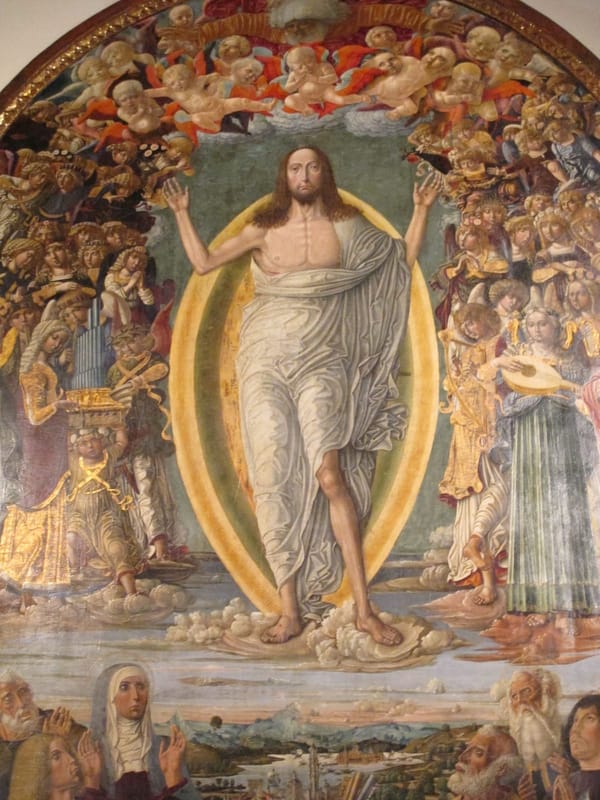
Tuesday within the Octave of the Ascension
The Lord of glory has ascended into heaven, and, as the apostle says, He has gone thither as our forerunner;1 but how are we to follow Him to this abode of holiness, we whose path is beset with sin, we who are ever needing pardon rather than meriting anything like glory? This brings us to another consequence of the exhaustless mystery of the Ascension; let us give it our closest attention. Jesus has gone to heaven, not only that He may reign as King, but also that He may intercede for us as our High Priest, and, in this quality, obtain for us both the pardon of our sins and the graces we need for following Him to glory. He offered Himself on the cross as a victim of propitiation for our sins; His precious Blood was shed as our superabundant ransom; but the gate of heaven remained shut against us, until He threw it open by His own entrance into that sanctuary, where He was to exercise His eternal office of’Priest according to the order of Melchisedech.’2 By His Ascension into heaven, His priesthood of Calvary was transformed into a priesthood of glory. He entered with the veil of His once passible and mortal Flesh,3 within the veil of His Father’s presence, and there is He our Priest for ever.
How truly is He called Christ, that is,’the Anointed!’ for, no sooner was His divine Person united to the human Nature, than He received a twofold anointing: He was made both King and High Priest. We have already meditated upon His kingship; let us now contemplate His priesthood. He gave proofs of both during His life among us on earth; but it was only by His Ascension that their unclouded splendour was to be declared. Let us, then, follow our Emmanuel, and see Him as our High Priest.
The apostle thus describes the office of a high priest.’He is taken from among men, and is ordained for men in the things that appertain to God that he may offer up gifts and sacrifices for sins’:4 he is appointed their ambassador and mediator with God. Jesus received this office and ministry, and He is fulfilling it in heaven. But, that we may the better appreciate the grand mystery, let us study the figures given of it in the holy Scriptures, and developed by St. Paul in his sublime Epistle; they will give us a precise idea of the grandeur of our Jesus’ pontifical character.
Let us go in thought to the temple of Jerusalem. First of all there is the spacious uncovered court with its porticoes; in the centre stands the altar, whereon are slain the victims of the various sacrifices, and from the altar there radiate a number of conduits, through which flows the blood. We next come to a more sacred portion of the edifice; it is beyond the altar of holocausts, is covered in, and is resplendent with all the riches of the east. Let us respectfully enter, for the place is holy, and it was God Himself who gave to Moses the plan of the various fittings which adorn it with their mysterious and rich beauty: the altar of incense, with its morning and evening cloud of fragrance; the seven-branched candlestick, with its superb lilies and pomegranates; the table of the loaves of proposition, representing the offering made by man to Him who feeds him with the harvests of the earth. And yet it is not here, though the walls are wainscoted with the bright gold of Ophir, that is centred the great majesty of Jehovah. At the extreme end of the temple there is a veil of precious texture, richly embroidered with figures of the Cherubim, and reaching to the ground: it is there, beyond this veil, that the God of Abraham, Isaac, and Jacob, has fixed the abode of His presence; it is there, also, that rests the ark of the covenant, over which two golden Cherubim spread their wings. It is called the Holy of holies, and no one, under pain of death, may draw aside the veil, or look, or enter within the hallowed precinct, where the God of hosts deigns to dwell.
So then, man is banished from the place wherein God dwells; he is unworthy to enter into so holy a presence. He was created that he might see God and be eternally happy with that vision; but, because of sin, he is never to enjoy the sight of God. There is a veil between himself and Him who is his last end; neither can he ever remove that veil. Such is the severe lesson given to us by the symbolism of the ancient temple.
But there is a merciful promise, and it gives a gleam of hope. This veil shall one day be raised up, and man shall enter within: on one condition, however. Let us return to the figurative temple, and we shall learn what this condition is. As we have already noticed, none was allowed to enter the Holy of holies; there was but one exception, and that was in favour of the high priest, who might, once a year, penetrate beyond the veil. Yet even he had certain conditions to observe. If he entered without holding in his hands a vessel containing the blood of two victims, previously immolated by him for his own and the people’s sins, he was to be put to death; if, on the contrary, he faithfully complied with the divine ordinances, he would be protected by the blood he carried in his hands, and might make intercession for himself and all Israel.
How beautiful and impressive are these figures of the first covenant! but how much more so their fulfilment in our Jesus’ Ascension! Even during the period of His voluntary humiliations, He made His power felt in this sacred dwelling of God’s Majesty. His last breath on the cross rent the veil of the Holy of holies, hereby signifying to us that man was soon to recover the right he had lost by sin, the right of admission into God’s presence. We say soon; for Jesus had still to gain the victory over death, by His Resurrection; He had to spend forty days on earth, during which He, our High Priest, would organize the true priesthood that was to be exercised in His Church to the end of time, in union with the priesthood He Himself was to fulfil in heaven.
The fortieth day came, and found all things prepared: the witnesses of the Resurrection had proclaimed the victory of their master; the dogmas of faith had all been revealed; the Church had been formed; the sacraments had been instituted: it was time for our High Priest to enter into the Holy of holies, accompanied by the holy souls of limbo. Let us follow Him with the eye of our faith. As He approached, the veil, that had closed the entrance for four thousand years, was lifted up. Jesus enters. Has He not offered the preparatory sacrifice?—not the figurative sacrifice of the old law, hut the real one of His own Blood P And having reached the throne of the divine Majesty, there to intercede for us His people, He has but to show His eternal Father the wounds He received, and from which flowed the Blood that satisfied every claim of divine justice. He would retain these sacred stigmata of His sacrifice, in order that He might ever present them, as our High Priest, to the Father, and so disarm His anger.’My little children,’ says St. John in his first Epistle, ‘I write these things to you, that ye may not sin; but, if any man do sin, we have an advocate with the Father, Jesus Christ the just.’5 Thus, then, beyond the veil, Jesus treats of our interests with His Father; He gives the merits of His sacrifice their full efficacy; He is the eternal High Priest, whose advocacy is irresistible.
St. John, who was granted a sight of the interior of heaven, gives us a sublime description of this twofold character of our divine Head,—Victim and yet King, sacrificed and yet immortal. He shows us the throne of Jehovah, round which are seated the four-and-twenty ancients, the four symbolical living creatures, and then the seven spirits burning like lamps before it. But the prophet does not finish his description here. He bids us look at the right hand of Him who sits on the throne. There we perceive a Lamb standing and as it were slain: slain and yet standing, for He is radiant with glory and power.6 We should be at a loss to understand the vision, had we not our grand mystery of the Ascension to explain it; but now, all is clear. We recognize in the Lamb, portrayed by the apostle, our Jesus, the Word eternal, who, being consubstantial with the Father, is seated on the same throne with Him. Yet is He also the Lamb; for He assumed to Himself our flesh, in order that He might be sacrificed for us as a victim; and this character of victim is to be for ever upon Him. Oh! see Him there, in all His majesty as Son of God, standing in the attitude of infinite power, yet withal, He will not part with the semblance of the immolated. The sword of sacrifice has left five wounds upon Him, and He would keep them for eternity. Yes, it is identically the same meek Lamb of Calvary, and He is to be for ever consummating in glory the immolation He perfected on the cross.
Such are the stupendous realities seen by the angels within the veil;7 and when our turn comes to pass that veil, we also shall be enraptured with the sight. We are not to be left outside, as were the Jewish people when, once each year, their high priest entered into the Holy of holies. We have the teaching of the apostle:’The fore-runner, Jesus, our High Priest, has entered within the veil for us.’8 For us! Oh what music there is in these two words: for us! He has led the way; we are to follow! Even at the commencement, He would not go alone; He would have the countless legion of the souls of limbo to accompany Him: and ever since then, the procession into heaven has been one of unbroken magnificence. The apostle tells us that we, poor sinners as we are, are already saved by hope;9 and what is our hope, but that we are one day to enter into the Holy of holies? Then shall we blend our glad voices with those of the angels, the four-and- twenty ancients, the myriads of the blessed, in the eternal hymn:’To the Lamb that was slain, power, and divinity, and wisdom, and strength, and glory, and benediction, for ever and ever! Amen.’10
We offer our readers, to-day, the following sequence, composed by the pious Notker, in the ninth century, for the abbey of Saint Gall.
Sequence
Cunctis concedat esse Christianis,
Amatoribus suis.
Mediator nostrae naturae
Ac divinae.
Æthera novus homo
Transvolans.
Stipant, ad Patrem
Reversurum.
Cum lactanti adhuc
Stella tibi serviret
Et angeli?
Rem novam et dulcem
Dedisti, Domine,
Sperandi cœlestia.
Levando super sidereas metas,
Regum Domine.
Tuos replent apostolos,
Quis dedisti cernere
Te cœlos pergere.
In cœlis tibi occurrunt
Novem ordines,
Diu dispersum a lupis,
Gregem unum,
Bone Pastor,
Tu dignare custodire.
who love him, that this day may be
to them a happy one!
thou unitest in thyself the two natures
of God and Man.
thou the new Man,
didst ascend into heaven.
paid the homage of their service to thee,
when thou returnedst to thy Father;
when we remember how,
when thou wast a Babe at thy Mother’s breast,
a star united with the angels in serving thee?
gavest to the inhabitants of earth
a new and sweet sentiment:
the hope of heaven,
—which thou, O King of kings, hadst truly assumed,
—above the highest stars.
the hearts of thine apostles,
whom thou permittedst to see thee
mounting up to heaven!
did the nine choirs of angels go forth
to meet thee as thou enteredst heaven,
the sheep, thy one flock,
that had long been scattered by wolves!
Good shepherd!
vouchsafe to watch over this thy flock!
Prayer
Prayer
June 3: St. Clotilde, Queen of the Franks
At this season, in which the Office of the time is leading us to consider the early developments of holy Church, eternal Wisdom so arranges, now as ever, that the feasts of the saints should complete the teachings of the movable cycle. The Paraclete, who has but just come down upon us, is to fill the whole earth;1 the Man-God has sent Him expressly to win over the whole earth and to secure all time to His Church. Now, it is by subjecting kingdoms to the faith, that He is to form Christ’s empire;
it is by enabling the Church to assimilate all nations to herself, that He gives growth and continuance to the bride. See, therefore, how at this Season wherein He has but just taken possession of the world anew, His co-operators in this His work of conquest shine out on every side in the heavens of the holy liturgy. But the west above all concurs in forming the magnificent constellation that is mingling its radiant splendour with the fires of Pentecost. Indeed, what could better show the omnipotence of the Spirit of Christ, than the establishment of this Latin Christendom, in these distant lands of the west?
What star is this shining to-day in such silvery beauty on the land of the Franks? The city of Lyons, prepared by the blood of martyrs for this her second glory, sees this new light rise in her midst. Clotilde is a mother; and the cruel sufferings which wrung her heart while she was yet young matured her soul for the grand destinies reserved by God for the privileged children of sorrow. The violent death of her father Chilperic, dethroned by a fratricidal usurper; the sight of her brothers massacred, and of her mother drowned in the Rhone; her long captivity in the Arian court of the murderer who brought heresy with him to the throne of the Burgundians, developed in her the heroism that was to make this niece of Gondebaud become the mother of a whole nation to Christ.
God drew the visible universe out of nothingness, solely to manifest His goodness. In like manner, He has willed that man, coming from His hands without power as yet to recognize his Creator, should recognize, at least, a mother’s tender love, the first sensible ray, as it were, of infinite love. Irresistible is this ray, sublime in its gentleness, exquisite in its purity, giving to the mother a facility, belonging only to her, to complete in the soul of her child the reproduction of the divine ideal that is to be impressed upon him. Now this she does by education. To-day’s feast reveals how much more sublime, more potent, more extensive, is maternity in the order of grace than in that of nature. For when God, coming down amongst us, was pleased, to take Flesh of a daughter of Adam, maternity was raised in her to the extreme limit that separates the endowments of a simple creature from the divine attributes. Thus rising above the heavens, maternity at the same time embraced the world, bringing all mankind together into close union, without distinction of nation or family, in the one filiation of that Virgin-Mother. The new Adam, the perfect model of our race, and our first born,2 willed to have us for His brethren, in all fullness, brethren in Mary as in God.3 The Mother of God was then proclaimed Mother of men on Calvary; from the summit of the cross, the Man-God replaced upon the brow of Mary that diadem of Eve, broken beneath the fatal tree. Constituted sole Mother of the living by this noble investiture,4 our Lady once again participated in the privileges of the Father who is in heaven. Not only was she Mother by nature, as He is Father, of His Son; but, just as all paternity flows down from the eternal Father, and borrows thence supereminent dignity; so from that moment, all maternity was nought but an outflow of Mary’s in the truest sense; a delegation of her love, and a communication of her august privilege whereby she brings forth men unto God, whose sons they are to be.
Good reason, therefore, have Christian mothers to glory in their maternity, for in that does their greatness consist; through Mary, their dignity has increased to a degree that nature could never have dreamed of. But at the same time, under the aegis of Mary, not less real is the maternity of holy virgins, not only in God’s eyes, but often manifested to their own: the wife, too, prepared by a special call from God and by suffering, is sometimes, like Clotilde, endowed with a fecundity of a spiritual order, a thousand times more prolific than that of earth. Happy the fruits of this supernatural maternity, which under the favour of Mary is fraught with so much greatness! Happy the nations on whom the divine munificence has bestowed a mother!
History tells us how the founders of empires have ever had the terrible prerogative of impressing upon nations the distinctive character, disastrous or beneficial, which, through length of ages, continues to be theirs. How often does that want of counterpoise to the preponderance of power, make itself only too evident in the impetus given rather to destroy than to build up! And wherefore? Because ancient empires never had a mother; for this noble title cannot be applied to those heroines who have transmitted their names to posterity merely for having rivalled the ambition and pomp of conquerors. To Christian times it was reserved to behold introduced into a people’s life this element of maternity, more salutary, more efficacious in its humble gentleness, than that which springs from the talents or vices, from the power or genius, of their first princes.
Time was needed to subdue the savage instincts of the warriors of Clovis, and to fit his sword to the noble destiny that awaited it in the hand of a Charlemagne, or of a St. Louis. With good reason has it been said that the honour of this labour is due to the bishops and the monks. But to be more accurate and to prove a deeper insight into the ways of divine Providence, it would have been well, perhaps, to pass less lightly over woman’s part in the work of conversion and of education, which made the Frankish nation become the eldest son of the Church. Clotilde it was who led the Franks to the baptistery of Rheims, and presented to Remigius the proud Sicambrian, transformed far less by the exhortations of the holy bishop than by the force of prayer, the prayer of that strong woman elected by God to bear away this rich spoil from the camp of hell. What manly energy, what devotedness to God, are displayed in every measure taken by this noble daughter of the Burgundians’ dethroned king! Beneath the suspicious eye of the usurper, the murderer of her family, she awaits, in the silence of prayer and in the exercise of charity, heaven’s appointed hour. When at last the moment comes, taking counsel of none save the Holy Ghost and her own heart, how nobly does she dart forward to conquer unto Christ her betrothed, though yet a stranger to her, out-doing in valour, in this instance, all the warriors of her escort! Strength and beauty were indeed her covering,5 her adornment on her bridal day; and the heart of Clovis soon learnt that the conquests reserved to his bride far out-stripped in importance the booty he had hitherto seized by force of arms. Clotilde, on the other hand, found her work already prepared on the banks of the Seine. For fifty years, St. Genevieve had been busy defending Paris against the pagan hordes, and only awaiting the Baptism of the king of the Franks in order to open to him the city gates.
Still, when on that Christmas night Clotilde gave birth to the eldest son of holy Church in Mary’s name, the great work was far from being completed; this new-born people had yet, by the slow process of a laborious education to be fashioned into the most Christian nation. This chosen one of God and of our Lady does not fall short of the maternal task. But still what anguish of heart to be endured, what tears yet to be shed over these her sons, whose inborn violence seems simply indomitable, and the very exuberance of whose rich nature yields them up to the fury of passions, urging them blindly on to crimes the most atrocious! Her grand-children, inveigled from her side and caught in the perfidious trap laid for them by their faithless uncles, are massacred. Fratricidal wars carry devastation over the whole of that territory of ancient Gaul, purged by her from paganism and heresy. Finally another pang, but one of a more glorious kind, seems given as a compensation for the bitterness of intestine strife. Her cherished daughter, Clotilde the younger, dies, worn out by ill usage endured for her faith at the hand of her Arian husband. Surely all this must have shown clearly enough to the queen of the Franks, that if she was chosen by heaven to be their mother, she was to have all the pangs as well as the honour that title involves. Thus does Christ ever deal with His own, when they have earned His confidence. Clotilde well understood this: already a widow and deprived by death of the aid of Genevieve likewise, she had long ago retired to Tours, near to the sepulchre of the Thaumaturgus of the Gauls. There, in the secret of prayer and in the heroism of her childhood’s faith, did she continue, aided by St. Martin, the preparation of this new people for its mighty destinies.
An immense work was this, and one for which no single life-time could suffice! But though Clotilde was not to witness the desired transformation accomplished, her life was not to close until she had pressed to her heart, at Tours, her illustrious daughter-in-law, Radegonde; and having by this last embrace invested her with her own sublime maternity, she sends her to Poitiers, there to continue, at the tomb of St. Hilary, this great work of intercession. Then, when at length Radegonde herself, having ended her task of suffering and love, must likewise quit this earth, Bathilde will presently come forward to consummate the work, in that remarkable seventh century, when ‘the Frank, at last ready for his mission, is betrothed to holy Church, and dubbed a knight of God.’6
Clotilde, Radegonde, Bathilde, all three of them mothers of France, bear a striking resemblance to one another. All three are prepared, from the early dawn of life, to the devotedness their grand mission would require, by the like trials, captivity, slavery, and massacre or loss of their own relatives: all three bring to the throne nought but a dauntless love of Christ, the King, and a desire of seeing Him rule the people; all three set aside the queenly diadem as soon as may be, in order to be able, prostrate before God in retirement and penitence, to attain more surely the one object of their maternal and royal ambition. Heiresses of Abraham, in very deed, they found in his faith7 the fecundity which made them mothers of those countless multitudes, which the soil watered by their tears produced for heaven. Even in these weakened times of ours, there is still a goodly throng ever passing from the land of the Franks to their true home yonder, there to join the happy bands of the combatants of better days. At the sight of this ever increasing group of sons joyously pressing round their thrones, the hearts of Clotilde, Radegonde, and Bathilde, overflowing with love, give utterance in one united cry, to this word of the Prophet: ‘Who hath begotten these? I was barren and brought not forth, led away, and captive: and who hath brought up these? I was destitute and alone: and these where were they?’ Then the Lord answering, saith: ‘As I live, thou shalt be clothed with all these as with an ornament, and as a bride thou shalt put them about thee. For thy deserts, and thy desolate places, and the land of thy destruction shall now be too narrow by reason of the inhabitants. The children of thy barrenness shall still say in thine ear: the place is too strait for me, make me room to dwell in. And kings shall be thy nursing fathers, and queens thy nurses. And thou shalt know that I am the Lord, for they shall not be confounded that wait for Him.’8
But it is time to listen to the liturgical account of Saint Clotilde’s life.
Great is thy glory on earth and in heaven, O Clotilde, mother of nations! Not only hast thou given to holy Church that people of France, surnamed the most Christian; but our own England and Spain also claim their descent from thee (in the pedigree of faith) by Bertha and Ingonda, thy noble granddaughters. Ingonda, more fortunate than thy daughter Clotilde, succeeded, by the help of Saint Leander of Seville, in bringing back to the true faith her husband Hermenegilde, and even leading him to the crown of martyrdom. Bertha, queen of our own fair Kent, welcomed Augustine to our Saxon shores, and through her influence was our royal Ethelbert brought from the darkness of paganism even unto Baptism and the aureola of sanctity: realizing thus that word of the apostle, that the unbelieving husband is sanctified by the believing wife.9 Since those early days, in how many other parts of Europe, and on how many other more distant shores, have the sons of thine own nation, that nation of which thou wast mother, propagated that light of faith which they received of thee: whether brandishing the sword in defence of the Church’s right to teach freely and everywhere the word of truth; or whether, becoming themselves missioners and apostles, carrying that same truth to infidel nations, far beyond reach of any possible protection, and at the expense of their sweat and of their blood. Happy thou, to be the first in bringing forth unto Christ, the King, a nation pure from every stain of heresy and vowed to holy Church from the first moment of its new birth! Rightly indeed the church of Sainte-Marie at Rheims was the one selected on that Christmas day of the year 496, for this birth unto God of the Frankish nation; wherein our Lady, in a proportionate measure, gave thee to share her own motherhood of our race.
There especially lies our motive of confidence as we turn to thee, O Clotilde, in our intercessory prayer this day. Alas! how many of thy sons are far from being what they should be towards such a mother! But when our Lady gave thee a share in her own maternal rights, she necessarily communicated to thee also her own tender compassion for beguiled children deaf to their mother’s voice. Take pity on these unfortunate sons, led so very far astray by strange doctrines.10 The Christian monarchy founded by thee is no more. Thou didst build it upon the recognized rights of God in His Christ and in the Vicar of His Christ. Princes with shortsighted views of self-interest, traitors to the mission they had received to maintain thy work, imagined they were performing marvels, when they allowed maxims to be spread in thy France, proclaiming the independence of civil power in respect of that of holy Church; and now by a just retribution, society has proclaimed its independence of princes! But at the same time, the infatuated populace has really no other idea than that of being its own sovereign; and intoxicated by this false liberty which it dreams of having acquired, it goes so far as to contemn even the supreme dominion of the Creator Himself. The rights of man have usurped the rights of God, as the basis of social contract; a new-fangled Gospel, which France, with misguided proselytism, is fain to carry over the whole world in place of the true Gospel so loved of yore!
In that unhappy country poisoned by a lying philosophy, such is the excess of delirium, that many who deplore the apostasy of the mass of the population, and wish to remain themselves Christians, imagine they can do so whilst at the same time maintaining the destructive principle of liberalism, the very essence of revolution. Let Christ have heaven and souls, say they, but let man have earth, together with full right of governing it as he chooses, and of thinking as suits him best. While they fall on their adoring knees before the Divinity of our Lord Jesus Christ in the sanctuary of their own conscience, they search the Scriptures, and are too blind to see there expressed how the Man-God is and must be King of the whole earth. In learned theses they inform us that they have probed the very depths of history, and find therein nothing that can contradict their arguments. If indeed they must admit that the government of a Clovis, or a Charlemagne, or a St. Louis does not correspond in everything with their political axioms, we must, they say, make allowances for those primitive ages: a nation cannot be expected to come in a day to the perfect age attained at last by the law of progress! Alas! have pity, O dear mother of France, on the ravings of these poor sons of thine! Arouse once more, in that noble land, the faith of the Franks! Oh! may the God of Clotilde, the Lord of hosts, the King of nations, show Himself once more, leading on thy sons to victory, in the name that won for Clovis the field of Tolbiac: Jesus Christ!
| Previous June 2: Sts. Marcellinus, Peter, and Erasmus, Martyrs | Next June 3: St. Clotilde, Queen of the Franks |