Daily reading
Paschal Time
Double · June 5 · Sanctoral
June 5, 2025
From Dom Guéranger’s The Liturgical Year.
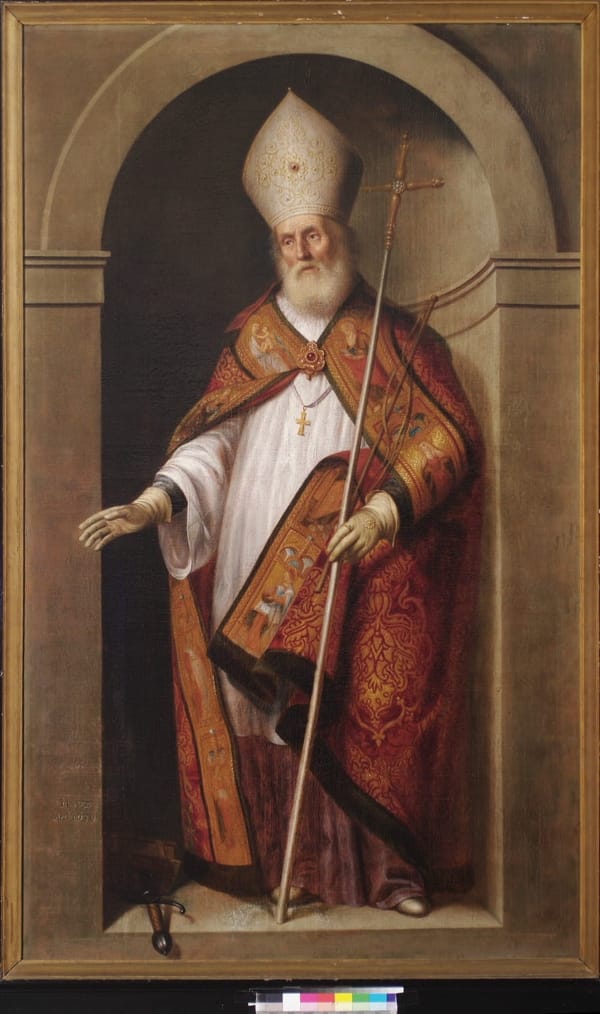 |
June 5: St. Boniface, Apostle of Germany, Bishop and Martyr
THE Son of Man, proclaimed King in the highest heavens on his triumphant Ascension day, leaves to his bride on earth the task of making his sovereign dominion recognized here below: this is her glory. Pentecost gives the signal for the Church's work of conquest; now does she awake, aroused by the breath of the Holy Ghost; replenished with this Spirit of love, she is all eagerness, as he is, to be possessed at once of the whole earth. We have already seen the Franks and the Anglo-Saxons pledging in her hands their oath of fealty to Christ, ‘to whom is given all power on earth and in heaven.’1 To-day we see how Winfrid realizes the fair name of Boniface, or well-doer, given him by Pope Gregory II. He presents himself before us, surrounded by the multitudes he has snatched at one blow from paganism and barbarism. Thanks to the Apostle of Germany, the hour is nigh when the Church may constitute in this world, apart from the spiritual dominion of souls, an empire more powerful than any that has ever been or is to be.
The eternal Father draws to his Son2 not men only but nations; these are his inheritance on earth no less than heaven is in eternity. The good pleasure that God takes in the Word made Flesh could never be content with merely seeing nations come, one here, another there, offering an isolated homage of recognition to Christ, as their Lord and Master. It was the whole world that was promised as his possession, without distinction of nations, without limits, save those of the earth itself:3 recognized or not, his power is universal. In the case of many, no doubt, the contempt or the ignorance of this regal claim of the Man-God is to last on throughout ages; for revolt, alas! is always possible to all. But it was the duty of the Church to exercise her influence over baptized nations, so as to gather them together in one public acknowledgement of the royalty of Christ, which is the source of every kingly power. At the Pontiff’s side there seemed to be a fitting place for a mailed chieftain of Christendom to be the lieutenant of Christ, who alone is Lord of lords and King of kings. Thus would be realized, in all its plenitude, the magnificent principality announced by the prophets for the Son of David.4
Such an institution was indeed worthy of the name it was to receive, that of the Holy Empire: in it we have the final result of our glorious Pentecost, the consummation of the testimony rendered by the Holy Ghost to Jesus, both as Pontiff and as King.5 In a few days, Leo III, the illustrious Pope called by the Holy Spirit to crown this his divine work, will proclaim, to the joy of the whole world, the establishment of this new empire beneath the sceptre-sway of the Man-God, in the person of Charlemagne, the representative of the King of kings. This marvellous work was not prepared all at once. Vast regions, destined to form the very nucleus of this future empire, for long centuries knew not so much as the very name of the Lord Jesus; or, at best, preserved but confused notions of truth, derived from some earlier evangelization that had been stifled in its birth by the turmoil of invasions—a mere mixture of Christian practices and idolatrous superstitions. At length we behold Boniface arise, endued with power from on high,6 the worthy precursor of St Leo III. Bom of those angelfaced Angles, by whom ancient Britain was transformed into the Island of Saints, he bums to carry into the heart of Germany, whence his ancestors had sprung, the light which first shone upon them in the land of their conquest.
Thirty years of monastic life, begun in childhood despite the tears and caresses of a tender father, had braced his soul. Prepared by this long period of retreat and silence, filled with divine science, and accompanied by the prayers of his cloistered brethren, he could now in all security set forth to follow the attraction of a divine call. But, first and foremost, Rome beholds him at the feet of the Sovereign Pontiff, submitting his plans and prospects to him who is the only source of all mission in the Church. Gregory II, in every way worthy of the great Popes that have borne that name, was at that time watching with apostolic vigilance over the Christian world, and preparing for the glorious sovereignty that awaited the Church in the coming eighth century. In the humble monk prostrate at his feet, the immortal Pontiff recognizes a powerful auxiliary sent to him by heaven; and so, armed with the apostolic benediction, Winfrid, now become Boniface, feels the powerful attraction of the Holy Spirit drawing him irresistibly to conquests of which ancient Rome had never dreamed.
Beyond the Rhine, farther than Roman legions ever penetrated, the Church now advances into this barbarous land, along pathways tracked for her by Boniface; overturning in her victorious march the last idols of the false gods, civilizing and sanctifying those savage hordes, the scourge of the old world. This Anglo-Saxon, a true son of St Benedict, gives to his work a stability that will defy the lapse of ages. Everywhere monasteries arise, taking root in the very soil, for God's sake; and, by force of example and beneficence, fixing around them its various nomad tribes. From the river banks, from the forest depths, instead of cries of war and of vengeance, is wafted the accent of prayer and of praise to the Most High. Sturm, the beloved disciple of St Boniface, presides over these peaceful colonies far superior to those of pagan Rome, planted though they were by her noblest veterans and manned by the best forces of her empire.
Here, too, where violence has hitherto reigned supreme, in these savage wilds, a novel kind of army is organized, formed of the gentle brides of Christ. The Spirit of Pentecost, like a mighty wind, has blown over the land of the Angles; and, even as in the cenacle holy women had a share in its influence, consecrated virgins, obedient to the heavenly impulse, have quitted the land of their birth, even the monastery that has sheltered them from childhood. Having for a while administered only at a distance to Winfrid's needs, and copied out for him the sacred books in letters of gold, they at length come to join the apostle. Fearlessly have they crossed the sea, and, guided by their divine Spouse, have come to share the labours undertaken for his glory. Lioba is at their head; she whose gentle majesty, whose heavenly aspect, uplifts the mind from earthly thoughts, and who by her knowledge of the scriptures, of the fathers, and of the sacred canons, is equal to any of the most celebrated doctors. But the Holy Ghost has still more richly gifted the soul of Lioba with humility and Christian heroism. Behold the chosen mother of the German nation! Germany's proud daughters, athirst for blood, who on their wedding-day disdained all other gift save a steed, a buckler, and a lance,7 are to learn from her the true qualities of the valiant woman. No more shall they be seen, intoxicated with slaughter, leading back to the field of battle their vanquished husbands; but the virtues of the wife and of the mother shall replace in them the fury of the camp; family life is to be founded on German soil, and through it the fatherland.
This was Boniface's intention when he called to his aid Lioba, Walburga, and their companions. Worn out with toil, but still more with the incessant wear and fret of petty jealousies (never spared to men of God by such as would cover their paltry complaints under the cloak of false zeal), our athlete of Christ was not ashamed to come to Lioba, his well-beloved daughter, humbly seeking from her that enlightened counsel and comfort which was never denied. Estimating at its true worth the share she had borne in his work, he was desirous that she should be laid to rest in the same tomb prepared for him in his abbey of Fulda.
But not yet was his labour ended, nor was the evening of life at hand. The spiritual welfare of his numberless converts must be secured, and at their head must be placed such as the Holy Ghost designated for the government of God's Church.8 By his means the hierarchy was constituted and developed; the land was covered with churches; and, beneath the rule of holy bishops chosen by God, these once wandering tribes now began to live a life to the glory of the most blessed Trinity, in a country but recently pagan, wherein Satan had hoped to perpetuate his own domination.
Nor was this our saint’s only work in Germany; in certain isolated parts, the seeds of Arianism and Manichæism had been silently taking root, by means of an intruded clergy, half pagan and half Christian in their rites; and these would inevitably prove a serious scandal to his recent converts that came within reach of their influence. Even as Christ, armed with a whip of cords, drove the buyers and sellers from the temple, so did Boniface, by vigorous measures, rid the land of these sectarian priests, who, with hands polluted by heathenish sacrifices to the vanquished deities of Valhalla, dared to offer also the spotless victim to the Most High.
The powerful action of Boniface, as the precursor of the Holy Empire, was not confined to preparing the German race alone for its share in so high a destiny. His beneficent influence was now to be exercised, at a most critical moment, upon France, the eldest daughter of the Church; for she was chosen, in the person of her princes, to be the first to bear the emblem of Christ’s universal kingship. The descendants of Clovis had preserved nought of his royal inheritance, save the vain title of a power that had now passed into the hands of a new family, a more vigorous branch of his stock. Charles Martel, the head of this race, measuring his strength with the Moors, had crushed their entire army near Poitiers: but, in the flush of victory, the hero of the day had wellnigh brought the Church of France to the brink of ruin, by distributing to his comrades in arms the episcopal sees and abbeys of the land. Unless a situation no less disastrous than would have been the triumph of Abderahman was to be accepted, these usurped croziers must at once be wrested from the hands of such strange titularies. To effect this, as much gentleness as firmness was needed, together with an ascendancy belonging only to virtue, if the hero of Poitiers and his noble race were to be gained over to respect the rights of holy Church. This victory, more glorious than had been the defeat of the Moors, was won by Boniface, a veritable triumph of unarmed holiness, as profitable to the vanquished as to the Church herself. Of this fierce warrior he was to make the worthy father of a second dynasty, the glory whereof should far surpass the brilliant hopes of the first race of the Frankish kings.
Boniface, now legate of Pope St Zachary as he had formerly been of Gregory III, fixed his episcopal see at Mainz, the better to keep within the fold both Germany the conquest of his earlier apostolate, and France more recently rescued by his labours. Like another Samuel, he himself, with his own hands, consecrated this new regal dynasty, by conferring the sacred unction on Pepin le Bref, son of Charles Martel. This was in the year 752. Another Charles, as yet a child, who was one day to inherit that throne thus firmly established, attracted the notice of the aged saint, and received his benediction; it was the future Charlemagne. But to the hand of a Sovereign Pontiff would be reserved the anointing of that royal brow; and a diadem more glorious still than that of a king of the Franks was one day to be his, exhibiting in his person the head of the new Roman Empire, the lieutenant of the King of kings.
The personal work of Boniface was now accomplished; like the old man Simeon, his eyes had seen the object of all his ambition, of his life-long toil, the salvation prepared by God for this new Israel. He too had now no desire left save that of departing in peace to our Lord; but could such an apostle enter into peace by any other gate than that of martyrdom? He understands this well: his hour has sounded: the old warrior has chosen his last battlefield. Friesland is still pagan: half a century ago, at the opening of his apostolic career, he had avoided this country, in order to escape the bishopric which St Willibrord, at that early date, was anxious to bestow upon him: but now that it has nought save death to offer him, he will enter this land. In a letter of sublime humility, prostrate at the feet of Pope Stephen III, he submits to the correction of the Apostolic See, the 'awkward mistakes,' as he terms them, and the many faults of his long life;9 to Lullus, his dearest son, he leaves the Church of Mainz; he recommends to the care of the Frankish king the several priests scattered all through Germany, the monks and virgins, who from distant homes have followed him hither. Then ordering to be placed amongst the few books which he is taking with him the winding sheet that is to enwrap his body, he designates the companions chosen by him for the journey, and sets out to win the martyr's palm.
Let us now read the liturgical record of this grand life.
Thou wast, O great apostle, the faithful servant of him who chose thee as the minister of his word and the propagator of his kingdom. When the Son of Man quitted earth to receive the delighted homage of the heavenly hosts in recognition of his kingship over them, he none the less remained King of this lower world which he has left but for a little while.10 He counted on his Church to guard his principality here below. Small indeed was the number of those who recognized him, on the day of his glorious Ascension, as their Master and Lord. But that faith deposited in those first chosen souls was a treasure which they, like skilful bankers, knew how to work with, and how to multiply by apostolic commerce. Transmitted from generation to generation, up to the day of the Lord's return, this precious capital was to go on yielding to the absent Lord more and more accumulated interest. Thus was it with thee, O Winfrid, in that age wherein thou didst bring into the Church that tribute of labour which she requires, though in very different proportion, from each of her sons. In her gratitude, for thy works which appeared to her well done and profitable above those of others, forestalling the Spouse himself, she would, even in this world, call thee by that new name11 whereby thou art known in heaven.
Indeed, when did riches, such as thou didst bring, come pouring at once into the hands of the bride? When did the Spouse appear to be so fully and truly head of the whole world, as in the eighth century, in which the Frankish princes, formed by thee to their noble destinies, constituted the temporal sovereignty of the Church, and gloried in being the lieutenants of Christ standing at the side of his Vicar on earth? To thee, O Boniface, is the Holy Empire indebted for its very existence. But for thee, France would have perished, debased by a simoniacal clergy, even before a Charlemagne had appeared; but for thee, Germany would have remained a prey to pagan barbarians, enemies of all civilization and progress. O thou that didst rescue both Germans and Franks, receive our grateful homage.
At the sight of thy works, and remembering the great popes and magnificent princes, whose glory is indeed derived from thee, our admiration equals our gratitude. But pardon us, dear saint, if the thought of those grand centuries of yore, so far removed, alas, from these our days, should mingle sadness with our joy. Viewed in the light of thy holy policy and its results, O glorious precursor of the confederation of Christian nations, how we must bewail the fatal errors of those princes and statesmen, so renowned in the seventeenth century, and so foolishly admired by a world whose ruin they were hastening! For, by the isolation of Catholic nations from one another, the ties that bound them to the Vicar of Christ became loosened: princes, forgetful of their true position as representatives of the divine King, made friends with heresy, in order to assert their independence of Rome, or to lower one another’s power. Therefore Christendom is no more. Upon its ruins, like a woful mimicry of the Holy Empire, Protestantism has raised its false evangelical empire, formed of nought but encroachments, and tracing its recognized origin to the apostasy of that felon knight Albert of Brandenburg.
The complicities that rendered such a thing possible have received their chastisement. May God’s justice be satisfied at last! O Boniface, cry out with us unto the God of armies for mercy. Raise up in the Church servants of Christ, powerful in word and work, as thou wast. Save France from anarchy; and restore to Germany a right appreciation of true greatness, together with the faith of her ancient days.
Thursday within the Octave of the Ascension
|
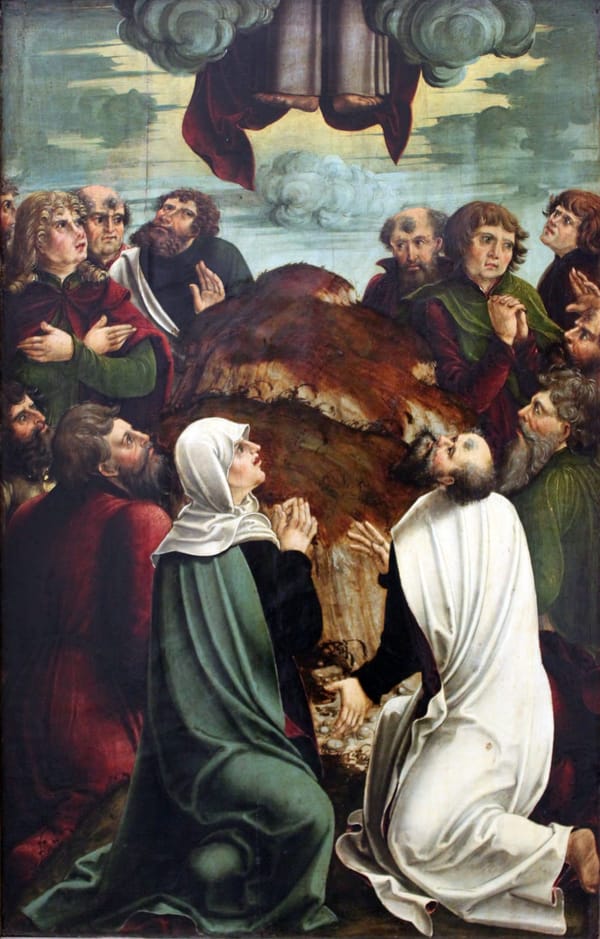
We have already seen how the Ascension of our Emmanuel won Him the empire over our understanding: it was the triumph of faith. The same mystery gave Him a second victory: the victory of love, which makes Him reign in our hearts. For eighteen hundred years, in whom have men believed, firmly and universally, except Jesus? In what have men agreed, except the dogmas of faith? What countless errors has this divine torch dispelled! What light has it given to the nations that received it! And in what darkness has it left those which rejected it after having once received it!
In like manner, no one has been loved as our Jesus has been, ever since the day of His Ascension; no one is so loved now or ever will be, as He. But that He might thus win our love He had to leave us, just as He had to do in order to secure our faith. Let us return to our text, that we may get deeper into the beautiful mystery.’It is expedient for you that I go!’1 Before the Ascension, the disciples were as inconstant in their love as they were in their faith. Jesus could not trust them. But no sooner had He left them, than they became warmly devoted to Him. Instead of complaining of their bereavement, they returned full of joy to Jerusalem. The thought of their master’s triumph made them forget their own loss, and they hastened, as He bade them, to the cenacle, where they were to be endued with power from on high. Watch these men during the subsequent years; examine what their conduct was from that time to the day of their death; count, if you can, their acts of devotedness in the arduous labour of preaching the Gospel; and say, if any other motive than love for their master could have enabled them to do what they did. With what cheerfulness did they drink His chalice!2 With what raptures did they hail His cross, when they saw it being prepared for themselves!
But let us not stop at these first witnesses; they had seen Jesus, and heard Him, and touched Him.3 Let us turn to those who came after them, and knew Him by faith only; let us see if the love, which burned in the hearts of the apostles, has been kept up by the Christians of the past eighteen centuries. First of all, there is the contest of martyrdom, which has never been altogether interrupted since the Gospel began to be preached. The opening campaign lasted three hundred years. What was it that induced so many millions to suffer, not only patiently but gladly, every torture that cruelty could devise? Was it not their ambition to testify how much they loved their Jesus? Let us not forget how these frightful ordeals were cheerfully gone through, not only by men hardened to suffering, but also by delicate women, by young girls, yea even by little children. Let us call to mind the sublime answers they gave to their persecutors, whereby they evinced their generous ardour to repay the death of Jesus by their own. The martyrs of our own times, in China, Japan, the Corea, and elsewhere, have repeated, without knowing it, the very same words to their judges and executioners as were addressed to the proconsuls of the third and fourth centuries by the martyrs of those days.
Yes, our divine King who has ascended into heaven, is loved as no other ever was or could be. Think of those millions of generous souls, who, that they might be exclusively His, have despised all earthly affections, and would know no other love than His. Every age,—even our own, in spite of all its miseries,—has produced souls of this stamp, and God alone knows how many.
Our Emmanuel has been, and to the end of time will ever be, loved on this earth. Have we not reason to say so, when we consider how many there have always been, even among the wealthiest ones of the world, who, in order that they might bear a resemblance to the Babe of Bethlehem, have given up everything they possessed? What an irresistible proof of the same truth we have in the countless sacrifices of self-love and pride, made with a view to imitate the obedience of the God-Man on earth! And what else but an ardent love of Jesus could have prompted those heroic acts of mortification and penance, whereby the sufferings of His Passion have been emulated, and, as the apostle says, filled up?4
But grand as all this is, it was not enough to satisfy man’s devoted love of His absent Lord. Jesus had said: ‘Whatsoever you do to the least of your brethren, you do it to Me.’5 Love is ever quick at catching the meaning of our Redeemer’s words. It took advantage of these, and saw in them another means for reaching Jesus,—reaching Him through the poor. And as the worst of poverties is the ignorance of divine truths, because it would make a man poor and miserable for eternity, therefore have there risen up in every age zealous apostles, who, bidding farewell to home and fatherland, have carried the light of the Gospel to them that sat in darkness and in the shadow of death. They heeded not the fatigues or the perils of such a mission: what cared they for all these things, if they could but make Jesus known and honoured and loved by one poor savage or Hindoo?
But what of those other poor ones, the sick, in whom Jesus suffers? Fear not: He is too much loved to be forgotten there. Once let the Church be free enough to develop her plans of charity, and there will be an institute of relief for every class of sufferers. The poor, the sick, all will be cared for and comforted. There will be vocations to charity, to meet every want; and women, too, urged by the love of their divine Lord, will deem it an honour to be the nurses and attendants of a suffering or dying Lazarus. The world itself is in admiration at their heroism; and though it knows not the divine principle which originates these charitable institutions, yet is it obliged to acknowledge the extraordinary good they effect.
But man’s observation can only reach the exterior; the interior is the far grander reality, and it is beyond his notice. What we have said so far is, therefore, but a very feeble description of the ardour wherewith our Lord Jesus Christ has been, and still is, loved on this earth. Let us picture to ourselves the millions of Christians who have lived since the first foundation of the Church. Many, it is true, have had the misfortune to be unfaithful to the object of their existence; but what an immense number have loved Jesus with all their heart and soul and strength!
Some have never flagged in their love; others have needed a conversion from vice or tepidity, returned to Him, and slept in the kiss of peace. Count, if you can, the virtuous actions, the heroic sacrifices, of those countless devoted servants of His, who are to be arrayed before Him in the valley of Josaphat. His memory alone can hold and tell the stupendous total of what has been done. This well-nigh infinite aggregate of holy deeds and thoughts, from the seraphic ardour of the greatest saint down to the cup of cold water given in the name of the Redeemer, what is it all but the ceaseless hymn of our earth to its beloved absent One, its never-forgotten Jesus? Who is the man, how dear soever his memory may be, for whom we would be devoted, or sacrifice our interests, or lay down our lives, especially if he had been ten or twenty ages gone from us? Who is that great Dead, the sound of whose name can make the hearts of men vibrate with love, in every country, and in every generation? It is Jesus, who died, who rose again, who ascended into heaven.
But we humbly confess, O Jesus, that it was necessary for us that Thou shouldst go from us, in order that our faith might soar up to Thee in heaven, and that our hearts, being thus enlightened, might burn with Thy love. Enjoy thine Ascension, O Thou King of angels and of men! We, in our exile, will feast on the fruits of the great mystery, waiting for it to be fulfilled in ourselves. Enlighten those poor blind infidels, whose pride will not permit them to recognize Thee, notwithstanding these most evident proofs. They continue in their errors concerning Thee, though they have such superabundant testimony of Thy Divinity in the faith and love Thou hast received in every age. The homage offered Thee by the universe, represented, as it has ever been, by the chief nations of the earth and by the most virtuous and learned men of each generation, is as nought in the eyes of these unbelievers. Who are they, to be compared with such a cloud of faithful witnesses? Have mercy on them, O Lord! save them from their pride; then will they unite with us in saying:’It was indeed expedient for this world to lose Thy visible presence, O Jesus! for never were Thy greatness, Thy power, and Thy Divinity, so recognized and loved, as when Thou didst depart from us. Glory, then, be to the mystery of Thine Ascension, whereby, as the psalmist prophesied, Thou receivedst gifts, that Thou mightest bestow them upon men!’6
We will take a hymn to-day from the Greek Church: it is the one she sings in honour of our Redeemer’s triumph, at her evening Office of Ascension day.
Hymn (In Assumptione Domini, ad magnum Vespertinum.)
As a close to this glorious octave, we offer the eighth and last of the beautiful prayers given by the Mozarabic breviary in honour of our Lord’s Ascension.
Prayer
| Previous June 4: St. Francis Caracciolo, Confessor | Next Thursday within the Octave of the Ascension |