Daily reading
Paschal Time
Double of the I Class · Movable from Easter · Temporal
June 10, 2025
From Dom Guéranger’s The Liturgical Year.

|
Tuesday in Whitsun Week
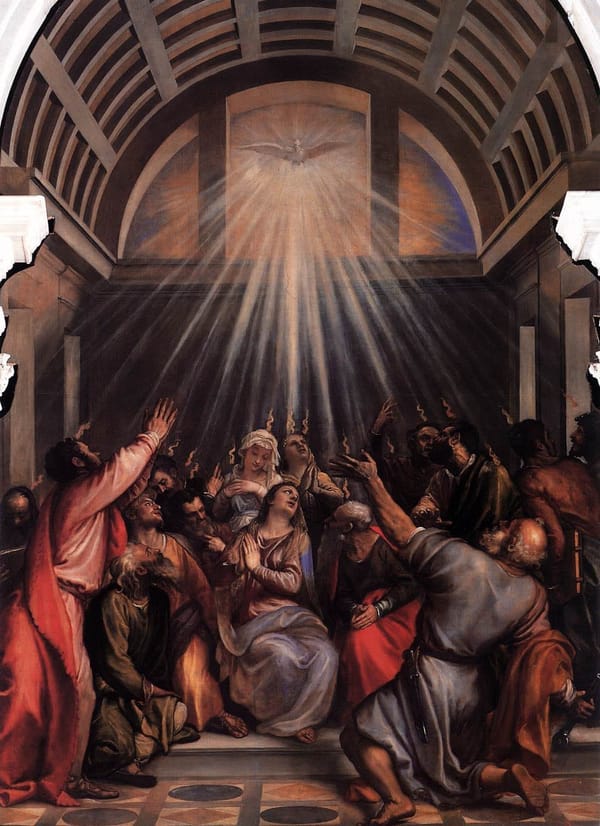
Yesterday, we were admiring the work of the Holy Ghost, whereby He drew mankind to the faith and the name of Jesus, to whom ‘all power was given in heaven and in earth.’1 The instruments used for this conquest were the apostles and their immediate successors. The tongue of fire was victorious, and the prince of this world was defeated, Let us continue our reflections, and see the further workings of the holy Spirit for the glory of the Son of God, who had sent Him into this world.
Our Emmanuel came down from heaven, that He might effect the union He had desired from all eternity. He began it by uniting our human nature to His own divine Person; but this personal union did not satisfy His love. He mercifully deigned to invite the whole human race to a spiritual union with Himself, by giving her to become His Church, His own dearest one,2 as He calls her; His ‘glorious Church, not having spot or wrinkle, but holy and without blemish.’3 But how could mankind, deformed as it was by sin, be worthy of such an honour? His love would make it worthy. He tells us that this Church is His bride.4 Having chosen her, He beautified her in the laver of His own precious Blood, and gave her, in dowry, the infinite merits He had acquired.
Thus prepared, her union with Him was to be of the closest. Jesus and His Church are one body; He is the Head, she is the aggregate of the members united together under this one Head. Such is the teaching of the apostle: ‘Christ is the Head of the Church; we are members of His body, of His flesh, and of His bones’.5 This body is to be formed of all who shall, in each successive age, be faithful to the call of divine grace, and enroll themselves as children of the Church. The world we inhabit is to be preserved, till the last elect required to complete the mystic body of Jesus, be added to the Church triumphant: then all will be consummated; the divine mystery of the Incarnation will have achieved its whole work.
But as in the Incarnate Word there was the invisible Soul and the visible Body, so also the Church was to have a soul and a body: a soul, whose hidden beauty no eye but God’s can fully see, at least during her earthly sojourn; and a body, which is to be visible to men: an ever-living proof of God’s power, and of His love for the human race. Up to the day of Pentecost, the just, who had been united under Jesus, their Head, had belonged only to the soul of the Church, for the body was not then in existence. The heavenly Father had adopted them as His children; the Son of God had accepted them as His members; and the Holy Ghost, who is now about to work exteriorly, had interiorly wrought their election and sanctification. The new order of things is to begin in Mary’s person. As we have already explained, the Church in its entirety, that is both soul and body, resided first in her. It was but fitting that she who was as truly the Mother of the Son of God, according to His human Nature, as the heavenly Father was His Father according to the divine Nature, should be superior to all other members of the Church, and this not only in the high degree of grace, but also in the precedence of time.
When our Saviour gave His Church an existence outside the loved sanctuary of His Mother’s heart, He, with His own hands, set the foundation stone, Peter, the rock; He raised up the pillars, and we have seen how He spent the forty days before His Ascension in organizing this Church, which was then so small, but which was afterwards to cover the whole earth. He told His apostles that He would be with them all days even to the consummation of the world;6 it was the same as telling them that, even after His Ascension into heaven, His Church was to continue on earth, even to the end of time.
He left the plan, thus begun by Himself, to be perfected by the Holy Ghost. It was necessary that this holy Spirit should come down from heaven, in order to strengthen those whom Jesus had chosen as His apostles. He was to be their Paraclete; their comforter, in the absence of their Master; He was to be the power from on high, who was to serve them as armour in their future combats; He was to remind them of all the words spoken to them by Christ; He was to give fruitfulness, by His own action, to the Sacraments, which Jesus had instituted, and over which the apostles had power because of the character impressed upon them by this holy Spirit. It is on this account that Jesus said to His apostles: ‘It is expedient to you that I go; for if I go not, the Paraclete will not come to you’.7 We have seen this divine Spirit, on the day of Pentecost, producing His effects on the apostles and disciples; let us now see His action in the creation, maintenance, and perfecting of this Church, which Jesus has promised to assist, by His mysterious presence, even to the consummation of the world.
The first operation of the Holy Ghost in the Church is the election of its members. This right of election is so especially Hisprerogative, that, as we learn from the Scriptures, it was by the Holy Ghost8 that Jesus chose the apostles, who were to be the pillars of His Church. We have seen how this holy Spirit began His mission on the day of Pentecost, by the election of three thousand Jews. A few days after, five thousand were added to the number, being converted by the preaching of Peter and John.9 The Gentiles, also, were called to the Church; and the Holy Ghost, having led Peter to Cornelius the centurion, descended upon this Roman and his household, thus declaring them to be elected as candidates for holy Baptism. The liturgy put this history before us, in the Mass of yesterday.
We seem able to keep pace with these first workings of the holy Spirit; but the sequel is all impetuosity, divine rapidity of action, irresistible conquest. He sends forth His messengers: their sound goeth forth into all the earth, and their words unto the ends of the world.10 He goes before them; He goes with them; He works the victory, while they speak. We come to the commencement of the third century, and we find a Christian writer addressing the magistrates of the Roman empire in these words: ‘We are but of yesterday, and we abound everywhere; in your cities, in your towns, in your camps; in the palace, the senate, the forum.’11 Nothing can withstand the Spirit of God; and in less than three hundred years from the day of His first manifestation, He calls the very emperors of Rome to be members of the Church.
Thus does the bride of Jesus advance in her beauty and strength; He looks upon her from His throne in heaven, and tenderly loves her. In the early part of the fourth century, she exceeds the limits of the Roman empire. Here and there, within this vast empire, there are men who still cling to paganism; but they all know what the Church is, and the very hatred they bear her is a proof that they are aware of her progress.
But let us not suppose that the mission of the Holy Ghost is limited to founding the Church on the ruins of the great pagan empire. No; the bride of Jesus is to be immortal; she is to exist in every place and age; she is to be superior, both by the extent of her dominions and the number of her subjects, to every other human power.
The divine Spirit could not, therefore, suspend His mission. The Roman empire has merited, by her crimes, to be swept away by the inundation of barbarous nations: it is the preparation of a new triumph for the Spirit. He comes and works, invisibly and silently, amidst this huge mass: He has His elect there, and by millions. He has renewed the face of the pagan world; He renews the face of the World, now that the barbarians rule it. He chooses His co-operators, and right faithful are they. He creates new apostles, and He selects them from all classes, for He is Master to do as He wills. Queens such as Clotilda, Bertha, Theodolind, or Hedwiges, are ready to do His biddings; they deck the bride of Jesus with their royal hands, and she comes forth to the world once more, younger and lovelier than ever.
There are, indeed, immense tracts of country in Europe not yet in the Church; it was necessary first to give stability to the work in those that had pre viously been Christian, and had been well-nigh submerged beneath the deluge of invasion. But, at the close of the sixth century, the holy Spirit visits Britain, Germany, Scandinavia and Sclavonia; He sends them apostles, such as Augustine, Boniface, Anscharius, Adalbert, Cyril, Methodius, Otho. By the labours of missioners like these, the bride is compensated for the losses she has sustained in the east, where schism and heresy have encroached upon her primitive inheritance. That holy Spirit, who is God together with the Father and the Son, and has been sent by Them to defend the honour of the bride, is ever faithful to His trust.
Thus, when the so-called Reformation was preparing for Europe the great apostasy of the sixteenth century, the Paraclete was extending the glories of the Church in other continents. The East Indies became the conquest of the most faithful nation; and, in the west, a new world was discovered by and made subject to the Catholic kingdom. The divine Spirit, who is ever jealous to maintain the honour and entirety of the deposit entrusted to Him by the Incarnate Word, then raised up new apostles to go and carry the name of Jesus to these immense tracts of country, which were to be added to the kingdom of His bride. St. Francis Xavier was sent to the East Indies; his brethren, together with the sons of St. Dominio and St. Francis of Assisi, laboured most perseveringly in preaching the Gospel to the people of the West Indies.
If, later on again, our Europe be misled by false theories and break with the Church; if this beloved bride of Jesus be betrayed and pillaged, calumniated and deprived of her rights, by those very nations which she had protected for so many ages, as the most loving of mothers—fear not; the Holy Ghost will add to her glories in some other way. Look at His present workings in the Church. Whence, if not from Him, are those ever increasing vocations to the apostolic ministry? Moreover, whilst conversions from heresy are more numerous than at any previous period, there is not an infidel country where the Gospel is not being preached. Our century has had its martyrs for the faith; it has heard the authorities of China and Cochin China, like the proconsuls of old, putting the Christians through an examination; it has heard the sublime answers, suggested by the Holy Ghost to these brave confessors, as Christ had promised.12 The farthest east produces its elect; the negroes of Africa are evangelized; and the most recently discovered portion of the world already counts its faithful by thousands, flourishing under a hierarchy of lawfully appointed pastors.
Be Thou blessed, then, O holy Spirit! who thus watchest over the dear bride of Jesus! Thanks to Thy ceaseless and untiring action, she has never once failed. In every age, Thou hast raised up apostles to enrich her by their conquests: Thy grace has been uninterruptedly inviting men to give themselves to her; in every nation and period, Thou Thyself hast chosen the members of her happy and countless family. She is our mother and we are her children; she is the bride of our divine Master, to whom we hope to be united through her: so that, by working for the glory of the Son of God who sent Thee, O holy Spirit! Thou hast deigned to work for us poor sinful creatures. We offer Thee our feeble tribute of thanks for all these Thy benefits to us.
Our Emmanuel has revealed to us that Thou art to abide with us to the end of the world; and we now understand how necessary is Thy presence. It is Thou that presidest over the formation of the bride; that maintainest her; that renderest her victorious over her enemies; that carriest her from one country to another, when a people becomes unworthy to possess her; that avengest her when she is insulted; and all this Thou wilt continue to do to the end of time.
But this noble bride of our God is not to remain for ever an exile from her Lord. As Mary was left for several years upon the earth, in order that she might labour for the glory of her Son, and was then taken up to heaven, there to reign eternally with Him; so likewise the Church is to remain militant here below as long as God sees her to be needed for completing the number of His elect. But the time will come of which it is written: ‘The marriage of the Lamb is come, and His wife hath prepared herself. And it is granted to her that she should clothe herself with fine linen glittering and white; for the fine linen are the justifications of the saints.’13 that is, the virtues of the saints she has formed. In those days, the bride ever comely and worthy of her Jesus, will grow no more, nay, she will decrease on earth in proportion as her triumphant glory is perfect in heaven. The revolt, spoken of by St. Paul,14 will show itself; men will abandon her, side with the prince of this world, who is to be let loose for a little while,15 and serve the beast, to whom it shall be given to make war with the saints, yea, and to overcome them.16 The bride herself will not be degenerate, during these her last days on earth, for Thou O holy Spirit! wilt still be with her, supporting her. But as soon as the last of the elect shall have been born, the Spirit and the bride will say ‘Come!’17 Then will Jesus appear upon the clouds of heaven; the mission of the Spirit will be accomplished; and the bride leaning upon her Beloved,18 will ascend from this ungrateful barren earth to heaven, where the eternal nuptials with the Lamb await her.
Mass
The station for to-day is in the church of Saint Anastasia, where we assisted at the Mass of the Aurora on the birthday of our Emmanuel. We revisit it now that we have celebrated all the grand mysteries of our Redemption. Let us bless our God for having so magnificently completed what He began so humbly and so sweetly. The neophytes, clothed in their white garments, are present, bearing testimony both to the love of the Son of God who has cleansed them by His Blood, and to the power of the Holy Ghost who has rescued them from the tyranny of satan, the prince of this world.
The Introit is addressed to the neophytes, inviting them to appreciate the glory they have received, and to give thanks to the God who has called them to a heavenly kingdom. The words of this Introit, which has been used almost from the very commencement of the Church, are taken from the fourth Book of Esdras, which, although not received by the Church as part of the sacred Scriptures, was frequently read by the early Christians on account of the admirable instructions it contains.
Introit
Ps. Attendite, popule meus, legem meam: inclinate aurem vestram in verba oris mei. ℣. Gloria Patri. Accipite.
Ps. Attend, O my people, to my law: incline your ears to the words of my mouth. ℣. Glory, &c. Receive, &c.
In the Collect, the Church teaches us that the action of the Holy Ghost in our souls is one of mercy and power combined. This divine action purifies our souls from all their stains, and defends them from the attacks of the crafty and jealous enemy, who is ever lying in wait for us.
Collect
Epistle
Cap. viii.In diebus illis: Quum au- dissent apostoli, qui erant Jerosolymis, quod recepisset Samaria verbum Dei, miserunt ad eos Petrum et Joannem, qui quum venissent, oraverunt pro ipsis ut acciperent Spiritum sanctum; nondum enim in quemquam illorum venerat, sed baptizati tantum erant in nomine Domini Jesu. Tunc imponebant manus super illos, et accipiebant Spiritum sanctum.
Ch. viii.In those days: When the apostles, who were in Jerusalem, had heard that Samaria had received the word of God, they sent unto them Peter and John. Who when they were come, prayed for them, that they might receive the Holy Ghost. For he was not as yet come upon any of them; but they were only baptized in the name of the Lord Jesus. Then they laid their hands upon them, and they received the Holy Ghost.
The inhabitants of Samaria had received the word of God through the preaching of Philip the deacon. They had received, at his hands, the Sacrament of Baptism, which made them Christians. This reminds us of the dialogue between Jesus and the woman at Jacob’s well, and of the three days that He spent in the city. Their faith is rewarded: Baptism has made them children of God and members of Christ their Redeemer. But they must also receive the Holy Ghost, in the Sacrament that gives perfection to the Christian character. The deacon Philip has not power to confer it upon them: Peter and John, who are invested with episcopal authority, visit them, and complete their happiness. This event makes us think of the grace bestowed on us by the Holy Ghost, when He strengthened our souls by the Sarcrament of Confirmation. Let us thank Him for this favour, which brought us into closer union with Himself, and gave us the courage needed for confessing our faith before heretics or tyrants.
Here all kneel.
Then follows the Sequence, Veni, sancte Spiritus; page 305.
Gospel
Cap. x.In illo tempore: Dixit Jesus Pharisæis: Amen, amen dico vobis, qui non intrat per ostium in ovile ovium, sed ascendit aliunde, ille fur est, et latro. Qui autem intrat per ostium, pastor est ovium. Huic ostiarius aperit, et oves vocem ejus audiunt, et proprias oves vocat nominatim, et educit eas. Et quum proprias oves emiserit, ante eas vadit: et oves illum sequuntur, quia sciunt vocem ejus. Alienum autem non sequuntur, sed fugiunt ab eo: quia non noverunt vocem alienorum. Hoc proverbium dixit eis Jesus. Illi autem non cognoverunt quid loqueretur eis. Dixit ergo eis iterum Jesus: Amen, amen dico vobis, quia ego sum ostium ovium. Omnes quotquot venerunt, fures sunt et latrones, et non audierunt eos oves. Ego sum ostium. Per me si quis introierit, salvabitur: et ingredietur, et egredietur, et pascua inveniet. Fur non venit nisi ut furetur, et mactet et perdat. Ego veni ut vitam habeant, et abundantius habeant.
Ch. x.At that time: Jesus said to the Pharisees: Amen, amen, I say to you: he that entereth not by the door into the sheepfold, but climbeth up another way, the same is a thief and a robber. But he that entereth in by the door, is the shepherd of the sheep. To him the porter openeth; and the sheep hear his voice: and he calleth his own. sheep by name, and leadeth them out. And when he hath let out his own sheep, he goeth before them: and the sheep follow him, because they know his voice. But a stranger they follow not, but fly from him, because they know not the voice of strangers. This proverb Jesus spoke to them. But they understood not what he spoke to them. Jesus therefore said to them again: Amen, amen, I say to you, I am the door of the sheep. All others, as many as have come, are thieves and robbers: and the sheep heard them not. I am the door. By me if any man enter in, he shall be saved; and he shall go in, and go out, and shall find pastures. The thief cometh not, but for to steal, and to kill, and to destroy. I am come that they may have life, and may have it more abundantly.
The Church’s motive for putting this passage of the Gospel before the neophytes of Pentecost was, to put them on their guard against a danger which might probably occur in after years. At present, they are the favoured sheep of the good Shepherd Jesus, represented by men to whom He Himself has given the charge to feed His lambs. These men have received their mission from Peter; and he who is with Peter, is with Jesus. But it has not unfrequently happened that false shepherds have got into the fold; our Saviour calls them thieves and robbers. He tells us that He Himself is the door, through which they must pass who can claim the right to feed His sheep. Every shepherd, if he would avoid the imputation of being a robber, must have received his mission from Jesus; and this mission cannot be given save by him whom Jesus has appointed to be His vicar and representative until He Himself return.
The Holy Ghost has poured forth His divine gifts upon these new Christians; but the virtues that are in them cannot be meritorious of eternal life, unless they continue to be members of the true Church. If, instead of following the lawful pastor, they were to be so unhappy as to go after false pastors, all these virtues would become barren. They should, therefore, flee, as they would from a stranger, from any guide who has not received his mission from the Master, who alone can lead them to the pastures of life. During the past centuries, schismatical pastors have risen up from time to time: the faithful were bound to shun them. We, who are living now, should take seriously to heart the admonition here given us by our Redeemer. The Church He has founded, and which He guides by His holy Spirit, is apostolic. The mission of those pastors alone is lawful who are sent by apostolic authority; and whereas Peter lives in his successors, the successor of Peter is the source whence alone can come pastoral power. He who is with Peter, is with Christ.
In the Offertory, the Church excites our devotion to the holy Sacrifice at which we are assisting, by speaking to us, in the words of the psalmist, the praises of the sacred nourishment which is to be given to us; it is a manna from heaven, it is the very Bread of the angels.
Offertory
The Victim that is about to be offered, has the power to purify, by His immolation, those who are to feed upon His sacred Flesh. The Church prays in the Secret, that it may be thus with them that are assisting at this holy sacrifice.
Secret
The Preface is given page 310.
In the Communion-anthem, the Church puts before us the words wherein Jesus told His disciples that the Holy Ghost would glorify Him. We, who have seen the workings of this holy Spirit throughout the whole earth, can testify to the most perfect fulfilment of the prophecy.
Communion
The faithful people have partaken of the sacred mysteries; and the Church comes immediately after, telling them that the Holy Ghost has actively co-operated in what has taken place. It is He that achieved the change of the bread and wine into the Body and Blood of our Redeemer; it is He also that prepared our souls for their union with the Son of God, by purifying them from their sins.
Postcommunion
Vespers
They are the same as on Sunday page 311, with the exception of the Magnificat antiphon and the Prayer.
Antiphon of the Magnificat
The Prayer is the Collect of the Mass, given above, page 368.
Again let us give ear to the Armenian Church celebrating the coming of the Holy Ghost, and that with all the dignity of sentiment and diction which characterizes its hymnarium.
Hymn (Canon tertiæ diei)
Sequence
Veri splendor auxilii,
Totius spes solatii.
Et præmium justorum:
Sublevator perditorum.
Ac omnis sanctitudinis
Ac beatitudinis Donator,
Omnis rectitudinis amator.
Omnitenens, innoxius.
Justius, carius
Quo nihil est potentius,
Quo nihil est vel melius.
Per quem ad Patrem omnium
Venitur, et ad Filium.
Dator gaudii:
Medicina vitii,
Spiritus consilii.
Et invariabilis;
Habilis, nobilis,
Et insuperabilis,
Promptus et amabilis.
Dans intellectum,
Dans et affectum,
Diligens rectum.
Vivificans Paraclitus:
Divinæ dextræ digitus.
Pietas et bonitas,
Benignitas et largitas:
Quando vult,
Et ubi vult,
Quousque vult,
Et quantum vult,
Spirat et erudit,
Replet et erigit,
Ditat et instruit.
Ad consolandum hodie
Apostolis donatur:
Et eis plenarie
Fons verae sapientiae
Per hunc administratur.
thou art our true and brightest aid,
in whom alone we hope for solace.
the reward of the just,
the resuscitator of sinners!
and holiness,
and blessing!
Lover of all righteousness.
All-governing,
and so merciful!
and strong, and spiritual!
No, nothing is so mighty, nothing so good!
by whom we come to the Father of all,
and to the Son.
giver of joy;
remedy for sin;
Spirit of counsel!
and unchangeable;
prudent, noble,
and invincible;
prompt and endearing!
‘tis thou that givest us understanding
and love,
and that lovest what is right.
the lifegiving Paraclete;
the Finger of God’s right hand!
mercy and goodness,
benignity and munificence;
and when he wills,
and where he wills,
and as long as he wills,
and as much as he wills,
inspires and teaches,
fills and exalts,
enriches and guides.
is given to the apostles,
on this day,
that he may console them.
By him is opened to them, in all its fullness,
the fount of true wisdom.
- St. Matth. xxviii. 18. ↩︎
- Cant. vi. 8. ↩︎
- Eph. v. 27. ↩︎
- St. Matth, ix. 15; xxv. 6. St. Mark, ii. 19. St. Luke, v. 34. St. John, iii. 29. ↩︎
- Eph. v. 23, 30. ↩︎
- St. Matth, xxviii. 20. ↩︎
- St. John, xvi. 7. ↩︎
- Acts, i. 2. ↩︎
- Ibid. iii. & iv. 4 ↩︎
- Ps. xviii. 5. ↩︎
- Tertullian, Apologet. xxxvii. ↩︎
- St. Matth. x. 20. ↩︎
- Apoc. xix.7, 8. ↩︎
- II Thess. ii. 3. ↩︎
- Apoc. xx. 3. ↩︎
- Ibid. xiii. 7. ↩︎
- Ibid. xxii. 17. ↩︎
- Cant. viii. 5. ↩︎
Tuesday in Whitsun Week: The Gift of Knowledge
Detached from evil by the fear of the Lord, and ennobled with holy love by the gift of godliness, the soul feels the want of knowing how she is to avoid what she must fear, and how to find what she must love. The Holy Ghost comes to her assistance, and brings her what she needs, by infusing into her the gift of knowledge. By means of this precious gift, truth is made evident to her; she knows what God asks of her and what He condemns, she knows what to seek and what to shun. Without this holy knowledge, we are in danger of going astray, because of the frequent darkness which, more or less, clouds our understanding. This darkness arises, in the first place, from our own nature, which bears upon itself the hut too visible proofs of the fall. It is added to by the false maxims and judgments of the world, which so often warp even those whose upright minds seemed to make them safe. And lastly, the action of satan, who is the prince of darkness, has this for one of its chief aims: to obscure our mind, or to mislead it by false lights.
The light of our soul is faith, which was infused into us at our Baptism. By the gift of knowledge, the Holy Ghost empowers our faith to elicit rays of light strong enough to dispel all darkness. Doubts are then cleared up, error is exposed and put to flight, truth beams upon us in all its beauty. Everything is viewed in its true light, the light of faith. We see how false are the principles which sway the world, which ruin so many souls, and of which we ourselves were once, perhaps, victims.
The gift of knowledge reveals to us the end which God had in creation, and out of which creatures can never find either happiness or rest. It teaches us what use we are to make of creatures, for they were not given us to be a hindrance, but a help whereby to reach our God. The secret of life thus possessed, we walk on in safety, we halt not, and we are resolved to shun every path which would not lead us to our end.
The apostle had this gift in view, when, speaking to the converts of Ephesus, he said: ‘Ye were heretofore darkness, but now light in the Lord: walk then as children of the light.’1 Hence comes that unhesitatingness, that confidence of the Christian life. There may be a want of experience now and then; so much so, indeed, that the little world around talks feelingly about the indiscretions and scandals which are almost sure to arise; but they forget that there is the gift of knowledge, of which the sacred Scripture thus speaks: ‘She conducted the just through the right ways, and gave him the knowledge of holy things,’ or, as some render it, ‘the science of the saints.’2 We have daily proofs of this truth: a Christian, by means of supernatural light, is found to escape every danger; he has no experience of his own, but he has the experience of God.
We give thee thanks, O holy Paraclete! for this Thy gift of light, which Thou so lovingly maintainest within us! Oh! never permit us to seek any other. It alone is sufficient; without it, there is nought but darkness. Preserve us from those sad inconsistencies, of which so many are guilty, who follow Thy guidance to-day, and the maxims of the world to-morrow; wretched double-dealing, which displeases Thee, and does not please the world! Make us love that knowledge, which Thou gavest us in order to our salvation. The enemy of our souls is jealous of our having such a gift, and is ever studying to make us exchange it for his lying principles. O divine Spirit! suffer not his treachery to triumph. Be Thou ever within us, aiding us to distinguish truth from falsity, and right from wrong. May our eye be single and simple, as our Jesus bids it be; that so our body, that is, our actions, desires, and thoughts, may be lightsome; and preserve us from that evil eye, which makes the whole body to be darkness.3
June 10: St. Margaret, Queen of Scotland
|
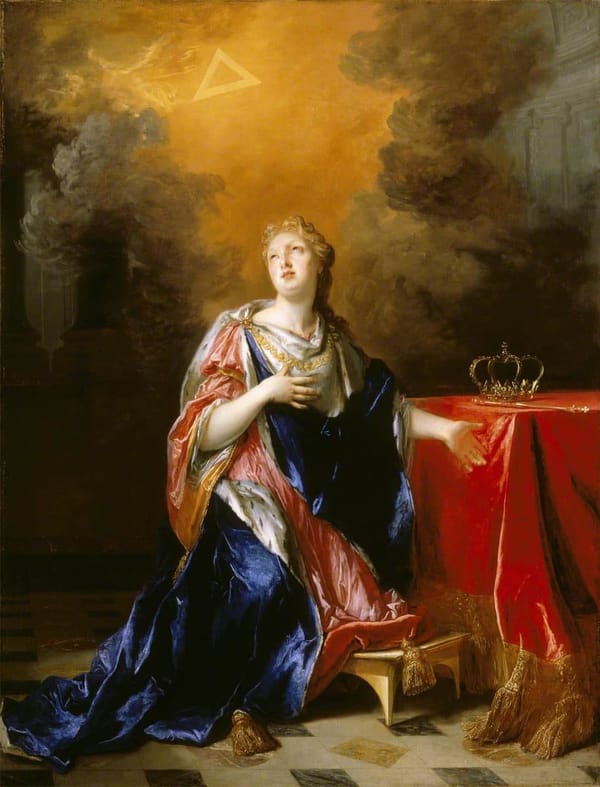
SCOTLAND had long been Christian when Margaret was given to her to establish, amidst a population so diversified, and so often at mutual enmity as was hers, that unity which makes a nation. Ancient Caledonia, defended by her lakes, mountains, and rivers, had, up to the fall of the Roman empire, kept her independence. But, whilst herself inaccessible to invading troops, she had become the refuge of the vanquished of every race and the proscribed of every epoch. Many an advancing wave, that had paused at the feet of her granite frontiers, had swept pitilessly over the southern provinces of the great British island. Britons, Saxons, and Danes in turn, dispossessed and driven from their homes, fleeing northwards, had successively crept in, and settling down as best they might, had maintained their own customs in juxtaposition with those of the first inhabitants, adding consequently their own mutual jealousies to the inveterate divisions of the Picts and Scots. But from the very evil itself the remedy was to come. God, in order to show that he is master of revolutions just as he is of the surging waves, was about to confide the execution of his merciful designs upon Scotland to such casual instruments as a storm or a political overthrow may sometimes prove to be.
At the opening of the eleventh century, Danish invasion had driven from the English shore the sons of the Saxon king, Edmund Ironside. The crowned apostle of Hungary, St Stephen I, generously received the fugitives at his court, welcoming in these helpless children the great-nephews of a saint, namely Edward the Martyr. To the eldest he gave his own daughter in marriage, and the second he affianced to the niece of St Henry, emperor of Germany. Of this last mentioned union were bom three children, Edgar, surnamed Atheling, Christina, afterwards a nun, and Margaret, whose feast the Church is keeping to-day. By the turning tide of fortune, the exiles once more returned to their country, and Edgar was brought to the very steps of the English throne. For in the meantime, the sceptre had passed from the Danish princes back again to the Saxon line, in the person of their uncle, St Edward the Confessor, and by very birthright seemed destined to pass ultimately to Edgar Atheling. But almost immediately after their return from exile, the death of St Edward and the Norman conquest again banished the royal Saxon family. The ship bearing these noble fugitives, bound for the continent, was driven in an opposite direction by a hurricane, and stranded on the Scottish shore. Edgar Atheling, in spite of the efforts of the Saxon party, was never to raise up the fallen throne of his sires; but his sister, the saint of this day, made conquest of the land whither the storm, God's instrument, had carried her.
Having become the wife of Malcolm III, her gentle influence softened the fierce instincts of the son of Duncan, and triumphed over the barbarism still so dominant in those parts of the country as to separate them utterly from the rest of the known world. The fierce highlander and haughty lowlander, reconciled at last, now followed their gentle queen along hitherto unknown paths, thrown open by her to the light of the Gospel. The strong now bent down to meet the weak or the poor; and all alike, casting aside the rigidity of their hardy race, let themselves be captured by the alluring charms of Christian charity. Holy penitence resumed its rights over the gross instincts of mere nature. The frequentation of the Sacraments, once more brought into esteem, produced seasonable fruits. Everywhere, whether in Church or in State, abuses vanished. The whole kingdom became one family, whereof Margaret was called the mother; for Scotland was bom by her to true civilization. David I (inscribed like his mother in the catalogue of the saints) completed the work begun by her; and another child of Margaret’s, alike worthy of her, Matilda of Scotland, surnamed ‘good Queen Maud,’ was married to Henry I of England; and thus an end was put on the English soil to the persistent rivalries of victors and vanquished, by this admixture of Saxon blood with the Norman race.
The following are the words given in the liturgy concerning St Margaret.
We hail thee, O Queen, truly worthy of the praises lavished upon thee by posterity, among the most illustrious of sovereigns! Power, in thy hands, became an instrument of rescue for an entire population. Thine earthly passage marks the meridian of true light for Scotland. Yesterday, holy Church commemorated in her martyrology him who was thy precursor in this far-off land, Columba, who, leaving Ireland in the sixth century, had borne the faith thither. But Christianity, crippled in its soarings by divers combined circumstances, could produce scarcely any of its civilizing effects on the inhabitants of the land at that period. Only a mother could perfect the supernatural education of the nation. The Holy Ghost, who had chosen thee, O Margaret, for the task, prepared thy maternity in the midst of tribulation and anxiety; thus had he acted in the case of Clotilde; thus does he ever act in the case of mothers. How mysterious and hidden did the ways of eternal Wisdom seem, as realized in thy person! Thy birth in exile, far from the land of thy sires; thy return home; then fresh misfortunes; then the tempest at sea; and at last thy being cast, despoiled of everything, upon the crags of an unknown coast: what a list of disasters! And who among the worldly-wise would ever have dreamed that herein was the direct course of a merciful Providence, to make the combined violence of men and the elements serve the sweet purposes of his designs in thy regard? Yet so it was; and this is the way thou wast moulded into the valiant woman,1 raised in all thy loftiness above the deceits of this present life, and wholly fixed on God, the one supreme Good, alone untouched by earth's revolutions.
Far from becoming either soured or dried up by suffering, thy heart, firmly anchored beyond the influence of this world's ebb and flow on unshaken and eternal love, was ever up to the mark in foresight and in devotedness, such as was needed to hold thee always at the height of the mission destined for thee. Wherefore thou wast indeed that treasure worthy of being sought from the uttermost coasts; that merchant-ship bringing bread from afar, and all good things to the favoured shore on which she is cast.2 Yea, fortunate indeed were thy land of adoption, had she never forgotten thy teaching and example! Happy thy descendants, had they ever remembered that the blood of saints flowed in their veins! Yet worthy of thee in death was at least the last queen of Scots, as she bowed beneath the headsman's axe a brow faithful to her Baptism up to her last breath. But alas! the unworthy son of Mary Stuart, by a policy as false as it was sacrilegious, abandoned at once both the Church and his own mother. Thenceforth heresy blighted the noble stem whence so many kings had sprung; and this at the very moment when England and Scotland were first united under one sceptre's sway! Nor may the treason of a James I be redeemed by the fidelity of a second James to the faith of his fathers! O Margaret, thy throne is firmly fixed for ever in the eternal kingdom; but abandon not thine own England, the land of thy sires, nor Scotland, still more thine own, of which holy Church has declared thee patroness. The apostle Andrew shares with thee the rights of patronage: in concert with him, preserve those who have been steadfast in fidelity, multiply converts to the ancient faith, and prepare the way for the speedy gathering of the whole flock into the fold of the one Shepherd.3
| Previous Monday in Whitsun Week | Next Tuesday in Whitsun Week: The Gift of Knowledge |