Daily reading
Paschal Time
Double · June 12 · Sanctoral
June 12, 2025
From Dom Guéranger’s The Liturgical Year.
A Double leads the weekday.Rubric
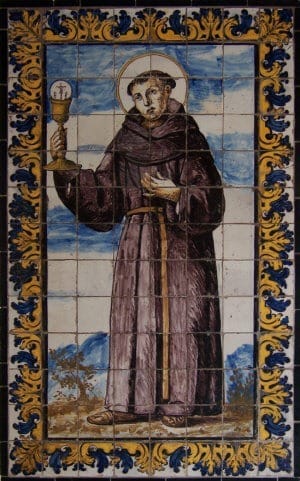 |
June 12: St. John a S. Facundo or of Sahagun, Confessor
THE kingdom which the apostles are commissioned to establish upon earth is a reign of peace. Such was the promise pledged by heaven to earth, on that glorious night wherein Emmanuel was given to us. And on that other night which witnessed our Lord’s last farewell at the Supper, did not the Man-God base the New Testament upon the double legacy which he bequeathed to his Church, of his sacred Body and Blood, and of this peace announced of yore by Bethlehem’s angels?1 A peace unknown till then here below; a peace all his own, because, as he said, it proceeds from him, but still is not himself; this gift substantial and divine is no other than the Holy Ghost in Person! Like to some sacred leaven, this peace has been spread amongst us during this time of Pentecost. Men and nations alike have felt the secret influence. Man, at strife with heaven and divided against himself, was indeed justly punished for his insubordination to God by the ascendancy of the senses in his revolted flesh; but he now sees harmony once again established in his own being, and his appeased God treating as a son the obstinate rebel of former days. The sons of the Most High are to form a new people, stretching their confines unto earth’s furthest bounds. Seated in the beauty of peace, to use the Prophet’s expression,2 this blessed race shall see all nations flocking to its midst, and shall draw down, here below, the goodwill of heaven.
Whereas formerly nations were constantly at strife and wreaking vengeance in many a bloody combat that knew no end but the extermination of the vanquished, once baptized, they recognize each other as sisters, according to the filiation of the Father who is in heaven. Faithful subjects of the one pacific King, they yield themselves up to the Holy Ghost that he may soften their manners; and if war, the result of sin, must needs sometimes come, wofully reminding man of the consequences of the fall, this inevitable scourge will henceforth have at least some law besides that of might. The right of all nations, that Christian right which pagan antiquity rejected, the faith of treaties, the arbitration of the Vicar of Christ, supreme controller of the consciences of kings, these, and only these, can eliminate occasions of bloody discord. Thus there were to be ages in which the ‘peace of God,’ or the ‘truce of God,’ or a thousand such loving artifices of the common mother, would prevail to restrict the number of years and of days wherein the sword might be allowed to remain unsheathed against human life; were these limits outstepped, the transgressor's blade would be snapped in twain by the power of the spiritual sword, more dreaded, in those days, than warrior's steel. Such is the power of the Gospel that, even in these present days of universal decadence, the fiercest adversary respects a disarmed foe; so that after a battle victors and vanquished, meeting like brothers, lavish the same cares both corporal and spiritual on the wounded of either camp. Such is the persistent energy of the supernatural leaven which has been working progressive transformation in mankind for eighteen hundred years, and is even still acting upon those who would fain deny its power!
He whom we are honouring to-day is one of the most glorious instruments of this marvellous conduct of divine Providence. Heaven-born peace mingles her placid ray with the brilliant aureole that wreaths his brow. A noble son of Catholic Spain, he knew how to prepare the future glory of his country, as well as any mailed hero that laid Moor prostrate in the dust. Just as the eight hundred years' crusade that drove the crescent from Iberian soil was closing, and the several kingdoms of this magnanimous land were blending together under one sceptre, this lowly hermit of St Augustine was laying within hearts the foundation of that powerful unity which would inaugurate the glory of Spain's sixteenth century. When he first appeared, rivalries engendered too easily by a false point of honour in a nation armed to the teeth sullied the fair land of Spain with the blood of her sons, slain by Christian hands. As he now stands before us receiving the Church's homage, we behold discord at his feet, overthrown and vanquished by his defenceless hand.
Let us read his life as related in the liturgy.
O blessed Saint, well hast thou earned the privilege of appearing in the heavens of holy Church during these weeks that are radiant with the light of Pentecost. Long ago did Isaias thus portray the loveliness of earth, on the morrow of the coming down of the Paraclete: ‘How beautiful upon the mountains are the feet of them that bring good tidings, and that preach peace: of them that preach salvation; that say to Sion: Thy God shall reign!’3 What the prophet thus admired was the sight of the apostles taking possession of the word, in God's name. But in what did thine own mission differ from theirs thus enthusiastically pictured by the inspired pencil? The same Holy Ghost animated thy ways and theirs; the same pacific King beheld his sceptre by thy hand made yet more steadfast in its sway over a noble nation of his vast empire. Peace, the one object of all thy labours here below, is now thine eternal recompense in heaven, where thou reignest with him. Thou dost now experience the truth of thy Master's word, when he said of such as resemble thee by working to establish peace at least within the territory of their own hearts: ‘Blessed are the peacemakers, for they shall be called the children of God!’4 Yea, rest then, dear Saint, in thy Father's inheritance, into which thou hast entered; rest in the beatific repose of the Holy Trinity that inundates thy soul, and may we here, afar off on this chilly earth below, feel something of that genial peacefulness!
Vouchsafe to lavish upon thine own land of Spain the same succour which in thy lifetime was so precious to her. No longer does she hold that pre-eminence in Christendom which became hers just after thy glorious death. Would that thou couldst now persuade her that never can her greatness be recovered by lending an ear to the deceptive whisperings of false liberty! But that which could in bygone days render her so strong and powerful can do so again if she draw down upon her the benedictions of him by whom alone kings reign.5 Devotedness to Christ, that was her glory; devotedness to truth, that was her treasure! Revealed truth is alone that whereby men enter into true liberty: Truth will make you free.6 Truth alone is able to bind in unity indissoluble the many minds and wills that make up a nation; powerful is that bond, for it secures strength to a country beyond her frontiers and peace to her within. Apostle of peace, remind thine own people, and teach the same to all, that absolute fidelity to the Church's doctrines is the sole ground whereon Christians may seek and find concord.
Thursday in Whitsun Week
|
The divine Spirit has been sent to secure unity to the bride of Christ; and we have seen how faithfully He fulfils His mission, by giving to the members of the Church to be one, as He Himself is one. But the bride of a God, who is, as He calls Himself, the truth,1 must be in the truth, and can have no fellowship with error. Jesus entrusted His teachings to her care, and has instructed her in the person of the apostles. He said to them: ‘All things whatsoever I have heard of My Father, I have made known to you.’2 And yet, if left unaided, how can the Church preserve free from all change, during the long ages of her existence, that word which Jesus has not written, that truth which He came from heaven to teach her? Experience proves that everything changes here below; that written documents are open to false interpretations; and that unwritten traditions are frequently so altered in the course of time, as to defy recognition.
Here again we have a proof of our Lord’s watchful love. In order to realize the wish He had to see us one, as He and His Father are one,3 He sent us His Spirit; and in order to keep us in the truth, He sent us this same Spirit who is called the Spirit of truth. ‘When the Spirit of truth is come,’ said He, ‘He will teach you all truth.’4 And what is the truth which this Spirit will teach us? ‘He will teach you all things, and bring all things to your mind, whatsoever I shall have said to you.’5
So that nothing of what the divine Word spoke to men is to be lost. The beauty of His bride is to be based on truth, for ‘beauty is the splendour of truth.’ Her fidelity to her Jesus shall be of the most perfect kind; for if He be the truth, how could she ever be out of the truth? Jesus had said:’I will ask the Father, and He shall give you another Paraclete, that He may abide with you for ever; and He shall be in you.’6 It is by the Holy Ghost, then, that the Church is ever to possess the truth, and that nothing can rob her of it; for this Spirit, who is sent by the Father and the Son, will abide unceasingly with and in her.
The magnificent theory of St. Augustine comes most appropriately here. According to his teaching—which, after all, is but the explanation of the texts just cited—the Holy Ghost is the principle of the Church’s life; and He, being the Spirit of truth, preserves and directs her in the truth, so that both her teaching and her practice cannot be other than expressions of the truth. He makes Himself responsible for her words. jnst as our spirit is responsible for what our tongue utters. Hence it is that the Church, by her union with the Holy Ghost, is so identified with truth, that the apostle did not hesitate to call her ‘the pillar and ground of the truth’.7 The Christian, therefore, may well rest on the Church in all that regards faith. He knows that the Church is never alone; that she is always with the holy Spirit who lives within her; that her word is not her own, hut the word of the Spirit, which is the word of Jesus.
Now, this word of Jesus is preserved in the Church by the Holy Ghost, and in two ways. He guards it as contained in the four Gospels, which the evangelists wrote under His inspiration. It is by His watchful care that these holy writings have been kept free from all change during the past ages. The same is to be said of the other books of the new Testament, which were also written under the guidance of the same Spirit. Those of the old Testament are equally the result of the inspiration of the Holy Ghost: and, although they do not give us the words spoken by our Saviour during His mortal life, yet do they speak of Him, and foretell His coming, and contain, moreover, the primitive revelations made by God to mankind. The Books of sacred Writ are replete with mysteries, the interpretation of which is communicated to the Church by the Holy Ghost.
The other channel of Jesus’ word is tradition. It was impossible for everything to be written; and even before the Gospels were composed, the Church was in existence. Tradition, like the written word itself, is from God; but unless the Spirit of truth watch over and protect it, how can it remain pure and intact? He therefore fixes it in the memory of the Church, He preserves it from change: it is His mission; and thanks to the fidelity wherewith He fulfils His mission, the Church remains in possession of the whole treasure left her by her Spouse.
But it is not enough that the Church possesses the word, written and traditional: she must also have the understanding of that word, in order that she may explain it to her children. Truth came down from heaven that it might be communicated to men; for it is their light, and without it they would be in darkness, knowing not whither they are going.8 The Spirit of truth could not, therefore, be satisfied if the word of Jesus were kept as a hidden treasure; no, He will have it thrown open to men, that they may thence draw life to their souls. Consequently, the Church will have to be infallible in her teaching; for how can she be deceived herself, or deceive others, seeing it is the Spirit of truth who guides her in all things and speaks by her mouth? He is her soul; and we have already had St. Augustine telling us that when the tongue speaks, the soul is responsible.
The infallibility of our holy mother the Church is the direct and immediate result of her having the Spirit of truth abiding within her. It is the promise made to her by Jesus; it is the necessary consequence of the presence of the holy Spirit. The man who does not acknowledge the Church to be infallible, should, if he be consistent, admit that the Son of God has not been able to fulfil His promise, and that the Spirit of truth is a Spirit of error. But he that reasons thus, has strayed from the path of life; he thought he was but denying a prerogative to the Church, whereas, in reality, he has refused to believe God Himself. It is this that constitutes the sin of heresy. Want of due reflection may hide the awful conclusion; but the conclusion is strictly implied in his principle. The heretic is at variance with the Holy Ghost, because he is at variance with the Church; he may become once more a living member, by humbly returning to the bride of Christ; but at present he is dead, for the soul is not animating him. Let us again give ear to the great St. Augustine: ‘It sometimes happens,’ he says, ‘that a member—say a hand, or finger, or foot—is cut from the human body; tell me, does the soul follow the member that is thus severed? As long as it was in the body, it lived; now that it is cut off, it is dead. In the same manner, a Christian is a Catholic so long as he lives in the body (of the Church); cut off, he is a heretic; the Spirit follows not a member that is cut off.’9 Glory, then, be to the holy Spirit, who has conferred upon the bride the ‘splendour of truth!’ With regard to ourselves: could we, without incurring the greatest of dangers, put limits to the docility wherewith we receive teachings which come to us simultaneously from ‘the Spirit and the bride,’ who are so indissolubly united?10 Whether the Church intimates what we are to believe, by showing us her own practice, or by simply expressing her sentiments, or by solemnly pronouncing a definition on the subject, we must receive her word with submission of heart. Her practice is ever in harmony with the truth, and it is the Holy Ghost, her life-giving principle, that keeps it so; the utterance of her sentiments is but an aspiration of that same Spirit, who never leaves her; and as to the definitions she decrees, it is not she alone that decrees them, but the Holy Ghost who decrees them in and by her. If it be the visible head of the Church who utters the definition, we know that Jesus prayed that Peter’s faith might never fail,11 that He obtained it from the Father, and that He gave the Holy Ghost the mission of perpetuating this precious prerogative granted to Peter. If it be the sovereign Pontiff and bishops, assembled in council, who proclaim what is the faith on any given subject, it is the Holy Ghost who speaks by this collective judgement, makes truth triumph, and puts error to flight. It is this divine Spirit that has given to the bride to crush all heresies beneath her feet; it is He that, in all ages, has raised up within her learned men, who have confuted error whensoever or wheresoever it was broached.
So that our beloved mother the Church is gifted with infallibility; she is true, always and in all things; and she is indebted for this to Him who proceeds eternally from the Father and the Son. But there is auother glory which she owes to Him. The bride of the thrice holy God could not but be holy. She is so; and it is from the Spirit of holiness that she receives her holiness. Truth and holiness are inseparably united in God. Hence it is that our Saviour, who willed us to be perfect as our heavenly Father is perfect,12 and, creatures as we are, would have us take the infinite good as our model, prayed that we might be sanctified in the truth.13
Jesus, therefore, consgined His bride to the direction of the Spirit, that He might make her holy. Holiness is so inherent in this divine Spirit, that it is His very name. Jesus Himself calls Him the Holy Ghost;14 so that it is on the authority of the Son of God that we call Him by this beautiful name. The Father is power; the Son is truth; the Spirit is holiness: and it is for this reason that the Spirit has, here below, the office of Sanctifier; although the Father and the Son are holy, just as truth is in the Father and the Spirit, and power is in the Spirit and the Sou. The three Persons of the blessed Trinity have each His special property, but They are all one in essence or nature. Now, the special property of the Holy Ghost is love, and love produces holiness; for it unites the sovereign Good with the soul that loves Him, and this union is holiness, which is the splendour of goodness, as beauty is the splendour of truth.
That she might be worthy, then, of the Emmanuel, her Spouse, the Church was to be holy. He gave her truth, and the divine Paraclete has preserved it within her: the Spirit is to endow her with holiness; and the Father, seeing her true and holy, will adopt her as His daughter:—this is her glorious destiny. Let us now see what proofs she gives of her being holy. The first is her fidelity to her Spouse. History is one long testimony of this her fidelity. Every possible snare has been laid, every sort of violence has been used, to make her unfaithful: she has bravely withstood them all: she has sacrificed everything, her blood, her peace, the very countries where she reigned, rather than allow what Jesus had entrusted to her to be corrupted or changed. Count, if you can, her martyrs, from the apostles down to our own times, who have died for the faith. Call to mind the offers made to her by the potentates of the earth, soliciting her to dissemble the truth. Think of the threats and persecutions whereby the world sought to make her withdraw one or other dogma of her Creed. Who that knows aught of past or present history, can forget the great battle she fought against the emperors of Germany in defence of the liberty wherewith her Jesus had made her free, and of which He is so jealous; or the noble love of justice she evinced, when her refusal to sanction by an unlawful dispensation the adultery of a king, was to be followed by the apostasy of England; or the high-minded love of principle she showed in the person of Pius IX, when she braved the clamours of modern infidelity, yea, and the cowardly remonstrances of temporizing Catholics, rather than allow a Jewish boy who had been baptized when in danger of death, to be exposed to the temptation of denying his faith and blaspheming the Saviour who had made him His child?
Such has been, and such ever will be, the conduct of the Church, because she is holy in her fidelity, and because the divine Spirit inspires her with a love which overleaps everything when duty is at stake. She can show the code of her laws to her enemies as well as to her faithful children, and defy them to point out a single enactment that has not been made with a view to procure the glory of her Jesus and lead mankind to virtue. The observance of these her laws has given to God millions of saints, whom she has produced through the influence of the Holy Ghost. The Church claims each one of those myriads of the elect as the fruit of her maternal care. Even those whom Providence has permitted to be born of heretical parents—if they have lived in the disposition of mind of entering the true Church as soon as they should find it, and have faithfully corresponded, by a virtuous life, to the grace given to them through the merits of the Redeemer—they, too, are children of the Church.
She is the school of devoted ness and heroism. Virtues, of which men knew not so much as the name before she was founded, are now being practised in every country of the world. There are extraordinary actions of saintliness, which she rewards with the honour of canonization; there are the more humble and hidden virtues, which are to be published only on the day of judgement. The precepts of Jesus are observed by all His disciples; they obey Him as their dear Master. This Master has also His counsels, which all cannot follow, but which afford the Church a new scope for the development of her gift of holiness. Not only are there individual and generous souls who fervently practise these counsels; there are the religious Orders, whose aim is perfection, and whose first law is the obligation, under vow, of observing the evangelical counsels, unitedly with the precepts; and these Orders are produced in the Church by the action of the Spirit of holiness.
After this, we cannot wonder at her having the gift of miracles, which is the outward mark of holiness. It is a supernatural gift, which our Lord told her she should always possess.15 Now, the apostle assures us, that the working of miracles comes directly from the Holy Ghost.16
It may be objected that all the members of the Church are not holy: to this we reply, that she offers to all the means of becoming so, but that their freewill may, and frequently does, reject such means. Free-will has been granted to man that he might thereby merit; and it is a contradiction in terms to say that he who has free-will is, at the same time, necessitated to choose good. Moreover, an immense number of those who are now in a state of sin, but who are members of the Church by faith and respectful submission to her lawful pastors, and particularly to the sovereign Pontiff, will sooner or later be reconciled to God and die in holy dispositions. It is the mercy of the Holy Ghost that works this wonderful change, and He works it through the Church, who, imitating her divine Spouse, breaketh not the bruised reed, nor quencheth the smoking flax.17
How could she be otherwise than holy, who has received, in order to administer them to her children, the seven sacraments, of which we have spoken in one of the preceding weeks? What more holy than these divine rites, some of which give life to sinners, and others an increase of grace to the just? These sacraments, which were instituted by Christ and given in heritage to His Church, all bear some relation to the Holy Ghost. In Baptism, Confirmation, and Holy Orders, His operation is direct; in the eucharistic sacrifice, it is by His action that the Man-God lives and is immolated on our altars; it is He that restores baptismal grace by Penance; He is the Spirit of fortitude, who strengthens the dying by Extreme Unction; He is the sacred link which inseparably unites husband and wife together in the sacrament of Matrimony. Our Jesus gave us these seven sacraments as a pledge of His love, when He left us to return to His Father; but the treasure remained sealed up until the descent of the Holy Ghost. It was for Him to prepare the bride, by sanctifying her, to receive these precious gifts into her royal hands, and to administer them faithfully to her children; it was for Him, therefore, to put her in possession of them.
Lastly, the Church is holy because of her ceaseless prayer. He who is the Spirit of grace and of prayers,18 is ever producing, in the children of the Church, those varied acts of adoration, thanksgiving, petition, repentance, and love, which constitute the sublime concert of prayer. To these He adds, for many of the faithful, the gifts of contemplation, whereby either the creature is raised up to his God, or God comes down to him, with favours which seem only fit for such as are already in heaven. Who could enumerate the aspirations, we mean the effusions of love, which the holy bride sends up to her Jesus in those millions of prayers, which are day and night ascending from earth to heaven, and seem to unite the two in the embrace of closest intimacy? How could she be otherwise than holy, who, as the apostle so forcibly expresses it, has her conversation in heaven?19
But if the individual prayer offered up by her children is thus admirable by its multiplicity and its ardour, how beautiful and grand must be the united prayer of the Church herself in her liturgy, wherein the Holy Ghost acts with all the plenitude of His inspiration, and puts upon her lips those thrilling and sublime words, which we have undertaken to explain in our Liturgical Year! We would ask those who have followed us thus far, if the liturgy is not the best of all prayers, and the guide and soul of their own individual prayer? Let them, therefore, love the holy mother who gives them to partake of her own abundance. Let them glorify the Spirit of grace and of prayers for all that He so mercifully deigns to do both for her and for them!
O Church of our God! thou art sanctified in truth! By thee we are taught the whole doctrine of our Jesus! By thee we are put in the path of that holiness, which is thy very life. What would we have more, having truth and holiness? They that seek them out of thee, seek in vain. Happy we, who have nothing to seek, because we have thee for our mother, who art ever lavishing upon us all thy grand gifts and lights! Oh! how beautiful art thou on this solemnity of Pentecost, which gave thee the riches thou givest to us! We gaze with delighted wonder at the magnificent prerogatives prepared for thee by thy Jesus, and communicated to thee by the Holy Ghost. And now that we know thee better, we will love thee with warmer hearts!
The Station for the Thursday of Whitsuntide is in the basilica of St. Laurence outside the walls. This venerable church, where lie the relics of the intrepid archdeacon of Rome, is one of the grandest trophies of the victory gained by the Holy Ghost over the prince of this world. This annual assembly of the faithful in so holy a place, and for all these long ages, is an eloquent testimony to the completeness of that victory, which made Rome and her power subject to Christ.
The Armenian Church comes, for the fourth time, to aid us in our homage to the Holy Ghost. The richest fragrance of antiquity is in the stanzas we select for to-day.
Hymn (Canon quintæ diei.)
We subjoin a sequence from Germany; in which her illustrious prophetess, the holy abbess Hildegarde, gives expression to her love of the divine Spirit, whose inspiration she almost uninterruptedly enjoyed and obeyed.
Sequence
Vita vitae omnis creaturae.
Sanctus es ungendo Periculose fractos.
Sanctus es tergendo Foetida vulnera.
O ignis charitatis,
O dulcis gustus
In pectoribus, et infusio cordium
In bono odore virtutum!
Quod Deus alienos Colligit, et perditos requirit.
Et spes compaginis
Membrorum omnium!
Salva beatos!
Et solve ligatos, quos divina vis salvare vult.
In altissimis, e in terrenis, et in omnibus abyssis,
Et colligis.
Lapides humorem habent,
Aquæ rivulos educunt Et terra viriditatem sudat.
Per inspirationem sapientiae Laetificatos.
Qui es sonus laudis Et gaudium vitæ,
Spes et honor fortissimus,
Dans praemia lucis.
thou art the life of every creature’s life.
Thou art the Holy One, healing with thine unction them that are dangerously bruised!
Thou art the Holy One, cleansing our festered wounds!
O fire of charity!
O thou sweet Saviour
of the soul, and the heart’s infusion
of the pleasing odour of virtues!
who adopts aliens for his children, and goes in search of them that are lost.
that givest all the members hope
of compact strength!
save us thy happy people!
Loose the bonds of them whom God’s power would save!
that penetratest heaven and earth, and every deep abyss,
and unity!
that rocks yield springs,
that waters flow, and earth gives forth her verdure.
gladdening them with the inspiration of wisdom.
O thou praise-yielding Spirit, thou joy of life,
our hope, our highest honour,
the giver of the reward of light!
- St. John, xiv. 6. ↩︎
- Ibid. xv. 15. ↩︎
- Ibid. xvii. 11. ↩︎
- St. John, xvi. 13. ↩︎
- Ibid. xiv. 26. ↩︎
- Ibid. 16, 17. ↩︎
- 1 Tim. iii. 15. ↩︎
- St. John, xii. 35. ↩︎
- Serm. cclxvii. In die Pentecostes. ↩︎
- Apoc. xxii. 17. ↩︎
- St. Luke, xxii. 32. ↩︎
- St. Matth. v. 48. ↩︎
- St. John, xvii. 19. ↩︎
- Ibid. xiv. 26. xx. 22, et alibi. ↩︎
- St. John, xiv. 12. ↩︎
- 1 Cor. xii. 11. ↩︎
- Is. xlii. 3. ↩︎
- Zach. xii. 10. ↩︎
- Philipp. iii. 20. ↩︎
Thursday in Whitsun Week: The Gift of Counsel
We have seen how necessary for the sanctification of a Christian is the gift of fortitude; but it is not sufficient; there is need of another gift, which completes it. This other gift is Counsel. Fortitude needs direction. The gift of knowledge is not the guide of fortitude, and for this reason: knowledge teaches the soul her last end, and gives her general rules for her conduct; hut it does not bring her light sufficient for the special application of God’s law to particular cases, and for the practical doing of her duty. In those varied circumstances in which we are to be placed, and in the decisions we must then form, we shall have to hearken to the voice of the Holy Ghost, and this voice speaks to us through the gift of counsel. It will tell us, if we are attentive to its speaking, what we must do and what we must not do, what we must say and what we must not say, what we may keep and what we must give up. The Holy Ghost acts upon our understanding by the gift of counsel, as He acts upon our will by the gift of fortitude.
This precious gift bears upon our whole life; for we are continually obliged to be deciding on one of two sides or questions. How grateful, then, should we be to the Holy Ghost, who is ever ready to be our counsellor, if we will but permit Him! And if we follow His direction, what snares He will teach us to avoid! how many illusions He will dispel! bow grand the truths He will show us! But, in order that His inspirations may not be lost upon us, we must be on our guard against such miseries of our nature as the following: natural impulse, which is but too often the sole motive of our acts; rashness, which makes us follow whatever feeling happens to be uppermost in our mind; precipitation, which urges us to judge or act, before we have seen both sides of the case; and lastly, indifference, which makes us decide at haphazard, out of a repugnance we have to take the trouble of examining what is the best course to pursue.
By the gift of counsel, the Holy Ghost saves us from all these evils. He corrects the impetuosity, or, it may be, the apathy, of our temperament. He keeps the soul alive to what is true, and good, and conducive to her real interests. He introduces into the soul that virtue which completes and seasons every other—we mean discretion whereby the other virtues are harmonized and kept from extremes. Under the direction of the gift of counsel, the Christian has nothing to fear; the Holy Ghost takes the whole responsibility. What matters it, therefore, if the world find fault, or criticize, or express surprise, or be scandalized? The world thinks itself wise; but it has not the gift of counsel. Hence it often happens that what is undertaken by its advice, results in the very opposite to what was intended. Was it not of the world that God spoke, when He said:’My thoughts are not your thoughts, nor your ways my ways’?1
Let us, then, with all the ardour of our hearts, desire this divine gift, that will preserve us from the danger of being our own guides; but let us remember, it will only dwell in us on the condition of our allowing it to be master. If the Holy Ghost sees that we are not led by worldly principles, and that we acknowledge our own weakness, He will be our counsel; if He find that we are wise in our own eyes, He will withdraw His light, and leave us to ourselves.
O holy Spirit! we would not that Thou shouldst ever abandon us. Sad experience has taught us how fraught with danger is all human prudence. Most cheerfully do we promise Thee to mistrust our own ideas, which are so apt to blind and mislead us. Keep up within us the magnificent gift Thou gavest us at Baptism: be Thou our counsel, yea, unreservedly and for ever! Show me, O Lord, Thy ways, and teach me Thy paths. Direct me in Thy truth, and teach me: for Thou art the God who canst save me; therefore have I waited on Thee, all the day long.2 We know that we are to be judged for all our works and intentions; but we know, too, that we have nothing to fear so long as we are faithful to Thy guidance. Therefore will we attentively hear what the Lord God will speak in us;3 we will listen to Thee, O holy Spirit of counsel, whether Thou speakest to us directly Thyself, or whether Thou sendest us to those whom Thou shalt appoint as our guides. Blessed, then, be Jesus, who has sent us such a Counsellor! And blessed be Thou, O holy Spirit, who deignest to give us Thine aid, in spite of all our past resistance!
June 12 (the Same Day): St. Basilides and Companions, Martyrs
BESIDE John of Sahagun, the apostle of peace, are grouped four warriors of our Lord's army. Thus peace and war go this day hand in hand, and form but one in the kingdom of the Son of God. The threefold peace preached by Christ—namely, man’s peace with his God, with himself, and with his brethren and fellowcitizens in the holy city—is to be won only at the cost of combat with Satan, the flesh, and the world, which is the ‘accursed city.’ Together with the Church, let us blend in one united homage our praises of the glorious confessor of these later ages, and of the stern veterans of persecuting times.
From you we learn, O soldiers of Jesus Christ, the nature of that peace which he came to bring upon earth to men of goodwill. Its reward is no other than God himself, who, by it and together with it, communicates himself to such as are worthy. Its invigorating sweetness overpowers every sensitive feeling, even that of tortures such as Christians, after your example, must be ready to undergo in order to preserve intact this priceless treasure. Amidst torments and beneath the deathstroke, this peace upheld you, keeping your mind and heart free, fixed on heaven alone:* this same peace now forms for ever your eternal beatitude, in the presence of the undivided Trinity. Whatsoever be the varied condition of our life here below, lead us, O holy martyrs, by the path of this perfect peace, fraught as it necessarily is with valour and love, unto the repose of endless bliss.
* Phil. iv 7. ↩︎
June 12 (the Same Day): Saint Leo the Third, Pope and Confessor
The fragrance of Christmas is suddenly wafted around us, while we are in the midst of Pentecost! Leo III, as he speeds his flight from earth, sheds upon us the perfumed memory of that day, whereon the Infant God was pleased to manifest, by his means, the plenitude of His principality over all nations. Christmas Day of the year 800 witnessed the proclamation of the Holy Empire. The obscurity and poverty which had, eight centuries previously, ushered in the Birth of the Son of God, had for its object the drawing of men’s hearts; but this feebleness, so full of tenderness and condescension, was far from expressing the fullness of the mystery of the Word made Flesh. The Church tells us so, every year, as this blessed night of love comes round: ‘A Child is bom to us, and upon His shoulder is the sign of principality; His name shall be called the Wonderful, the Mighty, the Father of the world to come, the Prince of peace.’1 Peace, this day, once more shines upon the cycle: the peace of Christ, indisputably Victor and King! More even in one respect than our St. John of to-day, does Leo III deserve the united gratitude of the faithful. Here he stands like a new Sylvester, in presence of a new Constantine; by him alone is the complete victory of the Word Incarnate absolutely revealed.
Christ had successively triumphed over the false gods, over Byzantine Caesarism, and over barbarian hordes. A new society had sprung up, governed by princes who confessed that they held their crowns of the Man-God alone. To the old Roman empire founded on might, to Cæsarism, crushing the world with the iron teeth of its domination,2 rather than binding it together, was to succeed that confederation of baptized nations, which was to be called Christendom. But whence the unity needed for so vast a body? Who the chief amongst such a multitude of princes equal in birth and in rights? On what basis can the primacy of such a chieftain stand? Who may summon him? who point out the chosen of the Lord and anoint him with so potent an anointing, that his right to the first place in the councils of kings shall be undisputed by the strongest amongst them? The Holy Ghost, brooding over the chaos of peoples, as in the beginning over the dark waters,3 had long been elaborating this new creation, which must declare the glory of our Emmanuel:4 the new empire thus prepared would, as it were of itself, spring forth unto light, out of circumstances preordained strongly and sweetly,5 by eternal Wisdom.
Up to this period, the uncontested primacy of the spiritual power had stood majestic and alone, amidst Christian kingdoms. Though weakest of them all, ever did Peter’s successor behold earth prostrate at his feet; the city of the Cæsars had become his; Rome, by his voice, commanded all nations. Nevertheless, his authority, unarmed and defenceless, would have need at times to repel such assaults of violence as had already more than once imperilled the sacred patrimony which secured the independence of Christ’s Vicar. For the spiritual power, when once able to appear in sublime magnificence, became itself the object of sacrilegious ambition, the coveted prey of blackest perfidy. Leo III himself had lately experienced this in his own sacred person. A powerful lord, in conjunction with certain unworthy clerics, banded together by one common greed for gain, had beguiled the Pontiff into an ambush; his body had been mutilated, his eyes and tongue tom out, and his life preserved only by miracle; more wondrous still, his sight and speech had been afterwards restored by divine intervention. All Rome, witnessing this prodigy, was loud in heartfelt thanksgiving. God had indeed delivered His anointed; but the assassins had remained, nevertheless, masters of the city until the victorious troops of the Frankish king brought back the illustrious victim and reinstated him in his palace. Still this noble triumph was of itself no guarantee against future peril; for it had been preceded by other such victories, likewise due to the ever ready arm of the eldest daughter of the Roman Church. When her protecting sword was again withdrawn, leaving the work of restoration scarcely accomplished, new plots within or outside of Rome would soon be again set in motion for the usurpation of either the spiritual or temporal power of the Papacy. From the coast of the Bosphorus, too, the depraved successors of Constantine only applauded such intrigues, even keeping conspirators and traitors in secret pay.
Such a state of things could no longer continue. The sovereign Pontiff must necessarily look around, to find some security less precarious for the great interests confided to his keeping; the peace of the whole Christian world, the peace of souls as well as of nations, demanded that the highest authority upon earth should not be left at the mercy of ceaseless cabals. It was by no means sufficient that, at the hour of peril, the Vicar of Jesus Christ should be able to depend upon the fidelity of one nation, or of one prince. Some permanent institution was needed, not only to repair, but to ward off, every blow aimed by violence or by perfidy against Rome. Christian society was, by this time, advanced enough to furnish materials for the carrying out of such a noble conception. Already indeed, Pepin le Bref, by abandoning his Italian conquests into the hands of the apostolic See, had unreservedly constituted the temporal sovereignty of the Roman Pontiffs. But, though the use of the sword in self defence belongs to the Popes by right, just as much as to any king in his own states, yet, even when absolutely unable to act otherwise, personal use of armed force must ever be distasteful to the successor of him whom the Man-God appointed, here below, as the Vicar of His love.6 On the other hand, he well knows that he must maintain those sacred rights for which he has to answer to both God and man. Monarch as he is, Peter’s successor would be at liberty to choose from amongst the kings of the west (all of whom gloried in being his sons) one prince to whom he might confide the office of protector and defender of holy Church. Head as he is of the whole spiritual army of the elect, porter of heaven’s gates, depositary of grace and of infallible truth, he could invite the said prince to the honour of his alliance. Sublime indeed would such an alliance be, the legitimacy whereof bears the palm over that of all treaties ever concluded between potentates. Such an alliance, inasmuch as it is intended to guarantee the rights of the King of kings in the person of His representative, would entail certain obligations, it is true, on the recipient; but, at the same time, it would single him out to lofty privileges. Intrinsically vain and powerless are nobility of race, vastness of territory, glory of arms, and brilliancy of genius, to exalt a prince above his peers; such a greatness merely springs from earth, and outstrips not man’s limits. But the ally of Pontiffs would possess a dignity touching upon the heavenly; for such are the sacred interests whereof he would assume the filial guardianship. Without in the least encroaching on the domain of other kings, his compeers in other respects, or derogating from their independence, he must hold it his right, as accredited protector of his mother the Church, to carry the sword whithersoever the spiritual authority is aggrieved or requires his concurrence, in the accomplishment of the divine mission of teaching and saving souls. In this sense, his power must be universal, because the mission of holy Church is universal. So real this power, so distinct from every other, that to express it a new diadem must needs be added to the regal crown already his by inheritance; and a fresh anointing, different from the usual royal unction, must manifest in his person superiority over all other kings, chieftainship of the Holy Empire, of the Roman empire renewed, ennobled, and limitless as the earthly dominion assigned to Jesus Christ by the eternal Father.
Verily this magnificent conception unveils before us the boundless empire of the Word Incarnate, in all its wondrous plenitude! He alone possesses fully, by right of birth, by right of conquest, the universality of nations;7 He alone can delegate, for and by His Church, such power to kings. Who then may tell the splendour of that Christmas festival, whereon Charlemagne the greatest of princes, prostrate before the Infant God, beheld his anterior glories eclipsed by the pomp of that unexpected title, whereby he was officially appointed lieutenant of the divine Child couched in the humble crib! Beside the tomb of the first of Popes, of him that was crucified by the orders of a Caesar, Leo III, in the plenitude of his sole authority, reconstituted the empire; in Peter’s name, on Peter’s tomb, he linked once more the broken chain of the Caesars. Henceforth, before the eyes of all nations, the Pope and the emperor (to use the language of the papal bulls) will appear as two luminaries directing earth’s movements; the Pope, as the faithful image of the Sun of justice; the emperor, as deriving his light from the radiance cast on him by the supreme Pontiff.
Too often, indeed, will parricides stand up in revolt, and turn against the Church the sword that should be brandished only in her defence. But even these will serve only to demonstrate more clearly that the Papacy is verily the one source of empire. True, the day may come when German tyrants, rejected as unworthy by the Roman Pontiffs, will lay violent hands on the eternal city, creating antipopes, with a view to the aggrandizement of their own power. But by the very fact of carrying their insolence so far as to get themselves crowned champions of St. Peter by these pseudo-vicars of Christ, on the very tomb of the prince of the apostles, they will prove that society in those days could acknowledge no title to greatness, save such as either came, or seemed to come, from the apostolic See. The abuses and crimes, everywhere to be met with on history’s page, must not allow us Christians to forget that the value of an epoch or of an institution must, as regards God and His Church, be measured only by the progress derived thence by truth. Even though the Church suffer from the violence of rightful or of intruded emperors, she nevertheless rejoices much to see her Spouse glorified by the faith of nations, still recognizing how, through Christ, all power resides in her alone. Children of the Church, let us judge of the Holy Empire, as the Church, our mother, judges of it: it was the highest expression ever given to the influence and power of the Popes. To this glorification of Christ in His Vicar did Christendom owe its thousand years of existence.
Space fails us, or gladly would we here describe in detail the gorgeous liturgical function used during the middle-ages, in the ordination of an emperor. The Ordo Romanus, wherein these rites are handed down to us, is full of the richest teachings clearly revealing the whole thought of the Church. The future lieutenant of Christ, kissing the feet of the Vicar of the Man-God, first made his profession in due form: he ‘guaranteed, promised, and swore fidelity to God and blessed Peter pledging himself on the holy Gospels, for the rest of his life to protect and defend, according to his skill and ability, without fraud or ill intent, the Roman Church and her ruler in all necessities or interests affecting the same.’ Then followed the solemn examination of the faith and morals of the elect, almost word for word the same as that marked in the Pontifical at the consecration of a bishop. Not until the Church had thus taken sureties regarding him who was to become in her eyes, as it were, an extern bishop, was she content to proceed to the imperial ordination. While the apostolic suzerain, the Pope, was being vested in pontifical attire for the celebration of the sacred Mysteries, two cardinals clad the emperor elect in amice and alb; then they presented him to the Pontiff, who made him a clerk, and conceded to him, for the ceremony of his coronation, the use of the tunic, dalmatic, and cope, together with the pontifical shoes and the mitre. The anointing of the prince was reserved to the Cardinal Bishop of Ostia, the official consecrator of popes and emperors. But the Vicar of Jesus Christ himself gave to the new emperor the infrangible seal of his faith, namely the ring; the sword, representing that of the Lord of armies, the most potent One, chanted in the Psalm;8 the globe and sceptre, images of the universal empire and of the inflexible justice of the King of kings; lastly, the crown, a sign of the glory reserved in endless ages as a reward for his fidelity, by this same Lord Jesus Christ, whose figure he had just been made. The giving of these august symbols took place during the holy Sacrifice. At the Offertory, the emperor laid aside the cope and the ensigns of his new dignity; then, clad simply in the dalmatic, he approached the altar and there fulfilled, at the Pontiff’s side, the office of subdeacon, the servitor, as it were, of holy Church and the official representative of the Christian people. Later on, even the stole was given him: as recently as 1530, Charles V on the day of his coronation, assisted Clement VII in quality of deacon, presenting to the Pope the paten and the Host, and offering the chalice together with him.
The Christmas day of the year 800, witnessed not indeed the display of all this sacred pageantry; for these splendid rites reached full development only in course of centuries. Up to the last moment, Leo III had kept wholly secret the grand project conceived in his heart. But none the less solemn was this marvellous historic fact, when Rome, at the sight of the golden crown placed by the Pontiff’s hand on the row of the new Caesar, re-echoed the cry: To Charles, the most pious, the ever august, the monarch crowned by God, to the great and pacific emperor of the Romans, life and victory!’ This creation of an empire by the sole power and will of the supreme Pontiff, on such a day, and for the sole service of the interests of our Emmanuel, verily puts the finishing stroke to that which the birth of the Son of God was meant to achieve. As year by year this august Christmas festival returns, let us remember Leo the Third’s work,9 and so enter more and more fully into the touching antiphons of that day: The King of peace, whom the whole earth desireth to see, hath shown His greatness. He is magnified above all the kings of the earth.’
The account of this holy Pope’s life we here borrow from the ‘Proper of the city of Rome.’
Commissioned by the Lion of Juda to complete His own victory, thou, O Leo, didst constitute His kingdom, and proclaim His empire. Apostles had preached, martyrs had shed their blood, confessors had toiled and suffered, to win that great day whereon thou didst crown the labour of eight centuries; by thee, the Man-God could then rule supreme over the social edifice, not only as Pontiff in the person of His vicar, but as Lord-paramount and King in the person of His lieutenant, the armed defender of holy Church, the civil head of all Christendom. Thy work lasted as long as the eternal Father permitted the glory of His Son to shine in full splendour over the world. After a thousand years, when the divine light be came too strong for their weakened and diseased eyes, men turned away from holy Church and renounced her mighty works. They replaced God by self; the power of Christ, by the sovereignty of the people; institutions sprung from centuries of toil, by the instability of ephemeral chartas; bygone union, by the isolation of nationalities; and within each of these, anarchy. In this dark age, every utopia of man’s wild brain is called light, and every step towards nonentity is called progress! Thus the Holy Empire is no more; like Christendom itself, it can henceforth be but a name in history: and history too must soon cease to be, for the world is verging on the final term of its destinies.
Great for ever shall thy glory be, in endless ages, O thou by whom eternal Wisdom hath manifested the grandeur of His wondrous ways. A docile instrument in the hand of the Holy Ghost for the glorification of our Emmanuel, thy firmness was equalled only by thy gentleness; and this humble sweetness of thine attracted the eyes of the Lamb, the Ruler of the earth.10 Praying like Him, under the stroke of treason, for thy murderers, thou hadst to pass through thy day of humiliation, through a day of crushing anguish and of death-agony; but therefore was it given thee to distribute the spoils of the strong;11 and then, for centuries, the will of the Lord to be prosperous in thy hand,12 according to the plan which thou didst trace.
Even in these unhappy times, so unworthy of thee, vouchsafe to bless our earth. Strengthen those whom universal apostasy has as yet left unshaken. Make them by faith cling loyally to Christ; hold them ever aloof from liberalism, that fatal error whereby, men would fain remain Christians whilst actually refusing to acknowledge Christ’s kingship over all creation. What an insult to the eternal Father is such a wild notion as this; what a misconception of the mystery of the Incarnation! O holy Pontiff, make it to be clearly understood that safety is not to be sought at the hands of lying compromise with rebels; that the time is nigh, when God’s kingdom will assert itself, when the upheaving of nations against the Lord and against His Christ will be mocked by Him who dwelleth in the heavens.13 On that day, none may contest the origin of all power. On that day of wrathful vengeance, happy he who hath kept the oath of allegiance sworn to his King in Baptism!14 Like the prophet of Patmos, the faithful will easily recognize that King, when the heavens opening out a way before His feet, He shall come to crush the nations; for all the crowns of the whole earth shall rest upon His head, and He shall bear written upon the vesture of His human Nature: King of kings and Lord of lords.15
- The Office of Matins, Christmas day. ↩︎
- Dan. ii. 40. ↩︎
- Gen. i. 2; Apoc. xvii. 15. ↩︎
- Ps. xviii. 2. ↩︎
- Wisd. viii. 1. ↩︎
- Ambr. in Luc. x. ↩︎
- Ps. ii. 8. ↩︎
- Ps. xliv. 4. ↩︎
- See ‘Christmas’ Vol. I. where mention is made of this historic event in its proper place. ↩︎
- Is. xvi. 1. ↩︎
- Ibid. liii. 12. ↩︎
- Ibid. 10. ↩︎
- Ps. ii. ↩︎
- Ibid. lxii. 12. ↩︎
- Apox. xix ↩︎
| Previous Wednesday in Whitsun Week: The Gift of Fortitude | Next Thursday in Whitsun Week |