Daily reading
Paschal Time
Double · June 13 · Sanctoral
June 13, 2025
From Dom Guéranger’s The Liturgical Year.
A Double leads the weekday.Rubric
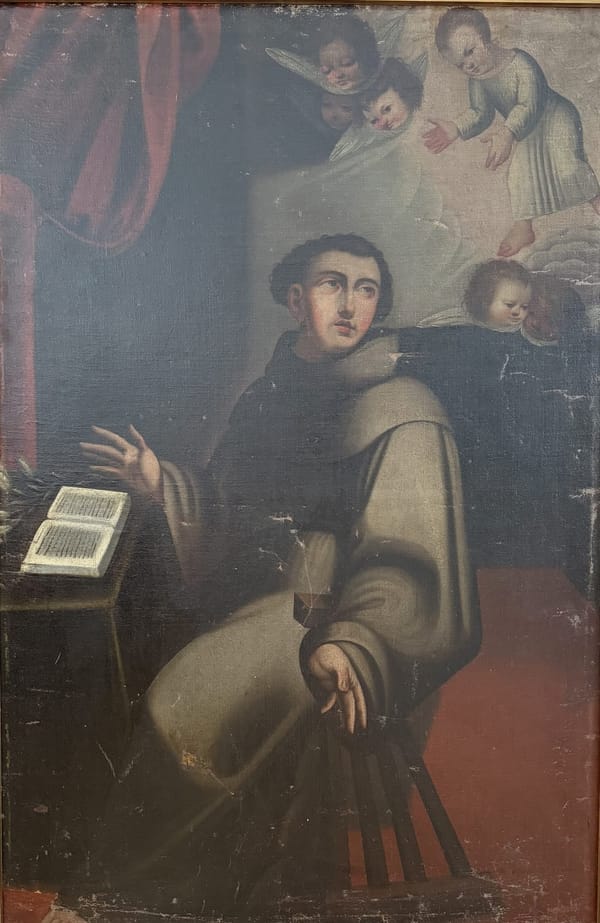 |
June 13: St. Anthony of Padua, Confessor
REJOICE thee, happy Padua, rich in thy priceless treasure!1 Anthony, in bequeathing thee his body, has done more for thy glory than the heroes who founded thee on so favoured a site, or the doctors who have illustrated thy famous university!
The days of Charlemagne were past and gone: yet the work of Leo III still lived on, despite a thousand difficulties. The enemy, now at large, had sown cockle in the field of the divine householder; heresy was springing up here and there, whilst vice was growing apace in every direction. In many an heroic combat, the Popes, aided by the monastic Order, had succeeded in casting disorder out of the sanctuary itself: still the people, too long scandalized by venal pastors, were fast slipping away from the Church. Who could rally them once more? Who wrest from Satan a reconquest of the world? At this trying moment the Spirit of Pentecost, ever living, ever present in holy Church, raised up the sons of St Dominic and of St Francis. The brave soldiers of this new militia, organized to meet fresh necessities, threw themselves into the field, pursuing heresy into its most secret lurking-holes, and thundering against vice in every shape and wheresoever found. In town or in country, they were everywhere to be seen confounding false teachers by the strong argument of miracle as well as of doctrine; mixing with the people, whom the sight of their heroic detachment easily won over to repentance. Crowds flocked to be enrolled in the Third Orders instituted by these two holy founders, to afford a secure refuge for the Christian life in the midst of the world.
The best known and most popular of all the sons of St Francis is Anthony, whom we are celebrating this day. His life was short; at the age of thirty-five he took his flight to heaven. But a span so limited allowed, nevertheless, of a considerable portion of time being directed by our Lord to preparing this chosen servant for his destined ministry. The all-important thing in God's esteem, where there is question of fitting apostolic men to become instruments of salvation to a greater number of souls, is not the length of time which they may devote to exterior works, but rather the degree of personal sanctification attained by them, and the thoroughness of their self-abandonment to the ways of divine Providence. As to Antony, it may almost be said that, up to the last day of his life, eternal Wisdom seemed to take pleasure in disconcerting all his thoughts and plans. Out of his twenty years of religious life, he passed ten amongst the Canons Regular, whither the divine call had invited him at the age of fifteen, in the full bloom of his innocence; and there, wholly captivated by the splendour of the liturgy, occupied in the sweet study of the Holy Scriptures and of the fathers, blissfully lost in the silence of the cloister, his seraphic soul was ever being wafted to sublime heights, where (so it seemed) he was always to remain, held and hidden in the secret of God's face. Suddenly, behold! the divine Spirit urges him to seek the martyr's crown: and presently he is seen emerging from his beloved monastery, and following the Friars Minor to distant shores, where already some of their number had won the glorious palm. Not this, however, but the martyrdom of love, was to be his. Falling sick and reduced to impotence before his zeal could effect anything on the African soil, he was recalled by obedience to Spain, but was cast by a tempest on the Italian coast.
It happened that St Francis was just then convoking his entire family, for the third time, in general chapter. Anthony, unknown, lost in this vast assembly, beheld at its close each of the friars in turn receive his appointed destination, whereas to him not a thought was given. What a sight! The scion of the illustrious family de Bouillon and of the kings of the Asturias completely overlooked in the throng of holy poverty’s sons! At the moment of departure the Father Minister of the Bologna province, remarking the isolated condition of the young religious whom no one had received in charge, admitted him, out of charity, into his company. Accordingly, having reached the hermitage of Monte Paolo, Anthony was deputed to help in the kitchen and in sweeping the house, being supposed quite unfitted for anything else. Meanwhile, the Augustinian Canons, on the contrary, were bitterly lamenting the loss of one whose remarkable learning and sanctity, far more even than his nobility, had, up to this, been the glory of their Order.
The hour at last came, chosen by Providence, to manifest Anthony to the world; and immediately, as was said of Christ himself, the whole world went after him.2 Around the pulpits where this humble friar preached there were wrought endless prodigies in the order of nature and of grace. At Rome he earned the surname of ‘ark of the covenant'; in France, that of 'hammer of heretics.' It would be impossible for us here to follow him throughout his luminous course; suffice it to say that France, as well as Italy, owes much to his zealous ministry.
St Francis had yearned to be himself the bearer of the gospel of peace throughout the fair realm of France, then sorely ravaged by heresy; but in his stead, he sent thither Anthony, his well-beloved son, and, as it were, his living portrait. What St Dominic had been in the first crusade against the Albigenses, Anthony was in the second. At Toulouse was wrought that wondrous miracle of the famished mule turning aside from the proffered grain in order to prostrate in homage before the sacred Host. From the province of Berry, his burning word was heard thundering in various distant provinces; whilst heaven lavished delicious favours on his soul, ever childlike amidst the marvellous victories achieved by him, and the intoxicating applause of an admiring crowd. Under the very eyes of his host, at a lonely house in Limousin, the Infant Jesus came to him radiant in beauty; and throwing himself into his arms, covered him with sweetest caresses, pressing the humble friar to lavish the like on him. One feast of the Assumption Anthony was sad, because a phrase then to be found in the Office seemed to throw a shade of discredit on the fact of Mary’s body being assumed into heaven together with her soul. Presently, the Mother of God herself came to console her devoted servant, in his lowly cell, assuring him of the truth of the doctrine of her glorious Assumption; and so left him, ravished with the sweet charms of her countenance and the melodious sound of her voice. Suddenly, as he was preaching at Montpellier, in a church of that city thronged with people, Anthony remembered that he had been appointed to chant the Alleluia at the conventual Mass in his own convent, and he had quite forgotten to get his place supplied. Deeply pained at this involuntary omission, he bent his head upon his breast: whilst standing thus motionless and silent in the pulpit, as though asleep, his brethren saw him enter their choir, sing his verse, and depart; at once his audience beheld him recover his animation, and continue his sermon with the same eloquence as before. In this same town of Montpellier another well-known incident occurred. When engaged in teaching a course of theology to his brethren, his commentary on the Psalms disappeared; but the thief was presently constrained, even by the fiend himself, to bring back the volume, the loss whereof had caused our saint so much regret. Such is commonly thought to be the origin of the popular devotion, whereby a special power of recovering lost things is ascribed to St Anthony. However this may be, it is certain that, from the very outset, this devotion rests on the testimony of startling miracles of this kind; and in our own day constantly repeated favours of a similar nature still confirm the same.
The following is the abridgement of this beautiful life, as given in the liturgy.
Want of space obliges us to be very meagre in the number we give of liturgical pieces; but we cannot omit here the miraculous Responsory, as it is called, the composition whereof is attributed to St Bonaventure. It continues still to justify its name, in favour of those who recite it in the hour of need. In the Franciscan breviary it is the eighth responsory of the office of St Antony of Padua. At a very early date, this, together with the nine Tuesdays in our Saint's honour, became a very popular devotion and was fraught with immense fruits of grace.
The Miraculous Responsory
O glorious Anthony, the simplicity of thine innocent soul made thee a docile instrument in the hand of the Spirit of love. The Seraphic Doctor, St Bonaventure, hymning thy praises, takes for his first theme thy childlike spirit, and for his second thy wisdom which flowed therefrom. Wise indeed wast thou, O Anthony, for, from thy tenderest years, thou wast in earnest pursuit of divine Wisdom; and wishing to have her alone for thy portion, thou didst hasten to shelter thy love in some cloister, to hide thee in the secret of God’s face, the better to enjoy her chaste delights. Silence and obscurity in her sweet company was thine heart's one ambition; and even here below her hands were pleased to adorn thee with incomparable splendour. She walked before thee; and blithely didst thou follow, for her own sake alone, without suspecting how all other good things were to become thine in her company.3 Happy a childlike spirit such as thine, to which are ever reserved the more lavish favours of eternal Wisdom!
'But,' exclaims thy sainted panegyrist, 'who is really a child nowadays? Humble littleness is no more; therefore love is no more. Naught is to be seen now but valleys bulging into hills, and hills swelling into mountains. What saith Holy Writ? “When they were lifted up, thou hast cast them down.”4 To such towering vaunters, God saith again: "Behold I have made thee a small child ”; but exceedingly contemptible among the nations5 such infancy is. Wherefore will ye keep to this childishness, O men, making your days an endless series of inconstancy, boisterous and vain effort at garnering wretched chaff? Other is that infancy which is declared to be the greatest in the land of true greatness.6 Such was thine, O Anthony! and thereby wast thou wholly yielded up to Wisdom's sacred influence.’7 In return for thy loving submission to God our Father in heaven, the populace obeyed thee, and fiercest tyrants trembled at thy voice.8 Heresy alone dared once to disobey thee, dared to refuse to hearken to thy word: thereupon, the very fishes of the sea took up thy defence; for they came swimming in shoals, before the eyes of the whole city, to listen to thy preaching which heretics had scorned. Alas! error, having long ago recovered from the vigorous blows dealt by thee, is yet more emboldened in these days, claiming even sole right to speak. The offspring of Manes, whom, under the name of Albigenses, thou didst so successfully combat, would now, under the new appellation of freemasonry, have all France at its beck; thy native Portugal beholds the same monster stalking in broad daylight almost up to the very altar; and the whole world is being intoxicated by its poison. O thou who dost daily fly to the aid of thy devoted clients in their private necessities, thou whose power is the same in heaven as heretofore upon earth, succour the Church, aid God's people, have pity upon society, now more universally and deeply menaced than ever. O thou ark of the covenant, bring back our generation, so terribly devoid of love and faith, to the serious study of sacred letters, wherein is so energizing a power. O thou hammer of heretics, strike once more such blows as will make hell tremble and the heavenly powers thrill with joy.
Friday in Whitsun Week
|
So far, we have considered the action of the Holy Ghost in the Church; we must now study His workings in the soul of the Christian. Here, also, we shall find fresh motives for admiration and gratitude towards this divine Paraclete, who so graciously condescends to minister to us in all our necessities, and lead us to the glorious end for which we were created.
As the Holy Ghost, who was sent that He might abide with us for ever,1 exercises His power in upholding and guiding the Church, that thus she may be the faithful bride of Jesus; so, likewise, does He work in each one of us, that He may make us worthy members of our divine Head. This is His mission: to unite us so closely with Jesus, that we may be made one body with Him. His office is, to create us in the supernatural order, to give and maintain within us the life of grace, by applying to us the merits acquired for us by Jesus, our Mediator and our Saviour.
Let us begin by considering how sublime is this mission given by the Father and the Son to the Holy Ghost. In the Godhead, the Holy Ghost is produced, and does not produce. The Father begets the Son; the Father and the Son produce the Holy Ghost. This difference is founded on the divine Nature itself, which is not and cannot be but in three Persons. Hence, as the holy fathers teach, the Holy Ghost has received a fecundity outside, having none within, the Godhead. Thus, when the Humanity of the Son of God was to be produced in Mary’s womb, it was the Holy Ghost that achieved the mystery. Again, when the Christian is to be formed in the creature corrupted by original sin, it is the same holy Spirit who produces the new being. St. Augustine thus forcibly expresses himself: ‘The same grace that produced Christ when He first became Man, produces the Christian when He first becomes a believer; the same Spirit of whom Christ was conceived, is the principle of the new birth of the Christian.’2
We have dwelt at some length on the action of the Holy Ghost in the formation and government of the Church, because the chief work of this divine Spirit is to produce, here upon the earth, the bride of the Son of God, and because it is through her that all blessings come to us. She is the depository of a portion of the Paraclete’s graces, inasmuch as He is ever ready to serve her for our salvation and sanctification’s sake. It is for us, also, that He made her Catholic and visible to the world; and this, to the end that we might the more easily find her. It is for us that He maintains her in truth and holiness, that so we may drink our fill at these two sources of life-giving water. Coming now to consider what He does in the souls of men, the first marvel that demands our attention is His creative power. Is it not a veritable creation, when He raises a soul from the abyss of original sin, or from the still deeper fall of actual guilt, and instantly makes her an adopted child of God, and a member of the Son of God? The Father and the Son look with complacency upon this work of the Spirit, who is their own mutual love. They sent Him into the world that He might work, yea, work with sovereign authority; and wheresoever He reigns, there do They also reign.
This elect soul has been eternally present to the mind of the blessed Trinity. The time fixed by the divine decree having come, the Holy Ghost descends, and takes possession of this object of His love. Swifter than ever eagle to his prey, the Dove of infinite mercy flies to His destined habitation. If no hindrance be offered to His action by the creature’s free-will, there happens in her what St. Paul describes as happening in the Church herself: the things that were not become superior to the things that were,3 and where sin abounded, grace is made to dwell in rich superabundance.4
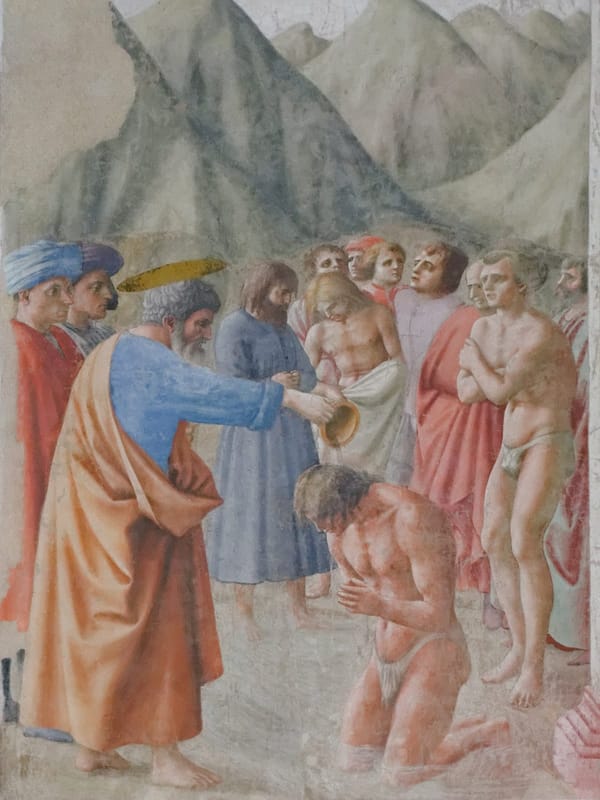
We have already seen how our Emmanuel gave to water the power of purifying the soul; but we also remember how, when He went down into the Jordan stream, the Dove rested upon Him; hereby showing that He, the Spirit of God, took possession of the element of regeneration. The font of Baptism is His domain.’The water of Baptism,’ says the great St. Leo,’is like the virginal womb (that conceived Jesus) it gives to man a spiritual regeneration; for the same holy Spirit that gave fecundity to the Virgin, gives fecundity to the font, to the end that sin, of which there could be no question in the sacred conception (of the Son of God in Mary’s womb), may be washed away by the mystic font.’5
What tongue could describe the fond delight wherewith the holy Spirit looks upon the new creature that rises from the font, or the impetuosity of love wherewith He comes into such a soul? He is’the Gift of the Most High,’ sent that He may dwell within us. He takes up His abode in the new-born soul, be it that of an infant but one day old, or that of an adult advanced in years. He is well-pleased with the dwelling He has, from all eternity, longed to possess; He fills it with His glowing and His light; and being, by nature, one with the other divine Persons, He brings thither with Him the presence of the Father and the Son, and all Three abide in that happy soul!6
But the Holy Ghost has here His own special action, His mission of sanctification: and in order that we may understand the full effect of His presence in the Christian, we must know that it is not confined to the soul. The body, too, is part of man, and had its share in the regeneration. The apostle tells us that the soul is the dwelling of the Holy Ghost;7 but he also assures us that our bodies are the temple of the same divine Spirit,8 who bids us make them serve justice unto sanctification.9 He graces them with a germ of immortality, which will rest upon them even in the tomb, and give them to rise again, at the last day, spiritualized,10 and bearing on them the seal of the divine Paraclete, who deigned to be their Guest during the term of their mortality.
After having thus made the Christian to be His dwelling-place, the Holy Ghost bestows upon him what may fit him for this high destiny. Think, for a moment, of the beauty of the theological virtues! Faith puts us into the certified and real possession of the divine truths which our mind cannot, in this present life, understand; hope gives us both the divine assistance we stand in need of, and the eternal happiness we look forward to; charity unites us to God by the strongest and sweetest of ties. Now it is to the indwelling of the Holy Ghost within him, that the Christian is indebted for these three virtues, these three means whereby regenerated man is made capable of attaining the end of his creation. The holy Spirit marked His first entrance into the soul by this triple gift, which surpasses all the creature’s merits, past, present, or future.
Over and above the three theological virtues, He bestows on the soul four other virtues, which are the hinges whereon the rest of the moral virtues turn, and hence their name of cardinal; they are, justice, fortitude, prudence, and temperance. Though, in themselves, natural qualities, the Holy Ghost transforms them by making them serve the supernatural end of the Christian. Finally, as a finish to the beauty of His abode, He infuses His seven gifts, which are to impart movement and life to the seven virtues.
But though the virtues and gifts relate to God, yet do they need that element, which is the essential means of union with Him: an element which is indispensable, for which nothing can serve as substitute, the soul of the soul, the life-giving principle, without which man can neither see nor possess God, viz. sanctifying grace. The Holy Ghost exultingly plants it in the soul; it becomes part of herself, and makes her an object of delight to the blessed Trinity. So close is the union between this grace and the presence of the holy Spirit, that when it is lost by mortal sin, He, that same instant, ceases to dwell in the soul.
He watches most carefully over His inheritance. He is ceaselessly working for the interests of His much-loved dwelling. The virtues He has infused into her are not to remain inert; they must elicit virtuous acts, and by the merits they thus produce, must increase, strengthen, and develop the fundamental element of sanctifying grace, which unites the Christian to his God. The Holy Ghost is, therefore, ever exciting the soul to action, either interior or exterior, by means of those divine influences, which theologians call actual graces. He thus enables the soul to raise herself higher and higher in virtue, add to her riches, strengthen her strength, and, in a word, become the instrument of glory to her Maker, who created her that she might serve Him, labour for Him, and yield Him fruit.
To this end, the Spirit, after giving Himself to her, and dwelling within her with devoted love, urges her to prayer, whereby she may procure every blessing: light, strength, and success in what she undertakes. But how are we to know what to pray for? The apostle solves the difficulty, by telling us the truth, of which he himself had such experience. He says: ‘The Spirit Himself asketh for us with unspeakable groanings’.11 Yes, the Holy Ghost makes our wants His own. God as He is, He unites His own speakings with the voice of our prayer, and, with His dove-like moaning, cries in our hearts to the Father.12 He thus, by His presence and His workings, makes us feel that we are children of God.13 Could there be intimacy greater than this? And who, after this, can be surprised at our Jesus’ saying that we have but to ask, and we shall receive?14 Is it not His own Spirit that asks within us?
So that He is the author of our prayer, when we pray: He is, also, the great co-operator with us in the good actions we do. So intimate is His union with the soul, that He leaves her no liberty of her own save what is necessary for her to have merit; but it is He that does the rest: that is, He inspires her, He supports her, He directs her. All she has to do, is to co-operate in what He does in and by her. It is by this mark, that is, by the united action of the Holy Ghost and the soul, that our heavenly Father knows who are His. Hence that saying of the apostle: Whosoever are led by the Spirit of God, they are the sons of God.15 O glorious union! which brings the Christian to life everlasting, and makes Jesus triumph in him, Jesus, whose likeness is imprinted by the Holy Ghost in the creature, that the creature may become worthy to be united with his divine Head!
Alas! this union may be severed, as long as we are on earth. Our free-will is not confirmed in good, until we reach heaven; and meanwhile, it may, and frequently does, lead to a rupture between the Spirit that sanctifies, and the creature that is sanctified. The unhappy love of independence, and the passions, which we cannot master, save when we are docile to the divine Spirit, excite the unguarded heart to the desire of what is unworthy of her. Satan is jealous of the reign of the Holy Ghost, and seeks to make us disloyal, by holding out to us the lying promise of happiness and good, other than those we can find in God. The world, too, which is a spirit of evil, sets itself up as a rival of the holy Spirit of God. Wily, audacious, and active, it excels in the art of seduction, and its victims are countless, although our Saviour has put us on our guard against it, by telling us that He excluded it from any share in His prayers;16 and the apostle tells us, that we have received, not the spirit of the world, but the Spirit that is of God.17
And yet, how many there are who bring about in themselves a cruel separation of their soul from the Holy Ghost! The separation is generally preceded by a certain coolness of the creature for his divine Benefactor. A want of respect, a slight disobedience, are the preliminaries of the rupture. This occasions in the holy Spirit a displeasure, which proves the tender love He bears to a faithful soul. The apostle describes the nature of this displeasure, where he says: ‘Grieve not the holy Spirit, who put His seal upon you on the day of your redemption.’18 There is a deep meaning in these few words, and, among other truths, they reveal to us the effects of venial sins: the Holy Ghost is grieved, He finds but little pleasure in that soul; there is danger of a separation; and though, as St. Augustine tells us, ‘He does not leave us, unless we leave Him,’ and though, consequently, such a soul still possesses sanctifying grace, yet actual grace becomes less frequent and less powerful.
But, when mortal sin—that act of the creature’s boldest malice and worst ingratitude—enters the soul, it breaks the sacred compact which closely united the Christian and the Holy Ghost. He, the Spirit of love, is driven from the dwelling He had chosen for Himself and had enriched with so many graces. A greater outrage cannot be offered to God by man; for, as the apostle so strongly expresses it, he hath trodden under foot the Son of God, and hath esteemed the Blood of the testament unclean, by which he was sanctified, and hath offered an affront to the Spirit of grace.19
And yet, this miserable state of the sinner may excite the compassion of the Holy Ghost, who has been sent that He might ever be our Guest. Could anything be imagined more sad, than the wretchedness of a Christian, who, by having cast out the divine Spirit, has lost the soul of his soul, forfeited the treasure of sanctifying grace, and robbed himself of all past merits? But—O mystery of mercy, worthy of eternal praise!—the Holy Ghost longs to return to the dwelling whence sin has driven Him. Yes, such is the fulness of the mission given by the Father and the Son to the Holy Ghost: He is love, and in His love He abandons not the poor ungrateful worm, but would restore him to his former dignity, and make him, once more, a partaker of the divine nature.20
This divine Spirit of love labours to regain possession of His dwelling. He begins by exciting within the soul a fear of divine justice; He makes her feel the shame and anguish of spiritual death. He thus detaches her from evil, by what the holy Council of Trent calls ‘impulses of the Holy Ghost, not indeed as yet dwelling within the soul, but moving her.’21 Dissatisfied and unhappy, the soul sighs after a reconciliation; she breaks the chains of her slavery; the sacrament of Penance then comes, bringing life-giving love, and her justification is completed. Who could describe the triumphant joy wherewith the divine Spirit re-enters His dear abode? The Father and the Son return to the dwelling that for days, or perhaps for years, had been defiled with sin. The soul is restored to life. Sanctifying grace returns to her, just as it was on the day of her Baptism. As we have already said, she had lost, by mortal sin, that fund of merit which had developed the power of grace; it is now restored to her fully and entirely, for the power of the holy Spirit is equal to the vehemence of His love.
This admirable raising from death to life is going on every day, yea every hour. It is part of the mission given to the Holy Ghost. He does the work He came for—the sanctification of man. The Son of God came down from heaven, and gave Himself to us. He found us slaves to satan; He ransomed us at the price of His Blood; gave us everything that could lead us to Himself and His heavenly Father; and, when He returned to heaven, there to prepare a place for us, He sent us His own Spirit to be our second Comforter, until He Himself should return to us. We have seen how strenuously this divine Helper undertakes His work. Let us fervently celebrate the love wherewith He treats us, and the wisdom and power wherewith He accomplishes His glorious mission. May He be blessed and glorified! May He be known throughout the whole world, for it is through Him that all blessings are imparted unto men! He is the soul of the Church; may she render Him the homage of her praise! And may He be tenderly loved by those countless millions of hearts, wherein He desires to dwell that He may give them eternal salvation and happiness.
This is the second of the three days’ fast prescribed for this week. To-morrow is the day for the ordination of the priests and other sacred ministers. It behoves us to redouble our efforts to obtain from God that the abundance of His grace may be in keeping with the sacred and ever-abiding character, which the divine Spirit is to imprint on these aspirants to Holy Orders.
At Rome, to-day’s Station is in the church of the twelve apostles, where repose the bodies of St. Philip and St. James the Less. This allusion to the favoured ones of the cenacle is most appropriate, for they were the first guests of the Holy Ghost.
The Armenian Church again lends us its beautiful hymn, in praise of the coming of the Paraclete.
Hymn (Canon sextæ diei)
implevisti apostolos; precibus horum miserere.
The following is taken from the Mozarabic missal. It is an address made to the faithful by the bishop, during the Mass of Whit Sunday. He exhorts them to receive with devotion the divine Spirit, who is about to visit them.
Missa
- St. John, xiv. 16. ↩︎
- De Prædestinatione Sanctorum, cap. xv. ↩︎
- 1 Cor. i. 28. ↩︎
- Rom. v. 20. ↩︎
- Serm. xxiv. In Nativitate Domini, iv. ↩︎
- St. John, xiv. 23. ↩︎
- Rom. viii. 11. ↩︎
- 1 Cor. vi. 19. ↩︎
- Rom. vi. 19. ↩︎
- 1 Cor. xv. 44. ↩︎
- Rom. viii. 26. ↩︎
- Gal. iv. 6. ↩︎
- Rom. viii. 16. ↩︎
- St. Luke, xi. 9. ↩︎
- Rom. viii. 14. ↩︎
- St. John, xvii. 9. ↩︎
- 1 Cor. ii. 12. ↩︎
- Eph. iv. 30. ↩︎
- Heb. x. 29. ↩︎
- 2 St. Peter, i. 4. ↩︎
- Sess. xiv. cap. iv. De Pœitentia. ↩︎
Friday in Whitsun Week: The Gift of Understanding
This sixth gift of the Holy Ghost raises the soul to a still higher state. The first five gifts all tend to action. The fear of God keeps man in his right place, for it humbles him; godliness opens his heart to holy affections; knowledge enables him to discern the path of salvation from that of perdition; fortitude arms him for the battle; counsel directs him in his thoughts and works:—thus gifted, he can act, and pursue his journey with the sure hope of coming at length to his heavenly home. But the Holy Ghost has other favours in store for him. He would give him a foretaste, here below, of the happiness that awaits him in the next life: it will give him confidence, it will encourage him, it will reward his efforts. Contemplation—this is the blissful region thrown open to him, and the Holy Ghost leads him thither by the gift of understanding.
There will be a feeling of surprise and hesitation arising in the minds of many at hearing this word, contemplation. They have been taught to look on contemplation as an element of the spiritual life which is rarely to be hoped for, and almost impossible for persons who are in the ordinary walks of life. We must begin, then, by telling them that such an idea is a great and dangerous error, and one that checks the progress of the soul. No: contemplation is a state to which, more or less, the soul of every Christian is called. It does not consist in those extraordinary effects which the Holy Ghost occasionally produces in some privileged souls, and by which He would convince the world of the reality of the supernatural life. It is simply a relation of close intimacy existing between God and a soul that is faithful to Him in action. For such a soul, unless she herself put an obstacle, God reserves two favours: the first is the gift of understanding, which consists in a supernatural light granted to the mind of man.
This light does not remove the sacred obscurity of faith: but it enlightens the eye of the soul, strengthens her perception, and widens her view of divine things. It dispels clouds, which were occasioned by the previous weakness and ignorance of the soul. The exquisite beauty of the mysteries is now revealed to her, and the truths which hitherto seemed unconnected, now delight her by the sweetness of their harmony, It is not the face-to-face vision which heaven gives, but it is something incomparably brighter than the feeble glimmer of former days, when all was mist and doubt. The eye of her spirit discovers analogies and reasons, which do something more than please—they bring conviction. The heart opens under the influence of these bright beams, for they feed faith, cherish hope, and give ardour to love. Everything seems new to her. Looking at the past, and comparing it with the present, she wonders within herself, how it is that truth, which is ever the same, has a charm and a power over her now which once it had not.
The reading or hearing of the Gospel produces an impression far deeper than formerly: she finds a relish in the words of Jesus, which, in times past, she never experienced. She can understand so much better the object of the institution of the Sacraments. The holy liturgy, with its magnificent ceremonies and sublime formulas, is to her an anticipation of heaven. She loves to read the lives of the saints; she can do so, and never feel a temptation to carp at their sentiments or conduct: she prefers their writings to all others, and she finds in these communications with the friends of God a special increase of her spiritual good. No matter what may be the duties of her station in life, she has, in this glorious gift, a light which guides her in each of them. The virtues required from her, however varied they may be, are so regulated, that one is never done to the detriment of another; she knows the harmony that exists between them all, and she never breaks it. She is as far from scrupulosity as from tepidity; and when she commits a fault, she loses no time in repairing it. Sometimes the Holy Ghost favours her with an interior speaking, which gives her additional light for some special emergency.
The world and its maxims are mere vanities in her estimation; and when necessity obliges her to con- form to what is not sinful in either, she does so without setting her heart upon it. Mere natural grandeur or beauty seems unworthy of notice to her whose eye has been opened, by the holy Spirit, to the divine and the eternal. To her, this outward world which the carnal-minded man loves to his own destruction, has but one fair side, viz: that the visible creation, with the impress of God’s beauty upon it, can be turned to its Maker’s glory. She gives Him thanks when she uses it; she elevates it to the supernatural order, by praising, as did the royal prophet, Him who shadowed the likeness of His own beauty on this world of created things, which men so often abuse to their perdition, but which were intended as so many steps to lead us to our God.
The gift of understanding teaches the Christian a just appreciation of the state of life in which God has placed Him. It shows him the wisdom and mercy of those designs of Providence which have, at times, disconcerted his own plans, and led him in a direction the very opposite to his wishes. He sees that had he been left to arrange things according to his own views, he would have gone astray; whereas now, God has put him in the right place, though the workings of His fatherly wisdom were, at first, hidden from him. Yes, he is so happy now! he enjoys such peace of soul! he knows not how sufficiently to thank his God for having brought him where he is, without consulting his poor fancies! If such a Christian as this be called upon to give counsel, if either duty or charity require him to guide others, he may safely be trusted; the gift of understanding teaches him to see the right thing for others as well as for himself. Not that he ever intrudes his counsel upon others, or makes himself adviser-general to all around him; but if his advice be asked, he gives it, and the advice is a reflex of the inward light that burns within him.
Such is the gift of understanding. It is the true life of the soul, and it is weaker or stronger according to the measure of her correspondence with the other gifts. Its safeguards are humility, restraint over the desires of the heart, and interior recollection. Dissipation of mind would dim its brightness, or even wholly put out the light. But where duty imposes occupations, not only busy and frequent, but even distracting, let the Christian discharge them with a pure intention, and his soul will not lose her recollection. Let him be single-hearted, let him be little in his own eyes, and that which God hides from the proud and reveals to the humble,1 will be manifested to him and abide with him.
It is evident from all this, that the gift of understanding is of immense importance to the salvation and sanctification of the soul. It behoves us, therefore, to beg it of the Holy Ghost with all the earnestness of supplication; for we must not forget that it is obtained rather by the longings of our love, than by any efforts of the intellect. True, it is the intellect that receives the light; but it is the heart, the will, inflamed with love, that wins the radiant gift. Hence that saying of Isaias: ‘Unless ye believe, ye shall not understand!’2 Let us, then, address ourselves to the holy Spirit in these words of the psalmist: ‘Open Thou our eyes, and we will consider the wondrous things of Thy law! Give us understanding and we shall live!’3 Let us beseech Him in these words of the apostle, wherein he is praying for his Ephesians: ‘Give us the Spirit of wisdom and revelation, whereby we may have the knowledge of our God! Enlighten the eyes of our heart, that we may know what is the hope of our calling, and what the riches of the glorious inheritance prepared for the saints!’4
| Previous June 12 (the Same Day): Saint Leo the Third, Pope and Confessor | Next Friday in Whitsun Week |