Daily reading
After Pentecost
Double · June 18 · Sanctoral
June 18, 2025
From Dom Guéranger’s The Liturgical Year.
A Double leads the weekday; Sts. Mark and Marcellian are commemorated.Rubrics
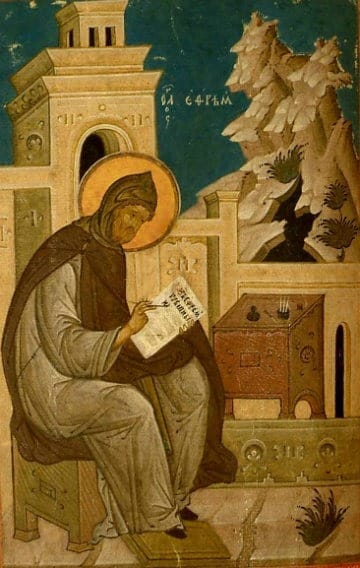 |
June 18: St. Ephraem the Syrian, Deacon, Confessor, and Doctor of the Church
ST EPHRAEM, monk and deacon, the contemporary of St Athanasius, St Basil, St Gregory of Nazianzen and St Gregory of Nyssa, was with them one of the glories of the Christian East so rich in testimonies to faith and sanctity during the first centuries. He takes his place in the liturgical cycle among the doctors of the Universal Church. It is only fitting that the ancient piety of Edessa and Nisibis should be represented in the Roman calendar.
by him who was always held to be the most illustrious of her sons. St Ephraem was honoured by the whole Church for the depth and vastness of his doctrine, and the whole Catholic world rejoiced when Pope Benedict XV pronounced him worthy to be placed among the great doctors of the Church both Greek and Latin. No one was more worthy than the celebrated Deacon of Edessa of such an honour. Even during his lifetime men delighted to honour him with such titles as illustrious ‘ doctor of the universe,' ‘prophet and sun of the Syrians,’ ‘pillar of the Church,' and ‘harp of the Holy Spirit.’1 All the Orthodox fathers and doctors from St Basil, St John Chrysostom and St Jerome down to St Francis de Sales and St Alphonsus Liguori are unanimous in his praise.2 Seldom has reputation been more brilliant, authority more universally acknowledged than that of the humble Syrian monk: less than twenty years after his death his writings were read publicly in church after the Scriptures.3 As theologian, poet and orator his literary work was immense. His writings comprise commentaries on the Scriptures, theological discourses and poems, moral and ascetic treatises, hymns in praise of Almighty God, our Lady and the saints. These form an inestimable treasure where successive generations have found not only weapons wherewith to combat error but also food to strengthen their souls. The works of St Ephraem, written in Syriac, were at an early date translated not only into Greek, but also into all the languages of the East—Coptic, Ethiopian, Arabic and Armenian—so that his hymns and canticles are to be found in all the liturgical books of the Syriac Church, both Orthodox and Uniate, which thus remains indebted to his fruitful genius.
St Ephraem was bom in Mesopotamia, very probably at Nisibis, on the frontier of the Roman Empire and Persia, at the beginning of the fourth century. Tradition says that his father fulfilled the duties of a priest to an idol in that town, but that his mother may have been a Christian.4 In any case he does not appear ever to have taken part in idolatrous worship, for we know that in his youth he was a member of the household of James, the bishop of Nisibis, one of the three hundred and eighteen fathers of the Council of Nicæa. He received baptism, and under the guidance of this bishop gave himself to prayer, to all the practices of Christian asceticism, to reading and profound study of the Scriptures. It was during this time that he acquired his remarkable knowledge and love of the Holy Scriptures so noticeable in all his writings and which is one of his chief characteristics. Later on he said: 'He who applies himself with simplicity and purity of heart to the study of the Sacred Books will receive the knowledge of God. Some people glory in conversing familiarly with the great ones of the earth, with princes and kings, but let it be your glory to converse with the Holy Ghost in the presence of the angels of God by reading the divine Scriptures, for it is the Holy Ghost who there speaks to you. Spare no pains to become familiar with this study.’5
The first verses of 'Hymns of Nisibis' show us what Ephraem was to James and his successors. These poems, the earliest of his that have come down to us, give us a picture of the times in which he lived. James, Babou and Vologesus found him a zealous auxiliary, intent upon upholding their authority, drawing men to them and ardently desirous of reform. His great influence on the people was shown especially when Nisibis was besieged by Sapor, king of the Persians. During those perilous days he incessantly encouraged the citizens to resist the enemy, strengthening the besieged by his word and example, until his courage and his prayer forced the enemy to acknowledge their powerlessness and retire. Later on, when as a result of the disastrous campaign of the emperor Julian against the Persians, his successor Jovian was forced to cede Eastern Mesopotamia with Nisibis to Sapor, Ephraem joined the emigrants who left for ever a town where Christians could no longer dwell in security.
From Nisibis St Ephraem went to Edessa, which name is for ever associated with his. On the west of the town there rises a hill on whose rocky slopes are numerous caves and tombs in which lived many anchorites. St Ephraem in his turn came to seek, among the rocks of the holy mountain, a retreat which would enable him to devote himself to prayer, study and penitential exercises. His knowledge of sacred sciences, however, could not long remain hidden, and disciples soon began to gather around him. This was the period of his literary activity, which was so great as to be almost miraculous. It was during the ten years that he passed in the capital of Osrhoene that he wrote most of his works. It was also the period of his greatest activity in religious affairs, and it seems certain that the School of Edessa, famous under the name of the Persian School, owes to him, if not its existence, at least a great part of its renown.
However, Edessa could not escape the ravages to which the spread of the heresies of Arms, Manes, Marcion and other sowers of discord subjected the whole world, and we owe a great number of St Ephraem’s theological discourses and poems to his solicitude in combating heresy under all its forms, and to his care in safeguarding the purity of faith among the Christians of the town. In obedience to the inspiration of divine grace,6 he left his solitude for a time to pour forth to the faithful exhortations so rich in imagery, so full of unction and of doctrine, that to this day the heart of the reader is moved. The holy doctor inveighs with much vigour against the Arians, who deny the Divinity of Christ. The following passage occurs in one of his sermons on the Passion: ‘The King of kings who is above all kings is the only Saviour Jesus, who sits at the right hand of his Father. He is his Word, his strength, his mighty arm; he descended from the height of heaven to the depths of the earth and ascended into heaven. He came down in secret, he ascended openly, he came down as the Word, he ascended with a human body, he descended and ascended according to his own will. Blessed be he who has acted according to his power. Men should be astonished and should admire the providence of the author of all grace who has abased himself even to us. Blessed be he who in his goodness has drawn from the ocean of his mercy the life that he has bestowed upon us. The Son of God is God, and God of God, he descended from heaven and conversed upon earth, he the power of preaching. The consuming fire which fell from heaven has become a dew for mankind, he who is all on fire has hidden his flame, the vehement God has restrained himself, there is no thunder in his voice nor lightning in his movements, the terrible God has hidden his majesty, the powerful God his force, wholly in heaven, he was wholly upon earth. When you consider him in heaven there is nothing to which you can liken him; when you consider him upon earth he seems to you to be simply a man. If you look towards heaven millions of angels serve him, and seraphim without number cry before him, Holy, holy, holy. If you look towards earth he is confined in a human body. “The foxes have holes, and the birds of the air have nests, but he who is the Son of God has not where to lay his head.”7 Indeed, where could he, who is the refuge of all, have sought shelter? Where could he have rested his head, he who is the pillar that sustains the universe, who upholds the earth and the heavens in either hand, and who in the hollow of his hand holds the seas and the world?’8
With equal energy and with remarkable doctrinal precision, St Ephraem asserts the prerogatives of St Peter. In the person of our Lord speaking to Simon Peter he says: ‘I have established you, Simon my disciple, as the foundation of holy Church. Formerly I called you Peter because you upheld my building, you are the overseer of those who construct the Church upon earth. If they wish to build that which is evil, you, who are the foundation, will prevent them. You are at the source of my doctrine, you are the chief of my disciples, it is through you that I will quench the thirst of all nations, the quickening sweetness that I give belongs to you, I have chosen you as the firstfruits of my disciples to be the inheritor of my treasures. I have given you the keys of my kingdom; I have given all my treasures into your power.’9
It is interesting to receive such testimony from the mouth of him whom all the Eastern Christians reverence as their greatest doctor and consider their special glory. But few of the fathers of the first centuries of Christianity have spoken so explicitly on the subject of the Holy Eucharist as the Deacon of Edessa. He discredits in advance all the sophistry put forth at the time of the Reformation, and thus comments on the words of the institution of the Sacrament of the Body and Blood of our Lord: ‘Do not believe that what I have just given to you is bread, receive it, eat it, do not crumble it away. That which I have called my Body, truly is so. The smallest morsel is sufficient to sanctify millions of souls and suffices to give life to those who receive it. Receive and eat with faith, do not waver, for it is my Body, and he who partakes of it with faith partakes of the fire of the Holy Spirit. It seems to him who partakes without faith to be but ordinary bread, but to him who with faith partakes of the Bread consecrated in my name, if he be pure it preserves his purity, if a sinner it obtains his pardon. Let those who reject, despise or outrage this Bread know that of a certainty they do outrage to the Son, who has called and has made bread to be his Body. Take and eat, and by it partake of the Holy Spirit, for it is truly my Body, and he who eats thereof has eternal life. It is the Bread of heaven come down from on high unto us. The manna which the Israelites ate in the desert, the manna which they gathered and which they despised although it fell from heaven, was a figure of the spiritual food you have just received. Take ye all of it and eat, in eating this Bread you eat my Body, the true source of the redemption.’10
In St Ephraem's time the people of Edessa still took pleasure in the poetical compositions of Bardesanes and his son Harmonius. A hundred and fifty years previously these impious men had spread abroad the errors of Gnosticism by means of these writings, and therefore St Ephraem, in his indefatigable zeal for the purity of the faith, resolved to defeat the heresy with its own arms. ‘When he saw how the inhabitants of Edessa delighted in songs,’ says his biographer, ‘he instituted plays and dances of his own for the young folk. He established choirs of nuns, whom he taught to sing hymns having a refrain between the verses. These hymns embody beautiful thoughts and spiritual instruction on the Nativity, the Baptism, the Fast and deeds of our Lord, the Passion, Resurrection and Ascension, as well as on the confessors, on Penance and the faithful departed. The religious came together on Sunday, on great feasts and on the festivals of the martyrs, and he in the midst of them like a father accompanied them on his harp. He divided them into two choirs, so that they might sing alternately, and taught them the various musical airs with such success that the whole town came to listen. Thus his adversaries were put to shame and disappeared.11
Readers of the Liturgical Year will have often noticed and admired the spirit of faith and tender piety which fills the poems of St Ephraem, whether he celebrates the mystery of the birth of our Saviour and borrows the voices of the Shepherds and Magi to render homage to the Infant God,12 or whether he extols the humility of St John the Baptist,13 or, again, in order to console mourners, he sings of the happiness of young children caught up to heaven in their innocence.14 But never does this harp of the Holy Ghost sound forth in more harmonious tones than when it sings of Mary and extols her incomparable virginity, her divine maternity or her merciful protection of mankind.15 It is well known that the eloquent Deacon of Edessa was one of the earliest of the fathers whose testimony to the privilege of the Immaculate Conception of the Blessed Virgin was brought forward. He addresses our Lord and his Mother in these words: 'Thou, O Lord, and thy Mother are the only ones who are perfectly beautiful in every respect, for in thee, O Lord, there is no blemish, and in thy Mother there is no stain.’16 The last years of St Ephraem's life were marked by an heroic act which seems to have made a great impression upon his contemporaries. There was a terrible famine in Edessa, which brought many other evils in its train. Moved by so much suffering, the holy anchorite left his cell for a time and took up his abode in the town. By his fervent exhortations he implored the rich to come to the help of their less fortunate fellow-citizens, and he knew how to call forth abundant alms, which he himself distributed. At the same time, by his arrangement, all who were sick were brought together, and night and day he laboured to procure for them such assistance and relief as the nature of their case demanded. He did not abandon his charitable ministrations until the city again enjoyed food in plenty.
St Ephraem returned once more to his solitude, and, feeling that his end was near, he composed for his disciples his last testament, a touching discourse of considerable length in which the dominant features of his character shine forth—his faith, hope, charity, humility, and zeal for the orthodox belief. We quote a few passages which reveal the characteristics of the soul of this great monk.
I, Ephraem, am dying, and I am writing a last testament so that I may leave to each one a souvenir in order that my friends may remember me even if only on account of my words. Alas! my life is finished and the term of my years is ended. The warp is finished and the threads must be cut. The lamp is nearly empty of oil, my days and my hours are fled away. The hired soldier has completed his year, the stranger has finished his time. My guards and executioners surround me on all sides. I groan and there is none to hear; I ask mercy and there is none to deliver me. Woe is thee, Ephraem, because of the judgement when thou wilt appear before the tribunal of the Son and thine acquaintance will stand on either side of thee. There will be thy shame; woe to him who shall be confounded there. O Jesus, be thou the Judge of Ephraem; do not hand him over to another to be judged, for he whom God will judge shall receive mercy at the tribunal.
I swear by him who descended from Mount Sinai, and who spoke upon the rock, by his mouth who said Eloi, and the bowels of the earth were shaken, by him who was sold by Judas and scourged in Jerusalem, by the might of him who was buffeted and by the majesty of him who was spit upon, by the three fiery names and by the one authority and will, that I have never separated myself from the Church nor have I ever doubted the power of God. If in my mind I have ever magnified the Father more than the Son may I be deprived of his loving mercy, and if I have ever lessened the authority of the Holy Spirit may blindness come upon me. If my life has not been in conformity with my speech may I be cast into exterior darkness, and if I speak hypocritically may I bum with the ungodly. If I recount these things through pride may our Lord condemn me at the judgement . . . .
When I think of my past life my knees tremble and my teeth chatter, and when I call to mind my deeds I am overcome with horror. For I have never done anything good, nothing worthy of praise since the day of my birth. Do not embalm me for burial, such honour is not due to me; do not place sweet perfumes upon my body, I am not worthy of such distinction. Bum the incense in the sanctuary, but encompass me with your prayers. Offer sweet perfumes to God and chant psalms for my soul. Instead of pouring perfumes and sweet savours over my body remember me in your prayers, for of what use are sweet odours to a dead man who has no senses with which to perceive them? Carry your incense to the house of God and there bum it that others may benefit thereby. Do not bury that which decays in silk which is useless to it, but rather leave in the pit that which cannot appreciate honours. Luxury belongs to the rich, the dunghill to the poor. Authority belongs to the royal family, but abjection and humility to the stranger and wayfarer . . . .
Come, brethren, hearken unto me, for it is decreed that I may live no longer. Help me on my journey by your prayers, psalms and sacrifices. When the thirty days are over make a memento of me, brethren, for the dead are helped by the masses offered by the living . . . .
The one thing that gives me courage and hope before God is that I have never insulted my Saviour and no blasphemy has ever been uttered by my lips. Those who hated thee, Lord, I have hated and have abhorred thy enemies.17 Write my words upon your hearts and be mindful of what I say, for after I am dead evil persons will come among you in the clothing of sheep, but inwardly they are ravening wolves.18 Their speech is sweet, but the desires of their hearts are bitter; they have the appearance of good, but they are the messengers of Satan. Fly from them and from their doctrines; do not go near them, for you know that whoever is found in a place where outrage has been offered to the king has to come into court to be questioned according to law. Even if he can prove he was not guilty he will be condemned for want of zeal. Do not sit with heretics nor associate with apostates. It would be better to dwell with a demon than with a renegade. For if you abjure the demon he will flee, for he cannot stand before the name of Jesus, but even were you to exorcise the apostate ten thousand times he would not cease from his wickedness nor renounce his folly. It would be better to teach demons than to try to convince heretics. Demons bore witness, saying, “Thou art the Son of God,”19 but infidels and heretics daily contend pertinaciously that he is not the Son of God. Satan himself who dwells in them confesses the truth, but they assiduously deny it . . . .
O my disciples, hear my precepts and be mindful of my words. Do not depart from my faith nor be untrue to my lessons. When you hear of seditions and tumults in the world be constant and hold fast to the truth and your faith . . . .
Farewell, my friends, and pray for me, my beloved. The time has come for the merchant to return to his own country. Woe is me, my merchandise is gone and my riches are all spent. No one weeps over the death of the holy, because they pass from death to life; but weep for me, brethren, for we have wasted our days and hours in idleness. May peace abide on the earth and may her sons be joyful. May peace abide in the Church and may the persecution of the malicious cease. May the wicked become just and be converted from their sins.
Hail, O angel guide, who leadest the soul out of the body, parting them asunder that they may remain separated until the general resurrection . . . .20
Let us now read the account given of the illustrious Deacon of Edessa by the Church in her office of matins. The lessons record the chief features of this fruitful life.
Thy glory, O Ephraem, shines henceforward throughout the whole world. Let us join our feeble praise to that of East and West, which, in admiration of thy virtue, rises to thee this day. But we know that this praise will not be pleasing to thee unless we follow thy teaching and example in our lives. Help us to walk in those paths which thy writings and deeds have marked out so clearly for us, and above all strengthen our faith. Thou hast said that there is no richer man than he who has the faith. At a time when everything seems to conspire to diminish or obscure the truth, when ignorance joins with false doctrine to lessen its brightness and deter souls, obtain for us a holy eagerness to receive the doctrine of the Church, the expression of eternal truth; help us to be earnest in our search and zealous to keep and uphold it in all its purity. Inspire in us that hatred of error with which thy burning words inflamed the hearts of the faithful of Edessa, and which at thy death thou didst leave to them as thy last counsel and most precious gift.
O holy anchorite, help us to acquire all the Christian virtues, encourage within our souls the interior life, the sources of which, as thou hast taught us, are to be found where Christ himself has placed them—'that is, in the Sacraments, in the observance of the precepts of the Gospel and in the various exercises of piety which the liturgy affords and which the authority of the Church recommends to us.’21 We pray that by these means the virtue of charity, that is above all others, that is characterized by all the dispositions especially dear to Almighty God and is unable to exist without the presence of many other virtues, may ever be increasing in our souls. For, according to one of thine own graceful comparisons, even as the royal diadem lacks lustre if one of the gems is missing, so love of God and our neighbour cannot be perfect unless it be united in the other virtues.22
In order that we may dwell in charity and may safeguard our weakness from error and vice, we will live in fear of the last judgement, that terrible day thou hast described so eloquently, when the earth, sea and sky will be burnt up by a spark from the divine fire, when all men will be called upon to undergo a searching examination into each thought, word and deed. By thine assistance may we be faithful to our baptismal promises, so that on the last day we may be found worthy to take our place among the elect.
O holy doctor, who now before the divine altar and the Ruler of life art, with the angels, adoring the Blessed Trinity, be mindful of us and obtain for us the pardon of our sins that we may rejoice in the eternal happiness of the heavenly kingdom.23
- S Greg. Nyss., Vita S Ephraem; Lamy, S Ephraem Syri Hymni et Sermones, I Proleg. ↩︎
- Bened. XV Litt. encyl. Principi Apostolorum. ↩︎
- S Hier. De script. eccl., c. cxv. ↩︎
- Assemani, Bibl. Orient. i 26; Lamy, op. cit., iv, p. xxvii; Bouvy, “Les Sources historiques de la vie de saint Ephrem,” Revue augustinienne, Janvier, 1903. ↩︎
- Serm. de patientia et consummatione hujus sæculi. ↩︎
- S Greg, Nyss., op. cit. ↩︎
- St Matt. viii 20. ↩︎
- Discours sur la Passion, De Lamy, “ Étude de Patrologie orientale, saint Ephrem,” V Université catholique, 1890. ↩︎
- De Lamy, Discours sur la Passion, loc. cit. ↩︎
- De Lamy, Discours sur la Passion, loc. cit. ↩︎
- Rubens Duval, Littérature syriaque, p. 21. ↩︎
- Christmas, vol. i, p. 220; vol. ii, Passim. ↩︎
- Pentecost, vol. iii, p. 302. ↩︎
- Ibid., vol. vi, p. 193. ↩︎
- Bened. XV, loc. cit. ↩︎
- Carm. Nisib., n. 27. ↩︎
- Ps. cxxxviii 21. ↩︎
- St Matt. vii 15. ↩︎
- Ibid. viii 29. ↩︎
- Rubens Duval, Journal Asiatique, 1901. ↩︎
- Bened. XV, loc. cit. ↩︎
- Serm. de vita et exercit. monast. ↩︎
- S Greg. Nyss., loc, cit. ↩︎
June 18 (the Same Day): Sts. Mark and Marcellian, Martyrs
WE have already met with these noble athletes of to-day's feast; for on January 20, when celebrating St Sebastian, the brave defender of holy Church, Mark and Marcellian appeared at his side as the noblest conquest won by the sainted head of the praetorian guards. There are other heroes, likewise gained over by his zealous intrepidity, whose names gild the pages of the Martyrology; but these two, whose festival we are keeping, were the immediate occasion of Sebastian's leading to God so goodly a troop of valiant Christians. Their conversion prepared Sebastian’s martyrdom, by reason of his apostolate in their regard; and their glory eternally redounds to him around whom in heaven they form a resplendent phalanx.
Captivity, torments, and even the sentence of death pronounced upon them, had failed to shake the courage of these two brethren. A trial yet more terrible awaited them—namely, the sight forced upon them of the heartbroken grief caused to all they loved on earth by their sentence of condemnation; for their family, not being Christian, knew no bounds to sorrow. Their father and mother bent down by years, the wife of each, surrounded by a group of weeping children, all uttering bitterest reproaches against these soldiers of Christ for the destitution into which their coming death would plunge the survivors: such was the dire attack! Sebastian, profiting by the liberty his position afforded to approach the Christians in prison, was ever their comfort and encourager. He failed not to be present at this scene, for his noble heart fully realized how dangerously severe such a trial must be for souls as yet unscathed by any personal peril. The danger he knew might be imminent at that moment: wherefore, scorning his own safety, he there and then revealed himself a Christian, in order to hold out a strengthening hand to the two brethren. Moreover, God lent such wondrous efficacy to his words, that they converted even the pagans there assembled. Thus Mark and Marcellian had the joy of beholding those whose piteous complaints had a moment before so painfully thrilled their souls, now applauding their constancy and demanding baptism. Their unbounded happiness was evident all through their final conflict, which opened heaven to them, and which is related as follows in this short Lesson:
The Holy Ghost filled you with strength, O glorious martyrs; and the love which he poured into your hearts changed into exquisite delights torments that terrify our cowardice. Yet after all, of how much less account are those tortures that touched but your perishable body, compared with that intense anguish of soul over which you so nobly triumphed? The dire grief of those whom you held dearer far than life, and whom, to all appearance, you needs must leave in hopeless woe, was verily the culminating pitch of your martyrdom. Those alone can fail to realize this, who deserve the reproach cast by St Paul upon the pagans of his day, that they are without affection:1 when the world once more presents such a hateful spectacle as this, then will be the sign of the last day's near approach, so says the same apostle.2 Nevertheless, human love must cede to that of God: he that loveth father or mother more than me is not worthy of me: and he who loveth son or daughter more than me is not worthy of me.3 You understood all this, dear martyrs; your relatives, who would separate you from our Lord, became enemies in your eyes.4 At that very instant, Jesus, who can never let himself be outdone in generosity, restored these dear ones to you, by taking them, through a miracle of grace, together with you and because of your example, unto himself. Thus do you complete for us the instructions already given by Julitta and her boy, by Vitus and his glorious companions. Obtain for us, ye victors in such keen trials, an ever growing courage and love proportionate to our increase in the light and in the knowledge of our duty to God.
Wednesday after Trinity Sunday
Including descriptions of:
- Wednesday after Trinity Sunday
- First Vespers of Corpus Christi
We have not, as yet, reached the feast of the divine Memorial; not until the morrow, shall we have it in all its splendour. But this evening, at first Vespers, the Church will begin her acclamations to the eternal Priest; and, although the sovereign Pontiffs have not ordained that a vigil, properly so called, shall precede the feast of Corpus Christi, yet have they granted indulgences1 to a voluntary fast practised on this its eve. Let us now resume the history of the Church’s worship of the great mystery.
We have already seen how the unity of the Church is based upon the Eucharist. Our Lord Jesus Christ, in that Sacrament, is the corner-stone, upon which rises, in the harmony of its several parts, the temple of living stones, built to the glory of God.2 Jesus is the High Priest, ordained for men, Himself being Man,3 that He may present to God the homage of His brethren, by offering, to His and their Father, a Sacrifice in the name of all. And although this homage of regenerate mankind—this Sacrifice which is the highest expression of that homage—owes its whole worth to the infinite dignity of Him who is the Head of the Church, yet the Sacrifice is completed only by the union of the members with the Head. The Head must have the body. The Church is, as the apostle tells us, the fullness, the completion, of Him who is filled in all;4 the Church perfects the Sacrifice, as being herself an integral portion of the Victim who is offered upon the altar. What is true of the Church, is true, likewise, of each one of us, who are members of Christ; and we are really His members, provided we be united, in the great Action of the Sacrifice, by that intimate union which makes one body of many members.
Herein consists the social influence of the Eucharist. The human family had been broken up by sin; it regains its lost unity by the Blood of the Lamb; and the original intention, which God had in creating the world, is fulfilled. After all other beings, the creature man came forth out of nothing. He was to give a voice of praise to the whole of creation; for his own twofold nature, material and spiritual, made him the compendium of all other creatures. When he was restored by redemption, he regained his position in the glorious choir of beings. The Eucharist, the thanksgiving, the praise by excellence, is the sweet produce of the human race. The Eucharist, that grand hymn of divine Wisdom sung to the King of ages, ascends from this earth of ours, blending two harmonies into one: the ineffable harmony of the eternal Canticle, that is, the Word in the Father’s bosom, and the harmony of the new canticle, which is repeated by the choir of creatures to the glory of their Creator.
The ages of faith lived on this grand truth; they thoroughly understood the priceless worth of the gift bestowed by the Man-God upon His Church. Appreciating the honour thence accruing to our earth, they felt themselves bound to respond to it, in the name of all creatures, by giving to the celebration of the sacred mystery everything that ritual could impart of grandeur and solemnity. The liturgy, for the Christians of those times, was exactly what is implied by the word: it was the public function, the social act by excellence; and, as such, it claimed every sort of external pomp; and the presence of the whole people round the altar was looked upon as a matter of course. As to the lawfulness of what are called private Masses, it would be easy to prove, by most authentic facts of history, that what the Catholic Church teaches regarding them, was her teaching from the very commencement; and yet, practically, and as a general rule, the richness of ceremonial, the enthusiasm of sacred chant, the magnificence of sacred rites, were, for a long period, regarded as inseparable from the offering up of the holy Sacrifice.
The solemnity of divine service, as celebrated in any Catholic cathedral on the grandest feast of the year, is but a feeble image of the magnificent forms of the ancient liturgies, such as we described them yesterday. The Church herself, whose desires for what is most perfect never vary, ever evinces a marked predilection for the remnants she has been able to keep up of her ancient forms of worship; but, as far as the generality of her people is concerned, there can be no doubt of the existence of a growing feeling of indifference for the external pomp wherewith the holy Sacrifice is so deservedly accompanied; whatever demonstrations of Christian piety still exist, are directed elsewhere. The cultus of the divine Presence in the Eucharist, as developed in these our own times, is certainly a blow to the heresy which denies that Presence; it is, too, a joy to every Catholic who loves God; but care must be taken lest a movement which is so profitable to individual souls and so redounding to the glory of the holy Sacrament, should be turned, by the craft of the enemy, against the Eucharist itself. Now, this might easily be the case, if, in consequence of such devotion being illregulated, the very primary object of the eucharistic dogma, which is Sacrifice, were permitted to lose its place either in the appreciation, or in the practical religion, of the faithful.
In the admirable connexion existing throughout the whole body of Christian revelation, there can be no such thing as one dogma becoming a danger to another. Every new truth, or every truth presented under a new aspect, is a progress in the Church, and an acquisition for her children. But the progress is only then a true one, when, in its application, the new truth, or its new aspect, is not treated with such prominence as to throw a more important truth into the shade. Surely no family would ever count that gain of new property to be a boon, which would jeopardise or lessen the rich patrimony which past ages had secured. The principle is a self-evident one; and must be borne in mind, when studying the different phases of the history of any human society, and especially when the history of the Church is in question. Although the holy Spirit, who is ever urging the Church to what is highest, is incessantly adorning her for the eternal nuptials and decking her brow with a gradual increase of light, yet is it but too often the case, that the human element of which she partakes through her members makes its weight tell upon the bride of Christ. When that happens, she redoubles her maternal solicitude for these her children; they are too delicate to live on the summits, and bear the bracing atmosphere to which their forefathers were accustomed. She herself continues her aspirations after what is most perfect, and approaches gradually nearer to heaven; but for the sake of her weakly children, she quits the mountain paths she loved to tread in better times, for those paths kept her closer to her divine Spouse; she comes lower down, she is content to lose something of her external charms, she stoops, that she may the better reach the children she has to save. This her condescension is admirable; but it certainly gives no right to the children, who live in these less healthy times, to think themselves better than their forefathers. Is a sick man better than the one who is in health, because the food, which is indispensable for keeping up the little strength he has, is given to him under new forms, and such as will suit his debilitated frame?
Because, in these our days, a certain increase of devotion towards the divine Host, who dwells in our tabernacles, has been observed in some souls, and the external demonstration of this devotion is under a new form, it has been asserted, that ‘no age ever equalled our own in the cultus of the most holy Sacrament!’ And because of this holy enthusiasm, the nineteenth century, which with its restless activity has opened out so many new methods of devotion, has been called by a certain writer ‘the great age of the Eucharist!' Would to God these assertions were correct! For it is quite true, and history is rich in bearing testimony to the fact, ‘that an age is more or less glorious, according to its devotion towards the adorable Eucharist.’ But it is no less true that, if the different centuries be compared with each other for devotion towards the Sacrament of love, which, at all times, ib the very life of the Church, there can be no doubt that that ought to be counted as the golden age, in which our Lord's intentions in instituting the divine mystery were the best understood and carried out, and not that wherein individual devotion was busiest.
Now, leaving aside, for the present, all principles connected with dogma, which will find their place more appropriately a few days later, we have history to bear witness to this fact, that, so long as the western nations kept up their faith and fervour, the Church, who is the faithful and sure interpreter of her Jesus' intentions, maintained the discipline observed in the worship practised towards the Eucharist during the early ages. After her twofold victory over the pagan persecutions and the obstinate dogmatism of the emperors of Byzantium, the Church, the noble depositary of the new Testament, was in possession of a freedom greater than she has had at any other period; her children, too, made it their perfection to follow her every wish. Thus free to act as she knew was best, and sure to be obeyed, she kept to the way of eucharistic worship which her martyrs had followed, and her doctors had so enthusiastically developed in their writings: that is, she took the energies of the new children she had received by the conversion of barbarian nations, and centred them in the Sacrifice, that is, in the holy fatigues of solemn Mass, and the Canonical Hours, which are but a natural irradiation of the Sacrifice.
Nothing in those times was more Catholic, nothing less individual and private, than the eucharistic worship thus based on the social character which pertains to the Sacrifice. It was the uppermost idea even in such of the faithful as, through sickness or other personal reasons, were obliged to communicate of the universal Victim separately from the rest of the people. It was the one leading thought which made them turn their hearts and their adorations towards the gilded dove, or the ivory tower, in which were preserved, under the mysterious integrity of the Sacrament, the precious remnants of the Sacrifice.
Faith in the real presence, a faith quite as animated and deep as any that can be witnessed in our own times, was the soul of the whole liturgy; it was the basis of the entire system of the Church’s rites and ceremonies, all of which are unmeaning if you take away the Catholic dogma of the Eucharist. This dogma was admitted by all the children of the Church as a principle beyond discussion; it was their dearest treasure; it was both foundation-stone and roofing of the house built amongst men by eternal Wisdom. To a superficial observer it might seem as though the faithful of those early ages were less intent upon it than we now are: but is it not always the case, that the rock which supports the edifice, and the timber which roofs it, call for less solicitude when the building is under no risk, either from the indifference of its inmates, or from the attacks of enemies outside?
The Church herself cannot grow decrepit; but it is a law in history, that, even within her fold, and in spite of the vitality she imparts to nations, no society ever maintains itself long at its highest pitch of perfection. Men are like stars in this, that their apogee marks the period of their decline; they seem to mount on high only that they may speedily descend: and, after the fullest vigour of age, we gradually approach the impotency of the old man. So it was to be with Christendom itself, with that grand confederation which had been established, by the Church, in the strong unity of unfeigned charity, and of faith unalloyed by error. The Crusades were, for a second time, rousing the world to holy enterprise; the preaching of St. Bernard was stirring mankind to zeal for the cause of God. The impulse was so immense, that it seemed as though the event marked the culminating point of Christ’s reign upon earth, and secured perpetuity to the power of the Church. And yet, that was the very period when old signs of decay returned, and with fresh intensity. The heroic Pontiff, St. Gregory VII., had stemmed the evil for a considerable time; but, at the period we speak of, a relapse set in, and advanced with its work of ravage, till it brought about the great revolt of the fifteenth century, and the general apostasy of nations.
The celebrated prophetess of the middle ages, Saint Hildegard, was then scanning, with her eagle eye, the miseries of her own day, and the still more sombre threatenings of the future. She that was used to write the messages of God to Pontiffs and kings, penned these words in a letter to Werner and his brother priests of Kircheim, who had written to Hildegard, and solicited her reply: ‘It was while lying for a long time on a bed of sickness, in the year of the Lord’s Incarnation one thousand one hundred and seventy, that I saw, wakeful both in body and mind, a most beautiful image, having a woman’s appearance: she was all perfect in her suavity, and most dear in the charms of her beauty, which was such, as that the human mind could in no wise comprehend it. Her stature was so great, that it reached from earth even up to heaven. Her face, too, beamed with exceeding brightness, and her eye was fixed on heaven. She was clad in a spotless garment, made of white silk. The mantle which covered her, was adorned with most precious stones, of emerald, sapphire, and likewise of beads and pearls. The shoes on her feet were of onyx. But her face was covered with dust, and her garment was rent on the right side, and her mantle had lost its elegant beauty, and her shoes were dimmed. And she with a loud and plaintive voice, cried out towards the high heavens: “Hearken, O heaven, that my face is defiled! And wail, O earth, that my garment is rent! And thou, O abyss, tremble, because my shoes are dimmed! Foxes have holes, and birds of the air nests;5 but I have not helper or comforter, nor staff whereon to lean, and whereby to have support . . . . They that should have adorned me in every way, have, in all these things, abandoned me. For it is they that besmear my face, by dragging the Body and Blood of my Spouse into the great uncleanness of the impurity of their living, and the great filth of their fornications and adulteries; and by buying and selling holy things, defiling them, as a child would be defiled were he put down in mire before swine . . . The wounds of Christ my Spouse are contaminated . . . . Princes and a headlong people will rush upon you, O priests! They will cast you forth, and put you to flight, and will take your riches away from you . . . They will say: Let us cast out from the Church these adulterers, and extortioners, and men that are full of all wickedness! And in doing this they will have it that they do a service unto God, because they say that it is by you that the Church is defiled . . . By God’s permission, many nations will begin to rage against you in their judgments, and many people will devise vain things concerning you, for they will count as nought your priestly office and your consecration. Kings of the earth will assist these in your overthrow, and they will thirst after the earthly things (you possess); and the princes in whose dominions you live, shall make a convention in this one plan, that they may drive you out of their territories, because you, by your most wicked deeds, have driven away the innocent Lamb from your midst.” And I heard a voice from heaven, saying: “This image is the Church!”’6
What a fearful description of the evils brought upon the Church in the twelfth century! What a prophecy of its far off results! These miseries were in keeping with the way in which the august mystery of the altar was treated. It has always been so. The disorders of the sanctuary necessarily brought about relaxation in the people. They grew wearied of receiving the heavenly food from hands that were, but too often, unworthy ones. The guests at the banquet of divine Wisdom became rare, so rare indeed that, in the year 1215 a General Council, the fourth of Lateran, passed the well-known law which obligee, under the severest penalties, the faithful of both sexes to receive Communion at least once in the year. The evil became so great, that the legislation of Councils and the genius of Innocent III, the last of the great Popes of the middle ages, would not have sufficed to arrest it, had not God given to His Church the two Saints, Dominio and Francis; they reclaimed the priesthood, and, for a time, brought back the people to the practice of Christian piety. But the ancient forms of the liturgy had perished during the interval of the crisis.
The oblation in common, which supposed that all communicated in the divine Victim, had given place to private foundations, and to honoraries or stipendium; in themselves, they were quite lawful, but they had been so considerably increased by the introduction of the mendicant Orders, that a change in the liturgy was the consequence. Private Masses, for special intentions, were multiplied, in order to satisfy obligations which had been contracted with individual donors; and, by a necessary consequence, the imposing rite of concelebration, maintained in Rome till the thirteenth century, entirely disappeared in the western Church. The Sacrifice of the Mass was no longer brought before the faithful with the majestic ceremonial which, in former times, had secured to it a preponderance over the whole religion and life of the Christian people. The holy Eucharist soon began to be given out of the time of Mass, and for reasons which were not always serious ones. More than one scholastic theologian encouraged the practice, if not with true learning, at least with sharp definitions and categorical divisions; so that Communion became, in the minds of some men, quite a distinct section in the institution of the Eucharist. This was the forerunner of what we so often find practised in our own times: Communions made isolatedly and furtively on principle, that is, in accordance with an ideal of spirituality, which has a dread of a crowd, and a repugnance to the excitement of the Church’s ceremonies!
The notion, then, of the Sacrifice, which includes the chief motive of the Presence of the Incarnate Word in the Eucharist, was no longer brought before the people with the emphatic pre-eminence of former ages. As a counter result of this, the truth of this Presence of our God under the eucharistic Species gained an ascendancy over the soul in a more exclusive, and therefore in a more impressive and direct, way. It was at this period that, out of a spirit of holy fear and from a feeling of respect—a feeling which can never be too great—several ancient usages began to be discontinued. Usages which had been established in order to express more fully the application of the Sacrifice, were now suppressed as exposing the sacred Species to involuntary irreverence. It is thus that the custom of giving the chalice to the laity, and communion to infants, fell into disuse.
An immense ritual change, then, was brought about. The Church accepted it, although she was aware of its being, in more than one point, a degeneracy as compared with former ages. The time had come, when the grand social forms of the liturgy, requiring as they did the strong union of Christian nations for their basis, would be but unrealities. The jealous mistrust of States against the Church—that is, against the power which was the sole bond of mutual union between the several nations—was ever on the increase, and only waited for an occasion to break out into open hostility. Diplomacy became a system of rupture between one country and another, whereas the Church had been the framer and maintainer of their union.
If the evil from within was thus great, still greater were the dangers to which the faithful were exposed by the onslaughts of heresy. And yet, it is precisely in such a time as this, that the superhuman prudence of the Church is most manifested. In defence of the faith, which is the essential element of her existence here below, she formed a rampart out of the very ruins caused by the liturgical revolution she had been compelled to accept; she sanctioned with her authority what was worthy of sanction, and thereby controlled the movement. She took advantage of the increase of devotion to the real Presence, which the movement had excited; she gave a fresh direction to her liturgy, by substituting a ceaseless expression of the dogma, for the less precise, though not less complete and far grander, forms of the earlier period. It was a reply to heresy, all the stronger because of its being more direct. We have already seen how, in consequence of the covert attacks of false doctrine, there was an evident reason felt in the thirteenth century for instituting a special feast in honour of the Eucharist, as the mystery of faith. That reason became sheer necessity at the approach, foreseen by God alone, of the bold triumph of the sacramentarian heresy. It was necessary to forestall the attack; and, by so doing, to render the coming assault less hurtful to the Christian world, and less injurious to our Lord present in the Sacrament of His love. The means for efficaciously realizing these two ends was the development of exterior devotion to the real Presence. The Church would thus proclaim her unshaken faith in the dogma, and the adorable Sacrament would receive, by the renewed fervour of faithful souls, a compensation for the indifference and insults of others.
Established throughout the world by the authority of the Roman Pontiffs, the feast of Corpus Christi was, therefore, both in itself and in its developments, as we were observing yesterday, the commencement of a new phase in the Catholic worship of the holy Eucharist. Once the feast was instituted, there followed processions, benediction, Forty-Hours, expositions, watchings in adoration; each of which was an additional affirmation of the Church’s belief in the real Presence; the piety of her children was re-enkindled; and the tribute of homage, which is so justly His due, was offered to our Lord under the sacramental Species.
O holy Church, our mother, thou bride of the Son of God, those times are past when thou couldst produce on this earth a likeness to the heavenly eruealem. Free to follow the inspirations of thy heart as bride, thou didst surround the great Sacrifice with the gorgeous ceremonial, which gave our ancestors an insight into the grandeurs of the mystery they saw thus celebrated. That royal magnificence of ritual would be too much for such times as these we live in. The nations of the earth have allowed themselves to be misled: for the glory they once enjoyed, when thou gavest them unity with each other through the unity of the sacred mysteries, is now exchanged for the dishonour and misery of alliance with the old enemy. Whilst thou, with nothing to fear, and strong in the consciousness of thy rights and thy influence for good, wast beautifying, in peace, the garden of thy Spouse; whilst thou wast rejoicing in the sweet fragrance of that garden, and in the fruits of the mystic vine: a strange noise was heard, the noise of ‘the chariots of Aminadab’, driven by the hands of thine own children turned traitors.7 It would have been but a just punishment, hadst thou then left this ungrateful earth, and gone to thy divine Spouse in heaven above. But, O loving 'Sulamitess', with all this increase of the evils of thine exile, thou gavest ear to the cries of them who willed to be ever thy faithful children; and thou remainedst for us, dear mother, that we might receive thy teachings, and thence derive light and life.
We know it: instead of the peaceful grandeurs which thou, beautiful queen, didst once display when thy sovereignty was undisputed; instead of choirs of exultation and triumph resounding in thy courts, we are to see thee, henceforth, as a warrior, and thy hymns are to be the songs of the camp; but how beautiful are thy steps8 in the armour of thy pilgrimage, O thou daughter of the King! Thou art terrible as an army set in array; but thou art, too, all sweet and comely, when, laying aside the robe of gold and all the richly varied clothing which decked thee standing at the right hand of the King’s throne, thou girdest thyself, like Him, with the sword, and piercest the hearts of His enemies with the arrows of thy truth and zeal.9
Turning our thoughts, for a moment, to the Greek Church, how different is the spectacle! She is motionless and sterile as a branch severed from the trunk. She retains, like so many withered leaves, the ancient forms of her liturgy, which has indeed an imposing unity, but it is the unity of schism. The very heresy, which here, in our own country, celebrates its unmeaning Supper in the cathedrals built by our forefathers, is it more out of place than the lifeless schism of the east, so scrupulously keeping up the ancient forms which are its condemnation, and making a parade of vestments which sit so awkwardly on rebels? What life can the members of such a Church derive from these dead forms of worship?
She alone is mother who knows how to meet the wants of her children, for her affection tells her not to give to delicate ones the food that suits the strong. She alone is the bride of the Lamb, who has the instinctive talent of making, in each period of time, the most of the treasure of her Spouse, the priceless Pearl He has committed to her care; and to this end she hesitates not to modify, if need be, her dearest practices, her most cherished schemes for good; yea, and changes the delights and grandeurs of her queenly supremacy for the hard work of battling with the enemy of her Lord.
We recognize thee, O bride of Christ, by this mark, that thou now lispest with us who are weak, thou who heretofore, didst sing so divinely with the strong; and that thou, who so long enjoyedst the peace and company of thy Spouse, art as ready and as powerful to meet and vanquish His enemies, now that they are filling His world. Thus struggling, thus labouring, and yet misunderstood and blamed by an ever-increasing number of ungrateful children, thou wilt not abandon them; thou remainest, that thou mayst carry to the last of the elect the sacred Host which is to unite him with the great Sacrifice. Affectionate and generous mother! we will follow thee in thy militant career; through the laborious passes of the steep road which leads thee to thy eternal rest; we will follow thee because thou bearest with thee the treasure of the world. The bolder the attacks of heresy, and the more insulting the neglect or blasphemies of ungrateful children, the louder shall be the profession of our faith, the humbler our adorations, the warmer and truer the demonstrations of our love towards the sacred Host.
FIRST VESPERS
OF THE FEAST OF CORPUS CHRISTI
We have, at last, reached the great feast which, since Monday, has kept our minds attentive. Our earth is preparing to acknowledge, by the homage of a solemn triumph, the presence of Christ, its Priest and King, in the sacred Host. Everywhere are the faithful busy preparing the triumph which is to be given to it to-morrow. These preparations are inspired by faith and love; and whilst they are progressing, the Church is ushering in the great feast by the celebration of first Vespers. Tuning her harp to the sublime antiphons of the angelic Doctor, St. Thomas, she proclaims, in a chant which is worthy of the words, that her Jesus is the eternal Priest according to the order of Melchisedech, and that the divine banquet He has prepared brings the children of the Church around the table of the Lord, like so many young olive plants.
The limits we have been obliged to observe in this work, would require us to exclude all those portions of the Office for the present feast, at which the faithful generally do not assist. But as this Office, which was composed by St. Thomas of Aquin, is one of exceptional beauty, we have resolved to give it in its entirety. The magnificence of these hymns, and psalms, and antiphons, and responsories—all of which are teeming with genuine Catholic spirit—will furnish the faithful with the best materials for contemplation, whereby to enlighten their minds and inflame their hearts during the whole octave. On each of the days of this week, they will be eager to adore that beautiful King of glory, who is going to hold His court in the midst of His people, with no other veil between Himself and them than the light cloud of the sacramental Species. During these happy hours, which love is ingenious enough to steal from one’s ordinary occupations, let the faithful prefer to take, wherewith to give utterance to their sentiments, the formulas which the Church herself uses when singing to her Spouse in the sacred banquet of His love. Not only will they there find the poetry, doctrine, and gracefulness of diction, which the bride ever has at her command when she addresses her beloved Jesus, but they will soon learn by experience that, like the divine food itself, those approved and sanctified formulas suit every soul; for these formulas of the Church adapt themselves to the several dispositions and degrees of spiritual advancement, and thus become, to each one of her children, the fittest and warmest expression of every want and desire.
The first Vespers of the feast of Corpus Christi are exactly the same as the second, with the single exception of the Magnificat antiphon. By this antiphon, O quam suavis, the Church declares to us, her children, how great is the sweetness of our Lord, and that it is manifested to us by the sweetness of the eucharistic Bread; but she also tells us who they are that taste this sweetness, and derive from it the fruits of salvation: they are the souls that are led to the divine banquet by the spiritual hunger of an humble and ardent desire. With such sentiments, let us, with the immaculate Mary, magnify the Lord, who exalteth the humble and putteth down the mighty, the proud. It is to the humblest of the daughters of Adam that we are indebted for the Bread of heaven: it was formed, in her chaste womb, by the Holy Ghost, as we shall explain further on; but let us, thus early, rejoice in the thought that the feast of Corpus Christi leads us to Mary, and bids us give her the tribute of our gratitude.
Antiphon of the Magnificat
Collect
The octave of Corpus Christi has the same privileges as that of the Epiphany. It admits of no feasts, except those of first class; and even on these a commemoration must be made of the octave at Mass, Lauds, and Vespers. Feasts of double and semidouble rite are merely commemorated. Our solemnity also tells upon all the hymns of the several feasts which may be kept during this octave; for, if the metre admit it, they conclude with the following doxology, which is the one used at Compline and the Little Hours of to-morrow’s Office:10
This continually repeated mention of virginal fecundity, during the feast in honour of the Eucharist, is an affectionate homage paid to the Virgin-Mother. The Church is mindful that the ‘first blasphemy against the dogma of the Sacrament of the altar, consisted in denying that the eucharistic Body of Christ was the one born of Mary.’11 Seeing, too, that the later heretics, who denied the real Presence, have constantly insulted the Mother of Jesus who resides in the holy Sacrament, the Church united them together in one and the same formula of confession and praise, when standing before the sacred Host. Those early and brave witnesses of the faith, Saints Ignatius and Irenæus, did the like; for, as St. Augustine says: 'Christ took flesh from Mary’s flesh; and it is that very flesh that He gave us to eat for our salvation; and we adore it as the foot-stool of His feet.’12
At this evening hour, when holy Church is proclaiming the adorable Sacrament, let us be imbued with these same sentiments, and offer our love to the sacred Host, which, in a few hours, is to be receiving our joyous adorations. We may, for this purpose, make use of the following formula, which has been such a favourite in so many of our Churches, ever since the fourteenth century. It used formerly to be sung, in Germany and France, during the Elevation, as an appropriate termination to the trisagion; for, as we find in the best manuscripts, this piece concluded with the same words as the Sanctus, namely, in excelsis. Liturgical compositions of this kind went under the name of tropes, and were much loved by the faithful of the middle ages; it is from them that our proses or sequences are derived.
Vere passum, immolatum in cruce pro homine,
Cujus latus perforatum fluxit aqua et sanguine:
Esto nobis prægustatum mortis in examine.
O Jesu dulcis!
O Jesu pie!
O Jesu, Fili Mariæ!
Which truly suffered, and was immolated on the cross, for man.
Whose side was pierced, and streamed with Water and Blood.
Be thou our foretaste (of heaven) when we are struggling with death!
O sweet Jesus!
O good Jesus!
O Jesus, Son of Mary!
- Two hundred days, for the fast, or for any other good work substituted for the same, at the discretion of the confessor. ↩︎
- Eph. ii. 21. ↩︎
- Heb. v. 1. ↩︎
- Eph. i. 22, 23. ↩︎
- St. Matt. viii. 20. ↩︎
- Ep. lii. ↩︎
- Cant. vi. 11, 12. ↩︎
- Ibid. vii. 1, 2. ↩︎
- Ps. xliv. 6. ↩︎
- In the monastic rite, it is as follows:
Gloria tibi Domine,
Qui natus es de Virgine,
Cum Patre et sancto Spiritu,
In sempiterna sæcula. Amen. ↩︎ - Mgr. Pie, Bishop of Poitiers. Homily given at Issoudun, Sept. 8, 1869. ↩︎
- Enarrat. in Psalm, xcviii. 9. ↩︎
| Previous Tuesday after Trinity Sunday | Next June 18 (the Same Day): Sts. Mark and Marcellian, Martyrs |