Daily reading
After Pentecost
Double · Movable from Easter · Temporal
June 26, 2025
From Dom Guéranger’s The Liturgical Year.

|
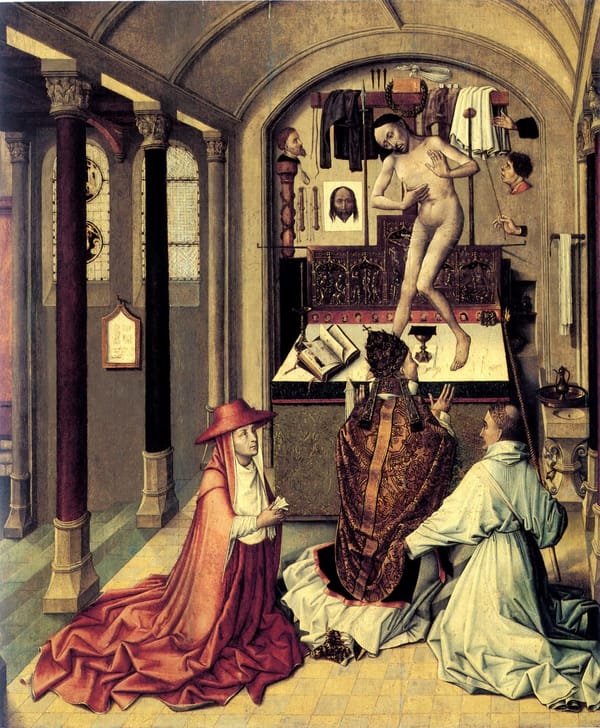
Thursday, the Octave of Corpus Christi
The bright octave, consecrated to the glory of the blessed Sacrament, closes to-day; and although we began the subject three days before the feast itself, we have been able to do little more than slightly touch upon the sublime subject proposed for our consideration and love by the Church. The Memorial left us by our Lord of all His wondrous mercies1 far exceeds the measure of our poor thoughts, and the capabilities of human language; such is the extremity of the infinite love, which God bears to His own2 creatures, that no possibility of ours could make it a return such as it deserves.
Eternal Wisdom was, even from His Father’s bosom, betrothed to human nature. He came down into this world, which sin had marred, and there He found man, who had become the slave of sin;3 He assumed the nature of man: He was thus able to make a Sacrifice, which gives infinite glory and full satisfaction to God, and He perfected His union with His creature, by means of that divine banquet, at which, as food and drink, He Himself is served; for He is the divine Victim4 immolated on the cross and at our altars.
O man! O child of Adam, that wast formed of earthy slime,5 what art thou, that thou shouldst be remembered in the court of heaven?6 Thou desired one of the everlasting hills7—for we may apply this name even to thee—what hast thou done, that thou shouldst thus be glorified?8 Yet doubt it not, thou hast had all these favours. ‘Let not my few weak words stagger thee,’ cries out St. Cyril, the brave defender at Ephesus of the sacred nuptials, of which the Eucharist is what the fathers call the glorious extension, ‘heed not my unworthiness, but listen to the voice, respect the authority, of them that have gone before us, and have preached these truths. They were not men of the common sort, they were not men undeserving of notice, who went about, like hired criers, to proclaim these things on the highroads; no, they were such men as the great Solomon, who was sent as the herald of the King of kings; he sat on his high throne, and proclaimed the mysteries of the Most High; he was clad in scarlet robes, and wore a diadem on his brow, and he was the one to publish the mandate of the God who makes and unmakes kings.’9
Christians! ye people of kings,10 who are to have crowns and thrones yonder in heaven,11 it is to you this Solomon speaks. Your dignity is great. Listen to this herald of God; learn whence comes your greatness, and live up to it. ‘Hearken, ye kings, and understand! Give ear, ye kings! To you are these my words. If ye love your thrones and your sceptres, love wisdom, that ye may reign for ever. I preferred this wisdom before kingdoms and thrones; I loved her above all treasures, and health, and beauty, and chose to have her instead of light. What this wisdom is, and what her origin, I will declare, and I will not hide from you the mysteries of God; but will seek wisdom out from the beginning of her birth, and bring the knowledge of her to light, and will not pass over the truth. I have learned her without guile, and I communicate her to you without envy. Receive, therefore, instruction by my words, and it shall be profitable unto you.’12 Would to God, that we had been able to tell the wonderful mystery we have been celebrating! Divine Wisdom Himself has been pressing us, during all these days, to study the excellencies of that sacred Bread, which yields delights to the kings, His guests.13 The Church has kept close to the throne of her Jesus, that cloud in which He dwells out of love for us.14 She is full of love for Him; He has given her unity by the Sacrament of union; and she, like a strong compact city, summons her tribes of Israel,15 the holy nation, the people of the redeemed, the chosen race of the priests and kings,16 to come together again on this octave-day, that they may testify their faith, and sing their love, and be grateful for the peace which the holy Eucharist secures to them, and for the abundance of grace and blessing it gives to these her children.17 These days of universal joy and festivity around the holy Host were revealed by the Holy Ghost to the son of Sirach; and the vision made him exclaim: ‘Wisdom shall praise her own self, and shall be honoured in God, and shall glory in the midst of her people, and shall open her mouth in the churches of the Most High, and shall glorify herself in the sight of His power. And in the midst of her own people, she shall be exalted, and shall be admired in the holy assembly. And in the multitude of the elect, she shall have praise, and among the blessed (of the Father) she shall be blessed.’18
‘Blessed the man,’ continues the inspired writer, still speaking in the future, ‘that shall dwell in wisdom! Blessed the man that considereth her ways in his heart, and hath understanding in her secrets, who goeth after her as one that traceth, and prepareth for her snares of love;19 who looketh in at her windows, and hearkeneth at her door! Blessed is he that lodgeth near her house, and, fastening a pin in her walls, shall set up his tent nigh unto her, where good things shall rest in his lodging for ever. He shall set his children under her shelter, and shall lodge under her branches. He shall be protected under her covering from the heat, and shall rest in her glory.’20
O house of God, house of the feasting of kings,21 filled with the fragrance of sweetest incense!22 Better is one day in thy precincts, than a thousand elsewhere. It is a joy to my soul to think of days spent there!23 The poor bird that once was lonely, and sat moaning on a roof that could never give her rest,24 here, in the house of God, finds all she wants. The turtle-dove, having found at the altar of her Lord a nest for her young ones,25 has no further solicitude. In the secret of that little cloud, far from the conflicts and disturbances of the world, and where there is no contradiction of tongues—there, from early dawn, eternal Wisdom is pouring out upon souls the multitude of His light and sweetness;26 there, each of the Church’s hours, choirs will be singing psalms and canticles of praise and joy around the tabernacle,27 wherein resides the Lamb who, though slain, is ever living,28 beautiful on His throne of love, the Hod of gods in our Sion.29
Truly, He abides among us; our earth has received the mystery of the marriage-feast, of the divine espousals with human nature, and she ever possesses the Lord her Hod dwelling with her in the Eucharist. O thou gladness of morning!30 O heavenly wine that bringest forth virgins!31 O happy moments, wherein the beauty of Jesus, whose full vision is the joy of the angels, gives itself under the sacramental veil to our souls, you leave behind you something more than a joyous recollection. The altar of Sacrifice, and the house of the great Banquet, both continue as the throne ever occupied by our King; they are the earthly abode of that Wisdom, who, though He is seated at the right hand of the Father in the brightness of the saints,32 and is loved by the Lord of all things,33 yet has not changed towards us poor children of men; He still delights to be with us, and keep up His loved union with us; and, as He tells us He did at the beginning, so He still loves this world of ours, and, to use His own word, He still plays with it.34 On the throne of His tabernacle, He, beautiful Wisdom, receives the adorations of them that rule this world, for it is from Him they have their crowns and sceptres; and when they have wisdom, it is from Him they have it, and they asked Him for it on bended knees.35 On that same throne He hears and grants the prayer of those little ones, little by humility and simplicity of heart, whom He so sweetly presses to go to Him;36 they are attracted to Him by His divine loveliness and riches;37 and they go to Him, that He may teach them how to love Him and fill their treasures to the brim.38
Glory be to the Lamb, whose Sacrifice has given us this wonderful Presence in the blessed Sacrament I To Him be power, and divinity, and wisdom, and strength, and honour, and glory, and benediction, for ever and ever!39 By His lovely light40 let us, as a close to this day and the octave, respectfully contemplate what this ineffable permanence is, which thus secures to us in its fullness, to the end of time, the great mystery of faith.
How different is the divine Lamb of the true Passover, from that ancient one of the Jewish people, which we now so well understand!41 In prescribing the rites to be observed in the sacrifice of the figurative Paschal Lamb, which was to be eaten but once a year, Moses laid down this strict injunction: ‘Neither shall there remain anything of it until morning’;42 nothing was to be left, all was to be consumed! Let us listen, now, to an apostle of the new Law: it is Andrew, brother of Peter; he is speaking to a Roman proconsul, and, through him, to all the Gentiles: ‘Every day, I offer up to the almighty God, who is one and true, not the flesh of oxen, nor the blood of goats, but the spotless Lamb, upon the altar; of whose Flesh the whole multitude of the people eat; and the Lamb that is sacrificed, remains whole and living.’43
‘How can that be?’ asks the proconsul. ‘Become a disciple and thou shalt learn,' replies Andrew. But that could not be: the representative of the pagan world was officially appointed to persecute the crucified Jesus in His members; and as to the sublime dogma he had just heard, and which was the very basis of the religion proscribed by the State, he had but one way of dealing with it and its preacher: laugh at it, and hang Andrew on the cross. The apostle thus sealed his testimony by his death, leaving to the Holy Ghost, who had inspired him with the words he had spoken,44 the future victory which that teaching was to win. His brother-apostles, who had been his fellow-guests at the last Supper, also laid down their lives for Jesus and His doctrine; and, by that sacrifice of themselves, they made themselves food to the same dear Lord. So did Andrew. He followed the counsel of the Wise Man: ‘When thou shalt sit to eat with a prince, consider diligently what is set before thy face, and lay this to thy heart, and know that it behoveth thee to give a like feasting to the prince.’45 Having, therefore, been fed with Jesus’ cross in the banquet of His Body at the last Supper, as St. Augustine expresses it,46 Andrew made a right noble return.
And so was it with the other martyrs, who came after him: the joy they showed, in the midst of their tortures, kept up the proof of the power that exists in the precious Wine and heavenly Bread, which can thus gladden man’s heart and make it brave.47 The time would come, when the demonstration of the mystery of faith, so sublimely expressed by the apostle St. Andrew, would convince the world; not indeed by the force of argument, or by the clever sequel of learned deductions, but by the world itself becoming transformed from paganism to Christianity. That transformation was an impossibility, as far as the world’s own misery and power were concerned; and yet it was an undeniable fact; and it was the result of an irresistible influence: the influence of the divine leaven, which, in the language of the Gospel, was put into the whole measure of flour at the last Supper. From south to north, from east to west, everywhere throughout the globe, the children of the Church now sing these words, which are but St. Andrew’s expression that has triumphed over the world, won its faith, and is set to rhythm and music: ‘Christ’s Flesh is food, and His Blood is drink; yet is He whole under each Species. He is not cut by the receiver, nor broken, nor divided: He is taken whole. He is received by one, He is received by a thousand; the one receives as much as all; nor is He consumed, who is received And when the Sacrament is broken, waver not, but remember that there is as much under each fragment as is hidden under the whole. Of the substance there is no division; it is but the sign that is broken; and He who is the Signified, is not thereby diminished, either as to state or stature.’48
The Church’s doctrine is this: that ‘under each Species, and under each part of each Species, there is contained, truly, really, and substantially, the Body and the Blood, together with the Soul and Divinity of our Lord Jesus Christ, and therefore the whole Christ.’49 Of themselves, it is true, the words of Consecration in the Sacrifice do but produce what they signify; and therefore, exclusively and isolatedly, under the twofold Species, produce the Body and the Blood; but our risen Lord, who liveth now for ever, remains indivisible. As the apostle teaches us, Christ, rising again from the dead, dieth now no more; for, in that He died to sin (that is, because of our sin), He died once; but in that He liveth, He liveth unto God.50 Therefore, wheresoever, in virtue of the words of consecration, there is the most holy Body, or the Blood of our Redeemer, there also, by an essential and necessary concomitance, is the whole entire sacred Humanity, united with the Word.
And here, for the sake of greater precision, we are going to adopt the scholastic phraseology. And firstly, the change of bread into the Body, and of wine into the Blood, is one of substance into substance; but in this miraculous change, very appropriately, on that account, called trans-substantiation, the accidents or modes of the two terms of the change are in no way altered or destroyed. So that, being deprived of their natural subject, or support, the species, or appearances of bread and wine are immediately sustained by God’s omnipotence, and they produce and receive the same impressions as they would do if they were joined to their own proper substances. They are the sacramental sign; and although they do not inform the Body of Christ, that is, do not give It their own qualities or properties, yet they determine and maintain Its presence, so long as these species are not essentially modified. As regards the Body of our Lord—which, in Its own true substance, is substituted for the substance alone of bread and wine—It is withdrawn, by the sacred formula, from those mysterious laws of extension, which are so far from being thoroughly understood by human science; It is whole under the whole species, and whole under each sensible portion of the species; and, in this, It resembles spiritual substances, such as, for instance, the soul of man, which is whole in his whole body, and whole in each member of the same. Such, then, is the mystery of the sacramental state: whilst present to us under the dimensions of the Host, and not beyond them, by reason of His substance being independent of our known laws of extension, Christ our Lord abides in Himself precisely what He is in heaven. As St. Thomas of Aquin expresses it: ‘The Body of Christ, in the Sacrament, retains all Its accidents, as a necessary consequence; and Its several parts are just as they are in His sacred Body, although they are not subject to the conditions of external space.’51
The very notion of Sacrifice required this passive appearance; in the same way that the idea of a banquet, in which He is received, determined what was to be the peculiar nature of the sacramental elements selected by our divine Lord. Of course, when we behold the sacred Host, we must banish every such thought as bondage, or actual suffering, or laborious virtues, on the part of the divine Guest who dwells under the sacred Species: under this external passiveness or apparent death, there abound life, and love, and the beauty of the Lamb, who has vanquished death, and who is the immortal King of ages.
He resides under the white Host, with all His power and brightness, the most beautiful of the children of men;52 He has all those admirable proportions, and all the perfect finish of those divine members, which were formed from the flesh of the most beautiful of the daughters of Adam, and the purest of virgins. Let us venerate, with all the respect we are capable of, those feet, which were watered by the tears of the repentant Magdalene, and dried with her hair,53 and embalmed with the sweetest ointment, beforehand, as Jesus emphasised her act, when He praised it;54 those feet of our merciful Redeemer, more beautiful than the feet of them who bring us the tidings of His having come among us;55 they are bright, beyond the brightness of fine brass when in a burning furnaoe.56 Let us send our reverential kisses, beyond the veil, to those hands, which are spotless, and consecrated for the office of High Priest;57 those hands, which worked at the wood in Joseph’s shop; those hands, which scattered blessings and miracles throughout the land of Israel; they are there, under that Host, just as the bride of the Canticle saw and described them, bright as gold, formed to the model of perfection, and full of something extremely precious, which she called hyacinths,58 and which perhaps signify those wounds of which the prophet speaks, saying, ‘horns are in His hands, and there is His strength hid.’59 Would that we might look beneath the little cloud which hides from us that divine head, the admiration of the angels; that face, once disfigured, and buffeted, and covered all over with reproaches, out of love for us,60 but now resplendent as the sun when he shineth in his power!61 O mouth of our Jesus, thou instrument of the Word, whose voice is as the sound of many waters,62 and whose breathing is death to the wicked!63 O lips, which our Scriptures tell us, are as lilies dropping choice myrrh!64 And you, O eyes, which shed tears over Lazarus,65 and now are lighting up with your brightness66 the abode of the saints! Oh! that we might see all, see Thee Thyself, Jesus, beneath the mystery and the veil! But no! the mystery and the veil may not be removed; and surer are we, than if our eyes were the witnesses, that Thou, O Beloved of our hearts, art behind our wall, looking at us through the lattices;67 and this is enough to make us adore Thee. Verily the sweetest test to which Thou couldst put our love, was that we should have faith in this mystery of the adorable Sacrament!
O precious Blood, thou price of our ransom, shed profusely on this earth, but now again within the sacred veins of Jesus! thou art now, as during His years here below, diffusing thy life-giving qualities to His divine members, under the action of that sacred Heart, which we are so solemnly to honour to-morrow! Most holy Soul of Jesus, present in the Sacrament as form substantial68 of that most perfect Body, which, through thee, is the ever-living Body of the Man-God, thou possessest within thee all the treasures of eternal Wisdom.69 Thou hadst the office intrusted to thee, of putting into a varied and sensible language the ineffable beauty of that Wisdom of the Father, who was taken with love for the children of men, and desired, by a manifestation which they could understand, to secure their love to Himself! Every word, every step, of Jesus, every mystery of His public or hidden life, was a gradual revelation, to us men, of that divine brightness. Truly, as we have it in the Gospel, this Wisdom, like the grace that was within Him, advanced in His manifestation to the creatures, whose love He had come down from heaven to win.70 When, at length, He had achieved all His work—given us His teachings, and examples, and mysteries, those marvellous manifestations of His own infinite perfections—He gave them perpetuity, that so all ages to come might possess them and benefit by them; He fixed them, so to say, in the Sacrament of love, that abiding source of grace and light to men, that living Memorial, wherein divine love is ever ready to bestow upon us the graces of the wonderful works He has wrought by His Incarnation. ‘The Flesh, the Blood of Christ, is the Word made manifest,’ says St. Basil; ‘it is Wisdom made visible by the Incarnation and by all that mystery of His life in the flesh, whereby He unfolds to us all moral perfection, and all the beautiful, both natural and divine. It is that which is the food of our soul, and which is preparing her, even in this world, for the contemplation of the divine realities.’71
The solemn Exposition, during which the blessed Sacrament has been receiving our most fervent homage of adoration and love, is concluded, as it began, with a procession. As soon as the Vespers are over (and they are the same as those of the feast, page 273), the deacon takes the monstrance from the throne, and gives it to the priest. The sacred Host is once more carried outside the church, with the same holy ceremonies, and chants, and joyous worship of the faithful. Again It has all nature doing homage to the Creator; It sanctifies every place through which It is carried; drives away the hostile power which, as the apostle tells us, seeks to infest this air;72 blesses our streets and our country lanes, and imparts to our fields a pledge of rich harvest. It is then brought back to the church, not to leave the hallowed precincts again, save for the sake of the dying, to strengthen them for their last long journey, or for the sick, that It may be administered to them, since they are not able to go to their Lord. The Benediction is then given to the adoring assembly, and the sacred Host is replaced in the tabernacle.
Whilst these sentiments of faith and love are so active within us, let us give them expression, by the beautiful hymn, Adoro te devote: it was composed by the Angelic Doctor, St. Thomas of Aquin; and it is hard to say which of the two predominates in these verses, the theological science of the saint, or his humble and glowing love.
But when the tabernacle-door closes upon Jesus in His holy Sacrament, our hearts will still continue with Him. This octave always brings with it such an increase of light regarding the great Mystery! It has been so, this year. More than ever, for the future, will we love and reverence the Banquet which is, and produces, all that we have been considering during these days: we know so much better now, than formerly, the perfections of eternal Wisdom, who has given Himself to us in the Eucharist; we will let Him guide us into all grace and truth.
Rhythmus S. Thomæ
Quæ sub his figuris vere latitas:
Tibi se cor meum totum subjicit,
Quia te contemplans totum deficit.
Sed auditu solo tuto creditur.
Credo quidquid dixit Dei Filius,
Nil hoc verbo veritatis verius.
At hic latet simul et humanitas;
Ambo tamen credens atque confitens,
Peto quod petivit latro pœnitens.
Deum tamen meum te confiteor.
Fac me tibi semper magis credere,
In te spem habere, te diligere.
Panis vivus, vitam præstans homini:
Præsta meæ menti de te vivere,
Et te illi semper dulce sapere.
Me immundum munda tuo sanguine,
Cujus una stilla salvum facere
Totum mundum quit ab omni scelere.
Oro fiat illud quod tam sitio:
Ut te revelata cernens facie
Visu sim beatus tuæ gloriæ.
who truly liest concealed under these forms:
to thee my whole heart subjects itself,
because it finds itself quite lost in contemplating thee.
but the hearing alone may be safely believed.
I believe whatsoever the Son of God has spoken;
nothing is more true than this word of truth.
but here the humanity also lies hid:
but I believe and confess them both,
and ask for what the penitent thief asked.
yet do I confess thee to be my God.
Oh! grant that I may ever believe in thee, more and more,
and put my hope in thee, and love thee.
O living Bread, that givest life to man!
Grant that my soul may ever live on thee,
and may ever relish thy sweetness.
cleanse me, an unclean sinner, with thy Blood,
one drop whereof
could save the whole world from all its guilt.
I beseech thee, let that be done,
for which I do so thirst: that I may see thine unveiled face,
and be happy in the vision of thy glory.
The devout Ratpert, monk of St. Gall, friend of Notker, and, like him, a writer of liturgical compositions, shall provide us with an appropriate conclusion to this our octave of Corpus Christi, in the following devout hymn, which he composed for the faithful of the ninth century.
Ad Eucharistiam Sumendam
Corporis immensi, Sanguinis atque tui.
Tu licet indignis propitiare tuis:
Prosit ut invictis appropiare sacris.
Purificans corpus, cor pariterque pius.
Interea terris dans medicamen opis.
Summeque pascentes protege Pastor oves.
Consolidans dono nos sine fine tuo.
Tu pietate tua, Rex, rege castra tua.
Spiritus atque potens, trinus et unus apex.
honouring the gifts bestowed upon us of the adorable Body and Blood.
have mercy on us thy servants, though unworthy ones.
that our approaching these triumphant sacred Mysteries may be to our profit.
the holy angel who will lovingly cleanse both our body and soul.
giving us meanwhile, here on earth, the restoring power.
O best of shepherds, protect us thy sheep, now feeding on it!
for ever strengthen us by the gift
do thou in thy mercy, O King, rule thine own soldiers!
and the all-powerful Spirit, the perfect Three and One giver of the gifts.
- Ps. cx. 4. ↩︎
- St. John xiii. 1. ↩︎
- Heb. ii. 14, 15. ↩︎
- Prov. ix. 2. ↩︎
- Gen. ii. 7. ↩︎
- Ps. viii. 5. ↩︎
- Gen. xlix. 26. ↩︎
- Job vii. 17. ↩︎
- Hom. div. x in Myst. cœn. ↩︎
- St. Matt. xxv. 34. ↩︎
- Apoc. v. 9, 10. ↩︎
- Wisd. vi. vii. passim. ↩︎
- Gen. xlix. 20. Cf. ant. 3 Laud. in die festi. ↩︎
- Ecclus. xxiv. 7. ↩︎
- Ps. cxxi. 3, 4. ↩︎
- 1 St. Pet. ii.9. ↩︎
- Ps. cxxi. 4-8. ↩︎
- Ecclus. xxiv. 1-4. ↩︎
- Juxta græc. ↩︎
- Ecclus. xiv. 22-27. ↩︎
- Ps. xli. 5. ↩︎
- Ecclus. xxiv. 20, 21. ↩︎
- Ps. lxxxiii. 2, 11. ↩︎
- Ps. ci. 8. ↩︎
- Ibid. lxxxiii. 4. ↩︎
- Ibid. xxx. 20, 21. ↩︎
- Ibid. xxvi. 6. ↩︎
- Apoc. v. 6. ↩︎
- Ps. lxxxiii. 8. ↩︎
- Ps. xxix. 6. ↩︎
- Zach. ix. 17. ↩︎
- Ps. cix. 3. ↩︎
- Wisd. viii. 3. ↩︎
- Prov. viii. 31. ↩︎
- Ibid. 14-16. ↩︎
- Prov. ix. 4; St. Mark x. 14. ↩︎
- Ecclus, xxiv. 26. ↩︎
- Prov. viii. 21. ↩︎
- Apoc. v. xii. ↩︎
- Ibid. xxi. 23. ↩︎
- Paschal Time, vol. 1. ↩︎
- Exod. xii. 10. ↩︎
- Pass. S. Andr. ap. Lipom. ↩︎
- St. Matt. x. 20. ↩︎
- Prov. xxiii. 1, 2. juxta græc. ↩︎
- In Ps. c. ↩︎
- Ps. ciii. 15. ↩︎
- Sequen. Lauda Sion. ↩︎
- Conc. Trid. Sess. xiii. can. 1, 3. ↩︎
- Rom. vi. 9, 10. ↩︎
- P. 3. Q,. lxxvi. a, 4; Sent. lib. 4. dist. 10, art. 2. ↩︎
- Ps. xliv. 3. ↩︎
- St. Luke vii. 37, 38. ↩︎
- St. Mark xiv. 8. ↩︎
- Is. lii. 7. ↩︎
- Apoc. i. 15. ↩︎
- Lev. xxi. 10. ↩︎
- Cant. v. 14. ↩︎
- Hab. iii. 4. ↩︎
- Lam. iii. 30. ↩︎
- Apoc. i. 16. ↩︎
- Ibid. 15. ↩︎
- Is. xi. 4. ↩︎
- Cant. v. 13. ↩︎
- St. John xi. 35. ↩︎
- Apoc. i. 14. ↩︎
- Cant. ii. 9. ↩︎
- Concil. Vienn. ↩︎
- Col. ii. 3. ↩︎
- St. Luke ii. 52. ↩︎
- Epist. viii. ↩︎
- Eph. ii. 2; vi. 12. ↩︎
June 26: Sts. John and Paul, Martyrs
AMIDST the numerous sanctuaries which adorn the capital of the Christian universe, the church of Saints John and Paul has remained from the early date of its origin one of the chief centres of Roman piety. From the summit of the Cœlian Hill it towers over the Coliseum, the dependencies of which stretch subterraneously even as far as the cellarage of the house once inhabited by our saints. They, the last of the martyrs, completed the glorious crown offered to Christ by Rome, the chosen seat of his power. The conflict in which their blood was spilt consummated the triumph whose hour was sounded under Constantine, but which an offensive retaliation on the part of hell seemed about to compromise.
No attack could be conceived more odious for the Church than that devised by the apostate Cæsar. Nero and Diocletian had violently and with hatred declared against the Incarnate God a war of sword and torture; and without recrimination, Christians by thousands had died, knowing that the testimony thus demanded was merely the order of things, just as it had been in the case of their august Head1 before Pontius Pilate and upon the cross. But with the clever astuteness of a traitor, and the affected disdain of a false philosopher, Julian proposed to stifle Christianity by a progressive oppression, respectfully abhorrent of human blood. Merely to preclude Christians from public offices, and to prohibit them from holding chairs for the teaching of youth, that was all the apostate aimed at! However, the blood which he wanted to avoid shedding must flow, even though a hypocrite's hands be dyed therewith; for, according to the divine plan, bloodshed alone can bring extreme situations to an issue, and never was holy Church menaced with greater peril. They would now make a slave of her whom they had beheld still holding her royal liberty in face of executioners. They would now await the moment when, once enslaved, she would at last disappear of herself, in powerlessness and degradation. For this reason the bishops of that time found vent for their indignation in accents such as their predecessors had spared to princes whose brute violence was then inundating the empire with Christian blood. They now retorted upon the tyrant scorn for scorn; and the manifestations of contempt that consequently came showering in from every quarter upon the crowned fool completely unmasked at last his feigned moderation. Julian was now shown up as nothing but a common persecutor of the usual kind; blood flowed, the Church was rescued.
Thus is explained the gratitude which this noble bride of the Son of God has never ceased to manifest to the glorious martyrs we are celebrating to-day: for amidst the many generous Christians whose outspoken indignation brought about the solution of this terrible crisis, none is more illustrious than theirs. Julian was most anxious to count them amongst his confidants: with this view, he made use of every entreaty, as we learn from the breviary lessons; nor does it appear that he even made the renouncing of Jesus Christ a condition. Well then, it may be retorted, why not yield to the imperial whim? Could they not do so without wounding their conscience? Surely too much stiffness would be calculated to ill-dispose the prince, perhaps even fatally: whereas to listen to him would very likely have a soothing effect upon him; and might even bring him round to relax somewhat of those administrative trammels unfortunately imposed upon the Church by his prejudiced government. For aught one knew, the possible conversion of his soul, the return of so many of the misled who had followed him in his fall, might be the result! Should not such things as these deserve some consideration? Should they not impose, as a duty, some gentle handling? Such reasoning as this would doubtless appear to some people as wise policy. Such preoccupation for the apostate's salvation could easily have had nothing in it but what was inspired by zeal for the Church and for souls; and indeed the most exacting casuist could not find it a crime for John and Paul to dwell in a court where nothing was demanded of them contrary to the divine precepts. Nevertheless the two brothers resolved otherwise; to the course of soothing and reserve-making, they preferred that of the frank expression of their sentiments, and this boldness infuriated the tyrant and brought about their death. The Church has judged their case, and she considers they did well; hence, it is unlikely that the former path would have led them to a like degree of sanctity in God's sight.
The names of John and Paul inscribed on the sacred diptychs show well enough their credit in the eyes of the divine Victim, who never offers himself to the God Thrice-Holy without blending their memory with that of his own immolation. The enthusiasm excited by the noble attitude of these two valiant witnesses of the Lord still re-echoes in the antiphons and responsories proper to the feast. It was formerly preceded by a vigil and fast; together with the sanctuary which encloses their tomb, it may be said to date back to the time of their martyrdom. By a singular privilege mentioned in the Leonine Sacramentary, whilst so many other martyrs slept their sleep of peace outside the walls of the holy city, John and Paul reposed in Rome itself, the definitive conquest of which had been won for the God of armies by their gallant combat. The very same day of the year immediately succceeding their victorious death,2 Julian fell dead, uttering against Heaven his cry of rage: 'Galilean, thou hast conquered!'
From the queen city of the universe their renown, passing beyond the mountains, shone forth almost as soon and with nearly equal splendour in Gaul. On his return from the scene of his own struggle in the cause of the divinity of Jesus Christ, Hilary of Poitiers at once propagated their cultus. The great bishop was called to our Lord scarcely five years after their martyrdom; but he had already found time to consecrate to their name the church in which his loving hands had laid his daughter Abra and her mother, and in which he too was to await with them the day of the resurrection. It was from this church of Saints John and Paul, named later on after St Hilary the Great, that Clovis on the eve of the battle of Vouillé beheld streaming towards him a mysterious light, presage of the victory which would result in the expulsion of Arianism from Gaul, and in the foundation of monarchical unity. These holy martyrs continued in after years to show the interest they took in the advancement of the kingdom of God by the Franks. When the disastrous issue of the Second Crusade was filling the soul of St Bernard with bitterness, who had preached it, they appeared to him, revived his courage, and manifested by what secrets the King of heaven had known how to draw his own glory out of events in which man saw only failure and disaster.3
Let us now read the simple and touching legend consecrated by the Church to the two brethren.
We give below the proper antiphons and responsories, of which we have spoken, which are to be found just as we now use them, with but few variations, in the most ancient responsorialia and antiphonaria which have come down to us. The person mentioned in one of these antiphons by the name of Gallicanus is a consul who was drawn to the faith and to a saintly life by the influence of the two brothers; he is named in yesterday's martyrology.
Antiphons And Responsories
Sancti Spiritus et animæ justorum, hymnum dicite Deo. Alleluia.
Antiphon of the Magnificat
Antiphon of the Magnificat
At the Benedictus
Twofold is the triumph that thrills through heaven and twofold the gladness re-echoed on earth this day, whilst your outpoured blood proclaims the victory of the Son of God! Verily, by the martyrdom of the faithful does Christ triumph. The effusion of his Blood marked the defeat of the prince of this world; the blood of his mystical members possesses, alone and always, the power of establishing his reign. Contest has never been an evil for the Church militant; the noble bride of the God of armies delights in combat; for she knows her Spouse came upon earth to bring not peace but the sword.4 Therefore, to the end of time will she hold up as an example to her sons your chivalrous courage and your bold frankness, which scorned to dissimulate your utter contempt for an apostate tyrant, or to suffer you to dwell for a moment on such considerations as might perhaps, had you listened to him at the first, have just saved your conscience together with life. Woe to the day wherein the deceptive mirage of guileful peace misleads minds; wherein, merely because sin does not stare them in the face, Christian souls stoop from the lofty standpoint of their Baptism, to compromises which even a pagan world would avoid. Glorious brethren! make the children of holy Church turn aside from that fatal error which would lead them to misconceptions of sacred traditions received by them in heritage. Maintain the sons of God at the full height of the noble sentiments demanded by their heavenly origin, by the throne that awaits them, by the divine Blood they daily drink; far from them be all such base notions as would be calculated to excite against their heavenly Father the blasphemies of the accursed city! Nowadays there has arisen a persecution not dissimilar to that in which you gained the crown; Julian's plan of action is once more in vogue; if these mimics of the apostate do not equal him in intelligence, they at least surpass him in hatred and hypocrisy. But God is no more wanting to his Church now than he was then; obtain for us the grace to do our part in resistance, as was done by you, and the victory will be the same.
Your very names, O John and Paul, remind us of the friend of the Bridegroom whose octave we are keeping; and of Paul of the Cross who revived, in the last century, heroism of sanctity in your very house on Monte Cœlio. Vouchsafe to unite your powerful protection to that which the Precursor exercises over the mother and mistress of all Churches, become by the very fact of her primacy the chief butt of the enemies’ attack; uphold the new militia raised by the necessity of the times, and entrusted with the guardianship both of your sacred remains and of those of its glorious founder. Remembering the power which the Church specially attributes to you, that of opening or shutting the floodgates of heaven, be pleased to bless our harvest nearly ripe for the sickle. Be propitious to our reapers and assuage their painful labour. Preserve from lightning man and his possessions, the home that shelters him, the beasts that serve him. Too often, ungrateful and forgetful man would indeed deserve to incur your wrath; but prove yourselves children of him who maketh his sun to rise upon the wicked as well as upon the good, and giveth his rain to fall alike upon the just and upon sinners.5
| Previous June 25: St. William, Abbot | Next June 26: Sts. John and Paul, Martyrs |