Daily reading
After Pentecost
Double of the II Class · Movable from Easter · Temporal
August 10, 2025
From Dom Guéranger’s The Liturgical Year.

|
The Ninth Sunday after Pentecost
The lamentation over Jerusalem's woes, the subject of to-day's Gospel, has given its name to this ninth Sunday after Pentecost, at least among the Latins. We have already observed that it is easy to find, even in the liturgy as it now stands, traces of how the early Church was all attention to the approaching fulfilment of the prophecies against Jerusalem—that ungrateful city upon which our Jesus heaped His earliest favours. The last limit put by mercy upon justice has, at length, been passed. Our Lord, speaking of the ruin of Sion and its temple, had foretold that the generation that was listening to His words should not pass until what He had announced should be fulfilled.;1 The almost forty years accorded to Juda, that he might avert the divine wrath, have had no other effect than to harden the people of deicides in their determination not to accept Christ as the Messiah. As a torrent, which, having been long pent back, rushes along all the fiercer when the embankment breaks, vengeance at length burst on the ancient Israel; it was in the year 70 that was executed the sentence he himself had passed when, delivering up his King and God to the Gentiles,2 he had cried out: 'His blood be upon us and upon our children!'3
Even as early as-the year 67, Rome, irritated by the senseless insolence of the Jews, had deputed Flavius Vespasian to avenge the insult. The fact of this new general being scarcely known was, in reality, the strongest reason for Nero's approving of his nomination; but to the hitherto obscure family of this soldier God reserved the empire, as a reward for the service done to divine justice by this Flavius and his son Titus. Later on, Titus will see and acknowledge4 that it is not Rome but God Himself who conducts the war and commands the legions. Moses, ages before, had seen the nation, whose tongue Israel could not understand, rushing like an eagle upon the chosen people, and punishing them for their sins.5 But no sooner has the Roman eagle reached the land where he is to work the vengeance, than he finds himself visibly checked by a superior power; and his spirit of rapine is held back, or urged on, precisely as the prophets of the Lord of hosts had foretold. The piercing eye of that eagle, as eager to obey as it was to fight, almost seemed to be scrutinizing the Scriptures. It was actually here that he found the order of the day for the terrible years of the campaign.6
As an illustration of this, we may mention what happened in the year 66. The army of Syria, under the leadership of Cestius Gallus, had encamped under the walls of Jerusalem. Our Lord intended this to be nothing more, in His plan, than a warning to His faithful ones, which He had promised them when foretelling the events that were to happen. He had said: 'When ye shall hear of wars, and seditions, and rumours of wars, be not terrified; these things must first come to pass; but the end is not yet presently.7 But when ye shall see Jerusalem compassed about with an army, then know that the desolation thereof is at hand.'8 The Jews had been for years angering Rome by their revolts, but she bore with it all, if not patiently, contemptuously; but when, in one of these seditions, Roman blood had been spilt, then she was provoked and sent her legions. Her army, however, had first of all to furnish Jesus' disciples with a sign9 He had promised them that this sign should consist in her Compassing Jerusalem,' then withdrawing for a time; this would give the Christians an opportunity of quitting the accursed city. The Roman proconsul had his troops stationed so near to Jerusalem that it seemed as though he had but to give the word of command and the war would be over; instead of that, he gave the strange order to retreat, and throw up the victory which he might have if he wished.10 Cestius Gallus seemed to men to have lost his senses; but no, he was following, without being aware of it, the commands of heaven. Jesus had promised an escape to His loved ones; He fulfilled His promise by this unwitting instrument.
Vespasian himself had scarcely started for Judea when he met with one of those divine adjournments which all the Roman tactics were several times powerless to resist; the hour marked for them to act had not come, so they must wait, however reluctantly. The preordained counsel of the Most High decreed that before all these things11 which men were to bring about, before the already broken sceptre of the ancient alliance12 should have disappeared in the flames enkindled by the Jews themselves13—the establishment of the new Testament was to be solidly set up among the Gentiles, and be solemnly confirmed by the blood of the apostles, its witnesses.14 It was on June 29 in the year 67 that Peter and Paul suffered martyrdom in the city of Rome. Rome was thus made the mother-Church; and the reign of the Messiah, whom Israel rejected, was promulgated to the whole world, with an evidence which only the voluntarily blind could resist. Though Vespasian had opened the campaign against Judea in the spring of that year 67, yet he had to wait for the glorious confession of these two princes of the apostles; that triumph secured, the impatient legions might rush to victory as soon as they pleased. For fortyseven long days they had been kept, by some power, staring at the citadel of Jotapata, which it was so easy for them to take, and which would make them masters of Galilee; but June 29 had now had its apostolic triumph in Rome, and Vespasian was at liberty to do what he had so long wished to do; on that very June 29 he did it—he took Jotapata.
Forty thousand dead, strewn on the steeps of the hill, and heaped up as high as the walls, showed the Romans what desperate resistance they were to expect from Jewish fanaticism. Of all the male defenders or inhabitants of Jotapata, only two survived; one of these was Josephus, a chief leader in the Jewish forces, and historian of these cruel wars. The women and children were spared.15 But, some short time later on, another fortress, Gamala, was attacked; it overhung a chasm. When one-half of the besieged had been slain, and it was evident that further resistance was impossible, the survivors, assembling together the women and children, threw them and themselves down the rock; and five thousand was their number. When the legions stood looking around, at the close of that day's work, they could see but a desert and death.16
In every part of the unhappy Galilee blood was flowing in torrents, and the flames of burning villages lighted up the horizon. It was hard to recognize this as the land where Jesus had spent the years of His childhood, or as the scene of His first miracles, and of those teachings of His which were ever borrowing some exquisite parable or other from the sight of the pretty hills and fertile vales of that then favoured country. The arm of God was now pressing with all its weight on this land of Zabulon and Nephthali, on which first so brightly shone the light of salvation,17 as we sang on Christmas night. So again this time it was the first to be visited by God. But these were unhappy times; and the visit was no longer that of the divine Orient, opening out to the world the paths of peace.18 He was hid behind the tempest,19 and darted the fiery arrows of destruction on the ungrateful country that had refused to welcome Him in the weakness of human flesh, which nothing but His mercy had led Him to assume. 'They cried out, on the day of my vengeance,' says this rejected King of Israel, 'but there was none to save them; they cried to me their Lord, but I heard them not : and I will break them as small as dust, and scatter them before the wind; I will bring them to nought, like the dirt in the streets.'20
Terrible lesson which the Church learned and has never forgotten, that no blessing, no past holiness, is of itself a guarantee that the place thus favoured will not afterwards draw down on itself desecration and destruction! She saw, and trembled as she saw, these events of the first age of her history. She beheld violence and every sort of crime profaning the paths that had been trodden by the feet of her adorable Master, and the hills where He had passed whole nights in prayer and praise to His eternal Father. She one day witnessed even the pure waters of the Lake of Genesareth fearfully polluted; those waters that had so oft reflected the features of her divine Spouse, as when He walked on their glassy surface, or sat in Peter’s bark superintending those mysterymeaning fishings of His apostles. The event we here allude to was that of six thousand Jewish insurgents—hemmed in between God's wrath and their Roman pursuers—reddening with their blood this Sea of Tiberias, where once Jesus had spoken to the storm and quelled it.21 Their livid carcasses were thrown back by the waves on the shore, where our Lord had uttered woe to the cities that had witnessed His miracles, and yet were not converted.22
And souls, too, on whom God heaps His choicest favours, inviting them thereby to a closer union with Himself, have a lesson to learn from all this. Woe to them if, through indifference or sloth, they neglect to correspond with their graces! Woe to them if they imitate the cities on the Lake of Galilee, by greedily accepting the honour done them but never producing the fruits of holiness which should follow such signal and frequent gifts of heaven. The prophet Amos couples these forgetful, careless souls with the cities which our Lord had treated with such partiality, and which yet remained apathetic and worldly; and he tells us what this slighted benefactor will say to both : ‘You only have I known of all the families of the earth! therefore will I visit upon you all your iniquities! Shall two walk together, except they be agreed?’23
As to Israel, the highly-favoured above all people, he would not agree with the Jesus who so loved him, and was visited with chastisements exactly corresponding to his crimes. In the spring of the year 68, an officer under Vespasian scoured the left banks of the Jordan, driving the terrified Israelites before him.24 They fled in thousands towards Jericho, where they hoped to find refuge; but the river had so flooded the country round the city, that entrance was impossible; the wretched fugitives were overtaken and slain by the Roman troops. The Ark of the Covenant had once opened there a miraculous passage to the tribes of Israel; but even had it been there now, how was it to protect such unworthy descendants of the patriarchs—descendants, that is, who broke the Covenant made by God with the sons of Jacob? A frightful massacre, a merciless mowing down of human beings, followed; and, at what a place! the very place where, forty years before, St. John the Baptist had seen the axe laid to the root of the tree, and foretold the wrath to come upon this brood of vipers, who called themselves children of Abraham, and would not do penance.25 A countless multitude drowned themselves in the Jordan; they found death in the very stream to which our Saviour had imparted sanctification by being Himself baptized in it, and imparting to it the power to give light to the world. But Israel had chosen the kingdom of the prince of this world in preference to that of the divine Giver of life.26 The number of those who perished in that holy stream was so great that the heap of their dead bodies made it impossible for vessels to sail in the river; and this fearful obstado continued until such time as the current had swept the corpses down to the Dead Sea, and scattered far into that dismal lake of malediction that hideous jetsam of the Synagogue. Had not our Lord said, that Sodom’s guilt was less than theirs?27
Rome and her legions were masters, in the north, of Galilee and Samaria; in the east and west, of the banks of the Jordan and of the Mediterranean coast; and the conquest of Idumæa completed the circle of iron and fire that was to shut Jerusalem in. Roman garrisons held Emmaus, Jericho, and all the fortified positions round the Jewish capital. Having, as God's instrument, chastised so many other ungrateful cities, Vespasian was preparing to lay siege to the most guilty of all, when Nero’s fall, and the events which followed it, drew the attention, both of himself and of the whole world, from Judea.
The last years of the tyrant had witnessed frequent 'earthquakes in divers places,'28 and 'plagues,'29 and ‘signs in the heavens';30 but when he died there came 'risings of nation against nation, and kingdom against kingdom.’31 The entire west was in arms; and the east herself was attracted towards Rome by the immense political commotion of the year 69. From the heights of Atlas to the Euxine Sea, and from the Humber to the Nile, provinces and peoples were striving for the mastery. Galba, Otho, Vitellius, Vespasian, proclaimed emperors by their respective armies, sent their rival legions from Britain and the Rhine, from Illyria and the Danube; they met at Bedriac for mutual slaughter. In one thing alone they that survived were unanimous : friends or foes, all must lay Italy waste. Rome was taken by the Romans; whilst on the undefended frontiers appeared Suevians, Sarmatians, and Dacians. The Capitol and Jupiter’s temple in flames excited the Gauls to declare their independence, and Velleda to stir up Germany to revolt. The old world was gradually disappearing beneath the universal anarchy and war.
Circumstances, then, suddenly seemed favourable to Jerusalem; they gave her a fresh invitation to atone for her crimes; but, as we shall see when commenting on this Sunday's Gospel, she made no other use of them than to multiply her sins, and treat herself with greater cruelty than the Romans would have done.
In the Mass of this Sunday, which is their ninth of St. Matthew, the Greeks read the episode of Jesus' walking upon the waters.
Mass
Israel had made himself the enemy of the Church; and God, as He had warned him,32 punishes and disperses his children. The Church takes occasion, from the fulfilment of the divine judgments, to profess the humble confidence she has in her Spouse’s aid.
Introit
The Jews cried to heaven, and the ears of God were deaf to their supplications, because they asked for what was displeasing to Him. In her Collect, the Church prays that it may never be thus with her children.
Collect
The other Collects, as on page 120.
Epistle
1 Cap. x.Fratres : Non simus concupiscentes malorum, sicut et illi concupierunt. Neque idololatræ effciamini sicut quidam ex ipsis : quemadmodum scriptum est : Sedit populus manducare, et bibere, et surrexerunt ludere. Neque fornicemur, sicut quidam ex ipsis fornicati sunt, et ceciderunt una die viginti tria millia. Neque tentemus Christum, sicut quidam eorum tentaverunt, et a serpentibus perierunt. Neque murmuraveritis, sicut quidam eorum murmuraverunt, et perierunt ab exterminatore. Hæc autem omnia in figura contingebant illis : scripta sunt autem ad correptionem nostram, in quos fines sæculorum devenerunt. Itaque qui se existimat stare, videat ne cadat. Tentatio vos non apprehendat, nisi numana : fidelis autem Deus est, qui non patietur vos tentari supra id, quod potestis, sed faciet etiam cum tentatione proventum, ut possitis sustinere.
1 Ch. x.Brethren : Let us not covet evil things, as they also coveted. Neither become ye idolaters, as some of them : as it is written: The people sat down to eat and drink, and rose up to play. Neither let us commit fornication, as some of them committed fornication, and there fell in one day three and twenty thousand. Neither let us tempt Christ : as some of them tempted, and perished by the serpents. Neither do ye murmur : as some of them murmured, and were destroyed by the destroyer. Now, all these things happened to them in figure : and they are written for our correction, upon whom the ends of the world are come. Wherefore he that thinketh himself to stand, let him take heed lest he fall. Let no temptation take hold on you, but such as is human. And God is faithful, who will not suffer you to be tempted above that which ye are able; but will make also with temptation issue, that ye may be able to bear it.
‘I have great sadness,’ cried out the Apostle of the Gentiles, as he thought of the malediction which was about to fall on the Jews: 'continual sorrow have I in my heart; for I wished myself to be an anathema from Christ for my brethren, who are my kinsmen according to the flesh; who are Israelites, to whom belongeth the adoption of children, and the glory, and the covenant, and the giving of the Law, and the service (the worship of God, prescribed by Himself), and the promises; whose are the fathers, and of whom is Christ according to the flesh, who is over all things, God blessed for ever!’33 But now, they are gone astray by their own fault; they see nothing; they understand nothing.34 The royal banquet of the Scriptures, on which their fathers feasted,35 is now turned by them into an occasion of error; they have made those Scriptures a snare for their own destruction; darkness covers their understanding, and chastisement for all future ages is their own making.36
Gentiles! you that have been substituted for those broken branches, and are grafted on the stem of the Covenant,37 learn a lesson from their fall. God, who has shown you so much and so great gratuity of mercy, and that at the very time He was inflicting upon them the chastisements they so richly merited, will not allow His loving designs upon you to be frustrated against your own will. If you are faithful to the call of His grace, He will be faithful to you, and preserve you from temptations which you could not resist; or, He will so watch the combat that His divine help will make your soul rise superior to the trial; and thus in every temptation you will find, not defeat, but the merit of a victory, all the more glorious, as it seemed so much above the power of human strength. And yet, never forget that the same causes which brought about the destruction of the Jews would also lead you to ruin. They fell, because of their unbelief; you, who once had no faith and yet God showed mercy to you, are now what you are by faith. Be not, therefore, high-minded with self-complacency; but remember how God, who broke off the natural branches from the glorious tree, will not spare you, if you cease to be faithful; and whilst you do well to admire His mercy, you do not wisely if you forget His inexorable justice.38
Well, therefore, does our mother the Church instruct us in to-day's Epistle, as to the lamentable antecedents of the Jewish deicides; she tells us of that list of sins and chastisements, which gradually led on to the final crime and total ruin of the apostate nation. We, who live in what the Church calls the 'evening of the world,'39 have this great advantage, that we can profit by what the past ages have experienced. The holy Spirit had no other end in view, when He would have the history of the ancient people written : He would have the future ages there learn lessons of salvation. By the various episodes of that history, which form so many groups of prophetic events, He would show us the economy of God's providence in His government of the world and of His Church. Founded as she has been by her divine Spouse in immutable truth, and maintained by the Holy Ghost in unfailing and ever-increasing holiness, the Church has nothing to fear of that which happened to the Synagogue—we mean, of that total wreck which the liturgy brings forward for our consideration to-day. No, the ruin of the Jews is a prophetic image of the destruction of the world,40 which will have rejected the Church; not of the Church herself, who will then ascend to her Lord, perfected in love and holiness by the trials endured in those latter days.41 But the assurance of salvation, granted to the bride of the Son of God, does not extend to her children, taken either individually or collectively—that is, men or nations. On each one of us it is incumbent that we meditate on the sad fate which befell Jerusalem; as also on what happened, ages before, to the ancestors of the Jewish people, viz., that scarce one of those who were living when Moses led them out of Egypt lived to enter into the promised land.
And yet, as the apostle argues, they were all journeying in the path of life, protected by the mysterious cloud, beneath which divine Wisdom shaded them by day, and served them as a pillar of fire by night.42 Led on by Moses—who was a type of the future divine Head of the Christian people— they had all passed through the sea. All of them thus baptized in that symbolic cloud and in those saving waters which had engulfed their foes, just as the water of the Christian font destroys the sins of them that are washed in it—all of them were fed by the same spiritual food, and all drank at the same holy source which issued from the rock, which was Christ. Yet were there very few, out of all those thousands, with whom God was pleased.43 But how much more grievous would the sins of Christians be, who are blessed with the resplendent and solid realities of the Law of grace, than were the evil desires, and idolatry, and fornication, and murmurings of the Israelites, who had but the figures and foreshadowings of our privileges!
The fervent expression of praise given to our good God in the words whicn now follow is a solace to our hearts, which are grieved at the sight of the ingratitude of the Jewish people and the chastisements that ingratitude drew down upon them. How sad soever may be the day, the Church never neglects her tribute of praise to the divine Majesty; for no event can happen here below that can make the bride forget the infinite perfections of her Spouse, or keep her from extolling His magnificence We have all this in the Gradual. The Alleluiaverse is plaintive and suppliant; it well suits today's recollections.
Gradual
Gospel
Cap. xix.In illo tempore : Cum appropinquaret Jesus Jerusalem, videns civitatem, flevit super illam, dicens : Quia si cognovisses et tu, et quidem in hac die tua, quæ ad pacem tibi, nunc autem abscondita sunt ab oculis tuis. Quia venient dies in te : et circumdabunt te inimici tui vallo, et circumdabunt te : et coangustabunt teundique: et ad terram prosternent te, et filios tuos, qui in te sunt, et non relinquent in te lapidem super lapidem : eo quod non cognoveris tempus visitationis tuæ. Et ingressus in templum, cœpit ejicere vendentes in illo, et ementes, dicens illis: Scriptum est : Quia domus mea domus orationis est. Vos autem fecistis illara speluncam latronum. Et erat docens quotidie in templo.
Chapter xix.
At that time : When he drew near Jerusalem, seeing the city, he wept over it, saying : If thou also hadst known, and that in this thy day, the things that are to thy peace : but now they are hidden from thy eyes. For the days shall come upon thee : and thy enemies shall cast a trench about thee, and compass thee round, and straiten thee on every side, and beat thee flat; to the ground, and thy children who are in thee : and they shall not leave in thee a stone upon a stone: because thou hast not known the time of thy visitation. And entering into the temple, he began to cast out them that sold therein. and them that bought. Saying to them : It is written : My house is the house of prayer: but you have made it a den of thieves. And he was teaching daily in the temple.
The passage just read to us from the holy Gospel takes us back to the day of our Lord's triumphant entry into Jerusalem. This triumph, which God the Father willed should be offered to His Son before the commencement of His Passion, was not, as we well know, anything of a recognition of the Messiah made by the Synagogue. Neither the meek, gentle manners of this King, who came to the daughter of Sion seated on an ass,44 nor His merciful severity upon the profaners of the temple, nor His farewell teachings in His Father's house, could open the eyes of men who were determined to keep them shut against the light of salvation and peace. Not even the tears of the Son of Man, then, could stay God’s vengeance : there is a time for justice, and the Jews were resolved it should come to themselves.
How loudly had the prophets spoken to them in God’s name! 'Woe to the provoking and redeemed city! She hath not hearkened to the voice of her God. Her princes are in the midst of her as roaring lions; her judges are evening wolves; her prophets are senseless, men without faith; her priests have defiled the sanctuary; they have acted unjustly against the law (they have violated it).45 Crush the city as in a mortar!46 Go through the city, and strike! let not your eye spare, nor be ye moved to pity! Utterly destroy old and young, maidens, children, and women —yea, destroy all that are not marked upon their foreheads with Thau! And begin ye at my sanctuary; slay the priests, and the ancients; defile the house (my temple), and fill its courts with the bodies of the slain!'47
Alas! precedence in chastisement was richly due to those princes of the people who had had precedence in crime; it was due to those priests and ancients who had decreed the death of the Just One, and driven the multitude to cry out : 'Crucify Him!’48 Jealous of the miracles of the Man-God, they said in their perfidious hypocrisy : 'If we let Him alone’ (doing all these miracles), ‘all men will believe in Him, and the Romans will come and take away our city and nation.’49 God has turned their impious diplomacy against them. But, as far as they themselves are concerned, they will have their way; not one of them will see the Romans; for, before the arrival of the legions, John of Gischala, and Simon the son of Gioras, will have annihilated this deicidal aristocracy, hated of both heaven and earth. When, after the war is over, Titus shall enter into Rome, these two brigand chiefs, and prime movers of the war, shall adorn his triumph; they shall be the substitutes of the nobles of Juda before the conqueror’s chariot. Two bandits, representatives of Jerusalem, in the streets of Rome, her rival! What a divine retaliation for the two thieves, whom the Synagogue gave as an escort to its King on the Dolorous Way, and made them His crucified fellows on Calvary!—But, let us resume the sequel of events, and give them as briefly as the subject permits.
After the rupture with Rome, and the retreat of Cestius Gallus, the government of Jerusalem had been entrusted to the high-priest Ananus,50 brotherin-law to Caiphas, and the last of the five sons of Annas, who succeeded each other in the office of high-priest. By a visible dispensation of God's justice, this family, the guiltiest of all in the crime of the crucifixion, found itself at the head of the nation when the fatal hour came : it was impossible then to mistake the meaning of God's vengeance upon His people. Independently of the enormous crime, whose responsibility rested on his race, Ananus had a personal sin to atone for—the death of St. James the Less, who had been martyred, by his orders, in the year 62. Rationalist or Sadducee like his kin, he deplored the war, and would have been glad to see peace restored;51 but he could not shirk the obligation his office imposed on him of organizing the defence. Ruler most unworthy, yet ruler he was; and therefore, as the Prophet Isaias expresses it, this whole ruin was under his hand,52 under his management; it would, necessarily, when it came, fall on him and crush him.
It was not long before the fanatics, who had instigated the rebellion and taken the name of Zealots, became dissatisfied with the way in which Ananus was managing affairs: so they revolted against him, and put to death the most illustrious men of the city. Reinforced by all the enthusiasts of other towns, and by the highway-robbers who were daily flocking to Jerusalem, they made themselves masters of the temple. Out of hatred for the ancient priestly families, they changed the order of offering sacrifice. They put the office of high-priest on a peasant, who happened to be a descendant of Aaron’s family, but was so unfitted for the dignity that he did not even know what was meant by a priest.53
About this same time the wreck of the Galilean bands, headed by John of Gischala, occasioned the first defeats, and excited the people to exasperation; they made common cause with the rebels, and increased their fury against all whom they suspected of an inclination to treat with Rome. The Zealots were hard pressed by the troops of Ananus, and had already been forced back into the inner temple; on the advice of John of Gischala, they called the wild Idumean herdsmen to come to their aid. These fierce auxiliaries came on Jerusalem in the thick of a storm that was raging during the night; they found the watchmen asleep, and put them to death. The very earth, says Josephus, had shaken at their approach; and, on the evening before their arrival, had been heard to moan.54 Up to the morning, amidst violent wind and rain and lightning, howling themselves as if to add to the din of the tempest, amidst the shouts of the wounded and the screams of women, they pitilessly murdered every one they met. When at length daylight appeared, it revealed the horrors of the previous night; eight thousand five hundred dead bodies were lying on the ground, and the blood was running in streams all round the temple. The corpse of Ananus, after being insulted, stripped, trodden on, was given as food to the dogs. The following days, twelve thousand men, in the vigour of health, and picked out of the most distinguished families, were also put to death by the Idumeans, either by torture or by other means. As soon as they had left, the Zealots became masters of the city, and were guilty of cruelties even greater than those exercised by the Idumeans. All those whose independent character, or influence, or noble birth, excited suspicions were at ° once massacred, nor were their friends or relatives allowed to bury or mourn over them. The lower classes, the poor, and the unknown, alone escaped with their lives.
The justice of God overtook the princes of Juda.55 Their blood mingled with the dust, their unburied bodies lying as dung upon the streets,56 would all this remind Sion of those prophecies which had foretold these days of tribulation and anguish, these days of bitterness for the mighty and the strong?57 The Christians of Jerusalem, who were then sheltering beyond the Jordan, would remember, if no one else did, the inspired words which their bishop, St. James, had written eight years before to the twelve tribes who were dispersed throughout the world:58 ‘Go to now, ye rich men! weep and howl for your miseries that shall come upon you! Your riches are putrefied; your treasure is a store of wrath. Ye have feasted; but your feasts have but nourished you for the day of slaughter. Ye have condemned, and put to death the just one, and he resisteth you not . . . . But the coming of the Lord draweth near.’59 It was truly the Lord, who was avenging His own cause;60 and Vespasian was well aware of it, when he thus answered those who urged him to take advantage of all these troubles, and attack the city: ‘God is a better general than I :let us leave Him to deliver up the Jews to the Romans without any trouble on our side, and give us victory without our incurring any risk.’61
Jerusalem was then but in the beginning of her woes and of her civil strifes. The ambitious character of John of Gischala did not allow him to be long at peace with the Zealots. He separated himself from them; and to the Galileans, who supported his cause, he gave permission to do whatsoever they pleased. To pillage and murder were added the frightful excesses of that halfidolatrous race which, in the days of the Assyrian kings, had been substituted for the tribes of Israel;62 it had borrowed from Judaism little better than a mass of superstition, which it mingled with the customs and vices of its predecessors. Then was the daughter of Sion compelled to witness and endure the abominations, wherewith the prophets of the Most High had threatened her. Humbled and indignant, the unhappy city would fain have shaken off the yoke.63
In those days a celebrated brigand was laying Idumea waste; towns and villages were destroyed, houses were pulled down or burnt; and, according to the prophecy of Abdias,64 he was ransacking Edom through and through, right to the very core. His name was Simon, son of Gioras. What with slaves, criminals, outlaws, and malcontents of every party, he had got together upwards of 20,000 well-armed men, not counting other 40,000 who followed him. This was the strange Messiah on whom Jerusalem cast her eyes for help in her trouble! A deputation, headed by a high-priest, waited on this son of Gioras, begging him to accept the sovereignty. He deigned to consent to their wishes! Proud and haughty, says Josephus,65 he graciously allowed Sion to offer him her suppliant homage. He was led into the city of David, amidst the enthusiastic acclamations of the people, who hailed as their protector and saviour Simon the murderer, Simon the brigand! O Jesus, Son of David and Son of God, how art Thou avenged by all this! They wished it to be; they themselves had passed the sentence : 'Not Him, but Barabbas!'66 The choice of the children was in keeping with the preference entertained by their fathers. Bar Gioras — worthy descendant of Barabbas—once he was master of the city, treated alike both them that had invited him and them that he had been invited to reduce to order—that is, he treated them all as enemies. Day and night was the massacre kept up by his savage horde, until every man of worth or credit in Jerusalem was made away with.67
Meanwhile, the Galileans, driven back from Sion and the lower town by the new-comers, had retreated to the temple, of which they occupied the first enclosure. The Zealots had grown more than ever discontented with John of Gischala, and made the inner temple their fortified place of refuge. They were less numerous than the two other parties, but their position was far preferable, for it was on the very summit of the holy mount. Then, too, they had provisions in abundance, seeing that all the first-fruits and offerings made to the temple were under their absolute control. They passed their time in feasting and drunken revellings. Little cared they for the stones hurled by the Galilean catapults; nor were they in the least troubled at finding that these huge missiles struck the priests at the altar, thus mingling the blood of the sacrificers with that of the victims, and strewing the sacred courts with the bodies of dead or dying. Sacrilege and drunkenness—such was the end of those descendants of the austere pharisees!68 Here again Jesus, their crucified victim, was avenged.
Whilst the abomination of desolation, foretold by Daniel, was thus standing in the holy place,69 John of Gischala saw that the Zealots were too stupefied by their feastings to cause him any further alarm. He fell on the city, like a bird of prey, there to find the necessary provisions; and out of hatred for Simon, he destroyed by fire all he could not carry away. Simon, instead of quenching the fire, extended it in every part where John was likely to pass, hoping, by this means, to deprive the Galileans of all further victualling. Immense stores of corn and other provisions had been amassed by the Jewish leaders, as a necessary resource in case of a future siege; but all were now destroyed by these two men, who were greater enemies to their country than were the Romans themselves. Thus was spent the year 69—a year of respite, which Rome, torn as she was by factions of her own, was compelled to allow, and which might have been of such incalculable benefit to the Jews.70
With the exception of armed troops, there were no other inhabitants in Jerusalem but women and old men. The passover of 70 was drawing near, and it produced a sort of truce among the several parties. The city began to be again crowded, and with a population far exceeding the ordinary number. The Romans had pillaged the Jewish provinces; Sion had been even more cruelly treated, and by her own children : and yet, in this year 70, there assembled within this city of final vengeance as though it were the whole nation, and that from every quarter of the globe.71 It had been the same at the time of our Jesus' crucinxion; it seemed as though the whole Jewish people insisted on witnessing the consummation of the deicide. The apostles afterwards besought them to confess their having been accomplices in the crime of Calvary, but the preaching was fruitless; the terrific lesson of recent events was unable to open their eyes. As it was in the days of that Pasch so salutary to mankind, but so fatal to Juda; and as it was at the subsequent Pentecost, so now there were Jews congregated 'out of every nation under heaven,'72 not, indeed, to hear an apostle preaching to them to do penance,73 but to undergo that which Moses had foretold, and St. Peter had recalled to their memory—the extermination of all such as should refuse to hearken to the Messiah of the Lord.74
As the Man-God had said, the terrible day came suddenly, and as a snare, upon this immense assemblage of people.75 The empire was in the hands of Vespasian; the prosperous fortune of Rome was re-established on the whole of the frontiers; and Titus had just reached Cæsarea, with orders to put an end to the eastern question. He sent word to the legions then in Judea to effect, from the respective points they occupied, a joint concentration towards the capital. When the tenth legion marched from Jericho and was seen encamped on Mount Olivet—that is, on the very place where Jesus wept as He looked on Jerusalem, and foretold the siege which was to be its ruin— the unexpected arrival of the Romans alarmed the pilgrims, and made them busy themselves with preparations for a battle, rather than for the solemnization of the Pasch. The several parties agreed to forget, at least for a day, tneir own animosities, and unite all their forces together; they made two desperate sallies, for the purpose of dislodging the enemy from the Mount; but each time they were repelled.76
The Pasch which is about to be celebrated is, as ever, and now more than ever, the passover of the Lord; but the Lord is no longer leading the sons of Jacob to their deliverance by it. Juda has made himself the enemy of the Lamb, whose blood should be the sign of the redeemed of the Pasch. Whilst the blood of this divine Lamb is enriching the whole earth, whilst the light of the vanquisher of death is illumining the whole world, Juda is there, obstinately keeping to his figures and shadows. More stiff-necked than the Egyptian, and more guilty than Pharaoh, he would, if he could, hold the true Israel in the trammels of his own slavish law, just as he once vainly tried to make the true Son of God an everlasting prisoner in the tomb. As to Jesus, He has, years ago, set Himself free; and now, more terrible than He was in Mesraïm, He is passing over, as the avenger both of Himself and of His Church. The Pasch—the feast of feasts, whose memory is every Sunday brought back to us —is now about to receive its final completion. On the Tuesday of our Easter, we were saying: 'How terrible will be the passage of the Lord over Jerusalem, when the sword of the Roman legions shall destroy a whole people!'77
‘Woe to thee, O Ariel! Ariel, the city which David took—the city where God had His temple and His altar—thy years are passed; thy solemnities are at an end!78 Take away from me the tumult of thy songs! Psalms, in thy mouth, have lost all their meaning. I will not hear the canticles of thy harp.79 The song of lamentation is heard in Israel, for his house is fallen.80 In every street there shall be wailing; and in all places, they shall say: Woe! Woe!’81
This prophetic cry of Woe—this most gloomy foreboding that all the threats uttered in Scripture against Jerusalem are on the point of being fulfilled—was forced upon the inhabitants' ears. Ever since the feast of Tabernacles of the year 62, an unknown peasant—the husbandman, as the prophet Amos called him, a man skilful in lamentation82—had been ceaselessly pacing the streets of the wretched city, crying out day and night : 'A voice from the east, a voice from the west, a voice from the four winds, a voice against Jerusalem and the holy house, a voice against the bridegrooms and the brides, a voice against all this people!' Tried, questioned, scourged, even till his flesh was torn to pieces and his bones laid bare—nothing could prevent him from continuing his most unwelcome work. On the festival days above all, this precursor of the vengeance of the Son of Man redoubled the energy of his plaintive enthusiasm, which gave a superhuman emphasis to his cry of Woe. To every word of kindness or reproach, to every act of charity or cruelty, he gave neither thanks nor plaints, but went on with the same words : 'Woe! Woe! to Jerusalem ‘And thus he continued for seven years and five months, without his voice being altered by weakness or hoarseness. During the early days of the siege he was seen by the Romans running to and fro along the walls, shouting :'Woe to the city! Woe to the people! Woe to the holy house!' At length he added : 'Woe! woe to me!’ Immediately a stone, thrown from one of the engines, smote him, and he died on the spot.83
Jerusalem has drunk of the cup of madness, and nothing seems to impress her; she is drunk with the cup of God's wrath; yea, she has drained it to the dregs.84 What a terrific day, this last celebration of the Jewish Pasch! The historian Josephus tells us what it was—sacrilegious, bloody, and noisy with the shouts, which even the enemy could hear, of the strife of the dissentient factions, for all had revived. Taking advantage of the gates being opened to the pilgrims, some Galileans, disguised, made their way into the inner temple; where, throwing aside their cloaks, and displaying their weapons, they attacked the crowd that stood round the altar. They beat and murdered; then, trampling on the dying and the dead, they drove the people outside the courts. Meanwhile, the Zealots, who were taken unawares, rushed, in dismay, into the subterranean caverns of the temple.85 What a Pasch! What a feast! worthy, indeed, of God’s hatred and rejection.86 Unhappy feasters, that had come from the ends of the world to this solemnity! how is it that they forgot to apply the words of the prophet? 'Woe to them that desire the day of the Lord! To what end is it for you? This day of the Lord is darkness and not light. You shall be as a man fleeing from the face of a lion, and a bear should meet him; or, as one that entereth into the house, and, when he leaneth with his hand upon the wall, a serpent should bite him.'87 Terrible prophecy! how strangely is it verified : —the Romans are yonder in their camps; Simon is in the city; John of Gischala is in the temple, its sole master!
As in the days of Jeremias, so now : the sword and famine—it is hard to say, which was the busier to make this multitude its prey;88 for, owing to the previous depredations, famine had made itself felt from the beginning of the siege. Each day added to its intensity, and urged on the savage instincts of the armed ruffians to attack all who were not of their party. It was not hatred only that now filled Sion with murder; to rob, or to get something to keep themselves from starvation, these were additional motives to make such men grudge each other’s existence. Under plea that they were conspirators, Simon and John had the rich summoned to their respective tribunals; and then, adding insult to injustice, these two wretches, who, in the intervals between fighting against the Romans, were carrying on their own deadly feud— these two judges, having first seized the property of their victims, sent them to the second bar,89 under pretence that they wished to show each other a mutual kindly feeling; giving the one who had nothing to steal, the option of condemning to death. Scarcely forty years before in these very streets, through which the Jewish aristocracy was being ignominiously dragged from Simon to John, and from John to Simon, there was another Victim who, amidst the approving ridicule of the leaders of the nation, was made the pledge of a mock reconciliation, and, with a fool's uniform put on Him, was sent back from Herod to Pilate, there to await judgment!90
Whilst these tyrants were thus living on the public distress, there were hundreds of starved creatures, whom hunger drove to go forth by night into the fields, and there try to find some wild herbs. If they fell into the hands of the Romans, these, unwilling to be burdened with such prisoners, had them crucified within sight of the walls. Five hundred and upwards were thus captured each day; and, oh! what a fearful detail, but how loud in its significance!—all this was done, with Calvary opposite! and, as Josephus tells us, there was not room enough to plant the crosses, nor wood enough for making them.91
Titus had flattered himself that the taking of Jerusalem would be an affair of a few days. He, of course, disregarded the prophecies which declared that the deicide city was to be 'compassed round with a trench'; and preferred to use negotiations and a series of assaults, rather than be detained by the tedious operation of a blockade. But he was, of course, mistaken; his messengers receives, in answer to their parleys of peace, nothing but insults and arrows; and, as to assaults, all the bravery of his legions was powerless against the fortresses where the factions were protected. Two months thus passed away in useless attempts; all that the Romans had possession of was the lower town, which the Jewish contesting parties had already reduced to ruins; but Sion and Moriah still held up their heads in defiance against the determined invaders. There was nothing, then, to do, but make up their minds to defer Rome and her pleasures to some later season,92 and encircle Jerusalem with that terrible trench, which the Gospel had said must be cast about her. The literal following out of the plan traced by God got the better of Titus' impatience. He set ms legions to the work; they must change their manual labour, and, instead of bows and arrows, they must handle pickaxe and spade. To have seen them at work, one would have said they were thinking of Jesus' words, for they were fulfilling them as though they were the most devoted of His servants; Josephua would have it, that they were animated by a divine influence.93 In the brief space of three days, they completed an earth-wall measuring a little over five miles round, a work which would, ordinarily, have occupied several months. God had thus spoken by the prophet Isaias : 'I will make a trench about Ariel; and it shall be in sorrow and mourning; and it shall be to me as Ariel. I will make a circle round about thee (O Jerusalem), and will cast up a rampart against thee, and raise up bulwarks to besiege thee.’94 Truly, Jerusalem was thus made as an Ariel to Jehovah—that is, one immense altar of countless victims.
The famine, by this time, was intensely increased; for every exit into the fields was now closed against the unfortunate creatures, who, till then, had been able to eke out their miserable existence by picking up, at the risk of their lives, a few seeds or roots.95 A bushel of wheat was sold for a talent (about 240 pounds sterling). Those who could afford it gave their costliest treasures for a morsel of bread;96 but, as to those who had nothing to give, they must drag the sewers in the hope of finding food. The vilest rubbish was devoured with avidity. Filth, too foul to have a name, was hidden as though it were a treasure, for which husband quarrelled with his wife, and mothers grudged it their children.97 The factions had, thus far, laughed at the people's starvation; but they soon began themselves to feel the gnawings of famine, and then they furiously attacked those who were reported as having something to eat. If a man were sinking, he was said to be feigning the weakness of death, in order to prevent search being made for his victuals; if he had just strength enough to walk a few steps, it was taken as an indication that he had some hidden eatables about him. All were savagely tortured to make them own the imputed crime of having something yet to live on. Like famished dogs—it is the expression used both by the historian and the Psalmist98—they ran wildly through the city, knocking down the doors of the suspected, ferreting in every nook and hole, and returning two or three times within the hour. A savoury smell was one day perceived coming from a house which had been thus frequently visited; this was more than enough for a further search. In they rushed; a woman was there; they threatened her with death, unless she at once declared where was her feast. 'It is my son,' she replied; 'there are the remnants!’ The woman was Mary, daughter of Eleazer; once rich, and of a noble family, she, maddened by hunger, had murdered her infant child, and had fed on his flesh.99
All these horrors failed to subdue the ferocious obstinacy of John of Gischala and Simon, son of Gioras. In spite, however, of their precautions, and their cruelties towards those who were suspected of meditating an escape, there were, every day, scores who, by throwing themselves down the walls, were able to reach the Roman camp. Deeply moved at the sight of so much misery, Titus received them kindly, and gave them their liberty. But, adds Josephus, 'God had condemned the whole of this people, and turned the very means of safety into occasion of destruction.'100 Many of these poor fugitives were so exhausted on reaching the camp that they died on taking the food which had been too long denied them. A still greater number fell victims to the Arabs and Syrians, who followed the Roman army; for, a report having been circulated that some of the Jews had swallowed their gold before leaving Jerusalem, in order the more effectually to hide it, these wild auxiliaries, strangers to the discipline of the legions and born enemies of the Jewish people, ensnared the unfortunate fugitives and cut them into pieces, hoping to find what would satisfy their monstrous avarice. During one single night there were two thousand found lying thus embowelled.101 How all this forces us to think of the death of Judas,102 and of the punishment of his deicidal betrayal! And had not all this people imitated that traitorous apostle? He, the Iscariot, had delivered up the Son of Man to the chief priests and leaders of the Jews; the Jews delivered Him up to the Gentiles; and the Prophet Zacharias makes them all share in the responsibility of that infamous barter, wherewith began the sacred Passion of our sweet Jesus.103
In the city, the ravages of the famine were beyond all imagination. Josephus, speaking of them, uses, without being aware of it, the very expression of our Redeemer : 'In no time did any other city ever suffer such miseries.’104 In the space of a few months there were counted six hundred thousand dead, and to these burial of one sort or other was given; as to the rest, they could not be numbered, for the survivors had not the strength needed for burying them, and they were left to rot in the houses or streets.
Meanwhile, on July 12, a greater trial than all this befell Jerusalem and the whole Jewish people: lor want of victims, the continual sacrifice was taken away, as in the days of Antiochus,105 but this time it was for ever. It was the end, the openly declared end, of Mosaism and its worship, to be henceforth replaced, and without dispute, by the Sacrifice of the law of love; the end, with but the brief interval of a siege and a war, which had then no other object to achieve, and therefore no further reason for its continuance. An immense grief—a grief that admitted no consolation—seized the hearts of the Jewish people, who, up to the very last, had lived on the empty hope fostered by the false prophets.106
The foolhardy obstinacy of Simon and John rejected, even then, the proposals of Titus, that he would spare both city and temple. Hostilities were therefore resumed, implacably and pitilessly resumed. But the Jewish soldiers had not energy enough to keep pace with the fanaticism of their leaders; worn out by famine, they had not the unflinching resistance needed for repelling the sustained assaults of the Romans. Already the tower of Antonia, which commanded the temple, was in the power of the enemy, and each day he was seen closing in nearer to the sacred edifice. Its defenders resolved on one last effort; roused by the greatness of their misfortune, they rushed through the vale of Cedron, and made a desperate charge on the post of Mount Olivet. It looked as though, for these final engagements, the instinct of God's vengeance, which weighed upon them, was leading them to this place of prophecy, where the Son of Man had wept over Jerusalem, and where, as we have already said, the first battle was fought. Repelled, and in despair, they returned to the city, which they were never again to leave; then, with their own hands, setting fìre to the outer porticoes of the temple, they gave the first enclosure over to the Romans.
Titus was desirous, above all things, to save the temple; but, as Josephus observes, 'God had, for certain, long ago doomed it to the fìre; . . . and the flames were kindled by the Jews themselves, when that fatal day came.'107 It was August 4, in the year 70, a Sabbath-day, and the anniversary of the first destruction of the holy place under Nabuchodonosor. The guards of the temple, exasperated by suffering, stupefied by hunger, attacked the soldiers who, by Titus' orders, were quenching the fire that had been some days burning at the outer portion of the building. They were soon beaten back into the temple, and, this time, they were not the only ones to enter. While they were falling by hundreds beneath the sword of the Romans, now unexpectedly made masters of the inner enclosure, one of the soldiers, forgetting the orders given by Titus, but, as Josephus puts it, 'urged on by a divine power,'108 seized a firebrand, and hurled it, through a window, into one of the rooms adjoining the sanctuary. The flame burst forth and spread; the efforts of Titus to stay it were useless. Simon’s soldiers on Mount Sion saw it rising up towards the sky. At this fearful spectacle, the famished and wounded, turning towards the falling temple, forgot all their sufferings. From these thousands of dying Jews, all of them possessed with the one same grief, there arose a loud scream of despair, which, blending with the shouts of the pagan soldiers, was heard even on the mountains of Perea, beyond the Jordan and the Dead Sea. Mount Moriah, on fire, seemed as though its very foundations were burning, and blood was flowing enough to quench the flames. The number of the slain was so great that the ground could not be seen, and the soldiers, as they marched, had to trample on the dead. The priests who had mounted on the roof of their temple, the women and children crouching by thousands in its galleries, all perished in the flames, with the treasures of the sanctuary.109
John of Gischala, gathering together his few remaining followers, had escaped between the enemy's battalions, and had joined Simon in the high portion of the city. The contest continued for a few weeks longer, but it was the effort of a last agony. On September 1, Sion was taken, plundered and burnt like Moriah and the lower town. The prediction of to-day's Gospel was fulfilled. Jerusalem, beaten flat to the ground, and her children that were in her, was but a mass of smoking ruins. Eleven hundred thousand men had perished during the siege. Of the ninety-seven thousand that had been taken prisoners during the whole war, seven hundred were picked out as fit to grace the conqueror's triumph; of the remainder, those who were over seventeen years of age were sent to the mines, or reserved for the amphitheatre; the others supplied the slavemarkets of the empire for some length of time.110
In the Offertory of to-day's Mass, the Church delights in the thought that her children, aided by the grace of her divine Spouse, are all care to keep the commandments (the justices) of their Lord. It is this obedience of theirs which renders those judgments a joy and a sweetness to them, whereas, for the Synagogue, they were so fearful.
Offertory
The Secret is a prayer, that God would grant us children of the Church the grace of assisting worthily at the holy sacrifice, which really renews, each time it is offered, the work of our salvation.
Secret
The other Secrets, as on page 130.
The Communion-anthem expresses the mystery of divine union, which is realized in the Sacrament just received.
Communion
The sanctification of each individual member of the Church, and the unity of the social body, are the two fruits of these sacred mysteries : the Church, in her Postcommunion, asks them of God.
Postcommunion
The other Postcommunions, as on page 131.
Vespers
The psalms, capitulum, hymn and versicle, as above, pages 71-81.
Antiphon of the Magnificat
- St. Luke xxi. 32. ↩︎
- St. Matt. xx.19. ↩︎
- Ibid. xxvii. 25. ↩︎
- Jos., De Bello Jud., vi. 9. ↩︎
- Deut. xxviii. 49. ↩︎
- St. Luke xxi. 22. ↩︎
- St. Matt. xxiv. 6; St. Luke xxi. 9. ↩︎
- Ibid. 20. ↩︎
- St. Mark xiii. 4. ↩︎
- Jos., De Bello Jud., ii.19. ↩︎
- St. Luke xxi. 12. ↩︎
- Zach. xi. 10. ↩︎
- Isa. 1. 11. ↩︎
- St. Matt. xxiv. 9; St. Mark xiii.10. ↩︎
- Jos., De Bello Jud., iii. 7. ↩︎
- Ibid. iv. 1. ↩︎
- Isa. ix. 1, 2. ↩︎
- St. Luke i. 78, 79. ↩︎
- Ps. xvii. 12. ↩︎
- Ps. xvii. 42, 43. ↩︎
- Jos., De Bello Jud., iii. 9. ↩︎
- St. Matt. xi. 20, 21. ↩︎
- Amos iii. 2, 3. ↩︎
- Jos., De Bello Jud., iv. 7. ↩︎
- St. Matt. iii. 5-12. ↩︎
- St. John xix. 15. ↩︎
- St. Luke x. 12. ↩︎
- Senec., Natur. Quœst., vi.1.; Tac. An., xiv. 27, xv. 22. ↩︎
- Senec., Ibid., 27; Tac., Ibid., xvi. 13; Suet, in Ner., 39. ↩︎
- Tac., Hist., v.13; Jos., De Bello Jud., vi. 5. ↩︎
- St. Luke xxi. 10, 11. ↩︎
- Deut. xxviii. 15-68. ↩︎
- Rom. ix. 2-5. ↩︎
- Isa. vi. 9; St. Matt. xiii. 14, 15. ↩︎
- Ibid, iv. 4. ↩︎
- Ps.lxviii. 23, 24. ↩︎
- Rom. xi. 17. ↩︎
- Rom. xi. 20-30. ↩︎
- Hymn for Adv. Vesp. ↩︎
- St. Matt. xxiv. 3. ↩︎
- Apoc. xxii. 17. ↩︎
- Wisd. x.17 ↩︎
- 1 Cor. x. 1-6. ↩︎
- Zach. ix. 9. ↩︎
- Soph. iii. 1-4, i. 9. ↩︎
- Ibid. 11. ↩︎
- Ezech. ix. 4-7. ↩︎
- St. Matt. xxvii. 20. ↩︎
- St. John xi. 47-53. ↩︎
- Jos., De Bello Jud., ii. 20 et seq. ↩︎
- Jos., De Bello Jud., iv. 5. ↩︎
- Isa. iii. 6. ↩︎
- Jos., De Bello Jud., iv. 3. ↩︎
- Jos., De Bello Jud., iv. 4. ↩︎
- Isa. iii. 14. ↩︎
- Soph. i. 8, 17. ↩︎
- Ibid. 14-16; Ezech. xxiv. 3-5. ↩︎
- St. James i. 1. ↩︎
- Ibid, v. 1-8. ↩︎
- Jer. v. 5, 9. ↩︎
- Jos., De Bello Jud., iv. 6. ↩︎
- 4 Kings XV. 29, xvii. 6, 18, 23-41. ↩︎
- Jos., De Bello Jud., iv. 7, 9. ↩︎
- Abdias 5, 6. ↩︎
- Ubi supra. ↩︎
- St. John xviii. 40. ↩︎
- Jos., De Bello Jud., vii. 8. ↩︎
- Jos., Ibid., v.1. ↩︎
- St. Matt. xxiv.15. ↩︎
- Jos., ubi supra. ↩︎
- Ibid. vi. 9. ↩︎
- Acts ii. 5. ↩︎
- Ibid. 38. ↩︎
- Ibid. iii. 22, 23. ↩︎
- St. Luke xxi. 34, 35. ↩︎
- Jos., De Bello Jud., v. 2. ↩︎
- See our first vol. of 'Paschal Time,' p. 226. ↩︎
- Isa. xxix.1. ↩︎
- Amos v. 23. ↩︎
- Ibid.1. ↩︎
- Ibid.16. ↩︎
- Ibid. ↩︎
- Jos., De Bello Jud., vi. 5. ↩︎
- Isa. xxix. 9-14, li.17. ↩︎
- Jos., De Bello Jud., v. 3. ↩︎
- Amos v. 21. ↩︎
- Ibid,18, 19. ↩︎
- Jer. xiv. 18. ↩︎
- Jos., De Bello Jud., v. 10. ↩︎
- St. Luke xxiii. 7-12. ↩︎
- Jos., De Bello Jud., v. 11. ↩︎
- Tac., Hist., v.11. ↩︎
- Jos., De Bello Jud., v. 12. ↩︎
- Isa. xxix. 2, 3. ↩︎
- Lam. v. 9, 10. ↩︎
- Lam. i. 11. ↩︎
- Deut. xxviii. 56, 57; Jos., De Bello Jud., v. 10-12. ↩︎
- Ibid. vi. 3; Ps. lviii. 7, 15, 16. ↩︎
- Jos., De Bello Jud., vi. 3; Deut. xxviii. 53-56. ↩︎
- Jos., De Bello Jud., v. 13. ↩︎
- Ibid. ↩︎
- Acts i. 18. ↩︎
- Zach. xi., 12. 13. ↩︎
- Jos., De Bello Jud., v. 10; St. Matt. xxiv. 21. ↩︎
- Dan. viii. 11-13. ↩︎
- Jos., De Bello Jud., vi. 5. ↩︎
- Jos., De Bello Jud., vi 4. ↩︎
- Jos., De Bello. Jud., vi. 4. ↩︎
- Ibid, 5. ↩︎
- Jos., De Bello Jud., vi. 9. ↩︎
August 10: St. Laurence, Deacon and Martyr
|
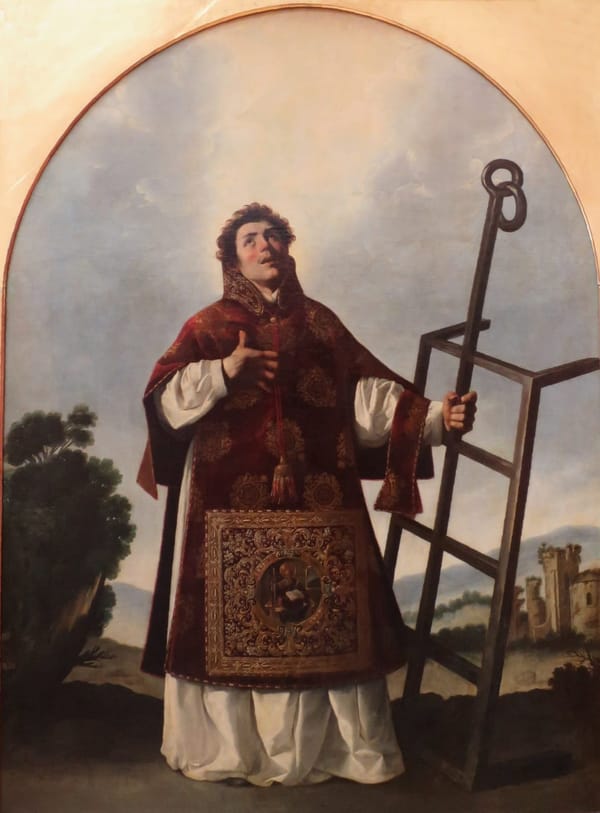
‘ONCE the mother of false gods, but now the bride of Christ, O Rome, it is through Laurence thou art victorious! Thou hast conquered haughty monarchs and subjected nations to thine empire; but though thou hadst overcome barbarism, thy glory was incomplete till thou hadst vanquished the unclean idols. This was Laurence's victory, a combat bloody yet not tumultuous like those of Camillus or of Cæsar; it was the contest of faith, wherein self is immolated, and death is overcome by death. What words, what praises suffice to celebrate such a death? How can I worthily sing so great a martyrdom?'1
Thus opens the sublime poem of Prudentius, composed little more than a century after the saint's martyrdom. In this work the poet has preserved to us the traditions existing in his own day, whereby the name of the Roman deacon was rendered so illustrious. About the same time St. Ambrose, with his irresistible eloquence, described the meeting of Sixtus and his deacon on the way to martyrdom.2 But, before both Ambrose and Prudentius, Pope St. Damasus chronicled the victory of Laurence's faith, in his majestic monumental inscriptions, which have such a ring of the days of triumph.3
Rome was lavish in her demonstrations of honour towards the champion who had prayed for her deliverance upon his red-hot gridiron. She inserted his name in the Canon of the Mass, and moreover celebrated the anniversary of his birth to heaven with as much solemnity as those of the glorious apostles her founders, and with the same privileges of a Vigil and an Octave. She has been dyed with the blood of many other witnesses of Christ, yet as though Laurence had a special claim upon her gratitude, every spot connected with him has been honoured with a church. Amongst all these sanctuaries dedicated to him, the one which contains the martyr's body ranks next after the churches of St. John Lateran, St. Mary's on the Esquiline, St. Peter's on the Vatican, and St. Paul's on the Ostian Way. St. Laurence outside the Walls completes the number of the five great basilicas that form the appanage and exclusive possession of the Roman Pontiff. They represent the patriarchates of Rome, Alexandria, Antioch, Constantinople, and Jerusalem, which divide the world between them, and express the universal and immediate jurisdiction of the Bishops of Rome over all the churches. Thus through Laurence the Eternal City is completed, and is shown to be the centre of the world and the source of every grace.
Just as Peter and Paul are the riches, not of Rome alone, but of the whole world, so Laurence is called the honour of the world, for he, as it were, personified the courage of martyrdom. At the beginning of this month we saw Stephen himself come to blend his dignity of Protomartyr with the glory of Sixtus II's deacon, by sharing his tomb. In Laurence, it seemed that both the struggle and the victory of martyrdom reached their highest point; persecution, it is true, was renewed during the next half-century, and made many victims, yet his triumph was considered as the death-blow to paganism.
‘The devil,’ says Prudentius, ‘struggled fiercely with God's witness, but he was himself wounded and prostrated for ever. The death of Christ's martyr gave the death-blow to the worship of idols, and from that day Vesta was powerless to prevent her temple from being deserted. All these Roman citizens, brought up in the superstitions taught by Numa, hasten, O Christ, to Thy courts, singing hymns to Thy martyr. Illustrious senators, flamens and priests of Lupercus, venerate the tombs of apostles and saints. We see patricians and matrons of the noblest families vowing to God the children in whom their hopes are centred. The pontiff of the idols, whose brow but yesterday was bound with the sacred fillet, now signs himself with the Cross, and the vestal virgin Claudia visits thy sanctuary, O Laurence.'4
It need not surprise us that this day's solemnity carries its triumphant joy from the city of the seven hills to the entire universe. 'As it is impossible for Rome to be concealed,' says St. Augustine, 'so it is equally impossible to hide Laurence's crown.' Everywhere, in both East and West, churches were built in his honour; and in return, as the Bishop of Hippo testifies, ' the favours he conferred were innumerable, and prove the greatness of his power with God; who has ever prayed to him and has not been graciously heard?'5
Let us, then, conclude with St. Maximus of Turin that ‘in the devotion wherewith the triumph of St. Laurence is being celebrated throughout the entire world, we must recognize that it is both holy and pleasing to God to honour, with all the fervour of our souls, the birth to heaven of the martyr who by his radiant flames has spread the glory of his victory over the whole Church. Because of the spotless purity of soul which made him a true Levite, and because of that fulness of faith which earned him the martyr's palm, it is fitting that we should honour him almost equally with the apostles.'6
First Vespers
Laurence has entered the lists as a martyr, and has confessed the name of our Lord Jesus Christ. Such is the antiphon wherewith the Church opens the first Vespers of the feast; and in fact, by this hour he has already entered the arena; with noble irony he has challenged the authorities, and has even shed his blood.
On the very day of the martyrdom of Sixtus II, Cornelius Secularis,7 prefect of Rome, summoned Laurence before his tribunal, but granted him the delay necessary for gathering together the riches required by the imperial treasury. Valerian did not include the obscure members of the Church in his edicts of persecution; he aimed at ruining the Christians by prohibiting their assemblies, putting their chief men to death, and confiscating their property. This accounts for the fact that, on August 6, the faithful assembled in the cemetery of Pretextatus were dispersed, the pontiff executed, and the chief deacon arrested and ordered to deliver up the treasures which the Government knew to be in his keeping. 'Acknowledge my just and peaceable claims,' said the prefect. 'It is said that at your orgies your priests are accustomed, according to the laws of your worship, to make libations in cups of gold; that silver vessels smoke with the blood of the victims, and that the torches that give light to your nocturnal mysteries are fixed in golden candlesticks. And then you have such love and care for the brotherhood: report says you sell your lands in order to devote to their service thousands of sesterces; so that while the son is disinherited by his holy parents and groans in poverty, his patrimony is piously hidden away in the secrecy of your temples. Bring forth these immense treasures, the shameful spoils you have won by deceiving the credulous; the public good demands them; render to Cæsar the things that are Cæsar's, that he may have wherewith to fill his treasury and pay his armies.’
Laurence, untroubled by these words, and as if quite willing to obey, gently answered: 'I confess you speak the truth; our Church is indeed wealthy; no one in the world, not even Augustus himself, possesses such riches. I will disclose them all to you, and I will show you the treasures of Christ. All I ask for is a short delay, which will enable me the better to perform what I have promised. For I must make an inventory of all, count them up, and value each article.’
The prefect's heart swelled with joy, and gloating over the gold he hoped soon to possess, he granted him a delay of three days. Meanwhile Laurence hastened all over the town and assembled the legions of poor whom their Mother the Church supported; lame and blind, cripple and beggars, he called them all. None knew them better than the archdeacon. Next he counted them, wrote down their names, and arranged them in long lines. On the appointed day he returned to the judge and thus addressed him: ‘Come with me and admire the incomparable riches of the sanctuary of our God.' They went together to the spot where the crowds of poor were standing, clothed in rags and filling the air with their supplications. ‘Why do you shudder?’ said Laurence to the prefect. ‘Do you call that a vile and contemptible spectacle? If you seek after wealth, know that the brightest gold is Christ, who is the light, and the human race redeemed by Him; for they are the sons of the light, all these who are shielded by their bodily weakness from the assault of pride and evil passion; soon they will lay aside their ulcers in the palace of eternal life, and will shine in marvellous glory, clothed in purple and bearing golden crowns upon their heads. See, here is the gold which I promised you—gold of a kind that fire cannot touch or thief steal from you. Think not, then, that Christ is poor: behold these choice pearls, these sparkling gems that adorn the temple, these sacred virgins, I mean, and these widows who refuse second marriage; they form the priceless necklace of the Church, they deck her ears, they are her bridal ornaments, and win for her Christ's love. Behold, then, all our riches; take them: they will beautify the city of Romulus, they will increase the Emperor's treasures and enrich you yourself.'8
From a letter of Pope St. Cornelius, written a few years after these events, we learn that the number of widows and poor persons that the Church of Rome supported exceeded 1,500.9 By thus exhibiting them before the magistrate, Laurence knew that he endangered no one but himself, for the persecution of Valerian, as we have already observed, overlooked the inferior classes and attacked the leading members of the Church. Divine Wisdom thus confronted Csesarism and its brutality with Christianity which it so despised, but which was destined to overcome and subdue it.
This happened on August 9, 258. The first answer the furious prefect made was to order Laurence to be scourged and tortured upon the rack. But these tortures were only a prelude to the great ordeal he was preparing for the noble-hearted deacon. We learn this tradition from St. Damasus, for he says that, besides the flames, Laurence triumphed over ' blows, tortures, torments, and chains.'10
We have also the authority of the notice inserted by Ado of Vienne in his martyrology in the ninth century, and taken from a still more ancient source. The conformity of expression proves that it was partly from this same source that the Gregorian Antiphonal had already taken the antiphons and responsories of the feast.
Besides the details which we learn from Prudentius and the Fathers, this office alludes to the converts Laurence made while in prison, and to his restoring sight to the blind. This last seems to have been the special gift of the holy deacon during the days preceding his martyrdom.
Ps. Dixit Dominus, page 35.
Ps. Confitebor tibi Domine, page 37.
Ps. Beatus vir, page 38.
Ps. Laudate pueri, page 39.
Psalm 116
Capitulum (2 Cor. ix.)
Hymn
Sors, et corona, præmium,
Laudes canentes martyris
Absolve nexu criminis.
Et blanda fraudum pabula
Imbuta felle deputans,
Pervenit ad cœlestia.
Et sustulit viriliter,
Fundensque pro te sanguinem,
Æterna dona possidet.
Te poscimus, piissime:
In hoc triumpho martyris
Dimitte noxam servulis.
Gloria Patri sit, atque Filio,
Sancto simul Paraclito,
In sempiterna sæcula.
crown, and reward of Thy soldiers!
absolve from the bonds of our sins
us who sing the praises of Thy martyr.
and the deceitful bait of its caresses
as things embittered with gall,
Thy martyr obtained the delights of heaven.
and manfully did he bear, his pains:
and shedding his blood for Thy sake,
he now possesses Thy eternal gifts.
we beseech Thee, in most suppliant prayer,
forgive us, Thy unworthy servants, our sins,
for it is the feast of Thy martyr’s triumph.
to the Father and to the Son,
as also to the Holy Paraclete,
for everlasting ages.
Antiphon of the Magnificat
The Canticle, Magnificat, page 43.
Collect
The August sun has set behind the Vatican, and the life and animation, which his burning heat had stilled for a time, begin once more upon the seven hills. Laurence was taken down from the rack about midday. In his prison, however, he took no rest, but wounded and bleeding as he was, he baptized the converts won to Christ by the sight of his courageous suffering. He confirmed their faith, and fired their souls with a martyr's intrepidity. When the evening hour summoned Rome to its pleasures, the prefect recalled the executioners to their work, for a few hours' rest had sufficiently restored their energy to enable them to satisfy his cruelty.
Surrounded by this ill-favoured company, the prefect thus addressed the valiant deacon: 'Sacrifice to the gods, or else the whole night long shall be witness of your torments.' 'My night has no darkness,' answered Laurence, 'and all things are full of light to me.' They struck him on the mouth with stones, but he smiled and said: ‘I give Thee thanks, O Christ.'
Then an iron bed or gridiron with three bars was brought in and the saint was stripped of his garments and extended upon it while burning coals were placed beneath it. As they were holding him down with iron forks, Laurence said: ' I offer myself as a sacrifice to God for an odour of sweetness.' The executioners continually stirred up the fire and brought fresh coals, while they still held him down with their forks. Then the saint said: ' Learn, unhappy man, how great is the power of my God; for your burning coals give me refreshment, but they will be your eternal punishment. I call Thee, O Lord, to witness: when I was accused, I did not deny Thee; when I was questioned, I confessed Thee, O Christ; on the red-hot coals I gave Thee thanks.' And with his countenance radiant with heavenly beauty, he continued: ‘Yea, I give Thee thanks, O Lord Jesus Christ, for that Thou hast deigned to strengthen me.' He then raised his eyes to his judge, and said: ' See, this side is well roasted; turn me on the other and eat.' Then continuing his canticle of praise to God: ‘I give Thee thanks, O Lord, that I have merited to enter into Thy dwelling-place.'11 As he was on the point of death, he remembered the Church. The thought of the eternal Rome gave him fresh strength, and he breathed forth this ecstatic prayer:' O Christ, only God, O Splendour, O Power of the Father, O Maker of heaven and earth and builder of this city's walls! Thou hast placed Rome's sceptre high over all; Thou hast willed to subject the world to it, in order to unite under one law the nations which differ in manners, customs, language, genius, and sacrifice. Behold the whole human race has submitted to its empire, and all discord and dissensions disappear in its unity. Remember thy purpose: Thou didst will to bind the immense universe together into one Christian Kingdom. O Christ, for the sake of Thy Romans, make this city Christian; for to it Thou gavest the charge of leading all the rest to sacred unity. All its members in every place are united—a very type of Thy Kingdom; the conquered universe has bowed before it. Oh! may its royal head be bowed in turn! Send Thy Gabriel and bid him heal the blindness of the sons of lulus that they may know the true God. I see a prince who is to come—an Emperor who is a servant of God. He will not suffer Rome to remain a slave; he will close the temples and fasten them with bolts for ever.'
Thus he prayed, and with these last words he breathed forth his soul. Some noble Romans who had been conquered to Christ by the martyr's admirable boldness, removed his body: the love of the most high God had suddenly filled their hearts and dispelled their former errors. From that day the worship of the infamous gods grew cold; few people went now to the temples, but hastened to the altars of Christ. Thus Laurence, going unarmed to the battle, had wounded the enemy with his own sword.12
The Church, which is always grateful in proportion to the service rendered her, could not forget this glorious night. At the period when her children's piety vied with her own, she used to summon them together at sunset on the evening of August 9 for a first Night Office. At midnight the second Matins began, followed by the first Mass called 'of the night or of the early morning.’13 Thus the Christians watched around the holy deacon during the hours of his glorious combat. 'O God, Thou hast proved my heart, and visited it by night, Thou hast tried me by fire, and iniquity hath not been found in me. Hear, O Lord, my justice; attend to my supplication.'14 Such is the grand Introit which, immediately after the night Vigils, hallowed the dawn of August 10, at the very moment when Laurence entered the eternal sanctuary to fulfil his office at the heavenly altar.
Later on certain churches observed on this feast a custom similar to one in use at the Matins of the commemoration of St. Paul; it consisted in reciting a particular versicle before repeating each antiphon of the Nocturns. The doctors of the sacred liturgy tell us that the remarkable labours of the Doctor of the Gentiles and those of St. Laurence earned for them this distinction.15
Our forefathers were greatly struck by the contrast between the endurance of the holy deacon under his cruel tortures and his tender-hearted, tearful parting with Sixtus II three days before. On this account, they gave to the periodical showers of 'falling stars,' which occur about August 10, the graceful name of St. Laurence’s tears: a touching instance of that popular piety which delights in raising the heart to God through the medium of natural phenomena.
Mass
The deacon has followed his Pontiff beyond the veil; the faithful Levite is standing beside the ark of the eternal covenant. He now gazes on the splendour of that tabernacle not made with hands, feebly figured by that of Moses, and but partially revealed by the Church herself.
And yet to-day, though still an exile, Mother Church thrills with a holy pride, for she has added something to the glory and the sanctity of heaven. She triumphantly advances to the altar on earth, which is one with that in heaven. Throughout the night she has had her eyes and her heart fixed on her noble son; and now she dares to sing of the beauty, the holiness, the magnificence of our fatherland as though they were already hers; for the rays of eternal light seem to have fallen upon her as the veil lifted to admit Laurence into the Holy of Holies.
The Introit and its verse are taken from Psalm xcv.:
Introit
No doubt our weakness will not be called upon to endure the ordeal of a red-hot gridiron; nevertheless, we are tried by flames of a different kind, which, if we do not extinguish them in this life, will feed the eternal fire of hell. The Church, therefore, asks on this feast of St. Laurence that we may be gifted with prudence and courage.
Collect
Epistle
II. Cap. ix.
II. Ch. ix.
Brethren, he who soweth sparingly shall also reap sparingly; and he who soweth in blessings shall also reap of blessings. Every one as he has determined in his heart; not with sadness, or of necessity; for God loveth a cheerful giver. And God is able to make all grace abound in you; that ye, always having all sufficiency in all things, may abound to every good work, as it is written: He hath dispersed abroad; He hath given to the poor; His justice remaineth for ever. And He that ministereth seed to the sower, will both give you bread to eat and will multiply your seed, and increase the growth of the fruits of your justice.
He hath dispersed abroad; He hath given to the poor; His justice remaineth for ever. The Roman Church loves to repeat these words of Psalm cxi. in honour of her great archdeacon. Yesterday she sang them in the Introit and Gradual of the Vigil; again they were heard last night in the responsories, and this morning in the versicle of her triumphant Lauds. Indeed, the Epistle we have just read, which also furnishes the Little Chapters for the several Hours, was selected for to-day because of this same text being therein quoted by the apostle. Evidently the choice graces which won for Laurence his glorious martyrdom were, in the Church's estimation, the outcome of the brave and cheerful fidelity wherewith he distributed to the poor the treasures in his keeping. He who soweth sparingly, shall also reap sparingly; and he who someth in blessings, shall also reap of blessings; such is the supernatural economy of the Holy Ghost in the distribution of His gifts, as exemplified in the glorious scenes we have witnessed during these three days.
We may add with the apostle: What touches the heart of God, and moves Him to multiply His favours, is not so much the work itself as the spirit that prompts it. God loveth a cheerful giver. Noble-hearted, tender, devoted, and self-forgetful, heroic with a heroism bom of simplicity no less than of courage, gracious and smiling even on his gridiron: such was Laurence towards God, towards his father Sixtus II, towards the lowly; and the same he was towards the powerful and in the very face of death. The closing of his life did but prove that he was as faithful in great things as he had been in small. Seldom are nature and grace so perfectly in harmony as they were in the young deacon, and though the gift of martyrdom is so great that no one can merit it, yet his particularly glorious martyrdom seems to have been the development, as if by natural evolution, of the precious germs planted by the Holy Ghost in the rich soil of his noble nature.
The words of Psalm xvi., which formerly composed the Introit of the Mass of the night, are repeated in the Gradual of the morning Mass. The Alleluia Verse reminds us of the miracles wrought by St. Laurence upon the blind; let us ask him to cure our spiritual blindness, which is more terrible than that of the body.
Gradual
[ . . .]
Gospel
Cap. xii.In illo tempore: Dixit Jesus discipulis suis: Amen, amen dico vobis, nisi granum frumenti cadens in terram, mortuum fuerit, ipsum solum manet: si autem mortuum fuerit, multum fructum affert. Qui amat animam suam, perdet eam; et qui odit animam suam in hoc mundo, in vitam æternam custodit eam. Si quis mihi ministrat, me sequatur: et ubi sum ego, illic et minister meus erit. Si quis mihi ministraverit, honorificabit eum Pater meus.
Ch. xii.At that time: Jesus said to His disciples: Amen, amen, I say to you, unless the grain of wheat falling into the ground die, itself remaineth alone; but if it die, it bringeth forth much fruit. He that loveth his life shall lose it; and he that hateth his life in this world keepeth it unto life eternal. If any man minister to Me, let him follow Me; and where I am, there also shall My minister be. If any man minister to Me, him will My Father honour.
The Gospel we have just read was thus commented by St. Augustine on this very feast: ‘Your faith recognizes the grain that fell into the earth, and, having died, was multiplied. Your faith, I say, recognizes this grain, for the same dwelleth in your souls. That it was concerning Himself Christ spake these words no Christian doubts. But now that that seed is dead and has been multiplied, many grains have been sown in the earth; among them is the blessed Laurence, and this is the day of his sowing. What an abundant harvest has sprung from these grains scattered over all the earth! We see it, we rejoice in it, nay, we ourselves are the harvest; if so be, by his grace, we belong to the granary. For not all that grows in the field belongs to the granary. The same useful, nourishing rain feeds both the wheat and the chaff. God forbid that both should be laid up together in the granary; although they grew together in the field, and were threshed together in the threshing-floor.
Now is the time to choose. Let us now, before the winnowing, separate ourselves from the wicked by our manner of life, as in the floor the grain is threshed out of the chaff, though not yet separated from it by the final winnowing. Hear me, ye holy grains, who, I doubt not, are here; for if I doubted, I should not be a grain myself: hear me, I say; or rather, hear that first grain speaking by me. Love not your life in this world: love it not if you truly love it, so that by not loving you may preserve it; for by not loving, you love the more. He that loveth his life in this world, shall lose it.16
Thus because Laurence was as an enemy to himself and lost his life in this world, he found it in the next. Being a minister of Christ by his very title, for deacon means minister, he followed the Man-God, as the Gospel exhorts; he followed Him to the altar, and to the altar of the Cross. Having fallen with Him into the earth, he has been multiplied in Him. Though separated from St. Laurence by distance of time and place, yet we are ourselves, as the Bishop of Hippo teaches, a part of the harvest that is ever springing from him. Let this thought excite us to gratitude towards the holy deacon; and let us all the more eagerly unite our homage with the honour bestowed on him by our heavenly Father for having ministered to His Son.
The Offertory repeats the words of the Introit to a different melody; it is earth's echo to the music of heaven. The beauty and sanctity that so magnificently enhance the worship of praise around the eternal altar ought to shine by faith in the souls of the Church's ministers, as the angels beheld them shining in Laurence's soul while he was still on earth.
Offertory
At this point of the mysteries it was once Laurence’s duty to present the offerings; the Church, while now presenting them, claims the suffrage of his merits.
Secret
Laurence worthily fulfilled his august ministry at the Table of his Lord; and He, to whom he thus devoted himself, keeps His promise made in the Gospel, by calling him to live for ever where He is Himself.
Communion
After feasting at the sacred banquet of which Laurence was once the dispenser, we beg that the homage of our own service may draw down upon us, through his intercession, an increase of grace.
Postcommunion
Second Vespers
This morning, as soon as Laurence had given up his brave soul to his Creator, his body was taken, like precious gold from the crucible, and wrapt in linen cloths with sweet spices. As in the case of Stephen the protomartyr, and of Jesus the King of martyrs, so now, too, noble persons vied with each other in paying honour to the sacred remains. In the evening of August 1017 the noble converts mentioned by Prudentius bowed their heads beneath the venerable burden; and followed by a great company of mourners, they carried him along the Tiburtian Way, and buried him in the cemetery of Cyriacus. The Church on earth mourned for her illustrious son; but the Church in heaven was already overflowing with joy, and each anniversary of the glorious triumph was to give fresh gladness to the world.
The Office of Second Vespers is the same as that of the First, except for the last psalm, the versicle, and the Magnificat antiphon. This psalm, which the Church sings for all her martyrs, is the 115th. It admirably expresses Laurence's exulting gratitude: his confession of faith was the cause of his triumph over suffering and over snares; he filled with his own blood the chalice committed to his care, thus proving himself a true deacon, a minister of God's altar, and a son of the Church, the handmaid of the Lord. And now that his bonds are broken, he has begun his everlasting service in the company of the saints, in the midst of thee, O Jerusalem.
Psalm 115
Ego dixi in excessu meo: * Omnis homo mendax.
Quid retribuam Domino: * pro omnibus quæ retribuit mihi?
Calicem salutaris accipiam: * et nomen Domini invocabo.
Vota mea Domino reddam coram omni populo ejus: * pretiosa in conspectu Domini mors sanctorum ejus.
O Domine, quia ego servus tuus: * ego servus tuus, et filius ancillæ tuæ.
Dirupisti vincula mea.: * tibi sacrificabo hostiam laudis, et nomen Domini invocabo.
Vota mea Domino reddam in conspectu omnis populi ejus: * in atriis domus Domini, in medio tui, Jerusalem.
I said in my excess: Every man is a liar.
What shall I render unto the Lord, for all the things that He hath rendered unto me?
I will take the chalice of salvation, and I will call upon the name of the Lord.
I will pay my vows to the Lord before all His people; precious in the sight of the Lord is the death of His saints.
O Lord, for I am Thy servant: I am Thy servant, and the son of Thy handmaid.
Thou hast broken my bonds: I will sacrifice unto Thee the sacrifice of praise, and I will call upon the name of the Lord.
I will pay my vows to the Lord in the sight of all His people: in the courts of the house of the Lord, in the midst of thee, O Jerusalem.
After the hymn the following versicle is sung, and then the Magnificat antiphon:
Antiphon of the Magnificat
Beatus Laurentius dum in craticula superpositus ureretur, ad impiissimum tyrannum dixit: Assatum est jam, versa, et manduca: nam facultates ecclesiæ, quas requins, in cœlestes thesauros manus pauperum deportaverunt.
While blessed Laurence was burning, stretched upon the gridiron, he said to the wicked tyrant: I am now roasted, turn and eat: as to the goods of the Church which thou demandest, the hands of the poor have already conveyed them into the heavenly treasures.
The Greeks in their Menæa echo the homage paid by the West to the conqueror: her glorious son:' Perfectis gaudiis expleatur oblatio.. . . Gratias tibi, Domine, quoniam sanctum Lauretinum Martyrem tuum, te inspirante diligimus: May our offering be made with perfect joy . . . . We give thanks to Thee, O Lord, that, by Thy inspiration, we love Thy holy martyr Laurence.' Such is the character of the formulæ which precede and follow, in the holy Sacrifice, the words we here give:
Preface
The so-called Gothic Missal, which represents, as we know, the liturgy of the churches of France before Pepin and Charlemagne, is to-day in full harmony with the sentiments of Mother Church.
Missa S. Laurenti Mart.
Immolatio Missæ
From the Mozarabic liturgy we will take but one prayer for to-day:
Capitula
Adam of St. Victor shall crown the day with one of his admirable sequences:
Sequence
Admiremur,
Laureatum,
Veneremur
Laudibus Laurentium;
Veneremur
Cum tremore,
Deprecemur
Cum amore
Martyrem egregium.
Non negavit;
Sed pulsatus
Resultavit
In tubis ductilibus,
Cum in pœnis
Voto plenis
Exsultaret
Et sonaret
In divinis laudibus.
Tandem sonum dat sonorum
Plectri ministerio;
Sic, in chely tormentorum,
Melos Christi confessorum
Dedit hujus tensio.
Quia fide
Stat invictus
Inter ictus,
Minas et incendia:
Spes interna,
Vox superna
Consolantur
Et hortantur
Virum de constantia.
Per tormenta non acquiris
Tibi, sed Laurentio.
Hos in Christo coacervat,
Hujus pugna Christus servat,
Triumphantis præmio.
Ut in pœnis quid impurum
Fide tractet dubia;
Neque cæcis lumen daret,
Si non eum radiaret Luminis præsentia.
Lucet in Laurentio:
Non ponit sub modio,
Statuit in medio
Lumen coram omnibus
Juvat Dei famulum
Crucis suæ bajulum,
Assum quasi ferculum,
Fieri spectaculum
Angelis et gentibus.
Qui de carne cupit solvi
Et cum Christo vivere,
Neque timet occidentes
Corpus, sed non prævalentes
Animam occidere.
Probat fornax, et eorum
Solidat substantiam,
Sic et ignis hunc assatum
Velut testam solidatum
Reddit per constantiam.
Alter homo renovatur
Veteris incendio;
Unde nimis confortatus
Est athletæ principatus
In Dei servitio.
Factum foris
Putat rorem
Vis amoris
Et zelus justitiæ;
Ignis urens,
Non comburens,
Vincit prunas
Quas adunas,
O minister impie.
Vim sinapis,
Si non tangis,
Si non frangis;
Et plus fragrat
Quando flagrat
Thus injectum ignibus.
Sic arctatus Et assatus,
Sub labore.
Sub ardore,
Dat odorem Pleniorem
Martyr de virtutibus.
Rege victo rex sublimis,
Regis regum fortis miles,
Qui duxisti poenas viles
Certans pro justitia;
Contemplando bona Christi,
Fac nos malis insultare,
Fac de bonis exsultare
Meritorum gratia.
Laurence
laid upon
hot coals:
let us with praises
honour the laurel-crowned:
let us reverence
with trembling,
and beseech with love,
this illustrious martyr.
he did not deny;
but being struck
he answered back
with a long-sounding trumpet,
when in his wished-for
sufferings
he exulted
and sounded forth
the divine praises.
struck with the plectrum
gives forth its loud melody,
so he, stretched on the lyre of the torture,
sounded the strain
of the confessors of Christ.
how he
stands invincible in faith,
amid the blows
and threats
and flames:
hope within,
and a voice from above,
console him
and exhort him to constancy.
are not gotten to thee by the torments,
but to Laurence.
He gathers them in Christ,
and for his combat Christ
keeps them for him as the reward of his triumph.
nor in his sufferings is he defiled by wavering faith;
for he could not have given light
to the blind,
had not the light been present shining upon him.
shines bright in Laurence:
he hides not the light beneath a bushel,
but sets it in the midst before all.
It is pleasant
to the servant of God,
the bearer of His Cross,
to be roasted as food,
to be made a spectacle
to angels and to the nations.
from being turned upon the coals,
who desires to be delivered from the flesh,
and to live with Christ;
nor fears he them that slay the body,
but are not able to hurt the soul.
the potter's vessels,
and hardens their substance,
so does the fire, roasting him,
make him firm by constancy
like the fired clay.
the other is renewed
in the burning of the old;
hence the power of the combatant
is exceedingly strengthened
in the service of God.
of his love
and his zeal
for justice
he deems
this outward
heat but dew;
the fire that burns but not consumes,
outdoes thy heaped-up coals,
O impious minister.
the virtue of the mustard-seed,
unless thou touch it,
unless thou crush it;
and more fragrant is the incense
when it smokes
upon the fire;
even so the martyr,
oppressed and burned with suffering
and with heat,
exhales more fully
the fragrance of his virtue.
exceedingly honourable,
having conquered a king,
thou hast become
an eminent king,
who didst make small account of sufferings
when fighting for justice; thou who didst
overcome so many evils by contemplating the good things of Christ,
make us by the grace of thy merits spurn evil and rejoice in good.
‘Thrice blessed are the Roman people, for they honour thee on the very spot where thy sacred bones repose! They prostrate in thy sanctuary, and watering the ground with their tears they pour out their vows. We who are distant from Rome, separated by Alps and Pyrenees, how can we even imagine what treasures she possesses, or how rich is her earth in sacred tombs? We have not her privileges, we cannot trace the martyrs' bloody footsteps; but from afar we gaze on the heavens. O holy Laurence! it is there we seek the memorial of thy passion; for thou hast two dwelling-places, that of thy body on earth, and that of thy soul in heaven. In the ineffable heavenly city thou hast been received to citizenship, and the civic crown adorns thy brow in its eternal Senate. So brightly shine thy jewels that it seemeth the heavenly Rome hath chosen thee perpetual Consul. The joy of the Quirites proves how great is thine office, thine influence, and thy power, for thou grantest their requests. Thou hearest all who pray to thee, they ask what they will and none ever goes away sad.
‘Ever assist thy children of the queen city; give them the strong support of thy fatherly love, and a mother’s tender, fostering care. Together with them, O thou honour of Christ, listen to thy humble client confessing his misery and sins. I acknowledge that I am not worthy that Christ should hear me; but through the patronage of the holy martyrs, my evils can be remedied. Hearken to thy suppliant; in thy goodness free me from the fetters of the flesh and of the world.’18
- Prudent. Peristephanon, Hymn ii. ↩︎
- Ambr. De offic. i. 41. ↩︎
- De Rossi, Inscript ii. 82. ↩︎
- Prudent. ↩︎
- Aug. Serm. 303 and 302. ↩︎
- Maxim. Taurin. Homil. 75 and 74. ↩︎
- Elenchus, Philocal. ↩︎
- Prudent. ↩︎
- Cornelius ad Fabium Antioch. ↩︎
- Verbera, camifices, flammas, tormenta, catenas. Vincere Laurenti sola fides potuit.
Hæc Damasus cumulat supplex altaria donis, Martyris egregium suspiciens meritum. ↩︎ - Adon. Martyrol. ↩︎
- Prudent. ↩︎
- De nocte, in prime mane: Sacramentar. Greg. apud H. Menard. ↩︎
- Introit, ex Ps. xvi: Antiphona apud Tommasi. ↩︎
- Beleth. cxlv; Sicard. ix, xxxix; Durand, vii, xxiii. ↩︎
- Aug. Sermo cccv, al. xxvi, In Nat. S. Laurent. ↩︎
- Adon. Martyrolog. ↩︎
- Prudent. ↩︎
| Previous August 9: Vigil of St. Laurence (and St. Romanus, Martyr) | Next August 10: St. Laurence, Deacon and Martyr |