Daily reading
After Pentecost
Double of the II Class · November 9 · Sanctoral
November 9, 2025
From Dom Guéranger’s The Liturgical Year.
A Double of the II Class leads the minor Sunday, which is commemorated; St. Theodore is commemorated.Rubrics

|
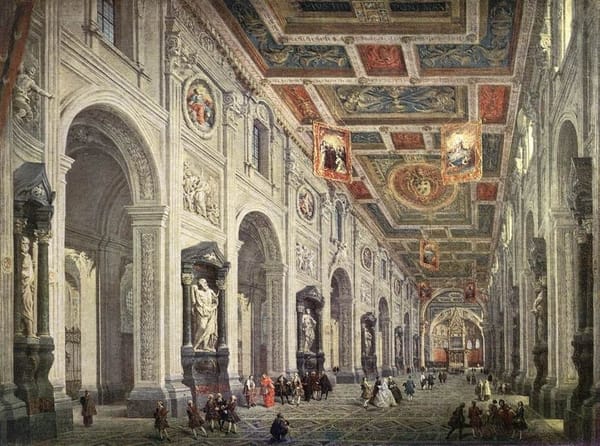
November 9: Dedication of the Basilica of St. Saviour
IN the fourth century of our era, the cessation of persecution seemed to give the world a foretaste of its future entrance into eternal peace. “Glory to the Almighty! Glory to the Redeemer of our souls!” wrote Eusebius at the opening of the tenth and last book of his History. Himself a witness of the triumph, he describes the admirable spectacle everywhere displayed by the dedication of the new sanctuaries. In city after city the Bishops assembled, and crowds flocked together. From nation to nation, the good-will of mutual charity, of common faith, and of recollected joy, so harmonized all hearts, that the unity of Christ's body was clearly manifested in these multitudes animated by the same inspiration of the Holy Ghost. It was the fulfilment of the ancient prophecies: the living city of the living God, where all, whatever their age or sex, praise together the Author of all good things. How solemn were then the rites of the Church! The complete perfection therein displayed by the Pontiffs, the enthusiasm of the psalmody, the inspired readings, the celebration of the ineffable Mysteries, formed a divine pageantry.1
Constantine had placed the imperial treasure at the disposal of the Bishops; and he himself stimulated their zeal for what he called in his edicts the work of the churches.2 Rome, the place of his victory by the Cross, the capital of the now Christian world, was the first to benefit by the prince's munificence. In a series of dedications, to the glory of the holy Apostles and Martyrs, Sylvester, the Pontiff of peace, took possession of the eternal city in the name of the true God.
Today is the birthday of the mother and mistress of churches, called “of our Saviour, Aula Dei (God's palace), the golden Basilica;” it is a new Sinai,3 whence the apostolic oracles and so many Councils have made known to the world the law of salvation. No wonder this feast is celebrated by the whole world.
Although the Popes for centuries have ceased to dwell in the Lateran palace, the Basilica still holds the first rank. It is as true now, as it was in the time of St. Peter Damian, to say that “as our Saviour is the Head of the elect, so the church which bears his name is the head of all churches; those of St. Peter and St. Paul, on its right and left, are the two arms with which this sovereign and universal church embraces the whole earth, saving all those who desire salvation, cherishing and protecting them in its maternal bosom.”4 And St. Peter Damian applied conjointly to our Saviour and his Basilica the words of the prophet Zacharias; Behold a Alan, the Orient is his name: and under him shall he spring up, and shall build a temple to the Lord. Yea, he shall build a temple to the Lord: and he shall bear the glory, and shall sit, and rule upon his throne: and he shall be a priest upon his throne.5
It is still at the Lateran Basilica that the Roman Pontiffs take official possession of their See. There each year, in the name of the Pope as Bishop of Rome, the episcopal functions are performed, viz: the blessing of the Holy Oils on Maundy Thursday, and on Holy Saturday the blessing of the Font, solemn Baptism and Confirmation, and the general Ordination. Could the great poet of the age of triumph, Prudentius, return to life in these our days, he might still say: “The Roman people hasten in eager crowds to the Lateran, whence they return marked with the sacred sign, with the royal chrism. And are we yet to doubt that Rome is consecrated " to thee, O Christ!”6
So many details might seem superfluous to the profane. But, just as the Pope is to all of us our first and our own Pastor, so his church of the Lateran is our own church; whatever concerns it cannot, or at least should not, be a matter of indifference to the faithful. Let us take our inspirations regarding it from the following beautiful formulae, given us by the Roman Pontifical in the dedication ceremony. To no church could they be better applied than to this.
Antiphons And Responsories
℟. Fundata est domus Domini super verticem montium, et exaltata est super omnes colles, et venient ad eam omnes gentes. * Et dicent: Gloria tibi, Domine.℣. Venientes autem venient cum exaultatione, portantes manipulos suos. * Et dicent.
℟. The house of the Lord is founded upon the summit of mountains, and raised up above all hills, and all nations shall come to her. * And they shall say: Glory be to thee, O Lord.℣. Coming they shall come with joyfulness, carrying their sheaves. *And they shall say:
Prayer
The Twenty-Second Sunday after Pentecost
|
Mass
According to Honorius of Autun, the Mass of to-day has reference to the days of Antichrist.1 The Church, foreseeing the reign of the man of sin,2 and as though she were actually undergoing the persecution which is to surpass all others, takes her Introit of this twenty-second Sunday from the Psalm De profundis.3
If, unitedly with this prophetic sense, we would apply these words practically to our own personal miseries, we must remember the Gospel we had last week, which was formerly appointed for the present Sunday. Each one of us will recognize himself in the person of the insolvent debtor, who has nothing to trust to but his master’s goodness; and, in our deep humiliation, we shall exclaim : If thou, O Lord, mark iniquities, who shall endure it?4
Introit
Ps. De profundis clamavi ad te, Domine : Domine, exaudi vocem meam. Gloria Patri. Si iniquitates.
Ps. Out of the depths have I cried unto thee, O Lord : Lord! hear my voice. Glory, etc. If thou.
We have just been rousing our confidence by singing that with God there is merciful forgiveness. It is He Himself who gives that loving unction to the prayers of the Church, which proves that He wishes to grant them. But we shall not be thus graciously heard, as she is, unless, like her, we ask with faith, that is to say, conformably with the teachings of the Gospel. To ask with faith is to forgive our fellow-creatures their trespasses against us; on that condition we may confidently beseech our common Lord and Master to forgive us.5
Collect
The other Collects, as on page 120.
Epistle
Cap. i.Fratres, Confidimus in Domino Jesu, quia qui cœpit in vobis opus bonum, perficiet usque in diem Christi Jesu. Sicut est mihi justum hoc sentire pro omnibus vobis, eo quod habeam vos in corde, et in vinculis meis, et in defensione, et confirmatione Evangelii, socios gaudii mei omnes vos esse. Testis enim mihi est Deus, quomodo cupiam omnes vos in visceribus Jesu Christi. Et hoc oro, ut charitas vestra magis ac magis abundet in scientia, et in omni sensu: ut probetis potiora, ut sitis sinceri, et sine offensa in diem Christi, repleti fructu justitiæ per Jesum Christum, in gloriam et laudem Dei.
Ch. i.Brethren : We are confident of this very thing, that he who hath begun a good work in you, will perfect it unto the day. of Christ Jesus. As it is meet for me to think this for you all: for that I have you in my heart; and that in my bands, and in the defence and confirmation of the Gospel, you are all partakers of my joy. For God is my witness, how I long after you all in the bowels of Jesus Christ. And this I pray, that your charity may more and more abound in knowledge and in all understanding; that you may approve the better things, that you may be sincere and without offence unto the day of Christ. Filled with the fruit of justice, through Jesus Christ, unto the glory and praise of God.
St. Paul, in the Church’s name, again invites our attention to the near approach of the last day. But what, on the previous Sunday, he called the evil day, he now, in the short passage taken from his Epistle to the Philippians which has just been read to us, calls twice over the day of Christ Jesus. The Epistle to the Philippians is full of loving confidence; its tone is decidedly one of joy, and yet it plainly shows us that persecution was raging against the Church, and that the old enemy was making capital of the storm to stir up evil passions, even amidst the very flock of Christ. The apostle is in chains; the envy and treachery of false brethren Intensify his sufferings;6 still, joy predominates in his heart over everything else, because he has attained that perfection of love, wherein divine charity is enkindled by suffering more even than by the sweetest spiritual caresses. To him, to live is Christ and to die is gain;7 he cannot make up his mind which of the two to choose: death, which would give him the bliss of being with his Jesus,8 or life, which would add to his merits and his labours for the salvation of men.9 What are all personal considerations to him? His one joy, for both the present and the future, is that Christ may be known and glorified, no matter how! As to his hopes and expectations, he cannot be disappointed, for Christ is sure to be glorified in his body by its life and by its death!10
Hence, in Paul’s soul, that sublime indifference which is the climax of the Christian life; it is, of course, a totally different thing from that fatal apathy, to which the false mystics of the seventeenth century pretended to reduce the love of man’s heart. What tender affection has this convert of Damascus for his brethren, once he has reached this point of perfection! God, says he, is my witness how I long after you all in the bowels of Jesus Christ! The one ambition which rules and absorbs him11 is that God, who has begun in them the work which is good by excellence, the work of Christian perfection such as we know had been wrought in the apostle himself, may continue and perfect it in them all, by the day, when Christ is to appear in His glory.12 This is what he prays for, that charity, the wedding-garment of those whom he has betrothed to the one Spouse,13 may beautify them with all its splendour for the grand day of the eternal nuptials.14
Now, how is charity to be perfected in them? It must abound, more and more, in knowledge and in all understanding of salvation, that is, in faith. It is faith that constitutes the basis of all supernatural virtue. A restricted, a diminished,15 faith could never support a large and high-minded charity. Those men, therefore, are deceiving themselves whose love for revealed truth does not keep pace with their charity! Such Christianity as that believes as little as it may; it has a nervous dread of new definitions; and out of respect for error, it cleverly and continually narrows the supernatural horizon. Charity, they say, is the queen of virtues; it makes them take everything easily, even lies against truth; to give the same rights to error as to truth is, in their estimation, the highest point of Christian civilization grounded on love! They quite forget that the first object of charity, God who is substantial Truth, has no greater enemy than a lie; they cannot understand how it is that a Christian does not do a work of love by putting on the same footing the Object beloved and His mortal enemy!
The apostles had very different ideas; in order to make charity grow in the world, they gave it a rich sowing of truth. Every new ray of light they put into their disciples’ hearts was an intensifying of their love; and these disciples, having by Baptism become themselves light,16 were most determined to have nothing to do with darkness. In those days, to deny the truth was the greatest of crimes; to expose themselves, by a want of vigilance, to infringe on the rights of truth, even in the slightest degree, was the height of imprudence.17 When Christianity first shone upon mankind, it found error supreme mistress of the world. Having, then, to deal with a universe that was rooted in death,18 Christianity adopted no other plan for giving it salvation than that of making the light as bright as could be; its only policy was to proclaim the power which truth alone has of saving man, and to assert its exclusive right to reign over this world. The triumph of the Gospel was the result. It came after three centuries of struggle— a struggle intense and violent on the side of darkness, which declared itself to be supreme, and was resolved to keep so; but a struggle most patient and glorious on the side of the Christians, the torrents of whose blood did but add fresh joy to the brave army, for it became the strongest possible foundation of the united kingdom of love and truth.
But now, with the connivance of those whose Baptism made them, too, children of light, error has regained its pretended rights. As a natural consequence, the charity of an immense number has grown cold in proportion;19 darkness is again thickening over the world, as though it were in the chill of its last agony. The children of light,20 who would live up to their dignity, must behave exactly as did the early Christians. They must not fear, nor be troubled: but, like their forefathers and the apostles, they must be proud to suffer for Jesus' sake,21 and prize the word of life22 as the dearest thing they possess; for they are convinced that, so long as truth is kept up in the world, so long is there hope for it.23 As their only care is, to make their manner of life worthy of the Gospel of Christ,24 they go on, with all the simplicity of children of God, faithfully fulfilling the duties of their state of life, in the midst of a wicked and perverse generation, as stars of the firmament shine in the night.25 ‘The stars shine in the night,' says St. John Chrysostom, ‘they glitter in the dark; so far from growing dim amidst the gloom that surrounds them, they seem all the more brilliant. So will it be with thee, if thou art virtuous amidst the wicked; thy light will shine so much the more clearly.’26 ‘As the stars,' says St. Augustine, ‘keep on their course in the track marked out for them by God, and grow not tired of sending forth their light in the midst of darkness, neither heed they the calamities which may be happening on earth; so should do those holy ones whose conversation is truly in heaven;27 they should pay no more attention to what is said or done against them, than the stars do.’28
The Gradual hymns the praise of the sweet and strong unity, which the Church maintains even to the end; she does this by charity, in which the Epistle urged us to be making fresh progress, and which the ancient Gospel of this same Sunday put before us as the one means of securing a favourable sentence at the day of judgment.
Gradual
Gospel
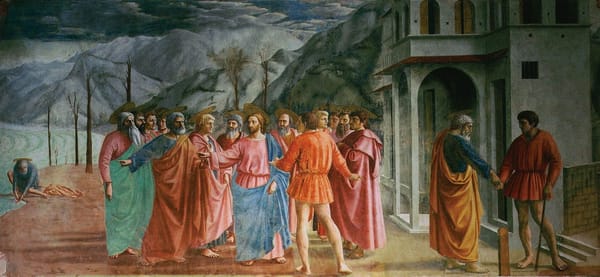
Cap. xxii.In illo tempore: Abeuntes Pharisæi, consilium inierunt, ut caperent Jesum in sermone. Et mittunt ei discipulos suos cum Herodianis, dicentes : Magister, scimus quia verax es, et viam Dei in ventate doces, et non est tibi cura de aliquo : non enim respicis personam hominum : dic ergo nobis, quid tibi videtur : licet censum dare Cæsari, an non? Cognita autem Jesus nequitia eorum, ait : Quid me tentatis, hypocritæ? ostendite mihi numisma census. At illi obtulerunt ei denarium. Et ait illis Jesus : Cujus est imago hæc, et superscriptio? Dicunt ei: Cæsaris. Tunc ait illis : Reddite ergo quæ sunt Cæsaris, Cæsari: et quæ sunt Dei, Deo.
Ch. xxii.At that time : The Pharisees going, consulted among themselves how to ensnare Jesus in his speech. And they send to him their disciples, with the Herodians, saying : Master, we know that thou art a true speaker, and teachest the way of God in truth, neither carest thou for any man : for thou dost not regard the person of men. Tell us therefore what dost thou think; is it lawful to give tribute to Caesar or not? But Jesus knowing their wickedness, said : Why do you tempt me, ye hypocrites? Show me the coin of the tribute. And they offered him a penny. And Jesus saith to them: Whose image and inscription is this? They say to him : Cæsar’s. Then he saith to them: Render therefore to Cæsar the things that are Caesar’s: and to God the things that are God’s.
The diminution of truth29 is evidently to be a leading peril of the latter times; for, during these weeks which represent the last days of the world, the Church is continually urging us to a sound and solid understanding of truth, as though she considered that to be the great preservative for her children. Last Sunday she gave them, as defensive armour, the shield of faith, and, as an offensive weapon, the word of God.30 On the previous Sunday, it was circumspection of mind and intelligence that she recommended to them,31 with a view to their preserving, during the approaching evil days, the holiness which is founded on truth;32 for, as she told them the previous week, their riches in all knowledge are of paramount necessity.33 To-day, in the Epistle, she implored of them to be ever progressing in knowledge and all understanding, as being the essential means for abounding in charity, and for having the work of their sanctification perfected for the day of Christ Jesus. The Gospel comes with an appropriate finish to these instructions given us by the apostle: it relates an event in our Lord’s life, which stamps those counsels with the weightiest possible authority, viz., the example of Him, who is our divine Model. He gives His disciples the example they should follow, when, like Himself, they have snares laid, by the world, for their destruction.
It was the last day of Jesus’ public teaching; it was almost the eve of His departure from this earth.34 His enemies had failed in every attempt hitherto made to ensnare Him; this last plot was to be unusually deep-laid. The pharisees, who refused to recognize Cæsar’s authority and denied his claim to tribute, joined issue with their adversaries, the partisans of Herod and Rome, to propose this insidious question to Jesus : Is it lawful to give tribute to Cæsar, or not? If our Lord’s answer was negative, He incurred the displeasure of the government; if He took the affirmative side, He would lose the estimation of the people. With His divine prudence, He disconcerted their plans. The two parties, so strangely made friends by partnership in one common intrigue, heard the magnificent answer, which was divine enough to make even pharisees and Herodians one in the truth. But truth was not what they were in search of; so they returned to their old party quarrels. The league formed against our Jesus was broken; the effort made by error recoiled on itself, as must ever be the case; and the answer it had elicited, passed from the lips of our Incarnate Lord to those of His bride, the Church, who would be ever repeating it to the world, for it contains the first principle of all governments on earth.
Render to Caesar the things that are Caesar's and to God the things that are God's: it was the dictum most dear to the apostles. If they boldly asserted that we must obey God rather than men,35 they explained the whole truth, and added: 'Let every soul be subject to the higher powers: for there is no power but from God: and those that are, are ordained of God. Therefore, he that resisteth the power, resisteth the ordinance of God; and they that resist, purchase to themselves damnation. Wherefore, be subject of necessity, not only for wrath, but also for conscience' sake. For therefore also ye pay tribute; for they are the ministers of God serving unto this purpose.’36
The will of God:37 there is the origin, there is the real greatness of all authority amongst men! Of themselves, men have no right to command their fellow-men. Their number, however imposing it may be, makes no difference to this powerlessness of men over my conscience; for, whether they be one, or five hundred, I, by nature, am equal to each one among them; and, by adding the number of their so-called rights over me, they are only adding to the number of nothingnesses. But God, wishing that men should live one with the other, has thereby wished that there should exist amongst them a power which should rule over the rest; that is; should direct the thousands or millions of different wills to the unity of one social end. God leaves much to circumstances, though it is His providence that regulates those circumstances; He leaves to men themselves, at the beginning of any mere human society, a great latitude as to the choice of the form, under which is to be exercised both the civil power itself and the mode of its transmission. But, once regularly invested with the power, its depositaries are responsible to God alone, as far, that is, as the legitimate exercise of their authority goes, because it is from God alone that that power comes to them; it does not come to them from their people, who, not having that power themselves, cannot give it to another. So long as those rulers comply with the compact, or do not turn to the ruin of their people the power they received for its well-being, so long their right to the obedience of their subjects is the right of God Himself, whether they exercise their authority in exacting the subsidies needed for government; or in passing laws, which, for the general good of the people, restrain the liberty otherwise theirs by natural right; or again, by bidding their soldiers defend their country at the risk of life. In all such cases, it is God Himself that commands, and insists on being obeyed: in this world, He puts the sword into the hands of representatives, that they may punish the disobedient;38 and, in the next, He Himself will eternally punish them, unless they have made amends.
How great, then, is the dignity of human law! It makes the legislator a representative of God, and, at the same time, spares the subject the humiliation of feeling himself debased before a fellow-man! But, in order that the law oblige, that is, be truly a law, it is evident that it must be, first and foremost, conformable to the commands and the prohibitions of God, whose will alone can give it a sacred character by making it enter into the domain of man’s conscience. It is for this reason that there cannot be a law against God, or His Christ, or His Church. When God is not with Him who governs, the power he exercises is nothing better than brute force. The sovereign, or the parliament, that pretends to govern a country in opposition to the laws of God, has no right to aught but revolt and contempt from every upright man; to give the sacred name of law to tyrannical enactments of that kind is a profanation unworthy, not only of a Christian, but of every man who is not a slave.
The Offertory-anthem, together with the verses which used to be joined to it, refers, like the Introit, to the period of the last persecution. The words are taken from the prayer addressed to God by Esther, when about to enter into the presence of Assuerus that she might plead with him against Aman, who is a figure of Antichrist. Esther is a type of the Church; and we could not better show the spirit in which we ought to sing our Offertory, than by quoting the inspired words which preface this sublime prayer. ‘Queen Esther, fearing the danger that was at hand, had recourse to the Lord. And when she had laid away her royal apparel, she put on garments suitable for weeping and mourning; instead of divers precious ointments, she covered her head with ashes and filth, and she humbled her body with fasts: and all the places in which before she was accustomed to rejoice, she filled with her torn hair. And she prayed to the Lord the God of Israel, saying: O my Lord, who alone art our King, help me a desolate woman, and who have no other helper but Thee!’39
Offertory
℣. Everte cor ejus in odium repugnantium nobis, et in eos qui consentiunt eis; nos autem libera in manu tua, Deus noster in æternum.
℣. Qui regis Israel, intende; qui deducis velut ovem Joseph.
Recordare mei, Domine.
℣. Turn his heart into hatred of them that oppose us, and of them that consent unto them; but deliver us by thy hand, O our God for ever!
℣. O thou that rulest Israel, give ear; thou that leadest Joseph like a sheep.
Remember me, O Lord.
The surest guarantee a Christian can have against adversity is freedom from sin. It is sin that stirs up the anger of God, and calls upon Him for vengeance. Let us unite in the following prayer of the Church :
Secret
The other Secrets, as on page 130.
The Communion anthem shows us with what perseverance and earnestness the Church prays to her divine Lord. We must imitate her.
Communion
While offering the sacred mysteries in memory of our Jesus as He commanded us to do, we must not forget that these same are also our refuge in all our miseries. It would be presumption, or folly, to neglect to pray that they may thus protect us. The Church, here again, is our model, in utilizing these most powerful of all means for help.
Postcommunion
The other Postcommunions, as on page 131.
Vespers
The psalms, capitulum, hymn, and versicle, as above, pages 71-81.
Antiphon of the Magnificat
- Hon. Aug., Gemm. an., iv. ↩︎
- 2 Thess. ii. 3. ↩︎
- Ps. cxxix. ↩︎
- Rup., De. Div. Off., xii 22. ↩︎
- Bern, Aug., De Offic. Miss., v. ↩︎
- Phil. i. 15, 17. ↩︎
- Ibid. 21. ↩︎
- Ibid. 23. ↩︎
- Ibid. 22. ↩︎
- Ibid. 18, 20. ↩︎
- Phil. i. 24-27. ↩︎
- Col. iii. 4. ↩︎
- 2 Cor. xi. 2. ↩︎
- Durand., Ration., vi. 139. ↩︎
- Ps. xi. 2. (Diminutœ veritates.) ↩︎
- Eph. v. 8. ↩︎
- Ibid. 15, 17. ↩︎
- St. Matt. iv. 16. ↩︎
- St. Matt. xxiv. 12. ↩︎
- Eph. v. 8. ↩︎
- Phil. i. 28-80. ↩︎
- Ibid. ii. 16. ↩︎
- St. John viii. 32. ↩︎
- Phil. i. 27. ↩︎
- Ibid. ii. 15. ↩︎
- St. Chrys., in Phil., Hom. viii. 4. ↩︎
- Phil. iii. 20. ↩︎
- St. Aug., Enarr. in Ps. xciii. 5, 6. ↩︎
- Ps. xi. 2. ↩︎
- Epistle of the twenty-first Sunday after Pentecost. ↩︎
- Epistle of the twentieth Sunday. ↩︎
- Epistle of the nineteenth Sunday. ↩︎
- Epistle of the eighteenth Sunday. ↩︎
- Tuesday in Holy Week. ↩︎
- Acts v. 29. ↩︎
- Rom. xiii. 1, 2, 5, 6. ↩︎
- 1 St. Pet. ii. 15. ↩︎
- Rom. xiii. 4. ↩︎
- Esth. xiv. 1-3. ↩︎
November 9 (the Same Day): St. Theodore, Martyr
On this day is commemorated the great martyr Theodore of Amasea, a conscript soldier, who was burnt alive. His praises have been celebrated by St. Gregory of Nyssa; he is honoured in Rome at the foot of the Palatine, and had three churches dedicated to his name in Constantinople. Let us say with the Latin Church:
Prayer
| Previous November 8 (the Same Day): The Four Crowned Martyrs | Next The Twenty-Second Sunday after Pentecost |