Daily reading
After Pentecost
Double · Movable from Easter · Temporal
November 16, 2025
From Dom Guéranger’s The Liturgical Year.

|
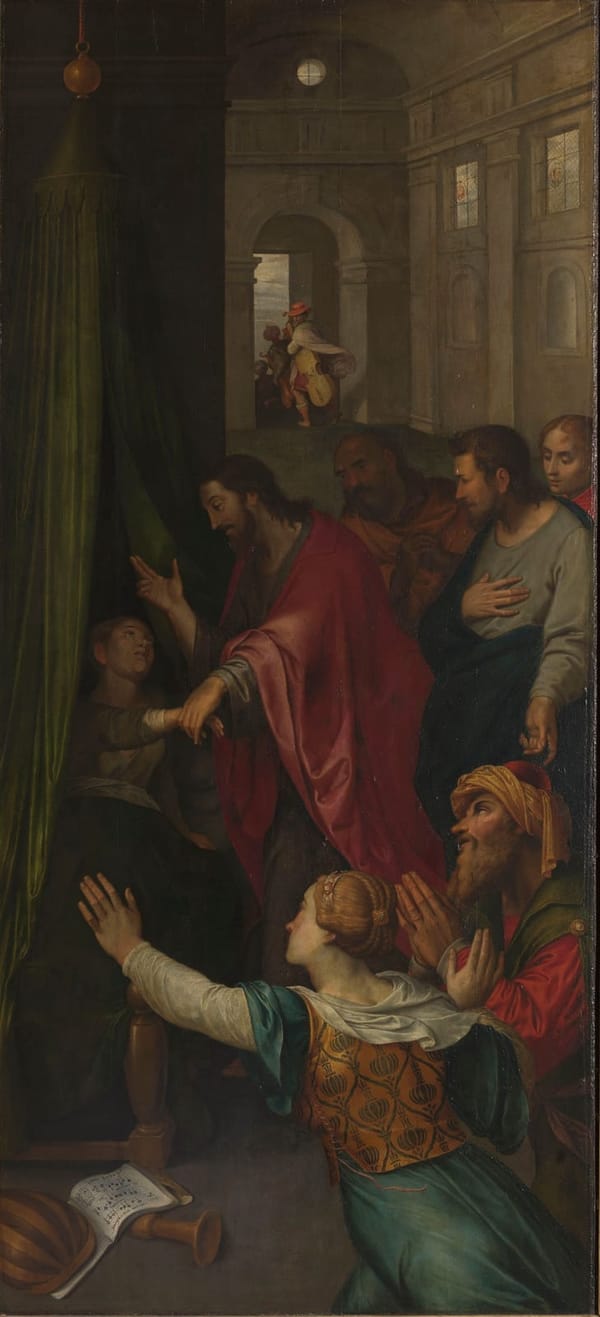
The Twenty-Third Sunday after Pentecost
When the number of the Sundays after Pentecost is only twenty-three, the Mass for to-day is taken from the twenty-fourth and last Sunday; and the Mass appointed for the twenty-third is said on the previous Saturday, or on the nearest day of the preceding week which is not impeded by a double or semi-double feast.
But, under all circumstances, the antiphonary ends to-day. The Introits, Graduals, Communions, and Postcommunions, which are given below, are to be repeated on each of the Sundays till Advent, which vary in number each year. Our readers will remember that, in the time of St. Gregory, Advent was longer than we now have it;1 and that, in those days, its weeks commenced in that part of the cycle which is now occupied by the last Sundays after Pentecost. This is one of the reasons for the lack of liturgical riches in the composition of the dominical Masses which follow the twenty-third.
Even on this one, the Church, without losing sight of the last day, used to lend a thought to the new season which was fast approaching, the season, that is, of preparation for the great feast of Christmas. There was read, as Epistle, the following passage from Jeremias, which was afterwards, in several Churches, inserted in the Mass of the first Sunday of Advent: 'Behold! the days come, saith the Lord, and I will raise up to David a just branch: and a King shall reign, and shall be wise: and shall execute judgment and justice in the earth. In those days, shall Juda be saved, and Israel shall dwell confidently: and this is the name that they shall call Him: The Lord our Just One. Therefore, behold the days come, saith the Lord, and they shall say no more: The Lord liveth, who brought up the children of Israel out of the land of Egypt! But: The Lord liveth, who hath brought out, and brought hither, the seed of the house of Israel, from the land of the north, and out of all the lands, to which I had cast them forth! And they shall dwell in their own land.’2
As is evident, this passage is equally applicable to the conversion of the Jews and the restoration of Israel, which are to take place at the end of the world. This was the view taken by the chief liturgists of the middle ages, in order to explain thoroughly the Mass of the twenty-third Sunday after Pentecost. Bearing in mind that, originally, the Gospel of this Sunday was that of the multiplication of the five loaves, let us listen to the profound and learned Abbot Rupert, who, better than anyone, will teach us the mysteries of this day, which brings to a close the grand and varied Gregorian melodies.
'Holy Church,’ he says,’is so intent on paying her debt of supplication, and prayer, and thanksgiving, for all men, as the apostle demands,3 that we find her giving thanks also for the salvation of the children of Israel, who, she knows, are one day to be united with her. And, as their remnants are to be saved at the end of the world,4 so, on this last Sunday of the year, she delights in them, as though they were already her members. In the Introit, calling to mind the prophecies concerning them, she thus sings every year: My thoughts are thoughts of peace, and not of affliction. Verily, His thoughts are those of peace, for He promises to admit to the banquet of His grace the Jews, who are His brethren according to the flesh; thus realizing what had been prefigured in the history of the patriarch Joseph. The brethren of Joseph, having sold him, came to him when they were tormented by hunger; for then he ruled over the whole land of Egypt. He recognized them; he received them; and made, together with them, a great feast. So, too, our Lord, who is now reigning over the whole earth, and is giving the bread of life, in abundance, to the Egyptians (that is, to the Gentiles), will see coming to Him the remnants of the children of Israel. He, whom they had denied and put to death, will admit them to His favour, will give them a place at His table, and the true Joseph will feast delightedly with His brethren.
‘The benefit of this divine Table is signified, in the Office of this Sunday, by the Gospel, which tells us of our Lord’s feeding the multitude with five loaves. For it will be then that Jesus will open to the Jews the five Books of Moses, which are now being carried whole, and not yet broken; yea, carried by a child, that is to say, this people itself, who, up to that time, will have been cramped up in the narrowness of a childish spirit.
Then will be fulfilled the prophecy of Jeremias, which is so aptly placed before this Gospel: “They shall say no more: The Lord liveth, who brought up the children of Israel out of the land of Egypt! But, the Lord liveth, who hath brought out the seed of Israel from the land of the north, and from all the lands into which they had been cast."
Thus delivered from the spiritual bondage which still holds them, they will sing with all their heart the words of thanksgiving as we have them in the Gradual: “Thou hast saved us, O Lord, from them that afflict us!"
‘The words we use in the Offertory: “From the depths I have cried to thee, O Lord," clearly allude to the same events; for, on that day, His brethren will say to the great and true Joseph: “We beseech thee to forget the wickedness of thy brethren!”5 The Communion: “Amen, I say to you, all things whatsoever ye ask, when ye pray," etc., is the answer made by that same Joseph, as it was by the first:6 “Fear not! Ye thought evil against me : but God turned it into good, that He might exalt me, as at present ye see, and might save many people. Fear not, therefore, I will feed you, and your children.”’7
Mass
The Introit, which we have just had explained to us by Rupert, is taken from the Prophet Jeremias,8 as was the ancient Epistle.
Introit
Prayer for pardon is continually on the lips of the Christian people, because the weakness of human nature is ever making itself felt, here below, even by the just man.9 God knows our frailty, and He is always ready to pardon us; but it is on the condition that we humbly acknowledge our faults, and have confidence in His mercy. These are the sentiments which suggest to the Church the words of the Collect.
Collect
The other Collects, as on page 120.
Epistle
Cap. iii. et iv.Fratres, Imitatores mei estote, et observate eos, qui ita ambulant, sicut habetis formam nostram. Multi enim ambulant, quos sæpe dicebam vobis (nunc autem et flens dico) inimicos crucis Christi : quorum finis interitus : quorum deus venter est : et gloria in confusione ipsorum, qui terrena sapiunt. Nostra autem conversatio in cœlis est: unde etiam Salvatorem exspectamus Dominum nostrum Jesum Christum, qui reformabit corpus humilitatis nostræ, configuratum corpori claritatis suæ, secundum operationem, qua etiam possit subjicere sibi omnia. Itaque, fratres mei charissimi et desideratissimi, gaudium meum et corona mea : sic state in Domino, charissimi. Evodiam rogo, et Syntichen deprecor idipsum sapere in Domino. Etiam rogo et te, germane compar, adjuva illas, quæ mecum laboraverunt in Evangelio, cum Clemente, et ceteris adjutoribus meis, quorum nomina sunt in libro vitæ.
Chapters iii. and iv.
Brethren: Be followers of me, and observe them who walk so as you have our model. For many walk, of whom I have told you often (and now tell you weeping) that they are enemies of the cross of Christ; whose end is destruction, whose god is their belly, and whose glory is in their shame: who mind earthly things. But our conversation is in heaven; from whence also we look for the Saviour, our Lord Jesus Christ, who will reform the body of our lowness, made like to the body of his glory, according to the operation whereby also he is able to subdue all things unto himself. Therefore, my dearly beloved brethren, and most desired, my joy, and my crown: so stand fast in the Lord, my dearly beloved. I beg of Evodia, and I beseech Syntyche, to be of one mind in the Lord. And I entreat thee also, my sincere companion, help those women that have laboured with me in the Gospel, with Clement and the rest of my fellow labourers, whose names are in the book of life.
The Clement here mentioned by the apostle was St. Peter’s second successor. Very frequently, the twenty-third Sunday after Pentecost comes close upon the feast of this great Pope and Martyr of the first century. Disciple of Paul, and, later on, in close intimacy with Peter, and named by the Vicar of Christ as the fittest to succeed him in the apostolic chair, Clement, as we shall see on November 23, was one of the saints most venerated by the faithful in those early times. The mention made of him in the Office of the time, just before his appearance on the cycle of holy Church, excited the Christian people to joy, and roused their fervour; it reminded them, that one of their best and dearest protectors would soon be visiting them.
At the time when St. Paul was writing to the Philippians, Clement, who was long to survive the apostles, was prominently one of those men spoken of in our Epistle, those illustrious models, who were called to perpetuate in the flock confided to their care10 the pattern of holy living; and that, not so much by their zealous teaching, as by the force of example. The Church, the one true bride of the divine Word, was known by the incommunicable privilege of possessing within her the truth; not only its dead letter, but its ever-living self. The Holy Ghost has not kept the Books of sacred Scripture from passing into the hands of the sects separated from the centre of unity; but He has reserved to the Church the treasure of tradition, which transmits, surely and fully, from one generation to another, the word which is life and light.11 This tradition is kept up by the truth and the holiness of the Man-God, ever existing in His members, ever tangible and visible in the Church.12 Holiness, which is inherent in the Church, is tradition in its purest and strongest form; because it is the truth, not only preached, but reduced to action and work,13 as it was in Christ Jesus, and as it is in God.14 It is the deposit,15 which the disciples of the apostles had the mission to hand faithfully down to their successors, just as the apostles themselves had received it from the Word, who had come upon the earth.
Hence, St. Paul did not content himself with entrusting dogmatic teaching to his disciple Timothy;16 he said to him : 'Be thou an example to the faithful, in word, and in living.,17 He said much the same to Titus: ‘Show thyself an example of good works, in doctrine and in integrity of life.’18 He repeated to all: 'Be ye followers of me, as I also am of Christ.'19 He sent Timothy to the Corinthians, that he might remind them, or, where it was necessary, might teach them, not only the dogmas of his Gospel, but likewise his ways in Christ Jesus, that is, his manner of life. For this manner of life of the apostle was, in a certain measure, his teaching everywhere in all the Churches;20 and he lauded the faithful of Corinth for being mindful to imitate him in all things, which was a keeping to the tradition of Christ.21 As for the Thessalonians, they had so thoroughly entered into this teaching, taken from their apostle’s life, that, as St. Paul says of them, they had become a pattern to all believers; this silent teaching of Christian revelation, which they showed forth in their conduct, made it superfluous for the messengers of the Gospel to say much.22
The Church is a magnificent temple, which is built up, to the glory of God, of the living stones, which let themselves be set into its walls.23 The constructing of those sacred walls on the plan laid down by Christ is a work in which all are permitted to share. What one does by word,24 another does by good example;25 but both of them build, both of them edify the holy city; and, as it was in the apostolic age, so always; example is more powerful than word, unless that word be supported by the authority of holiness in him who speaks it, unless, that is, he lead a life according to the perfection taught by the Gospel.
But, as the giving of edification to those around him is an obligation incumbent on the Christian—an obligation imposed both by the charity he owes to his neighbour, and by the zeal he should have for the house of God—so likewise, under pain of presumption, he should seek his own edification in the conduct of others. The reading of good books, the study of the lives of the saints, the observing, as our Epistle says, those holy people with whom he lives, all this will be an incalculable aid to him, in the work of his own personal sanctification and in the fulfilment of God’s purposes in this regard. This devout intercourse with the elect of earth and of heaven will keep us away from men who are enemies of the cross of Christ and mind earthly things, and put their happiness in carnal pleasures. It will make our conversation be in heaven. Preparing for the day which cannot now be far off, the day of the coming of our Lord, we shall stand fast in Him, in spite of the falling off of so many amongst us, who, by the current of the world’s fashion, are hurried into perdition. The troubles and sufferings of the last times will but intensify our hope in God; for they will make us long all the more ardently for the happy day when our Redeemer will appear and complete the work of the salvation of His servants by imparting to their very flesh the brightness of His own divine Body. Let us, as our apostle says, be of one mind in the Lord; and then, as he bids his dear Philippians, let us rejoice in the Lord always, for the Lord is nigh.26
Gradual
Gospel
Cap. ix.In illo tempore : Loquente Jesu ad turbas, ecce princeps unus accessit, et adorabat eum, dicens: Domine, filia mea modo defuncta est: sed veni, impone manum tuam super eam, et vivet. Et surgens Jesus sequebatur eum, et discipuli ejus. Et ecce mulier, quæ sanguinis fluxum patiebatur duodecim annis, accessit retro, et tetigit fimbriam vestimenti ejus. Dicebat enim intra se : Si tetigero tantum vestimentum ejus, salva ero. At Jesus conversus, et videns eam, dixit : Confide, filia, fides tua te salvam fecit. Et salva facta est mulier ex illa hora. Et cum venisset Jesus in domum principis, et vidisset tibicines, et turbam tumultuantem, dicebat : Recedite, non est enim mortua puella, sed dormii. Et deridebant eum. Et cum ejecta esset turba, intravit, et tenuit manum ejus. Et surrexit puella. Et exiit fama hæc in universam terram illam.
Ch. ix.At that time : As Jesus was speaking to the multitude: Behold a certain ruler came up and adored him, saying : Lord, my daughter is even now dead; but come lay thy hand upon her, and she shall live. And Jesus rising up followed him, with his disciples. And behold a woman who was troubled with an issue of blood twelve years, came behind him, and touched the hem of his garment. For she said within herself: If I shall touch only his garment I shall be healed. But Jesus turning and seeing her, said : Be of good heart, daughter, thy faith hath made thee whole. And the woman was made whole from that hour. And when Jesus was come into the house of the ruler, and saw the minstrels and the multitude making a rout, he said : Give place: for the girl is not dead, but sleepeth. And they laughed him to scorn. And when the multitude was put forth, he went in and took her by the hand. And the maid arose. And the fame hereof went abroad into all that country.
Although the choice of this Gospel for the twenty-third Sunday is not of great antiquity, yet is it in most perfect keeping with the post-pentecostal liturgy, and confirms what we have stated relative to the character of this portion of the Church’s year. St. Jerome tells us, in the homily selected for the day, that the hemorrhoissa, healed by our Lord, is a type of the Gentile world; whilst the Jewish people is represented by the daughter of the ruler of the Synagogue.27 This latter is not to be restored to life until the former has been cured; and this is precisely the mystery we are so continually commemorating during these closing weeks of the liturgical year, viz., the fullness of the Gentiles recognizing and welcoming the divine Physician, and the blindness of Israel at last giving way to the light.28
The liturgy at this close of the year continually alludes to the end of the world. The earth seems to be sinking away, down into some deep abyss; but it is only that it may shake off the wicked from its surface, and then it will come up again blooming in light and love. After the divine realities of this year of grace, we ought to be capable of feeling a thrill of admiration at the mysterious, yet, at the same time, the strong and sweet ways of eternal Wisdom.29 At the beginning, when man was first created, sin soon followed, breaking up the harmony of God’s beautiful world, and throwing man off the divine path where his Creator had placed him. Wickedness went on increasing, until God’s mercy fell upon one family. The light which beamed on that privileged favourite only showed more plainly the thick darkness in which the rest of mankind were enveloped. The Gentiles, abandoned to their misery, all the more terrible because they had caused it and loved it, saw God’s favours all bestowed on Israel, whilst they themselves were disregarded, and wished to be so. Even when the time came for original sin to be remedied, it seemed to be the very time for the final reprobation of the Gentiles; for the salvation that came down from heaven in the person of the Man-God was seen to be exclusively directed towards the Jews and the lost sheep of the house of Israel.30
But the people that had been treated with so much predilection, and whose fathers and first rulers had so ardently prayed for the coming of the Messias, was no longer in the position to which it had been raised by the holy patriarchs and prophets. Its beautiful religion, founded on desire and hope, was then nothing but a sterile expectancy, which kept it motionless and unable to advance a single step towards its Redeemer. As to its Law, Israel then minded nothing but the letter, and, at last, turned it into a mummy of sectarian formalism. Now, whilst in spite of all this sinful apathy it was mad with jealousy, pretending that no one else had any right to heaven’s favours, the Gentile, whose ever-increasing misery urged him to go in search of some deliverer, found one, and recognized him in Jesus the Saviour of the world. He was confident that this Jesus could cure him; so he took the bold initiative, went up to Him, and had the merit of being the first to be healed. True, our Lord had treated him with an apparent disdain; but that had only had the effect of intensifying his humility, and humility has a power of making way anywhere, even into heaven itself.31
Israel, therefore, was now made to wait. One of the Psalms he sang ran thus: ‘Ethiopia shall be the first to stretch out her hands to God.’32 It is now the turn for Israel to recover, by the pangs of a long abandonment, the humility which had won the divine promises for his fathers, the humility which alone could merit his seeing those promises fulfilled.
By this time, however, the word of salvation has made itself heard throughout all the nations, healing and saving all who desired the blessing. Jesus, who has been delayed on the road, comes at last to the house towards which He first purposed to direct His sacred steps; He reaches, at last, the house of Juda, where the daughter of Sion is in a deep sleep. His almighty compassion drives away from the poor abandoned one the crowd of false teachers and lying prophets, who had sent her into that mortal sleep, by all the noise of their vain babbling: He casts forth for ever from her house those insulters of Himself, who are quite resolved to keep the dead one dead. Taking the poor daughter by the hand, He restores her to life, and to all the charm of her first youth; proving thus, that her apparent death had been but a sleep, and that the long delay of dreary ages could never belie the word of God, which He had given to Abraham, His servant.33
Now therefore, let this world hold itself in readiness for its final transformation; for the tidings of the restoration of the daughter of Sion puts the last seal to the accomplishment of the prophecies. It remains now but for the graves to give back their dead.34 The valley of Josaphat is preparing for the great meeting of the nations;35 Mount Olivet is once more to have Jesus standing upon it,36 but this time as Lord and Judge!37
Offertory
The service we pay to God is, of itself, far beneath what His sovereign Majesty deserves; but the Sacrifice, which every day constitutes part of our service, ennobles it even to an infinite worth, and supplies all our own deficiencies of merit. This is what we are told in this Sunday’s Secret.
Secret
The other Secrets, as on page 130.
Communion
Having, by these sacred mysteries, entered into a participation of divine life, let us beseech our Lord, that we may no longer be subject to the dangers of this world. Let us say with the Church:
Postcommunion
The other Postcommunions, as on page 131.
Vespers
The psalms, capitulum, hymn, and versicle, as above, pages 71-81.
Antiphon of the Magnificat
- See our ‘Advent,’ chap. i., page 23 et seq. ↩︎
- Jer. xxiii. 5-8. ↩︎
- 1 Tim. ii. 1. ↩︎
- Rom. ix. 27. ↩︎
- Gen. l. 17. ↩︎
- Ibid. 19-21. ↩︎
- Rup., De Div. Off., xii. 28. ↩︎
- Jer. xxix. ↩︎
- Prov. xxiv. 16. ↩︎
- 1 St. Pet. v. 3. ↩︎
- St. John i. 4. ↩︎
- 1 St. John i. 1. ↩︎
- 1 Thess. ii. 13. ↩︎
- St. John v. 17. ↩︎
- 1 Tim. vi. 20. ↩︎
- 2 Tim. ii. 2. ↩︎
- 1 Tim. iv. 12. ↩︎
- Tit. ii. 7. ↩︎
- 1 Cor. iv. 16. ↩︎
- Ibid, 17. ↩︎
- Ibid. xi. 1-2. ↩︎
- 1 Thess. i. 5-8. ↩︎
- Eph. ii. 20-22. ↩︎
- 1 Cor. xiv. 3. ↩︎
- Rom. xiv. 19. ↩︎
- Phil. iv. 4, 5. ↩︎
- S. Hieron., in Matt., cap. ix. ↩︎
- Rom. xi. 25. ↩︎
- Wisd. viii. 1. ↩︎
- St. Matt. xv. 24. ↩︎
- Ecclus. xxxv. 21. ↩︎
- Ps. lxvii. 32. ↩︎
- St. Luke i. 54, 55. ↩︎
- Dan. xii. 1, 2. ↩︎
- Joel iii. 2. ↩︎
- Acts i. 11. ↩︎
- Zach. xiv. 4. ↩︎
November 16 [November 15]: St. Gertrude, Virgin
THE school which is founded upon the rule of the great Patriarch of the Monks of the West, began with St. Gregory the Great. Such was the independent action of the Holy Spirit who guided it, that in it women have prophesied as well as men. It is enough to mention St. Hildegarde and St. Gertrude, with whom we may fitly associate St. Mechtilde and St. Frances of Rome. Anyone who has tried modern methods will find, on making acquaintance with these ancient writers, that he is breathing another atmosphere, and is urged onward by a gentle authority which is never felt, but which allows no rest. He will not find that subtlety, that keen and learned analysis, he has met with elsewhere, and which rather weary than aid the soul.
The pious and learned Father Faber has brought out, with his characteristic sagacity, the advantages of that form of spirituality whioh gives the soul breadth and liberty, and so produces in many persons effects which some modern methods fail of producing: “No one,” says he, “can be at all acquainted with the old-fashioned Benedictine school of spiritual writers, without perceiving and admiring the beautiful liberty of spirit which pervades and possesses their whole mind. It is just what we should expect from an order of such matured traditions. St. Gertrude is a fair specimen of them. She is thoroughly Benedictine . . . A spirit of breadth, a spirit of liberty, that is the Catholic spirit; and it was eminently the badge of the old Benedictine ascetics. Modern writers for the most part have tightened things, and have lost by it instead of gaining. By frightening people, they have lessened devotion in extent; and by overstraining it, they have lowered it in degree.”1
In any ease, there are many ways, and every way is good which brings men back to God by a thorough conversion of heart. But we are sure that those who may be led to commit themselves to the guidance of a saint of the old school will not lose their time; and that if they meet with less philosophy and less psychology on their way, they will be subdued by the simplicity and authority of her language, and be moved and melted as they contrast their own souls with that of their saintly guide. And this blessed revolution will take place in almost every soul that follows St. Gertrude in the week of Exercises she proposes to them, if only they really desire to draw yet more closely the ties which unite them to God, if their intention be fixed aright, and their souls truly recollected in God. We may almost venture to assure such persons that they will come forth from these Exercises transformed in their whole being. They will return to them again and again with ever increasing pleasure; for they will have no discouraging memory of fatigue, nor of the slightest constraint laid upon their liberty of spirit. They will feel confounded, indeed, to be admitted so near the inmost heart of so great a saint; but they will also feel that they have been created for the same end as that saint, and that they must bestir themselves, and quit all easy, dangerous ways, which lead to perdition.
And if we be asked whence comes that wonderful influence which our Saint exercises over all who listen to her, our answer would be: from her surpassing holiness. She does not prove the possibility of spiritual movement and advance; she moves and advances. A blessed soul, sent down from heaven to dwell awhile with men, and speaking the language of the heavenly country in this land of exile, would doubtless, utterly transform those who heard its speech. Now St. Gertrude was admitted to such familiar converse with the Son of God, that her words have just the accent of such a soul; and this is why they have been and are like winged arrows, which pierce and wound all within their range. The understanding is enlarged and enlightened by her pure and elevated doctrine, and yet St. Gertrude never lectures or preaches; the heart is touched and melted, and yet St. Gertrude speaks only to God; the soul judges itself, condemns itself, renews itself by compunction, and yet St. Gertrude has made no effort to move or convict it.
And if we ask what is the source of the special blessing attached to the language of St. Gertrude, the answer is, that it blesses because it is so impregnated with the divine Gertrude received from her heavenly Spouse, Word, not only with the revelations which St. but with the sacred Scriptures and the liturgy of the Church. This holy daughter of the cloister drank in light and life day by day from the sources of all true contemplation, from the very fountain of living waters which gushes forth from the psalms and the inspired words of the divine Office. Her every sentence shows how exclusively her soul was nourished with this heavenly food. She so lived into the liturgy of the Church that we continually find in her revelations that the Saviour discloses to her the mysteries of heaven, and the Mother of God and the saints hold converse with her on some Antiphon, or Response, or Introit, which the Saint is singing with delight, and of which she is striving to feel all the force and the sweetness.
Hence that unceasing flow of unaffected poetry which seems to have become quite natural to her, and that hallowed enthusiasm which raises the literary beauty of her writings almost to the height of mystical inspiration. This child of the thirteenth century, buried in a monastery of Suabia, preceded Dante in the paths of spiritual poetry. Sometimes her soul breaks forth into tender and touching elegy; sometimes the fire which consumes her bursts forth in transports of fervour; sometimes her feelings clothe themselves quite instinctively in a dramatic form; sometimes she stops short in her sublimed flights, and she who almost rivals the seraphim, descends to earth, but only to prepare herself for a still higher flight. It is as though there had been an unending struggle between the humility which held her prostrate in the dust and the aspirations of her soul, panting after Jesus, who was drawing her, and who had lavished on her such exceeding love.
In our opinion the writings of St. Gertrude lose nothing of their indescribable beauty, even when placed beside those of St. Teresa. Nay, we think that the saint of Germany is not unfrequently superior to her sister of Spain. The latter, full of impetuous ardour, has not, it is true, the tinge of pensive melancholy which colours the writings of the former; but St. Gertrude knew Latin so well, and was so profoundly versed in the letter and the spirit of the holy Scriptures, that we do not hesitate to pronounce her style superior in richness and in force to that of St. Teresa.
Still we pray the reader not to be frightened at the thought of being placed under the guidance of a seraph, when his conscience tells him that he has still so much to do in the purgative way, before he can venture to enter upon paths which may never open to him on earth Let him simply listen to St. Gertrude, let him fix his eye upon her, and have faith in the end she proposes to him. When the holy Church puts in our mouths the language of the Psalms, she knows full well that that language is often far beyond the feelings of our soul; but if we wish to bring ourselves up to the level of these divine hymns, our best method is certainly to repeat them frequently in faith and humility, and await the transformation they will assuredly effect. St. Gertrude detaches us gently from ourselves, and brings us to Jesus by going before us herself, and by drawing us after her, though at a great distance. She goes straight to the heart of her divine Spouse, and she might well do so; but will it not be an inestimable blessing if she bring us to his feet like Magdalen, penitent and transformed by love?
Even when she writes for her sisters alone, let us not suppose that these exquisite pages are useless to those of us who are living in the midst of the world. The religious life, when expounded by such an interpreter, is a spectacle as instructive as it is striking. Need we say that the practice of the precepts of the Gospel becomes more easy to those who have well pondered and admired the practice of its counsels? What is the Imitation of Christ but a book written by a monk for the use of monks; and yet who is not familiar with its teaching? How many seculars delight in the writings of St. Teresa; and yet the holy Carmelitess makes the religious life the one theme of her teaching.
We will not now speak of her wonderful style of expression. We are so unused to the decided and elevated language of the ages of faith, that some readers, accustomed to modern books alone, may be startled, and even pained, by St. Gertrude. But what is the remedy for this inconvenience? If we have unlearned the language of that antique piety which fashioned saints, surely our best way is to learn it again as soon as we can ; and St. Gertrude will give us wonderful help in doing so.
The list of the devoted admirers of her writings would be long and imposing. But there is an authority far higher still — that of the Church herself. That mother of the faithful, ever guided by the Holy Ghost, has in her holy liturgy set her seal upon St. Gertrude. The Saint herself, and the spirit which animated her, are there forever recommended and glorified in the eyes of all Christians, in virtue of the solemn judgment contained in the Office of her festival.2
The life of Gertrude the Great, as she has merited to be distinguished among the Saints of the same name, was humble and obscure. (1256-1302). At five years of age she entered the Abbey of Helfta near Eisleben, and there she remained hidden in the secret of God's face.3 For several centuries, by an error which has also found its way into the Legend of the feast, she was confounded with the Abbess Gertrude of Hackeborn, who governed the monastery during our Saint's life-time, and was herself favoured with divine gifts. It was not until Gertrude's sublime Revelations, contained in the five books of the Legatus of divine pietatis, or Legate of divine love, had at length been published, that in 1677 her name was inscribed in the Roman Martyrology. In the following century (1738) Clement XII. ordered her feast to be celebrated, as a Double, by the whole Church. The West Indies chose her as patroness; and a town in New Mexico bears her name.
Hymn
Sponsoque juncta virginum,
Da nuptialis pangere
Castos amores foederis.
In claustra prompe convolas;
Spretoque nutricis sinu,
Sponsi requiries oscula.
Odore muloes sidera;
Et virginali coelitum
Regem decore pertrahis.
Cinctas perenni gloria,
Amanter, ut sponsus, tua
Recumbit inter ubera.
Hie te vicissim vulnerat,
Tuoque cordi propria
Inurit alte stigmata.
O mira commutatio;
Hic corde respirat tuo:
Tu vivis hujus spiritu.
Beata laudent agmina;
Patri, simul Paraclito,
Par sit per aevum gloria.
united to the Spouse of virgins;
grant us to celebrate
the chaste love of thy espousals.
when thou vast espoused to Christ, and didst flee to the shelter of the cloister.
Thou didst put from thee the breast of thy nurse,
and seek the divine kiss of thy Spouse.
a perfume which gladdens heaven;
and the splendour of thy virgin beauty
draweth to thee the King of Saints.
in the bosom of the Father,
surrounded with everlasting glory,
deigns to take his repose in thy love.
and he woundeth thee in return,
and deeply graveth on thy heart
the marks of his sacred Passion.
he it is who breatheth in thy heart,
and thy life hangeth
on the breath of his mouth.
O Jesus, Spouse of virgins;
and equal glory be ascribed
to Father and to Paraclete.
Antiphon
Prayer
O revealer of the Sacred Heart, what better prayer could we offer in thine honour than to say with thee to the Son of the Blessed Virgin:
O thou my soul's calm untroubled Light! O dawn of morning, soft-gleaming with thy beauteous light, become in me the perfect day. O my Love, who dost not only enlighten but deify, come unto me in all thy might; come and gently melt my whole being. May all that is of me be destroyed utterly; may I wholly pass into thee, so that I may no more find myself in time, but may be already and most intimately united to thee for all eternity.
Thou hast first loved me; it is thou who hast chosen me, and not I who have first chosen thee. Thou art he who of his own accord runneth towards his thirsting creature; and on thy kingly brow gleams the fair splendour of the everlasting light. Show me thy countenance, and let me gaze upon thy beauty. How mild and full of charms is that face, all radiant with the rosy light of the dawn of the divine Sun! How can the spark live and glow far from the fire that gave it being? Or how can the drop of water abide far from the spring from whence it was taken? O compassionate Love, why hast thou loved a creature so defiled and so covered with shame, but that thou hast willed to render it all fair in thee? O thou delicate flower of the Virgin Mary, thy goodness and thy tender mercy have won and ravished my heart. O Love, my glorious noontide, to take my rest in thee, gladly would I die a thousand deaths.
O Charity, O Love, at the hour of my death thou wilt sustain me with thy words, more gladdening far than choicest wine. Thou wilt then be my way, my unobstructed way, that I may wander no more nor stray. Thou wilt aid me then, O love, thou queen of heaven; thou wilt clear my way before me to those fair and fertile pastures hidden in the divine wilderness, and my soul shall be inebriate with bliss; for there shall I see the fake of the Lamb, my Spouse and my God. O Love, who art God, thou art my best beloved possession. Without thee neither earth nor heaven could excite in me one hope, nor draw forth one desire: vouchsafe to effect and perfect within me that union which thou thyself desirest: may it be the end, the crown, and consummation of my being. In the countenance of my God thy light beameth soft and fair as the evening star. O thou fair and solemn Evening, let me see thy ray when my eye shall close in death.
O Love, thou much-loved Evening-tide, at that dread moment let the sacred flame, which burneth evermore in thy divine essence, consume all the stains of my mortal life. O thou my calm and peaceful Evening, when the evening-tide of my life shall come, give me to sleep in thee in tranquil sleep, and to taste that blissful rest which thou hast prepared in thyself for them that love thee. With thy serene, enchanting look vouchsafe to order all things and prepare all things for my everlasting espousal. O Love, be thou unto me an eventide so bright and calm, that my ravished soul may bid a loving farewell to its body, and return to God who gave it, and rest in peace beneath thy beloved shadow!4
| Previous November 16 [November 15]: St. Gertrude, Virgin | Next November 16 [November 15]: St. Gertrude, Virgin |