lyp.network

Daily reading

Advent

Double of the II Class · Movable from Advent · Temporal

November 30, 2025

From Dom Guéranger’s The Liturgical Year.

Gold cross ornament
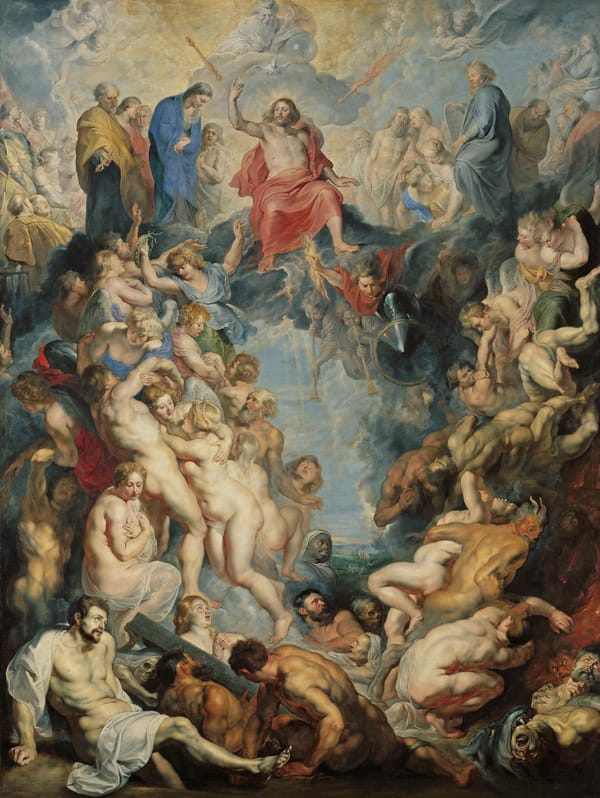
Peter Paul Rubens, The Great Last Judgement
Gold cross ornament
The Great Last Judgement, Peter Paul Rubens (1577–1640), c. 1617. Credits

The First Sunday of Advent

This Sunday, the first of the ecclesiastical year, is called, in the chronicles and charts of the middle ages, Ad te levavi Sunday, from the first words of the Introit; or, Aspiciens a longe, from the first words of one of the responsories of Matins.

The Station* is at St. Mary Major’s. It is under the auspices of Mary—in the splendid basilica which possesses the crib of Bethlehem, and is therefore called, in ancient documents, St. Mary’s ad Præsepe—that the Roman Church recommences, each year, the sacred cycle. It would have been impossible to select a place more suitable than this for saluting the approach of the divine birth, which is to gladden heaven and earth, and manifest the sublime portent of a Virgin Mother. Let us go in spirit to this august temple, and unite in the prayers which are there being offered up: they are the very ones we also use, and which we will now explain.

In the night Office, the Church commences the reading of the Book of Isaias, who, of all the Prophets, has the most distinctly and explicitly foretold the Messias; and she continues this same Book until Christmas day inclusively. Let us strive to enter into the teaching of the holy prophet, and let the eye of our faith affectionately recognize the promised Saviour in the descriptions, sometimes consoling and sometimes terrifying, under which Isaias depicts Him.

The first words of the Church, in the still midnight, are these:

Regem venturum Dominum, venite, adoremus.
Come, let us adore the King our Lord, who is to come.

This first duty of adoration complied with, let us listen to the oracle of the prophet Isaias, delivered to us by the holy Church.

Incipit liber Isaiæ Prophetæ.
Cap. i
Visio Isaiæ filii Amos, quam vidit super Judam et Jerusalem, in diebus Oziæ, Joathan, Achaz, et Ezechiæ regum Juda. Audite, cœli, et auribus percipe, terra; quoniam Dominus locutus est: Filios enutrivi et exaltavi: ipsi autem spreverunt me. Cognovit bos possessorem suum, et asinus præsepe Domini sui: Israel autem me non cognovit, et populus meus non intellexit. Væ genti peccatrici, populo gravi iniquitate, semini nequam, filiis sceleratis. Dereliquerunt Dominum, blasphemaverunt Sanctum Israel, abalienati sunt retrorsum. Super quo percutiam vos ultra, addentes praevaricationem? Omne caput languidum, et omne cor mærens. A planta pedis usque ad verticem non est in eo sanitas: vulnus, et livor et plaga tumens, non est circumligata, nec curata medicamine, neque fota oleo.
Beginning of the Book of the Prophet Isaias.
Ch. i.
The vision of Isaias, the son of Amos, which he saw concerning Juda and Jerusalem, in the days of Ozias, Joathan, Achaz, and Ezechias, kings of Juda. Hear, O ye heavens, and give ear, O earth, for the Lord hath spoken: I have brought up children, and exalted them: but they have despised me. The ox knoweth his owner, and the ass his master’s crib: but Israel hath not known me, and my people hath not understood. Woe to the sinful nation, a people laden with iniquity, a wicked seed, ungracious children. They have forsaken the Lord, they have blasphemed the holy One of Israel, they are gone away backwards. For what shall I strike you any more, you that increase transgression? The whole head is sick, and the whole heart is sad. From the sole of the foot unto the top of the head, there is no soundness therein; wounds, and bruises, and swelling sores; they are not bound up, nor dressed, nor fomented with oil.

These words of the holy prophet, or rather of God who speaks to us by the prophet, should make a deep impression on the children of the Church, at this opening of the holy period of Advent. Who could hear without trembling this voice of our Lord, who is despised and unknown even at the very time when He is coming to visit His people? Lest men should be terrified at the splendour of His majesty, He divested Himself of it; and far from acknowledging the divine power of Him who thus humbled Himself out of love to them, these men have refused even to know Him; and the crib where He lay after His birth, had, at first, but two dumb animals to honour or notice it. Do you feel, Christians, how just are the complaints which your God here makes? And how your indifference for all His love is an insult? He calls heaven and earth to witness; He utters anathema against the sinful nation, His ungrateful children. Let us honestly confess that we, too, have not known the value of our Jesus’ visit to us, and that we have but too faithfully imitated the obduracy of the Jews, who heeded not the bright light when it burst upon their darkness. In vain did the angels sing on that December night; in vain did shepherds receive and welcome the invitation to adore the Babe and know Him; in vain did the Magi come from the east, asking where they were to find the crib of the King that was born. At this last example, the city of Jerusalem was somewhat moved; but the astonishment was only for a moment, and the old indifference soon stifled the good tidings.

Thus it is, O Jesus, that Thou comest unto darkness, and darkness does not comprehend Thee. We beseech Thee, let our darkness comprehend the light, and desire it. The day will come when Thou wilt disperse the spiritual and voluntary darkness of men by the awful light of Thy justice. Thy glory, O sovereign Judge, will be magnificent on that day, and we love to think upon Thy having it: but during these days of our life on earth, deliver us from Thy wrath. We are one great wound from the sole of the foot unto the top of the head; Thou knowest not where to strike: be, then, a Saviour, O Jesus, in this coming, for which we are now preparing. The whole head is sick, and the whole heart is sad: come, and raise up this head which shame and vile passions bow down to the earth. Come, and comfort this heart oppressed with sin and fear. We confess it, our wounds are deep and sore; come, thou good Samaritan, pour in Thy soothing oil and heal them.

The whole world is in expectation of its Redeemer; come, dear Jesus, show Thyself to it by granting it salvation. The Church, Thy bride, is now commencing another year, and her first word is to Thee, a word which she speaks in the anxious solicitude of a mother for the safety of her children; she cries out to Thee, saying: ‘Come!’ No, we will go no farther in our journey through the desert of this life without Thee, O Jesus! Time is passing quickly away from us; our day is perhaps far spent, and the shades of our life’s night are fast coming on; arise, O divine Sun of justice. Come! guide our steps and save us from eternal death.


The Mass

Introit

While the priest is approaching the altar, there to offer up the holy sacrifice, the Church opens her chants by this beautiful one, which so well expresses her confidence as the beloved bride of Jesus. Let us repeat it together with her, and let the heart be in harmony with our voice, for the Saviour comes to each of us in proportion to the earnestness of our longing for Him.

Ad te levavi animam meam: Deus meus, in te confido, non erubescam; neque irrideant me inimici mei, etenim universi qui te exspectant non confundentur.
Ps. Vias tuas, Domine, demonstra mihi: et semitas tuas edoce me.℣. Gloria Patri, et Filio, et Spiritui sancto. Sicut erat in principio, et nunc, et semper, et in saecula saeculorum. Amen.Repeat: Ad te levavi.
To thee have I lifted up my soul: in thee, O my God, I put my trust, let me not be ashamed: neither let my enemies laugh at me: for none of them that wait on thee shall be confounded.
Ps. Show, O Lord, thy ways to me, and teach me thy paths.℣. Glory be to the Father, and to the Son, and to the Holy Ghost. As it was in the beginning, is now, and ever shall be, world without end. Amen.
Repeat: To thee.

Collect

After the Kyrie eleison, the priest embodies in the following prayers, called on that account the Collects, all the desires and petitions of the Church for this first Sunday:

Excita, quæsumus, Domine, potentiam tuam et veni; ut ab imminentibus peccatorum nostrorum periculis, te mereamur protegente eripi, te liberante salvari. Qui vivis et regnas, Deus, per omnia saecula sæculorum.
Exert, we beseech thee, O Lord, thy power and come; that by thy protection we may be freed from the imminent dangers of our sins, and be saved by thy mercy; who livest and reignest God, world without end.

In honor of the Blessed Virgin Mary

It is right that we should also beg, during this holy season, the all-powerful mediation of her who, at first, was the sole depositary of the great secret which was to give life to the world. Let us then say with the priest:

Deus, qui de beatæ Mariæ Virginis utero, Verbum tuum, angelo nuntiante, carnem suscipere voluisti; præsta supplicibus tuis, ut qui vere eam Genitricem Dei credimus, ejus apud te intercessionibus adjuvemur.
O God, who wast pleased that thy Word, when the angel delivered his message, should take flesh in the womb of the blessed Virgin Mary; give ear to our humble petitions, and grant that we who believe her to be truly the Mother of God, may be helped by her prayers.

To this is immediately added one of the following prayers:

Against the persecutors of the Church

Ecclesiae tuæ, quæsumus, Domine, preces placatus admitte: ut, destructis adversitatibus et erroribus universis, secura tibi serviat libertate. Per Dominum.
Mercifully hear, we beseech thee, O Lord, the prayers of the Church: that, all oppositions and errors being removed, she may serve thee with a secure liberty. Through, &c.

For the Pope

Deus, omnium fidelium Pastor et Rector, famulum tuum Leonem quem pastorem Ecclesiæ tuæ præesse voluisti, propitius respice: da ei, quæsumus, verbo et exemplo, quibus præest, proficere: ut ad vitam, una cum grege sibi credito, perveniat sompiternam. Per Dominum.
O God, the Pastor and Ruler of all the faithful, look down, in thy mercy, on thy servant Leo, whom thou hast appointed Pastor over thy Church; and grant, we beseech thee, that both by word and example, he may edify all those that are under his charge; and with the flock entrusted to him, arrive at length at eternal happiness. Through, &c.

Epistle

Lectio Epistolæ beati Pauli Apostoli ad Romanos.
Cap. xiii.
Fratres, scientes quia hora est jam nos de somno surgere. Nunc enim propior est nostra salus, quam cum credidimus. Nox præcessit, dies autem appropinquavit. Abjiciamus ergo opera tenebrarum, et induamur arma lucis. Sicut in die honeste ambulemus: non in comessationibus et ebrietatibus, non in cubilibus et impudicitiis, non in contentione et æmulatione: sed induimini Dominum Jesum Christum.
Lesson of the Epistle of St. Paul the Apostle to the Romans.
Ch. xiii.
Brethren, know that it is now the hour for us to rise from sleep. For now our salvation is nearer than when we believed. The night is passed, and the day is at hand. Let us therefore east off the works of darkness, and put on the armour of light. Let us walk honestly, as in the day: not in rioting and drunkenness, not in chambering and impurities, not in contention and envy: but put ye on the Lord Jesus Christ.

The Saviour, then, who is coming to us is the clothing which we are to put on over our spiritual nakedness. Here let us admire the goodness of our God, who, remembering that man hid himself after his sin, because he was naked, vouchsafes Himself to become man’s clothing, and to cover with the robe of His Divinity the misery of human nature. Let us, therefore, be on the watch for the day and the hour when He will come to us, and take precautions against the drowsiness which comes of custom and self-indulgence. The light will soon appear; may its first rays be witness of our innocence, or at least of our repentance. If our Saviour is coming to put over our sins a covering which is to hide them for ever, the least that we, on our part, can do, is to retain no further affection for those sins, else it will be said of us that we refused our salvation. The last words of this Epistle are those which caught the eye of St. Augustine, when, after a long resistance to the grace which pressed him to give himself to God, he resolved to obey the voice which said to him: ‘Tolle lege; take and read.’ They decided his conversion; he immediately resolved to abandon the worldly life he had hitherto led, and to put on Christ Jesus. Let us begin this very day, and imitate this saint. Let us long for that dear and glorious clothing with which the mercy of our heavenly Father is so soon to cover us; and let us say with the Church these touching words, which we cannot repeat too often during this time of the year:

Gradual

Universi qui te exspectant, non confundentur, Domine.℣. Vias tuas, Domine, notas fac mihi: et semitas tuas edoce me. Alleluia, alleluia.℣. Ostende nobis, Domine, misericordiam tuam: et salutare tuum da nobis. Alleluia.
None of them that wait on thee shall be confounded, O Lord.℣. Show, O Lord, thy ways to me: and teach me thy paths. Alleluia, alleluia.℣. Show us, O Lord, thy mercy: and grant us thy salvation. Alleluia.

Gospel

Sequentia sancti Evangelii secundum Lucam.
Cap. xxi.
In illo tempore: Dixit Jesus discipulis suis: Erunt signa in sole, et luna, et stellis; et in terris pressura gentium præ confusione sonitus maris et fluctuum: arescentibus hominibus præ timore et exspectatione, quæ supervenient universo orbi: nam virtutes cœlorum movebuntur; et tunc videbunt Filium hominis venientem in nube cum potestate magna et majestate. His autem fieri incipientibus, respicite et levate capita vestra; quoniam appropinquat redemptio vestra. Et dixit illis similitudinem: Videte ficulneam, et omnes arbores: cum producunt jam ex se fructum, scitis quoniam prope est aestas. Ita et vos cum videritis hæc fleri, scitote quoniam prope est regnum Dei. Amen dico vobis: quia non praeteribit generatio hæc, donec omnia fiant. Cœlum et terra transibunt: verba autem mea non transibunt.
Sequel of the holy Gospel according to Luke.
Ch. xxi.
At that time: Jesus said to his disciples: There shall be signs in the sun, and in the moon, and in the stars; and upon the earth distress of nations, by reason of the confusion of the roaring of the sea, and of the waves; men withering away for fear, and expectation of what shall come upon the whole world: for the powers of the heavens shall be moved; and then they shall see the Son of Man coming in a cloud with great power and majesty. But when these things begin to come to pass look up, and lift up your heads; because your redemption is at hand. And he spoke to them a similitude: See the fig-tree and all the trees; when they now shoot forth their fruit, you know that summer is nigh. So you also, when you shall see these things come to pass, know that the kingdom of God is at hand. Amen, I say to you, this generation shall not pass away till all things be fulfilled. Heaven and earth shall pass away; but my words shall not pass away.

Thou art to come, then, O Jesus, in all the terror of the last judgement, and when men least expect Thee. In a few days Thou art coming to us to clothe our misery with the garment of Thy mercy; a garment of glory and immortality to us; but Thou art to come again on a future day, and in such dread majesty that men will wither away with fear. O my Saviour! condemn me not on that day of the world’s destruction. Visit me now in Thy love and mercy; I am resolved to prepare my soul. I desire that Thou shouldst come and be born within me, so that when the convulsions of nature warn me of Thy coming to judge me, I may lift up my head as Thou biddest Thy faithful disciples do, who, when the rest of men shall tremble at the thunder of Thy judgement, will have confidence in Thee, because they have Thee in their hearts.

Offertory

During the offering of the bread and wine, the Church, with her look steadfastly fixed on Him who is to come, keeps to her sweet canticle:

Ad te levavi animam meam: Deus meus, in te confido, non erubescam; neque irrideant me inimici mei: etenim universi, qui te exspectant, non confundentur.
To thee, O Lord, have I lifted up my soul: in thee, O my God, I put my trust, let me not be ashamed; neither let my enemies laugh at me: for none of them that wait on thee shall be confounded.

Secret

After the oblation, she silently presents to God the petitions of all her children by the following prayers:

Hæc sacra nos, Domine, potenti virtute mundatos, ad suum faciant puriores venire principium. Per Dominum.
Grant, O Lord, that these sacred mysteries may cleanse us by their powerful virtue, and bring us with greater purity to him, who was the author and institutor of them. Through, &c.

In honor of the Blessed Virgin

In mentibus nostris, quæsumus, Domine, veræ fidei sacramenta confirma; ut qui conceptum de Virgine Deum verum et hominem confitemur, per ejus salutiferae Resurrectionis potentiam, ad æternam mercamur pervenire lætitiam.
Strengthen, we beseech thee, O Lord, in our souls the mysteries of the true faith: that we who confess him that was conceived of a Virgin, to be true God and true man, may, by the power of his saving Resurrection, deserve to come to eternal joys.

Against the Persecutors of the Church

Protege nos, Domine, tuis mysteriis servientes; ut divinis rebus inhærentcs, et corpore tibi famulemur et mente. Per Dominum.
Protect us, O Lord, while we assist at thy sacred mysteries: that being employed in acts of religion, we may serve thee both in body and mind. Through, &c.

For the Pope

Oblatis, quæsumus, Domine, placare muneribus: et famulum tuum Leonem quem Pastorem Ecclesiæ tuæ præesse voluisti, assidua protectione guberna. Per Dominum.
Be appeased, O Lord, with the offering we have made: and cease not to protect thy servant Leo, whom thou hast been pleased to appoint Pastor over thy Church. Through, &c.

Communion

After the Communion of the priest and people, the choir sings these beautiful words of David in praise of the sweetness of the divine Fruit, whom our earth is going to bring forth, and who has just given Himself, by anticipation, to His faithful servants. This earth, which is ours, and which, as the prophet Isaias says, opens and buds forth the Saviour, is the blessed Virgin Mary made fruitful by the dew of heaven.

Dominus dabit benignitatem: et terra nostra dabit fructum suum.
The Lord will give his goodness: and our earth shall yield her fruit.

Postcommunion

Then follow the concluding prayers of thanksgiving.

Suscipiamus, Domine, misericordiam tuam in medio templi tui: ut reparationis nostræ ventura solemnia congruis honoribus præcedamus. Per Dominum.
May we receive, O Lord, thy mercy in the midst of thy temple: that with due honour we may prepare for the approaching solemnity of our reparation. Through, &c.

In honor of the Blessed Virgin

Gratiam tuam, quæsumus, Domine, mentibus nostris infunde, ut qui, angelo nuntiante, Christi Filii tui Incarnationem cognovimus, per Passionem ejus et crucem ad Resurrectionis gloriam perducamur.

Pour forth, we beseech thee, O Lord, thy grace into our hearts, that we to whom the Incarnation of Christ thy Son was made known by the message of an angel, may, by his Passion and cross, be brought to the glory of his Resurrection.

Against the Persecutors of the Church

Quæsumus, Domine Deus noster: ut quos divina tribuis participatione gaudere, humanis non sinas subjacere periculis.
We beseech thee, O Lord our God, not to leave exposed to the dangers of human life those whom thou hast permitted to partake of these.

For the Pope

Hæc nos, quæsumus Domine, divini sacramenti perceptio protegat: et famulum tuum Leonem quem Pastorem Ecclesiæ tuæ præesse voluisti, una cum commisso sibi grege salvet semper et muniat. Per Dominum.
May the participation of this divine Sacrament protect us, we beseech thee, O Lord; and always procure safety and defence to thy servant Leo, whom thou hast appointed Pastor over thy Church, together with the flock committed to his charge. Through, &c.

Vespers

The psalms of the Sunday are given above, page 101. The choir chants, with each psalm, one of the five following antiphons:

1. Ant. In illa die stillabunt montes dulcedinem, et colles fluent lac et mel, alleluia.
2. Ant. Jucundare filia Sion, et exsulta satis, filia Jerusalem, alleluia.
3. Ant. Ecce Dominus veniet, et omnes sancti ejus eum eo: et erit in die illa lux magna, alleluia.
4. Ant. Omnes sitientes, venite ad aquas: quaerite Dominum, dum inveniri potest, alleluia.
5. Ant. Ecce veniet Propheta magnus, et ipse renovabit Jerusalem, alleluia.
1. Ant. On that day the mountains shall drop sweetness, and the hills shall flow with milk and honey, alleluia.
2. Ant. Be glad, O daughter of Sion; and rejoice exceedingly, O daughter of Jerusalem, alleluia.
3. Ant. Behold the Lord will come, and all his saints with him: and there shall be a great light on that day, alleluia.
4. Ant. O all you that thirst, come to the waters: seek the Lord, while he may be found, alleluia.
5. Ant. Behold the great Prophet will come, and he himself will renew Jerusalem, alleluia.

Chapter

Rom. xiii. 11.

Fratres, hora est jam nos de somno surgere. Nunc enim propior est nostra salus, quam cum credidimus.
Brethren, it is now the hour for us to rise from sleep. For now our salvation is nearer than when we believed.

The hymn, Creator alme siderum, the verse Rorate and the canticle Magnificat, are given on pages 107 and 109.


Antiphon of the Magnificat

Ne timeas, Maria; invenisti enim gratiam apud Dominum: ecce concipies, et paries Filium, alleluia.
Fear not, Mary; for thou hast found favour with the Lord: behold thou shalt conceive, and bring forth a Son, alleluia.

Collect

Excita, quæsumus, Domine, potentiam tuam et veni: ut ab imminentibus peccatorum nostrorum periculis, te mereamur protegente eripi, te liberante salvari. Qui vivis et regnas cum Deo Patre in unitate Spiritus sancti Deus, per omnia sæcula sæculorum. ℟. Amen.
Exert, we beseech thee, O Lord, thy power and come; that by thy protection we may be freed from the imminent dangers of our sins, and be saved by thy mercy. Who livest and reignest with God the Father, in the unity of the Holy Ghost, God, world without end. ℟. Amen.

* The Stations marked in the Roman missal for certain days in the year, were formerly processions, in which the whole clergy and people went to some given church, and there celebrated the Office and Mass. This usage, which dates from the earliest period of the Roman Church, and of which St. Gregory the Great was but the restorer, still exists, at least in a measure; for the Stations are still observed, though with less solemnity and concourse of people, on all the days specified in the missal. ↩︎


November 30: Saint Andrew, Apostle (at the beginning of the year)

Gold cross ornament
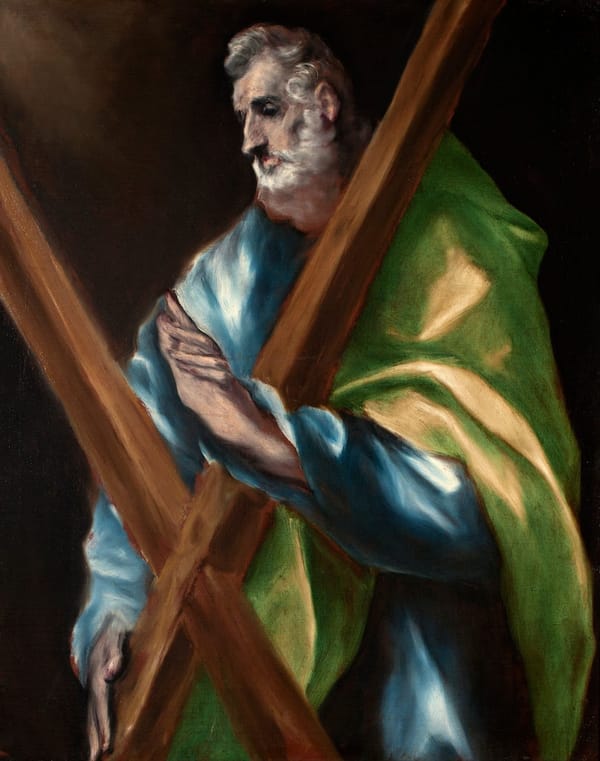
Saint Andrew
Gold cross ornament
Saint Andrew, El Greco (1541–1614), c. 1610. Credits

We open our Proper of Saints for Advent with St. Andrew, because, although his feast frequently occurs before this holy season has begun, it sometimes happens that we have entered Advent when the memory of this great apostle has to be celebrated by the Church. This feast is therefore destined to terminate with solemnity the cycle which is at its close, or to add lustre to the new one which has just begun. It seems, indeed, fitting that the Christian year should begin and end with the cross, which has merited for us each of the years that it has pleased the divine goodness to grant us, and which is to appear, on the last day, in the clouds of heaven, as the seal put on time.

We should remember that Saint Andrew is the apostle of the cross. To Peter, Jesus has given firmness of faith; to John, warmth of love; the mission of Andrew is to represent the cross of his divine Master. Now it is by these three, faith, love, and the cross, that the Church renders herself worthy of her Spouse. Everything she has or is, bears this threefold character. Hence it is that after the two apostles just named, there is none who holds such a prominent place in the universal liturgy as Saint Andrew.

But let us read the life of this glorious fisherman of the lake of Genesareth, who was afterwards to be the successor of Christ Himself, and the companion of Peter, on the tree of the cross. The Church has compiled it from the ancient Acts of the martyrdom of the holy apostle, drawn up by the priests of the Church of Patras, which was founded by the saint. The authenticity of this venerable piece has been contested by Protestants, inasmuch as it makes mention of several things which would militate against them. Their sentiment has been adopted by several critics of the seventeenth and eighteenth centuries. On the other hand, these Acts have been received by a far greater number of Catholic writers of eminence; amongst whom may be mentioned the great Baronius, Labbe, Natalis Alexander, Gallandus, Lumper, Morcelli, &c. The Churches, too, of both east and west, which have inserted these Acts in their respective Offices of St. Andrew, are of some authority, as is also St. Bernard, who has made them the groundwork of his three admirable sermons on St. Andrew.

Andreas apostolus Bethsaidæ natus, qui est Galilææ vicus, frater Petri, discipulus Joannis Baptistae, quum eum de Christo dicentem audisset, Ecce Agnus Dei, secutus Jesum, fratrem quoque suum ad eumdem perduxit. Quum postea una cum fratre piscaretur in mari Galilææ, ambo a praetereunto Christo Domino ante alios apostolos vocati illis verbis: Venite post me, faciam vos fieri piscatores hominum: nullam interponentes moram, et relictis retibus secuti sunt eum. Post cujus Passionem et Resurrectionem Andreas cum in Scythiam Europæ, quæ ei provincia ad Christi fidem disseminandam obtigerat, venisset, deinde Epirum ac Thraciam peragrasset, doctrina et miraculis innumerabiles homines ad Christum convertit. Post Patras Achaiæ profectus, et in ea urbe plurimis ad veritatem Evangelicam perductis, Ægeam proconsulem prædicationi Evangeliæ resistentem, liberrime increpavit quod qui judex hominum haberi vellet, Christum Deum omnium Judicem a dæmonibus elusus non agnosceret.
Tunc Ægeas iratus: Desine, inquit, Christum jactare, cui similia verba nihil profuerunt, quominus a Judæis crucifigeretur. Andream vero do Christo nihilominus libere praedicantem, quod pro salute humani generis se crucifigendum obtulisset, impia oratione interpellat; ac demum hortatur, ut sibi consulens, diis velit immolare. Cui Andreas: Ego omnipotenti Deo, qui unus et verus est, immolo quotidie, non taurorum carnes, nec hircorum sanguinem, sed immaculatum Agnum in altari, cujus carnem posteaquam omnis populus credentium manducaverit, Agnus, qui sacrificatus est, integer perseverat et vivus. Quamobrem ira accensus Ægeas jubet eum in carcerem detrudi: unde populus Andream facile liberasset, nisi ipse sedasset multitudinem; vehementius rogans, ne se ad optatissimam martyrii coronam properantem impedirent.
Igitur paulo post in tribunal productum, cum Ægeas crucis extollentem mysteria, sibique suam impietatem exprobrantem diutius ferre non posset, in crucem tolli, et Christi mortem imitari jussit. Adduotus Andreas ad locum martyrii, cum crucem vidisset longe, exclamare cœpit: O bona crux, quæ decorem ex membris Domini suscepisti, diu desiderata, sollicite amata, sine intermissione quaesita, et aliquando cupienti animo praeparata: accipe me ab hominibus, et redde me magistro meo; ut per te me recipiat, qui per te me redemit. Itaque cruci affixus est: in qua biduum vivus pendens, et Christi fidem prædicare numquam intermittens, ad eum migravit, cujus mortis similitudinem concupierat. Quæ omnia presbyteri et diaconi Achaiæ qui ejus passionem scripserunt, se ita ut commemorata sunt audisse et vidisse testantur. Ejus ossa primum Constantio imperatore Constantinopolim, deinde Amalphim translata sunt. Caput, Fio secundo Pontifice, Romam allatum, in basilica sancti Petri collocatum est.
Andrew, the apostle, born at Bethsaida, a town of Galilee, was brother of Peter, and disciple of John the Baptist. Having heard his master say, speaking of Christ: Behold the Lamb of God! he followed Jesus, and brought to him his brother also. When, afterwards, he was fishing with his brother in the sea of Galilee, they were both called, before any of the other apostles, by our Lord, who, passing by, said to them: Come after me; I will make you to be fishers of men. Without delay, they left their nets and followed him. After the Passion and Resurrection, Andrew went to spread the faith of Christ in Scythia in Europe, which was the province assigned to him; then he travelled through Epirus and Thrace, and by his teaching and miracles converted innumerable souls to Christ. Afterwards, having reached Patras in Achaia, he persuaded many in that city to embrace the truth of the Gospel. Finding that the proconsul Ægeas resisted the preaching of the Gospel, he most freely upbraided him for that he, who desired to be considered as a judge of men, should be so far deceived by devils as not to acknowledge Christ to bo God, the Judge of all.
Then Ægeas being angry, said: Cease to boast of this Christ, whom such words as these kept not from being crucified by the Jews. But finding that Andrew continued boldly preaching that Christ had offered himself to be crucified for the salvation of mankind, he interrupts him by an impious speech, and at length exhorts him to look to his own interest and sacrifice to the gods. Andrew answered him: I offer up every day to almighty God, who is one and true, not the flesh of oxen, nor the blood of goats, but the spotless Lamb upon the altar; of whose flesh the whole multitude of the faithful eat, and the Lamb that is sacrificed, remains whole and living. Whereupon Ægeas being exceedingly angry, orders him to be thrust into prison, whence the people would easily have freed Andrew, had he not himself appeased the multitude, begging of them, with most earnest entreaty, that they would not keep him from the long-desired crown of martyrdom, to which he was hastening.
Not long after this, he was brought before the tribunal; where he began to extol the mystery of the cross, and rebuke the judge for his impiety. Ægeas, no longer able to contain himself on hearing these words, ordered him to be hoisted on a cross, and so to die like Christ. Andrew, having been brought to the place of execution, seeing the cross at some distance, began to cry out: O good cross, made beautiful by the body of my Lord! so long desired, so anxiously loved, so unceasingly sought after, and now at last ready for my soul to enjoy! take me from amidst men, and restore me to my Master; that by thee he may receive me, who by thee redeemed me. He was therefore fastened to the cross, on which he hung alive two days, preaching without cessation the faith of Christ: after which he passed to him, whose death he had so coveted. The priests and deacons of Achaia, who wrote his passion, attest that all the things which they have recorded were heard and seen by them. His relics were first translated to Constantinople under the emperor Constantius, and afterwards to Amalfi. During the Pontificate of Pius II., the head was taken to Rome, and placed in the basilica of St. Peter.

Let us now listen to the several Churches on earth, celebrating the grand triumph of our apostle. Let us begin with Rome, the mother and mistress of all Churches. Nothing could be more expressive than the language she uses in praise of the apostle of the cross. First, she employs the words of the Gospel, which record the circumstances of his vocation; then, she selects the most touching passages from the Acts of his martyrdom, drawn up by the priests of Patras; and both are intermingled with appropriate sentiments of her own. Our first selection shall be from the responsories of Matins.

℟. Cum perambularet Dominus juxta mare Galilææ, vidit Petrum et Andream retia mittentes in mare: et vocavit eos, dicens:* Venite post me, faciam vos fieri piscatores hominum.℣. Erant enim piscatores, et ait illis:* Venite post me, faciam vos fieri piscatores hominum.
℟. When the Lord was walking by the sea of Galilee, he saw Peter and Andrew casting nets into the sea, and he called them, saying:* Come after me, I will make you to be fishers of men.℣. For they were fishers, and he saith to them:* Come after me, I will make you to be fishers of men.
℟. Mox ut vocem Domini prædicantis audivit beatus Andreas, relictis retibus, quorum usu actuque vivebat,* Æternæ vitæ secutus est præmia largientem.℣. Hic est qui pro amore Christi pependit in cruce, et pro lege ejus sustinuit passionem.* Æternæ vitae secutus est præmia largientem.
℟. As soon as blessed Andrew heard the voice of the Lord calling him, leaving his nets, by the use and working of which he lived,* He followed him who gives the reward of eternal life.℣. This is he who, for the love of Christ, hung upon a cross, and for his law endured a passion.* He followed him who gives the reward of eternal life.
℟. Doctor bonus, et amicus Dei Andreas ducitur ad crucem; quam a longe aspiciens dixit: Salve, crux!* Suscipe discipulum ejus, qui pependit in te, magister meus Christus.℣. Salve, crux, quæ in corpore Christi dedicata es; et ex membris ejus tamquam margaritis ornata.* Suscipe discipulum ejus qui pependit in te, magister meus Christus.
℟. Andrew, the good teacher, and the friend of God, is led to the cross; which seeing afar off, he says: Hail, O cross!* Receive the disciple of him who hung upon thee, Christ, my Master.℣. Hail, O cross, which art consecrated by the body of Christ, and art adorned by his members, as with pearls.* Receive the disciple of him who hung upon thee, Christ, my Master.
℟. Videns crucem Andreas exclamavit, dicens: O crux admirabilis! O crux desiderabilis! O crux quae por totum mundum rutilas!* Suscipe discipulum Christi, ac per te me recipiat, qui per te moriens me redemit.℣. O bona crux, quæ decorem et pulchritudinem de membris Domini suscepisti.* Suscipe discipulum Christi, ac per te me recipiat, qui per te moriens me redemit.
℟. Andrew seeing the cross, cried out, saying: O admirable cross; O desirable cross! O cross which shinest throughout the whole world!* Receive the disciple of Christ, and by thee may he receive me, who dying by thee redeemed me.℣. O good cross, which art made fair and beautiful by the body of the Lord.* Receive the disciple of Christ, and by thee may he receive me, who dying by thee redeemed me.
℟. Oravit sanctus Andreas, dum respiceret in cœlum, et voce magna clamavit et dixit: Tu es Deus meus, quem vidi: ne me patiaris ab impio judico deponi:* Quia virtutem sanctæ crucis agnovi.℣. Tu os magister meus Christus, quem dilcxi, quem cognovi, quem confessus sum: tantummodo in ista voce, exaudi me.* Quia virtutem sanctæ crucis agnovi.
℟. Saint Andrew prayed, as he looked up to heaven, and with a loud voice, cried out and said: Thou art my God, whom I have seen: suffer me not to be detached by the impious judge:* For I have learnt the power of the holy cross.℣. Thou art the Christ my master, whom I have loved, whom I have known, whom I have confessed: graciously hear me in this one prayer.* For I have learnt the power of the holy cross.

The antiphons of Vespers are full of a lyric gracefulness and unction.

Antiphons

Salve crux pretiosa! suscipe discipulum ejus qui pepondit in te, magister meus Christus.
Beatus Andreas orabat, dicens: Domine, Rex æternæ gloriæ, suscipe me pendentem in patibulo.
Andreas Christi famulus, dignus Dei apostolus, germanus Petri, et in passione socius.
Maximilla Christo amabilis, tulit corpus apostoli, optimo loco cum aromatibus sepelivit.
Qui persequebantur justum, demersisti eos, Domine, in inferno, et in ligno crucis dux justi fuisti.
Hail, O precious cross! receive the disciple of him who hung upon thee, Christ my master.
The blessed Andrew prayed saying: O Lord, King of eternal glory, receive me hanging on this gibbet.
Andrew, the servant of Christ, the worthy apostle of God, the brother of Peter, and his companion in the cross.
Maximilla, a woman dear to Christ, took the body of the apostle, and embalming it, buried it in a most honoured place.
Thou, O Lord, didst plunge into hell them that persecuted thy just one, and wast his guide and helper on the wood of the cross.

The following hymn was composed in honour of the holy apostle, by Pope St. Damasus, the friend of St. Jerome. There is an allusion in it to the name Andrew, which amongst its many meanings has that of beauty.

Hymn

Decus sacrati nominis,
Vitamque nomen exprimens,
Hoc to decorum prædicat
Crucis beatæ gloria.
Andrea, Christi apostolo,
Hoc ipso jam vocabulo
Signaris, isto nomine
Decorus idem mystice.
Quem crux ad alta provehit,
Crux quem beata diligit,
Cui crux amara præparat
Lucis futurae gaudia.
In te crucis mysterium
Cluit gemello stigmate,
Dum probra vincis per crucem,
Crucisque pandis sanguinem.
Jam nos foveto languidos,
Curamque nostri suscipe,
Quo por crucis victoriam
Cœli potamus patriam.
Amen.
The beauty of thy sacred name,
expressive of thy life,
declares how beautiful thou art
in the glory of thy blessed cross.
Andrew, apostle of Christ,
thy very name
points to the mystic
beauty of thy soul.
The cross exalts thee,
the blessed cross loves thee,
the bitter cross prepares for thee
the joys of the light to come.
The mystery of the cross
shines in thee with a twofold beauty:
for by the cross thou dost vanquish insults,
and thou preachest to men the divine blood shed on the cross.
Then warm up our languid hearts,
and take us under thy care;
that so, by the victory of the cross,
we may reach our heavenly country.
Amen.

The two following sequences, in honour of the apostle of the cross, were written in the middle ages. The first belongs to the eleventh century. Like all the sequences of that period, it has no regular rhythm.

Sequence

Sacrosancta hodiernae festivitatis praeconia,
Digna laude universa categorizet Ecclesia.
Mitissimi sanctorum sanctissima extollenda merita,
Apostoli Andreæ, admiranda praefulgentis gratia.
Hic accepto a Joanne Baptista quod venisset qui tolleret peccata:
Mox ejus intrans habitacula, audiebat eloquia.
Inventoque fratre suo Barjona: Invenimus, ait ovans, Messiam.
Et duxit eum ad dulcifluam Salvatoris presentiam.
Hunc perscrutantem maria, Christi vocavit clementia.
Artem piscandi commutans dignitate apostolica.
Hujus animam post clara festi Paschalis gaudia,
Sancti Spiritus præclara perlustravit potentia;
Ad prædicandum populis pœnitentiam, et Dei Patris per Filium clementiam.
Gratulare ergo tanto patre, Achaia;
Illustrata ejus salutari doctrina;
Honorata multimoda signorum frequentia.
Et tu gemens plora, trux carnifex Ægea.
Te lues inferna et mors tenet æterna.
Sed Andream felicia per crucem manent gaudia.
Jam Regem tuum spectas, jam in ejus conspectu, Andrea, stas.
Odorem suavitatis jam adspiras, quem divini amoris aroma dat.
Sis ergo nobis inclyta dulcedo, spirans intima cœlestis vitæ balsama.
Amen.
The most holy praises of this day’s solemnity,
Let the universal Church sing in worthy strains.
The most holy merit of the meekest of saints is to be extolled,
Of the apostle Andrew, so bright in his admirable graces.
Having learned from John the Baptist, that he had come who would take sin away,
He straightway entered his dwelling, and listened to his words;
And finding his own brother, Barjona, he said to him with great joy: We have found the Messias.
And he led him to the loved presence of the Saviour.
As Andrew was fishing in the sea, the mercy of Christ called him,
Giving him, in exchange for his art of fishing, the dignity of an apostle.
His soul, after the grand joys of the Paschal feast,
Was visited by the glorious power of the Holy Ghost,
That he might go and preach penance to the world, and tell it of the mercy of the Father by the Son.
Rejoice, then, O Achaia! that thou hast such an apostle,
Who enlightened thee with his saving doctrine,
And honoured thee with his many and manifold miracles.
But thou fierce torturer, Ægeas, cry and weep:
The pains of hell and eternal death are thine:
Whilst Andrew has won happiness and joy by his cross.
O Andrew! now thou seest thy King: now thou art in his presence;
Now thou art breathing the odour of sweetness, which comes from the aroma of divine love.
Be, then, unto us a delicious sweetness, giving out the hidden balsam of the celestial life.
Amen.

The second sequence, written in rhythm and correct metre, is the composition of the pious Adam of Saint Victor, the greatest lyric poet of the middle ages.

Sequence

Exsultemus et lætemur:
Et Andreae delectemur
Laudibus apostoli.
Hujus fidem, dogma, mores,
Et pro Christo tot labores,
Digne decet recoli.
Hic ad fidem Petrum duxit,
Cui primum lux illuxit,
Joannis indicio.
Secus mare Galilaeæ,
Petri simul et Andreæ
Sequitur electio.
Ambo prius piscatores,
Verbi fiunt assertores,
Et forma justitiæ.
Rete laxant in capturam;
Vigilemque gerunt curam
Nascentis Ecclesiæ.
A fratre dividitur,
Et in partes mittitur
Andreas Achaiæ.
In Andreæ retia
Currit, Dei gratia,
Magna pars provinciæ.
Fide, vita, verbo, signis,
Doctor pius et insignis
Cor informat populi.
Ut Ægeas comperit
Quid Andreas egerit,
Iræ surgunt stimuli.
Mens secura, mens virilis,
Cui præsens vita vilis,
Viget patientia.
Blandimentis aut tormentis
Non enervat robur mentis
Judicis insania.
Crucem videns præparari,
Suo gestit conformari
Magistro discipulus.
Mors pro morte solvitur,
Et crucis appetitur
Triumphalis titulus.
In cruce vixit biduum,
Victurus in perpetuum:
Neo vult volente populo
Deponi de patibulo.
Hora fere dimidia,
Luce perfusus nimia,
Cum luce, cum lætitia,
Pergit ad lucis atria.
O Andrea gloriose,
Cujus preces pretiosæ,
Cujus mortis luminosae
Dulcis est memoria,
Ab hac valle lacrymarum,
Nos ad illud lumen clarum,
Pie pastor animarum,
Tua transfer gratia.
Amen.
Let us exult and rejoice,
and be delighted in the praises
sung to Andrew the apostle.
His faith and teachings, and actions,
and all his labours for Christ,
deserve a worthy celebration.
’Twas he led Peter to the faith.
’Twas he on whom the light first shone;
the Baptist showed it him.
Near the sea of Galilee,
our Lord called Peter and Andrew
by the one same election.
They who were once fishermen,
are become heralds of the Word,
and models of every virtue.
They let down their nets for a draught of men;
and carefully watch over
the infant Church.
Andrew is separated
from his brother, and sent
into the country about Achaia.
A great portion of that province enters,
by the grace of God,
into Andrew’s net.
The holy and learned doctor
forms the hearts of his people
by his faith, life, preaching, and miracles.
When Ægeas discovered
what Andrew had done,
he was excited to great anger.
But Andrew’s mind, ever calm and manly,
set little value on this life,
and armed itself with patience.
The senseless judge offers him his favour,
or threatens him with tortures,
but cannot shake his constant soul.
Seeing the cross being prepared,
Andrew, as a true disciple, is proud
to be thus made like his Master.
He repays the death of Jesus by his own,
ambitious to have
the trophy of triumph, the cross.
He lived two days hanging on that cross,
which was to make him live for ever;
the people resolve to loose him from it:
but he would not have it so; and clings to his cross.
An exceeding bright light surrounds him
for nearly half an hour;
and then, in this light, and in this joy,
he mounts to the realms of light.
O glorious Andrew,
whose prayers are so precious,
and whose bright death
is so sweet to think on,
Take us, by thy loving prayers,
from this vale of tears,
and transfer us to that fair land of light,
O thou good shepherd of souls.
Amen.

The pieces so far given belong to the Roman liturgy, being taken from the books of this mother of Churches, or from those of the different Churches of the west, which follow the form of her Offices. We will now give, in honour of our holy apostle, some of the formulæ which the other ancient liturgies used for his feast; we will begin with the Ambrosian rite, from which we take the following beautiful preface.

Preface

Vere dignum et justum est, æquum et salutare, nos tibi semper et ubique gratias agere, Domine sancte, Pater omnipotens, æterne Deus. Adest enim nobis dies sacri votiva mysterii: qua beatus Andreas germanum se Petri apostoli tam prædicatione Christi tui, quam confessione monstravit; et apostolicæ numerum dignitatissimul passione supplevit et gloria; ut id, quod libera prædicaverat voce, nec pendens taceret in cruce: auctoremque vitae perennis tam in hac vita sequi, quam in mortis genere meruit imitari: ut cujus præcepto terrena in semetipso crucifixerat desideria, ejus exemplo ipse patibulo figeretur. Utrique igitur germani piscatores, ambo cruce elevantur ad cœlum; ut, quos in hujus vitae cursu tua gratia tot vinculis pietatis constrinxerat, hos similis in regno cœlorum necteret et corona: et quibus erat una causa certaminis, una retributio esset et praemii.
It is truly meet and just, right and available to salvation, that we should always, and in all places, give thanks to thee, O holy Lord, almighty Father, eternal God; for we are keeping the feast of a sacred mystery, a day on which the blessed Andrew showed himself to be indeed the brother of Peter the apostle, both by his preaching and his confession of thy Christ: and filled up the measure of the apostolic dignity by his passion and his glory; for what he had loudly and boldly preached, he would not cease to proclaim even on his cross: and he deserved to follow, during life, the author of eternal life, and to imitate him in the manner of his death; that thus having, in obedience to his precept, crucified in himself all earthly desires, he might, in accordance with his example, be fastened to a cross. The two brothers, the two fishermen, are both, therefore, raised up to heaven by a cross; that so, having been, by thy grace, bound together by so many ties during this life, they might also be like each other by the crown they wear in heaven; and as their combat was the same, their reward might be the same.

The Gallican liturgy also celebrated the glories of St. Andrew. Amongst the few fragments which have been handed down to us of this liturgy, there is not a single piece in poetry. The following preface, or, as it was then called, Contestation, will show that the Church of Gaul, from the fourth to the eighth century, shared the enthusiasm of the Roman and Ambrosian Churches for the glorious apostle of the cross.

Contestation

Dignum et justum est; æquum et justum est; piotati tuæ ineffabiles gratias referre, omnipotens sempiterne Deus; et inæstimabili gaudio passionem tuorum prædicare sanctorum, per Christum Dominum nostrum. Qui beato Andreæ in prima vocatione dedit fidem; et in passione donavit victoriam. Acceperat hæc utraque beatus Andreas; ideo habebat et in prædicatione constantiam, et in passione tolerantiam. Qui post iniqua verbera, post carceris septa, alligatus suspendio se purum sacrificium tibi obtulit Deo. Extendit mitissimus brachia ad cœlos; amplectitur crucis vexillum; defigit in osculis ora: Agni cognoscit arcana. Denique dum ad patibulum duceretur, in cruce suspenderetur, carne patiebatur, et Spiritu loquebatur. Obliviscitur crucis tormenta; dum de cruce Christum præconat. Quantum enim corpus ejus in ligno extendebatur: tantum in lingua ejus Christus exaltabatur: quia pendens in ligno, sociari se ei gratulabatur. Absolvi se non patitur a cruce, ne tepescat certamen in tempore. Turba circumspicit, et lamentat: demitti a vinculo petit, quem reparatorem mentis intelligit. Laxari postulat justum, ne pereat populus hoc delicto. Interea fundit martyr spiritum, possessurus sempiterni Judicis regnum: pro cujus meritis concede nobis, omnipotens Deus, ut a malis omnibus tuti atque defensi, tibi Domino nostro, Deo martyrum et Principi apostolorum, laudes semper et gratias referamus.
It is meet and just; it is right and just, that we should give ineffable thanks to thy mercy, O almighty and eternal God! and celebrate with incomparable joy the sufferings of thy saints, through Christ our Lord. Who gave to the blessed Andrew, at his first calling him, the gift of faith; and in his martyrdom, victory. Both had the blessed Andrew received; therefore had he constancy in his preaching, and patience in his passion. After being unjustly scourged, and thrust into prison, he was tied to a gibbet, and on it offered himself a pure sacrifice to thee his God. Most gentle saint, he lifts up his hands to heaven; he embraces the standard of the cross; he kisses it; he understands the secrets of the Lamb. When, at last, he was led to the cross, and fastened to it, his flesh suffered, but he spoke by the holy Spirit. He forgot the torture of the cross whilst he preached Christ from the cross; for the more his body was being stretched on the wood, the more did his tongue extol Christ, seeing that by thus hanging on the cross he was honoured with being made a companion of Christ. He suffers not himself to be loosened from the cross, lest the combat should lose intensity by the delay. The crowd looks upon him, and is in lamentation; it knows him to be the physician of the soul, and demands that he be freed from his chains. It demands that the just man be liberated, lest this crime should destroy the people. Meanwhile the martyr breathes forth his soul, and goes to take possession of the kingdom of the eternal Judge. Grant us, O almighty God, by his merits, that we, being safe and protected from all evils, may for ever give praise and thanks to thee, our Lord, the God of the martyrs, and the Prince of the apostles.

The Mozarabic liturgy is extremely rich in its praises of St. Andrew, both in the missal and the breviary: we must limit ourselves to the following beautiful prayer.

Capitulum

Christe Dominus noster, qui beatissimum Andream, et apostolatus gratia, et martyrii decorasti corona; hoc illi specialiter in munere præstans, ut crucis prædicando mysterium, ad crucis mereretur pervenire patibulum: da nobis, ut sanctae crucis tuæ verissimi amatores effecti, abnegantes nosmetipsos tollamus crucem nostram, et sequamur te: ut passionibus tuis in hac vita communicantes, ad æternam vitam pervenire mereamur felices.
O Christ, our Lord, who didst beautify the most blessed Andrew with the grace of apostleship, and the crown of martyrdom, by granting to him this special gift, that by preaching the mystery of the cross, he should merit the death of the cross: grant us to become most true lovers of thy holy cross, and, denying ourselves, to take up our cross and follow thee; that by thus sharing thy sufferings in this life, we may deserve the happiness of obtaining life everlasting.

The Greek Church is as fervent as any of the Churches of the west in celebrating the prerogatives and merits of St. Andrew. He is the more dear to it, because Constantinople considers him as her patron apostle. It would, perhaps, be difficult for the Greeks to give any solid proofs of St. Andrew’s having founded, as they pretend, the Church of Byzantium; but this is certain, that Constantinople enjoyed, for many centuries, the possession of the precious treasure of the saint’s relics. They were translated to that city in the year 357, through the interest of the emperor Constantius, who placed them in the basilica of the apostles built by Constantine. Later on, that is, about the middle of the sixth century, Justinian caused them to be translated a second time, but only from one part of that same basilica to another. We borrow the two following beautiful hymns from the Menæa of the Greeks; the first is sung in the evening Office, the second in the morning Office.

In the solemn evening office

Luci antelucanæ assimilatus, quem splendorem hypostaticum Paternæ gloriæ dicimus, hominum genus per suam magnam misericordiam salvare cum voluisset, tunc primus, gloriose illi occurristi, illustratus interius perfectissima ejus Deitatis claritate: unde et præco et apostolus vocaris Christi Dei nostri; quem deprecare salvare et illuminare animas nostras.
Præcurrenti voce insonans, quando omnisanctum Verbum caro factum est, quando nobis vitam donavit, salutemque in terris evangelizavit, tunc, sanctissime, istud secutus es, et teipsum primitias et sacrificium quasi primam ipsi oblationem constituisti: quem cognoscere fecisti, fratri que tuo monstrasti Deum nostrum; hunc deprecare salvare animas nostras.
Qui carnem e sterili florescenti induit, quando Virginalis Filius apparuit, præceptor pietatis puritatem demonstrans, tunc tu, ardentissime virtutis amator, Andrea, beatus effectus es; ascensiones in tuo corde disponens, a gloria in gloriam sublimatus es inauditam Domini Dei nostri: quem deprecare salvare et illuminare animas nostras.
Piscium piscationem derelinquens, homines carpis calamo prædicationis, mittens hamum pietatis, et extrahens e profundo erroris omnes Gentes, Andrea apostolo, coryphæi frater, et terræ dux celeberrime, excellens et non deficiens; tenebrosos homines illustra tua veneranda memoria.
Primovocatus discipulus et imitator passionis tuæ, assimilatus tibi, Domine, Andreas apostolus in abysso degentes ignorantiæ olimque errantes, hamo tuae crucis cum abstraxisset, tibimetipsi adduxit: et ideo salvati fideles ad te clamamus precibus illius, optime, Domine, vitam nostram pacifica, et salva animas nostras.
Ignis illuminans mentes et comburens peccata, in corde interius arripiens, apostolus Christi discipulus fulget mysticis radiis instructionum in Gentium tenebrosis cordibus. Urit autem iterum surculosas impiorum fabulas; ignis enim Spiritus tantam habet energiam! O mirabiliter terribile! Cœnosa lingua, fictilis natura, corpus pulverinum, intellectualem et immaterialem praebuit Gnosim. Sed tu, O initiate rerum ineffabilium, et contemplator cœlestium, deprecare illuminari animas nostras.
Gaudeas, disertum cœlum, gloriam Dei passim enarrans. Primus Domino obediens ardenter effectus, ipsi immediate adhærens, ab ipso accensus, lumen apparuisti alterum, et degentes in tenebris, tuis illuminasti radiis, hanc Domini benignitatem imitatus: unde tuam omni8anctam perficimus laudem et reliquiarum thecam cum gaudio magno deosculamur, ex qua scaturit salus petentibus et magna misericordia.
Gentes nescientes Deum quasi ex abysso ignorantiæ vivas carpsisti sagena tuorum oraculorum, salsaque commoves æquora sapienter, equus optimus visus Dominatoris maris, celebrande; qui siccasti putredinem impietatis, sal honorandum, spargens sapientiam tuam: quam stupentes admirati sunt, apostole gloriose, qui malesanam sapientiam inflati amplexi erant, ignorantes Dominum donantem mundo magnam misericordiam.
When he, who is likened to the star of early mom, whom we call the hypostatic splendour of the Father’s glory, willed in his great mercy to save the human race: thou, O glorious Andrew, wast the first to meet him, being enlightened interiorly with the most perfect brightness of his Divinity; hence thou art called the herald and apostle of Christ our Lord. Pray to him for us, that he may save and enlighten our souls.
When he, whom the Precursor’s voice had proclaimed, the all-holy Word, was made flesh, and gave us life, and gave the good tidings of salvation to the earth; then didst thou, most holy Andrew, follow him, and make thyself his first-fruits, and sacrifice, and as it were the first oblation of men: thou didst make him known to thy brother, telling him that this was our God. Pray to Jesus for us, that he save our souls.
When he appeared who clothed himself with our flesh in a virginal yet fruitful womb, and was thus the Son of a Virgin, the teacher of piety, giving us this model of purity; then wast thou happy, O Andrew, most ardent lover of virtue; disposing in thy heart to ascend step by step, and wast raised up from glory to the unspeakable glory of the Lord our God. Beseech him, that he save and enlighten our souls.
Leaving thy fishing of fish, thou catchest men by the rod of thy preaching, throwing to them the bait of virtue, and dragging all nations from the depths of error. O Andrew, the apostle, brother of the leader, most honoured prince of the earth, excelling and unfailing! may the venerable remembrance of thee enlighten them that are in darkness.
Andrew, the apostle, the first-called of thy disciples, O Lord, and the imitator of thy Passion, and made like to thee, drew out with the hook of thy cross them that lived and wandered in the sea of ignorance, and then brought them unto thee: therefore do we thy faithful. who have been saved, cry to thee by his prayers, O infinitely good Lord: grant us peaceful lives, and save our souls.
The apostle, disciple of Christ, is a fire which inflames men’s minds and bums out their sins, penetrating into the very depth of their hearts: and by the mystic rays of his instructions he shines in the dark hearts of the Gentiles. Then, too, he bums the wild brambles of pagan fables, for the fire of the Spirit has such energy! And is it not a wonder to be trembled at, that a tongue of slime, a nature of clay, a body of dust, should make known the intellectual and the immaterial Knowledge? Do thou, the initiated into unspeakable things, the contemplator of heavenly truths, pray that our minds be illumined.
Be glad, O thou heaven of eloquence, everywhere telling the glory of God! The first to obey our Lord with ardour, immediately uniting thyself to him, thou wast set on fire by him, and didst appear as a second light, enlightening with thy rays them that sat in darkness, thus imitating the mercy of Jesus for man. Therefore do we celebrate thy most holy memory, and kiss with great joy the shrine of thy relics, from which flows health and every sort of boon to thy clients.
By the nets of thy oracles thou didst draw from the abyss of ignorance the nations that knew not God, and gavest them life. Like the splendid courser of the Ruler of the sea, thou, O worthy of all praise, didst stir up the bitter waves by thy wisdom. Thou, the venerable salt of earth, didst season with thy penetrating wisdom what ungodliness was corrupting. This thy wisdom, O glorious apostle, struck dumb with admiration those who had become imbued and puffed up with an unsound wisdom, and ignored the Lord that showed his great mercy to the world.

In the morning office

Accurristi siti non vocatus, Andrea, sed voluntarie, sicut cervus ad fontem vitæ. Fide innixus, de incorruptionis fontibus siti fatigatas extremas usque regiones potasti.
Cognovisti naturæ leges, Andrea admirande, et comparticipem accepisti fratrem, clamans: Invenimus Desideratum; atque ei qui iter fecerat secundum camis generationem, accersisti Spiritus cognitionem.
Verbum cum dixisset: 'Hic retro mei,' Christum alacer secutus est cum Andrea et Cephas, genitori valedicentes, et naviculæ, et retibus, tanquam fidei propugnacula.
Deifica inexhaustaque potentis omnifactoris atque flammantis Spiritus virtus in te, Andrea divine, inhabitans in igneæ linguæ forma, ineffabilium te indicavit praeconem.
Non arma ad defensionem attulit carnea, et ad destructionem terribilium inimici propugnaculorum, Andreas honoratissimus; sed ad Christum loricatus, quas captivitate redegerat Gentes, adduxit submissas.
Tuam ineffabilem pulchritudinem Andreas videns primus, Jesu, fratrem clara voce vocavit: Petre ardenter desiderans, invenimus Messiam, qui in Lege et in Prophetis proclamatus est; veni, veræ Vitæ agglutinemur.
Hunc pro mercede recuperasti quem desiderabas, Andrea apostole, ligatis cum eo laborum manipulis, tuisque digne cum eo collectis: unde te hymnis glorificamus.
Magistrum desiderasti, et illum insecutus es, qui illius vestigiis ad vitam ambulasti, et illius passiones, vere honorande Andrea, usque ad mortem imitatus.
Spiritualem vitæ tranquille navigatus abyssum, apostole, perambulasti cum velo Spiritus, fide Christi: ideoque ad vitæ portum pervenisti gaudens in cuncta sæcula.
Spiritali Sole in cruce occidente, voluntate propria, solis jubar cum illo quaerens dissolvi et occidere in Christum, in ligno suspensus est Andreas, fax magna et fulgida Ecclesiae.
Velut discipulus omnium optimus, illius qui voluntarie affixus est cruci, magistrum tuum usque ad mortem secutus, cum gaudio in altitudinem ascendisti crucis, viam instruens ad cœlos, beate apostole.
Gaude nunc, Bethsaida; in te enim floruerunt e materno fonte nimis odorifera lilia, Petrus et Andreas, universo mundo fidei prædicationis odorem ferentes gratia Christi, cujus passionibus communicaverunt.
Te patrum civitas pastorem possidet, et divinum præsidem, et periculorum omnium liberatorem, et custodem te, Andrea sapiens; gratanter honoravit te: sed tu deprecare incessanter pro ea, ut sorvetur ab omni perditione.
Not by thirst but by love wast thou urged, O Andrew, when thou didst run, as a stag, to the fountain of life. Leaning on faith, thou didst give to drink of the fountains of incorruption to the distant nations that were parched with thirst.
Thou didst feel the law of nature, O admirable Andrew, and thou didst take thy brother into partnership, crying out to him: ‘We have found the Desired One!’ and thus he who was walking in the ways of the flesh, was brought by thee to the knowledge of the Spirit.
When the Word said: ‘Now, follow me,' Cephas also joyfully followed Christ with Andrew, and bidding farewell to father, boat, and nets, they became the citadels of the faith.
The deifying and exhaustless virtue of the mighty Creator of all things, and of the burning Spirit, dwelt in thee in the form of a fiery tongue; showing that thou, O divine Andrew, wast a herald of unspeakable things.
Most honoured Andrew! he boro not weapons of the flesh for his defence, or for the destruction of the formidable ramparts of the enemy; but with a breast plate on him, he led subject to Christ the nations which had been redeemed by Christ from captivity.
Thy ineffable beauty, O Jesus, was first seen by Andrew, who then called out with a loud voice to his brother: 'Peter,' he said, 'thou man of ardent desires! we have found the Messias, whom the Law and the Prophets have foretold. O come, let us cling to this true life.’
As thy reward, O apostle Andrew, thou hast regained him whom thou desiredst: him with whom thou didst bind up and worthily garner the sheaves of thy labours. Therefore do we sing to thee our hymns of praise.
Thou desiredst the Master, and thou hast followed him, walking unto life in his footsteps, and imitating, even unto death, his passion, O verily venerable Andrew!
Calmly sailing the sea of the spiritual life, O apostle, thou didst cross it with the sails of the Spirit and the faith of Christ. Therefore didst thou enter with joy into the port of life for ever.
The spiritual Sun having, by his own will, sunk on the cross, Andrew, that Sun’s reflection, the great and bright light of the Church, wishing also to be dissolved and to set with him, was hung upon a cross.
As the best of all the disciples of him, who, of his own will, was fastened to the cross, thou, O blessed apostle, following thy Master even unto death, didst ascend with joy to the summit of the cross, showing us the way that leads to heaven.
Rejoice now, O Bethsaida! for in thee and thy maternal fount bloomed the two most fragrant lilies, Peter and Andrew, bearing by the grace of Christ, whom they resembled in his passion, the odour of the preaching of the faith to the whole world.
The city of the fathers possesses thee as its pastor, and its divine chief, and its liberator in all dangers, and its keeper, O Andrew, full of wisdom! Gratefully has it kept thy feast; but do thou unceasingly pray for it, that it may be preserved from all danger.

The Church of Constantinople, so devoted, as we have seen, to the glory of St. Andrew, was at length deprived of the precious treasure of his relics. This happened in the year 1210, when the city was taken by the crusaders. Cardinal Peter of Capua, the legate of the holy See, translated the body of St.

Andrew into the cathedral of Amalfi, a town in the kingdom of Naples, where it remains to this day, the glorious instrument of numberless miracles, and the object of the devout veneration of. the people. It is well known how, at the same period, the most precious relics of the Greek Church came, by a visible judgement of God, into the possession of the Latins. Byzantium refused to accept those terrible warnings, and continued obstinate in her schism. She was still in possession of the head of the holy apostle, owing, no doubt, to this circumstance, that in the several translations which had been made, it had been kept in a separate reliquary by itself. When the Byzantine empire was destroyed by the Turks, divine Providence so arranged events, as that the Church of Rome should be enriched with this magnificent relic. In 1462, the head of St. Andrew was, therefore, brought thither by the celebrated Cardinal Bessarion; and on Palm Sunday, the twelfth of April, the heroic Pope Pius II. went in great pomp to meet it as far as the Milvian bridge (Ponte Molle), and then placed it in the basilica of St. Peter, on the Vatican, where it is at present, near the confession of the prince of the apostles. At the sight of this venerable head, Pius II. was transported with a religious enthusiasm, and before taking up the glorious relic in order to carry it into Rome, he pronounced the following magnificent address, which we give as a conclusion to the liturgical praises given by the several Churches to St. Andrew.

At length thou hast arrived, O most holy and venerable head of the saintly apostle! The fury of the Turks has driven thee from thy resting-place, and thou art come as an exile to thy brother, the prince of the apostles. Thy brother will not fail thee; and by the will of God, the day will come when men shall say in thy praise: O happy banishment, which caused thee to receive such a welcome! Meanwhile, here shalt thou dwell with thy brother, and share in his honours.

‘This is Rome, the venerable city, which was dedicated by thy brother’s precious blood. The people thou seest, are they whom the blessed apostle, thy most loving brother, and St. Paul, the vessel of election, regenerated unto Christ our Lord. Thus the Romans are thy kinsmen. They venerate, and honour, and love thee as their father’s brother; nay, as their second father; and are confident of thy patronage in the presence of the great God.

O most blessed apostle Andrew! thou preacher of the truth, and defender of the dogma of the most holy Trinity! with what joy dost thou fill us on this day, whereon it is given us to behold thy sacred and venerable head, which deserved that, on the day of Pentecost, the holy Paraclete should rest upon it in the form of fire!

O ye Christians that visit Jerusalem out of reverence for your Saviour, that there ye may see the places where His feet have stood; lo! here is the throne of the Holy Ghost. Here sat the Spirit of the Lord. Here was seen the Third Person of the Trinity. Here were the eyes that so often saw Jesus in the flesh. This was the mouth that so often spake to Jesus; and on these cheeks did that same Lord doubtless impress His sacred kisses.

O wondrous sanctuary, wherein dwelt charity, and kindness, and gentleness, and spiritual consolation. Who could look upon such venerable and precious relics of the apostle of Christ, and not be moved? and not be filled with tender devotion? and not shed tears for very joy? Yea, O most admirable apostle Andrew! we rejoice, and are glad, and exult, at this thy coming, for we doubt not that thou thyself art present here, and bearest us company as we enter with thy head into the holy city.

The Turks are indeed our enemies, as being the enemies of the Christian religion: but in that they have been the occasion of thy coming amongst us, we are grateful to them. For what greater blessing could have befallen us than that we should be permitted to see thy most sacred head, and that our Rome should be filled with its fragrance? Oh! that we could welcome thee with the honours which are due to thee, and receive thee in a way becoming thy exceeding holiness! But accept our good will, and our sincere desires to honour thee, and suffer us now to touch thy relics with our unworthy hands, and, though sinners, to accompany thee within the walls of the city.

‘Enter, then, the holy city, and show thy love to her people. May thy coming be a boon to Christendom. May thy entrance be peaceful, and thy abode amongst us bring happiness and prosperity. Be thou our advocate in heaven, and, together with the blessed apostles Peter and Paul, defend this city, and protect, with thy love, all Christian people; that, by thy intercession, the mercy of God may be upon us; and if His indignation be enkindled against us by reason of our manifold sins, let it fall upon the impious Turks and the pagan nations that blaspheme our Lord Jesus Christ. Amen.’

Thus has the glory of St. Andrew been blended, in Rome, with that of St. Peter. But the apostle of the cross, whose feast was heretofore kept in many Churches with an octave, has also been chosen as patron of one of the kingdoms of the west. Scotland, when she was a Catholic country, had put herself under his protection. May he still exercise his protection over her, and, by his prayers, hasten her return to the true faith!

Let us now, in union with the Church, pray to this holy apostle, for this is the glorious day of his feast: let us pay him that honour which is due to him, and ask him for the help of which we stand in need.

We have scarce begun our mystic journey of Advent, seeking our divine Saviour Jesus, when lo! God grants us to meet thee, O blessed Andrew, at our very first step. When Jesus, our Messias, began His public life, thou hadst already become the obedient disciple of His Precursor, who preached His coming: thou wast among the first of them who received the Son of Mary as the Messias foretold in the Law and the Prophets. But thou couldst not keep the heavenly secret from him who was so dear to thee; to Peter, then, thou didst bear the good tidings, and didst lead him to Jesus.

O blessed apostle! we also are longing for the Messias, the Saviour of our souls; since thou hast found Him, lead us also unto Him. We place under thy protection this holy period of expectation and preparation, which is to bring us to the day of our Saviour’s Nativity, that divine mystery in which He will manifest Himself to the world. Assist us to render ourselves worthy of seeing Him on that great night. The baptism of Penance prepared thee for receiving the grace of knowing the Word of life; pray for us that we may become truly penitent and may purify our hearts, during this holy time, and thus be able to behold Him, who has said: ‘Blessed are the clean of heart, for they shall see God.’

Thou hast a special power of leading souls to Jesus, O glorious saint! for even he, who was to be made the pastor of the whole flock, was presented to the Messias by thee. By calling thee to Himself on this day, our Lord has given thee as the patron of Christians who, each year at this season, are seeking that God in whom thou art now living: they must begin it with praying to thee to show them the way which leads to Jesus.

Thou teachest us this way; it is that of fidelity, of fidelity even to the cross. In that way thou didst courageously walk: and because the cross leads to Jesus Christ, thou didst passionately love the cross. Pray for us, O holy apostle! that we may begin to understand this love of the cross; and that, having understood it, we may put it in practice. Thy brother says to us in his Epistle: ‘Christ having suffered in the flesh, be you also armed with the same thought.’* Thy feast, O blessed Andrew! shows us thee as the living commentary of this doctrine. Because thy Master was crucified, thou wouldst also be crucified. From the high throne to which thou hast been raised by the cross, pray for us, that the cross may be unto us the expiation of the sins which are upon us, the quenching of the passions which burn within us, and the means of uniting us by love to Him, who, through love alone for us, was nailed to the cross.

Important, indeed, and precious are these lessons of the cross: but the cross, O blessed apostle, is the perfection and the consummation, and not the first commencement. It is the Infant God, it is the God of the crib that we must first know and love; it was the Lamb of God that St. John pointed out to thee; and it is that Lamb whom we so ardently desire to contemplate. The austere and awful time of Jesus’ Passion has not come; we are now in Advent. Fortify us for the day of combat; but the grace we now most need is compunction and tender love. We put under thy patronage this great work of our preparation for the coming of Jesus into our hearts.

Remember also, O blessed Andrew, the holy Church, of which thou wast the pillar, and which thou hast beautified by the shedding of thy blood: lift up thy hands for her to Him, whose battle she is for ever fighting. Pray that the cross she has to bear in this her pilgrimage may be lightened; that she may love this cross, and that it may be the source of her power and her glory. Remember with especial love the holy Roman Church, the mother and mistress of all Churches; and by reason of that fervent love she has for thee, obtain for her victory and peace by the cross. Visit anew, in thy apostolic zeal, the Church of Constantinople, which has forfeited true light and unity, because she would not render homage to Peter, thy brother, whom thou honouredst as thy chief, out of love to Him who is the common Master of both him and thee. And lastly, pray for Scotland, that has dishonoured thy protection for these three past ages; obtain for her that the days of her rebellion from the faith may be shortened, and, with the rest of our isle of saints, she may soon return to the fold of the one Shepherd.

We will close this day with a prayer to the Saviour, whom we are expecting; and celebrate, by this ancient and venerable hymn, the mystery of His coming.

Hymn for the time of Advent
(In the Mozarabic breviary; in the hymnarium)

Gaudete, flores martyrum!
Salvete, plebes gentium,
Visum per astra mittite,
Sperate signum gloriæ.
Voces prophetarum sonant,
Venire Jesum nuntiant,
Redemptionis praevia
Quæ nos redemit gratia.
Hic mane nostrum promicat,
Et corda laeta exaestuant,
Cum vox fidelis personat
Praenuntiatrix gloriam.
Tantæ salutis gaudium,
Quo est redemptum saeculum,
Exceptionis inclytum
Abhinc ciamus canticum.
Adventus hic primus fuit,
Punire quo non saeculi
Venit, sed ulcus torgere,
Salvando quod perierat.
At hunc secundus præmonet
Adesse Christum januis,
Sanctis coronas reddere,
Cœli que regna pandere.
Æterna lux promittitur,
Sidusque salvans promitur;
Jam nos jubar præfulgidum
Ad jus vocat cœlestium.
Te, Christe, Solum quaerimus
Videre sicut es Deus,
Ut laeta nos haec visio
Evellat omni tartaro.
Quo dum Redemptor veneris,
Cum candidato martyrum
Globo, adunes cœlibi
Nos tunc beato cœtui.
Deo Patri sit gloria,
Eljusque soli Filio,
Cum Spiritu Paraclito,
Et nunc et in perpetuum.
Amen.
Rejoice, ye flowers of the martyrs!
Hail, all ye people and nations!
lift up your eyes to heaven,
and await the sign of glory.
The voice of the prophets is heard,
announcing the coming of Jesus;
it is the harbinger of our redemption,
of the grace which saved us.
How bright is our morn,
and how do our hearts swell with joy,
when the faithful voice comes
heralding in our glory!
May the joy of so great a salvation,
whereby the world is redeemed,
inspire us with a solemn canticle
in praise of Jesus’ coming.
It was his first:
and he came not to punish,
but to heal the sores and sins of the world,
saving his creature that was lost.
But when the second Advent comes,
it will tell the world that Christ is at its very doors,
to give the saints their crowns,
and throw open the kingdom of heaven.
We have a promise of eternal light:
the star of our salvation is rising;
and even now its splendid rays are calling us
to our right to heaven.
Thee alone, O Jesus, do we seek,
and wish to see thee as thou art, God.
Happy vision,
which will put us out of all reach of hell!
That thus, when thou comest, O Redeemer,
surrounded by the white-robed army of martyrs,
thou mayst admit us also
into their pure company.
To God the Father,
and to his only Son,
and to the holy Paraclete,
be glory both now and for over.
Amen.

* 1 St. Peter iv. 1. ↩︎


November 30: St. Andrew, Apostle (at the end of the year)

THIS feast is destined each year to terminate with solemnity the cycle which is at its close, or to add lustre to the new one which has just begun. It seems, indeed, fitting that the Christian year should begin and end with the cross, which has merited for us each of those years which it has pleased the divine goodness to grant us, and which is to appear, on the last day, in the clouds of heaven, as the seal put on time.

We should remember that Saint Andrew is the Apostle of the Cross. To Peter, Jesus has given firmness of faith; to John, warmth of love; the mission of Andrew is to represent the Cross of his divine Master. Now it is by these three, faith, love, and the Cross, that the Church renders herself worthy of her Spouse. Everything she has or is, bears this threefold character. Hence it is that after the two Apostles just named, there is none who holds such a prominent place in the universal Liturgy as Saint Andrew.

But let us read the life of this glorious fisherman of the lake of Genesareth, who was afterwards to be the successor of Christ himself, and the companion of Peter, on the tree of the Cross. The Church has compiled it from the ancient Acts of the Martyrdom of the holy Apostle, drawn up by the priests of the Church of Patrae, which was founded by the Saint . The authenticity of this venerable piece has been contested by Protestants, inasmuch as it makes mention of several things which would militate against them. Their sentiment has been adopted by several critics of the 17th and 18th centuries. On the other hand, these Acts have been received by a far greater number of Catholic writers of eminence; amongst whom may be mentioned the great Baronius, Labbe, Natalia Alexander, Gallandus, Lumper, Morcelli, etc. The Churches, too, of both East and West, which have inserted these Acts in their respective Offices of St. Andrew, are of some authority, as is also St. Bernard, who has made them the groundwork of his three admirable sermons on St. Andrew.

Andreas Apostolus, Bethsaidae natus, qui est Galilaeae vicus, frater Petri, discipulus Joannis Baptistae, quum eum de Christo dicentem audisset, Ecce Agnus Dei, secutus Jesum, fratrem quoque suum ad eumdem perduxit. Quum postea una cum fratre piscaretur in mari Galilaeae, ambo a praetereunte Christo Domino ante alios Apostolos vocati illis verbis: Venite post me, faciam vos fieri piscatores hominum: nullam interponentes moram, et relictis retibus secuti sunt eum. Post cujus Passionem et Resurrectionem Andreas cum in Scythiam Europae, quae ei provincia ad Christi fidem disseminandam obtigerat, venisset, deinde Epirum ac Thraciam peragrasset, doctrina et miraculis innumerabiles homines ad Christum convertit. Post Patras Achaia profectus, et in ea urbe plurimis ad veritatem Evangelicam perductis, AEgeam Procousulem, praedicationi Evangelicae resistentem, liberrime increpavit quod qui judex hominum haberi vellet, Christum Deum omnium Judicem a daemonibus elusus non agnosceret.
Tunc Aegeas iratus: Deusine, inquit, Christum jactare, cui similar vrba nihil profuerunt, quominus a Judaeis crucifigeretur. Andream de Christo nihilominus libere praedicantem, quod pro salute humani generis se crucifigendum obtulisset, impia oratione interpellat, ac demum hortatur, ut sibi consulens, diis velit immolare. Cui Andreas: Ego omnipotenti Deo, qui unus et verus est, immolo quotidie, non taurorum carnes, nec hircorum sanguinem, sed immaculatum Agnum, in altari, cujus carnem posteaquam omnis populus credentium manducaverit, Agnus qui sacrificatus est, integer perseverat et vivus. Quamobrem ira accensus AEgeas jubet cum in carcerem detrudi: unde popoulus Andream facile liberasset, nisi ipse sedasset multitudinem; vehementius rogans, ne se ad optatissimam martyrii coronam properantem impedirent.
Igitur paulo post in tribunal productum, cum AEgeas Crucis extollentem mysteria, sibique suam impietatem exprobrantem diutius ferre non posset, in crucem tolli, et Christi mortem imitari jussit. Adductus Andreas ad locum martyrii, cum crucem vidisset longe, exclamare cospit: O bona Crux, quae decorem ex membris Domini suscepisti, diu desiderata, sollicite amata, sine intermissione quaesita, et eliquando cupienti animo praeparata: accipe me ab hominibus, et redde me magistro mec; ut per te me recipiat, qui per te me redemit. Itaque cruci affixus est: in qua biduum vivus pendens, et Christi fidem praedicare nunquam intermittens, ad eum migravit, cujus mortis similitudinem concupierat. Quae omnis presbyteri et Passionem scripserunt, se ita ut commemorata sunt, audisse et vidisse testantur. Ejus ossa primim Constantinopolim, deinde Amalphim translata sunt. Caput, Pio Secundo Pontifice, Romam allatum, in Basilica sancti Petri collocatum est.
Andrew, the Apostle, born at Bethsaida, a town of Galilee, was brother of Peter, and disciple of John the Baptist. Having heard his master say, speaking of Christ: Behold the Lamb of God! He followed Jesus, and brought to him his brother also. When, afterwards, he was fishing with his brother in the sea of Galilee, they were both called, before any of the other Apostles, by our Lord, who, passing by, said to them: Come after me; I will make you to be fishers of men. Without delay, they left their nets and followed him. After the passion and resurrection, Andrew wont to spread the faith of Christ in Scythia in Europe, which was the province assigned to him; then he travelled through Epirus and Thrace, and by his teaching and miracles converted innumerable souls to Christ. Afterwards, having reached Patrae in Achaia, he persuaded many in that city to embrace the truth of the Gospel. Finding that the Proconsul AEgeas resisted the preaching of the Gospel. he most freely upbraided him for that he, who desired to be considered as a judge of men, should be so far deceived by devils as not to acknowledge Christ to be God, the Judge of all.
Then Aegeas being angry, said: Cease to boast of this Christ, whom such like words as these kept not from being crucified by the Jews. But finding that Andrew continued boldly preaching that Christ had offered himself to be cru­cified for the salvation of man­kind, he interrupts him by an impious speech, and at length exhorts him to look to his own interest and sacrifice to the gods. Andrew answered him: I offer up every day to almighty God, who is one and true, not the flesh of oxen, nor the blood of goats, but the spotless Lamb upon the altar; of whose flesh the whole multitude of the faithful eat, and the Lamb that is sacrificed, remains whole and living. Whereupon AEgeas being exceeding angry, orders him to be thrust into prison, whence the people would easily have freed Andrew, had he not himself appeased the multitude, begging of them, with most earnest entreaty, that they would not keep him from the long-sought-for crown of martyrdom, to which he was hastening.
Not long after this, he was brought before the tribunal, where he began to extol the mystery of the Cross, and rebuke the judge for his impiety. AEgeas, no longer able to contain himself on hearing these words, ordered him to be hoisted on across, and so to die like Christ. Andrew having been brought to the place of execution, seeing the Cross at some distance, began to cry out: O good Cross, made beautiful by the body of my Lord! So long desired, so anxiously loved, so unceasingly sought after, and now at last ready for my soul to enjoy take me from amidst men, and restore me to my Master, that by thee He may receive me, who by thee redeemed me. He was therefore fastened to the cross, on which he hung alive two days, preaching without cessation the faith of Christ: after which he passed to Him, whose death he had so coveted. The Priests and Deacons of Achaia, who wrote his Passion, attest that all the things which they have recorded were heard and seen by them. His relics were first translated to Constantinople, under the emperor Constantius, and afterwards to Amalfi. During the Pontificate of Pius II., the head was taken to Rome, and placed in the Basilica of St. Peter.

Nothing could be more expressive than the language used by holy Church in praise of the Apostle of the Cross. First, she employs the words of the Gospel, which record the circumstances of his vocation; then, she selects the most touching passages from the Acts of his martyrdom, drawn up by the priests of Patrae; and both are intermingled with appropriate sentiments of her own. Our first selection shall be from the Responsories of Matins.

℟. Cum perambularet Dominus juxta mare Galilaeae, vidit Petrum et Andream retia mittentes in mare: et vocavit eos, dicens:* Venite post me, faciam vos fieri piscatores hominum.℣. Erant enim piscatores, et ait illis:* Venite post me, faciam vos fieri piscatores hominum.

℟. When the Lord was walking by the sea of Galilee, he saw Peter and Andrew casting nets into the sea, and he called them, saying:* Come after me, I will make you to be fishers of men.℣. For they were fishers, and he saith to them:* Come after me, I will make you to be fishers of men.

℟. Mox ut vocem Domini praedicantis audivit eatus Andreas, relictis retibus, quorum usu actuque vivebat.* Aeternae vitae secutus est praemia largientem.℣. Hic est qui pro amore Christi pependit in cruce, et pro lege ejus sustinuit passionem.* Aeternae vitae secutus est praemia largientem.
℟. As soon as blessed Andrew heard the voice of the Lord calling him, leaving his nets, by the use and working of which he lived,* He followed him who gives the reward of eternal life.℣. This is he who, for the love of Christ, hung upon a cross, and for his law endured a passion.* He followed Him who gives the reward of eternal life.
℟. Doctor bonus, et amicus Dei Andreas ducitur ad crucem; quam a longe aspiciens dixit: Salve, Crux!* Suscipe discipulum ejus, qui pependit in te magister meus Christus.℣. Salve, Crux, quae in corpore Christi dedicata es; et ex membris ejus tamquam margaritis ornata.* Suscipe discipulum ejus qui ependit in te, magister meus Christus.
℟. Andrew, the good Teacher, and the friend of God, is led to the cross ; which, see­ing afar off, he says: Hail, O Cross!* Receive the disciple of Him who hung upon thee, Christ, my master.℣. Hail, O Cross, which art consecrated by the body of Christ, and art adorned by his members as with pearls.* Receive the disciple of Him who hung upon thee, Christ, my master.
℟. Videns crucem Andreas exlamavit, dicens: O Crux admirabilis! O Crux desiderabilis! O Crux quae per totum mundum rutilas!* Suscipe discipulum Christi, ac per te me recipiat, qui per te moriens me redemit.℣. O bona Crux, quae decorem et pulchritudinem de membris Domini suscepisti.* Suscipe discipulum Christi, ac per te me recipiat, qui per te moriens me redemit.
℟. Andrew seeing the Cross, cried out, saying: O admirable Cross O desirable Cross! O Cross which shinest through­out the whole world!* Receive the disciple of Christ, and by thee may He receive me, who dying by thee redeemed me.℣. O good Cross, which art made fair and beautiful by the body of the Lord.* Receive the disciple of Christ, and by thee may he receive me, who dying by thee re­deemed me.
℟. Oravit sanctus Andreas, dum respiceret in coelum, et voce magna clamavit et dixit: Tu es Deus meus, quem vidi: ne me patiaris ab impio judice deponi:* Quia virtutem sanctae Crucis agnovi.℣. Tu es magister meus Christus, quem dilexi, quem cognovi, quem confessus sum: tantummodo in ista voce, exaudi me.* Quia virtutem sanctae Crucis agnovi.

℟. Saint Andrew prayed, as he looked up to heaven, and with a loud voice, cried out and said: Thou art my God, whom I have seen: suffer me not to be detached by the im­pious judge:* For I have learnt the power of the holy Cross.℣. Thou art the Christ my master, whom I have loved, whom Ihave known, whom I have confessed: graciously hear me in this one prayer.* For I have learnt the power of the holy Cross.


Antiphons.

Salve Crux pretiosa! Suscipe discipulum ejus, qui pependit in te, magister meus Christus.
Beatus Andreas orabat, dicens: Domine, Rex aeternae gloriae, suscipe me pendentem in patibulo.
Andreas Christi famulus dignus Dei Apostolus, germanus Petri, et in passione socius.
Maximilla Christo amabilis, tulit corpus Apostoli, optimo loco cum aromatibus sepelivit.
Qui persequebantur justum, demersisti eas, Domine, in inferno, et in ligno Crucis dux justi fuisti.
Hail O precious Cross! Receive the disciple of Him, who hung upon thee, Christ my master.
The blessed Andrew prayed, saying: O Lord, King of eternal glory, receive me hanging on this gibbet.
Andrew, the servant of Christ, the worthy Apostle of God, the brother of Peter, and his companion in the cross.
Maximilla, a woman dear to Christ, took the body of the Apostle, and embalming it, buried it in a most honoured place.
Thou, O Lord, didst plunge into hell them that persecuted thy just one, and west his guide and helper on the wood of the cross.

In order to avoid a lengthy repetition, we refer our readers to the Advent Volume for the translation of the various liturgical pieces.

God grants us to meet thee, O blessed Andrew, at the threshold of the mystic Season of Advent, on which we are so soon to enter. When Jesus, our Messias, began his public life, thou hadst already become the obedient disciple of the Precursor, who preached his coming: thou wast among the first of them who received the Son of Mary as the Messias foretold in the law and the prophets. But thou couldst not keep the heavenly secret from him who was so dear to thee; to Peter, then, thou didst bear the good tidings, and didst lead him to Jesus.

O blessed Apostle! We also are longing for the Messias, the Saviour of our souls; since thou hast found him, lead us also unto him. We place under thy protection the holy period of expectation and preparation, which is to bring us to the day of our Saviour's Nativity, that divine mystery in which he will manifest himself to the world. Assist us to render ourselves worthy of seeing him on that great night. The baptism of penance prepared thee for receiving the grace of knowing the Word of life; pray for us that we may become truly penitent and may purify our hearts, during that holy time, and thus be able to behold him, who has said: Blessed are the clean of heart, for they shall see God.

Thou hast a special power of leading souls to Jesus, O glorious Saint! For even he, who was to be made the pastor of the whole flock, was presented to the Messias by thee. By calling thee to himself on this day, our Lord has given thee as the patron of Christians who, each year, seeking again that God in whom thou art now living, pray to thee to show them the way which leads to Jesus.

Thou teachest us this way; it is that of fidelity, of fidelity even to the Cross. In that way thou didst courageously walk: and because the Cross leads to Jesus Christ, thou didst passionately love the Cross. Pray for us, O holy Apostle! That we may begin to understand this love of the Cross; and that having understood it, we may put it in practice. Thy brother says to us in his Epistle: Christ having suffered in the flesh, be you also armed with the same thought. Thy feast, O blessed Andrew! Shows us thee as the living commentary of this doctrine. Because thy Master was crucified, thou wouldst also be crucified. From the high throne to which thou had been raised by the Cross, pray for us, that the Cross may be unto us the expiation of the sins which are upon us, the quenching of the passions which burn within us, and the means of uniting us by love to him, who, through love alone for us, was nailed to the Cross.

Previous
November 29: St. Saturninus, Martyr
Next
November 30: Saint Andrew, Apostle (at the beginning of the year)