Daily reading
December 1 · Sanctoral
December 1, 2025
From Dom Guéranger’s The Liturgical Year.
December 1
The Church of Rome does not keep this day as a feast of any saint; she simply recites the Office of the feria, unless it happen that the first Sunday of Advent fall on this first day of the month, in which case the Office of that Sunday is celebrated, as given above in the Proper of the Time.
But should this first day of December be a simple feria of Advent, we shall do well to begin at once our considerations upon the preparations which were made for the merciful coming of the Saviour of the world.
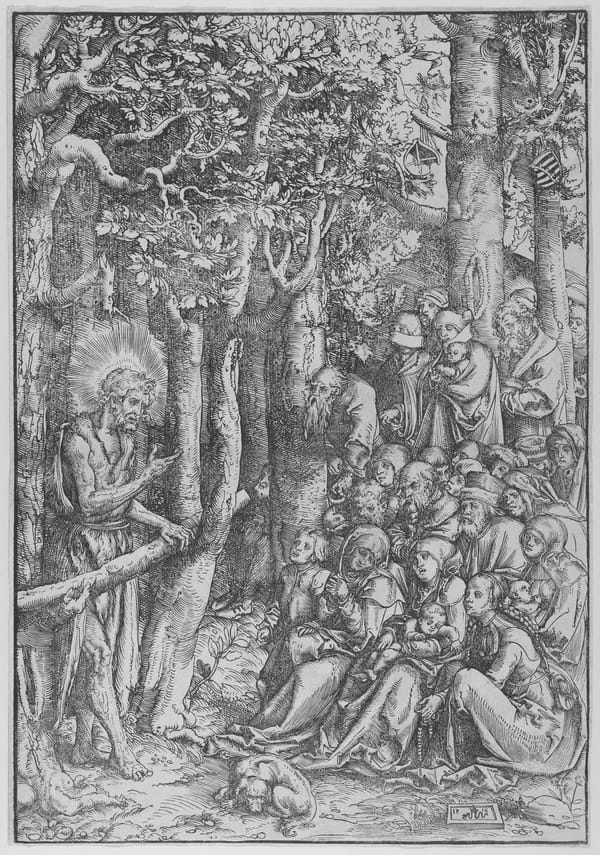
Four thousand years of expectation preceded that coming, and they are expressed by the four weeks of Advent, which we must spend before we come to the glorious festivity of our Lord’s Nativity. Let us reflect upon the holy impatience of the saints of the old Testament, and how they handed down, from age to age, the grand hope, which was to be but hope to them, since they were not to see it realized. Let us follow, in thought, the long succession of the witnesses of the promise: Adam, and the first patriarchs, who lived before the deluge; then, Noah, Abraham, Isaac, Jacob, and the twelve patriarchs of the Hebrew people; then Moses, Samuel, David, and Solomon; then, the prophets and the Machabees; and, at last, John the Baptist and his disciples. These are the holy ancestors, of whom the Book of Ecclesiasticus speaks, where it says: ‘Let us praise men of renown, and our fathers in their generation’:1 and of whom the apostle thus speaks to the Hebrews: ‘All these being approved by the testimony of faith, received not the promise; God providing some better thing for us, that they should not be perfected without us their faith was tried and approved, and yet they received not the object of the promises made to them. It is for us that God had reserved the stupendous gift, and therefore He did not permit them to attain the object of their desires.2
Let us honour them for their faith; let us honour them as our veritable fathers, since it is in reward of their faith, that our Lord remembered and fulfilled His merciful promise; let us honour them, too, as the ancestors of the Messias in the flesh. We may imagine each of them saying, as he lay on his dying bed, this solemn prayer to Him who alone could conquer death: ‘I will look for Thy Salvation, O Lord!’ It was the exclamation of Jacob, at his last hour, when he was pronouncing his prophetic blessings on his children: ‘and then,’ says the Scripture, ‘he drew up his feet upon his bed, and died, and he was gathered unto his people.’3
Thus did all these holy men, on quitting this life, go to await, far from the abode of eternal fight, Him who was to come in due time and reopen the gate of heaven. Let us contemplate them in this place of expectation, and give our grateful thanks to God, who has brought us to His admirable light, without requiring us to pass through a limbo of darkness. It is our duty to pray ardently for the coming of the Deliverer, who will break down, by His cross, the gates of the prison, and will fill it with the brightness of His glory. During this holy season, the Church is continually borrowing the fervent expressions of these fathers of the Christian people, making them her own prayer for the Messias to come. Let us turn to those great saints, and beg of them to pray, that our work of preparation for Jesus’ coming to our hearts may be blessed by God.
We will make use, for this end, of the beautiful hymn wherein the Greek Church celebrates the memory of all the saints of the old Testament, on the Sunday immediately preceding the feast of Christmas.
Hymn for the Feast of the Holy Fathers
(Taken from the Menæa of the Greeks)
A responsory for Advent
(The Roman breviary, first Sunday of Advent, at Matins)
Monday of the First Week of Advent
Cap. i.Lavamini, mundi estote, auferte malum cogitationum vestrarum ab oculis meis: quiescite agere perverse, discite benefacere: quaerite judicium, subvenite oppresso, judicate pupillo, detendite viduam. Et venite, et arguite me, dicit Dominus. Si fuerint peccata vestra ut coccinum, quasi nix dealbabuntur: et si fuerint rubra quasi vermiculus, velut lana alba erunt.
Ch. i.Wash yourselves, be clean, take away the evil of your devices from my eyes: cease to do perversely, learn to do well; seek judgement, relieve the oppressed, judge for the fatherless, defend the widow. And then come, and accuse me, saith the Lord. If your sins be as scarlet, they shall be made as white as snow; and if they be red as crimson, they shall be white as wool.
The Saviour, who is so soon to be with us and to save us, warns us not only to prepare ourselves to appear before Him, but also to purify our souls. ‘It is most just,’ says St. Bernard, ‘that the soul, which was the first to fall, should be the first to rise. Let us therefore defer caring for the body, until the day when Jesus Christ will come and reform it by the Resurrection; for, in the first coming, the Precursor says to us: “Behold the Lamb of God, who taketh away the sins of the world.” Observe, he says not the maladies of the body, nor the miseries of the flesh; he says sins, which are the malady of the soul, and the corruption of the spirit. Take heed, then, thou my body, and wait for thy turn and time. Thou canst hinder the salvation of the soul, and thine own safety is not within thy reach. Let the soul labour for herself, and strive thou too to help her, for if thou sharest in her sufferings thou wilt share in her glory. Retard her perfection, and thou retardest thine own. Thou wilt not be regenerated until God sees His own image restored in the soul.’* Let us, then, purify our souls. Let us do the works of the spirit, not the deeds of the flesh. Our Saviour’s promise is most clear; He will turn the deep dye of our iniquities into the purest whiteness. He asks but one thing of us: that we sin no more. He says to us: ‘Cease to do perversely, and then come and accuse Me, come and complain against Me, if I do not cleanse you.’ O Jesus! we will not defer a single day of this holy season; we accept, from this moment, the conditions Thou offerest us. We sincerely desire to make our peace with Thee; to bring the flesh into subjection to our spirit, to make good all the injustice we have committed against our neighbour, and to hush, by the sighs of our heart-felt compunction, that voice of our sins which has so long cried to Thee for vengeance.
Prose for the Time of Advent
(Composed in the eleventh century, and taken from the ancient Roman-French missals)
Condolens humana perire sæcla per tentantis numina.
Ferens mundo gaudia.
Tu animas et corpora nostra, Christe, expia,
Ut possideas lucida nosmet habitacula.
Adventu primo justifica.
In secundo nosque libera;
Ut cum facta luce magna, judicabis omnia,
Moved with compassion to see the human race perish by its idolatry offered to its very tempter.
Then, by thy own gratuitous love, assuming our human nature,
Giving joy to this world.
Come, O Christ, purify our souls and bodies.
And make them thy own pure abode.
Justify us by thy first coming.
And in thy second, deliver us;
That so, when thou judgest all things, on the day of the great light,
Prayer from the Ambrosian Breviary
(Second Sunday of Advent)
* Sixth Sermon of Advent. ↩︎
| Previous November 30: St. Andrew, Apostle (at the end of the year) | Next Monday of the First Week of Advent |