Daily reading
Friday of the First Week of Advent
Cap. vi.In anno, quo mortuus est rex Ozias, vidi Dominum sedentem super solium excelsum et elevatum: et ea quæ sub ipso erant, replebant templum. Seraphim stabant super illud: sex alæ uni, et sex alæ alteri: duabus velabant faciem ejus, et duabus velabant pedes ejus, et duabus volabant. Et clamabant alter ad alterum, et dicebant: Sanctus, sanctus, sanctus Dominus Deus exercituum: plena est omnis terra gloria ejus.
Ch. vi.In the year that king Ozias died, I saw the Lord sitting upon a throne high and elevated: and his train filled the temple. Upon it stood the Seraphim: the one had six wings, and the other had six wings: with two they covered his face, and with two they covered his feet, and with two they flew. And they cried one to another and said: Holy, holy, holy the Lord God of hosts: all the earth is full of his glory.
Such is the glory of the Lord in the highest heavens: who could see it and live? But now, contemplate this same Lord upon our earth, during the days which have dawned upon us. The womb of a Virgin contains Him, whom heaven cannot contain. To angels His beauty is visible, but it dazzles them not; to men, it is not even visible. Not a single voice is heard saying unto Him those words of heaven: Holy, holy, holy is the Lord God of hosts! The angels no longer say of Him: All the earth is full of His glory; for the earth is witness of His abasement, and an abasement so abject and low, that the inhabitants of the earth do not even know it. At first, there was but one who knew the divine secret: the Virgin Mother; after her, Elizabeth was admitted to know that her cousin was Mother of God; and then, after the most painful and humiliating suspicions, the great mystery was revealed by an angel to Joseph. So that only three on earth know that God has come down upon it! Thus humbly did He re-enter the world, after the sin of pride had driven Him out of it. O God of the ancient Covenant, how great Thou art! and who would not tremble before Thee? O God of the new Covenant, how little Thou hast made Thyself! who would not love Thee? Heal my pride, the source of all my sins! teach me to value what Thou didst so much value. By Thy Incarnation Thou dost a second time create the world; and in this second creation, more excellent than the first, Thou workest by silence, and Thy triumph is won by self-annihilation. I wish to humble myself after Thine example, and to profit by the lessons which a God came down so low to give me. Lay low all that is high and lifted up within me, O my Jesus, for this is one of the ends of Thy coming. I abandon myself to Thee as to my sovereign Master! do with me and in me what Thou wilt.
Hymn taken from the Anthology of the Greeks
(December 23)
Prayer from the Mozarabic Missal
(In the Mass of the fifth Sunday of Advent)
December 5: St. Sabas, Abbot
|
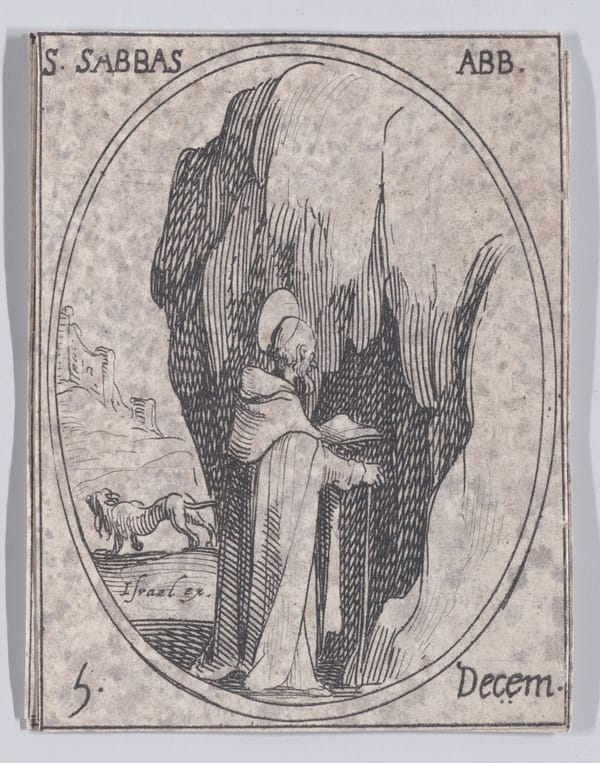
The Roman Church confines herself to-day to the Office of the feria: but to that she joins a commemoration of St. Sabas, abbot of the celebrated laura of Palestine which still exists under his name. This saint, who died in 533, is the only one of the monastic Order of whom the Church makes any mention in her liturgy during the whole period of Advent; we might even say that he is the only simple confessor whose name occurs in the calendar of this part of the year: for, as regards St. Francis Xavier, the glorious title of apostle of the Indies puts him in a distinct class of saints. Here, again, we should recognize divine Providence, which has selected for these days of preparation for Christmas, those saints whose characteristic virtues would make them our fittest models in this work of preparation. We have the feasts of apostles, pontiffs, doctors, virgins: Jesus, the Man-God, the King and Spouse of men, is preceded by this magnificent procession of the noblest of His servants: simple confession has but a single representative, the anchoret and cenobite Sabas, who, by his profession of the monastic life, is of that family of holy solitaries, which began with the prophet Elias under the old Testament, and continued up to the time of St. John the Precursor, who was one of its members, and will continue on, during the new Covenant, until the last coming of Jesus. Let us, then, honour this holy abbot, towards whom the Greek Church professes a filial veneration, and under whose invocation Rome has consecrated one of her churches. Let us beg his prayers by this Collect of the holy liturgy.
Collect
O Sabas, thou man of desires! in thy expectation of that Lord, who has bidden His servants watch until He come, thou didst withdraw into the desert, fearing lest the turmoil of this world might distract thy mind from its God. Have pity on us who are living in the world, and are so occupied in the affairs of that world, and yet who have received the commandment, which thou didst so take to heart, of keeping ourselves in readiness for the coming of our Saviour and our Judge. Pray for us, that when He comes we may be worthy to go out to meet Him. Kemember also the monastic state, of which thou art one of the brightest ornaments; raise it up again from its ruins; let its children be men of prayer and faith, as of old; let thy spirit be among them, and the Church thus regain, by thy intercession, all the glory which is reflected on her from the sublime perfection of this holy state.
Let us look again at the prophecy of Jacob. The holy patriarch not only foretells that the Messias will be the Expectation of nations; he adds that, when this promised Deliverer comes, the sceptre will have been taken away from Juda.1 This oracle is now fulfilled. The flag of Cæsar Augustus floats on the ramparts of Jerusalem. The temple is still untouched; the abomination of desolation stands not yet in the holy place; sacrifices are there still offered up to God; but then, the true temple of God, the Incarnate Word, has not yet been built; the Synagogue has not denied Him, who was her expectation; the Victim, that was to supersede all others, has not been immolated. Yet, Juda has no chief of her own race; Cæsar’s coin is current throughout all Palestine; and the day is not far off when the leaders of the Jewish people will own, in the presence of the Roman governor, that they have not the power to put any man to death.2 So that there is now no king upon the throne of David and Solomon, that throne which was to abide for ever. O Jesus! Son of David, and King of peace, now is the time when Thou must show Thyself and take possession of the sceptre which has been taken in battle from the hand of Juda, and put, for a time, into that of an emperor. Come! for Thou art King, and the psalmist, Thy ancestor, thus sang of Thee: 'Gird Thy sword upon Thy thigh, O Thou Most Mighty! With Thy comeliness and Thy beauty set out, proceed prosperously, and reign, because of truth and meekness and justice, and Thy right hand shall conduct Thee wonderfully. Thy arrows are sharp: under Thee shall people fall: Thy arrows shall go into the hearts of the King’s enemies. Thy throne is for ever and ever; the sceptre of Thy kingdom is a sceptre of uprightness . . . . God, Thy God, hath anointed Thee, O Christ! who takest thence Thy name, with the oil of gladness above Thy fellows, who have been honoured with the name of king.’3 When Thou hast come, O Messias! men will be no more as sheep going astray without a shepherd; there will be but one fold, in which Thou wilt reign by love and justice, for all power will be given unto Thee in heaven and on earth. When, in the hour of Thy Passion, Thy enemies shall ask Thee: ‘Art Thou King?’ Thou wilt answer them in all truth: ‘Verily, I am.’4 Come, dearest King, and reign over our hearts; come, and reign over this world, which is Thine because Thou didst create it, and will soon be Thine because Thou wilt have redeemed it. Reign, then, over this world, and delay not the manifestation of Thy royal power until the day of which it is written: 'He will break kings in the day of His wrath’;5 reign from this very hour, and let all people fall at Thy feet and adore Thee in one grand homage of love and obedience.
Sequence for the Time of Advent
(Composed in the eleventh century, and taken from the ancient Roman-French missals)
| Previous December 4 (the Same Day): Saint Barbara, Virgin and Martyr | Next December 5: St. Sabas, Abbot |