Daily reading
Movable from Advent · Temporal
December 12, 2025
From Dom Guéranger’s The Liturgical Year.
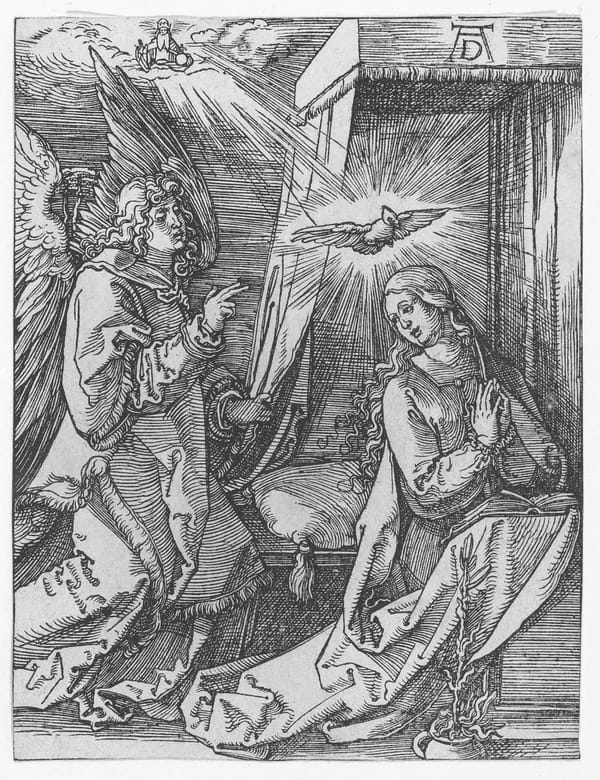
Friday of the Second Week of Advent
Cap. xxiv.Ecce Dominus dissipabit terram, et nudabit eam; et affliget faciem ejus et disperget habitatores ejus. Et erit sicut populus, sic sacerdos; et sicut servus, sic dominus ejus; sicut ancilla, sic domina ejus; sicut emens, sic ille qui vendit; sicut fœnerator, sic is qui mutuum accipit; sicut qui repetit, sic qui debet. Dissipatione dissipabitur terra, et direptione prædabitur: Dominus enim locutus est verbum hoc. Luxit et defluxit terra, et infirmata est: defluxit orbis, infirmata est altitudo populi terræ. Et terra infecta est ab habitatoribus suis: quia transgressi sunt leges, mutaverunt jus, dissipaverunt fœdus sempiternum. Propter hoc maledictio vorabit terram, et peccabunt habitatores ejus, ideoque insanient cultores ejus; et relinquentur homines pauci. Luxit vindemia, infirmata est vitis, ingemuerunt omnes qui laetabantur corde. Cessavit gaudium tympanorum, quievit sonitas lætantium, conticuit dulcedo citharæ. Cum cantico non bibent vinum: amara erit potio bibentibus illam. Attrita est civitas vanitatis: clausa est omnis domus, nullo introeunte. Clamor erit super vino in plateis: deserta est omnis laetitia, translatum est gaudium terræ. Relicta est in urbe solitudo, et calamitas opprimet portas. Quia hæc erunt in medio terræ, in medio populorum; quomodo si paucae olivae quae remanserunt, excutiantur ex olea: et racemi, cum fuerit finita vindemia. Hi levabunt vocem suam, atque laudabunt; cum glorificatus fuerit Dominus, hinnient de mari. Propter hoc in doctrinis glorificate Dominum, in insulis maris nomen Domini Dei Israel. A finibus terræ laudes audivimus, gloriam justi.
Ch. xxiv.Behold the Lord shall lay waste the earth, and shall strip it: and shall afflict the face thereof, and scatter abroad the inhabitants thereof. And it shall be as with the people, so with the priest; and as with the servant, so with his master; as with the handmaid, so with her mistress; as with the buyer, so with the seller; as with the lender, so with the borrower; as with him that calleth for his money, so with him that oweth. With desolation shall the earth be laid waste, and it shall be utterly spoiled: for the Lord hath spoken this word. The earth mourned and faded away, and is weakened: the world faded away, the height of the people of the earth is weakened. And the earth is infected by the inhabitants thereof: because they have transgressed the laws, they have changed the ordinance, they have broken the everlasting covenant. Therefore shall a curse devour the earth, and the inhabitants thereof shall sin; and therefore they that dwell therein shall be mad, and few men shall be left. The vintage hath mourned, the vine hath languished away, all the merry-hearted have sighed. The mirth of timbrels hath ceased, the noise of them that rejoice is ended, the melody of the harp is silent. They shall not drink wine with a song; the drink shall be bitter to them that drink it. The city of vanity is broken down, every house is shut up, no man cometh in. There shall be a crying for wine in the streets: all mirth is forsaken, the joy of the earth is gone away. Desolation is left in the city, and calamity shall oppress the gates. For it shall be thus in the midst of the earth, in the midst of the people, as if a few olives that remain should be shaken out of the olive tree: or grapes, when the vintage is ended. These shall lift up their voice, and shall give praise, when the Lord shall be glorified, they shall make a joyful noise from the sea. Therefore glorify ye the Lord in instruction: the name of the Lord God of Israel in the islands of the sea. From the ends of the earth we have heard praises, the glory of the just one.
Thus was the earth in desolation when the Messias came to deliver and save it. So diminished, so decayed, were truths among the children of men, that the human race was bordering on its ruin. The knowledge of the true God was becoming rarer as the world grew older; idolatry had made everything in creation an object of its adulterous worship; the practical result of a religion which was but gross materialism, was frightful immorality; man was for ever at war with man; and the only safeguards of what social order still existed in the world, were the execrable laws of slavery and extermination. Among the countless inhabitants of the globe, a mere handful could be found who were seeking God! they were as rare as the olives that remain on the tree after a careful plucking, or as grape-bunches after the vintage is ended. Of this happy few were, among the Jewish people, those true Israelites whom our Saviour chose for His disciples; and, among the Gentiles, the Magi that came from the east, asking for the new-born King; and later on, Cornelius the centurion, whom the angel of the Lord directed to St. Peter. But with what faith and joy did they acknowledge the incarnate God! and what their hymns of glad gratitude, when they found that they had been privileged, above others, to see with their own eyes the promised Saviour!
Now, all this will again happen when the time draws near of the second coming of the Messias. The earth will once more be filled with desolation, and mankind will be again a slave of its self-degradation. The ways of men will again grow corrupt; and, this time, the malice of their evil will be the greater, because they will have received Him who is the Light of the world, the Word of life. A profound sadness will sit heavy on all nations, and every effort for their well-being will seem paralyzed; they, and the earth they live on, will be conscious of decrepitude; and yet it will never once strike them that the world is drawing to an end. There will be great scandals; there shall fall stars from heaven, that is, many of those who had been masters in Israel shall apostatize, and their light shall be changed into darkness. There shall be days of temptation, and faith shall grow slack; so that when the Son of Man shall appear, faith shall scarce be found on the earth. Let it not be, O Lord, that we live to see those days of temptation; or, if it be Thy will that they overtake us, make our hearts firm in their allegiance to Thy holy Church, which will be the only beacon left to Thy faithful children in that fiorce storm. Grant, O Lord, that we may be of the number of those chosen olives, of those elect bunches of grapes, wherewith Thou wilt complete the rich harvest which Thou wilt garner for ever into Thy house. Preserve intact within us the deposit of faith which Thou hast entrusted to us; let our eye be fixed on that Orient of which the Church speaks to us, and where Thou art suddenly to appear in Thy majesty. When that day of Thine comes, and we behold Thy triumph, we will shout our glad delight, and then, like eagles which cluster round the body, we shall be taken up to meet Thee in the air, as Thy apostle speaks, and thus shall we for ever be with Thee.* Then we shall hear the praises and glory of the Just One, from the ends of this earth, which it is Thy good will to preserve until the decrees of Thy mercy and justice shall have been fully executed. O Jesus! we are the work of Thy hands; save us, and be merciful to us on that great day.
Hymn of Advent
(Mozarabic breviary, in the second week of Advent)
Ad nos venis per Virginem,
Baptismi rore consecrans,
Cunctos fide regenerans.
Excepit formam hominis,
Victor a morte rediens,
Gaudia vitae largiens.
Illabere propitius,
Clarum que nostris cordibus
Lumen præbe deificum.
Ejusque soli Filio
Cum Spiritu Paraclito,
In sempiterna sæcula.
thou comest to us by the Virgin,
consecrating us all by the dew of Baptism,
and by faith regenerating us.
has taken on himself the form of man,
returning after conquering death,
and giving us the joys of a now life.
descend upon us in thy mercy,
and give to our hearts
the brightness of the divine light.
and to his only Son,
and to the holy Paraclete,
be glory for ever and ever.
Prayer from the Gallican Missal
(In Adventu Domini, Collecta)
* 1 Thess. iv. 16. ↩︎
December 12: The Fifth Day within the Octave of the Immaculate Conception
Let us contemplate the sentiments of profound respect and maternal tenderness, which fill the soul of our blessed Lady, now that she has conceived Jesus in her chaste womb: He is her God, and yet He is her Son. Let us think upon this wonderful dignity bestowed upon a creature; and let us honour the Mother of our God. It is by this mystery that the prophecy of Isaias was fulfilled: ‘Behold, a Virgin shall conceive and bear a Son;’1 and that of Jeremias: ‘The Lord hath created a new thing upon the earth; a woman shall compass a Man.’2 The Gentiles themselves had received the tradition of these prophecies. Thus in the old pagan Carnutum (Chartres), there was an altar dedicated ‘To the Virgin that was to bring forth a Son and that of Jeremias: 'The Lord hath created a new thing upon the earth; a woman shall compass a Man.' 11 The Gentiles them- selves had received the tradition of these prophecies. Thus in the old pagan Oarnutum (Chartres), there was an altar dedicated ' To the Virgin that was to bring forth a Son and that of Jeremias: 'The Lord hath created a new thing upon the earth; a woman shall compass a Man.' 11 The Gentiles them- selves had received the tradition of these prophecies. Thus in the old pagan Oarnutum (Chartres), there was an altar dedicated ' To the Virgin that was to bring forth a Son (Virgini Parituræ)’; and whilst modern rationalism, with its ignorant scepticism, was affecting to throw a doubt on this fact of history, the researches of science were discovering that Carnutum was far from being the only city of the west which had such an altar.
But what human language could express the dignity of our Lady, who carries within her chaste womb Him that is the world’s salvation! If Moses, after a mere colloquy with God, returned to the Israelites with the rays of the majesty of Jehovah encircling his head, what an aureola of glory is due to Mary, who has within her, as in a living heaven, that very God Himself! The divine Wisdom tempers the effulgence of her glory that it be not visible to men; and this in order that the state of humility, which the Son of God has chosen as the one in which He would manifest Himself to the world, should not be removed at the very outset by the dazzling glory which would, otherwise, have been seen gleaming from His Mother.
The sentiments which filled the heart of Mary during these months of her ineffable union with the divine Word, may be thus expressed in the words of the bride in the sacred Canticle: ‘I sat under the shadow of Him whom I desired; and His fruit was sweet to my palate. I sleep, but my heart watches. My soul melted when He spoke. I to my Beloved and my Beloved to me, who feedeth among the lilies, till the day break, and the shadows retire.’3 And if there ever were a human heart, that was forced, by the overpowering vehemence of its love of God, to use these other words of the same Canticle, it was Mary’s: ‘O daughters of Jerusalem! stay me up with flowers, compass me about with fragrant fruits; for I languish with love.’4 ‘These sweet words,’ says the venerable Peter of Celles, ‘are those of the bride that dwelleth in the gardens, and is now near the time of her delivery. What so lovely in creation as this Virgin, who loves the Lord with such matchless love and is so exceedingly loved by this her Lord? It is she of whom the Scripture speaks, when it calls the bride the dearest hind. What, too, so lovely as that well-beloved Son of God, born of His beloved Father from all eternity, and now, at the end of time, as the apostle speaks, formed in the womb of His dearest Mother, and become to her, in the words of the same divine proverb, the sweetest fawn? Let us, therefore, cull our flowers, and offer them to both Child and Mother. But let me briefly tell you what are the flowers you must offer to our Lady. Christ says, speaking of His Humanity, “I am the flower of the field, and the lily of the valleys.” By Him, therefore, let us purify our souls and bodies, and so be able to approach our God in chastity. Next, preserve this flower of purity from all that would injure it; for flowers are tender things, and soon droop and fade. Let us wash our hands among the innocent, and, with a pure heart, and pure body, and cleansed lips, and chaste soul, let us gather in the paradise of our heavenly Father our fresh flowers for the new Nativity of our new King. With these flowers let us stay up this most saintly Mother, this Virgin of virgins, this Queen of queens, this Lady of ladies; that so we may deserve to receive the blessing of the Mother and of the divine Babe.’5
Virgo Mater gloriosa,
Mater Regis gloriæ.
Ave, fulgens margarita
Per quam venit mundi vita,
Christus sol justitiæ.
O oliva fructifera,
Tu pietatis viscera
Nulli claudis hominum.
Nos exsules laetificas,
Ut vitis, dum fructificas
Salvatorem Dominum.
Ave, Virgo Mater Dei,
Tu superni sol diei,
Et mundi noctis luna.
Succurre nobis miseris,
Mortalium spes unica.
Ave, decus virginale,
Templum Dei speciale! Per te fiat veniale
Omne quod committimus.
Tu nobis es singularis;
Tu nos ducas, stella maris;
Tu nos semper tuearis:
En ad te confugimus.
Ad te, pia, suspiramus,
Si non ducis, deviamus;
Ergo doce quid agamus;
Post hunc finem ut vivamus
Cum sanctis perenniter.
Jesu Christe, Fili Dei,
Tota salus nostræ spei;
Tuæ matris interventu,
Angelorum nos conventu
Fac gaudere jugiter.
glorious Virgin-Mother
of the King of glory!
Hail, fair pearl!
by whom came the life of the world,
Christ the Sun of justice.
O fruitful olive!
thou excludest no mortal
from thy tender compassion.
Thou givest gladness to us exiles,
for, like a fruitful vine,
thou yieldest thy fruit, Jesus our Lord.
Hail, Virgin Mother of God!
thou art the sun of the heavenly day!
thou art the moon of the world’s night!
Tenderest of Mothers!
help us poor mortals,
for God wills us to hope in thee above all creatures.
Hail, O purest Virgin!
God’s special temple! pray for us to him,
that he would forgive us all our sins.
Thou art unto us what no other creature is.
Guide us, O star of the sea!
Defend us always and in all places.
We fly to thee in our necessities.
Tender Mother! we pray thee guide us,
or we go astray.
Tell us what would thy Jesus have us do?
that so, after this life is ended,
we may live for ever with the saints.
O Jesus! Son of God,
our only Saviour, in whom rests all our hope!
grant by the intercession of thy Mother,
that we may be united
to the angels in eternal joy.
A Prayer for the Time of Advent
(The Mozarabic breviary, first Sunday of Advent)
| Previous December 11: Saint Damasus, Pope and Confessor | Next December 12: The Fifth Day within the Octave of the Immaculate Conception |