Daily reading
December 13 · Sanctoral
December 13, 2025
From Dom Guéranger’s The Liturgical Year.
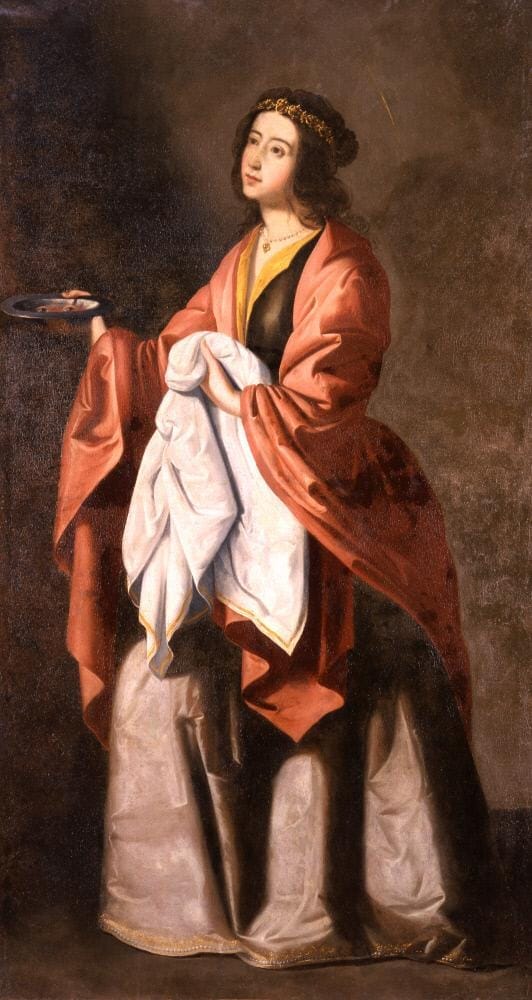
December 13: St. Lucy, Virgin and Martyr
We here give some of the antiphons which occur in the Office of the saint: they form a lyric poem of great beauty.
O virgin Lucy! why askest thou of me, what thyself canst straightway grant unto thy mother?
Because of thee, O virgin Lucy! the city of Syracuse shall be honoured by the Lord Jesus Christ.
Words of Lucy: I bless thee, the Father of my Lord Jesus Christ, because by thy Son the fire around me was quenched.
In thy patience thou didst possess thy soul, O Lucy, bride of Christ! thou didst hate the things that are in the world, and thou shinest among the angels. Thou didst conquer the enemy by thine own blood.
We present ourselves before thee, O virgin martyr, beseeching thee to obtain for us that we may recognize in His lowliness that same Jesus whom thou now seest in His glory. Take us under thy powerful patronage. Thy name signifies light; guide us through the dark night of this life. O fair light of virginity! enlighten us; evil concupiscence has wounded our eyes: pray for us, O thou bright light of virginity! that our blindness be healed, and that rising above created things, we may be able to see that true light, which shineth in darkness, but which darkness cannot comprehend. Pray for us, that our eye may be purified, and may see, in the Child who is to be born at Bethlehem, the new Man, the second Adam, the model on which the life of our regeneration must be formed. Pray too, O holy virgin, for the Church of Rome and for all those which adopt her form of the holy Sacrifice; for they daily pronounce at the altar of God thy sweet name; and the Lamb, who is present, loves to hear it. Heap thy choicest blessings on the fair Isle, which was thy native land, and where grew the palm of thy martyrdom. May thy intercession secure to her inhabitants firmness of faith, purity of morals, and temporal prosperity, and deliver them from the disorders which threaten her with destruction.
Saturday of the Second Week of Advent
Cap. xxv.Domine, Deus meus es tu, exaltabo te, et confitebor nomini tuo: quoniam fecisti mirabilia, cogitationes antiquas fideles. Amen. Quia posuisti civitatem in tumulum, urbem fortem in ruinam, domum alienorum, ut non sit civitas, et in sempiternum non aedificetur. Super hoc laudabit te populus fortis, civitas gentium robustarum timebit, te. Quia factus es fortitudo pauperi, fortitudo egeno in tribulatione sua: spes a turbine, umbraculum ab æstu.... Et faciet Dominus exercituum omnibus populis in monte hoc convivium pinguium, convivium vindemiae, pinguium medullatorum, vindemiae defæcatæ. Et praecipitabit in monte isto faciem vinculi colligati super omnes populos, et telam quam orditus est super omnes nationes. Præcipitabit mortem in sempiternum: et auferet Dominus Deus lacrymam ab omni facie, et opprobrium populi sui auferet de universa torra: quia Dominus locutus est. Et dicet in die illa: Ecco Deus noster iste, exspectavimus eum, et salvabit nos: iste Dominus, sustinuimus eum, exsultabimus et lætabimur in salutari ejus.
Ch. xxv.O Lord, thou art my God, I will exalt thee, and give glory to thy name: for thou hast done wonderful things, thy designs of old faithful. Amen. For thou hast reduced the city to a heap, the strong city to ruin, the house of strangers to be no city, and to be no more built up for ever. Therefore shall a strong people praise thee, the city of mighty nations shall fear thee. Because thou hast been a strength to the poor, a strength to the needy in his distress: a refuge from the whirlwind, a shadow from the heat And the Lord of hosts shall make unto all people, in this mountain, a feast of fat things, a feast of wine, of fat things full of marrow, of wine purified from the lees. And he shall destroy in this mountain the face of the bond with which all people were tied, and the web that he began over all nations. He shall cast death down headlong for ever: and the Lord God shall wipe away tears from every face. and the reproach of his people he shall take away from off the whole earth: for the Lord hath spoken it. And they shall say in that day: Lo, this is our God, we have waited for him, and he will save us: this is the Lord, wo have patiently waited for him, we shall rejoice and be joyful in his salvation.
Yet a little while, and the conqueror of death will appear, and then, in the joy of our hearts, we will say: Lo! this is our God; wo have waited for Him, and He will save us; we have patiently waited for Him; this is He, and we will rejoice and be joyful in His salvation. Let us, therefore, prepare the way of the Lord that wo may receive Him worthily; and in this work of our preparation, let us have recourse to Mary. Saturday is the day which is sacred to her; she will the more readily grant the prayers said to her upon it. Let us consider her in her grand privilege of being full of grace, carrying in her womb Him whom we so long to possess. If we ask her by what means she rendered herself worthy of such an immense favour, she will tell us that in her was simply fulfilled the prophecy, which the Church so continually repeats during these days of Advent: ‘Every valley shall be filled up.’ The humble Mary was the valley blessed by the Lord: a valley beautiful and fertile, in which God sowed the divine wheat, our Saviour Jesus: for it is written in the psalm, that the valleys shall abound with corn.* O Mary! it is thy humility that drew down upon thee the admiration of thy Creator. If, from the high heaven where He dwells, He had perceived a virgin more humble in her love, He would have chosen her in preference et thee: but no, it is thou that didst win His predilection, O mystic valley, ever verdant and lovely in thy flowers of grace. We that, like high hills, are so proud and such sinners, what shall we do? We must look on this our God, who comes to us in infinite humility, and then humble ourselves out of love and gratitude. O blessed Mother! obtain this grace for us. Pray for us that henceforth we may submit ourselves to the will of our Lord as thou didst, when thou didst speak those admirable words: ‘Behold the handmaid of the Lord: may it be done to me according to thy word!’
Prose in Honor of the Blessed Virgin
(Taken from the Cluny missal of 1523)
Verbi bajulus fidelis,
Sacris disserit loquelis
Cum beata Virgine.
Pandit intus in conclave,
Et ex Eva format Ave,
Evæ verso nomine.
Adest Verbum caro factum;
Semper tamen est intactum
Puellare gremium.
Et quam homo non deflorat,
Non torquetur nec laborat
Quando parit filium.
Crede solum, et est satis;
Non est nostræ facultatis
Solvere corrigiam.
Est in rubo et in igne:
Ne appropiet indigne
Calciatus quisquam.
Novo ritu, novo more,
Fructum protulit cum flore;
Sicque Virgo peperit.
Fructus gaudii, non luctus;
Non erit Adam seductus,
Si de hoc gustaverit.
Piæ Matris pium onus,
Cujus est in cœlo thronus
Nascitur in stabulo.
Nostros deleat reatus;
Quia noster incolatus
Hic est in periculo.
faithful bearer of the word,
holds sacred converse
with the holy Virgin.
he discloses the good and sweet word;
and inverting the name of Eve, Eva becomes Ave,
his salutation Hail!
instantly there was present the Word made flesh;
and yet the pure Maid
a Virgin still for ever.
Mother, yet not losing the treasure;
giving birth to her child,
yet not in pain or travail.
and all thou, my soul,
canst do is to believe it:
we have not power to loose the latchet.
of the burning bush;
let him that would approach,
take off the sandals from his feet.
once yielded a flower and fruit;
it was a new law, a new way:
so was it when the Virgin brought forth her Son.
a Fruit of joy, not of woe.
There will be no Adam deceived,
if men but eat of this.
lovely burden of a lovely Mother!
He who has a throne in heaven,
has a stable for his birth-place!
wipe away all our guilt;
for our sojourn
here is full of dangers.
Prayer from the Mozarabic Breviary
(For the Friday of the third week of Advent)
* Ps. lxiv. 14. ↩︎
December 13 (the Same Day): St. Odilia, Virgin and Abbess
On this same day, we have also the fifth of the wise virgins, whose bright lamps light us, during Advent, to the crib of Jesus their Spouse. Odilia did not shed her blood for Him, as did Bibiana, Barbara, Eulalia, and Lucy; her offering was her tears and her love. Her wreath of lilies blends sweetly with the roses, which form the crowns of her four companions. Her name is held in special veneration in the east of France, and beyond the Rhine. The holy hill whereon her tomb has rested now these thousand years, is still visited by numerous and devout pilgrims. Several kings of the Capetian race, and several emperors of the house of Hapsburg, were descendants of the father of our saint, Adalric or Atticus, Duke of Alsace.
Odilia was born blind. Her father insisted on her being removed from the house, for her presence would have been a continual humiliation to him. It seems as though this affliction was permitted by Providence, in order that the action and power of divine grace might be the more clearly manifested in her regard. The little exile was taken from her mother, and placed in a monastery. God, who designed to show the virtue of the holy Sacrament of regeneration, permitted that her Baptism should be deferred until she had reached her thirteenth year. The time at length came for Odilia to be made a child of God. No sooner was she taken from the baptismal font, than she received her eyesight, which was but a feeble figure of the light which faith had lit up in her soul. This prodigy restored Odilia to her father and to the world; and from that time forward, she had to defend, against unceasing attacks, the virginity which she had vowed to God. Her personal beauty, and her father’s wealth and power, attracted to her many rich suitors. She refused them all; and her father himself built a monastery on the rocks of Hohenburg, wherein she served her divine Lord, governed a large community, and gave relief to every sort of suffering.
After a long life spent in prayer, penance, and works of mercy, the day came which was to reward her for it all. It was this very day, the thirteenth of December, the feast of the holy virgin Lucy. The sisters of Hohenburg, desirous of treasuring up her last words, assembled round their saintly abbess. She was in an ecstasy, and already dead to the things of this life. Fearing lest she should die before she had received that holy Viaticum, which leads the soul to Him who is her last end, the sisters thought it their duty to rouse her from the mystic sleep, which, so it seemed to them, rendered her forgetful of the duties which she had to perform. Being thus brought to herself, she turned to the community, and said to them: ‘Dear sisters, why have you disturbed me? Why would you again oblige me to feel the weight of this corruptible body, when I had once left it? By the favour of His divine Majesty, I was in the company of the virgin Lucy, and the delights I was enjoying were so great that no tongue could tell them, nor ear hear them, nor human eye see them.’ No time was lost in giving her the Bread of life and the Chalice of salvation, which having received, she immediately rejoined her heavenly companion, and the thirteenth day of December thus united into one the feasts of the abbess of Hohenburg and of the martyr of Syracuse.
The Church of Strasburg, which honours Odilia as one of its greatest glories, has the following lessons for this feast. By giving them a place here, we do not adopt the statement they contain with regard to the rule which was followed in the monastery of Hohenburg. Mabillon, who proves that St. Odilia followed the rule of St. Benedict, shows that the Canonical Rule, as it was called, did not exist at that time.
The ways of God in thy regard, O holy virgin, were admirable indeed, and He manifested in thee the riches and power of His grace. He deprived thee of sight, that so thy soul might the more eagerly cling to His own infinite beauty; and when afterwards He bestowed on thee thy bodily vision, thou hadst already made choice of the better part. The harshness of thy father deprived thee of the innocent pleasures of home; but it prepared thee to become the spiritual mother of so many noble virgins, who, following thy example, trampled on all the vanities of the world. Thou didst choose a life of humility, because thy heavenly Spouse Jesus had humbled Himself for our sake. Thou didst imitate Him also in His being our divine Deliverer, and taking upon Himself all our miseries, for thou hadst the tenderest compassion on the poor and the sick. Thou didst take on thyself the care of a poor leper, that had been abandoned by all else; with a mother’s courage thou didst feed him, and affectionately dress his loathsome sores. And is it not this that our Jesus is coming down from heaven to do for us; to heal our wounds by embracing our human nature, and to nourish us with that food, which He is preparing to give us at Bethlehem? Whilst the leper was receiving thy loving care, the frightful disease which excluded him from the society of his fellow-creatures suddenly disappeared; a delicious odour came from his whole person, whereas before, none but a saint like thyself could have borne to approach him. Is it not this which Jesus is coming down to do for us? The leprosy of sin was upon us; His grace heals us, and man regenerated sheds around him the good odour of Christ.1
In the midst of the joys which thou art now sharing with Lucy, remember us, O thou that wast ever so compassionate to the needy! We cannot forget the tears thou didst shed, and the prayers thou didst offer up for the soul of thy father after his death, whereby thou didst deliver him from purgatory, and open the gates of heaven to him that had banished thee from his house. Thou art no longer in the land of tears; thine eyes are opened to the light of heaven, and contemplate God in His glory: pray therefore for us, for thy prayers are now more powerful than heretofore. Think of us who are poor and infirm; obtain the cure of our maladies. The Emmanuel, who is coming to us, tells us that He is the Physician of our souls, for He has said: 'They that are in health need not the Physician, but they that are ill.’2 Ask Him to cure us of the leprosy of sin, and make us become even like unto Himself. Pray for France, thy country, and help her to maintain the purity of the Catholic faith. Watch over the ruins of the holy empire. Heresy has disunited the members of that great body; but it will once more flourish, if our Lord, propitiated by such prayers as thine, vouchsafe to bring Germany back again to the true faith and to submission to the Church. Yes, pray that these glorious things be brought about for the honour and glory of thy divine Spouse, and that nations, now weary of their errors and disunion, may unite together in propagating the kingdom of God upon earth.
Let us consider the ever blessed Mother of God leaving her humble dwelling at Nazareth, in order to visit her cousin, St. Elizabeth. The Church honours this mystery of the Visitation on the Friday in Ember Week of Advent, as we have mentioned above, in the Proper of the Time. We will let St. Bonaventure relate this sublime incident of Mary’s life, convinced that our readers will be pleased to hear the seraphic Doctor revealing to them, with his wonderful unction, these preludes to the birth of Jesus.
‘After, this, our Lady, pondering the words spoken unto her by the angel concerning her cousin Elizabeth, resolved to visit her, that she might congratulate with her and render her service. She, therefore, together with Joseph her spouse, set out from Nazareth for the house of Elizabeth, which might perhaps be fourteen or fifteen miles distant from Jerusalem. Neither the roughness nor the length of the journey discouraged her; but she walked with haste, forasmuch as she wished to be little seen in public. She was not like other mothers, burthened by her Child, nor was it to be thought that the Lord Jesus would be a burthen to His Mother. See, therefore, how the Queen of heaven and earth takes this journey alone, with none but her spouse Joseph; not riding, but walking; neither is she escorted by troops of soldiers and barons, nor attended by handmaids and fine ladies. Her train is poverty, humility, modesty, and the beauty of all virtues. The Lord Himself, too, is with her; and He verily hath a numerous and honourable suite, but it is not that of the world, vain and pompous.
‘Now, when she had entered the house of Elizabeth, she greeted her saying: “ Hail! my sister Elizabeth!” But she, exulting, and all full of joy, and inflamed by the holy Spirit, rises and most tenderly embraces Mary, exclaiming for joy: “Blessed art thou among women, and blessed is the fruit of thy womb! And whence is this to me, that there should come unto me the Mother of my Lord?” For as soon as the Virgin had greeted Elizabeth, John, in his mother’s womb, was filled with the Holy Ghost, as was likewise the mother. Nor was it that the mother was filled and then her child, but contrariwise the child was filled first, and he communicated the Spirit unto the mother. The babe effected nought in Elizabeth’s soul, but he merited that the Holy Ghost should do a work in her soul, because the grace of the divine Spirit had descended into him with greater abundance, and he was the first to receive the grace. And as Elizabeth had perceived the coming of Mary, so did John perceive the coming of Jesus. Therefore was it that he leaped for joy, and she prophesied. See the virtue of our Lady’s words, when by their utterance the Holy Ghost is conferred; for so replenished was Mary with Him, that, by her merits, He filled others also with Himself. Upon this, Mary made answer unto Elizabeth, saying: “My soul doth magnify the Lord, and my spirit hath rejoiced in God my Saviour.”
Sequence in Honor of the Mother of God
(Taken from the ancient Roman-French missals)
Celebris in Matris Dei
Agitur memoria.
Decantemus in hac die
Semper Virginis Mariæ
Landes et præconia.
Omnis homo, omni hora,
Ipsam ora et implora
Ejus patrocinia.
Psalle, psalle, nisu toto,
Cordis, oris, voce, voto:
Ave plena gratia!
Ave, Domina cœlorum,
Inexperta viri torum,
Parens paris nescia.
Fœcundata sine viro,
Genuisti more miro
Genitorem filia.
Florens hortus Austro flante,
Porta clausa post et ante,
Via viris invia.
Fusa cœli rore tellus,
Fusum Gedeonis vellus,
Deitatis pluvia.
Salve, splendor firmamenti:
Tu caliginosae menti
Desuper irradia.
Placa mare, maris stella,
Ne involvat nos procella
Et tempestas obvia.
Amen.
for on it we make commemoration of Mary,
the Mother of God.
Lot us sing to-day
the praises and the dignity of the ever blessed
Virgin Mary.
Whoe’er thou art,
and where’er thou art,
pray to her, beseech her to help thee.
Sing, sing, with all thy heart
and voice’s power;
Hail Mary! full of grace.
Hail, Queen of heaven,
purest of Virgins,
yet incomparable Mother!
Made fruitful by God,
thou, his creature, didst give birth,
O prodigy of prodigies! to thy Creator.
Here was the prophecy fulfilled;
that a garden should flower under the breath of the south wind;
that all its gates were closed, and no man could enter.
Mary is the earth spoken of as enriched with the dew of heaven;
she is as Gedeon’s fleece prefigured her,
filled with the dew of the Godhead.
Hail, Mary, thou brightness of heaven!
bring to our darkness
the light that is from above.
O star of the sea,
calm its storms,
and suffer not that they overwhelm us.
Amen.
Introit of Advent
(Ambrosian missal, sixth Sunday, Ingressa)
| Previous December 12: The Fifth Day within the Octave of the Immaculate Conception | Next Saturday of the Second Week of Advent |