Daily reading
Advent
Double · December 15 · Sanctoral
December 15, 2025
From Dom Guéranger’s The Liturgical Year.
A Double leads the weekday.Rubric

|
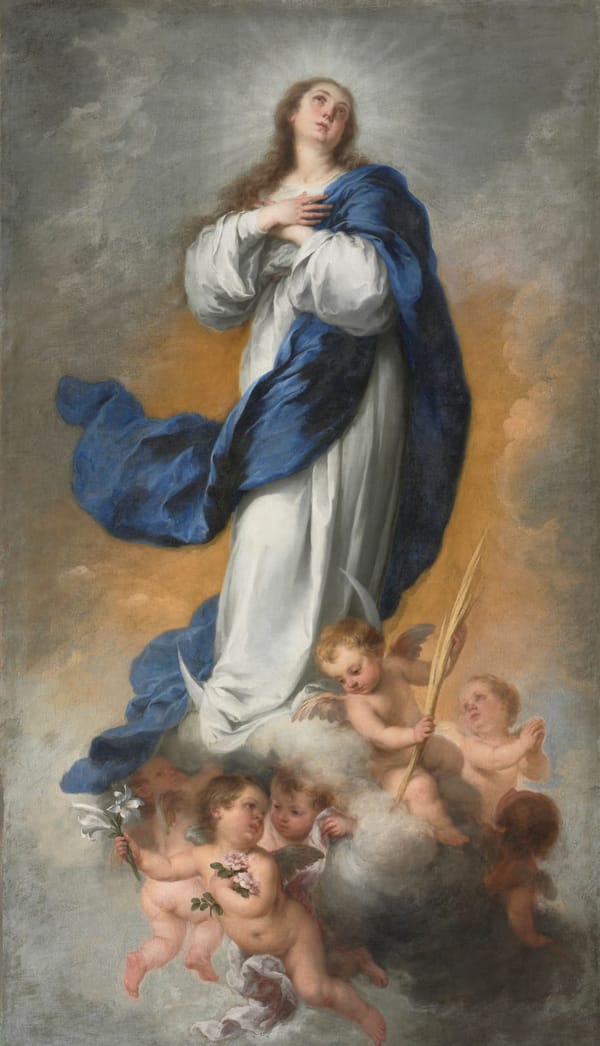
December 15: Octave of the Immaculate Conception of the Most Blessed Virgin
This, the eighth day from that on which we kept the feast of the Immaculate Conception, is the octave properly so called; whereas the other days were simply called days within the octave. The custom of keeping up the principal feasts for a whole week is one of those which the Christian Church adopted from the Synagogue. God had thus spoken in the Book of Leviticus: 'The first day shall be called most solemn and most holy, you shall do no servile work therein . . . . The eighth day also shall be most solemn and most holy, and you shall offer holocausts to the Lord, for it is the day of assembly and congregation: you shall do no servile work therein.'1 We also read in the Book of Kings, that Solomon, having called all Israel to Jerusalem for the dedication of the temple, suffered not the people to return home until the eighth day.
We learn from the Books of the new Testament that this custom was observed in our Saviour’s time, and we find Him authorizing, by His own example, this solemnity of the octave. Thus, we read in Saint John, that Jesus once took part in one of the Jewish festivals, about the midst of the feast;2 and the same Evangelist relating how our Lord cried out to the people: 'If any man thirst, let him come to Me, and drink’: observes, that it was on the last and great day of the festivity.3
In the Christian Church there are three kinds of octaves. Some feasts are celebrated with a privileged octave—that is, one of which the Office is said daily, or at least a commemoration is always made. Other feasts have a common octave, or one whose commemoration may, on greater feasts, be sometimes omitted. And, lastly, some have a simple octave, of which only the Octave Day itself is kept or commemorated. Privileged octaves, whose office is said or commemorated every day, are divided into three Orders. The octaves of the First Order are those of Easter and Pentecost. Those of the Second Order, of which days within the octave exclude all feasts except doubles of the First Class, are the octaves of the Epiphany and of Corpus Christi. The octaves of the Third Order, which must always be commemorated, although days within the octave exclude only the same feasts as do common octaves, are those of Christmas and of the Ascension of Our Lord. The octave of the Immaculate Conception, the first that occurs in the ecclesiastical year, is a common octave.
Let us once more devoutly reverence the mystery of Mary’s Immaculate Conception: our Emmanuel loves to see His Mother honoured. After all, is it not for Him and for His sake that this bright star was prepared from all eternity, and created when the happy time fixed by the divine decree came? When we honour the Immaculate Conception of Mary, it is really to the divine mystery of the Incarnation that we are paying our just homage. Jesus and Mary cannot be separated, for Isaias tells us that she is the branch and He the Flower.4
We give Thee thanks, O Jesus our Emmanuel, because Thou hast granted us to live during the time that the privilege of Thy blessed Mother was proclaimed on this earth; the glorious privilege wherewith Thou didst enrich the first instant of the life of the happy creature, from whom Thou didst take upon Thyself our human nature! This definition of Thy Church has given us a clearer knowledge of Thine infinite holiness. It has taught us to see more distinctly the harmony there is in all Thy divine mysteries. But it has also impressed upon us the great truth that we ourselves, being destined to the most intimate union with Thee here, and to the face to-face vision of Thy infinite Majesty hereafter, must labour without ceasing to purify ourselves from the smallest stains of sin. Thou hast said: 'Blessed are the clean of heart, for they shall see God';5 and Thou showest us, by the dogma of Thy blessed Mother’s Immaculate Conception, what is the purity which Thy sovereign sanctity demands of us. Ah! by the love, which led Thee to preserve her from every stain of sin, have mercy on us who are her devoted children. Thou art so soon to be among us! Before many days are past we shall have yielded to Thy invitations, and have presumed to approach Thy sacred crib. We are not yet ready, dear Jesus! The effects of original sin are still so plainly upon us, and, what is worse, there are so many of our own sins, which we have added to this of our first parent. Oh! prepare our hearts and our senses, for we will not approach to Bethlehem unworthily. The sinless purity of Thy Mother is not for us; we ask not for that; but we ask for forgiveness of our countless sins, for conversion, for hatred of the world and the world’s maxims, and for perseverance in Thy holy love.
O Mary! created mirror of divine justice, and purer than the Cherubim and Seraphim, in return for the homage paid thee by this our generation, on that blissful day when the glory of thy Immaculate Conception was proclaimed throughout the world, give us that abundant richness of thy protecting love, which thou didst reserve till now. The world is shaken to its very foundations: thy hand can help it to rest again. Hell has let loose upon mankind the most terrible of its spirits of wickedness, who breathe but blasphemy and destruction; but, at the same time, the Church of thy Jesus feels that her youth has been renewed within her, and that the seed of the divine word is broadcast and healthy in a thousand fresh portions of the earth. Never was the battle more fierce on both sides: so that we need all our hope to make us feel that hell will not prevail. Is this the great struggle, which is to be followed by the day of judgement?
O blessed Mother of Jesus! O Queen of the universe! can it be that the star of thy Immaculate Conception has shone in the heavens only to light up the ruin and wreck of this earth? The sign foretold by the beloved disciple St. John, of the woman that appeared in the heavens clad with the sun, bearing on her head a crown of twelve stars, and crushing the crescent beneath her feet6—has it not more brightness and power than that other, which appeared in the heavens telling men that God’s anger was appeased, and that the deluge was over? The light which shines upon us is from a Mother. It is our Mother that comes to console and heal us. It is heaven that smiles upon poor guilty earth. We have deserved the chastisement we have received, and more than we have received: but the anger of God will give way, and He will spare us.
The graces which God poured out upon the world on that great day of the Church’s definition of Mary’s Immaculate Conception, were not to be without their effect; a new period then commenced. Mary, on whom heresy had heaped its blasphemies for three hundred years, will again reign in the love of those whom her Son redeemed; countries will abandon those errors which have made them slaves and dupes of men’s doctrines; the old serpent will again writhe under that crushing pressure which God set up from the beginning; and the divine Sun of justice will pour out on the regenerated world the floods of a light more than ever dazzling and resplendent. We may not live to see that time; but we have signs of ite near approach.
It was in the last century that thy devout servant whom the Church has placed upon her altars, Leonard of Porto-Maurizio, predicted that when this dogma of thy Immaculate Conception should be defined, the world would enjoy a long period of peace. The troubles of the present time in which we are living are, we doubt not, a prelude to that happy peace, during which the divine word will traverse the whole world unimpeded, and the Church militant will reap her harvest for the Church in heaven. Sweet Mother of our Jesus! the world was also in agitation in those times which preceded the birth of thy divine Son; but peace reigned throughout the whole earth, when thou didst give it its Saviour in Bethlehem. Until that grand time come when thou wilt show to the world the magnificence of the power which God has given to thee, assist us, each year, to prepare for the glorious solemnity of Christmas: oh! pray for us, that we may be cleansed from all our sins when that splendid night comes, during which will be born of thee Jesus Christ, the Son of God, the light eternal.
Prose in Honour of the Holy Mother of God
(Taken from the ancient Roman-French missals)
Ut devote celebretur
Virginis Conceptio.
Mens amore inflammetur
Et amori copuletur
Laus et jubilatio.
Haec concepta miro more
Est ut rosa cum nitore,
Est ut candens lilium.
Ut fructus exit a flore,
Est producta cum pudore,
Praeventa per Filium.
Sicut ros non corrumpitur,
Quando in terra gignitur,
Elementi rubigine;
Sic Virgo non inficitur.
Quum in matre concipitur,
Originali crimine.
Nos ergo dulci carmine,
Laudemus in hac Virgine
Conceptum Bine nubilo.
Hanc conceptam ex semine,
Et mundam ab origine,
Laudet chorus cum jubilo.
Ut mota dulci modulo,
Nos servet in hoc saeculo
Mundos ab omni crimine.
Et in mortis articulo,
Liberet a periculo
Et inferni voragine.
Amen.
and devoutly celebrate the Conception
of the Virgin ever blessed.
Let the mind be inflamed with love;
and let praise and jubilee
unite with the love.
In her admirable Conception,
she is a rose in its beauty,
she is a lily in its whiteness.
As fruit that comes from the flower,
so was Mary brought forth in her purity,
for her Son had possession of her from the first.
As a dew-drop contracts not a stain
from the earth
whereon ’tis formed,
when she was conceived
in her mother’s womb.
in praise of a cloudless brightness,
the Immaculate Conception.
Put on all your joy, ye choirs of earth,
and sing of her, that was a daughter of Adam,
but not of his sin.
May she be pleased with our hymns,
and defend us from all sin
in this our present life.
And when our last hour comes,
deliver us by her prayers from the abyss of hell,
into which the devil will seek to drag us.
Amen.
A Prayer for the Time of Advent
(The Mozarabic breviary, fourth Sunday of Advent, Oratio)
Monday of the Third Week of Advent
Cap. xxviii.Hæc dicit Dominus Deus: Ecce ego mittam in fundamentis Sion lapidem, lapidem probatum, angularem, pretiosum, in fundamento fundatum. Qui crediderit, non festinet. Et ponam in pondere judicium, et justitiam in mensura, et subvertet grando spem mendacii, et protectionem aquæ inundabunt. Et delebitur fœdus vestrum cum morte, et pactum vestrum cum inferno non stabit.
Ch. xxviii.Thus saith the Lord God: Behold I will lay a stone in the foundations of Sion, a tried stone, a corner-stone, a precious stone, founded in the foundation. He that believeth, let him not hasten. And I will set judgement in weight, and justice in measure; and hail shall overturn the hope of falsehood, and waters shall overflow its protection. And your league with death shall be abolished, and your covenant with hell shall not stand.
Heavenly Father! Thou art preparing to set in the foundations of Sion a corner-stone, that is tried and solid; and this stone, which is to give firmness to Sion Thy Church, is Thy Incarnate Son. It was prefigured, as Thy apostle assures us,1 by that rock of the desert, which yielded the abundant and saving stream that quenched the thirst of Thy people. But now Thou art about to give us the reality; it has already come down from heaven, and the hour is fast approaching when Thou wilt lay it in the foundations. O sacred Stone, which makest all one, and givest solidity to the whole structure! By Thee it will come to pass, that there shall be no longer Jew or Gentile, but all nations shall become one family. Men shall no more build on sand, nor set up houses which floods and storms may overturn. The Church shall rise up from the stone which God now sets, and, secure on the great foundation, her summit shall touch the clouds. With all his weakness, and all his fickleness, man will partake of Thy immutability, O divine Stone, if he will but lean on Thee. Woe to him that rejects Thee, for Thou hast said, and Thou art the eternal Truth: 'Whosoever shall fall upon that stone, shall be bruised; and upon whomsoever it shall fall, it will grind him to powder.’2 From this twofold evil, O Thou that art chief corner-stone, deliver us, and never permit us to be of the number of those blind men who rejected Thee. Give us grace ever to honour and love Thee as the cause of our strength, and the one sole origin of our solidity: and since Thou hast communicated this Thy quality of the rock to one of Thine apostles, and by him to his successors unto the end of the world, grant us ever to cling to this rock, the holy Roman Church, in union with which all the faithful on the face of the earth are preparing to celebrate the glorious solemnity of Thy coming, O precious and tried Stone! Thou art coming, that Thou mayst destroy the kingdom of falsehood, and break the league which mankind had made with death and hell.
Hymn for Advent
(In the Mozarabic breviary, first Sunday of Advent)
Rerum parenti proximas
Quas esse sentit gratias,
Laudesque promat maximas.
Perfecit olim tradita,
Cum nos redemit unicus
Factoris orbis Filius.
Tulit reatum criminum,
Sumensque nostrum pulverem,
Mortis peremit principem.
Sed sempiternus a Patre,
Duabus in substantiis,
Persona sola est Numinis.
Nitescat ut cultu novo
Renatus in nato Deo,
Factus novus vetus homo.
Ovans trophæo, gentium
Renata plebs per gratiam
Hæc festa præbet annua.
Votis feratur omnibus,
Quos sustinere convenit,
Tanti diei gloriam.
Orbemque terror presserit;
Succurrat hæc humillima
Susceptionis dignitas.
Ejusque soli Filio,
Cum Spiritu Paraclito,
In sempiterna sæcula.
laud the graces that are nigh,
and sing their highest praises
to their Creator.
who created this world, redeemed us,
he fulfilled the promises
which the heavensent prophets spoke in the ages past.
and shown himself to men,
took away the punishment due to their sins;
and assuming our nature, though but dust, he vanquished the prince of death.
but begotten eternally from the Father,
in the two substances there is but one Person,
that is the Person of the Word.
that our old man being changed into the new,
we may put on new beauty
by being regenerated in the new-born God.
in gladness and exultation
at the trophy won by the divine Nativity,
keep every year its feast.
be celebrated with devout solemnity by all,
who have so just a share
in the glory of this great day.
shall burst upon the world and fill it with fear,
this most humble expression
of our devout celebration of the first may give us confidence.
and to his only Son,
and to the holy Spirit,
be glory for ever and ever.
Prayer from the Ambrosian Missal
(In the Mass of the sixth Sunday of Advent, Preface).
| Previous December 14: The Seventh Day within the Octave of the Immaculate Conception | Next Monday of the Third Week of Advent |