Daily reading
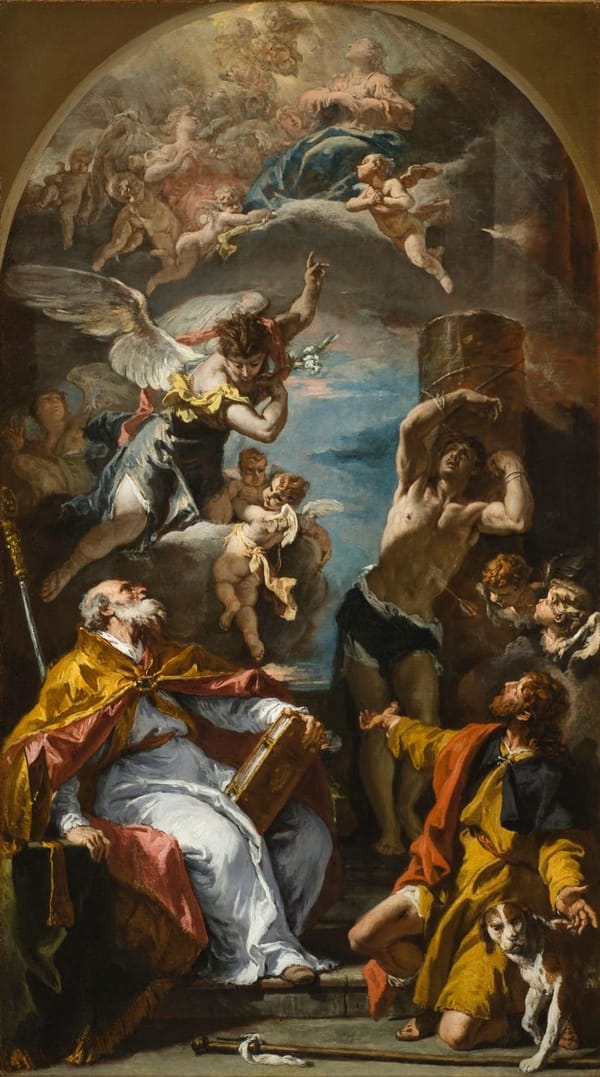
December 16: Saint Eusebius, Bishop of Vercelli and Martyr
When asked to tell the names of the saints who were foremost in defending the dogma of the Incarnation, we think at once of the intrepid Eusebius of Vercelli, as one of the glorious number. The Catholic faith, which was so violently attacked in the fourth century by the Arian heresy, was maintained at that time by the labours and zeal of four sovereign Pontiffs: Sylvester, who confirmed the decrees of the Council of Nicæa: Julius, the supporter of St. Athanasius; Liberius, whose faith failed not, and who, when restored to his liberty, confounded the Arians; and lastly, Damasus, who destroyed the last hopes of the heretics. One of these four Pontiffs appears on our Advent calendar—Damasus, whose feast we kept but a few days since. The four Popes have for their fellow-combatants, in this battle for the Divinity of the Incarnate Word, four great bishops, of whom it may be said that the defence of the dogma of the Consubstantiality of the Son of God was what they lived for, and that to say anathema to them was to say anathema to Christ Himself; all four most powerful in word and work, lights of the Churches of the world, objects of the people’s love, and the dauntless witnesses of Jesus. The first and greatest of the four is the bishop of the second See of Christendom, St. Athanasius, the Patriarch of Alexandria: the second is St. Ambrose of Milan, whose feast we kept on the seventh of this month; the third is the glory of Gaul, St. Hilary, bishop of Poitiers; the fourth is the ornament of Italy, St. Eusebius, bishop of Vercelli, whom we have to honour to-day. Hilary will come to us during Christmastide, and will stand at the crib of the Word, whose Divinity he so bravely confesses; Athanasius will meet us at Easter, and help us to celebrate, in the triumphant Resurrection, Him whom he proclaimed as God in those dark times, when human wisdom hoped to destroy, by fifty years of peace, that Church which had survived the storm of three centuries of persecution. St. Eusebius’ place is Advent; and divine Providence has thus chosen him as one of the patrons of the faithful during this mystic season. His powerful prayers will help us to come devoutly to Bethlehem, and see in the Child, that is lying there, the eternal Word of God. So great were the sufferings which St. Eusebius had to undergo for the Divinity of Jesus, that the Church awards him the honours of a martyr, although he did not actually shed his blood. Let us now listen to the admirable account which the Church gives us of his life.
That Council was held the following year, at Milan; Eusebius was invited by Constantius to be present at it, which was what the legates of Liberius had desired and begged. So far was he from being duped by the synagogue of the malicious Arians to side with them against St. Athanasius, that he openly declared from the first that several of those present were known to him to be heretics, and he therefore proposed that they should subscribe to the Nicene Creed before proceeding any further. This the Arians, infuriated with anger, refused to do; whereupon, he not only refused to subscribe to what was drawn up against Athanasius, but he also, by a most ingenious device, succeeded in having the name of St. Denis the martyr blotted out from the decree, which the craft of the Arians had induced him to sign. Wherefore, they being exceedingly angry against Eusebius, loaded him with injuries, and had him sent into banishment. The holy man, on his side, shaking off the dust from his feet, caring little either for the threats of the emperor, or the sword which was held over him, submitted to banishment as to something which belonged to his episcopal office. Being sent to Scythopolis, he there endured hunger, thirst, blows, and sundry other punishments; he generously despised his life for the true faith, feared not death, and gave up his body to the executioners.
Valiant soldier of Jesus, Eusebius, martyr and pontiff, how much labour and suffering thou didst undergo for the Messias! And yet, they seemed to thee to be little in comparison with what is due to this eternal Word of the Father, who, out of His pure love, has made Himself the Servant of His own creatures, by becoming Man for them in the mystery of the Incarnation. We owe the same debt of gratitude to this divine Saviour. He is born in a stable for our sake, as He was for thine; pray, therefore, for us that we may be ever faithful to Him both in war and in peace; and that we may resist our temptations and evil inclinations with that same firmness, wherewith we would confess His name before tyrants and persecutors. Obtain for the bishops of our holy mother the Church such vigilance, that no false doctrines may surprise them, and such courage that no persecution may make them yield. May they be faithful imitators of the divine Pastor, who gives His life for His sheep; and may they ever feed the flock entrusted to them in the unity and charity of Jesus Christ.
Let us consider how our blessed Lady, having returned to Nazareth, is overwhelmed with joy to feel living within her Him, who gives being to every created thing, and whom she loves with all the intensity of the Mother of God. Joseph, the faithful guardian of her virginity, tenderly loves this his spouse, and blesses God for having entrusted such a treasure to his keeping. The angels crowd round this favoured house wherein dwell their sovereign Lord, and she whom He has chosen to be His Mother. Never was there happiness like that which fills this little dwelling; and yet, God has decreed to visit it with a heavy trial, in order that He may give an occasion to Mary to exercise heroic patience, and to Joseph an occasion of meriting by his exquisite prudence. Let us listen to the Meditation of St. Bonaventure, in which he thus ponders the Gospel narrative:
'But while our Lady and Joseph her spouse were thus dwelling together, the Infant Jesus grew within His Mother’s womb. Then Joseph, perceiving that Mary was with Child, was above all measure grieved. Here give, I pray thee, all thine attention, for thou hast many fair things to learn. If thou wouldst know wherefore it was that our Lord wished that His Mother should have a husband, whereas He always wished that she should be a Virgin, I answer thee that He so wished on three accounts: firstly, that she might not be disgraced when it was seen that she was a Mother: secondly, that she might have Joseph’s aid and company; and thirdly, that the birth of the Son of God might be concealed from the devil.
‘Now, Joseph did look many times on Mary, and grief and trouble of heart fell upon him, and his displeasure was seen in his face, and he turned his eyes away from her as one that was guilty of that which he perforce suspected. See how God permits His servants to be afflicted and sorely tried, that they may so receive their crown. Now Joseph was minded to put her away privately. In very truth may it be said of this holy man, that his praise is in the Gospel, for the Gospel says of him that he was a just man, that is, a man of great virtue. For albeit they say that no shame, nor suffering, nor insult can befall a man so grievous as that of his wife’s unfaithfulness; yet did Joseph restrain himself withal, and would not accuse Mary, but bore this great injury patiently. He sought not how to avenge himself, but, overcome with pity, and wishing to forgive, he was minded to put her away privately. But herein also had our Lady her share of tribulation, for she took notice of Joseph’s trouble, and it sorely grieved her. Yet did she humbly hold her peace, and hide the gift of God. Better did it seem unto her that evil should be thought of her than that she should reveal the divine mystery, and say aught of herself which would come nigh to boasting. Therefore did she beseech our Lord that Himself would right this matter, and make pass this grief from Joseph and herself. Here thou mayst learn what great tribulation and anxiety was theirs. But God came unto their assistance.
‘He therefore sent His angel, who spake unto Joseph in his sleep, and told him that his spouse had conceived of the Holy Ghost, and that he was to abide with her in all surety and joy. Whereupon, the tribulation ceased, and they were both exceedingly comforted. So likewise would it befall us if we would suffer patiently, for after a storm God brings a calm. Neither oughtest thou to doubt this, for God suffereth not His servants to be afflicted save for their good. After this, Joseph requested our Lady to narrate unto him what had happened; and she faithfully narrated all unto him. Whereupon Joseph remains with his blessed spouse, and lives with her in all contentment, and loves her above what words can say, and diligently provides her with whatsoever she needed. So also our Lady continues to remain confidently with Joseph, and they live right joyfully in their poverty.’
Prayer for the Time of Advent
(The Mozarabic breviary, Wednesday of the first week of Advent, Capitula)
Tuesday of the Third Week of Advent
Cap. xxx.Exspectat Dominus ut misereatur vestri, et ideo exaltabitur parcens vobis; quia Deus judicii Dominus, beati omnes qui exspectant eum. Populus enim Sion habitabit in Jerusalem: plorans nequaquam plorabis: miserans miserebitur tui: ad vocem clamoris tui statim ut audierit, respondebit tibi. Et dabit vobis Dominus panem arctum, et aquam brevem: et non faciet avolare a te ultra doctorem tuum, et erunt oculi tui videntes præceptorem tuum. Et dabitur pluvia semini tuo, ubicumque seminaveris in terra: et panis frugum terrae erit uberrimus et pinguis. Pascetur in possessione tua in die illo agnus spatiose, et tauri tui, et pulli asinorum, qui operantur terram, commixtum migma comedent sicut in area ventilatum est. Et erunt super omnem montem excelsum, et super omnem collem elevatum rivi currentium aquarum in die interfectionis multorum, cum ceciderint turres. Et erit lux lunæ sicut lux solis, et lux solis erit septempliciter sicut lux septem dierum, in die qua alligaverit Dominus vulnus populi sui, et percussuram plagæ ejus sanaverit. Ecce nomen Domini venit de longinquo, ardens furor ejus, et gravis ad portandum: labia ejus repleta sunt indignatione, et lingua ejus quasi ignis devorans. Spiritus ejus velut torrens inundans usque ad medium colli, ad perdendas Gentes in nihilum, et frenum erroris quod erat in maxillis populorum.
Ch. xxx.The Lord waiteth that he may have mercy on you, and therefore shall he be exalted sparing you: because the Lord is the God of judgement, blessed are all they that wait for him. For the people of Sion shall dwell in Jerusalem: weeping thou shalt not weep: he will surely have pity on thee: at the voice of thy cry, as soon as he shall hear, he will answer thee. And the Lord will give you spare bread and short water: and will not cause thy teacher to flee away from thee any more, and thy eyes shall see thy teacher. And rain shall be given to thy seed, wheresoever thou shalt sow in the land: and the bread of the corn of the land shall be most plentiful and fat. The lamb in that day shall feed at large in thy possession, and thy oxen, and the ass-colts, that till the ground, shall eat mingled provender as it was winnowed in the floor. And there shall be upon every high mountain, and upon every elevated hill, rivers of running waters in the day of the slaughter of many, when the towers shall fall. And the light of the moon shall be as the light of the sun, and the light of the sun shall be sevenfold as the light of seven days, in the day when the Lord shall bind up the wound of his people, and shall heal the stroke of their wound. Behold the name of the Lord cometh from afar, his wrath burneth, and is heavy to bear: his lips are filled with indignation, and his tongue as a devouring fire. His breath as a torrent overflowing even to the midst of the neck, to destroy the nations unto nothing, and the bridle of error that was in the jaws of the people.
And are we then to weep no more, O Jesus? Happy we! How could we be sad now that Thou hast heard our prayers, and our eyes shall behold Thee, our Master, and our Teacher? If Thou yet delayest some days longer, it is only that we may have more time to receive what Thou hast made it Thy glory to give—mercy and the pardon of our sins. Oh, the happiness of Thy kingdom! Oh, the richness of our lands, that is, of our souls, when Thy dew shall have fallen upon them! Oh, the sweetness of our Bread, which is to be Thyself, O living Bread come down from heaven! Oh, the brightness of the light which Thou wilt give us, even on the very day when Thou wilt have bound up our wounds! Blessed day, come quickly! And thou, dear night, when Mary is to give her divine Babe to us, when wilt thou come? So great is our hope in this Thy merciful coming, that we listen with less dread to the awful words of Thy prophet, who, with a rapidity swift as Thine own word, passes over the long ages between the two events, and speaks to us of the approach of the terrible day, when Thou wilt come suddenly in Thy burning wrath, with Thy lips filed with indignation, and Thy tongue as a devouring fire. Our present feeling is hope, for we are looking forward to that coming, in which Thou art the beautiful Prince of peace and love, and we cannot but hope. When that last day comes, have mercy on us! but on this day of Thine amiable visit, permit us to say to Thee the words of one of Thy servants: ‘Yes, dear Jesus, come; come to us! but in swathing-bands, not with Thy hand raised to punish us: in humility, not in Thy greatness: in the crib, not in the clouds of heaven: in the arms of Thy Mother, not on the throne of Thy Majesty: on the colt of the ass, not on the Cherubim: to us, and not against us: to save us, and not to judge: to visit us in Thy peace, not to condemn us in Thy anger. If Thou comest unto us thus, O Jesus! it is not from Thee, but to Thee, that we will flee.’ (The venerable Peter of Celles, First sermon of Advent.)
Hymn Taken from the Anthology of the Greeks
(December 20)
Prayer from the Gallican Missal
(InAdventu Domini, Immolatio)
| Previous Monday of the Third Week of Advent | Next Tuesday of the Third Week of Advent |