Daily reading
Movable from Advent · Temporal
December 17, 2025
From Dom Guéranger’s The Liturgical Year.
Wednesday in Ember Week of Advent
To-day the Church begins the fast of Quatuor Tempora, or, as we call it, of Ember days: it includes also the Friday and Saturday of this same week. This observance is not peculiar to the Advent liturgy; it is one which has been fixed for each of the four seasons of the ecclesiastical year. We may consider it as one of those practices which the Church took from the Synagogue; for the prophet Zacharias speaks of the fasts of the fourth, fifth, seventh, and tenth months.* Its introduction into the Christian Church would seem to have been made in the apostolic times; such, at least, is the opinion of St. Leo, of St. Isidore of Seville, of Rabanus Maurus, and of several other ancient Christian writers. It is remarkable, on the other hand, that the orientals do not observe this fast.
From the first ages the Quatuor Tempora were kept, in the Roman Church, at the same time of the year as at present. As to the expression, which is not unfrequently used in the early writers, of the three times and not the four, we must remember that in the spring, these days always come in the first week of Lent, a period already consecrated to the most rigorous fasting and abstinence, and that consequently they could add nothing to the penitential exercises of that portion of the year.
The intentions, which the Church has in the fast of the Ember days, are the same as those of the Synagogue; namely, to consecrate to God by penance the four seasons of the year. The Ember days of Advent are known, in ecclesiastical antiquity, as the fast of the tenth month; and St. Leo, in one of his sermons on this fast, of which the Church has inserted a passage in the second nocturn of the third Sunday of Advent, tells us that a special fast was fixed for this time of the year, because the fruits of the earth had then all been gathered in, and that it behoved Christians to testify their gratitude to God by a sacrifice of abstinence, thus rendering themselves more worthy to approach to God, the more they were detached from the love of created things. 'For fasting,’ adds the holy doctor, 'has ever been the nourishment of virtue. Abstinence is the source of chaste thoughts, of wise resolutions, and of salutary counsel. By voluntary mortifications, the flesh dies to its concupiscences, and the spirit is renewed in virtue. But since fasting alone is not sufficient whereby to secure the soul’s salvation, let us add to it works of mercy towards the poor. Let us make that which we retrench from indulgence, serve unto the exercise of virtue. Let the abstinence of him that fasts, become the meal of the poor man.’
Let us, the children of the Church, practise what is in our power of these admonitions; and since the actual discipline of Advent is so very mild, let us be so much the more fervent in fulfilling the precept of the fast of the Ember days. By these few exercises which are now required of us, let us keep up within ourselves the zeal of our forefathers for this holy season of Advent. We must never forget that although the interior preparation is what is absolutely essential for our profiting by the coming of our Lord Jesus Christ, yet this preparation could scarcely be real unless it manifested itself by the exterior practices of religion and penance.
The fast of the Ember days has another object besides that of consecrating the four seasons of the year to God by an act of penance: it has also in view the ordination of the ministers of the Church, which takes place on the Saturday, and of which notice was formerly given to the people during the Mass of the Wednesday. In the Roman Church, the ordination held in the month of December was, for a long time, the most solemn of all; and it would appear, from the ancient chronicles of the Popes, that, excepting very extraordinary cases, the tenth month was, for several ages, the only time for conferring Holy Orders in Rome. The faithful should unite with the Church in this her intention, and offer to God their fasting and abstinence for the purpose of obtaining worthy ministers of the word and of the Sacraments, and true pastors of the people.
The Church does not read anything, in the Matins of to-day, from the prophet Isaias: she merely reads a sentence from the chapter of St. Luke, which gives our Lady’s Annunciation, to which she subjoins a passage from St. Ambrose’s Homily on that Gospel. The fact of this Gospel having been chosen for the Office and Mass of to-day, has made the Wednesday of the third week of Advent a very marked day in the calendar. In several ancient Ordinaries, used by many of the larger churches, both cathedral and abbatial, we find it prescribed that feasts falling on this Wednesday should be transferred: that the ferial prayers should not be said kneeling on that day; that the Gospel Missus est, that is, of the Annunciation, should be sung at Matins by the celebrant vested in a white cope, with cross, lights, and incense, the great bell tolling meanwhile; that in abbeys, the abbot should preach a homily to the monks, as on solemn feasts. We are indebted to this custom for the four magnificent sermons of St. Bernard on our blessed Lady, which are entitled: Super Missus est.
As the Mass of the Ember days is seldom sung, excepting in churches where the canonical Office is said, as also that we might not add unnecessarily to this volume, we have thought it advisable to omit the Masses of Ember Wednesday, Friday, and Saturday of Advent. The Station for the Wednesday is at St. Mary Major, on account of the Gospel of the Annunciation, which, as we have just seen, has caused this day to be looked upon as a real feast of the blessed Virgin.
Having to speak, later on, of this mystery, in the proper of saints, we will conclude this Wednesday with a prose of the middle ages, in honour of our blessed Lady’s receiving the angel’s salutation, and with a prayer taken from one of the ancient liturgies.
Prose in Honour of the Blessed Virgin
(Taken from the missal of Cluny of 1523.)
Subintrans in conclavi,
Virginis formidinem
Demulcens, inquit ei:
Cœli terraeque Dominum
Concipies et paries,
Salutem hominum;
Tu porta cœli facta,
Medela criminum
Quæ virum non cognovi?
Qualiter infringerem
Quæ firma mente vovi?
Perficiet haec omnia:
Ne timeas, sed gaudeas,
Quod castimonia
Manebit in te pura,
Dei potentia.
Respondens inquit ei:
Servula sum humilis
Omnipotentis Dei.
Tanti secreti conscio,
Consentiens, et cupiens
Factum quod audio,
Parata sum parere
Dei consilio.
Et statim puellaris
Uterus intumuit,
Vi partus virginalis.
Novem mensium numero,
Hinc exiit et iniit
Affigens humero crucem,
Quæ dedit ictum
Hosti mortifero.
Quæ pacem reddidisti
Angelo et homini,
Quando Christum genuisti;
Ut se nobis propitium
Exhibeat, et deleat
Præstans auxilium
Vita frui beata,
Post hoc exsilium.
entering the Virgin’s chamber,
and gently bidding her not to fear,
says to her:
thou shalt conceive in thy womb
the Lord of heaven and earth;
thou shalt bring forth the salvation of mankind,
O gate of heaven bringing to the world
the remedy of its iniquities!
for I know not man?
How wouldst thou have me
break the vow which I have sworn to keep?
shall accomplish all these things, said the angel.
Fear not, but rejoice.
shall be left intact:
the power of God
shall maintain it.
said to the angel:
I am the lowly handmaid
of the omnipotent God.
O heavenly messenger,
bearer of so great a secret,
what thou announcest,
I am ready to obey
the decree of God.
and in that moment her virginal womb conceived
the Word made flesh
from hers.
for nine months:
then he left it, and began
carrying the cross upon his shoulders,
wherewith he struck the enemy who brought death into the world.
who didst bring peace
to angels and to men
by giving birth to Christ,
that he be merciful to us,
and forgive us
and give us his assistance,
whereby, after this exile,
we may possess the blessed joys of eternal life.
Prayer from the Mozarabic Missal
(Second Sunday of Advent, Illatio)
* Zach. viii. 19. ↩︎
December 17: The Commencement of the Great Antiphons
The Church enters to-day on the seven days which precede the Vigil of Christmas, and which are known in the liturgy under the name of the Greater Ferias. The ordinary of the Advent Office becomes more solemn; the antiphons of the psalms, both for Lauds and the Hours of the day, are proper, and allude expressly to the great coming. Every day, at Vespers, is sung a solemn antiphon, consisting of a fervent prayer to the Messias, whom it addresses by one of the titles given Him in the sacred Scriptures.
In the Roman Church, there are seven of these antiphons, one for each of the greater ferias. They are commonly called the O’s of Advent, because they all begin with that interjection. In other Churches, during the middle ages, two more were added to these seven; one to our blessed Lady, O Virgo virginum; and the other to the angel Gabriel, O Gabriel; or to St. Thomas the apostle, whose feast comes during the greater ferias; it began O Thoma Didyme.1 There were even Churches where twelve great antiphons were sung; that is, besides the nine we have just mentioned, O Rex Pacifice to our Lord, O mundi Domina, to our Lady, and O Hierusalem to the city of the people of God.
The canonical Hour of Vespers has been selected as the most appropriate time for this solemn supplication to our Saviour, because, as the Church sings in one of her hymns, it was in the evening of the world (vergente mundi vespere) that the Messias came amongst us. These antiphons are sung at the Magnificat, to show us that the Saviour whom we expect is to come to us by Mary. They are sung twice, once before and once after the canticle, as on double feasts, and this to show their great solemnity. In some Churches it was formerly the practice to sing them thrice; that is, before the canticle, before the Gloria Patri, and after the Sicut erat. Lastly, these admirable antiphons, which contain the whole pith of the Advent liturgy, are accompanied by a chant replete with melodious gravity, and by ceremonies of great expressiveness, though, in these latter, there is no uniform practice followed. Let us enter into the spirit of the Church; let us reflect on the great day which is coming; that thus we may take our share in these the last and most earnest solicitations of the Church imploring her Spouse to come, to which He at length yields.
First Antiphon
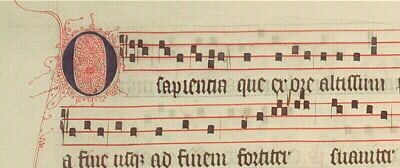
O uncreated Wisdom, who art so soon to make Thyself visible to Thy creatures, truly Thou disposest all things. It is by Thy permission that the emperor Augustus issues a decree ordering the enrolment of the whole world. Each citizen of the vast empire is to have his name enrolled in the city of his birth. This prince has no other object in this order, which sets the world in motion, but his own ambition. Men go to and fro by millions, and an unbroken procession traverses the immense Roman world; men think they are doing the bidding of man, and it is God whom they are obeying. This world-wide agitation has really but one object; it is, to bring to Bethlehem a man and woman who live at Nazareth in Galilee, in order that this woman, who is unknown to the world but dear to heaven, and who is at the close of the ninth month since she conceived her Child, may give birth to this Child in Bethlehem; for the Prophet has said of Him: ‘His going forth is from the beginning, from the days of eternity. And thou, O Bethlehem! art not the least among the thousand cities of Juda, for out of thee He shall come.’2 O divine Wisdom! how strong art Thou in thus reaching Thine ends by means which are infallible, though hidden; and yet, how sweet, offering no constraint to man’s free-will; and withal, how fatherly, in providing for our necessities! Thou choosest Bethlehem for Thy birth-place, because Bethlehem signifies the house of bread. In this, Thou teachest us that Thou art our Bread, the nourishment and support of our life. With God as our food, we cannot die. O Wisdom of the Father, living Bread that hast descended from heaven, come speedily into us, that thus we may approach to Thee and be enlightened3 by Thy light, and by that prudence which leads to salvation.
A Prayer for the Time of Advent
(The Mozarabic breviary, fourth Sunday of Advent, Oratio)
| Previous Tuesday of the Third Week of Advent | Next December 17: The Commencement of the Great Antiphons |