Daily reading
Movable from Advent · Temporal
December 18, 2025
From Dom Guéranger’s The Liturgical Year.
Thursday of the Third Week of Advent
Cap. xxxiii.Domine, miserere nostri: te enim exspectavimus: esto brachium nostrum in mane, et salus nostra in tempore tribulationis. A voce angeli fugerunt populi, et ab exaltatione tua dispersæ sunt Gentes. Et congregabuntur spolia vestra sicut colligitur bruchus, velut cum fossæ plenæ fuerint de eo. Magnifìcatus est Dominus, quoniam habitavit in excelso: implevit Sion judicio et justitia. Et erit fides in temporibus tuis: divitiæ salutis sapientia et scientia: timor Domini ipse est thesaurus ejus. Conterriti sunt in Sion peccatores: possedit tremor hypocritas. Quis poterit habitare de vobis cum igne devorante? quis habitabit ex vobis cum ardoribus sempiternis? Qui ambulat in justitiis, et loquitur veritatem, qui projicit avaritiam ex calumnia, et excutit manus suas ab omni munere, qui obturat aures suas ne audiat sanguinem, et claudit oculos suos ne videat malum. Iste in excelsis habitabit, munimenta saxorum sublimitas ejus: panis ei datus est, aquæ ejus fideles sunt. Regem in decore suo videbunt oculi ejus: cernent terram de longe.
Ch. xxxiii.O Lord, have mercy on us: for we have waited for thee: be thou our arm in the morning, and our salvation in the time of trouble. At the voice of the angel the people fled, and at the lifting up thyself the nations are scattered. And your spoils shall be gathered together as the locusts are gathered, as when the ditches are full of them. The Lord is magnified, for he hath dwelt on high: he hath filled Sion with judgement and justice. And there shall be faith in thy times, riches of salvation, wisdom and knowledge: the fear of the Lord is his treasure. The sinners in Sion are afraid: trembling hath seized upon the hypocrites. Which of you can dwell with devouring fire? which of you shall dwell with everlasting burning? He that walketh in justices, and speaketh truth, that casteth away avarice by oppression, and shaketh his hands from all bribes, that stoppeth his ears lest he hear blood, and shutteth his eyes that he may see no evil. He shall dwell on high, the fortifications of rocks shall be his highness: bread is given him, his waters are sure. His eyes shall see the king in his beauty; they shall see the land far off.
Happy he whose eyes shall thus contemplate the new-born King in the sweet majesty of His love and His humility! He shall be so taken with this His beauty, that the earth, with all its magnificence, shall appear as nothing in his eyes. The only thing he will care to look upon, will be the Child laid in a manger, and wrapped in swaddling clothes. But, that we may have this happiness of closely contemplating the divine King who is coming to us, that we may merit to enter His court, we must do as the prophet bids us: we must walk in justice, and speak truth. Let us listen to the pious Rabanus Maurus, who expresses this, with much unction, in his first sermon on preparation for the feast of Christmas: ‘If at all times it behoves us to be adorned with the comeliness of good works, we should be so, with an especial care, on the day of our Saviour’s birth. Consider within yourselves, my brethren, what you would do, were a king, or prince, to invite you to come to celebrate his birthday. Your garments would be as new, as elegant, even as magnificent, as you could procure them, for you would think it an insult to him who invited you, were you to appear before him with anything upon you that was tom, or poor, or unclean. Show a like solicitude on the occasion of the coming feast: and let your souls, beautified with the several ornaments of virtue, go forth to their King. He loves the pearls of simplicity, and the flowers of chaste sobriety: wear them therefore. Let your consciences be composed in a holy calm, now that the solemn feast of Jesus’ Nativity is so close upon us. Assist at it lovely in your chastity, gorgeous in your charity, beauteous by your almsdeeds, brilliant with justice and humility, and, above all, radiant in the love of God. If the Lord Jesus shall see you thus when you keep His feast, believe me, He will do more than visit your souls; He will treat you with such familiarity, that He will choose them for His favourite abode, and there He will dwell for ever, as it is written: Behold! I will come, and I will dwell with them and they shall be my people, and I will be their God.’ Christians, you have no time to lose: quickly prepare yourselves for this great visit. Let sinners be converted and become just: let the just become more just; let the holy become more holy, for He that is coming is the Lord our God, and none else.
Prose for the Time of Advent
(Composed in the eleventh century, and taken from the ancient Roman-French missals)
Per quem condita sunt sæcula;
Cœlum quod plurima luce coruscat, et diversa sidera;
Sol mundi schema, noctium decus luna, cunctaque splendentia;
Mare, solum, alta, plana, et profunda flumina;
Aeris ampla spatia: quæ discurrunt aves, venti atque pluvia.
Haec simul cuncta tibi soli Deo Patri militant.
Nunc et in ævum, sine fine per sæcula:
Laus eorum tua gloria:
Qui pro salute nostra Prolem unicam,
Pati in terra misisti sine culpa, sed ob nostra delicta.
Te, sancta Trinitas, precamur, ut corpora nostra et corda regas et protegas, et dones peccatorum veniam. Amen.
By whom all ages were made;
The firmament, which shines with much light, and the countless stars;
The sun, the ornament of the world; the moon, which is the night’s beauty; and all shining things;
The sea, the land, the hills, the plains, and the deep rivers;
The wide space of the air, through which float birds, and winds, and rain;
All these obey thee alone, O God, as their Maker and King.
Now and evermore, for endless ages:
Their praise is thy glory;
Who for our salvation didst send thine only-begotten Son,
In whom could be no sin, to suffer on earth for our sins.
We beseech thee, O holy Trinity, to govern and protect our souls and bodies, and grant us forgiveness of cur sins. Amen.
Prayer from the Ambrosian Missal
(Second Sunday of Advent, Præfatio)
December 18: Second Antiphon
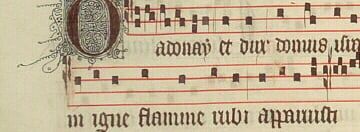
O sovereign Lord! O Adonai! come and redeem us, not by Thy power, but by Thy humility. Heretofore, Thou didst show Thyself to Moses Thy servant in the midst of a mysterious flame; Thou didst give Thy law to Thy people amidst thunder and lightning; now, on the contrary, Thou co mest not to terrify, but to save us. Thy chaste Mother having heard the emperor’s edict, which obliges her and Joseph her spouse to repair to Bethlehem, prepares everything needed for Thy divine Birth. She prepares for Thee, O Sun of justice! the humble swathing-bands, wherewith to cover Thy nakedness, and protect Thee, the Creator of the world, from the cold of that midnight hour of Thy Nativity! Thus it is that Thou wiliest to deliver us from the slavery of our pride, and show man that Thy divine arm is never stronger than when he thinks it powerless and still. Everything is prepared, then, dear Jesus! Thy swathing-bands are ready for Thy infant limbs! Come to Bethlehem, and redeem us from the hands of our enemies.
December 18 (the Same Day): The Expectation of the Blessed Virgin Mary
This feast, which is now kept not only throughout the whole of Spain but in many other parts of the Catholic world, owes its origin to the bishops of the tenth Council of Toledo, in 656. These prelates thought that there was an incongruity in the ancient practice of celebrating the feast of the Annunciation on the twenty-fifth of March, inasmuch as this joyful solemnity frequently occurs at the time when the Church is intent upon the Passion of our Lord, so that it is sometimes obliged to be transferred into Easter time, with which it is out of harmony for another reason; they therefore decreed that, henceforth, in the Church of Spain there should be kept, eight days before Christmas, a solemn feast with an octave, in honour of the Annunciation, and as a preparation for the great solemnity of our Lord’s Nativity. In course of time, however, the Church of Spain saw the necessity of returning to the practice of the Church of Rome, and of those of the whole world, which solemnize the twenty-fifth of March as the day of our Lady’s Annunciation and the Incarnation of the Son of God. But such had been, for ages, the devotion of the people for the feast of the eighteenth of December, that it was considered requisite to maintain some vestige of it. They discontinued, therefore, to celebrate the Annunciation on this day; but the faithful were requested to consider, with devotion, what must have been the sentiments of the holy Mother of God during the days immediately preceding her giving Him birth. A new feast was instituted, under the name of 'the Expectation of the blessed Virgin’s delivery.’
This feast, which sometimes goes under the name of Our Lady of O, or the feast of O, on account of the great antiphons which are sung during these days, and, in a special manner, of that which begins O Virgo virginum (which is still used in the Vespers of the Expectation, together with the O Adonai, the antiphon of the Advent Office), is kept with great devotion in Spain. A High Mass is sung at a very early hour each morning during the octave, at which all who are with child, whether rich or poor, consider it a duty to assist, that they may thus honour our Lady’s Maternity, and beg her blessing upon themselves. It is not to be wondered at that the holy See has approved of this pious practice being introduced into almost every other country. We find that the Church of Milan, long before Rome conceded this feast to the various dioceses of Christendom, celebrated the Office of our Lady’s Annunciation on the sixth and last Sunday of Advent, and called the whole week following the Hebdomada de Exceptato (for thus the popular expression had corrupted the word Expectato). But these details belong strictly to the archaeology of liturgy, and enter not into the plan of our present work; let us, then, return to the feast of our Lady’s Expectation, which the Church has established and sanctioned as a new means of exciting the attention of the faithful during these last days of Advent.
Most just indeed it is, O holy Mother of God, that we should unite in that ardent desire thou hadst to see Him, who had been concealed for nine months in thy chaste womb; to know the features of this Son of the heavenly Father, who is also thine; to come to that blissful hour of His birth, which will give glory to God in the highest, and, on earth, peace to men of good-will. Yes, dear Mother, the time is fast approaching, though not fast enough to satisfy thy desires and ours. Make us redouble our attention to the great mystery; complete our preparation by thy powerful prayers for us, that when the solemn hour has come, our Jesus may find no obstacle to His entrance into our hearts.
The Great Antiphon to Our Lady
| Previous December 17: The Commencement of the Great Antiphons | Next December 18: Second Antiphon |