Daily reading
Movable from Advent · Temporal
December 19, 2025
From Dom Guéranger’s The Liturgical Year.
Friday in Ember Week of Advent
The Church does not read anything from the prophet Isaias to-day; she merely gives, in the Office of Matins, a sentence of that chapter of St. Luke’s Gospel, which relates the mystery of our Lady’s Visitation: and to this she subjoins a fragment of St. Ambrose’s homily upon that passage. The considerations and affections with which this important event of our Lady’s life ought to inspire the faithful, will be given further on in the proper of the saints.
The Station for to-day is in the church of the Holy Apostles, which many suppose to have been first built by Constantine. The glorious bodies of the two holy apostles Philip and James the Less, lie buried under the altar, awaiting the second coming of Him who chose them as His co-operators in the work of the first, and who will give them, on the last day, to sit upon thrones near His own, judging the twelve tribes of Israel.*
That we may better conform to the intentions of our holy mother the Church, who offers to our contemplation the Visitation of the blessed Virgin, let us recite the following hymn, composed in honour of this mystery during the ages of faith.
A Prose in Honour of the Blessed Virgin
(Taken from the ancient Roman-French missals)
Virginis humilitas.
Ave, omni nodo carons,
Humilis virginitas.
Nec gravaris Filio:
Gaude quae sic oneraris
Onere gratissimo.
Virgula fructifera.
Salve, clausa templi porta,
Soli Deo pervia.
Rore madens Pneumatis.
Plaude, pellis Salomonis,
Pulchrior præ cæteris.
Circumlustrans maria.
Vale consignata cella,
Rubus in vi flammea.
Solem gignis stellula.
Euge, quod sis præelecta,
Scala cœli fulgida.
Luce novi sideris;
Pange, arca trina ferens
Charismata miseris.
Jesum Christum anima;
Eia! tecum ut laudemus
Ora, dulcis Maria.
of the divine Word!
Hail, most humble
and most spotless Virgin!
of a Son who supports thee!
Rejoice, thy burden is a burden
most sweet to bear!
Fruit-bearing branch!
Hail gate of the temple,
closed to all but God!
full of the dew of the holy Spirit!
Be glad, thou tent of Solomon,
of all the first in beauty!
lighting up the sea!
Hail, thou sealed-up sanctuary,
thou burning bush!
shouldst be clad with the Sun, and then bring forth the Sun!
What bliss is thine, that thou shouldst be elected
the bright ladder reaching up to heaven!
thou aurora rising in the light of the new Star!
Sing, thou ark of the covenant,
bearing unto us sinners thy three treasures.
and oh! sweet Mary,
pray that, with thee,
we too may magnify him.
Prayer from the Gallican Sacramentary
(In Adventu Domini, Collect)
* St. Matt. xix. 28. ↩︎
December 19: The Third Antiphon
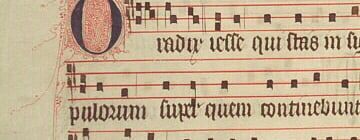
At length, O Son of Jesse! Thou art approaching the city of Thy ancestors. The Ark of the Lord has risen, and journeys, with the God that is in her, to the place of her rest. ‘How beautiful are thy steps, O thou daughter of the Prince,’1 now that thou art bringing to the cities of Juda their salvation! The angels escort thee, thy faithful Joseph lavishes his love upon thee, heaven delights in thee, and our earth thrills with joy to bear thus upon itself its Creator and its Queen. Go forward, O Mother of God and Mother of men! Speed thee, thou propitiatory that holdest within thee the divine Manna which gives us life! Our hearts are with thee, and count thy steps. Like thy royal ancestor David, ‘we will not enter into the dwelling of our house, nor go up into the bed whereon we lie, nor give sleep to our eyes, nor rest to our temples, until we have found a place in our hearts for the Lord whom thou bearest, a tabernacle for this God of Jacob.’2 Come, then, O Root of Jesse! thus hidden in this Ark of purity; Thou wilt soon appear before Thy people as the standard round which all that would conquer must rally. Then their enemies, the kings of the world, will be silenced, and the nations will offer Thee their prayers. Hasten Thy coming, dear Jesus! come and conquer all our enemies, and deliver us.
A Responsory of Advent
(Ambrosian breviary, sixth Sunday of Advent)
| Previous December 18 (the Same Day): The Expectation of the Blessed Virgin Mary | Next December 19: The Third Antiphon |