Daily reading
Christmas
Double of the II Class · Movable from Advent · Temporal
December 28, 2025
From Dom Guéranger’s The Liturgical Year.

|
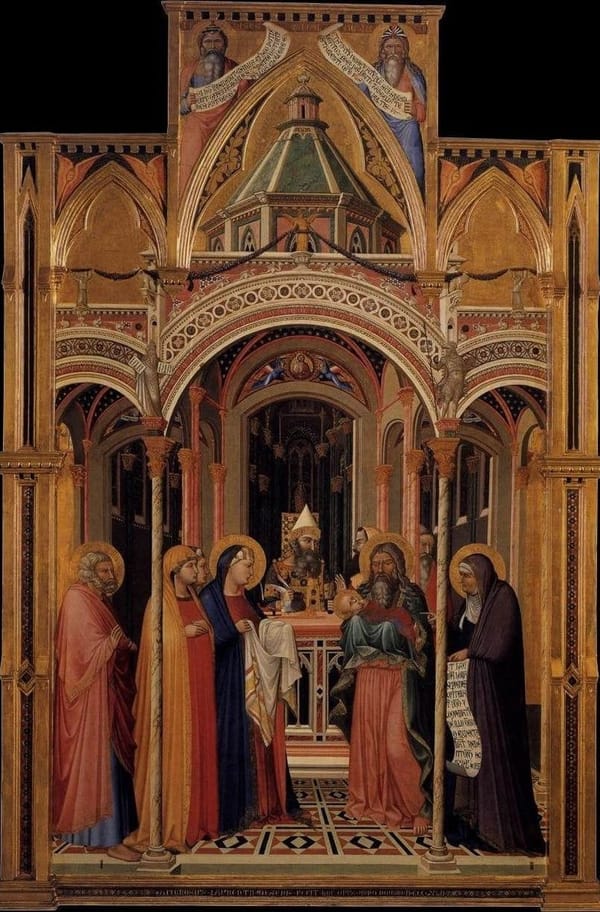
Sunday within the Octave of Christmas or the Sixth Day within the Octave of Christmas
(If December 30 falls on a Saturday, it is called the Sixth Day within the Octave, and the third Mass of Christmas Day, page 202, is repeated, except for the Epistle and Gospel, which are taken from the second Mass, pages 191, 192, the extra prayers are given on page 415, and in this case the Office of the Sunday in the Octave is said on December 31, with a commemoration of St Silvester. But if December 30 falls on any other day of the week, the Office is of the Sunday within the Octave of Christmas.)
THIS is the only day within the Christmas Octave which is not a Saint’s Feast. During the Octaves of the Epiphany, Easter and Pentecost, the Church is so absorbed in the respective mysteries that she puts off everything that could share her attention; whereas during this of Christmas, there is only one day which does not celebrate the memory of some glorious Saint, and our Infant Jesus is surrounded by a choir of heroes who loved and served him. Thus the Church, or, more correctly, God—for God is the first author of the cycle of the year—shows us how the Incarnate Word, who came to save mankind, desires to give mankind confidence by this his adorable familiarity.
We have already shown that the Birth of our Lord took place on a Sunday, the Day on which, in the beginning of the world, God created Light. We shall find, later on, that his Resurrection also was on a Sunday. This the first day of creation, and the first of the week, was consecrated by the old Pagans to the Sun: with us Christians, it is most sacred and holy, on account of the two risings of our divine Sun of Justice—his Birth and his Resurrection. Whilst the solemnity of Easter is always kept on a Sunday, that of Christmas falls by turns on each of the days of the week—we have already had this difference explained to us by the Holy Fathers: but the mystery of Jesus’ Birth is more aptly and strongly expressed, when its anniversary falls on a Sunday. Other years, when the coincidence does not happen, the Faithful will at least be led by their Christian instincts, to give especial honour to the day within the Octave which falls on the Sunday. The Church has honoured it with a proper Mass and Office, and we of course insert them.
Mass
It was at midnight that the Lord delivered his people from bondage, by the Passage of his destroying Angel over the land of the Egyptians: so also was it in the still hour of midnight that Jesus, the Angel of Great Counsel, came down from his royal throne, bringing mercy to our earth. It is just, that whilst commemorating this second Passage, the Church should sing the praises of her Emmanuel, who comes, clad in his strength and beauty, to take possession of his Kingdom.
Introit
In the Collect the Church prays to be directed by that divine rule which was taught us by our Saviour, the Sun of Justice, who shone upon us in order to enlighten and guide our steps in the path of good works.
Collect
The Commemoration of the Octave of Christmas is given on page 228.
Epistle
Cap. IV.Fratres, quanto tempore hæres parvulus est, nihil differt a servo, cum sit dominus omnium: sed sub tutoribus et actoribus est usque ad præfinitum tempus a patre: ita et nos, cum essemus parvuli, sub elementis mundi eramus servientes. At ubi venit plenitudo temporis, misit Deus Filium suum factum ex muliere, factum sub lege, ut eos, qui sub lege erant, redimeret, ut adoptionem filiorum reciperemus. Quoniam autem estis filii, misit Deus Spiritum Filii sui in corda vestra, clamantem: Abba, Pater. Itaque jam non est servus, sed filius. Quod si filius: et hæres per Deum,
Ch. IV.Brethren: As long as the heir is a child, he differeth nothing from a servant, though he be lord of all: but is under tutors and governors, until the time appointed by the father: so we also, when we were children, were serving under the elements of the world. But when the fulness of the time was come, God sent his Son, made of a woman, made under the law, that he might redeem them who were under the law, that we might receive the adoption of sons. And because you are sons, God hath sent the Spirit of his Son into your hearts, crying: Abba, Father. Therefore now he is not a servant, but a son. And if a son, an heir also, through God.
The Child that is born of Mary and is couched in the Crib at Bethlehem, raises his feeble voice to the Eternal Father, and calls him, My Father! He turns towards us and calls us My Brethren! We, consequently, when we speak to his Father, may call him Our Father! This is the mystery of adoption, revealed to us by the great event we are solemnizing. All things are changed, both in heaven and on earth: God has not only one Son, he has many sons; henceforth we stand before this our God, not merely creatures drawn out of nothing by his power, but children that he fondly loves. Heaven is now not only the throne of his sovereign Majesty; it is become our inheritance, in which we are joint-heirs with our Brother Jesus, the Son of Mary, Son of Eve, Son of Adam, according to his Human Nature, and (in the unity of Person) Son of God according to his Divine Nature. Let us turn our wondering and loving thoughts first to this sweet Babe, that has brought us all these blessings, and then to the blessings themselves, to the dear inheritance made ours by him. Let our mind be seized with astonishment at creatures having such a destiny! and then let our heart pour out its thanks for the incomprehensible gift!
Gradual
Gospel
Cap. II.In illo tempore: Erat Joseph, et Maria mater Jesu, mirantes super his quæ dicebantur de illo. Et benedixit illis Simeon, et dixit ad Mariam matrem ejus: Ecce positus est hic in ruinam et in resurrectionem multorum in Israel: et in signum cui contradicetur: et tuam ipsius animam pertransibit gladius, ut revelentur ex multis cordibus cogitationes. Et erat Anna Prophetissa, filia Phanuel, de tribu Aser. Hæc processerat in diebus multis, et vixerat eum viro suo annis septem a virginitate sua. Et hæc vidua usque ad annos octoginta quatuor: quæ non discedebat de templo, jejuniis et obsecrationibus serviens nocte ac die. Et hæc, ipsa hora superveniens, confitebatur Domino, et loquebatur de illo omnibus, qui exspectabant redemptionem Israel. Et ut perfecerunt omnia secundum legem Domini, reversi sunt in Galilæam, in civitatem suam Nazareth. Puer autem crescebat, et confortabatur, pienus sapientia: et gratia Dei erat in illo.
Ch. II.At that time: Joseph, and Mary the Mother of Jesus, were wondering at those things which were spoken concerning him. And Simeon blessed them, and said to Mary his Mother: Behold, this Child is set for the fall and for the resurrection of many in Israel: and for a sign which shall be contradicted: and thine own soul a sword shall pierce, that out of many hearts thoughts may be revealed. And there was one Anna, a prophetess, the daughter of Phanuel, of the tribe of Aser: she was far advanced in years, and had lived with her husband seven years from her virginity. And she was a widow until fourscore and four years: who departed not from the temple, by fastings and prayers serving day and night. Now she at the same hour, coming in, confessed to the Lord, and spoke of him to all that looked for the redemption of Israel. And after they had performed all things according to the law of the Lord, they returned into Galilee, to their city Nazareth. And the Child grew and waxed strong, full of wisdom: and the grace of God was in him.
The passage of the Gospel selected for this Mass, though bearing on the Divine Infancy, yet gives us, we may almost say prematurely, the terrible prophecy of Simeon regarding the dear Babe of Bethlehem. The heart of Mary, that was overflowing with joy at the miraculous Birth of her Child, is here made to feel the sword spoken of by the venerable Priest of the temple. Her Son, then, is to be but a sign that shall he contradicted! The mystery of man's adoption by God is to cost this Child of hers his life! We that are the Re deemed in his Blood, we may not yet dwell on the fatigues and the Passion and the Death of our Emmanuel; the time will come for that; at present we are forbidden to think of him other than as the sweet Child that is born to us, the source of all our happiness by his having come among us. Let us catch up the words of Anna, who calls him the Redemption of Israel. Let our eye delight in the sight of the earth regenerated by the birth of its Saviour. Let us admire and study well this Jesus newly born among us, and adore in humble love the wisdom and grace that are in him.
During the Offertory, the Church celebrates the wonderful renovation wrought in the world, a renovation which saved it from destruction. She sings the praises of the great God who came down into the poor Stable of Bethlehem, yet left not his eternal throne.
Offertory
Secret
The Commemoration of the Octave is given above, p. 232.
The words chanted by the Church at the Communion are those spoken by the Angel to St Joseph. She has given this Divine Infant to her faithful children in Holy Communion, in order that they may carry him in their hearts, and bids them guard him against the snares laid for him by his and their enemies. Let the
Christian, therefore, take heed lest Jesus should be taken from him. Let him, by strict watchfulness and by good works, crush the tyrant sin that seeks the life of the Divine Guest of his soul. It is for this reason that, in the Postcommunion, the Church prays that our vices may be destroyed, and our desires for a virtuous life be blessed.
Communion
Postcommunion
The Commemoration of the Octave is given above, p. 233.
Vespers
If December 30 be kept as the Sunday in the Octave of Christmas, Vespers are as follows:
The Antiphons and Psalms are those of Christmas Day, p. 210.
Capitulum (Gal. iv)
Hymn, Jesu Redemptor omnium, p. 217.
Antiphon to the Magnificat
Commemoration of St Sylvester, Pope
Then Commemoration of Christmas Day, p.321.
But if the Sunday in the Octave be kept on December 31, Vespers are as above, except that the Antiphon to the Magnificat is Dum medium silentium, as on p.321; and commemorations are made of St Sylvester, as above, and of the Octave of Christmas, as on p. 321.
On this the sixth day since the Birth of our Emmanuel, let us consider how the Divine Infant lies in the Crib of a Stable, and is warmed by the breath of the Ox and the Ass, as Isaias had foretold: The ox knoweth his owner, and the ass his master's crib; but Israel hath not known me.1 Thus does the great God enter that world which his own hands have created! The dwellings of men are refused him, for man has a hard heart for his God, and an indifference which is a real contempt. The only shelter he can find to be born in is a Stable; and that necessitates his coming into the world in the company of poor dumb brutes.
At all events, these animals are his own work. When he created the irrational world of living things, he subjected it, as the inferior part of creation, to man; and man was to ennoble it, by referring it to the Creator. When Adam sinned, this subjection, this harmony, was broken. The apostle teaches us that the brute creation is not insensible to the degradation thus forced upon it by sinful man.2 It obeys him with reluctance; it not infrequently rebels against and deservedly punishes him; and on the day of judgement it will take the side of its Creator, and avenge itself of that wickedness of which man has made it the unwilling instrument.3
In the mystery of his Birth, the Son of God visits this part of his creation; men refused to receive him, and he accepts the hospitality of the dwelling of brutes. It is from their dwelling that he begins the divine career of the three and thirty years. The first human beings he invites into the company of his blessed Mother and his dear St Joseph, the first he admits into the Stable to see and adore himself, are shepherds, who were busy watching their flocks, and whose simple hearts have not been corrupted by the atmosphere of cities.
The Ox—which, as we learn from Ezechiel4 and St John,5 is one of the symbolic creatures standing round God’s throne—is the figure of the sacrifices of the Old Law. The blood of oxen has flowed in torrents upon the altar of the Temple: it was the imperfect and material offering prescribed to be made to God, until he should send the true Victim. The Infant Jesus, who lies in the Crib, is that Victim, and St Paul tells us what he says to his Eternal Father: Sacrifices and Oblations and Holocausts for sin thou wouldst not have, neither are they pleasing to thee; behold, I come!6
The Prophet Zachary,7 foretelling the peaceful triumph of the Meek King, says that he will make his entry into Sion riding upon an Ass. We shall assist, further on in the year, at the accomplishment of this prophecy. Now that we are at Bethlehem, in our Christmas mystery, let us observe how the heavenly Father places his Divine Son between the instrument of his peaceful triumph and the symbol of his Sacrifice on Calvary.
Ah! dear Jesus! Creator of heaven and earth! how strange is this thy entrance into thine own world! The whole universe should have given thee a welcome of love and adoration: and yet what motionless indifference! Not one house to take thee in! Men buried in sleep! And when Mary had placed thee in the Crib, thy first sight was that of two poor animals, the slaves of him who proudly rejected thee! Yet this sight did not displease thee, for thou dost not despise the work of thy hands. What afflicts thy loving Heart is the presence of sin in our souls, the sight of that enemy of thine which has so often caused thee to suffer. Oh! hateful sin! we renounce it, and wish, dear Jesus, to acknowledge thee for our Lord and Master, at did the Ox and the Ass. We will unite in that hymn of praise which creation is ever sending up to thee, by henceforth adding to it the homage of our adoration and gratitude; nay, we will lend speech to nature, and give it soul, and sanctify it, by referring all creatures to thy service.
The following Prose is the composition of Adam of St Victor, and is one of the most mystical of the Sequences in the Missals of the Middle Ages. It will serve us as a further tribute of praise to the Divine Infant.
Sequence
Se conformans homini,
Tandem lætus,
Novum promat canticum;
Et captivus,
Prodeat in publicum.
Vitae fructum
Virgo gaudens edidit.
Propter illum
Castitatis perdidit.
Atque soli sit objecta,
Scintillat igniculum:
Nec in partu solvitur
Pudoris signaculum.
Stupet usus et natura,
Deficitque ratio.
Tam pia, tam humilis
Christi generatio.
Virga profert, et pudica
Virgo Dei Filium.
Vellus rorem,
Creatura creatorem,
Creaturæ pretium.
Nucis, roris;
Pietati Salvatoris
Congruunt mysteria.
Protegendo;
Flos, dulcore;
Nux, pascendo:
Ros, cœlesti gratia.
Est Judæis scandalum,
Cum virga produxerit
Sicca sic amygdalum?
Nam prolata nux in lucem
Lucis est mysterium.
Tria confert, unctionem,
Lumen et edulium.
Circa carnem pæna crucis,
Testa, corpus osseum.
Et Christi suavitas
Signatur per nucleum.
Christus ægris, et fomentum
Piis animalibus.
Fœnum carnis in frumentum
Convertit fidelibus.
Jesu, pascis in præsenti,
Tuo vultu satia.
Nos hinc transfer ad paternæ
Claritatis gaudia.
taking to himself the likeness and nature of man,
is at length made glad,
and may sing a new canticle;
and captive
may now come before the world.
Mary, the glad Virgin,
brought forth the Fruit of Life.
thereby lose
the treasure of virginity.
up to the sun;
the spark glitters through,
so in the Birth of Jesus,
it injured naught of the Mother's purity.
at that divine Birth,
and reason was confounded.
is an ineffable mystery
—so full of love, and so humble!
yields leaf and flower and almond:
so does the chaste Virgin her Child, the Son of God.
bears the dew from heaven;
the creature bears the creature's ransom
—the Creator.
the almond and the dew,
are mystic emblems
of our Saviour’s love.
that shades us;
the sweet flower that regales us;
the almond-nut that feeds us;
the dew that waters us with heavenly grace.
should be a stumbling-block to the Jews?
Have they forgotten the dry branch of Aaron,
how it bore the almonds?
for, viewed in its true light,
it is the mystic emblem of him that is the Light.
and all three it gives to man:
unction, light and food.
he endured in the Flesh:
the shell is his Body—his Flesh and Bones.
which are sheathed within the Flesh,
are figured by the kernel.
and unction to the sick,
and soothing to holy souls.
He changes his Flesh, that lies as hay in the manger,
into the Wheat of the elect.
to be satiated
with the sight of thy holy Face in heaven.
take us hence to the joys
of thy Father's glory.
We borrow from the Syrian Church the following stanzas of one of its hymns, written by her sublime poet, St Ephrem the Deacon of Edessa.
Hymn
December 28: The Holy Innocents
|
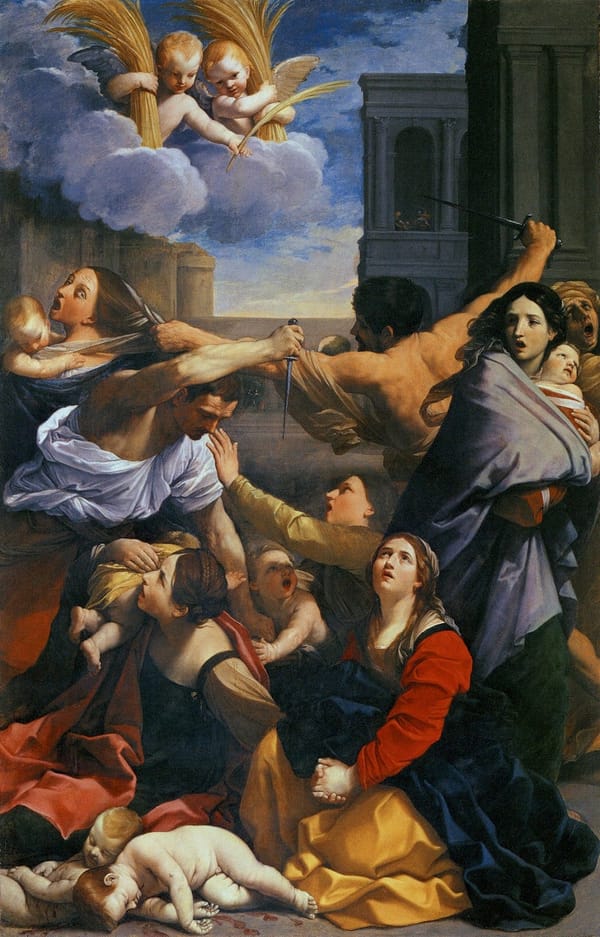
THE feast of the beloved Disciple is followed by that of the Holy Innocents. The Crib of Jesus, where we have already met and venerated the Prince of Martyrs and the Eagle of Patmos, has to-day standing round it a lovely choir of little Children, clad in snow-white robes, and holding green branches in their hands. The Divine Babe smiles upon them: he is their King; and these Innocents are smiling upon the Church of God. Courage and Fidelity first led us to the Crib; Innocence now comes, and bids us tarry there.
Herod intended to include the Son of God amongst the murdered Babes of Bethlehem. The Daughters of Rachel wept over their little ones, and the land streamed with blood; but the Tyrant’s policy can do no more: it cannot reach Jesus, and its whole plot ends in recruiting an immense army of Martyrs for heaven. These Children were not capable of knowing what an honour it was for them to be made victims for the sake of the Saviour of the world; but the very first instant after their immolation, all was revealed to them: they had gone through this world without knowing it, and now that they know it, they possess an infinitely better. God showed here the riches of his mercy: he asks of them but a momentary suffering, and that over, they wake up in Abraham's Bosom: no further trial awaits them, they are in spotless innocence, and the glory due to a soldier who died to save the life of his Prince belongs eternally to them.
They died for Jesus’ sake; therefore their death was a real Martyrdom, and the Church calls them by the beautiful name of the Flowers of the Martyrs, because of their tender age and their innocence. Justly then does the ecclesiastical Cycle bring them before us to-day, immediately after the two valiant Champions of Christ, Stephen and John. The connection of these three Feasts is thus admirably explained by St Bernard:
In St Stephen, we have both the act and the desire of Martyrdom; in St John, we have but the desire; in the Holy Innocents, we have but the act . . . . Will anyone doubt whether a crown was given to these Innocents? . . . If you ask me what merit could they have that God should crown them? et me ask you what was the fault for which Herod slew them? What! is the mercy of Jesus less than the cruelty of Herod? and whilst Herod could put these Babes to death, who had done him no injury, Jesus may not crown them for dying for him?
Stephen, therefore, is a Martyr by a Martyrdom of which men can judge, for he gave this evident proof of his sufferings being felt and accepted, that, at the very moment of his death, his solicitude both for his own soul and for those of his persecutors increased; the pangs of his bodily passion were less intense than the affection of his soul's compassion, which made him weep more for their sins than for his own wounds. John was a Martyr, by a Martyrdom which only Angels could see, for the proofs of his sacrifice being spiritual, only spiritual creatures could ken them. But the Innocents were Martyrs, to none other eye save thine, O God! Man could find no merit; Angel could find no merit: the extraordinary prerogative of thy grace is the more boldly brought out. From the mouth of the Infants and the Sucklings thou hast perfected praise. .1 The praise the Angels give thee is: Glory be to God in the highest, and peace on earth to men of good will:2 it is a magnificent praise, but I make bold to say that it is not Perfect till he cometh who will say: “Suffer Little Children to come unto me, for of such is the kingdom of heaven;3 and in the mystery of my mercy, there shall be peace to men that cannot even use their will.”
(Sermon for the Feast of the Holy Innocents.)
Yes, God did for these Innocents, who were immolated on his Son’s account, what he is doing every moment now by the sacrament of regeneration in the case of children who die before coming to the use of reason. We, who have been baptized by water, should be all the more ready to honour these Little Ones, who were baptized in their own blood, and thereby associated to all the mysteries of the Divine Infancy. We ought, together with the Church, to congratulate them, for that a glorious and premature death secured them their innocence. They have lived upon our earth, and yet it defiled them not! Truly, these tender Lambs deserve to be for ever with the Lamb of God! May this same earth of ours, grown old in wickedness, draw down the divine mercy on itself, by the love and honour it gives each year to these sweet Children of Bethlehem, who, like the Dove of Noah’s Ark, could not find whereon to rest their feet.
In the midst of the joy which, at this holy time, fills both heaven and earth, the Holy Church of Rome forgets not the lamentations of the Mothers who beheld their Children cruelly butchered by Herod’s soldiers. She hears the wailing of Rachel, and condoles with her; and unless it be a Sunday, she suspends on this Feast some of the manifestations of the joy which inundates her soul during the Octave of her Jesus’ Birth. The Red vestments of a Martyr’s Day would be too expressive of that stream of infant blood which forbids the Mothers to be comforted, and joyous White would ill suit their poignant grief; she therefore vests in Purple, the symbol of mournfulness.4 The Gloria in excelsis, the Hymn she loves so passionately during these days, when Angels come down from heaven to sing it—even that must be hushed to-day: and in the Holy Sacrifice she sings no Alleluia. In this, as in everything she does, the Church acts with an exquisite delicacy of feeling. Her Liturgy is a school of refined Christian considerateness.
This expression of sympathy gives to-day’s Office a pathetic sadness, which, however, in no way interferes with the joy which the Church feels in celebrating the Feast of the Holy Innocents. She keeps it with an Octave, as she does the two preceding Feasts of St Stephen and St John. She sanctions the practice, observed in Cathedrals and Collegiate Churches, of allowing young boys to share in the duties of the Choir, and blend their innocent chanting with that of the Ministers of God. She grants them several privileges, and takes pleasure in seeing the delight wherewith these children perform the several functions entrusted to them. This joy, this simplicity, this innocence, all add a charm to the divine Service; and through these youthful Choristers the Church pays honour to the Infant Jesus, and to the Holy Innocents of Bethlehem.
In Rome, the Station for the Feast of St Stephen is in the Church dedicated to the holy Protomartyr, on Monte Celio; that for St John is in the Basilica of St Mary Major; to-day the Station is made at St Paul's without the Walls, which possesses several of the bodies of the Holy Innocents. In the sixteenth century, Pope Xystus V caused a portion of these Relics to be translated to St Mary Major's, and put near the holy Relic of our Lord’s Crib.
Mass
In the Introit, the Church proclaims the wisdom of God in disconcerting the impious plans of Herod, and turning the murder of the Innocents into his own glory, by raising them to the dignity of Martyrs of Christ, whose praises they gratefully sing for ever.
Introit
In the Collect, the Church prays that her children may confess by their works their faith in Christ. The Holy Innocents give their testimony—the only one in their power—of suffering for their divine Master: but the Christian who has attained the use of reason has more to do than suffer for his faith: he must confess it before persecutors and tyrants when they bid him deny it, and also before that more permanent tribunal of the world and his own passions. No man has received the glorious character of a Christian on the condition that he should never own himself one.
Collect
Commemoration of Christmas Day
Epistle
Cap. XIV.In diebus illus: Vidi supra montem Sion Agnum stantem, et cum eo centum quadraginta quatuor millia, habentes nomen ejus, et nomen Patris ejus scriptum in frontibus suis. Et audivi vocem de cœlo tamquam vocem aquarum multarum, et tamquam vocem tonitrui magni; et vocem quam audivi, sicut citharædorum citharizantium in citharis suis. Et cantabant quasi canticum novum ante sedem, et ante quatuor animalia et seniores; et nemo poterat dicere canticum, nisi illa centum quadraginta quatuor millia, qui empti sunt de terra. Hi sunt qui cum mulieribus non sunt coinquinati: virgines enim sunt. Hi sequuntur Agnum quocumque ierit. Hi empti sunt ex hominibus primitiæ Deo et Agno, et in ore eorum non est inventum mendacium: sine macula enim sunt ante thronum Dei.
Ch. XIV.In those days: I beheld the Lamb standing on Mount Sion, and with him a hundred fortyfour thousand, having his name, and the name of his Father, written on their foreheads. And I heard a voice from heaven, as the voice of many waters, and as the voice of great thunder; and the voice which I heard was as the voice of harpers harping on their harps. And they sung as it were a new canticle before the throne, and before the four living creatures and the ancients; and no man could say the canticle but those hundred forty-four thousand, who were purchased from the earth. These are they who are not defiled with women: for they are virgins. These follow the Lamb whithersoever he goeth. These were purchased from among men, the first-fruits to God and to the Lamb, and in their mouths there was found no lie: for they are without spot before the throne of God.
The Church shows us, by her choice of this mysterious passage of the Apocalypse, how great a value she sets on Innocence, and what our own esteem of it ought to be. The Holy Innocents follow the Lamb, because they are pure. Personal merits on earth they could not have; but they went rapidly through this world, and its defilements never reached them. Their purity was not tried, as was St John's; but it is beautified by the blood they shed for the Divine Lamb, and he is pleased with it, and makes them his companions. Let the Christian, therefore, be ambitious for this Innocence, which is thus singularly honoured. If he have preserved it, let him keep and guard it as his most precious treasure; if he have lost it, let him repair the loss by repentance, and having done so, let him say with the Spouse in the Canticle: I have washed my feet; how shall I defile them?5
In the Gradual, we have the Innocents blessing their God for having broken the snare, wherewith the world would have made them captive. They have fled as a bird set free; there was nothing to clog their flight.
The Tract expresses the lamentation of Rachel over the cruelty of Herod and his minions. It invokes the divine vengeance which swept away the whole family of this vile Tyrant.
Gradual
Tract
If the Feast of the Holy Innocents fall on a Sunday, the Tract is not sung, but, in its place, the usual Alleluia verse, as follows:
Gospel
Cap. II.In illo tempore: Angelus Domini apparuit in somnis Joseph, dicens: surge, et accipe puerum et matrem ejus, et fuge in Ægyptum, et esto ibi usque dum dicam tibi. Futurum est enim, ut Herodes quærat puerum ad perdendum eum. Qui consurgens, accepit puerum et matrem ejus nocte, et secessit in Ægyptum, et erat ibi usque ad obitum Herodis: ut adimpleretur quod dictum est a Domino per Prophetam dicentem: Ex Ægypto vocavi Filium meum. Tunc Herodes videns quoniam illusus esset a Magis, iratus est valde: et mittens, occidit omnes pueros qui erant in Bethlehem, et in omnibus finibus ejus, a bimatu et infra, secundum tempus quod exquisierat a Magis. Tunc adimpletum est quod dictum est per Jeremiam Prophetam dicentem: Vox in Rama audita est, ploratus et ululatus multus: Rachel plorans filios suos; et noluit consolari, quia non sunt.
Ch. II.At that time: An Angel of the Lord appeared in sleep to Joseph, saying: Arise, and take the Child and his Mother, and fly into Egypt, and be there until I shall tell thee. For it shall come to pass that Herod will seek the Child to destroy him. Who arose, and took the Child and his Mother by night, and retired into Egypt, and he was there until the death of Herod; that it might be fulfilled which the Lord spoke by the Prophet, saying: Out of Egypt have I called my son. Then Herod, perceiving that he was deluded by the Wise Men, was exceedingly angry, and sending, killed all the men children that were in Bethlehem, and in all the borders thereof, from two years old and under, according to the time which he had diligently inquired of the Wise Men. Then was fulfilled that which was spoken by Jeremias the Prophet, saying: A voice in Rama was heard, lamentation and great mourning: Rachel bewailing her children, and would not be comforted, because they are not.
Thus does the Gospel, in its sublime simplicity, relate the Martyrdom of the Innocents. Herod, sending, killed all the Children! The earth paid no attention to the fell tyranny, which made so rich a harvest for heaven: there was heard a voice in Rama, Rachel wailing her little ones; it went up to heaven, and Bethlehem was still again, as though nothing had happened. But these favoured Victims had been accepted by God, and they were to be the companions of his Son. Jesus looked at them from his crib, and blessed them; Mary compassionated with them and their mothers; the Church, which Jesus had come to form, would, for all future ages, glorify these youthful Martyrs, and place the greatest confidence in the patronage of these Children, for she knows how powerful their intercession is with her heavenly Spouse.
During the Offertory, it is the choir of our Holy Innocents again singing their beautiful Canticle: as birds set free, they give praise to him who broke the snare which held them.
Offertory
Secret
Commemoration of Christmas Day
In the Communion Anthem we again hear the voice of Rachel's lamentation. Now that the Church has been nourished by the mystery of divine charity, she could not forget the affliction of the mothers of her dear Innocents. She compassionates them all through her Office, and turns to him who alone can comfort them that are in sorrow.
Communion
Postcommunion
Commemoration of Christmas Day
Vespers
The Antiphons and Psalms of Christmas Day having been sung, as given on p. 210, the rest of the Office is as follows:
Capitulum (Apoc. xiv)
Hymn
Quos lucis ipso in limine
Christi insecutor sustulit,
Ceu turbo nascentes rosas.
Grex immolatorum tener,
Aram sub ipsam simplices
Palma et coronis luditis.
Qui natus es de Virgine,
Cum Patre et almo Spiritu
In sempiterna sæcula.
tender flock of lambs ready for sacrifice,
now in your simplicity play with your palms and crowns
beneath the very altar.
who art born of a Virgin,
with Father and Holy Spirit,
for ever and ever.
Antiphon of the Magnificat
Commemoration of St Thomas
Commemoration of Christmas Day
And now let us listen to the several Churches celebrating the triumph of the Holy Innocents. Their chants for this Feast are very beautiful. We will begin with the following fine Preface, which is in both the Ambrosian Missal and the Leonine Sacramentary:
Preface
The following is from the Mozarabic Missal, and is full of unction and eloquence:
Our own Venerable Bede offers us the following Hymn, which is full of melody and pathos:
Hymn
Dicamus Innocentium,
Quos terra flendo perdidit,
Gaudens sed æthra suscipit.
Quorum tuentur Angeli,
Ejusque laudant gratiam,
Hymnum canentes Martyrum.
Pius sed Auctor colligit,
Secum beatos collocans,
In luce regni perpetis.
Largitus in domo Patris;
Donat supernis sedibus,
Quos rex peremit impius.
Herodis ira perculit;
Finesque Bethlehemiticos,
Sancto respersit sanguine.
Mors innocens fidelium:
Cœlis ferebant Angeli
Bimos et infra parvulos.
Lamenta luctus maximi,
Rachel suos, cum lacrymis
Perfusa, flevit filios.
Tormenta quique vicerant,
Quorum gemens ob verbera,
Vox in Rama percrebuit.
Dentes leonis perfidos!
Pastor bonus nam pascua
Vobis dabit cœlestia.
Mundo sequeris tramite;
Manus latronis impias
Ne, grex pusille, formides.
Vestris Pater de vultibus;
Mors vobis ultra non nocet,
Vitae receptis mœnibus.
Longo metent in gaudio.
Genis lugentum Conditor
Absterget omnem lacrymam.
In qua Redemptor nascitur:
Natoque primae
Martyrum In qua dicantur hostiæ.
In civitatuin millibus,
Ex qua novus dux ortus est;
O quam beata civitas.
Ejus throno nunc vestibus,
Stolas suas qui laverant
Agni rubentes sanguine.
Regno gementes fleverant:
Læti Deo cum laudibus
Adstant nitentes fulgidis.
of the martyred Innocents,
whom earth lost and wept,
but heaven gained and was glad.
the Face of the Eternal Father,
and sing the Hymn of their Martyrs,
lauding the grace of God.
the merciful Creator received them,
making them happy with himself
in the brightness of the never-ending kingdom.
a mansion in his Father's house,
places the Innocents, massacred by the impious king,
on thrones in heaven above.
and slew every child below the age of two,
staining with their sacred blood
the borders of Bethlehem.
shone the innocent death of these his faithful ones;
and Angels came down
to carry them to the land of heaven.
lamentation of poignant grief,
and Rachel shed a flood of tears
over her infant sons,
for they overcame their torments,
whose cruel blows filled Rama
with the voice of wailing.
the prowling Lion’s tooth!
for the Good Shepherd
will give you the pastures of heaven.
in the path of purity,
ye need not fear, dear Little Flock,
a robber’s wicked grasp.
from off your cheeks;
death shall have no further power to hurt you,
inclosed now within the walls of Life.
reap eternal joy:
and the Creator wipes every tear away
from the mourner's face.
city wherein our Redeemer was born,
and where he was presented with the first Martyrs
—the first Victims dedicated to the new-born King.
the least among the thousand cities,
for out of thee came the divine Leader!
O truly blessed City!
glittering in their fair bright robes,
these Innocents that washed their garments
red in the Blood of the Lamb.
for the kingdom of the everlasting world:
now they stand joyfully before God,
and bright in their robes of glory are ever singing his praise.
The Greek Church is, of course, profuse in her praises of the Holy Innocents. We extract from her Menæa the following stanzas:
XXVI Decembris, in magno Vespertino, et passim.
Regem sine tempore sub tempore natum, rex impius exquirebat, et non inveniens quomodo occideret, puerorum messuit malinesciam multitudinem, quos (et non cogitabat) fecit Martyres, supernique regni habitatores, et illius in sæcula impietatem exprobantes.
The wicked king sought for the King Eternal, yet born in time: and not finding how to kill him, he mowed down the innocent multitude of children, thinking not that he was making them Martyrs, and citizens of the heavenly kingdom, and eternal accusers of his impiety.
Into this sublime concert of the Liturgies singing the praises of the Innocents, we must admit the Latin Churches of the Middle Ages. We have selected a Prose of the eleventh century, found in most of the ancient Roman-French Missals.
Sequence
Pia Innocentum colentes tripudia.
Quos infans Christus hodie vexit ad astra,
Hos trucidavit frendens insania
Herodianæ fraudis, ob nulla crimina,
In Bethlehem ipsius cuncta.
Et per confinia,
A bimatu et infra,
Juxta nascendi tempora,
Herodes rex, Christi nati Verens, infelix! imperia,
Infremit totus, erigit arma Superba dextera.
Quærit lucis et cœli Regem,
Cum mente turbida;
Ut extinguat, qui vitam præstat,
Per sua jacula.
Dum non valet intueri lucem splendidam, Nebulosa quærentis pectora.
Ira fervet, fraudes auget Herodes sævus,
Ut perdat piorum agmina.
Castra militum dux iniquus aggregat,
Ferrum figit in membra tenera.
Inter ubera lac effundit,
Antequam sanguinis fierent coagula.
Hostis naturae natos eviscerat
Atque jugulat:
Ante prosternit, quam ætas parvula
Sumat robora.
Quam beata sunt Innocentum cæsa
Corpuscula!
Quam felices existunt matres,
Funerunt quæ talia pignora!
O dulces Innocentum acies!
O pia lactantum pro Christo certamina!
Parvorum trucidantur millia:
Membris ex teneris manant lactis flumina.
Cives angelici veniunt obviam,
Mira victoria,
Vitæ captat merita
Turba candidissima.
Te, Christe, petimus, mente devotissima,
Nostra qui venisti reformare sæcula,
Innocentum gloria
Perfrui nos concedas per æterna.
In honour of the holy joys of the Innocents.
The Infant Jesus took them this day to the realms above,
When the rabid madness of Herod’s craft slew them,
Though guilty of no crime:
They were the Children in the city,
And all the confines of Bethlehem,
Two years old and under,
Dating from the time of their birth.
The unhappy King Herod, fearing the kingdom of the Infant Christ,
Trembles from head to foot, and brandishes his sword with his haughty hand.
He, with his troubled mind,
seeks for the King of Light and heaven;
That by his weapons
he might put to death him that gives life:
For his eye cannot look on the bright Light of him who searcheth clouded hearts.
Herod is inflamed with rage, and cruelly
plots the death of thousands of Innocents.
A wicked chieftain takes with him a troop of soldiers,
and plunges his sword in the tender flesh.
The pure stream of infant veins
(for blood is scarce yet formed) flows upon the mothers’ breasts.
The brutal enemy tears the flesh with gaping wounds,
and on the throat inflicts a fatal gash:
Trampling out life, e'er the tender age
is sinewed into strength.
Oh! how glorious
the bodies of these murdered Innocents!
How happy the Mothers
of such Children!
O lovable legion of Innocents!
O holy infant combats fought for Christ!
The Babes lay slain in thou sands,
and from their tender limbs there flows a stream of sinless blood.
The citizens of heaven come forth
to meet the snow-white troop
that takes the crown of Life,
won by a singular victory.
We most devoutly beseech thee, O Jesus!
who camest to reform the world,
That thou grant us to enjoy
for everlasting ages the glory of the Innocents.
And we, too, blessed Babes! celebrate your triumph, and we congratulate you on your having been chosen as the companions of Jesus when in his Crib. What a glad waking was yours, from the darkness of unconscious infancy to the precious light of Abraham's bosom, where were congregated all the elect! How dear to you the sword that thus transformed you! What gratitude had you not to God, who thus chose you, out of millions of other children, to do honour to the birth of his Son by this sacrifice of your blood and lives! Too young to fight the battle, yet did you win the crown. The Martyr's Palm waved in those tiny hands which had not strength to pluck it. God would give proof of his munificence: he would teach us that he is Master of his gifts. And was it not fitting that the birth of the Son of this great King should be commemorated by largess such as this? Sweet Infant Martyrs! we give praise to our God for having thus favoured you, and with the whole Church we rejoice in the privileges you have received.
Flowers of the Martyrs! we confide in your intercession, and beseech you, by the reward so gratuitously conferred on you, to be mindful of us your brethren, who are struggling amidst the dangers of this sinful world. We too desire to receive those same Palms and Crowns which you have won, but with such innocence and simplicity that the Church says you played with them:6 whereas we have to fight hard and long for them, and are so often on the point of losing them for ever! The God that has glorified you is our last end as truly as he is yours; in him alone can our hearts find their rest; pray for us, that we may possess him for all eternity.
Pray for us, that we may obtain child-like simplicity of heart, whence comes that unreserved confidence in God which leads man to the perfect accomplishment of his holy will. May we bear the cross with patience when he sends it, and desire nothing but his holy will. You gazed upon the murderers who broke your gentle sleep, and you found nothing to make you fear; the bright sword they held over your cradle had but the look of a toy with which you asked to play; death stared you in the face, and you smiled on him. May we imitate you, and be meek and graceful in the trials that come to us; making them our martyrdom by the quiet endurance of our courage, and the conformity of our will with that of our Sovereign Lord and Master, who only gives the cross that he may give the crown. May we never object to or hate the instruments he uses wherewith to try us; may no harshness nor injustice nor pain ever quench the fire of our charity, nor any event ever deprive us of that peace without which our souls live not to God.
And, lastly, O ye Innocent Lambs, slain for Jesus, and following him whithersoever he goeth, because ye are pure, pray for us to the Lamb of God, that he permit us to come to him in Bethlehem, and, like you, fix our dwelling there, for it is the abode of love and innocence. Speak for us to Mary, a Mother more compassionate than Rachel; tell her that we are her children, and your brethren. She that compassionated your momentary sufferings will pity us and help us in our long years of temptation, pain and sorrow.
Three days have passed since the Birth of Jesus: let us visit him in the Stable, and humbly adore Emmanuel. Let us think on the mercy which led him to become a Little Child in order to bring us near to himself: let us be filled with astonishment at seeing our God thus close to his creatures.
‘He,’ says the holy Abbot Guerric,7 ‘that in heaven, surpasses the sublime intellects of the Angels, is here on earth palpable to the dull sense of men. For whereas God could not speak to us as spiritual beings, for we are carnal, his Word was made Flesh, that all flesh might not only hear, but might even see him whom the mouth of the Lord had spoken.8 And whereas the world knew not the Wisdom of God in his wisdom, that same wisdom, by an ineffable condescension, made himself Foolishness9.. I give thee praise, O Father, Lord of heaven and earth, for that thou hast hid this Wisdom from the wise and prudent, and hast revealed it to little ones. .10 . . The haughtiness of the proud is exceedingly adverse to the humility of this Little One; and that which is high to men is an abomination before God. .11 . . This Little One finds sympathy with none save with them that are little in heart, and he takes up his abode with none save with them that are humble and peaceful. As, therefore, these Little Children sing, glorying in him: A little Child is born unto us;12 so does he say of them: Behold me and my Children, whom the Lord hath given unto me!13 Thus it was that the glory of Martyrdom began with innocent Babes; for the Father would give to his Son, the Infant Jesus, Companions of his own tender age; and hereby the Holy Ghost taught us that of such is the Kingdom of heaven.’14
In honour of this Childhood of the Great King, let us recite the following admirable Hymn, composed by one of the most learned men of the primitive Church, Clement of Alexandria.
Hymn
Penna volucrum non errantium,
Verus clavus infantium,
Pastor agnorum regalium,
Tuos simplices Pueros congrega,
Ad sancte laudandum,
Sincere canendum,
Ore innoxio,
Christum puerorum ducem.
Verbum, qui domas omnia,
Patris altissimi
Sapientiæ rector,
Laborum sustentaculum,
Ævo gaudens,
Humani generis Servator, Jesu,
Clavus, frænum,
Penna cœlestis
Sanctissimi gregis,
Piscator hominum
Qui salvi fiunt;
Pelagi vitii,
Pisces castos
Unda ex infesta,
Dulci vita inescans.
Rationalium pastor;
Sancte, sis dux,
Rex puerorum intactorum:
Vestigia Christi,
Via cœlestis.
Ævum infinitum,
Lux æterna,
Fons misericordiæ,
Operatrix virtutis,
Honesta vita
Deum laudantium, Christe Jesu,
Dulcibus uberibus
Nymphæ gratiarum,
Sapientiæ tuæ expressum,
Infantuli
Ore tenero
Enutriti,
Mammæ rationalis
Roscido spiritu Impleti,
Laudes simplices,
Hymnos veraces
Regi Christo.
Vitæ doctrinæ
Canamus simul.
Canamus simpliciter
Puerum valentem.
Chorus pacis,
Christo geniti,
Populus modestus,
Psallamus simul Deum pacis.
Wing that protectest chickens which keep nigh their mother,
sure Rudder of infant age,
Shepherd of the King’s lambs!
call together thy simple children,
and bid them praise with holy hearts,
and sweetly sing with pure lips Jesus,
the King of Infants.
Incarnate Word
that rulest all things,
Dispenser of the Most High,
the Father,
support of them that toil,
joy eternal,
Saviour of mankind, Jesus!
Rudder, Curb,
Wing celestial
of the most holy flock,
Fisher of the elect,
drawing the chaste fish
by the bait
of the sweet
Bread of Life
from the boisterous sea of sin.
be thou our Guide!
Guide us, O Holy One,
O King of spotless Children!
The way to heaven
is to follow the footsteps of Christ.
Infinite duration,
Light Eternal,
Fount of mercy,
Author of virtue,
the Holy Life
of them that praise God, Christ Jesus!
whose infant mouths
have drunk the milk of heaven,
drawn from the sweet breasts
of thy wisdom,
grace’s virgin spring:
filled with the dewy spirit
of thy divine breast,
we sing
to Christ the King
our simple praises
and our truthful hymns.
the holy recompense
of the doctrine of Life!
Let us together sing
to the Almighty Babe!
O choir of peace,
O children of Christ,
O wisdom-loving people,
let us together praise the God of Peace!
Let us also salute Mary, the Mother of this Divine Infant, in the words of this beautiful Prose, taken from the ancient Missals of Germany.
Sequence
Potens et imperiosa,
Jesu Christi generosa
Mater atque filia:
Radix Jesse speciosa,
Virga florens et frondosa
Quam rigavit copiosa
Deitatis gratia.
Et perflando fœcundavit,
Aquilonem qui fugavit
Sua cum potentia.
Florem ergo genuisti,
Fructum ex quo protulisti,
Gabrieli dum fuisti
Paranympho credula.
Ista dum consideravit,
Sciens quod non irrigavit
Florescentem virgulam:
Bene tamen conservavit
Arcanum, nec divulgavit;
Sponsam sed magnificavit,
Honorans ut Dominam.
Nubes ex quo concreverunt,
Concretæque stillaverunt
Virginis in útero.
Res miranda! res novella!
Nam procedit sol de stella,
Regem dum parit puella.
Viri tori nescia.
Cunctorumque laudem digna,
Tuo nato nos consigna
Pia per suffragia;
Ut mortali, quo gravamur,
Compede sic absolvamur,
Ut soluti transferamur
Ad cæli palatia.
and sovereign Empress!
Noble Mother
and daughter of Jesus!
Fair Root of Jesse,
Branch lovely in thy bloom and leaf,
watered by the plentiful
grace of God!
and breathing gave thee Fruit,
and by his power
put the rough north wind to flight.
Thou therefore,
believing the Angel Gabriel’s word,
didst conceive a Flower,
one day to bring him forth, thy Fruit.
saw his lovely Branch in Flower;
none else could know like him
and tremble at the Mystery.
But the secret was sacred and well did he keep it,
revealing it to no mortal ear.
Mary was his Spouse, and he extolled her:
she was his Lady, and he honoured her.
and the clouds, laden with a mystic rain,
rained the Holy One;
He dwelt in the Virgin's womb.
O wondrous thing! O thing most strange!
A Star brings forth the Sun!
A Maid, a Virgin most pure,
brings forth the King of Heaven.
commend us to thy Son,
O Mother sweet and kind,
and worthy of this and every praise!
Pray for us,
that loosened from the shackle of mortality
that weighs us down,
we may take wing to the heavenly courts.
- Ps. viii 3. ↩︎
- St Luke ii 14. ↩︎
- St Matt xix 14. ↩︎
- Unless it be a Sunday; in which case the colour used is Red. ↩︎
- Cant. v 3. ↩︎
- . . . . Simplices
Palma et coronis luditis.
(Hymn for Vespers.) ↩︎ - Sermon the Fifth, On the Wonderful Providence of God in the Nativity of Christ. ↩︎
- Isa. xl 5. ↩︎
- 1 Cor i 25. ↩︎
- St Matt. xi 25. ↩︎
- St Luke xvi 15. ↩︎
- Isa. ix 6. ↩︎
- Ibid, viii 18. ↩︎
- St Matt, xix 14. ↩︎
| Previous December 27: St. John, Apostle and Evangelist | Next December 28: The Holy Innocents |