Daily reading
Epiphanytide
Greater Double · Temporal
January 18, 2026
From Dom Guéranger’s The Liturgical Year.

|
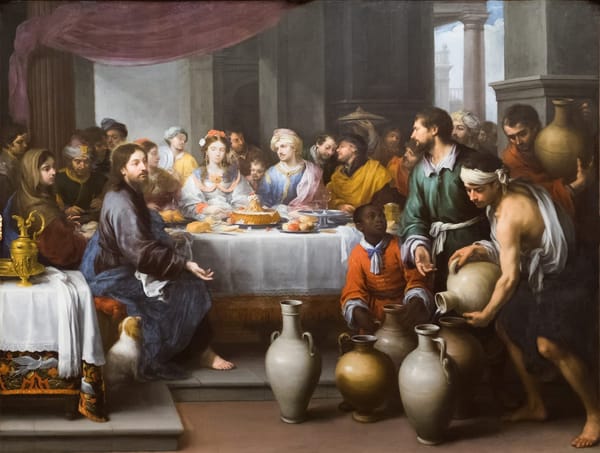
The Second Sunday after Epiphany
THE third Mystery of the Epiphany shows us the completion of the merciful designs of God upon the world, at the same time that it manifests to us, for the third time, the glory of our Lord and Saviour, Jesus Christ. The star has led the soul to faith; the sanctified Waters of the Jordan have conferred purity upon her; the Marriage-Feast unites her to her God. We have been considering, during this Octave, the Bridegroom revealing himself to the Spouse; we have heard him calling her to come to him from the heights of Libanus; and now, after having enlightened and purified her, he invites her to the heavenly feast, where she is to receive the Wine of his divine love.
A Feast is prepared;1 it is a Marriage-Feast; and the Mother of Jesus is present at it, for it is just that, having co-operated in the mystery of the Incarnation of the Word, she should take part in all that her Son does, and in all the favours he bestows on his elect. But, in the midst of the Feast, the Wine fails. Wine is the symbol of Charity or Love, and Charity had failed on the earth; for the Gentiles had never tasted its sweetness; and as to the Synagogue, what had it produced but wild grapes?2 The True Vine is our Jesus, and he calls himself by that name.3 He alone could give that Wine which gladdeneth the heart of man;4 he alone could give us that Chalice which inebriateth,5 and of which the Royal Psalmist prophesied.
Mary said to Jesus: They have no Wine. It is the office of the Mother of God to tell him of the wants of men, for she is also their Mother. But Jesus answers her in words which are apparently harsh: Woman! what is it to me and to thee? My hour is not yet come. The meaning of these words is, that, in this great Mystery, he was about to act, not as the Son of Mary, but as the Son of God. Later on, the hour will come when, dying upon the Cross, he will do a work, in the presence of his Mother, and he will do it as Man, that is, according to that human nature which he has received from her. Mary at once understands the words of her Son, and she says to the waiters of the Feast, what she is now ever saying to her children: Do whatsoever he shall say to you.
Now, there were six large waterpots of stone there, and they were empty. The world was then in its Sixth Age, as St Augustine and other Holy Doctors tell us. During these six ages, the earth had been awaiting its Saviour, who was to instruct and redeem it. Jesus commands these waterpots to be filled with water; and yet water does not suit the Feast of the Spouse. The figures and the prophecies of the ancient world were this water, and until the opening of the Seventh Age, when Christ, who is the Vine, was to be given to the world, no man had contracted an alliance with the Divine Word.
But, when the Emmanuel came, he had but to say, Now draw out, and the waterpots were seen to be filled with the wine of the New Covenant, the Wine which had been kept to the end. When he assumed our human nature—a nature weak and unstable as water—he effected a change in it; he raised it up even to himself, by making us partakers of the divine nature;6 he gave us the power to love him, to be united to him, to form that one Body, of which he is the Head, that Church of which he is the Spouse, and which he loved from all eternity, and with such tender love, that he came down from heaven to celebrate his nuptials with her.
St Matthew, the Evangelist of the Humanity of our Lord, has received from the Holy Ghost the commission to announce to us the Mystery of Faith by the star; St Luke, the Evangelist of Jesus' Priesthood, has been selected, by the same Holy Spirit, to instruct us in the Mystery of the Baptism in the Jordan; but the Mystery of the Marriage-Feast was to be revealed to us by the Evangelist John, the Beloved Disciple. He suggests to the Church the object of this third Mystery, by this expression: This beginning of miracles did Jesus in Cana of Galilee, and he manifested his glory.7 At Bethlehem, the Gold of the Magi expressed the Divinity of the Babe; at the Jordan, the descent of the Holy Ghost and the voice of the Eternal Father proclaimed Jesus (known to the people as a carpenter of Nazareth) to be the Son of God; at Cana, it is Jesus himself that acts, and he acts as God, for, says St Augustine, he who changed the water into wine in the waterpots could be no other than the same who, every year, works the same miracle in the vine. Hence it was that, from that day, as St John tells us, his disciples believed in him,8 and the Apostolic College began to be formed.
Mass
The Introit proclaims the joy of this day, which shows us human nature espoused to the Son of the eternal Father. Surely the earth will henceforth surrender itself wholly to the love and praise of this sacred Name which, in the Marriage Feast, has become that of the Sons of Adam.
Introit
This name of Sons of God which has become ours by right through the bond of the sacred nuptials is none other, as Jesus himself tells us in his Beatitudes, than Peace—the Peace of God, ours truly through the action of his grace ever working it out within us. In the Collect Peace again figures as the final end of God's government both in heaven and on earth, likewise as the supreme desire of the Church.
Collect
Commemoration is made, by their proper Collects, of the Saint whose feast may occur with this Sunday; the third prayer will be that of the Blessed Virgin.
Commemoration of the Blessed Virgin Mary
Epistle
Cap. XII.Fratres: Habentes donationes secundum gratiam, quæ data est nobis, differentes: sive prophetiam secundum rationem fidei, sive ministeriura in ministrando, sive qui docet in doctrina, qui exhortatur in exhortando, qui tribuit in simplicitate, qui præest in sollicitudine, qui miseretur in hilaritate. Dilectio sine simulatione. Odientes malum, adhærentes bono: Caritate fraternitatis invicem diligentes: Honore invicem prævenientes: Sollicitudine non pigri: Spiritu ferventes: Domino servientes: Spe gaudentes: In tribulatione patientes: Orationi instantes: necessitatibus sanctorum communicantes: Hospitalitatem sectantes. Benedicite persequentibus vos: benedicite et nolite maledicere. Gaudere cum gaudentibus, flere cum flentibus: idipsum invicem sentientes: non alta sapientes, sed humilibus consentientes.
Ch. XII.Brethren: Having different gifts, according to the grace that is given us, either prophecy, to be used according to the rule of faith: or ministry, in ministering; or he that teacheth, in doctrine; he that exhorteth in exhorting; he that giveth with simplicity; he that ruleth with carefulness; he that sheweth mercy with cheerfulness. Let love be without dissimulation. Hating that which is evil, cleaving to that which is good. Loving one another with the charity of brotherhood: with honour preventing one another. In carefulness not slothful, in spirit fervent: serving the Lord: rejoicing in hope: patient in tribulation: instant in prayer: communicating to the necessities of the saints: pursuing hospitality. Bless them that persecute you: bless and curse not. Rejoice with them that rejoice, weep with them that weep. Being of one mind one towards another, not minding high things, but consenting to the humble.
This peace which characterizes, in the abode of saints, the Sons of God, effects in like measure on earth the oneness of the Bride, that is of the Church: peace it is that makes her to be but one body wherein the many members find their multiplicity upheld and guided by the head, the one lord; their functions, so diverse in themselves, regulated and brought under the rule and love of the Bridegroom, Christ Jesus. The Epistle which has just been read sets before us the different operations of this peace which has as its ruling motive Charity, the Queen of virtues, and which is so essential to Christianity; the Apostle specifies in detail its forms and conditions and adapts its practice to every social condition and circumstance of life. Of such value does the Church judge these considerations, that, on the following Sunday, she resumes the text of the Apostle where today she has interrupted it.
Far from a divine life in the peace of God which was its precious gift, the human race incurred death with its penalty of separation. Let us then in the Gradual sing of this wonder that has been wrought in our midst, and with the angelic choirs exalt the Lord in praise and admiration.
Gradual
Gospel
Cap. II.In illo tempore: Nuptiæ factæ sunt in Cana Galilææ, et erat Mater Jesu ibi. Vocatus est autem et Jesus et discipuli ejus ad nuptias. Et deficiente vino, dicit Mater Jesu ad eum: Vinum non habent. Et dicit ei Jesus: Quid mihi et tibi est, mulier? nondum venit hora mea. Dicit Mater ejus ministris: Quodcumque dixerit vobis, facite. Erant autem ibi lapideæ hydriæ sex, positæ secundum purificationem Judæorum, capientes singulæ metretas binas vel ternas. Dicit eis Jesus: Implete hydrias aqua. Et impleverunt eas usque ad summum. Et dicit eis Jesus: Haurite nunc, et ferte architriclino. Et tulerunt. Ut autem gustavit architriclinus aquam vinum factam, et non sciebat unde esset, ministri autem sciebant qui hauserant aquam; vocat sponsum architriclinus, et dicit ei: Omnis homo primum bonum vinum ponit, et cum inebriati fuerint, tunc id quod deterius est; tu autem servasti bonum vinum usque adhuc. Hoc fecit initium signorum Jesus in Cana Galilææ, et manifestavit gloriam suam, et crediderunt in eum discipuli ejus.
Ch. II.At that time, there was a marriage in Cana of Galilee; and the Mother of Jesus was there. And Jesus also was invited, and his disciples to the marriage. And the wine failing, the Mother of Jesus saith to him, They have no wine. And Jesus saith to her, Woman, what is it to me and to thee? my hour is not yet come. His Mother saith to the waiters, Whatsoever he shall say to you, do ye. Now there were set there six waterpots of stone; according to the manner of the purifying of the Jews, containing two or three measures apiece. Jesus saith to them, Fill the waterpots with water. And they filled them up to the brim. And Jesus saith to them, Draw out now, and carry to the chief steward of the feast: and they carried it. And when the chief steward had tasted the water made wine, and knew not whence it was, but the waiters knew who had drawn the water; the chief steward calleth the bridegroom, and saith to him, Every man at first setteth forth good wine, and when men have well drunk, then that which is worse: but thou hast kept the good wine until now. This beginning of miracles did Jesus in Cana of Galilee, and manifested his glory, and his disciples believed in him.
O the wonderful dignity of man! God has vouchsafed, says the Apostle, to show the riches of his glory on the vessels of mercy, which had no claim to, nay, were unworthy of such an honour. Jesus bids the waiters fill them with water and the water of Baptism purifies us; but, not satisfied with this, he fills these vessels, even to the brim, with that heavenly and new Wine, which was not to be drunk save in the kingdom of his Father.9 Thus, divine Charity, which dwells in the Sacrament of Love, is communicated to us; and that we might not be unworthy of the espousals with himself, to which he called us, he raises us up even to himself. Let us, therefore, prepare our souls for this wonderful union, and, according to the advice of the Apostle, let us labour to present them to our Jesus with such purity as to resemble that chaste Virgin, who was presented to the spotless Lamb.10
During the Offertory, the Church resumes her songs of joy and gives free course to her holy transports. All faithful souls are invited by her to the celebration of this adorable Mystery, the intimate union of man with God.
Offertory
Secret
After the Secret of the Saint who is being commemorated today, that of the Blessed Virgin is said.
Commemoration of the Blessed Virgin Mary
The Communion Antiphon recalls once more the miracle of the changing of the water into wine. This was only a dim figure of that wondrous transformation which is accomplished on our altars, only a symbol of that divine Sacrament, the food of our souls whereby, in an unspeakable way, is realized our union with God.
Communion
Postcommunion
Commemoration of the Blessed Virgin Mary
Vespers
The Psalms, Capitulum, Hymn and Verse are given on pages 88-97.
Antiphon of the Magnificat
January 18: St. Peter's Chair at Rome
THE Archangel Gabriel told Mary, in the Annunciation, that the Son who was to be born of her should be a King, and that of his Kingdom there should be no end. Hence, when the Magi were led from the East to the Crib of Jesus, they proclaimed it in Jerusalem that they came to seek a King. But this new Empire needed a capital; and whereas the King, who was to fix his throne in it, was, according to the eternal decrees, to re-ascend into heaven, it was necessary that the visible character of his Royalty should be left here on earth, and this even to the end of the world. He that should be invested with this visible character of Christ our King would be the Vicar of Christ.
Our Lord Jesus Christ chose Simon for this sublime dignity of being his Vicar. He changed his name into one which signifies the Rock, that is ‘Peter’; and in giving him this new name, he tells us that the whole Church throughout the world is to rest upon this man as upon a Rock which nothing shall ever move.1 But this promise of our Lord included another; namely, that as Peter was to close his earthly career by the Cross, he would give him Successors in whom Peter and his authority should live to the end of time.
But again, there must be some mark or sign of this succession, to designate to the world who the Pontiff is on whom, to the end of the world, the Church is to be built. There are so many Bishops in the Church: in which one of them is Peter continued? This Prince of the Apostles founded and governed several Churches; but only one of these was watered with his blood, and that one was Rome; only one of these is enriched with his Tomb, and that one is Rome; the Bishop of Rome, therefore, is the Successor of Peter, and consequently the Vicar of Christ. It is of the Bishop of Rome alone that it is said: Upon thee will I build my Church:2 and again: To thee will I give the Keys of the Kingdom of Heaven:3 and again: I have prayed for thee, that thy faith fail not; do thou confirm thy brethren:4 and again: Feed my lambs; feed my sheep.5
Protestantism saw the force of this argument, and therefore strove to throw doubts on St Peter's having lived and died in Rome. They who laboured to establish doubts of this kind rightly hoped that, if they could gain their point, they would destroy the authority of the Roman Pontiff, and even the very notion of a Head of the Church. But History has refuted this puerile objection, and now all learned Protestants agree with Catholics in admitting a fact which is one of the most incontestable, even on the ground of human authority.
It was in order to nullify, by the authority of the Liturgy, this strange pretension of Protestants, that Pope Paul the Fourth, in 1558, restored the ancient Feast of St Peter's Chair at Rome, and fixed it on the 18th of January. For many centuries the Church had not solemnized the mystery of the Pontificate of the Prince of the Apostles on any distinct feast, but had made the single Feast of February 22nd serve for both the Chair at Antioch and the Chair at Rome. From that time forward, the 22nd of February has been kept for the Chair at Antioch, which was the first occupied by the Apostle.
To-day, therefore, the Kingship of our Emmanuel shines forth in all its splendour, and the children of the Church rejoice in finding themselves to be brethren and fellow-citizens, united in the Feast of their common Capital, the Holy City of Rome. When they look around them, and find so many sects separated from each other, and almost formed into decay, because they have no centre of union, they give thanks to the Son of God for having provided for the preservation of his Church and Truth by instituting a visible Head who never dies, and in whom Peter is for ever continued, just as Christ himself is continued in Peter. Men are no longer sheep without a Shepherd; the word spoken at the beginning is uninterruptedly perpetuated through all ages; the primitive mission is never suspended, and by the Roman Pontiff the end of time is united to the world's commencement. ‘What a consolation for the children of God!' cries out Bossuet, in his Essay on Universal History, ‘and what conviction that they are in possession of the truth, when they see that from Innocent the Eleventh, who now (1681) so worthily occupies the first See of the Church, we go back in unbroken succession even to St Peter, whom Jesus appointed Prince of the Apostles; that from St Peter we come, traversing the line of the Pontiffs who ministered under the Law, even to Aaron, yea, even to Moses; thence even to the Patriarchs, and even to the beginning of the world!’
When Peter enters Rome, therefore, he comes to realize and explain the destinies of this Queen of Cities; he comes to promise her an Empire even greater than the one she possesses. This new Empire is not to be founded by the sword, as was the first. Rome has been hitherto the proud mistress of nations; henceforth she is to be the Mother of the world by Charity; and though all peaceful, yet her Empire shall last to the end of time. Let us listen to St Leo the Great, describing to us in one of the finest of his Sermons, and in his own magnificent style, the humble yet all-eventful entrance of the Fisherman of Genesareth into the Capital of the Pagan world.
The good and just and omnipotent God, who never refused his mercy to the human race, and instructed all men in general in the knowledge of himself by his superabundant benefits, took pity, by a more hidden counsel and a deeper love, on the voluntary blindness of them that had gone astray, and on the wickedness which was growing in its proneness to evil; and sent therefore into the world his co-equal and co-eternal Word. The which Word being made Flesh did so unite the divine to the human nature, as that the deep debasement of the one was the highest uplifting of the other.
But that the effect of this unspeakable gift might be diffused throughout the entire world, the providence of God had been preparing the Roman Empire, which had so far extended its limits as to embrace in itself all the nations of the earth. For nothing could be better suited to the divine plan than the confederation of various kingdoms under one and the same Empire; and the preaching of the Gospel to the whole world would the more rapidly be effected by having the several nations united under the government of one common City.
But this City, ignoring the author of this her promotion, whilst mistress of almost every nation under the sun, was the slave of every nation's errors; and prided herself on having a grand religion, because she had admitted every false doctrine. So that the faster the devil’s hold of her, the more admirable her deliverance by Christ.
For when the twelve Apostles, after receiving by the Holy Ghost the gift of tongues, divided among themselves the world they had to evangelize, the most blessed Peter, the Prince of the Apostolic order, was sent to the Capital of the Roman Empire, in order that the light of truth, which had been revealed for the salvation of all nations, might the more effectively flow from the head itself into the whole body of the world.
The fact was that there were in this City people belonging to every nation, and the rest of the world soon learnt whatever was taught at Rome. Here, therefore, were to be refuted the opinions of philosophy; here the follies of human wisdom to be exploded; here the worship of devils to be convicted of blasphemy; here the impiety of all the sacrifices to be first abolished; for it was here that an official superstition had systematized into one great whole the fragmentary errors of every other portion of the earth.
To this City, therefore, O most blessed Apostle Peter, thou fearest not to come! The companion of thy glory, Paul the Apostle, is not with thee, for he is busy founding other Churches; yet thou enterest this forest of wild beasts, and with greater courage than when walking on the waters, thou settest foot on this deep stormy sea! Thou, that didst tremble before a servant-girl in the house of Caiphas, art fearless now before this Rome, this mistress of the world. Is it that the power of Claudius is less than the authority of Pilate? or the cruelty of Nero less than the savageness of the Jews? Not so: but the vehemence of thy love made thee heedless of thy risks; and having come that thou mightest love, thou didst forget to fear. Thou didst imbibe this sentiment of fearless charity on that day when the profession of thy love for thy Master was made perfect by the mystery of his thriceput question. And what asks he of thee, after thus probing thy heart, but that thou feed the sheep of him thou lovest with the food whereon thyself had feasted?
Then, too, there were the miracles thou hadst wrought, the gifts of grace thou hadst received, the proofs of the great works thou hadst achieved; all giving thee fresh courage. Thou hadst taught the truth to such of the children of Israel as had embraced the faith; thou hadst founded the Church of Antioch, where first began the glorious Christian title; thou hadst preached the gospel in Pontus, Galatia, Cappadocia, Asia and Bithynia; and assured of the success of thy work, and of the many years thou hadst yet to live, thou didst bring the trophy of the Cross of Christ into the very walls of Rome, where the counsels of God had already determined that thou shouldst have both the honour of power and the glory of martyrdom.6
The future of the human race, now under the guidance of the Church, is, therefore, centred in Rome, and the destinies of that City are interwoven with those of her undying Pontiff. We, the children of the Church, though differing in race and tongue and character, are all Romans by holy religion; as Romans we are united by Peter to Christ; and thus our glorious name is the link of that great Fraternity of Catholics throughout the world.7
Jesus Christ by Peter, and Peter by his successor—these are our rulers in the order of spiritual Government. Every Pastor whose authority emanates not from the See of Rome is a stranger to us, and an intruder. So likewise, in the order of our Faith, Jesus Christ by Peter, and Peter by his successor, teach us divine doctrine, and how to distinguish truth from error. Every Symbol of Faith, every doctrinal judgement, every teaching, contrary to the Symbol and judgements and teachings of the See of Rome, is of man, and not of God, and must be rejected, hated, and anathematized. On the Feast of St Peter’s Chair at Antioch (February 22) we will speak of the Apostolic See as the one only source of governing power in the Church; today we will consider and honour the Chair at Rome as the source and rule of our Faith. Here again let us borrow the sublime words of St Leo, and hear him discuss the claims of Peter to Infallibility of teaching. The Holy Doctor will teach us how to understand the full force of those words which were spoken by our Lord, and which he intended should be for all ages the grand charter of Faith.
The word made Flesh was dwelling among us, and he, our Saviour, had spent his whole self for the reparation of the human race. There was nothing too complicated for his wisdom, nothing too difficult for his power. The elements were subject to him, Spirits ministered to him, Angels obeyed him, nor could the mystery of human Redemption be ineffectual, for God, both in his Unity and Trinity, was the worker of that mystery. And yet Peter is chosen from the rest of the entire world to be the one, the only one, put over the vocation of all nations, and over all the Apostles, and over all the Fathers of the Church: that so, whilst there were to be many Priests and many Pastors in the people of God, Peter should govern, by the special power given to him, all those whom Christ also rules by his own supreme power. Great and wonderful, dearly Beloved, is this fellowship with Christ’s power granted, by divine condescension, to this man! Moreover, if our Lord willed that there should be something in common to Peter and the rest of the Princes of his Church, it was only on this condition—that whatsoever he gave to the rest, he gave it to them through Peter.
Again: our Lord questions all the Apostles as to what men say of him; and while telling him the opinions of human ignorance, they all indifferently join in making answer. But as soon as the sentiment of the disciples themselves is called for, he is the first to confess our Lord's divinity, who is the first in dignity among the Apostles. These were his words: Thou art Christ, the Son of the living God;8 which when he had said, our Lord thus answered him: Blessed art thou, Simon Bar-Jona; because flesh and blood hath not revealed it to thee, but my Father who is in heaven:9 that is, blessed art thou in that my Father hath taught thee, and human opinion hath not misled thee, but heavenly inspiration hath instructed thee; not flesh and blood, but he whose Only Begotten Son I am hath shown me to thee. And I say to thee: that is, as my Father hath manifested to thee my divinity, so do I now declare to thee thine own dignity. That thou art Peter (the Rock): that is, though I am the immovable Rock,10 the Corner-Stone11 who make both one,12 and the Foundation other than which no man can lay;13 yet art thou also a Rock, because thou art solidly based by my power, and what I have by right thou hast by participation. And upon this Rock I will build my Church, and the gates of hell shall not prevail against it:14 that is, I will construct an everlasting temple upon thy strength, and my Church, which is to reach to heaven, shall grow up on the firmness of this thy faith.
On the eve of his Passion, which was to test the courage of his disciples, our Lord said to Peter: Simon, Simon, behold Satan hath desired to have you, that he sift you as wheat. But I have prayed for thee that thy faith fail not. And thou, being once converted, confirm thy brethren.15 All the Apostles were in danger of being tempted to fear, and all stood in need of the divine help, for the devil desired to sift and crush them all; and yet it is especially for Peter that our Lord is careful; it is for Peter's faith that he offers an express prayer; as though the others would be sure to be firm if the mind of their leader were unflinching. So that the strength of all the rest is in Peter, and the assistance of divine grace is distributed in this order: Peter is to receive firmness through Christ, and he himself then give it to the Apostles.16
In another of his Sermons, the same holy Doctor explains to us how it is that Peter ever lives and ever teaches in the Chair of Rome. After having cited the passage from the sixteenth chapter of St Matthew (verses 16-19), he says: 'This promise, of him who is truth itself must, therefore, be a permanent fact, and Peter, the unceasing Rock of strength, must be the ceaseless ruler of the Church. For we have only to consider the pre-eminence that is given him, and the mysterious titles conferred on him, and we see at once the fellowship he has with our Lord Jesus Christ: he is called the Rock (Peter); he is named the Foundation; he is appointed keeper of the gates of heaven; he is made judge, with such power of loosing and binding that his sentence holds even in heaven. These commissions and duties and responsibilities wherewith he was invested, he discharges with fuller perfection and power now that he is in him and with him from whom he received all these honours.
If, therefore, we do anything that is right, if we decree anything that is right, if, by our daily supplications, we obtain anything from the divine mercy, it is his doing and his merit, whose power lives and whose authority is supreme in this his own Chair. All this, dearly Beloved, was obtained by that confession which, being inspired into the Apostle's heart by God the Father, soared above all the incertitudes of human opinions, and drew upon him who spoke it the solidity of a Rock that was to be proof against every attack. For, throughout the whole Church, Peter is every day still proclaiming: Thou art Christ, the Son of the living God; and every tongue that confesses the Lord is guided by the teaching of this word. This is the faith which conquers the devil, and sets his captives free. This is the faith which delivers men from the world, and takes them to heaven, and the gates of hell cannot prevail against it. For such is the solidity wherewith God has strengthened it, that neither heretical depravity has been able to corrupt, nor pagan perfidy to crush it.17
Thus speaks St Leo. ‘Let it not, therefore, be said,’ observes Bossuet, in his Sermon on the Unity of the Church, ‘let it not be said, or thought, that this ministry of Peter finishes with his life on earth. That which is given as the support of a Church which is to last for ever, can never be taken away. Peter will live in his sucsessors; Peter will speak, in his Chair, to the end of time. So speak the Fathers; so speak the six hundred and thirty Bishops of the Council of Chalcedon.’ And again: ‘Thus the Roman Church is ever a Virgin-Church; the Faith of Rome is always the Faith of the Church; what has once been believed will be for ever believed; the same voice is heard all over the world; and Peter, in his successors, is now, as he was during his life, the foundation on which the Faithful rest. Jesus Christ has said that it shall be so; and heaven and earth shall pass away rather than his word.’ who has vouchsafed to raise up this Chair in his Church, we will listen with submission of intellect and heart to the teaching which emanates from it. Rejecting with indignation those dangerous theories which can only serve to keep up sects within the Church; and confessing with all the past ages that the promises made to St Peter continue in his successors; we will conclude, aided by the twofold light of logic and history, that the teachings addressed to the Church by the Roman Pontiff can never contain error, and can contain nothing but the doctrine of truth. Such has always been the sense of the Church, and her practice has been the expression of her spirit. Now if we acknowledge a permanent miracle in the uninterrupted succession of the Bishops of Rome, in spite of all the revolutions of eighteen centuries, we acknowledge it to be a still higher prodigy that, notwithstanding the instability of man's opinions and judgements, the Chair of Rome has faithfully preserved the truth without the slightest admixture of error, whereas the sees of Jerusalem, Antioch, Alexandria and Constantinople were scarcely able to maintain the true Faith for a few centuries, and have become so frequently those Chairs of pestilence spoken of by the Royal Prophet.18
We are in that season of the ecclesiastical year which is devoted to honouring the Incarnation and Birth of the Son of God, and the Maternity of the Blessed Virgin: it behoves us to remember, especially on this present Feast, that it is to the See of Peter that we owe the preservation of these dogmas, which are the very basis of our holy religion. Rome not only taught them to us when she sent us the saintly missioners who evangelized our country; but, moreover, when heresy attempted to throw its mists and clouds over these high Mysteries, it was Rome that secured the triumph for truth by her sovereign decision. At Ephesus, when Nestorius was condemned, and the dogma which he assailed was solemnly proclaimed, that is, that the Divine Nature and the Human Nature which are in Christ make but one Person, and that Mary is consequently the true Mother of God, the two hundred Fathers of that General Council thus spoke: ‘Compelled by the Letters of our Most Holy Father Celestine, Bishop of the Roman Church, we have proceeded, in spite of our tears, to the condemnation of Nestorius.' At Chalcedon, where the Church had to proclaim, against Eutyches, the distinction of the two Natures in the Incarnate Word, God and Man, the six hundred and thirty Fathers, after hearing the Letter of the Roman Pontiff, gave their decision, and said: 'Peter has spoken by the mouth of Leo.'
Here then is the privilege of Rome: to watch by Faith over the eternal interests of mankind, as she watched previously, for long ages, and by the sword, over the temporal interests of the then known world. Let us love and reverence this City, our Mother and our Guide. Today we are called upon to celebrate her praise; let us do so with filial affection. Let us listen to some of the ancient Hymns in honour of St Peter, of which some were used in the Liturgy of certain Churches. First of all, there is the admirable poem which Prudentius gives as the Prayer of St Laurence, made during his martyrdom, for Christian Rome.
Hymn
O splendor, o virtus Patris,
O factor orbis et poli,
Atque auctor horum mœnium.
Rerum locasti, sanciens
Mundum quirinali togæ
Servire et armis cedere.
Mores et observantiam.
Linguasque et ingerua et sacra
Unis domares legibus.
Mortale concessit genus:
Idem loquuntur dissoni,
Ritus ad ipsum sentiunt.
Jus Christiani nominis,
Quodcumque terrarum jacet
Uno illigaret vinculo.
Sit Christiana ut civitas
Per quam dedisti ut cæteris
Mens una sacrorum foret.
Hinc inde membra in symbolum;
Mansuescit orbis subditus,
Mansuescat et summum caput.
Coire in unam gratiam:
Fiat fidelis Romulus,
Et ipse jam credat Numa.
Adhuc Catonum curiam,
Veneratus occultis focis
Phrygum Penates exsules.
Colit senatus (horreo
Tot monstra patrum dicere)
Et festa Saturni lenis.
Emitte Gabriel tuum,
Agnoscat ut verum
Deum Errans Iuli cæcitas.
Fidissimos hujus spei:
Hic nempe jam regnant duo
Apostolorum Principes.
Alter Cathedram possidens
Primam, recludit creditas
Æternitatis januas.
Stupro sororis oblite,
Relinque Romam liberam,
Plebemque jam Christi fuge.
Te sanguis exturbat Petri:
Tibi, id quod ipse armaveras
Factum Neronis officit.
Quandoque qui servus Dei,
Tetris sacrorum sordibus
Servire Romam non sinat.
Valvas eburnas obstruat;
Nefasta damnet limina,
Obdens ænos pessulos.
Tandem nitebunt marmora:
Stabunt et æra innoxia,
Quæ nunc habentur idola.
O Brightness, O Power of the Father!
O Creator of earth and heaven,
and founder of this City's walls!
to the sceptre of Rome,
and that didst will the subjection of the world
to the toga and the armies of the sons of Rome,
which varied in manners and customs
and tongues and character and religion,
thou mightest subject them to thy law.
to the kingdom of Remus;
all speak the same language,
and all practise the same rites.
that so the Christian Law
might the more easily link the universal world
together in unity of faith.
that Rome, the City
whereby thou didst give sacred unity of soul to others,
may herself become Christian.
in the fellowship of faith:
the world has yielded and obeys in meek submission:
oh! may the proud Capital, too, soften into faith.
who, though separated in all else, are now made one in grace:
let Romulus become a believer, yea,
let even Numa embrace thy faith.
in the errors imported from Troy,
and venerate, on their domestic altars,
the banished gods of Phrygia.
to tell these wicked follies of sober men)
adores the two-faced Janus, and Sterculus,
and keeps the feasts of the effeminate Saturn.
Send forth thine Angel Gabriel,
and teach the blind, straying sons of Julius
to acknowledge the true God.
for thou hast conferred on Rome
two most sure pledges of thy love:
thou hast established here the reign of the two Princes of the Apostles:
and Peter, who, seated on the first Chair,
opens to mankind
the gates of heaven.
rid Rome of thy presence,
thou incestuous god!
and flee from the people of Christ.
thou art dethroned by the blood of Peter:
the very deed thou didst inspire
Nero to commit is thine own defeat.
who shall be the servant of God;
he shall put an end to those wicked and polluted
rites which now are used by Rome.
and bar their ivory doors;
he shall forbid all entrance within their cursed walls,
and fasten their brazen locks.
shall stream no more with blood,
and the idols which are now held as gods
shall stand mere harmless lumps of brass.
The Gothic Church of Spain sang this Hymn of her Mozarabic Breviary on the Feast of St Peter's Chair.
Hymn
Isto beatus nomine,
Quo Petrus a Christo Petra,
Non Petra Christus a Petro.
Confessor es primus Dei:
Hinc primus in membris ma nens;
Ob quod Cephas vocatus es.
In urbe consecratus es;
In quo Cathedræ nobilis
Scandens thronum attolleris
In te potestas affluens,
Ligata solvat crimina,
Portasque averni obstruat.
Oves guberna creditas;
Intus forisque pervigil
Ne subruamur, protege.
Solvens catenas criminum,
Illic reos inducito,
Quo clarus exstas janitor.
Recisa membra junxeris,
Sit Trinitati gloria
Per cuncta semper sæcula.
Blessed art thou in this thy name,
which Jesus, the Rock, gave to thee;
for he was ‘the Rock,’ and shared his name with thee.
is Son of God. In reward of this, thou wast made first
among the members of the Church,
and wast therefore called Cephas.
in the city of Romulus; in which, ascending:
the throne of thy august Chair,
thou wast exalted.
that was conferred on thee
loosen the chains of our sins,
and bind fast the gates of hell.
govern the sheep entrusted to thee.
Protect us in thy great vigilance
from within and without, lest we be destroyed.
the chains of our sins,
lead us poor sinners to the kingdom
of which thou art the Porter chosen by Christ.
the members of God’s family, now separated by time and place,
and shalt have presented them before the King of heaven,
there may be glory for endless ages to the Trinity.
The Hymn we now offer to our readers is the one which is fastened to the balustrade of St Peter's confession in the Vatican Basilica. It is intended for the use of pilgrims.
Hymn
Tu nos precando subleva,
Tu redde nobis pervia
Aulæ supernæ limina.
Culpam rigasti lacrymis,
Sic nostra tolli poscimus
Fletu perenni crimina.
Tuis solutus vinculis.
Tu nos iniquis exue
Tot implicatos nexibus.
Columna flecti nescia,
Da robur et constantiam,
Error fidem ne subruat.
Olim sacrasti, protege;
In teque confidentibus
Præsta salutem gentibus.
Qui te colunt, fidelium.
Ne læsa sit contagiis,
Ne scissa sit discordiis.
Instruxit in nos, destrue;
Truces et iras comprime,
Ne clade nostra sæviat.
In morte vires suffice,
Ut et supremo vincere
Possimus in certamine.
raise us up by thy prayers,
and lead us to the portals
of the heavenly court.
by penance and many tears;
so, we beseech thee, pray that our sins may be removed
by reason of our life-long weeping.
from thy chains by the Angel;
so do thou set us free,
tied as we are by the fetters of sin.
and unshaken Pillar of the Church!
give us strength and courage,
that no error may ever subvert our faith.
consecrate by thy blood;
and grant thine assistance
to all nations that confide in thee.
shield them against contagion,
and suffer not dissensions
to sow discord among them.
for us by the old enemy;
and restrain his ruthless wrath,
lest he madly exult in our destruction.
against his fierce attacks,
that so we may conquer
in the last combat.
And lastly, let us salute the Prince of the Apostles with these solemn words, which are used by the Church of Rome, in to-day’s Office.
And, that we may conform to the tradition of the same Church of Rome, which never celebrates a Feast of St Peter without making a commemoration of St Paul, who, that he might add to the glory of her who is the Mother and Mistress of all Churches, came within her walls and paid her the triple tribute of his Apostolate, his teaching, and his martyrdom—let us say this Antiphon and Collect in honour of the Apostle of the Gentiles.
We are founded on Christ in our faith and our hopes, because, O glorious Prince of the Apostles! we are founded on thee, who art the Rock he has set. We are the sheep of the flock of Jesus, because we obey thee as our shepherd. By following thee, O Peter! we are made sure of our being admitted into the kingdom of heaven, because our Lord gave the Keys of his kingdom to thee. Having the happiness of being thy members, we may also count ourselves as the members of Jesus Christ himself; for he, the invisible Head of the Church, recognizes none as his members save those that are members of the visible Head whom he appointed. So, too, when we adhere to the faith of the Roman Pontiff, and obey his orders, we are professing thy faith, O Peter, we are following thy commands; for if Christ teaches and governs by thee, thou teachest and governest by the Roman Pontiff.
Eternal thanks, then, to our Emmanuel for that he has not left us orphans; but before returning to heaven, vouchsafed to provide us with a Father and a Shepherd, even to the end of time! On the evening before his passion, keeping up his love for us even to the end, he left us his sacred Body and Blood for our food. After his glorious Resurrection, and a few hours before ascending to the right hand of his Father, he called his Apostles around him, and constituted his Church (his Fold), and said to Peter: Feed my Lambs, Feed my Sheep.19 Thus, dear Jesus! didst thou secure perpetuity to thy Church; thou gavest her Unity, for that alone could preserve her and defend her from both external and internal enemies. Glory be to thee, O Divine Architect! for that thou didst build the House of thy Church on the Rock which was never to be shaken, that is, on Peter! Winds and storms and waves have beat upon that House; but it hath stood, for it was built on a Rock.20
O Rome! on this day, when the whole Church proclaims thy glory by blessing God for having built her on thy Rock, receive the renewal of our promise to love thee and be faithful to thee. Thou shalt ever be our Mother and our Mistress, our guide and our hope. Thy faith shall ever be ours; for he that is not with thee is not with Jesus Christ. In thee all men are brethren. Thou art not a foreign City to us; nor is thy Pontiff a foreign Sovereign to us, for he is our Father. It is by thee that we live the spiritual life, the life of both heart and intellect; and thou it is that preparest us to dwell one day in that other City of which thou art the image, the City of Heaven, into which men enter by thee.
Bless, O Prince of the Apostles! the flock committed to thy care; but forget not those that have unfortunately left the fold. There are whole nations whom thou didst bring up and civilize by the hands of thy Successors, who now have alienated themselves from thee, and continue their wretched existence, the more miserable, because they feel not the unhappiness of being separated from the Shepherd. They are victims either of schism or of heresy. Without Christ made visible in his Vicar, Christianity becomes sterile, and at last extinct. Those indiscreet doctrines which tend to throw a doubt on the richness of the prerogatives bestowed by Christ on thee, that is, on thee who wast to hold his place to the end of time—such doctrines produce a cold heart in those who profess them, and dispose them but too frequently to give to Cæsar that spiritual and religious obedience which they owe yet refuse to Peter. O supreme Pastor! do thou cure all these evils. Hasten the return of the nations that have separated themselves from thee. Let the heresy of the sixteenth century soon become a thing of the past. Open thine arms, and again press to thy heart the country once so dear to thee—England our fatherland—and pray for her, that she may regain her right to be called the beautiful 'Island of Saints.' Stir up the people of our northern Europe to redouble their ardour in the search of the Faith of their fathers; and let them learn the great truth that a religion out of union with the Chair at Rome is powerless to give salvation to its members. Destroy the Russian colossus of schism and heresy which tyrannizes over the consciences of so many millions of our dear fellow-creatures, and is ambitious to drag the rest of the world into apostasy from Jesus. Reclaim the East to her ancient fidelity, and let her Patriarchal Sees regain their dignity, by submission to the one Apostolic See.
And we, O Blessed Apostle! who by the mercy of God and the watchfulness of thy paternal love are still faithful, oh! preserve us in the faith of Rome, and submission to thy Successor. Instruct us in the mysteries which have been confided to thy teaching. What the Father revealed to thee, do thou reveal to us: show us Jesus, thy beloved Master; lead us to his Crib; and let us, after thine own example, be blessed by not being scandalized at his deep humiliations, and by ever saying thy beautiful confession: Thou art Christ, the Son of the living God.21
- St Matt, xvi 18. ↩︎
- St Matt. xvi 18. ↩︎
- Ibid. 19. ↩︎
- St Luke xxii 32. ↩︎
- St John xxi 15, 17. ↩︎
- Sermon 82, On the Feast of the Apostles Peter and Paul. ↩︎
- Roma! illa una Patria Communis, Says Cicero (De legibus, II.) ↩︎
- St Matt. xvi 16. ↩︎
- Ibid. xvi 17. ↩︎
- 1 Cor. x 4. ↩︎
- Eph. ii 20. ↩︎
- Ibid, ii 14. ↩︎
- 1 Cor. iii 11. ↩︎
- St Matt. xvi 18. ↩︎
- St Luke xxii 31, 32. ↩︎
- St Leo, Sermon 4. ↩︎
- St Leo, Sermon 3. ↩︎
- Ps. i 1. ↩︎
- St John xxi 15, 17. ↩︎
- St Matt. vii 25. ↩︎
- St Matt. xvi 16. ↩︎
January 18 (the Same Day): St. Prisca, Virgin and Martyr
FOUR Virgins grace the Christmas cycle with their presence; the brightness they cast around is inter-spersed with rays of a darker hue denoting that the aureola of martyrdom is theirs as well. Truly it is those who have washed their robes in the blood of the Lamb and who have likewise shed their own for him that have the double right to enter in by the gates to the city and be presented to the new-born King. Perhaps this is the thought of the Church in choosing for such an honour those only who have been twice crowned. They are the gift that Rome herself offers to the Emmanuel; each of this glorious band achieved her triumph within her walls. To-day we have Prisca, but she will be followed by Agnes, Emerentiana, and Martina. The legend which is inserted in the Roman Office gives us all the details that can be known of the sufferings and martyrdom of Saint Prisca; her relics are preserved in the Church which bears her name.
| Previous January 17: St. Antony, Abbot | Next January 18: St. Peter's Chair at Rome |