Daily reading
Simple · February 3 · Sanctoral
February 3, 2026
From Dom Guéranger’s The Liturgical Year.
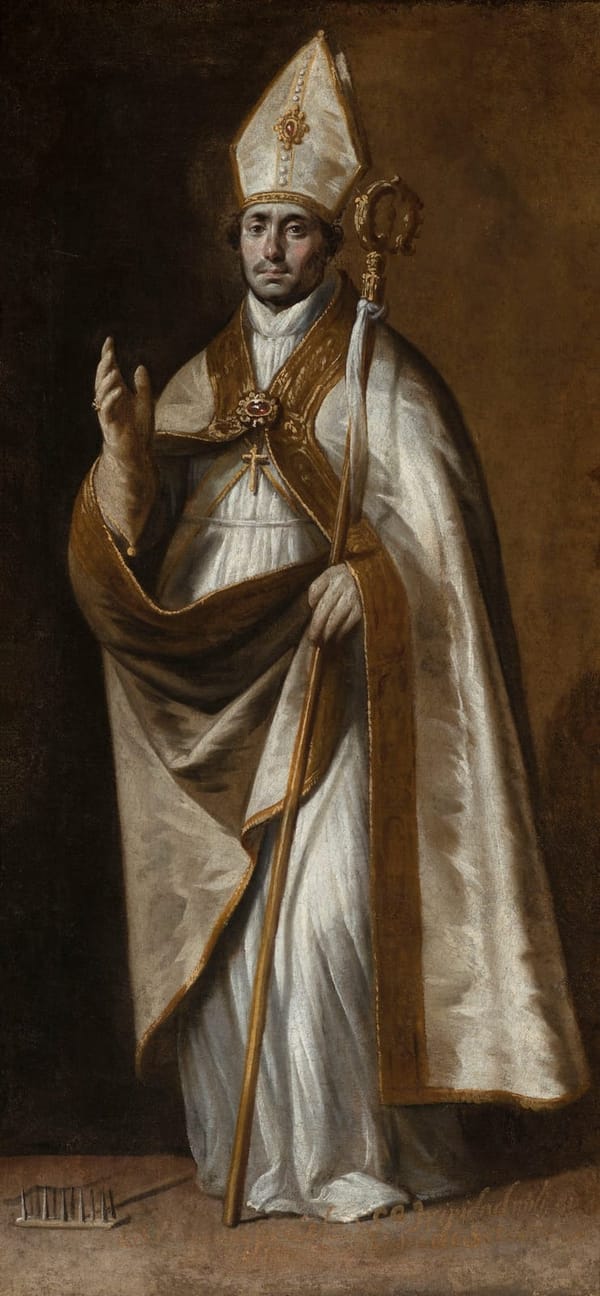
February 3: St. Blaise, Bishop and Martyr
Now that the Church has closed the joyous period of her forty days of Christmas, and is putting us through a course of meditations on subjects which are to excite a spirit of penance within us, each of the saints’ feasts must produce an impression, which shall be in accordance with that spirit. From this day till Easter, we will study the saints, as they come to us, in this special light: how much they laboured and suffered during their pilgrimage of life, and what was the plan they took for conquering the world and the flesh. ‘They went,’ says the psalmist, ‘and wept, casting their seeds: but coming they shall come with joyfulness, carrying their sheaves.’* It shall be the same with us; and at the end of our lenten labours, our risen Jesus will hail us as His living, regenerated children.
The calendar of this portion of the year abounds with martyrs; and, at the very outset, we meet with one of the most celebrated of these glorious champions of Christ. The scene of his pastoral virtues and of his martyrdom was Sebaste, a city of Armenia, the same that will give us forty martyred soldiers on a single day. The devotion to St. Blase is, even to this day, most fervently kept up in the east, especially in Armenia. The western Churches Boon began to love and honour his memory, and so universally, that we might call him one of the most popular of our saints. His feast, however, with us is only a simple, and the Church of Rome has given only one lesson on his life.
Accept, O glorious martyr, the praise which we, too, offer thee in union with that given thee by the whole Church. In return for this homage of our veneration, look down upon the Christian people, who are now preparing to enter on the season of penance, and to be converted to the Lord their God by holy compunction and tears. We ask it of thee by thine own combat: assist us in the one for which we are preparing. When duty required thee to undergo tortures and death, it found thee ready and brave; our duty is expiation by penance, and thy prayers must get us courage. Our enemies are not more cruel than thine, but they are more treacherous, and if we spare them we are lost. Obtain for us that heavenly assistance, which enabled thee to conquer. We are children of the martyrs; God forbid we should be degenerate! Pray, too, O holy pontiff, for the country thou didst water with thy blood. Armenia lost the faith for which thou didst lay down thy life. Intercede for her, that she may be restored to the Church, and let her conversion bring consolation to the few that have remained orthodox and faithful.
* Ps. cxxv. 6, 7. ↩︎
Tuesday of Septuagesima Week
The serpent’s promises had stifled, in Eve’s heart, every sentiment of love for the God that had created her and loaded her with blessings: she is ambitious to be God like Him! Her faith, too, is wavering; she is not sure that God may not have deceived her, by threatening her with death should she disobey His command. Flushed by pride, she looks up to the forbidden fruit; it seems good to eat, and it is fair to her eyes.* So that her senses too conspire against God, and against her own happiness. The sin is already committed in her heart; it needs but a formal act to make it complete. She cares for nothing but self; God is no more heeded than if He did not exist. She stretches forth her daring hand; she plucks the fruit; she puts it to her mouth, and eats!
God had said that if she broke His commandment she should die; she has eaten, she has sinned, and yet she lives as before! Her pride exults at this triumph, and, convinced that she is too strong for God’s anger to reach her, she resolves on making Adam a partner in her victory. Boldly she hands him the fruit, which she herself has eaten without any evil coming to her. Whether he was emboldened by the impunity of his wife’s sin, or, from a feeling of blind affection, wished to share the lot of her who was the 'flesh of his flesh and bone of his bones,’ our first father, also, forgets all he owes to his Creator, and, as though there had never been aught of love between him and his God, he basely does as Eve suggests: he eats of the fruit, and by that act ruins himself and all his posterity.
No sooner have they broken the tie which united them with God, than they sink into themselves. As long as God dwells in the creature, whom He has raised to the supernatural state, his being is complete; but, let that creature drive his God away from himself by sin, and he finds himself in a state worse than nothing—the state of evil. That soul which, a moment before, was so beautiful and pure, is a hideous wreck. Thus is it with our first parents: they stand alone; creatures without God; and an intolerable shame seizes them. They thought to become gods, they aspired at infinite being; see them now:—sinners, the prey of concupiscence. Hitherto, their innocence was their allsufficient garb; the world was obedient to them; they knew not how to blush, and there was nothing to make them fear; but now, they tremble at their nakedness, and must needs seek a place wherein to hide!
The same self-love that had worked their ruin, had made them forget the greatness and goodness of God, and despise His commandment. Now that they have committed the great sin, the same blindness prevents them from even thinking of confessing it, or asking the forgiveness of the Master they have offended. A sullen fear possesses them. They can think of nothing but how and where to hide!
In Dominica Tyrophagi
* Gen. iii. 6. ↩︎
| Previous Monday of Septuagesima Week | Next Tuesday of Septuagesima Week |