Daily reading
Septuagesima
Double · February 5 · Sanctoral
February 5, 2026
From Dom Guéranger’s The Liturgical Year.
A Double leads the weekday.Rubric
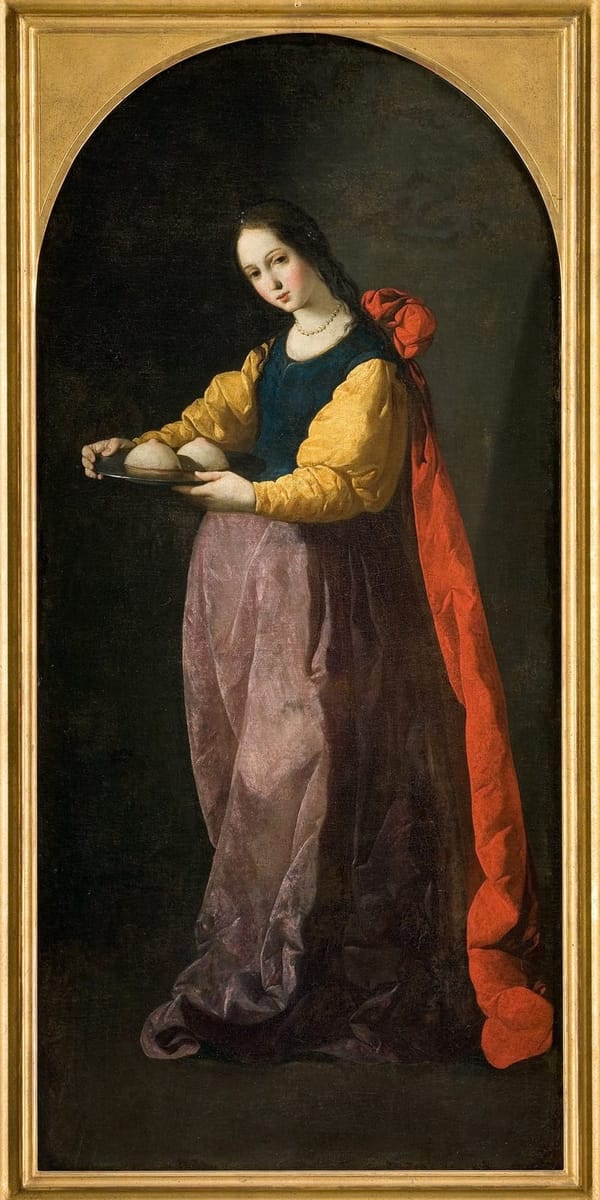 |
February 5: St. Agatha, Virgin and Martyr
Since the commencement of the ecclesiastical year, we have kept the feasts of two out of the four illustrious virgins whose names are daily honoured in the holy Sacrifice of the Lamb: the third comes to-day, lighting up the heaven of the Church with her bright soft rays. Lucy first, then Agnes, and now the gracious visit of Agatha. The fourth, Cecily, the immortal Cecily, is to be one of that magnificent constellation which gives such splendour to the closing of the year. To-day, then, let us keep a feast in honour of Agatha, the virgin daughter of that same fair Sicily which can boast of her Lucy. We must not allow the holy sadness of our present season to take aught from the devotion we owe to our saint. The joy wherewith we celebrate her merits will lead us to study her virtues. She will repay us by her prayers; she will encourage us to persevere in the path which is to bring us to the God she so nobly loved and served, and with whom she is now for ever united.
Let us begin by reading what the Church tells us of the virtues and combats of this glorious bride of Christ.
The ancient books of the liturgy abound with verses in honour of St. Agatha; but most of them are so poor in sentiment that we pass them over. The following beautiful hymn is the composition of Pope St. Damasus.
Hymn
Virginis emicat eximiæ:
Christus eam sibi qua sociat,
Et diadema duplex decorat.
Sed magia actibus atque fide,
Terrea prospera nil reputans,
Jussa Dei sibi corde ligans.
Exposuit sua membra flagris,
Pectore quam fuerit valido
Torta mamilla docet patulo.
Pastor ovem Petrus hanc recreat:
Inde gavisa magisque flagrans,
Cuncta flagella cucurrit ovans.
Hujus et ipsa meretur opem;
Quos fidei titulus decorat,
His Venerem magis ipsa premat.
Pro miseris supplica Domino,
Sio tua festa coli faciat,
Te celebrantibus ut faveat.
Spirituique proinde sacro,
Qui Deus unus et omnipotens
Hanc nostri faciat memorem.
of the glorious martyr and virgin Agatha,
when Christ took her to himself,
and a double crown wreathed her brow.
her grandest riches were her deeds and her faith.
Earthly prosperity was nothing in her eyes,
but her whole heart was on the precepts of her God.
she flinched not as they lashed her limbs:
and her wounded breast
reveals a dauntless heart.
where the pastor Peter heals his bleeding lamb;
and thence once more she runs to suffer,
gladder and braver at every wound.
was saved by Agatha’s prayer.
The same can check, in Christian hearts,
the threatening fire of lust.
intercede with him for us miserable sinners,
that he grant us so to spend thy feast,
that our celebration may draw down his grace.
and the Holy Ghost.
May the one almighty God
grant that this his saint be mindful of us.
How lovely are thy palms, O Agatha! But how long and cruel was thy combat for them! The day was thine; thy faith and thy virginity triumphed, but the battle-field streamed with thy blood, and thy glorious wounds bear testimony to the angels how stern was the courage of thy fidelity to Jesus thy Spouse. When thine enemies left thee, it was to Him thou didst look up; and then thy soul flew to its rest, in the bosom of thy King and God. The whole Church keeps feast to-day, praising her Lord in thee, great martyr and virgin! She knows the love thou bearest her, and how, amidst the joys of heaven, her interests and her wants are the object of thy prayers. Thou art our sister; be, too, our mother, by interceding for us. Centuries have passed away since that day, whereon thy soul quitted the body thou hadst sanctified by purity and suffering; but the great battle between the spirit and the flesh is still waging here on earth, and will do so to the end of time. Assist us in the struggle; keep up within our hearts the holy fire, which the world and our passions are ever seeking to quench.
It is now the season when every Christian should renew his whole being by repentance and compunction. We know the power of thy prayer; let it procure us these gifts: the fear of God, which keeps down the workings of corrupt nature; the spirit of penance, which repairs the injuries caused by our sins; and a solid love for our dear Lord, which sweetens the yoke, and ensures perseverance. More than once a whole people has witnessed how a relic of thine, thy veil, has checked the stream of lava which rolled down the sides of Etna; we are threatened with a torrent of vice, which will drive the world back to pagan corruption, unless divine mercy stay its wild fury; and prayers such as thine can obtain it for us. Delay not, O Agatha! each day gives strength to the danger. Not a nation but is now infected with the poison of a literature that is infidel and immoral; by thy prayers keep the poisonous cup from them that have not tasted, neutralize its power in them that have drunk its venom of death. Oh! spare us the shame of seeing our Europe the slave of sensuality, and the dupe of hell.
Thursday of Septuagesima Week
Forgiveness is promised; but atonement must be made. Divine justice must be satisfied, and future generations be taught that sin can never pass unpunished. Eve is the guiltier of the two, and her sentence follows that of the serpent. Destined by God to aid man in peopling the earth with happy and faithful children, formed by this God out of man’s own substance 'flesh of his flesh, and bone of his bones,’ woman was to be on an equality with man. But sin has subverted this order, and God’s sentence is this: conjugal union, notwithstanding the humiliation of concupiscence now brought upon it, is to be, as before, holy and sacred; but it is to be inferior in dignity, before both God and man, to the state of virginity, which disdains the ambitions of the flesh.
Secondly, woman shall be mother still, as she would have been in the state of innocence; but her honour shall be a burden. Moreover, she shall give birth to her children amidst cruel pains, and sometimes even death must be the consequence of her infant’s coming into the world. The sin of Eve shall thus be memorialized at every birth, and nature shall violently resist the first claims of him, whom sin has made her unwelcome lord.
Lastly, she who was at first created to enjoy equality of honour with man, is now to forfeit her independence. Man is to be her superior, and she must obey him. For long ages, this obedience will be no better than slavery; and this degradation shall continue till that Virgin comes, whom the world shall have expected for four thousand years, and whose humility shall crush the serpent’s head. She shall restore her sex to its rightful position, and give to Christian woman that influence of gentle persuasiveness, which is compatible with the duty imposed upon her by divine justice, and which can never be remitted: the duty of submission.
In Dominica Tyrophagi
| Previous Wednesday of Septuagesima Week | Next Thursday of Septuagesima Week |