Daily reading
Septuagesima
Double · Movable from Easter · Temporal
February 8, 2026
From Dom Guéranger’s The Liturgical Year.

|

Sexagesima Sunday
The Church offers to our consideration, during this week of Sexagesima, the history of Noah and the deluge. Man has not profited by the warnings already given him. God is obliged to punish him once more, and by a terrible chastisement. There is found out of the whole human race one just man; God makes a covenant with him, and with us through him. But, before He draws up this new alliance, He would show that He is the sovereign Master, and that man, and the earth whereon he lives, subsist solely by His power and permission.
As the ground-work of this week’s instructions, we give a short passage from the Book of Genesis: it is read in the Office of this Sunday’s Matins.
Cap. vi.Videns autem Deus quod multa malitia hominum esset in terra, et cuncta cogitatio cordis intenta esset ad malum omni tempore, pœnituit eum quod hominem fecisset in terra. Et tactus dolore cordis intrinsecus: Delebo, inquit, hominem quem creavi, a facie terræ, ab homine usque ad animantia, a reptili usque ad volucres cœli, pœnitet enim me fecisse eos. Noë vero invenit gratiam coram Domino.
Ch. vi.And God seeing that the wickedness of men was great on the earth, and that all the thought of their heart was bent upon evil at all times, it repented him that he had made man on the earth. And being touched inwardly with sorrow of heart, he said: I will destroy man, whom I have created, from the face of the earth, from man even to beasts, from the creeping thing even to the fowls of the air. For it repenteth me that I have made them. But Noah found grace before the Lord.
This awful chastisement of the human race by the deluge was a fresh consequence of sin. This time, however, there was found one just man; and it was through him and his family that the world was restored. Having once more mercifully renewed His covenant with His creatures, God allows the earth to be repeopled, and makes the three sons of Noah become the fathers of the three great families of the human race.
This is the mystery of the Divine Office during the week of Sexagesima. The mystery expressed in to-day’s Mass is of still greater importance, and the former is but a figure of it. The earth is deluged by sin and heresy. But the word of God, the seed of life, is ever producing a new generation: a race of men, who, like Noah, fear God. It is the word of God that produces those happy children, of whom the beloved disciple speaks, saying: ‘They are born not of blood, nor of the will of the flesh, nor of the will of man, but of God.’1 Let us endeavour to be of this family; or, if we are already numbered among its members, let us zealously maintain our glorious position. What we have to do, during these days of Septuagesima, is to escape from the deluge of worldliness, and take shelter in the Ark of salvation; we have to become that good soil, which yields a hundredfold from the heavenly seed. Let us flee from the wrath to come, lest we perish with the enemies of God: let us hunger after that word of God, which converteth and giveth life to souls.2
With the Greeks, this is the seventh day of their week Apocreos, which begins on the Monday after our Septuagesima Sunday. They call this week Apocreos, because they then begin to abstain from flesh-meat, which abstinence is observed till Easter Sunday.
Mass
At Rome the Station is in the basilica of St. Paul outside the walls. It is around the tomb of the Doctor of the Gentiles, the zealous sower of the divine seed, the father by his preaching of so many nations, that the Roman Church assembles her children on this Sunday, whereon she is about to announce to them how God spared the earth on the condition that it should be peopled with true believers and with faithful adorers of His name.
The Introit, which is taken from the Psalms, cries out to our Lord for help. The human race, all but extinct after the deluge, is here represented as beseeching its Creator to bless and increase it. The Church adopts the same prayer, and asks her Saviour to multiply the children of the Word, as He did in former days.
Introit
In the Collect, the Church expresses the confidence she puts in the prayers of the great apostle St. Paul, that zealous sower of the divine seed, who laboured more than the other apostles in preaching the word to the Gentiles.
Collect
Then are added two other Collects, as in the Mass of Septuagesima Sunday, page 120.
The Epistle is that admirable passage from one of St. Paul’s Epistles, in which the great apostle, for the honour and interest of his sacred ministry, is necessitated to write his defence against the calumnies of his enemies. We learn from this his apology what labours the apostles had to go through, in order to sow the word of God in the barren soil of the Gentile world, and make it Christian.
Epistle
2 Cap. xi.Fratres, libenter suffertis insipientes, cura sitis ipsi sapientes. Sustinetis enim si quis vos in servitutem redigit, si quis devorat, si quis accipit, si quis extollitur, si quis in faciem vos cædit. Secundum ignobilitatem dico, quasi nos infirmi fuerimus in hac parte. In quo quis audet (in insipientia dico), audeo et ego. Hebræi sunt, et ego. Israelitse sunt, et ego. Semen Abrahæ sunt, et ego. Ministri Christi sunt (ut minus sapiens dico), plus ego: in laboribus plurimis, in carceribus abundantius, in plagia supra modum, in mortibus frequenter. A Judæis quinquies quadragenas, una minus, accepi. Ter virgis cæsus sum, semel lapidatus sum, ter naufragium feci, nocte et die in profundo maris fui; in itineribus sæpe, periculis fluminum, periculis latronum, periculis ex genere, periculis ex gentibus, periculis in civitate, periculis in solitudine, periculis in mari, periculis in falsis fratribus; in labore et ærumna, in vigiliis multis, in fame et siti, in jejuniis multis, in frigore et nuditate. Præter illa, quæ extrinsecus sunt, instantia mea quotidiana, sollicitudoomnium Ecclesiarum. Quis infirmatur, et ego non infirmor? Quis scandalizatur, et ego non uror? Si gloriari oportet, quæ infirmitatis meæsunt, gloriabor. Deus et Pater Domini nostri Jesu Christi, qui est benedictus in sæcula, scit quod non mentior. Damasci præpositua gentis Aretæ regia, custodiebat civitatem Damascenorum, ut me comprehenderet; et per fenestram in sporta dimissus sum per murum, et sic effugi manus ejus. Si gloriari oportet (non expedit quidem), veniam autem ad visiones et revelationes Domini. Scio hominem in Christo ante annos quatuordecim (sive in corpore nescio, sive extra corpus nescio, Deus scit), raptum hujusmodi usque ad tertium cœlum. Et scio hujusmodi hominem (sive in corpore, sive extra corpus nescio, Deus scit), quoniam raptus est in paradisum, et audivit arcana verba quæ non licet homini loqui. Pro hujusmodi gloriabor; pro me autem nihil gloriabor, nisi in infirmitatibus meis. Nani, et si voluero gloriari, non ero insipiens; veritatem enim dicam: parco autem, ne quis me existimet supra id quod videt in me, aut aliquid audit ex me. Et ne magnitudo revelationum extollat me, datus est mihi stimulus carnis meæ, angelus Satanæ, qui me colaphizet. Propter quod ter Dominum rogavi ut discederet a me: et dixit mihi: Sufficit tibi gratia mea; nam virtus in infirmitate perficitur. Libenter igitur gloriabor in infirmitatibus meis, ut inhabitet in me virtus Christi.
2 Ch. xi.
In the Gradual, the Church beseeches her Lord to give her strength against those who oppose the mission He has entrusted to her, of gaining for Him a new people, adorers of His sovereign Majesty.
Gradual
Whilst the earth is being moved, and is suffering those terrible revolutions which, deluge-like, come first on one nation and then on another, the Church prays for her faithful children, in order that they may be spared, for they are the elect, and the hope of the world. It is thus she prays in the following Tract, which precedes the Gospel of the word.
Tract
Gospel
Cap. viii.In illo tempore, cum turba plurima convenirent, et de civitatibus properarent ad Jesum, dixit per similitudinem: Exiit, qui seminat, seminare semen suum: et dum seminat, aliud cecidit secus viam, et conculcatum est, et volucres cœli comederunt illud. Et aliud cecidit supra petram: et natum, aruit; quia non habebat humorem. Et aliud cecidit inter spinas, et simul exortæ spinæ suffocaverunt illud. Et aliud cecidit in terram bonam: et ortum fecit fructum centuplum. Hæc dicens clamabat: Qui habet aures audiendi, audiat. Interrogabant autem eum discipuli ejus, quæ esset hæc parabola. Quibus ipse dixit: Vobis datum est nosse mysterium regni Dei, cæteris autem in parabolis; ut videntes non videant, et audientes non intelligant. Est autem hæc parabola. Semen est verbum Dei. Qui autem secus viam, hi sunt qui audiunt: deinde venit diabolus, et tollit verbum de corde eorum, ne credentes salvi fiant. Nam qui supra petram: qui cum audierint, cum gaudio suscipiunt verbum: et hi radices non habent: quia ad tempus credunt, et in tempore tentationis recedunt. Quod autem in spinas cecidit, hi sunt qui audierunt, et a sollicitudinibus, et divitiis, et voluptatibus vitæ, euntes, suffocantur, et non referunt fructmn. Quod autem in bonam terram: hi sunt, qui in corde bono et optimo audientes verbum retinent, et fructum afferunt in patientia.
Ch. viii.At that time, when a very great multitude was gathered together, and hastened out of the cities to meet Jesus, he spoke by a similitude. The sower went out to sow his seed; and as he sowed, some fell by the wayside, and it was trodden down, and the fowls of the air devoured it. And other some fell upon a rock: and as soon as it was sprung up, it withered away, because it had no moisture. And other some fell among thorns; and the thorns growing up with it, choked it. And other some fell upon good ground, and being sprung up, yielded fruit a hundred fold. Saying these things he cried out: He that hath ears to hear, let him hear. And his disciples asked him what this parable might be. To whom he said: To you it is given to know the mystery of the kingdom of God; but to the rest in parables: that seeing they may not see, and hearing they may not understand. Now the parable is this: The seed is the word of God. And they by the wayside are they that hear; then the devil cometh, and taketh the word out of their heart, lest believing they should be saved. Now they upon the rock are they who, when they hear, receive the word with joy: and these have no roots; for they believe for a while, and in time of temptation fall away. And that which fell among thorns, are they who have heard, and going their way, are choked with the cares and riches and pleasures of this life, and yield no fruit. But that on the good ground, are they, who in a good and very good heart hearing the word, keep it, and bring forth fruit in patience.
St. Gregory the Great justly remarks, that this parable needs no explanation, since eternal Wisdom Himself has told us its meaning. All that we have to do, is to profit by this divine teaching, and become the good soil, wherein the heavenly seed may yield a rich harvest. How often have we, hitherto, allowed it to be trampled on by them that passed by, or to be torn up by the birds of the air! How often has it found our heart like a stone, that could give no moisture, or like a thorn plot, that could but choke! We listened to the word of God; we took pleasure in hearing it; and from this we argued well for ourselves. Nay, we have often received this word with joy and eagerness. Sometimes, even, it took root within us. But, alas! something always came to stop its growth. Henceforth, it must both grow and yield fruit. The seed given to us is of such quality, that the divine Sower has a right to expect a hundred-fold. If the soil, that is, our heart, be good; if we take the trouble to prepare it, by profiting by the means afforded us by the Church; we shall have an abundant harvest to show our Lord on that grand day, when, rising triumphant from His tomb, He will come to share with His faithful people the glory of His Resurrection.
Inspirited by this hope, and full of confidence in Him who has once more thrown this seed into this long ungrateful soil, let us sing with the Church, in her Offertory, these beautiful words of the royal psalmist: they are a prayer for holy resolution and perseverance.
Offertory
Secret
To this are added the other Secrets, as on Septuagesima Sunday, page 127.
The visit, which our Lord makes to us in the Sacrament of His love, is the grand means whereby He gives fertility to our souls. Hence it is that the Church invites us, in the Communion antiphon, to draw nigh to the altar of our God; there, our heart shall regain all the youthful fervour of its best days.
Communion
Postcommunion
Two other Postcommunions are said after this, as on Septuagesima Sunday, page 128.
Vespers
The psalms and antiphons as on page 72.
Capitulum (2 Cor. xi.)
The hymn and versicle, page 79.
Antiphon of the Magnificat
We will end our Sunday by a hymn taken from the ancient breviaries of the Churches of France: it will help us to keep up in our souls the sentiments proper to the season of Septuagesima.
Hymn
Tempus adest sobrium: Quæramus puro corde Dominum.
Hymnis et in confessionibus
Judex complacabitur Dominus.
Non negabit hic veniam, Qui vult ut homo quærat gratiam.
Post jugum servile Pharaonis,
Post catenas diræ Babylonis: Liber homo patriam Quærat cœlestem Hierosolymam.
Fugiamus de hoc exilio: Habitemus cum Dei Filio: Hoc decus est famuli Si sit cohæres sui Domini.
Sis Christe nobis dux hujus vitæ:
Memento quod sumus oves tuæ,
Pro quibus ipse tuam Pastor ponebas morte animam.
Gloria sit Patri et Filio: Sancto simul honor Paraclito:
Sicut erat pariter In principio et nunc et semper. Amen.
February 8: St. John of Matha, Confessor
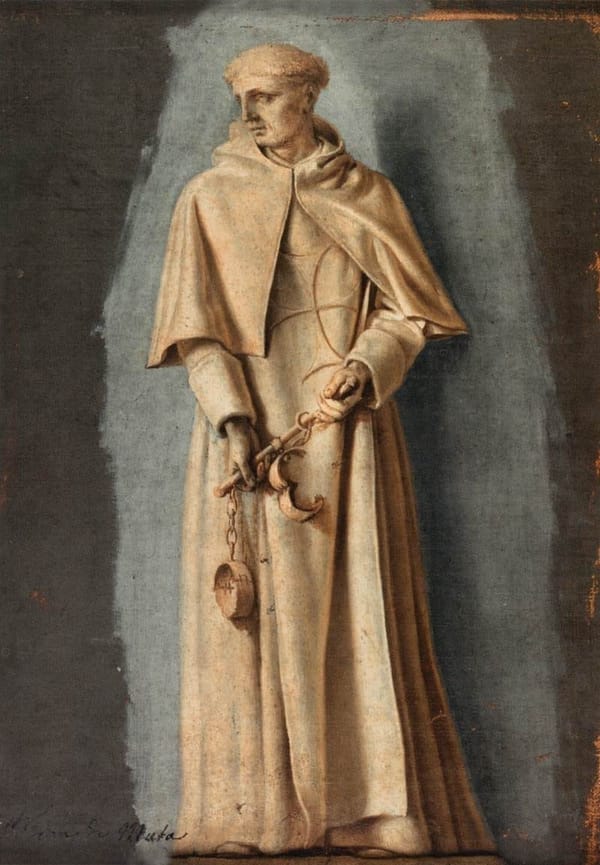 |
We were celebrating, not many days ago, the memory of Peter Nolasco, who was inspired, by the holy Mother of God, to found an Order for the ransoming of Christian captives from the infidels: to-day, we have to honour the generous saint, to whom this sublime work was first revealed. He established, under the name of the most holy Trinity, a body of religious men, who bound themselves by vow to devote their energies, their privations, their liberty, nay, their very life, to the service of the poor slaves who were groaning under the Saracen yoke. The Order of the Trinitarians, and the Order of Mercy, though distinct, have the same end in view, and the result of their labours, during the six hundred years of their existence, has been the restoration to liberty and preservation from apostasy of upwards of a million slaves. John of Matha, assisted by his faithful co-operator, Felix of Valois (whose feast we shall keep at the close of the year), established the centre of his grand work at Meaux, in France. We are preparing for Lent, when one of our great duties will have to be that of charity towards our suffering brethren: what finer model could we have than John of Matha, and his whole Order, which was called into existence for no other object than that of delivering from the horrors of slavery brethren who were utter strangers to their deliverers, but were in suffering and in bondage. Can we imagine any almsgiving, let it be ever so generous, which can bear comparison with this devotedness of men, who bind themselves by their rule, not only to traverse every Christian land begging alms for the ransom of slaves, but to change places with the poor captives, if their liberty cannot be otherwise obtained? Is it not, as far as human weakness permits, following to the very letter the example of the Son of God Himself, who came down from heaven that He might be our ransom and our Redeemer? We repeat it: with such models as these before us, we shall feel ourselves urged to follow the injunction we are shortly to receive from the Church, of exercising works of mercy towards our fellow-creatures, as being one of the essential elements of our lenten penance.
But it is time we should listen to the account given us by the liturgy of the virtues of this apostolic man, who has endeared himself, both to the Church and to mankind, by his heroism of charity.
And now, generous-hearted saint, enjoy the fruits of thy devoted charity. Our blessed Redeemer recognizes thee as one of His most faithful imitators, and the whole court of heaven is witness of the recompense wherewith He loves to honour thy likeness to Himself. We must imitate thee; we must walk in thy footsteps; for we too hope to reach the same eternal resting-place. Fraternal charity will lead us to heaven, for the works it inspires us to do have the power of freeing the soul from sin, as our Lord assures us.1 Thy charity was formed on the model of that which is in the heart of God, who loves our soul yet disdains not to provide for the wants of our body. Seeing so many souls in danger of apostasy, thou didst run to their aid, and men were taught to love a religion which can produce heroes of charity like thee. Thy heart bled at hearing of the bodily sufferings of these captives, and thy hand broke the chains of their galling slavery. Teach us the secret of ardent charity. Is it possible that we can see a soul in danger of being lost, and remain indifferent? Have we forgotten the divine promise, told us by the apostle: ‘He that causeth a sinner to be converted from the error of his way, shall save his soul from death, and shall cover a multitude of his own sins’?2 Obtain for us, also, a tender compassion for such as are in bodily suffering and poverty, that so we may be generous in comforting them under these trials, which are but too often an occasion of their blaspheming Providence. Dear friend and liberator of slaves! pray, during this holy season, for those who groan under the captivity of sin and Satan; for those, especially, who, taken with the frenzy of earthly pleasures, feel not the weight of their chains, but sleep on peacefully through their slavery. Ransom them by thy prayers, convert them to the Lord their God, lead them back to the land of freedom. Pray for France which was thy country, and save her from infidelity. Protect the venerable remnants of thy Order, that so it may labour for the present wants of the Christian world, since the object for which thou didst institute it has ceased to require its devotedness.
| Previous Saturday of Septuagesima Week | Next February 8: St. John of Matha, Confessor |