Daily reading
Septuagesima
Double · February 12 · Sanctoral
February 12, 2026
From Dom Guéranger’s The Liturgical Year.
A Double leads the weekday.Rubric
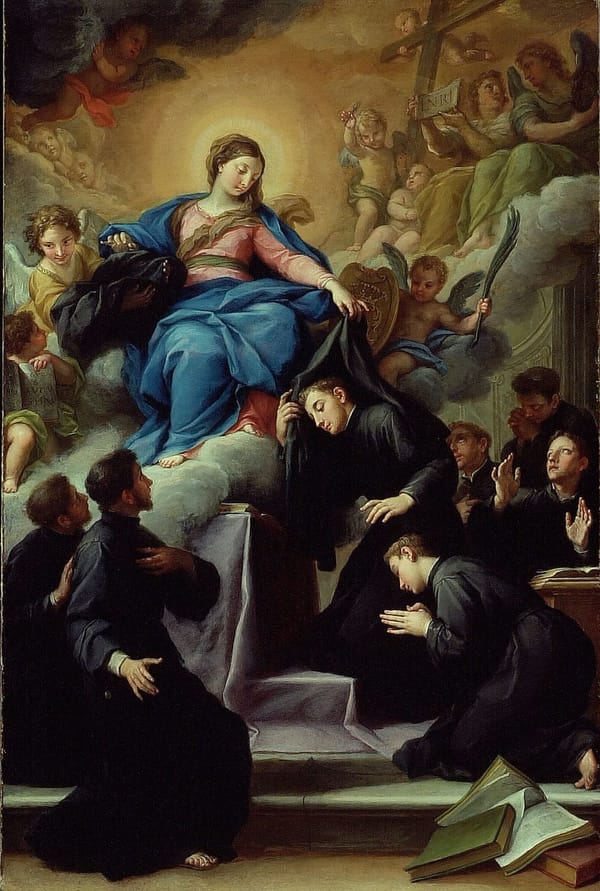 |
February 12: The Seven Holy Founders of the Order of Servites, Confessors
Clouds are gathering over Holy Church. We are reminded on every side of the approach of those days when our Emmanuel will show Himself to us in the pitiable state to which our sins have brought Him. Bethlehem is so soon followed by Calvary. We shall find the Mother of divine grace at the foot of the Cross as we found her at Ephrata. She brought forth her firstborn in joy, but now in tears she is to bring forth those brothers of His whose birth cost her so much. We have shared her joy, and we shall not refuse to weep and suffer with her.
Let us take for our models the saints whom the Church honours to-day. They passed their lives in the contemplation of our Lady’s sorrows, and the Order which they founded has the special mission to spread this devotion. St. Francis of Assisi raised the standard of the Cross anew in a world grown cold. The work of redemption seemed to be taken up afresh, and, as on the great Friday Jesus would not manifest Himself without Mary, the Servites completed the work of the Founder of the Friars Minor. Men regained confidence as they meditated on the Passion of the Son and the Compassion of the Mother.
The two feasts consecrated to the Dolours of our Lady will teach us in due course what place her compassion had in the economy of the Redemption. The Queen of heaven herself showed her predilection for the Order which made itself her apostle, in the striking outpouring of holiness which marked its origin. The simultaneous blooming of seven lilies, gathered on earth to-day by the angels, was a sight new even to heaven. Peter of Verona had a vision of them when they were implanting themselves on Monte Senario; and the future martyr saw the blessed Virgin smile as she gazed on that mountain where countless other flowers sprang up to perfume holy Church. Florence, the city of flowers, had never before given such blooms to God. Hell multiplied its attacks against the noble city, but could not prevail against Mary within its walls. We shall be reminded of these things by the feasts of St. Juliana Falconieri and St. Philip Benizi, which were established before the one we are keeping to-day. Let us unite our gratitude to that which the Church feels for the Religious family of the Servites. The world owes to them the grace of a new development in the knowledge and love of the Mother of God, who became our Mother at the price of unparalleled sufferings.
The lessons read by the Church on this day speak of the merits of our Saints and the favours with which our Lady rewarded their fidelity. February 11, the day first chosen as their common feast, is not the anniversary of the death of any one of them, but the day on which, in the year 1304, after passing through many vicissitudes, their Order obtained the definitive approbation of the Church.
You made the sorrows of Mary your own, and now she shares her eternal joys with you. The vine with its miraculously ripening grapes, which prefigured your fruitfulness in a frozen world, still yields a sweet odour in this land of exile, and the faithful still appreciate its fruit. Philip and Juliana have long been honoured as branches of this blessed vine, and to-day we pay our homage to the sevenfold root from which they sprang. You rejoiced in the obscurity which covered the life upon earth of the Queen of saints herself, but to-day the glory of Mary pierces all clouds, and no shadow can withdraw the servants from the radiance which surrounds the Mistress. May your glory be increased by the favours you bestow upon men! Teach an aged world to seek warmth at the fire whence you draw a love strong enough to triumph over the world and sacrifice self for God.
O Heart of Mary, pierced by the sword of sorrow, furnace of love which throughout all eternity feeds the fires of the very Seraphim, be our model, our refuge, and our consolation until the dawn of that blissful day which is to be the end of our exile in this vale of tears.
Thursday of Sexagesima Week
God promised Noah that He would never more punish the earth with a deluge. But, in His justice, He has many times visited the sins of men with a scourge which, in more senses than one, bears a resemblance to a deluge: the invasion of enemies. We meet with these invasions in every age; and each time we see the hand of God. We can trace the crimes that each of them was sent to punish, and in each we find a manifest proof of the infinite justice wherewith God governs the world.
It is not requisite that we should here mention the long list of these revolutions, which we might almost say make up the history of mankind, for in its every page we read of conquests, extinction of races, destruction of nations, and violent amalgamations, which effaced the traditions and character of the several peoples that were thus forced into union. We will confine our considerations to the two great invasions, which the just anger of God has permitted to come upon the world since the commencement of the Christian era.
The Roman Empire had made itself as preeminent in crime as it was in power. It conquered the world, and then corrupted it. Idolatry and immorality were the civilization it gave to the nations which had come under its sway. Christianity could save individuals in the great empire, but the empire itself could not be made Christian. God let loose upon it the deluge of barbarians. The stream of the wild invasion rose to the very dome of the Capitol; the empire was engulfed. The ruthless ministers of divine justice were conscious of their being chosen for this mission of vengeance, and they gave themselves the name of ‘God's scourge.’
When, later on, the Christian nations of the east had lost the faith which they themselves had transmitted to the western world; when they had disfigured the sacred symbol of faith by their blasphemous heresies; the anger of God sent upon them, from Arabia, the deluge of Mahometanism. It swept away the Christian Churches, that had existed from the very times of the apostles. Jerusalem, the favoured Jerusalem, on which Jesus had lavished His tenderest love, even she became a victim to the infidel hordes. Antioch and Alexandria, with their patriarchates, were plunged into the vilest slavery; and at length Constantinople, that had so obstinately provoked the divine indignation, was made the very capital of the Turkish empire.
And we, the western nations, if we return not to the Lord our God, shall we be spared? Shall the flood-gates of heaven's vengeance, the torrent of fresh Vandals, ever be menacing to burst upon us, yet never come? Where is the country of our own Europe, that has not corrupted its way, as in the days of Noah? that has not made conventions against the Lord and against His Christ?1 that has not clamoured out that old cry of revolt: Let us break their bonds asunder, let us cast away their yoke from us?2 Well may we fear lest the time is at hand, when, despite our haughty confidence in our means of defence, Christ our Lord, to whom all nations have been given by the Father, shall rule us with a rod of iron, and break us in pieces like a potter’s vessel.3 Let us propitiate the anger of our offended God, and follow the inspired counsel of the royal prophets Serve ye the Lord with fear; embrace the discipline of His Law; lest, at any time, the Lord be angry, and ye perish from the just way.4
We find the following beautiful words in the Ambrosian liturgy for Septuagesima. They occur in the missal.
Transitorium
(Dominica in Quinquagesima.)
| Previous Wednesday of Sexagesima Week | Next Thursday of Sexagesima Week |