Daily reading
Lent
Greater Double · Movable from Easter · Temporal
February 22, 2026
From Dom Guéranger’s The Liturgical Year.

|
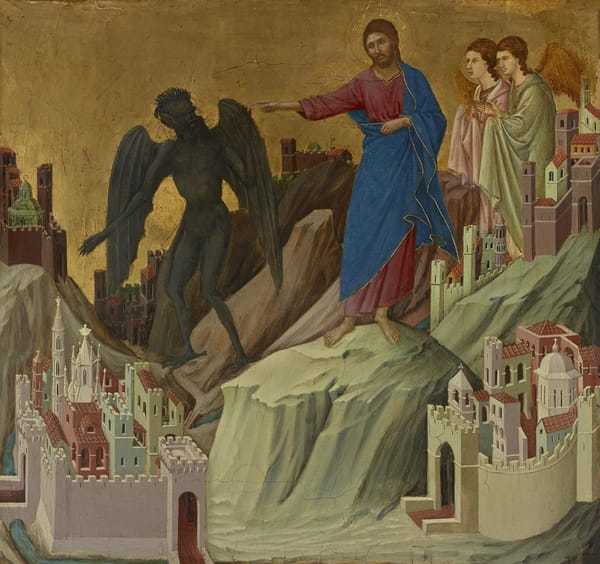
The First Sunday of Lent
This Sunday, the first of the six which come during Lent, is one of the most solemn throughout the year. In common with the other Sundays of Lent, it has the privilege of taking precedence of all feasts, even that of the patron, titular saint, or dedication of the Church. In the ancient calendars, it is called Invocabit, from the first word of the Introit of the Mass. In the middle ages,1 it was called Brand Sunday, because the young people, who had misconducted themselves during the carnival, were obliged to show themselves to-day at the church with a torch in their hands, as a kind of public satisfaction for their riot and excess.
Lent solemnly opens to-day. We have already noticed that the four preceding days were added since the time of St. Gregory the Great, in order to make up forty days of fasting. Neither can we look upon Ash Wednesday as the solemn opening of the season; for the faithful are not bound to hear Mass on that day. The holy Church, seeing her children now assembled together, speaks to them, in her Office of Matins, these eloquent and noble words of St. Leo the Great:
Having to announce to you, dearly beloved, the most sacred and chief fast, how can I more appropriately begin, than with the words of the apostle, in whom Christ Himself spoke, and by saying to you what has just been read: Behold! now is the acceptable time; behold! now is the day of salvation. For although there be no time which is not replete with divine gifts, and we may always, by God’s grace, have access to His mercy, yet ought we all to redouble our efforts to make spiritual progress and be animated with unusual confidence, now that the anniversary of the day of our redemption is approaching, inviting us to devote ourselves to every good work, that so we may celebrate, with purity of body and mind, the incomparable mystery of our Lord’s Passion.
It is true that our devotion and reverence towards so great a mystery should be kept up during the whole year, and we ourselves should be at all times, in the eyes of God, the same as we are bound to be at the Easter solemnity. But this is an effort which only few among us have the courage to sustain. The weakness of the flesh induces us to relax our austerities; the various occupations of every-day life take up our thoughts; and thus even the virtuous find their hearts clogged by this world’s dust. Hence it is that our Lord has most providentially given us these forty days, whose holy exercises should be to us a remedy, whereby to regain our purity of soul. The good works and the holy fastings of this season were instituted as an atonement for, and an obliteration of, the sins we commit during the rest of the year.
Now, therefore, that we are about to enter upon these days, which are so full of mystery, and which were instituted for the holy purpose of purifying both soul and body, let us; dearly beloved, be careful to do as the apostle bids us, and cleanse ourselves from all defilement of the flesh and of the spirit: that thus the combat between the two substances being made less fierce, the soul, which, when she herself is subject to God, ought to be the ruler of the body, will recover her own dignity and position. Let us also avoid giving offence to any man, so that there be none to blame or speak evil things of us. For we deserve the harsh remarks of infidels, and we provoke the tongues of the wicked to blaspheme religion, when we who fast lead unholy lives. For our fast does not consist in the mere abstinence from food; nor is it of much use to deny food to our body, unless we restrain the soul from sin.2
Each Sunday of Lent offers to our consideration a passage from the Gospel, which is in keeping with the sentiments wherewith the Church would have us be filled. To-day she brings before us the temptation of our Lord in the desert. What light and encouragement there is for us in this instruction!
We acknowledge ourselves to be sinners; we are engaged, at this very time, in doing penance for the sins we have committed—but how was it that we fell into sin? The devil tempted us; we did not reject the temptation; then we yielded to the suggestion, and the sin was committed. This is the history of our past; and such it would, also, be for the future, were we not to profit by the lesson given us to-day by our Redeemer.
When the apostle speaks of the wonderful mercy shown us by our divine Saviour, who vouchsafed to make Himself like to us in all things save sin, he justly lays stress on His temptations.3 He, who is very God, humbled Himself even so low as this, to prove how tenderly He compassionated us. Here, then, we have the Saint of saints allowing the wicked spirit to approach Him, in order that we might learn, from His example, how we are to gain victory under temptation.
Satan has had his eye upon Jesus; he is troubled at beholding such matchless virtue. The wonderful circumstances of His birth; the shepherds called by angels to His crib, and the Magi guided by the star; the Infant’s escape from Herod’s plot; the testimony rendered to this new Prophet by John the Baptist: all these things, which seem so out of keeping with the thirty years spent in obscurity at Nazareth, are a mystery to the infernal serpent, and fill him with apprehension. The ineffable mystery of the Incarnation has been accomplished unknown to him; he never once suspects that the humble Virgin, Mary, is she who was foretold by the prophet Isaias, as having to bring forth the Emmanuel;4 but he is aware that the time has come, that the last week spoken of to Daniel has begun its course, and that the very pagans are looking towards Judea for a deliverer. He is afraid of this Jesus; he resolves to speak with Him, and elicit from Him some expression which will show him whether He be or not the Son of God; he will tempt Him to some imperfection, or sin, which, should he commit it, will prove that the object of so much fear is, after all, but a mortal Man.
The enemy of God and men is, of course, disappointed. He approaches Jesus; but all his efforts turn only to his own confusion. Our Redeemer, with all the self-possession and easy majesty of a God-Man, repels the attacks of satan; but He reveals not His heavenly origin. The wicked spirit retires without having made any discovery beyond this—that Jesus is a prophet, faithful to God. Later on, when he sees the Son of God treated with contempt, calumniated and persecuted; when he finds that his own attempts to have Him put to death are so successful: his pride and his blindness will be at their height; and not till Jesus expires on the cross, will he learn that his victim was not merely Man, but Man and God. Then will he discover how all his plots against Jesus have but served to manifest, in all their beauty, the mercy and justice of God: His mercy, because He saved mankind; and His justice, because He broke the power of hell for ever.
These were the designs of divine Providence in permitting the wicked spirit to defile, by his presence, the retreat of Jesus, to speak to Him, and to lay his hands upon Him. But let us attentively consider the triple temptation in all its circumstances; for our Redeemer suffered it only in order that He might instruct and encourage us.
We have three enemies to fight against; our soul has three dangers; for, as the beloved disciple says, all that is in the world, is the concupiscence of the flesh, and the concupiscence of the eyes, and the pride of life!5 By the concupiscence of the flesh, is meant the love of sensual things, which covets whatever is agreeable to the flesh, and, when not curbed, draws the soul into unlawful pleasures. Concupiscence of the eyes expresses the love of the goods of this world, such as riches, and possessions; these dazzle the eye, and then seduce the heart. Pride of life is that confidence in ourselves, which leads us to be vain and presumptuous, and makes us forget that all we have, our life and every good gift, we have from God.
Every one of our sins comes from one of these three sources; every one of our temptations aims at making us accept the concupiscence of the flesh, or the concupiscence of the eyes, or the pride of life. Our Saviour, then, who would be our model in all things, deigned to subject Himself to these three temptations.
First of all satan tempts Him in what regards the flesh: he suggests to Him to satisfy the cravings of hunger, by working a miracle, and changing the stones into bread. If Jesus consent, and show an eagerness in giving this indulgence to His body, the tempter will conclude that He is but a frail mortal, subject to concupiscence like other men. When he tempts us, who have inherited evil concupiscence from Adam, his suggestions go further than this: he endeavours to defile the soul by the body. But the sovereign holiness of the Incarnate Word could never permit satan to use upon Him the power which he has received of tempting man in his outward senses. The lesson, therefore, which the Son of God here gives us, is one of temperance: but we know that, for us, temperance is the mother of purity, and that intemperance excites our senses to rebel.
The second temptation is to pride; ‘Cast Thyself down; the angels shall bear Thee up in their hands.’The enemy is anxious to see if the favours of heaven have produced in Jesus’soul that haughtiness, that ungrateful self-confidence, which makes the creature arrogate God’s gifts to itself, and forget its benefactor. Here, also, he is foiled; our Redeemer’s humility confounds the pride of the rebel angel.
He then makes a last effort: he hopes to gain over by ambition Him who has given such proofs of temperance and humility. He shows Him all the kingdoms of the world, and the glory of them; and says to Him: ‘All these will I give Thee, if falling down, Thou wilt adore me.’Jesus rejects the wretched offer, and drives from Him the seducer, the prince of this world;6 hereby teaching us that we must despise the riches of this world, as often as our keeping or getting them is to be on the condition of our violating the law of God and paying homage to satan.
But let us observe how it is that our divine Model, our Redeemer, overcomes the tempter. Does He hearken to His words? Does He allow the temptation time, and give it strength by delay? We did so, when we were tempted; and we fell. But our Lord immediately meets each temptation with the shield of God’s word. He says: ‘It is written: Not on bread alone doth man live. It is written: Thou shalt not tempt the Lord thy God. It is written: The Lord thy God shalt thou adore, and Him only shalt thou serve.’ This, then, must be our practice for the time to come. Eve brought perdition on herself, and on the whole human race, because she listened to the serpent. He that dallies with temptation is sure to fall. We are now in a season of extraordinary grace; our hearts are on the watch, dangerous occasions are removed, everything that savours of worldliness is laid aside; our souls, purified by prayer, fasting, and almsdeeds, are to rise with Christ, to a new life; but, shall we persevere? All depends upon how we behave under temptation. Here, at the very opening of Lent, the Church gives us this passage of the holy Gospel, that we may have not only precept but example. If we be attentive and faithful, the lesson she gives us will produce its fruit; and when we come to the Easter solemnity, we shall have those sure pledges of perseverance: vigilance, self-diffidence, prayer, and the never-failing help of divine grace.
The Greek Church, in spite of her principle of never admitting a feast during Lent, celebrates to-day one of her greatest solemnities. It is called Orthodoxia, and was instituted in memory of the restoration of sacred images in Constantinople and the eastern empire, in the year 842, when the empress Theodora, aided by the holy patriarch Methodius, put a stop to the Iconoclast persecution, and restored to the churches the holy images which the fury of the heretics had taken away.
Mass
The Station, at Rome, is in the patriarchal basilica of Saint John Lateran. It was but right, that a Sunday of such solemnity as this should be celebrated in the church which is the mother and mistress of all churches, not only of the holy city itself, but of the whole world. It is here that the public penitents were reconciled on Maundy Thursday; it is here, also, in the baptistery of Constantine, that the catechumens received Baptism on the night preceding Easter Sunday. No other basilica could have had such a claim for the Station of a day like this; for it is there that the Lenten Fast had been so often proclaimed by Leo and Gregory.
The Introit, as likewise the Gradual, Tract, Offertory, and Communion, are all taken from Psalm XC. We have elsewhere spoken of the appropriateness of this beautiful psalm to the spirit of the Church during the season of Lent. It bids the Christian soul confide in the divine aid. She is now devoting her whole energies to prayer; she is engaged in battle with her own and God’s enemies. She has need of support. Let her not be afraid: God tells her, in these words of the Introit, that her confidence in Him shall not be in vain.
Introit
In the Collect, the Church prays for her children, that their fast may not only purify them, but also obtain for them that divine assistance, which will secure their salvation by enabling them to abound in good works.
Collect
The two following Collects, for the general wants of the Church, are then added.
Second Collect
Third Collect
Epistle
2 Cap. vi.
Fratres, exhortamur vos, ne in vacuum gratiam Dei recipiatis. Ait enim: Tempore accepto exaudivi te, et in die salutis adjuvi te. Ecce nunc tempus acceptable, ecce nunc dies salutis. Nemini dantee ullam offensionem, ut non vituperetur ministerium nostrum: sed in omnibus exhibeamus nosmetipsos sicut Dei ministros, in multa patientia, in tribulationibus, in necessitatibus, in angustiis, in plagis, in carceribus, in seditionibus, in laboribus, in vigiliis, in jejuniis, in castitate, in scientia, in longanimitate, in suavitate, in Spiritu sancto, in charitate non ficta, in verbo veritatis, in virtute Dei, per arma justitiæ a dextris et a sinistris, per gloriam et ignobilitatem, per infamiam et bonam famam; ut seductores, et veraces; sicut qui ignoti, et cogniti; quasi morientes, et ecce vivimus: ut castigati, et non mortificati: quasi tristes, semper autem gaudentes: sicut egentes, multos autem locupletantes: tamquam nihil habentes, et omnia possidentes.
2 Ch. vi.
These words of the apostle give us a very different idea of the Christian life from that which our own tepidity suggests. We dare not say that he is wrong, and we are right; but we put a strange interpretation upon his words, and we tell both ourselves and those around us that the advice he here gives is not to be taken literally nowadays, and that it was written for those special difficulties of the first age of the Church, when the faithful stood in need of unusual detachment and almost heroism, because they were always in danger of persecution and death. The interpretation is full of that discretion which meets with the applause of our cowardice, and it easily persuades us to be at rest, just as though we had no dangers to fear, and no battle to fight; whereas, we have both: for there is the devil, the world, flesh and blood. The Church never forgets it; and hence, at the opening of this great season, she sends us into the desert, that there we may learn from our Jesus how we are to fight. Let us go; let us learn, from the temptations of our divine Master, that the life of man upon earth is a warfare,7 and that, unless our fighting be truceless and brave, our life, which we would fain pass in peace, will witness our defeat. That such a misfortune may not befall us, the Church cries out to us, in the words of St. Paul: Behold! now is the acceptable time. Behold! now is the day of salvation. Let us, in all things, comport ourselves as the servants of God, and keep our ground unflinchingly to the end of our holy campaign. God is watching over us, as He did over His beloved Son in the desert.
The Gradual tells us that we are under the protection of the angels, and that these blessed spirits leave us not, either day or night. During Lent they redouble their efforts against our enemies, and rejoice at seeing us sinners accept the penance which is to bring us to salvation.
The Tract, too, inspires us with confidence: it speaks to us of the goodness of God, and of His fatherly watchfulness over us His ungrateful children, whom He wishes to make His faithful friends and coheirs of His kingdom.
Gradual
Tract
Gospel
Cap. iv.In illo tempore, Ductus est Jesus in desertum a Spiritu, ut tentaretur a diabolo. Et, cum jejunasset quadraginta diebus et quadraginta noctibus, postea esuriit. Et accedens tentator, dixit ei: Si Filius Dei os, dic ut lapides isti panes fiant. Qui respondens, dixit: Scriptum est: Non in solo pane vivit homo, sed in omni verbo quod procedit de ore Dei. Tunc assumpsit cum diabolus in sanctam civitatem, et statuit eum super pinnaculum templi, et dixit ei: Si Filius Dei es, mitte te deorsum. Scriptum est enim: Quia angelis suis mandavit de te, et in manibus tollent te, ne forte offendas ad lapidem pedem tuum. Ait illi Jesus: Rursum scriptum est: Non tentabis Dominum Deum tuum. Iterum assumpsit eum diabolus in montem excelsum valde: et ostendit ei omnia regna mundi, et gloriam eorum, et dixit ei: Hæc omnia tibi dabo, si cadens adoraveris me. Tune dicit ei Jesus: Vade satana: scriptum est enim: Dominum Deum tuum adorabis, et illi soli servies. Tunc reliquit eum diabolus: et ecce angeli accesserunt, et ministrabant ei.
Ch. iv.At that time, Jesus was led by the Spirit into the desert, to be tempted by the devil. And when he had fasted forty days and forty nights, afterwards he was hungry. And the tempter coming, said to him: If thou be the Son of God, command that these stones be made bread. Who answered and said: It is written: Not in bread alone doth man live, but in every word that proceeded from the mouth of God. Then the devil took him up into the holy city, and set him upon the pinnacle of the temple, and said to him: If thou be the Son of God, cast thyself down: for it is written, that he hath given his angels charge over thee, and in their hands shall they bear thee up, lest perhaps thou dash thy foot against a stone. Jesus said to him: It is written again: Thou shalt not tempt the Lord thy God. Again the devil took him up into a very high mountain, and showed him all the kingdoms of the world, and the glory of them, and said to him: All these will I give thee, if falling down thou wilt adore me. Then Jesus saith to him: Begone, satan, for it is written: The Lord thy God shalt thou adore and him only shalt thou serve. Then the devil left him; and behold angels came and ministered to him.
Let us admire the exceeding goodness of the Son of God, who, not satisfied with atoning for all our sins by dying on the cross, deigns to suffer a fast of forty days and forty nights, in order to encourage us to do penance. He would not that the justice of His heavenly Father should exact any punishment from us, unless He Himself first suffered it, and that, too, a thousand times more severely than we could. What are all our penances, even were they done thoroughly, when we compare them with the severity of this fast of Jesus in the desert? Can we have the face to be ever seeking for dispensations from the little which our Lord asks of us in atonement for our sins—sins, alas! which deserve such rigorous penance? Instead of complaining at our feeling a slight inconvenience of a few days’duration, let us compassionate our innocent Jesus, who subjects Himself to forty days of most rigorous privation of food and drink.
What was it that supported Him? Prayer, devotedness to us, and the knowledge of the exigencies of His Father’s justice. And when the forty days were over, and His human Nature was faint from exhaustion, He is assailed by temptation; but here again He thinks upon us, and sets us an example: He triumphs over the temptation, calmly and resolutely, and thereby teaches us how to conquer. How blasphemous the boldness of satan, who dares to tempt the Just by excellence! But, how divine is the patience of Jesus, who permits the hellish monster to lay his hand upon Him, and carry Him from place to place! The Christian soul is oftentimes exposed to the vilest insults from this same enemy; nay, at times, she is on the point of complaining to her God, for permitting her to have such humiliations. Let her, on these occasions, think upon Jesus, the Saint of saints, who was given over, so to speak, to the wicked spirit; and yet, He is not the less the Son of God, the Conqueror of hell; and all that satan gains by his attack is utter defeat. In the same way, if the soul, when under the violence of temptation, resist with all her energy, she is not one jot less dear to God, and satan retires with one more eternal shame and chastisement upon him. Let us take part with the holy angels, who, as soon as the tempter is gone, come to our Redeemer, and respectfully administer food to Him. How affectionately do they compassionate His hunger and thirst! How zealously they make amends, by their adorations, for the frightful outrage offered to their King! How fervently they extol the charity of their God, who, out of His love for man, seems to have been forgetting His own dignity, in order to provide for the wants of the children of Adam.
At the Offertory, the Church borrows, once more, the words of David, and shows us our Lord overshadowing His faithful people with the wings of His tenderest care, and shielding us, with the truth of holy faith, from every attack.8
Offertory
Lent consists in something more than mere fasting. Fasting will not produce our conversion, unless we join with it the avoiding of dangerous occasions; for these would lead us into sin, and rob us at once of God’s grace. Hence it is that the Church, in her Secret, beseeches our Lord to bless us with the special grace of keeping from noxious pleasures.
Secret
Second Secret
Third Secret
In order to impress our minds with more and more confidence, the Church repeats, in her Communion-antiphon, the encouraging words already spoken to us in the Offertory. The sacrifice which has just been offered for us is a fresh earnest of how much God loves us.
Communion
In the Postcommunion, the Church reminds us that the holy Eucharist is our richest source of strength, because it purifies us. Let the sinner, therefore, lose no time in making his peace with his God; let him not wait for Easter, but receive, as soon as may be, that heavenly food, which saves us from the anger of God, because it makes us one with the very author of salvation.
Postcommunion
Second Postcommunion
Third Postcommunion
Vespers
The psalms and antiphons are given on page 99.
Capitulum (2 Cor . vi.)
For the hymn and versicle, see page 106.
Antiphon of the Magnificat
It sometimes happens, during Lent, that a double feast of the first or second class is kept on the Monday; in which case the Sunday Vespers are of the following feast, and only a commemoration is made of the Sunday.
We will finish our Sunday with the following two fine Prefaces; the first is from the Mozarabic, the second from the Ambrosian, missal. The truths proposed to-day by the Church for our instruction are here expressed with much unction and eloquence.
Prayer From The Mozarabic Missal
(Illatio. Feria VI. Hebdom. IV. Quadragesimæ.)
Prayer from the Ambrosian Missal
(Præfatio. Dom. I. in Quadrag.)
February 22: St. Peter's Chair at Antioch
We are called upon, a second time, to honour St. Peter’s chair: first, it was his pontificate in Rome; to-day, it is his episcopate at Antioch. The seven years spent by the prince of the apostles in the second of these cities, were the grandest glory she ever had; and they are too important a portion of the life of St. Peter to be passed by without being noticed in the Christian cycle.
Three years had elapsed since our Lord’s Ascension. The Church had already been made fruitful by martyrdom, and from Jerusalem she had spread into distant countries. Antioch, the first of the cities of Asia, had received the Gospel; and it was there that those who professed the faith of Jesus were first called Christians. Jerusalem was doomed to destruction for having not only refused to acknowledge, but even crucified, the Messias: it was time for Peter, in whom resided the supreme power, to deprive the faithless city of the honour she had heretofore enjoyed, of possessing within her walls the chair of the apostolate. It was towards the Gentiles that the Holy Spirit drove those clouds, which were shown to Isaias as the symbol of the holy apostles.1 Accordingly, it is in Antioch, the third capital of the Roman Empire, that Peter first places the august throne, on which, as vicegerent of Christ, he presides over the universal Church.
But the progress of the apostles was so rapid; the conquests they made, in spite of every opposition, were so extensive, that the vicar of Christ was inspired to leave Antioch, after he had honoured it with the chair during the space of seven years. Alexandria, the second city of the empire, is also to be made a see of Peter; and Rome, the capital of the world, awaits the grand privilege for which God has long been preparing her. Onwards, then, does the prince advance, bearing with him the destinies of the Church; where he fixes his last abode, and where he dies, there will he have his successor in his sublime dignity of vicar of Christ. He leaves Antioch, making one of his disciples, Evodius, its bishop. Evodius succeeds Peter as bishop of Antioch; but that see is not to inherit the headship of the Church, which goes whithersoever Peter goes. He sends Mark, another of his disciples, to take possession, in his name, of Alexandria; and this Church he would have to be the second in the world, and though he has not ruled it in person, he raises it above that of Antioch. This done, he goes to Rome, where he permanently establishes that chair, on which he will live, and teach, and rule, in his successors, to the end of time.
And here we have the origin of the three great patriarchal sees, which were the object of so much veneration in the early ages: the first is Rome, invested with all the prerogatives of the prince of the apostles, which, when dying, he transmitted to her; the second is Alexandria, which owes her preeminence to Peter’s adopting her as his second see; the third is Antioch, whither he repaired in person, when he left Jerusalem to bring to the Gentiles the grace of adoption. If, therefore, Antioch is below Alexandria in rank, Alexandria never enjoyed the honour granted to Antioch, of having been governed, in person, by him whom Christ appointed to be the supreme pastor of His Church. Nothing, then, could be more just, than that Antioch should be honoured, as having, for seven years, had the privilege of being the centre of Christendom; and this is the object of to-day’s feast.
The children of the Church have a right to feel a special interest in every solemnity that is kept in memory of St. Peter. The father’s feast is a feast for the whole family; for to him it owes its very life. If there be but one fold, it is because there is but one Shepherd. Let us, then, honour Peter’s divine prerogative, to which Christianity owes its preservation; and let us often reflect upon the obligations we are under to the apostolic see. On the feast of the chair at Rome, we saw how faith is taught, and maintained, and propagated by the mother-Church, which has inherited the promises made to Peter. To-day, let us consider the apostolic see as the sole source of the legitimate power, whereby mankind is ruled and governed in all that concerns eternal salvation.
Our Saviour said to Peter: ‘To thee will I give the keys of the kingdom of heaven,’2 that is to say, of the Church. He said to him on another occasion: ‘Feed My lambs, feed My sheep.’3 So that Peter is prince; for, in the language of the sacred Scriptures, keys denote princely power: he is also pastor, and universal pastor; for the whole flock is comprised under the two terms, lambs and sheep. And yet there are other pastors in every portion of the Christian world. The bishops, whom the Holy Ghost hath placed to rule the Church of God,4 govern, in his name, their respective dioceses, and are also pastors. How comes it that the keys, which were given to Peter, are found in other hands than his? The Catholic Church explains the difficulty to us by her tradition. She says to us, by Tertullian: ‘Christ gave the keys to Peter, and through him to the Church.’5 By St. Optatus of Milevis: 'For the sake of unity, Peter was made the first among all the apostles, and he alone received the keys, that he might give them to the rest.’6 By St. Gregory of Nyssa: ‘It is through Peter that Christ gave to bishops the keys of their heavenly prerogative.’7 By St. Leo the Great: 'If our Lord willed that there should be something common to Peter and the rest of the princes of His Church, it was only on this condition, that whatsoever He gave to the rest, He gave it to them through Peter.’8
Yes, the episcopate is most sacred, for it comes from the hands of Jesus Christ through Peter and his successors. Such is the unanimous teaching of Catholic tradition, which is in keeping with the language used by the Roman pontiffs, from the earliest ages, who have always spoken of the dignity of bishops as consisting in their being ‘called to a share of their own solicitude.' Hence St. Cyprian does not hesitate to say that 'our Saviour, wishing to establish the episcopal dignity and constitute His Church, says to Peter: “To thee will I give the keys of the kingdom of heaven and here we have both the institution of bishops, and the constitution of the Church.’9 This same doctrine is clearly stated in a letter written to Pope St. Symmachus by St. Cesarius of Arles, who lived in the fifth century: ‘The episcopate flows from the blessed apostle Peter; and consequently, it belongs to your holiness to prescribe to the several Churches the rules which they are to follow.’10 This fundamental principle, which St. Leo the Great has so ably and eloquently developed (as we have seen on the feast of the chair at Rome, January 18), this principle, which is taught us by universal tradition, is laid down with all possible precision in the magnificent letters, still extant, of Pope St. Innocent I., who preceded St. Leo by several years. Thus he writes to the Council of Carthage, that ‘the episcopate, with all its authority, emanates from the apostolic see’;11 to the Council of Milevis, that 'bishops must look upon Peter as the source whence both their name and their dignity are derived’;12 to St. Victricius, bishop of Rouen, that 'the apostolate and the episcopate both owe their origin to Peter.’13
Controversy is not our object. All we aim at by giving these quotations from the fathers on the prerogatives of Peter’s chair, is to excite the faithful to be devoted to it and venerate it. This we have endeavoured to do, by showing them that this chair is the source of the spiritual authority, which, in its several degrees, rules and sanctifies them. All spiritual authority comes from Peter; all comes from the bishop of Rome, in whom Peter will continue to govern the Church to the end of time. Jesus Christ is the founder of the episcopate; it is the Holy Ghost who establishes bishops to rule the Church; but the mission and the institution, which assign the pastor his flock, and the flock its pastor, these are given by Jesus Christ and the Holy Ghost through the ministry of Peter and his successors.
How sacred, how divine, is this authority of the keys, which is first given by heaven itself to the Roman Pontiff; then is delegated by him to the prelates of the Church; and thus guides and blesses the whole Christian world! The apostolic see has varied its mode of transmitting such an authority according to the circumstances of the several ages; but the one source of the whole power was always the same, the chair of Peter. We have already seen how, at the commencement, there were three chairs: Rome, Alexandria, and Antioch; and all three were sources of the canonical institution of the bishops of their respective provinces; but they were all three chairs of Peter, for they were founded by him that they might preside over their patriarchates, as St. Leo,14 St. Gelasius,15 and St. Gregory the Great,16 expressly teach. But of these three chairs, the Pontiff of Rome had his authority and his institution from heaven; whereas, the two other patriarchs could not exercise their rights, until they were recognized and confirmed by him who was Peter’s successor, as vicar of Christ. Later on, two other sees were added to these first three: but it was only by the consent of the Roman Pontiff that Constantinople and Jerusalem obtained such an honour. Let us notice, too, the difference there is between the accidental honours conferred on four of these Churches, and the divine prerogative of the Church of Rome. By God’s permission, the sees of Alexandria, Antioch, Constantinople, and Jerusalem, were defiled by heresy; they became chairs of pestilence;17 and having corrupted the faith they received from Rome, they could not transmit to others the mission they themselves had forfeited. Sad indeed was the ruin of such pillars as these! Peter’s hand had placed them in the Church. They had merited the love and veneration of men; but they fell; and their fall gave one more proof of the solidity of that edifice, which Christ Himself had built on Peter. The unity of the Church was made more visible. Obliged by the treachery of her own favoured children to deprive them of the privileges they had received from her, Rome was, more evidently than ever, the sole source of pastoral power.
We, then, both priests and people, have a right to know whence our pastors have received their power. From whose hand have they received the keys? If their mission come from the apostolic see, let us honour and obey them, for they are sent to us by Jesus Christ, who has invested them, through Peter, with His own authority. If they claim our obedience without having been sent by the bishop of Rome, we must refuse to receive them, for they are not acknowledged by Christ as His ministers. The holy anointing may have conferred on them the sacred character of the episcopate: it matters not; they must be as aliens to us, for they have not been sent, they are not pastors.
Thus it is that the divine Founder of the Church, who willed that she should be a city seated on a mountain,18 gave her visibility; it was an essential requisite; for since all were called to enter her pale, all must be able to see her. But He was not satisfied with this. He moreover willed that the spiritual power exercised by her pastors should come from a visible source, so that the faithful might have a sure means of verifying the claims of those who were to guide them in His name. Our Lord (we say it reverently) owed this to us; for, on the last day, He will not receive us as His children, unless we shall have been members of His Church, and have lived in union with Him by the ministry of pastors lawfully constituted. Honour, then, and submission to Jesus in His vicar! honour and submission to the vicar of Christ in the pastors he sends!
As a tribute of our devotion to the prince of the apostles, let us recite, in his honour, the following hymn, composed by St. Peter Damian:
Hymn
Princeps, et præco Domini:
Pastor prime fidelium,
Custodi gregem creditum.
Nos verbi fruge recrea:
Refectas oves prævius
Caulis infer cœlestibus.
Tibi, Petre, sunt traditæ:
Tuisque patent legibus
Terrena cum cœlestibus.
Tu basini sedificii
Fundas, in qua Catholica
Fixa surgit Ecclesia.
Fit medicina languidis;
Textrinis usa vestium
Sprevit Tabitha feretrum.
Virtus solvit angelica;
Veste sumpta cum caligis,
Patescunt fores carceris.
Sit decus Unigenito,
Sit utriusque parili
Majestas summa Flamini.
Herald of our Lord!
First pastor of the faithful!
watch over the flock entrusted to thee.
feeding us with the nourishment of the word;
and lead us, thus fed, into the heavenly fold,
whither thou hast already gone.
the keys of heaven’s gate;
and all things, both in heaven and on earth,
acknowledge thy authority.
where is to be established the rock of the true faith,
the foundation of the building,
on which the Catholic Church stands immovable.
heals the sick;
and Tabitha, that made garments for the poor,
was raised to life at thy bidding.
thou wast set free by an angel's power;
he bids thee put on thy garments and thy sandals,
and lo! the prisondoor is opened.
and to the only-begotten Son,
and to the coequal Spirit of them both,
be praise and kingly highest power.
Glory be to thee, O prince of the apostles, on thy chair at Antioch, where thou didst for seven years preside over the universal Church! How magnificent are the stations of thy apostolate! Jerusalem, Antioch, Alexandria (by thy disciple Mark), and Rome, these are the cities which have been honoured by thy august chair. After Rome, Antioch was the longest graced by its presence: justly, therefore, do we honour this Church, which was thus made, by thee, the mother and mistress of all other Churches. Alas! all her beauty has now left her; her faith is dead; she is in bondage to the Saracen. Save her, take her once more under thy power, bring her into allegiance to Rome, where thou hast thy chair, not for seven years only, but for all ages. The gates of hell have let loose the fury of every tempest upon thee, firm rock of the Church! and we ourselves have Been the immortal chair banished for a time from Rome. The words of St. Ambrose then came to our minds: ‘Where Peter is, there is the Church.’ How could we despair? Did we not know, that it was God’s inspiration which made thee choose Rome for the fixed resting-place of thy throne? No human will can put asunder what God has united; the bishop of Rome must ever be the vicar of Christ; and the vicar of Christ, let sacrilege and persecution banish him as they will, must ever be the bishop of Rome. Holy apostle! calm the wildness of the tempest, lest the weak should take scandal. Beseech our Lord that He permit not the residence of thy successor to be disturbed in that holy city, which has been chosen for so great an honour. If it be that her inhabitants deserve punishment for their offences, spare them for the sake of their brethren of the rest of the world; and pray for them, that their faith may once more become what it was when St. Paul praised it, and said to them: ‘Your faith is spoken of in the whole world.’19
- Isa. lx. 8. ↩︎
- St. Matt. xvi. 19. ↩︎
- St. John xxi. 15, 17. ↩︎
- Acts xx. 28. ↩︎
- Scorpiac., cap. x. ↩︎
- Contra Parmenianum, lib. vii. ↩︎
- Opp., tom. iii. ↩︎
- In Anniv. assumpt., serm. iv. ↩︎
- Epist. xxxiii. ↩︎
- Ibid., x. ↩︎
- Ibid., xxix. ↩︎
- Ibid., xxx. ↩︎
- Ibid., ii. ↩︎
- Epist. civ. Ad Anatolium. ↩︎
- Concli. Romanum. Labb., tom. iv. ↩︎
- Epist. Ad Eulogium. ↩︎
- Ps. i. 1. ↩︎
- St. Matt. v. 14. ↩︎
- Rom. i. 8. ↩︎
| Previous Saturday after Ash Wednesday | Next February 22: St. Peter's Chair at Antioch |