Daily reading
Lent
Double of the II Class · February 24 · Sanctoral
February 24, 2026
From Dom Guéranger’s The Liturgical Year.
A Double of the II Class leads the weekday.Rubric

|
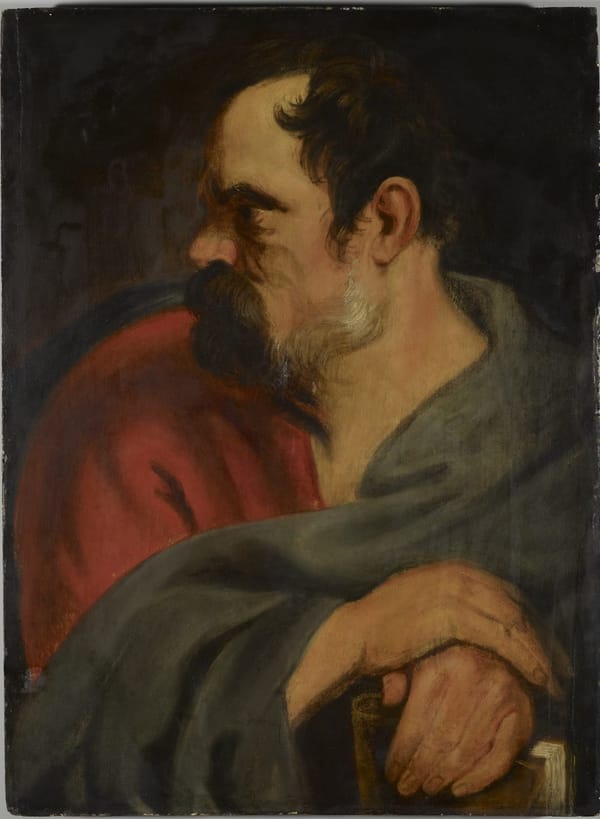
February 24: St. Mathias, Apostle
In leap-year, the feast of St Mathias is kept on February 25.
An apostle of Jesus Christ, St. Mathias, is one of the blessed choir which the Church would have us honour during the season of Septuagesima. Mathias was one of the first to follow our Saviour; and he was an eye-witness of all His divine actions up to the very day of the Ascension. He was one of the seventy-two disciples; but our Lord had not conferred upon him the dignity of an apostle. And yet, he was to have this great glory, for it was of him that David spoke, when he prophesied that another should take the bishopric1 left vacant by the apostasy of Judas the traitor. In the interval between Jesus’ Ascension and the descent of the Holy Ghost, the apostolic college had to complete the mystic number fixed by our Lord Himself, so that there might be the twelve on that solemn day, when the Church, filled with the Holy Ghost, was to manifest herself to the Synagogue. The lot fell on Mathias;2 he shared with his brother-apostles the persecution in Jerusalem, and, when the time came for the ambassadors of Christ to separate, he set out for the countries allotted to him. Tradition tells us that these were Cappadocia and the provinces bordering on the Caspian Sea.
The virtues, labours, and sufferings of St. Mathias have not been handed down to us: this explains the lack of proper lessons on his life, such as we have for the feasts of the rest of the apostles. Clement of Alexandria records in his writings several sayings of our holy apostle. One of these is so very appropriate to the spirit of the present season, that we consider it a duty to quote it. 'It behoves us to combat the flesh, and make use of it, without pampering it by unlawful gratifications. As to the soul, we must develop her power by faith and knowledge.’3 How profound is the teaching contained in these few words! Sin has deranged the order which the Creator had established. It gave the outward man such a tendency to grovel in things which degrade him, that the only means left us for the restoration of the image and likeness of God unto which we were created, is the forcible subjection of the body to the spirit. But the spirit itself, that is, the soul, was also impaired by original sin, and her inclinations were made prone to evil; what is to be her protection? Faith and knowledge. Faith humbles her, and then exalts and rewards her; and the reward is knowledge. Here we have a summary of what the Church teaches us during the two seasons of Septuagesima and Lent. Let us thank the holy apostle, on this his feast, for leaving us such a lesson of spiritual wisdom and fortitude. The same traditions, which give us some Blight information regarding the holy life of St. Mathias, tell us that his apostolic labours were rewarded with the palm of martyrdom. Let us celebrate his triumph by the following stanzas, which are taken from the Menææa of the Greeks.
Hymn (Die IX. Augusti)
Tuesday of the First Week of Lent
At Rome, the Station is in the church of St. Anastasia, where, formerly, the Mass of the Aurora on Christmas Day was celebrated. It is under the protection of this holy martyr, who suffered death for Christ on the day of His birth, that we offer our prayers to-day to the Father of mercy.
Collect
Epistle
Cap. lv.In diebus illis, locutus est Isaias propheta dicens: Quærite Dominum, dum inveniri potest: invocate eum dum prope est. Derelinquat impius viam suam et vir iniquus cogitationes suas: et revertatur ad Dominum, et miserebitur ejus, et ad Deum nostrum, quoniam multus est ad ignoscendum. Non enim cogitationes meæ, cogitationes vestræ; neque viæ vestræ viæ meæ, dicit Dominus. Quia sicut exaltantur cœli a terra, sic exalatæ sunt viæ meæ a viis yestris, et cogitationes mese a cogitationibus vestris. Et quomodo descendit imber, et nix de cœlo, et illuc ultra non revertitur, sed inebriat terram, et infundit eam, et germinare eam facit, et dat semen serenti, et panem comedenti: sic erit verbum meum quod egredietur de ore meo: non revertetur ad me vacuum; sed faciet quæcumque volui, et prosperabitur in his ad quæ misi illud, ait Dominus omnipotens.
Ch. lv.In those days, Isaias the prophet spake, saying: Seek ye the Lord while he may be found; call upon him while he is near. Let the wicked forsake his way, and the unjust man his thoughts; and let him return to the Lord, and he will have mercy on him, and to our God, for he is bountiful to forgive. For my thoughts are not your thoughts, nor your ways my ways, saith the Lord. For as the heavens are exalted above the earth, so are my ways exalted above your ways, and my thoughts above your thoughts. And as the rain and the snow come down from heaven, and return no more thither, but soak the earth, and water it, and make it to spring, and give seed to the sower and bread to the eater; so shall my word be which shall go forth from my mouth. It shall not return to me void, but it shall do whatsoever I please and shall prosper in the things for which I sent it, saith the Lord almighty.
The prophet, speaking to us in God’s name, assures us that, if we sincerely desire our conversion, we shall find mercy. The infinite distance which lies between the sovereign holiness of God and the soul that is defiled by sin is no obstacle to the reconciliation between the creature and the Creator. The goodness of God is omnipotent; it can create a clean heart1 in him that repents, and where sin abounded it can make grace abound more than ever sin abounded.2 The word of pardon will come down from heaven, like plentiful rain upon parched land, and that land will yield a rich harvest. But let the sinner give ear to the rest of the prophecy. Is man at liberty to accept or refuse this word that comes from heaven? May he, for the present, neglect it, in the hope that he will give it a welcome later on, when his life is at its close? No; God says to us by fche prophet: Seek ye the Lord, while He may be found; call ye upon Him, while He is near. We cannot, therefore, find the Lord just when it suits our fickle humour; His nearness to us is not always the same. Let us take heed; God has His times; the time for mercy may be followed by the time for justice. Jonas went through the streets of the proud city, and cried out:’Yet forty days, and Ninive shall be destroyed.’3 Ninive did not allow the forty days to pass without returning to the Lord: she put on sackcloth and ashes, she fasted, and she was spared. Let us imitate the earnest repentance of this guilty city; let us not set divine justice at defiance by refusing to do penance, or by doing it negligently. This Lent is, perhaps, the last God’s mercy will grant us. If we put off our conversion, God may refuse us another such opportunity. Let us meditate upon these words of the apostle, which repeat the truth told us in to-day’s Epistle:’The earth that drinketh in the rain which cometh often upon it, and bringeth forth herbs, meet for them by whom it is tilled, receiveth blessing from God; but that which bringeth forth thorns and briars is reprobate, and very near unto a curse, whose end is to be burnt.’4
Gospel
Cap. xxi.In illo tempore: Cum intrasset Jesus Jerosolymam, commota est universa civitas, dicens: Quis est hic? Populi autem dicebant: Hic est Jesus Propheta a Nazareth Galilææ. Et intravit Jesus in templum Dei, et ejiciebat omnes vendentes et ementes in templo, et mensas nummulariorum, et cathedrae vendentium columbas evertit: et dicit eis: Scriptum est: Domus mea domus orationis vocabitur: vos autem fecistis illam speluncam latronum. Et accesserunt ad eum cæci et claudi in templo: et sanavit eos. Videntes autem principes sacerdotum et scribæ mirabilia quæ fecit, et pueros clamantes in templo et dicentes: Hosanna filio David; indignati sunt et dixerunt ei: Audis quid isti dicunt? Jesus autem dixit eis: Utique; nunquam legistis: Quia ex ore infantium et lactentium perfecisti laudem? Et relictis illis, abiit foras extra civitatem in Bethaniam, ibique mansit.
Ch. xxi.At that time: When he was come into Jerusalem, the whole city was moved, saying: Who is this? And the people said: This is Jesus the prophet, from Nazareth of Galilee. And Jesus went into the temple of God, and cast out all them that sold and bought in the temple, and overthrew the tables of the money-changers, and the chairs oi them that sold doves. And he saith to them: It is written: My house shall be called the house of prayer: but you have made it a den of thieves. And there came to him the blind and the lame in the temple: and he healed them. And the chief priests and scribes seeing the wonderful things that he did, and the children crying in the temple, and saying: Hosanna to the son of Dayia; were moved with indignation, and said to him: Hearest thou what these say? And Jesus said to them: Yea, have you never read: Out of the mouth of infants and of sucklings thou hast perfected praise? And leaving them, he went out of the city into Bethania, and remained there.
Our forty days have scarcely begun, and we find the implacable enemies of Jesus showing their hatred against Him: that hatred will soon work His death. But how is this? Have they not been witnesses of His wonderful works? True; but pride and jealousy have made them lose their senses. These faithless guardians of God’s temple saw Jesus exercise His authority in the holy place, and they opened not their lips; they were astonished at what He did, and they feared Him. They did not even protest when He called the temple His house, for they were awed by His great virtue and superhuman power. But these first impressions having subsided, their bold impiety returns. They hear the little children greeting our Saviour with Hosanna, and they are indignant. They affect to be shocked at this honour which is paid to the Son of David, who went about everywhere doing good. These doctors of the Law are blinded by passion, and can neither understand the prophecies, nor their fulfilment. It is the verification of the words of Isaias, which we have just been reading in the Epistle: they would not seek the Lord, while He was near them; and now that they are even speaking with Him, they do not recognize Him for their Messias. Little children know Him and bless Him; the sages of Israel see in Him but an enemy of God, and a blasphemer! Let us, at least, profit by the visit He is now granting us; lest He should treat us, as He did the chief priests and scribes, and leave us. He withdrew His presence from them, He went out of the city, and returned to Bethania, which was near Jerusalem. It is there that Lazarus was living with his two sisters, Martha and Mary Magdalene. Mary, the Mother of Jesus, had also retired thither, awaiting the terrible event. St. Jerome observes here, that the word Bethania signifies the’house of obedience’: this, says the holy Doctor, should remind us, that our Saviour withdraws from those who are rebels to His grace, and that He loves to be with them that are obedient.5 Let us learn the lesson well; and during these days of salvation let us show by our obedience to the Church and our submission to the guide of our conscience, that we are thoroughly convinced of this truth: that there is no salvation for us, except in humility and simplicity of heart.
The Gothic Church of Spain, in her Mozarabic missal, offers us this formula, which our readers will justly appreciate.
Supplication
(Dominica II. in Quadragesima)
| Previous Monday of the First Week of Lent | Next Tuesday of the First Week of Lent |