Daily reading
Semidouble · Movable from Easter · Temporal
March 10, 2026
From Dom Guéranger’s The Liturgical Year.

Tuesday of the Third Week of Lent
The Station is in the church of St. Pudentiana, daughter of Pudens the senator. This holy virgin of Rome lived in the second century. She was remarkable for her charity, and for the zeal wherewith she sought for and buried the bodies of the martyrs. Her church is built on the very spot where stood the house in which she lived with her father and her sister St. Praxedes. St. Peter the Apostle had honoured this house with his presence, during the lifetime of Pudentiana’s grandfather.
Collect
Epistle
IV. Cap. iv.
It is not difficult to unravel the mystery of this day’s lesson. Man’s creditor is satan; our sins have made him such. ‘Go,’says the prophet, ‘and pay the creditor’But how is this to be done? We shall obtain the pardon of our sins by works of mercy, of which oil is the symbol. Blessed are the merciful, for they shall obtain mercy.1 Let us, then, during these 1days of salvation, secure our reconciliation and forgiveness by doing all we can to assist our brethren who are in want; let us join almsdeeds to our fasting, and practise works of mercy. Thus shall we touch the Heart of our heavenly Father. Putting our debts into His hands, we shall take away from satan all the claims he had upon us. Let us learn a lesson from this woman. She lets no one see her as she fills the vessels with oil: let us, also, shut the door, when we do good, so that our left hand shall not know what our right hand doth.2 Take notice, too, that the woman goes on pouring out the oil as long as she has vessels to hold it. So our mercy towards our neighbour must be proportionate to our means. The extent of these means is known to God, and He will not have us fall short of the power He has given us for doing good. Let us, then, be liberal in our alms during this holy season; let us make the resolution to be so at all times. When our material resources are exhausted, let us be merciful in desire, by interceding with those who are able to give, and by praying to God to help the suffering and the poor.
Gospel
Cap. xviii.In illo tempore: Dixit Jesus discipulis suis: Si peccaverit in te frater tuus, vade, et corripe eum inter te et ipsum solum. Si te audierit, lucratue eris fratrem tuum. Si autem te non audierit, adhibe tecum adhuc unum vel duos, ut in ore duorum vel trium testium etet omne verbum. Quod si non audierit eos, die Ecclesiae. Si autem Ecclesiam non audierit, sit tibi sicut ethnicus et publicanus. Amen dico vobis: quæcumque alligaveritis super terrain, erunt ligata et in cælo; et quæcumque solveritis super terram, erunt soluta, et in cælo. Iterum dico vobis, quia si duo ex vobis consenserint super terram, de omni re quamcumque petierint, fiet illis a Patre meo, qui in oælis est. Ubi enim sunt duo vel tres congregati in nomine meo, ibi sum in medio eorum. Tunc accedens Petrus ad eum, dixit: Domine, quoties peccabit in me frater meus, et dimittam ei? Usque septies? Dicit illi Jesus: Non dico tibi usque septies; sed usque septuagies septies.
Ch. xviii.At that time: Jesus said to his disciples: If thy brother shall offend against thee, go and rebuke him between thee and him alone. If he shallhear thee, thou shalt gain thy brother. But if he will not hear thee, take with thee one or two more; that in the mouth of two or three witnesses every word may stand. And if he will not hear them, tell the Church; and if he will not hear the Church, let him be to thee as the heathen and publican. Amen I say to you, whatsoever you shall bind upon earth, shall be bound also in heaven: and whatsoever you shall loose upon earth, shall be loosed also in heaven. Again, I say to you, that if two of you shall consent upon earth, concerning anything whatsoever they shall ask, it shall be done to them by my Father, who is in heaven; for where there are two or three gathered together in my name, there am I in the midst of them. Then came Peter unto him, and said: Lord, how often shall my brother offend against me, and I forgive him? till seven times? Jesus saith to him: I say not to thee, till seven times, but till seventy times seven times.
The mercy which God commands us to show to our fellow-creatures, does not consist only in corporal and spiritual almsdeeds to the poor and the suffering; it includes, moreover, the pardon and forgetfulness of injuries. This is the test whereby God proves the sincerity of our conversion. With the same measure that you shall mete withal, it shall be measured to you again.3 If we, from our hearts, pardon our enemies, our heavenly Father will unreservedly pardon us. These are the days when we are hoping to be reconciled with our God; let us do all we can to gain our brother; and for this end, pardon him, if needs be, seventy times seven times. Surely, we are not going to allow the miserable quarrels of our earthly pilgrimage to make us lose heaven! Therefore, let us forgive insults and injuries, and thus imitate our God Himself, who is ever forgiving us.
But how grand are these other words of our Gospel: Whatsoever you shall loose upon earth, shall be loosed, also in heaven! Oh, the hope and joy they bring to our hearts! How countless is the number of sinners, who are soon to feel the truth of this consoling promise! They will confess their sins, and offer to God the homage of a contrite and humble heart; and, at the very moment that the hand of the priest shall loose them upon earth, the hand of God will loose them from the bonds which held them as victims to eternal punishment.
And lastly, let us not pass by unnoticed this other sentence, which has a close relation with the one we have just alluded to: If a man hear not the Church, let him be to thee as a heathen and publican. What is this Church? Men, to whom Jesus Christ said: ‘He that heareth you, heareth Me; and he that despiseth you, despiseth Me.’4 Men, from whose lips comes to the world the truth, without which there is no salvation: men, who alone on earth have power to reconcile the sinner with his God, save him from the hell he has deserved, and open to him the gates of heaven. Can we be surprised, after this, that our Saviour—who would have these men to be His instruments, and as it were, the communication between Himself and mankind—should treat as a heathen, as one that has never received Baptism, him that refuses to acknowledge their authority? There is no revealed truth, except through their teaching; there is no salvation, except through the Sacraments which they administer; there is no hoping in Christ Jesus, except where there is submission to the spiritual laws which they promulgate.
Let us address ourselves to God in these words of a hymn composed by St. Andrew of Crete. We take it from the Greek liturgy.
Hymn (In V. Feria V. Hebdomadœ)
March 10: The Forty Martyrs
|
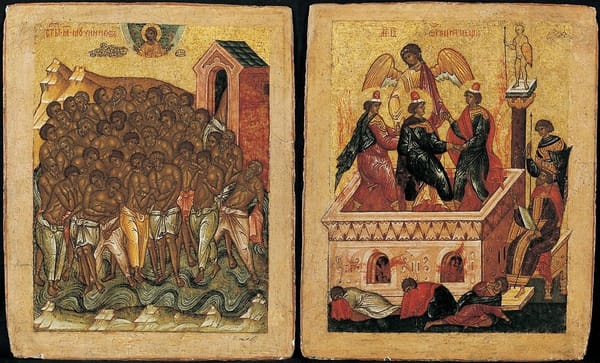
We know the mystery of the number forty. This tenth of March brings it before us. Forty new advocates! Forty encouraging us to enter bravely on our career of penance! On the frozen pool, which was their field of battle, these martyrs reminded one another that Jesus had fasted for forty days, and that they themselves were forty in number! Let us, in our turn, compare their sufferings with the lenten exercises which the Church imposes upon us; and humble ourselves on seeing our cowardice; or, if we begin with fervour, let us remember that the grand thing is to be faithful to the end, and bring to the Easter solemnity the crown of our perseverance. Our forty martyrs patiently endured the cruellest tortures; the fear of God, and their deep-rooted conviction that He had an infinite claim to their fidelity, gave them the victory. How many times we have sinned, and had not such severe temptations as theirs to palliate our fall! How can we sufficiently bless that divine mercy, which spared us, instead of abandoning us as it did that poor apostate, who turned coward and was lost! But, on what condition did God spare us? That we should not spare ourselves, but do penance. He put into our hands the rights of His own justice; justice, then, must be satisfied, and we must exercise it against ourselves. The lives of the saints will be of great help to us in this, for they will teach us how we are to look upon sin, how to avoid it, and how strictly we are bound to do penance for it after having committed it.
The Church, in her liturgy, thus relates to us the martyrdom of the soldiers of Sebaste.
That we may the more worthily celebrate the memory of the forty martyrs, we borrow a few stanzas from the hymn in which the Greek liturgy so enthusiastically sings their praises.
Hymn (Die IX . Martii)
Valiant soldiers of Christ, who meet us, with your mysterious number, at this commencement of our forty days’ fast, receive the homage of our devotion. Your memory is venerated throughout the whole Church, and your glory is great in heaven. Though engaged in the service of an earthly prince, you were the soldiers of the eternal King: to Him were you faithful, and from Him did you receive your crown of eternal glory. We, also, are His soldiers; we are fighting for the kingdom of heaven. Our enemies are many and powerful; but, like you, we can conquer them, if, like you, we use the arms which God has put in our hands. Faith in God’s word, hope in His assistance, humility, and prudence, with these we are sure of victory. Pray for us, O holy martyrs, that we may avoid all compromise with our enemies; for our defeat is certain, if we try to serve two masters. During these forty days, we must put our arms in order, repair our lost strength, and renew our engagements; come to our assistance, and get us a share in your brave spirit. A crown is also prepared for us: it is to be won on easier terms than yours; and yet we shall lose it, unless we keep up within us an esteem for our vocation. How many times, in our past lives, have we forfeited that glorious crown! But God, in His mercy, has offered it to us again, and we are resolved on winning it. Oh, for the glory of our common Lord and Master, make intercession for us.
Our work of preparation is over: we are ready to obey our mother’s call to Lent. During the three past weeks, we have studied the fall of our first parents, and the miseries it brought upon man; the necessity of a Saviour; the justice of God, against which the human race dared to rebel; the terrible chastisement of the deluge, wherewith that revolt was punished; and finally, the covenant made by God, through Abraham, with those who are faithful to Him, and shun the maxims of a perverse and guilty world.
Now we are to see the accomplishment of the great mysteries, whereby the wounds of our fall were healed, the divine justice was disarmed, and God’s grace was poured out upon us, delivering us from the yoke of Satan and the world.
The Man-God, whose sweet presence has been less sensible during this Septuagesima season, is now about to show Himself to us again, but this time it is on His way to Calvary, where He is to be immolated for our redemption. The dolorous Passion, which our sins have imposed upon Him, is about to be brought before us: the greatest of anniversaries will soon be upon us.
Let us be all attention to the mysteries: let us be fervent in the great work of our own purification. Let us walk on courageously in the path of penance, so that each day the burden of our sins may be lightened, and after we have partaken, by heartfelt compassion, of the cup of our Redeemer’s Passion, our lips will be once more permitted to sing the songs of joy, and our hearts will thrill at Easter with the loud burst of the Church’s Alleluia!
| Previous Monday of the Third Week of Lent | Next March 10: The Forty Martyrs |