Daily reading
Lent
Greater Double · March 21 · Sanctoral
March 21, 2026
From Dom Guéranger’s The Liturgical Year.
A Greater Double leads the weekday.Rubric

|
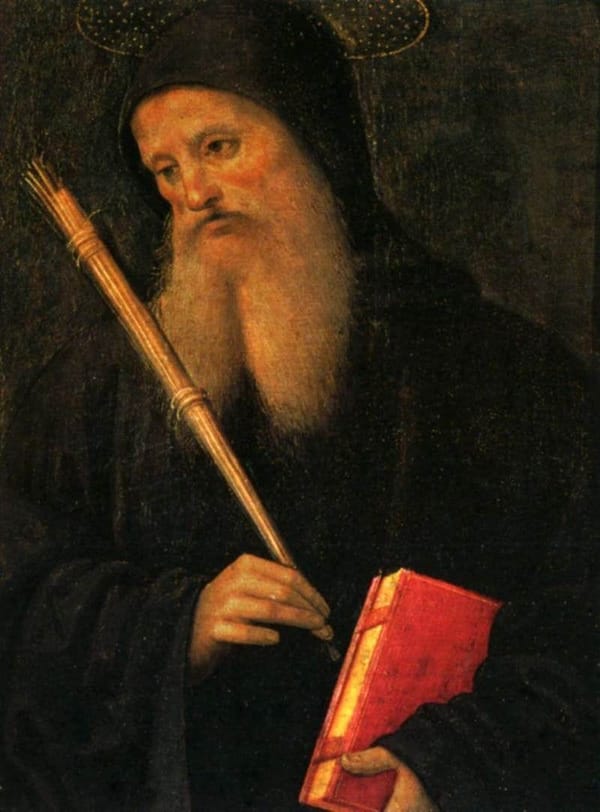
March 21: St. Benedict, Abbot
Forty days after the white dove of Cassino had mounted to heaven, Benedict, her glorious brother, ascended by a bright path to the blissful abode, where they were to be united for ever. Both of them reached the heavenly country during that portion of the year which corresponds with the holy season of Lent. It frequently happens, however, that St. Scholastica’s feast is kept before Lent has begun; whereas St. Benedict’s day, the twenty-first of March, always comes during the season of penance. God, who is the sovereign Master of time, willed that the faithful, whilst practising their exercises of penance, should always have before their eyes a saint whose example and intercession would inspire them with courage.
With what profound veneration ought we to celebrate the festival of this wonderful saint, who, as St. Gregory says, was filled with the spirit of all the just! If we consider his virtues, we find nothing superior in the annals of perfection presented to our admiration by the Church.
Love of God and man, humility, the gift of prayer, dominion over the passions—form him into a masterpiece of the grace of the Holy Ghost. Miracles seem to constitute his life: he cures the sick, commands the elements, casts out devils, and raises the dead to life. The spirit of prophecy unfolds futurity to him; and the most intimate thoughts of men are not too distant for the eye of his mind to scan. These superhuman qualifications are heightened by a sweet majesty, a serene gravity, and a tender charity, which shine in every page of his wonderful life; and it is one of his holiest children who wrote it, St. Gregory the Great. It is this holy Pope and Doctor, who had the honour of telling posterity all the wonders which God vouchsafed to work in His servant Benedict.
Posterity had a right to know the life and virtues of a man, whose salutary influence upon the Church and society has been so observable during the ages of the Christian era. To describe the influence exercised by the spirit of St. Benedict, we should have to transcribe the annals of all the nations of the western Church, from the seventh century down to our own times. Benedict is the father of Europe. By his Benedictines, numerous as the stars of heaven and as the sands of the sea-shore, he rescued the last remnants of Roman vigour from the total annihilation threatened by the invasion of barbarians; he presided over the establishment of the public and private laws of those nations, which grew out of the ruins of the Roman empire; he carried the Gospel and civilization into England, Germany, and the northern countries, including Slavonia; he taught agriculture; he put an end to slavery; and to conclude, he Baved the precious deposit of the arts and sciences from the tempest which would have swept them from the world, and would have left mankind a prey to a gloomy and fatal ignorance.
And Benedict did all this by that little book which we call his Rule. This admirable code of Christian perfection and prudence disciplined the countless legions of religious, by whom the holy patriarch achieved all these prodigies. During the ages which preceded the promulgation of this rule, so wonderful m its simple eloquence, the monastic life in the western Church had produced some few saintly men; but there was nothing to justify the hope that this kind of life would become, even more than it had been in the east, the principal means of the Christian regeneration and civilization of so many nations. Once this rule was written, all others gradually give place to it, as the stars are eclipsed when the sun has risen. The west was overspread with monasteries; and from these monasteries flowed upon Europe all those blessings, which have made it the privileged quarter of the globe.
An incredible number of saints, both men and women, who look up to Benedict as their father, purify and sanctify the world, which had not yet emerged from the state of semi-barbarism. A long series of Popes who had once been novices in the Benedictine cloister, preside over the destinies of this new world, and form for it a new legislation, which, being based exclusively on the moral law, is to avert the threatening prevalence of brutal despotism. Bishops innumerable, trained in the same school of Benedict, consolidate this moral legislation in the provinces and cities over which they are appointed. The apostles of twenty barbarous nations confront their fierce and savage tribes, and, with the Gospel in one hand and the rule of their holy father in the other, lead them into the fold of Christ. For many centuries, the learned men, the doctors of the Church, and the instructors of youth, belong, almost exclusively, to the Order of the great patriarch, who, by the labours of his children, pours forth on the people the purest beauty of light and truth. This choir of heroes in every virtue, of Popes, of bishops, of apostles, of holy doctors, proclaiming themselves as his disciples, and joining with the universal Church in glorifying that God, whose holiness and power shine forth so brightly in the life and actions of Benedict—what a corona, what an aureola of glory for one saint to have!
Let us now read the sketch of his life, as given us in the liturgy:
The Benedictine Order celebrates the praise of its illustrious patriarch in these three hymns:
Hymn I
Templa solemnes modulentur hymnos;
Hac die summi Benedicts arcem
Scandit Olympi.
Cum puer dulcis patriae penates
Liquit, et solus latuit silenti
Conditus antro.
Vicit altricem scelerum juventam:
lade conscripsit documenta vitæ
Pulchra beatæ.
Et nemus stravit Veneri dicatum,
Atque Baptistæ posuit sacrato
Monte sacellum.
Inter ardentes Seraphim catervas,
Spectat, et dulci reficit clientum
Corda liquore.
Et tibi compar utriusque semper
Spiritus alme, Deus unus, omni
Tempore sæcli.
let our temples echo with solemn hymns:
for on this day Benedict ascended
to the highest heavens.
he left his sweet home,
and hid himself from the sight of all
in a lonely cave.
by rolling amidst nettles and prickly thorns.
After this, he wrote a beautiful rule
of a holy life.
and a grove that was sacred to Venus:
and on the holy mount
he built an oratory in honour of the Baptist.
amidst the burning Seraphim:
he looks down on those that invoke him,
and refreshes their hearts with a nectar of sweetness.
To thee, also, O Spirit of love,
coequal with them, one God,
be glory for endless ages.
Hymn II
Quidquid æternæ monimenta legis,
Continet nobis celebranda summi
Vita monarchæ.
Inclytum proles Abraham decorat,
Isaac sponsae decus, et severi
Jussa parentis.
Celsior nostri patriarcha coetus
Isaac, Mosen, Abraham sub uno
Pectore clausit.
Hic pius flatu statuat secundo,
Pax ubi nullo, requiesque gliscit
Mista pavore.
Et tibi compar utriusque semper
Spiritus alme, Deus unus, omni
Tempore sæcli.
and all that the books of the divine Law tell us of holiness,
is contained in the life of the great patriarch
which we are now extolling.
Abraham for his being father of all believers;
Isaac for the beauty of his bride, and his obedience
to the trying commands of his father.
was richly laden with every virtue;
and in his single person represented
Isaac, Moses, and Abraham.
whom he has delivered from this stormy world,
and lead them with prosperous gales to the port
where there is no fear that can ruffle peace and repose.
To thee, also, O Spirit of love,
coequal with them, one God, be glory
for endless ages.
Hymn III
Quas sacro partas retinent agone,
Emicas celsis meritis coruscus,
O Benedicte.
Nil sibi de te rapuit voluptas,
Aruit mundi tibi flos ad alta
Mente levato.
Deseris, fervens nemorum colonus,
Edomas carnem, subigisque Christo
Tortor acerbus.
Signa te produnt operum pioruin,
Spargitur felix celeri per orbem
Fama volatu.
Et tibi, compar utriusque semper
Spiritus alme, Deus unus, omni.
Tempore sæcli.
with the crowns they have won in the holy contest,
thou, O Benedict, shinest resplendent
with thy sublime merits.
the pleasures of the world had no hold on thee,
and its flowers seemed but as withered weeds to a soul like thine,
that was fixed on heavenly things.
and becamest a fervent solitary.
Thou didst tame the rebellion of the flesh, and by sharp mortification
thou didst bring it into subjection to Christ.
thy holy miracles betrayed thee,
and the glorious fame of thy sanctity
swiftly spread through the world.
To thee, also, O Spirit of love,
coequal with them, one God,
be glory for endless ages.
The monastic missal contains the following sequence in honour of St. Benedict:
Sequence
Dona ferens novæ lucis,
Hodie recolitur.
Corde sonet in ardenti
Quidquid foris promitur.
Admiremur ascenderitis
Patriarchæ speciem.
Ilium fecit instar solis,
Abrahæ persimilem.
Hine Eliam latitantem
Specu nosce parvulo.
Cum securis revocatur
De torrentis alveo.
Illum Jacob futurorum
Mens effecit conscia.
Nos perducat in manentis
Semper Christi gaudia.
the happy death of our great leader,
which brings us the blessings of new light.
Oh! may the fervent heart re-echo
what the voice sings forth!
as he ascends to heaven
by the path of the east.
for he is the rich seed from which
a countless race hath sprung.
thou thinkest of Elias,
that hid himself in the little cave.
when he makes the head of the axe return
from the bed of the stream.
and like Jacob by the spirit
of prophecy.
and lead us safe to the joys of our Lord Jesus Christ,
who abideth for ever.
The Greek Church has not forgotten, in her liturgy, the praise of the great patriarch of the monks of the west. We take from the menæa some of the stanzas, in which she celebrates the name of Saint Benedict:
Hymn (Die XXI Martii)
O Benedict! thou vessel of election, thou palm of the wilderness, thou angel of earth, we offer thee the salutation of our love! What man was ever chosen to work on the earth more wonders than thou hast done? The Saviour has crowned thee as one of His principal co-operators in the work of the salvation and sanctification of men. Who could count the millions of souls who owe their eternal happiness to thee? Thy immortal rule has sanctified them in the cloister, and the zeal of thy Benedictines has been the means of their knowing and serving the great God who chose thee. Around thee, in the realms of glory, a countless number of the blessed acknowledge themselves indebted to thee, after God, for their eternal happiness; and upon the earth whole nations profess the true faith, because the Gospel was first preached to them by thy disciples.
O father of so many people! look down upon thine inheritance, and once more bless this ungrateful Europe, which owes everything to thee, yet has almost forgotten thy name! The light which thy children imparted to it has become dimmed, the warmth they imparted to the societies they founded and civilized by the cross has grown cold; thorns have covered a large portion of the land in which they sowed the seed of salvation. Come and protect thine own work; and, by thy prayers, keep it from perishing. Give firmness to what has been shaken. May a new Europe, a Catholic Europe, spring up in place of that which heresy and false doctrines have formed.
O patriarch of the servants of God! look down from heaven on the vineyard which thy hand hath planted, and see into what a state of desolation it has fallen. There was a time when thy name was honoured as that of a father in thirty thousand monasteries, from the shores of the Baltic to the borders of Syria, and from the green Erin to the steppes of Poland. Now, alas! few and feeble are the prayers that ascend to thee from the whole of that immense patrimony, which the faith and gratitude of the people had once consecrated to thee. The blight of heresy and the rapaciousness of avarice have robbed thee of these harvests of thy glory. The work of sacrilegious spoliation is now centuries old, and unceasingly has it been pursued; at one time having recourse to open violence, and at another pleading the urgency of political interests. Sainted father of our faith! thou hast been robbed of those thousands of sanctuaries, which, for long ages, were fountains of life and light to the people. The race of thy children has become almost extinct: watch over them that still remain, and are labouring to perpetuate thy rule. An ancient tradition tells us how our Lord revealed to thee that thy Order would last to the end of the world, and that thy children would console the Church of Rome and confirm the faith of many in the last great trials: deign to protect, by thy powerful intercession, the remnants of that family which still calls thee its father. Raise it up again; multiply it; sanctify it: let the spirit which thou hast deposited in thy holy rule flourish in its midst, and show, by thus blessing it, that thou art ever Benedict, the servant of God.
Support the holy Church, by thy powerful intercession, dear father! Assist the apostolic See, which has been so often occupied by disciples of thy school. Father of so many pastors of thy people! obtain for us bishops like those sainted ones whom thy rule has formed. Father of so many apostles! ask for the countries which have no faith preachers of the Gospel, who may convert the people by their blood and by their words, as did those who went out missioners from thy cloisters. Father of so many holy doctors! pray that the science of sacred literature may revive, to aid the Church and confound error. Father of so many sublime ascetics! rekindle the zeal of Christian perfection, which has grown so cold among the Christians of our days. Patriarch of the religious life in the western Church! bless all the religious Orders which the holy Spirit has given successively to the Church; they all look on thee with admiration, as their venerable predecessor: do thou pour out upon them the influence of thy fatherly love.
Lastly, O blessed favourite of God! pray for all the faithful of Christ during these days which are consecrated to thoughts and works of penance. It was in the midst of the holy austerities of Lent that thou didst mount to the abode of everlasting delight; ah! help us Christians, who are, at this very time, in the same campaign of penance. Rouse our courage by thy example and precepts. Teach us to keep down the flesh, and to subject it to the spirit, as thou didst. Obtain for us a little of thy blessed spirit, that, turning away from this vain world, we may think on the eternal years. Pray for us, that our hearts may never love, and our thoughts never dwell on, joys so fleeting as are those of time.
Catholic piety invokes thee as one of the patrons, as well as one of the models, of a dying Christian. It loves to tell men of the sublime spectacle thou didst present at thy death, when standing at the foot of the altar, leaning on the arms of thy disciples, and barely touching the earth with thy feet, thou didst give back, in submission and confidence, thy soul to its Creator. Obtain for us, dear saint! a death courageous and sweet as was thine. Drive from us, at our last hour, the cruel enemy who will seek to ensnare us. Visit us by thy presence, and leave us not till we have breathed forth our soul into the bosom of the God who has made thee so glorious a saint.
Saturday of the Fourth Week of Lent
This Saturday, in the early ages of Christianity, was called Sitientes, from the first word of the Introit of the Mass, in which the Church addresses her catechumens in the words of Isaias, and invites them that thirst after grace, to come and receive it in the holy Sacrament of Baptism. At Rome, the Station was originally in the basilica of Saint Laurence outside the walls; but it was found inconvenient, on account of its great distance from the city; and the church of Saint Nicholas in carcere, which is within the walls, was selected for to-day’s Station.
Collect
Epistle
Cap. xlix.Hæc dicit Dominus: In tempore placito exaudivi te, et in die salutis auxiliatus sum tui: et servavi te, et dedi te in fædus populi, ut susci tares terrain, et possideres hæreditates dissipatas; ut diceres his qui vincti sunt: Exite: et his qui in tenebris: Revelamini. Super vias pascentur, et in omnibus planis pascua eorum. Non esurient, neque sitient, et non percutiet eos æstus et sol: quia miserator eorum reget eos, et ad fontes aquarum potabit eos. Et ponam omnes montes meos in viam, et semitae mese exaltabuntur. Ecce isti de longe venient, et ecce illi ab aquilone et mari, et isti de terra australi. Laudate, cceli, et exsulta, terra; jubilate, montes, laudem: quia consolatus est Dominus populum suum, et pauperum suorum miserebitur. Et dixit Sion: Dereliquit me Dominus, et Dominus oblitus est mei. Numquid oblivisci potest mulier infantem suum, ut non misereatur filio uteri sui? Et si illa oblita fuerit, ego tamen non obliviscar tui, dicit Dominus omnipotens.
Ch. xlix.Thus saith the Lord: In an acceptable time I have heard thee, and in the day of salvation I have helped thee; and I have preserved thee, and given thee to be a covenant of the people, that thou mightiest raise up the earth and possess the inheritances that were destroyed; that thou mightest say to them that are bound: Come forth; and to them that are in darkness: Show yourselves. They shall feed in the ways, and their pastures-shall be in every plain. They shall not hunger nor thirst, neither shall the heat nor the sun strike them: for he that is merciful to them shall be their shepherd, and at the fountains of waters he shall give them drink. And I will make all my mountains a way, and my paths shall be exalted. Behold these shall come from afar, and behold these from the north and from the sea, and these from the south country. Give praise, O ye heavens, and rejoice, O earth; ye mountains, give praise with jubilation; because the Lord hath comforted his people, and will have mercy on his poor ones. And Sion said: The Lord hath forsaken me, and the Lord hath forgotten me. Can a woman forget her infant, so as not to have pity on the son of her womb? And if she should forget, yet will I not forget thee, saith the Lord almighty.
How these words of love must have consoled the hearts of our catechumens! Never did our heavenly Father express His tender mercy towards us in more glowing terms; and He bade His prophet deliver them to us. He gives the whole earth to His Son, Jesus Christ, our Incarnate Lord, not that He may judge and condemn it, as it deserves, but that He may save it.1 This divine Ambassador, having come on the earth, tells all that are galled by fetters, or that sit in the gloomy shadow of death, to come to Him, promising them liberty and light. Their hunger shall be appeased, and their thirst quenched. They shall no longer pant under the scorching rays of the sun, but shall be led by their merciful Shepherd to the cool shades on the banks of the water of life. They came from every nation under heaven: the fountain, the font, shall be the centre where all the human race is to meet. The Gentile world is to be henceforth called Sion, and the Lord loveth the gates of this new Sion above all the tabernacles of Jacob.2 God had not forgotten her during the long ages of her idol worship; His love is tender as that of the fondest mother; yea, and though a mother’s heart may forget her child, God never will forget His Sion. You, then, who received Baptism at your very entrance into the world, but have, since then, served another master besides Him to whom you swore perpetual allegiance at the font, be of good heart! If the grace of God has found you submissive, if the holy exercises of Lent and the prayers offered for you by the C hurch have had their effect, and you are now preparing to make your peace with God, read these words of your heavenly Father, and fear not! How can you fear? He has given you to His own Son; He has told Him to save, heal, and comfort you. Are you in the bonds of sin? Jesus can break them. Are you in spiritual darkness? He is the light of the world, and can dispel the thickest gloom. Are you hungry? He is the Bread of life. Are you thirsty? He is the fountain of living water. Are you scorched, are you burnt to the very core, by the heat of concupiscence? Ewen so, poor sufferers! you must not lose courage; there is a cool fountain ready to refresh you, and heal all your wounds; not indeed the first font, which gave you. the life you have lost; but the second Baptism, the divine Sacrament of Penance, which can restore you to grace and purity!
Gospel
Cap. viii.In illo tempore: Locutus est Jesus turbis Judæorum, dicens: Ego sum lux mundi: qui sequitur me, non ambulat in tenebris, sed habebit lumen vitae. Dixerunt ergo ei pharisæi: Tu de teipso testimonium perhibes: testimonium tuum non est verum. Respondit Jesus, et dixit eis: Et si ego testimonium perhibeo de meipso, verum est testimonium meum: quia scio unde veni, et quo vado: vos ftutem nescitis unde venio, aut quo vado. Vos secundum carnem judicatis: ego non judico quemquam: et si judico ego, judicium meum verum est: quia solus non sum, sed ego, et qui misit me, Pater. Et in lege vestra scriptum est, quia duorum hominum testimonium verum est. Ego sum qui testimonium perhibeo de meipso: et testimonium perhibet de me, qui misit me, Pater. Dicebant ergo ei: Ubi est Pater tuus? Respondit Jesus: Neque me scitis, neque Patrem meum: si me sciretis, forsitan et Patrem meum sciretis. Hæc verba locutus est Jesus in gazophylacio, docena in templo: et nemo apprehendit eum, quia necdum venerat hora ejus.
Ch. viii.At that time: Jesus spoke to the multitude of the Jews, saying: I am the light of the world; he that followeth me, walketh not in darkness, but shall have the light of life. The pharisees therefore said to him: Thou givest testimony of thyself; thy testimony is not true. Jesus answered and said to them: Although I give testimony of myself, my testimony is true: for I know whence I came and whither I go, but you know not whence I come, or whither I go. You judge according to the flesh, I judge not any man. And if I do judge, my judgment is true; because I am not alone, but I and the Father that sent me. And in your law it is written, that the testimony of two men is true. I am one, that give testimony of myself; and the Father that sent me, giveth testimony of me. They said therefore to him: Where is thy Father? Jesus answered: Neither me do you know, nor my Father; if you did know me, perhaps you would know my Father also. These words Jesus spoke in the treasury, teaching in the temple: and no man laid hands on him, because his hour was not yet come.
What a contrast between the tender mercy of God, who invites all men to receive His Son as their Redeemer, and the obduracy of heart wherewith the Jews receive the heavenly Ambassador! Jesus has proclaimed Himself to be the Son of God, and, in proof of His divine origin, has, for three long years, wrought the most astounding miracles. Many of the Jews have believed in Him, because they argued that God could never have authorized falsity by miracles; and they therefore accepted the doctrine of Jesus as coming from heaven. The pharisees hate the light, and love darkness; their pride will not yield even to the evidence of facts. At one time they denied the genuineness of Jesus’ miracles; at another, they pretended to explain them by the agency of the devil. Then, too, they put questions to Him of such a captious nature, that, in what way soever Jesus answered, they might accuse Him of blasphemy, or contempt for the Law. To-day, they have the audacity to make this objection to Jesus’ being the Messias: that He gives testimony in His own favour! Our blessed Lord, who knows the malice of their hearts, deigns to refute their impious sarcasm; but He avoids giving them an explicit answer. It is evident that the light is passing from Jerusalem, and is to bless other lands. How terrible is this punishment of a soul that abuses the truth, and rejects it by an instinctive hatred! Her crime is that sin against the Holy Ghost, which shall not be forgiven, neither in this world, nor in the world to come.3 Happy he that loves the truth, though it condemns his evil passions, and troubles his conscience! Such an one proves that he reveres the wisdom of God; and if it do not altogether rule his conduct it does not abandon him. But happier far he that yields himself wholly to the truth, and, as a humble disciple, follows Jesus. He walketh not in darkness; he shall have the light of life. Let us, then, lose no time, but take at once that happy path marked out for us by Him who is our light and our life. Keeping close to His footsteps, we went up the rugged hill of Quarantana, and there we witnessed His rigid fast; but now that the time of His Passion is at hand, He invites us to follow Him up another mount, that of Calvary, there to contemplate His sufferings and death. Let us not hesitate; we shall be repaid: we shall have the light of life.
Let us end these first four weeks of Lent with a hymn to our blessed Lady, the Mother of mercy. Saturday is always sacred to her. The hymn we give is taken from the ancient Roman-French missals.
Sequence
Gratia plena.
Dominus tecum,
Virgo serena.
In mulieribus,
Quæ peperieti
Pacem hominibus,
Et angelis gloriam.
Fructus ventris tui,
Qui cohæredes
Ut essemus sui,
Nos fecit per gratiam.
Mundo tam suave,
Contra carnis jura
Genuisti prolem,
Novum Stella solem,
Nova genitura.
Leonis et Agni,
Salvatoris Christi
Templum exstitisti;
Sed virgo intacta.
Panis et Pastoris,
Virginum Regina,
Rosa sine spina,
Genitrix es facta.
Tu mater es misericordiæ,
De lacu fæcis et miseriæ
Theophilum reformans gratiæ.
Tu Mater es Regis et filia,
Per te reis donatur venia,
Per te justis confertur gratia.
Verbi Dei celia,
Et solis aurora,
Per quam lux est orta,
Natum tuum ora,
Et in regno claritatis,
Quo lux lucet sedula,
Collocet per sæcula.
full of grace!
The Lord is with thee,
O gentle Virgin!
among women,
for thou didst bring forth
peace to men
and glory to the angels.
is the fruit of thy womb Jesus,
who, by his grace,
made us to be
his coheirs.
which sounded so sweetly to the world,
thou didst conceive,
and not by nature’s laws.
Thou wast the new star
that wast to bring forth a new Sun.
wast the temple
of our Saviour Jesus Christ
(who united in his person the little and the great),
the Lion and the Lamb.
O rose without thorns!
Thou wast made Mother of him
who is our Sun, our Dew,
our Bread, and our Shepherd.
thou art the Mother of mercy,
bringing grace to Theophilus,
by drawing him out of the den of filth and misery.
for thou art both Mother and Daughter of its King.
By thee, the guilty obtain pardon;
by thy prayers, the just receive grace.
O tabernacle of the Word,
O aurora of the divine Sun,
by whom Light arose to the world!
pray for us to thy Son,
and introduce us
into the kingdom of. brightness,
where perpetual light shines for ever.
| Previous Friday of the Fourth Week of Lent | Next Saturday of the Fourth Week of Lent |