Daily reading
Paschal Time
Double · April 28 · Sanctoral
April 28, 2026
From Dom Guéranger’s The Liturgical Year.
A Double leads the weekday; St. Vitalis is commemorated.Rubrics
 |
April 28: St. Paul of the Cross, Confessor
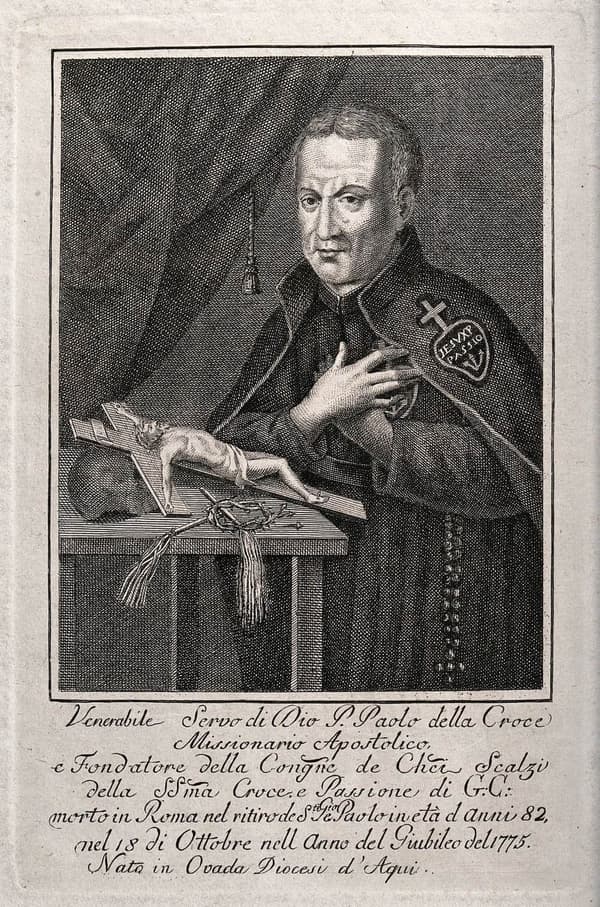
SPLENDIDLY adorned with the sacred sign of the Passion, Paul of the Cross comes to-day to pay homage to the Conqueror of Death. It behoved Christ to suffer and so enter into his glory. It behoves the Christian, the member of Christ, to follow his Head in suffering that he may share his triumph. Even as a child Paul penetrated deeply into the ineffable mystery of the suffering of a God. He was filled with an ardent love for the cross, and ran with giant strides along this royal road. He passed through the torrent, following his divine Head, he was buried with him in death, and has won a share in his Resurrection.
The diminution of truths among the children of men seemed to have dried up the fount of sanctity, when Italy, ever fruitful in her vivid faith, gave birth to the Christian hero, who stands out in the arid waste of the eighteenth century, like a saint of olden times. God never deserts his Church. He confronts a century of revolt and sensualism veiled under the name of philosophy with the Cross of his Son. A new Paul, recalling both in his name and his works the great Apostle of the Gentiles, rises in the midst of a generation intoxicated with pride and falsehood, to whom the Cross has become once more a folly and a scandal. This apostle was weak, poor, isolated and long misunderstood, but his heart was full of love and self-abnegation, and he sought to put to confusion the wisdom of sages and the prudence of prudent men. Clad in a coarse habit, with bare feet, his head crowned with thorns and a heavy cross on his shoulder, he journeyed through cities, claiming the attention of both the humble and the mighty, and desiring to know nothing but Jesus Crucified. The Cross made his zeal fruitful and showed itself to be indeed the power and the wisdom of God. Those who prided themselves on having banished the miraculous from history and the supernatural from the life of the people, might exult in their triumph, but, unknown to them, wonderful prodigies, countless miracles, were making whole peoples submissive to the voice of this man who, by completely destroying sin in his own person, had regained the power which Adam once had over nature, and seemed to possess in his mortal flesh the qualities of a glorified body.
But the apostolate of the Cross was not to end with Paul’s death. The resources of ancient times were no longer sufficient for a decrepit age. We are far from the days when the exquisite delicacy of Christian sentiment was strongly moved by the sight of the cross amid flowers, as it is seen in the paintings of the catacombs. Man’s senses have been dulled by unhealthy emotions, and there is need of a stimulant in the form of a constant representation of the tears, the Blood, and the gaping wounds of our divine Redeemer. Paul of the Cross received the mission to supply this need. At the cost of unspeakable sufferings he became the father of a new religious family, which adds to the three ordinary vows of religion a fourth vow—to propagate devotion to the sacred Passion of our Lord, the badge of which each Religious wears visibly on his breast.
We must not forget that the Passion of our Lord is for the Christian soul only a preparation for the great mystery of the Pasch, the glorious term of the manifestations of the Word, the supreme end of the elect, whose piety finds therein its completion and its crown. The Holy Spirit, who guides the Church throughout the admirable course of the liturgical cycle, has no other end in view for the souls who abandon themselves unreservedly to his sanctifying power. Paul's desire was to be nailed to the cross on Calvary, but he was often carried thence to the heights of heaven where he heard mysterious words such as it is not granted to man to utter.1 He assisted at the triumph of the Son of Man, who, after having lived on earth a mortal life and passed through death, is living now for ever and ever.2 He saw on the throne of God the Lamb standing as though slain, and giving light to the heavenly city,3 and this sublime vision of the realities of heaven inspired him with that divine enthusiasm, that intoxication of love, which, in spite of his terrifying austerities, gives an incomparable charm to his whole person. ‘Fear not,' he said to his children who were terrified by the furious attacks of the Devil, ' fear not, cry “Alleluia.” The devil is afraid of the Alleluia; it is a word that comes from Paradise.' He could not restrain his feelings when he saw nature born again with her Saviour in these days of spring, the flowers blossoming under the steps of his Risen Lord, the birds celebrating his victory in their harmonious songs. His heart was full to overflowing with love and poetry; he touched the flowers gently with his stick and upbraided them, saying: ‘Hold your peace, hold your peace.’ ‘To whom do these lands belong?’ he said one day to a companion, ‘to whom do these lands belong, I say? You do not understand. They belong to our great God.’ And his biographer relates that he was rapt in an ecstasy of love and carried some distance through the air. ‘Love God, my brethren,' he repeated to all those whom he met, ‘love God, who so well deserves our love. Do you not hear the very leaves on the trees telling you to love God? O love of God, love of God!'
We yield to the charm of a sanctity which is so sweet and yet so strong. It is a divine attraction, such as could never be exercised by the false spirituality, so much in vogue in the eighteenth century, even among the holiest. Under pretext of subduing man's evil nature and avoiding possible excesses, the new teachers allied themselves, though unwittingly, with Jansenism, checked the flight of the soul, disciplined it, remade it according to their own fashion, and confined it within the limits of certain rules which were supposed to lead all souls to perfection at the same rate. But saints are made by the divine Spirit, the spirit of love and holiness, to whose essence liberty belongs. He does not confine himself within the bounds of human methods. Our Lord says: ' The Spirit breatheth where he will . . . but thou knowest not whence he cometh and whither he goeth. So is every one that is bom of the Spirit.'4 The Holy Ghost chose Paul in his earliest infancy. He took possession of this child, so richly endowed by nature, destroyed nothing and sanctified everything. He formed him according to ancient models, always ardent, always attractive, and exceedingly holy. Such a one could never have been produced by a school whose over-correct methods wear the soul out by a barren and self-centred asceticism.
The Liturgy gives the following short account of St Paul of the Cross:
Romam profectus, theologicis disciplinis rite imbutus, a summo Pontifice Benedicto Decimo tertio ex obedientia sacerdotio auctus est. Facta sibi ab eodem potestate aggregandi socios, in solitudinem recessit Argentarii montis, quo eum beata Virgo jampridem invitaverat, veste illi simul ostensa atri coloris, Passionis Filli sui insignibus decorata, ibique fundamenta jecit novæ Congregationis. Quæ brevi, plurimis ab eo toleratis laboribus, præclaris aucta viris, cum Dei benedictione valde succrevit; a Sede Apostolica non semel confirmata una cum regulis, quas orando ipse a Deo acceperat, et quarto addito voto pergratam Dominicæ Passionis memoriam promovendi. Sacras Virgines quoque instituit, quæ excessum caritatis divini Sponsi sedulo meditarentur. Hæc inter, animarum inexhausta aviditate ab Evangelii prsedicatione numquam deficiens, homines pene innumeros etiam perditissimos aut in hæresim lapsos, in salutis tramitem adduxit. Præsertim Christi enarranda Passione, mirifica ejus prationis vis erat, qua una cum adstantibus in fletum effusus quælibet obdurata corda ad poenitentiam scindebat.
Thou hadst but one thought, O Paul. Hidden in those ‘clefts of the rock,’5 which are the sacred Wounds of the Saviour, thou wouldst bring all men to these divine fountains which quench the thirst of the true Israel in the desert of this life. Happy were they who could hear thy victorious word and save themselves by the Cross in the midst of a perverse generation. But in spite of thy apostolic zeal, thy voice could not make itself heard in all lands, and where thou wast absent evil was let loose upon the world. False science and mistaken piety, mistrust of Rome and the corruption of the great had prepared the way for the destruction of the old Christian social order, and the world was given over to teachers of lies. Thy prophetic gaze saw the abyss in which kings and peoples were soon to be engulfed. The successor of St Peter, unable to quell the storm which raged against the Church, sought by his efforts and sacrifices to hold back the floods, even for a time. Thou wert the friend of the Pontiffs and their support in those sad days, the witness of Christ suffering in his Vicar. What sorrows were confided to thee! And what must have been thy thoughts when at thy death thou didst bequeath the venerated image of the Mater Dolorosa to a Pontiff who was destined to drain the cup of bitterness and die a captive in a strange land! Thou didst promise to watch over the Church from thy throne in heaven with that tender compassion which identified thee on earth with her suffering Spouse. Keep this promise to-day, O Paxil! This age of social disintegration has neither made atonement for the sins of the past nor learnt wisdom from misfortune. The Church is the victim of oppression on all sides, the power is in the hands of her persecutors, and the Vicar of Christ is a prisoner in his palace and lives on alms. The Bride has no bed but the Cross of her Spouse, she lives on the memory of his sufferings. The Holy Spirit who guards her and is preparing her for the final summons, has raised thee up to keep her perpetually in mind of those sufferings which are to strengthen her in the trials of the last days.
Thy children all the world over are true to the spirit of their father and continue thy work on earth. They have gained a footing in England where thy prophetic gaze foresaw their labours, and this kingdom, for which thou didst pray so earnestly, is being gradually freed, through their influence, from the bonds of schism and heresy. Bless their apostolate. May they grow and be multiplied to meet the ever-increasing needs of these unhappy times! May their zeal ever continue to minister to the Church, and may the holiness of their lives ever redound to the glory of their father!
Thou, O Paul, wast faithful to thy crucified Master in his humiliation, and he has been faithful to thee in his triumphant Resurrection. In the hour of darkness thou didst live hidden in the clefts of the mysterious Rock. But what must be thy glory, now that Christ victorious ‘enlighteneth wonderfully from the everlasting hills’!6 Enlighten and perfect us, we beseech thee. We give thanks to God for thy triumph. Do thou in return help us to be faithful to the standard of the Cross, so that we, like thee, may be illuminated by its glory, when it appears in the clouds of heaven on the day of judgement.7 O Apostle of the Cross, initiate us into the mystery of the Pasch, which is so closely connected with that of Calvary. Only he who has shared the combat can comprehend the victory and have part in the triumph.
Tuesday of the Fourth Week after Easter
WE are bound to believe the word of God: but this word is accompanied with every proof of its really coming from God. When Jesus told men that he was the Son of God, he gave ample proof of his being such: in the same manner, he insists on our believing what he reveals, but he gives us a guarantee of its being the truth. What is this guarantee? Miracles. Miracles are the testimony which God bears to himself. A miracle rouses man’s attention, for he knows that it is by God’s will alone that the laws of nature can be suspended. If God employ a miracle to make his will known, he has a right to find man obedient. The Israelites were convinced that it was God who was leading them, for the sea opened a passage to them, immediately that Moses stretched forth his hand over its waters.
Now Jesus, the author and finisher of faith did not demand our belief in the truths he revealed to us until he had proved the divinity of his mission by miracles. The works which I do, said he, give testimony of me. And again: If you will not believe me, believe my works. And what are these works? When St John the Baptist sent some of his disciples to Jesus, that they might ask him if he were the promised Messias, Jesus gave them this answer: Go and relate to John what you have heard and seen. The blind see, the lame walk, the lepers are made clean, the deaf hear, the dead rise again, the poor have the Gospel preached unto them.
Such is the motive of our faith. Jesus requires of us that we receive his word, as being that of the Son of God—for he has proved himself to be so by the works he has wrought. Truly may we exclaim with the Psalmist: Thy testimonies, O Lord, are become exceedingly credible! Whom shall we believe, if we refuse to believe him? And what must be the guilt of them who refuse to believe! Let us hearken to our Jesus speaking of those proud men who, though they had witnessed his miracles, rejected his teaching: If, says he, I had not done among them the works that no other man hath done, they would not have sin. It is their incredulity that led them astray; but their incredulity showed itself when, after witnessing such miracles as the raising Lazarus to life, they refused to acknowledge the divinity of him who bore testimony to himself by such works as these.
But our Risen Jesus is soon to ascend into Heaven; the miracles he wrought will be things of long past; are we, henceforth, to have no testimony for his word, which is the object of our Faith? Let us not fear. Do we forget that historical documents, when genuine, bring the same conviction to our minds, with regard to past events, as though we ourselves had been witnesses of those events? Is it not a law of the human mind—is it not a basis of certainty—that we yield assent to the testimony of our fellow-men, as often as we have evidence that they are neither deceived themselves, nor wish to deceive us? The miracles wrought by Jesus will be handed down to the end of time, supported by guarantees of authenticity which no facts of history could possibly have. If the authority of history is what all acknowledge it to be, then is he a fool who doubts the miracles which we are told were worked by our Saviour. Though we have not been eye-witnesses of them, yet such is our certainty of their having been done, that our faith is as strong and as docile as though we had assisted at the admirable scenes described in the Gospel.
Our Lord had sufficiently provided for our yielding our Faith to his word, by letting us know that he had confirmed his teaching by his miracles. But he would do more. He gives his disciples the power to do what he himself had done, and this in order that our faith might be strengthened by these supernatural evidences. It was on one of the forty days spent with his Apostles before his Ascension, that he spoke these words to them: Go ye into the whole world, and preach the Gospel to every creature. He that believeth and is baptized shall be saved; but he that believeth not shall be condemned. We have already stated the basis on which this faith was to rest—the miracles of the God-Man who demands our faith. But there were to be other miracles superadded to his own. Let us continue the text just quoted: And these signs shall follow them that believe: in my name they shall cast out devils; they shall speak with new tongues; they shall take up serpents; and if they shall drink any deadly thing it shall not hurt them; they shall lay their hands upon the sick, and they shall recover. Here, then, we find the power of working miracles given to Jesus’ disciples. He bids them go and preach his word to men, and men must yield their faith; he therefore gives his disciples a power over nature which will prove them to be the ambassadors of the Most High. Their word is not their own; it is that of God. They are the ministers of the Incarnate God, and we must believe their teaching. By believing them, we are, in reality, believing him who sends them, and who, to make us sure of their rightful authority, gives them the credentials which he himself deigned to show to men, when he spoke with his own lips.
Neither is this all. If we carefully weigh his words, we shall see that he does not intend the gift of miracles to cease with his first disciples. It is true that history proves how faithfully Jesus fulfilled his promise, and that, when the Apostles went forth commanding the world to believe what they preached, they gave testimony of their divine mission by countless miracles; but our Risen Lord promised more than this. He said not:’These are the signs which shall follow my Apostles;' but: These are the signs which shall follow them that believe. By these words he perpetuated in his Church the gift of miracles; he made it one of her chief characteristics, and one of the grounds of our faith. Before his Passion, he had gone so far as to say: He that believeth in me, the works that I do, he also shall do, and greater than these shall he do. It is now that he graces her with this prerogative: so that, dating from that hour, we must not be surprised at finding that his saints perform miracles greater even, at times, than his own. He promised that it should be so, and he has kept his word; thus showing us how desirous he is that faith (which is one of the main objects of a miracle) should be fostered and made vigorous in his Church. Far, then, be from every loyal child of the Church that fear, that uneasy feeling, yea, that indifference which some people evince when they hear or read of a miracle. The only thing we should ask is—are the witnesses trustworthy? If so, a true Catholic should receive the account with joy and gratitude; he should give thanks to our Jesus who thus mercifully fulfils his promise, and keeps such a watchful eye over the preservation of faith.
Let us adore him in that miracle of miracles, his Resurrection. Let us enter into the sentiments of the following fine sequence; it dates from the ninth century, and is from the rich treasury of Saint Gall.
Sequence
Voce modulemur supplici,
Et devotis melodiis
Coelesti Domino
Jubilemus Messiæ:
Qui seipsum exinanivit,
Ut nos perditos
Liberaret homines.
Carne gloriam Deitatis occulens
Pannis tegitur in præsepi,
Miserans praecepti transgressorem,
Pulsum patria
Paradisi nudulum.
Joseph, Mariae, Simeoni, subditur, circumciditur,
Et legali hostia mundatur, ut peccator,
Nostra qui solet relaxare crimina.
Servi subit manus baptizandus,
Et perfert fraudes tentatoris,
Fugit persequentum lapides.
Famem patitur,
Dormit et tristatur,
Ac lavat discipulis pedes Deus homo, summus humilis.
Sed tamen
Inter haec objecta corporis ejus Deitas
Nequaquam quivit latere, signis variis,
Et doctrinis prodita.
Aquam nuptiis
Dat saporis vinei.
Claro lumine vestivit.
Tactu fugat placido.
Membraque curat debilia.
Et saturavit quinque de panibus quina millia.
Stagnum peragrat fluctuans,
Ceu siccum littus, ventos sedat.
Linguam reserat constrictam,
Reclusit aures privatas vocibus; febres depulit.
Post haec mira miracula taliaque,
Sponte sua comprehenditur,
Et damnatur, et se crucifigi non despexit,
Sed sol ejus mortem non aspexit.
Illuxit dies,
Quam fecit Dominus,
Mortem devastans,
Primo Mariae,
Dehinc Apostolis;
Cor aperiens,
Ut clausa de ipso reserarent.
Favent igitur resurgenti Christo cuncta gaudiis.
Flores, segetes redivivo fructu vernant,
Et volucres gelu tristi terso dulce jubilant.
Lucent clarius sol, et luna
Morte Christi turbida.
Tellus herbida
Resurgenti plaudit Christo,
Quæ tremula ejus morte se casuram minitat.
Ergo die ista exsultemus
Qua nobis viam vitæ
Resurgens patefecit Jesus.
Astra, solum, mare jocundentur,
Et cuncti gratulentur in cœlis
Spiritales chori Trinitati.
sing the praises of our Saviour;
let us joyously offer our devout melodies
to the God of heaven,
our Messias;
who emptied himself,
that he might deliver us men
from the perdition whereinto we had fallen.
He hides under a human body the glory of his Divinity;
he is wrapped in swaddling clothes, and laid in a manger;
for he has pity on man who transgressed the commandment
and was driven naked
from the land of Paradise.
He is subject to Joseph, Mary, and Simeon; he is circumcized;
and he that is wont to forgive us our sins, deigns to be ransomed,
as a sinner, by the offering prescribed in the Law.
He bows down beneath the hand of his servant, and is baptized by him;
he permits the tempter to lay snares for him;
he has to fly from his enemies, who seek to stone him.
He suffers hunger,
sleep, and sadness:
he, God and yet Man, most High and yet humble, washes his disciples’ feet.
But notwithstanding
these outward humiliations, his divinity could not be hid;
it was made evident
by his miracles and teaching.
He gives water the savour of wine
at the marriage feast.
the light of day.
He drives hideous leprosy away
by his gentle touch:
he cures them that are maimed.
and with five loaves feeds five thousand men.
He walks upon the waters
as though they were dry land; he calms the winds.
He makes the dumb to speak,
and the deaf to hear; he drives fever away.
After these and other such wonderful miracles,
he allows himself to be taken by his enemies,
and condemned; he refuses not to suffer crucifixion;
but the sun refuses to witness his Death.
Then comes the day
which the Lord hath made:
it destroys death.
to Mary first,
and then to the Apostles.
opening their hearts
that they might understand what was there written concerning him.
All creatures keep a feast of joy at the Resurrection of Jesus.
Flowers spring up, meadows are again clothed in their rich verdure,
and birds, now that gloomy winter is past, carol in sweet jubilation.
The sun and moon,
which mourned at Jesus’ death, are brighter now than ever.
The earth, that shook at his death,
and seemed ready to fall to ruin,
now puts on her richest green to greet her Risen God.
Let us, therefore, be glad on this day,
whereon our Jesus, by his Resurrection,
opened to us the way of Life.
Let stars, and earth, and sea rejoice:
let all the choirs of the blessed in heaven
give praise to the Trinity.
April 28 (the Same Day): St. Vitalis, Martyr
THERE are few martyrs of the West whose names are more celebrated than those of SS Gervasius and Protasius. The veneration in which they aie held by the Roman Church has led her to honour the memory of their father, who also won the palm under the persecution of Nero. She has chosen for his feast the glad season of Easter. The account given by the Liturgy of St Vitalis is short; but we can gather, from the few circumstances related, what fine characters these primitive Christians were who received the crown of martyrdom under the first of all the persecutions—the one that numbers among its choicest victims the two Apostles SS Peter and Paul.
Sin is the enemy of the soul; it throws her back again into that death whence Jesus had drawn her by his Resurrection. To preserve one of thy brethren from this misery, thou, O Vitalis, didst bravely raise a cry of zealous warning to him in the midst of his torments, and thy words awakened him to self-possession and courage. Show this same fraternal charity to us. We are living the life of our Risen Jesus; but the enemy is bent on robbing us of this life. He will seek to intimidate us; he will lay all manner of snares wherewith to deceive us; he will give us battle, and this untiringly. Pray then for us, O holy martyr, that we may be on our guard, and that the mystery of the Pasch may be fully accomplished within us, now and for ever!
| Previous Monday of the Fourth Week after Easter | Next Tuesday of the Fourth Week after Easter |