Daily reading
Paschal Time
Double · May 2 · Sanctoral
May 2, 2026
From Dom Guéranger’s The Liturgical Year.
A Double leads the weekday.Rubric
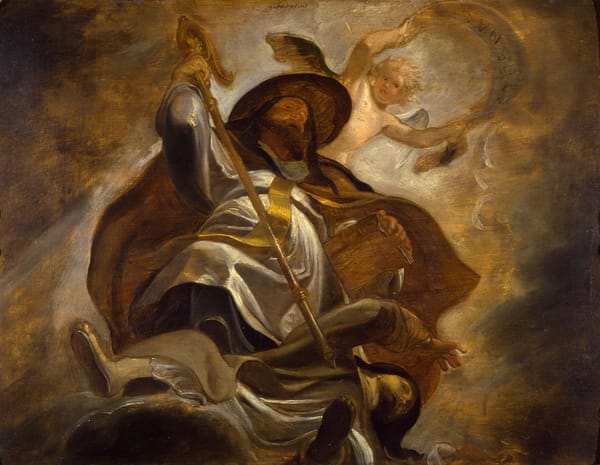 |
May 2: St. Athanasius, Bishop and Doctor of the Church
THE court of our divine King, during this grandest of seasons, is brilliant beyond measure; and, to-day, it is gladdened by the arrival of one of the most glorious champions that ever fought for his holy cause. Among the guardians of the word of truth, confided by Jesus to the earth, is there one more faithful than Athanasius? Does not his very name remind us of dauntless courage in the defence of the sacred deposit, of heroic firmness and patience in suffering, of learning, of talent, of eloquence—in a word, of everything that goes to form a Saint, a Bishop, and a Doctor of the Church? Athanasius lived for the Son of God; the cause of the Son of God was that of Athanasius: he who blessed Athanasius, blessed the eternal Word; and he who insulted Athanasius insulted the eternal Word.
Never did our holy faith go through a greater ordeal than in the sad times immediately following the peace of the Church, when the bark of Peter had to pass through the most furious storm that hell has, so far, let loose against her. Satan had vainly sought to drown the Christian race in a sea of blood; the sword of persecution had grown blunt in the hands of Diocletian and Galerius; and the Cross appeared in the heavens, proclaiming the triumph of Christianity. Scarcely had the Church become aware of her victory when she felt herself shaken to her very foundation. Hell sent upon the earth a heresy which threatened to blight the fruit of three hundred years of martyrdom. Arius began his impious doctrine, that he who had hitherto been adored as the Son of God was only a creature, though the most perfect of all creatures. Immense was the number, even of the clergy, that fell into this new error; the Emperors became its abettors; and had not God himself interposed, men would soon have set up the cry throughout the world that the only result of the victory gained by the Christian religion was to change the object of idolatry, and put a new idol, called Jesus, in place of the old ones.
But he who had promised that the gates of hell should never prevail against his Church, faithfully fulfilled his promise. The primitive faith triumphed; the Council of Nicæa proclaimed the Son to be consubstantial with the Father; but the Church stood in need of a man in whom the cause of the consubstantial Word should be, so to speak, incarnated—a man with learning enough to foil the artifices of heresy, and with courage enough to bear every persecution without flinching. This man was Athanasius: and everyone that adores and loves the Son of God, should love and honour Athanasius. Five times banished from his See of Alexandria by the Arians, who even sought to put him to death, he fled for protection to the West, which justly appreciated the glorious confessor of Jesus' divinity. In return for the hospitality accorded him by Rome, Athanasius gave her of his treasures. Being the admirer and friend of the great St Antony, he was a fervent admirer of the monastic life, which, by the grace of the Holy Ghost, had flourished so wonderfully in the deserts of his vast patriarchate. He brought the precious seed to Rome, and the first monks seen there were the ones introduced by Athanasius. The heavenly plant became naturalized in its new soil; and though its growth was slow at first, it afterwards produced fruit more abundantly than it had ever done in the East.
Athanasius, who has written so admirably upon that fundamental dogma of our faith—the divinity of Christ —has also left us most eloquent treatises on the mystery of the Pasch: they are to be found in the Festal Letters which he addressed each year to the churches of his patriarchate of Alexandria. The collection of these Letters, which were once thought to have been irretrievably lost, was found, a few years back, in the monastery of St Mary of Scete, in Egypt. The first, for the year 329, begins with these words, which beautifully express the sentiments we should feel at the approach of Easter: ' Come, my beloved brethren, celebrate the feast; the season of the year invites you to do so. The Sun of justice, by pouring out his divine rays upon you, tells you that the time of the solemnity is come. At such tidings, let us keep a glad feast; let not the joy slip from us with the fleeting days, without our having tasted of its sweetness.’ During almost every year of his banishment, Athanasius continued to address a Paschal Letter to his people. The one in which he announces the Easter of 338, and which he wrote at Treves, begins thus: ' Though separated from you, my brethren, I cannot break through the custom which I have always observed, and which I received from the tradition of the Fathers. I will not be silent; I will not omit announcing to you the time of the holy annual feast, and the day on which you must keep the solemnity. I am, as you have doubtless been told, a prey to many tribulations; I am weighed down by heavy trials; I am watched by the enemies of truth, who scrutinize everything I write, in order to rake up accusations against me and thereby add to my sufferings; yet notwithstanding, I feel that the Lord strengthens and consoles me in my afflictions. Therefore do I venture to address to you the annual celebration; and from the midst of my troubles, and despite the snares that beset me, I send you, from the furthermost part of the earth, the tidings of the Pasch, which is our salvation. Commending my fate into God’s hands, I will celebrate this feast with you; distance of place separates us, but I am not absent from you. The Lord who gives us these feasts, who is himself our feast, who bestows upon us the gift of his Spirit—he unites us spiritually to one another, by the bond of concord and peace.’
How grand is this Pasch, celebrated by Athanasius, an exile on the Rhine, in union with his people who keep their Easter on the banks of the Nile! It shows us the power of the Liturgy to unite men and make them, at one and the same time, and despite the distance of countries, enjoy the same holy emotions and feel the same aspirations to virtue. Greeks or Barbarians, we have all the same mother-country, the Church; but that which, after faith, unites us all into one family, is the Church’s Liturgy. Now there is nothing in the whole Liturgy so expressive of unity as the celebration of Easter. The unhappy Churches of Russia and the East, by keeping Easter on a different day from that on which it is celebrated by the rest of the Christian world, show that they are not a portion of the One Fold of which our Risen Jesus is the One Shepherd.
We will now read the sketch of the life of St Athanasius, given in the Breviary.
The Greek Church, which celebrates the feast of our Saint at another season of the year, is enthusiastic in her admiration of his virtues. The following stanzas are from the hymn she sings in his praise:
Hymn (Die XVIII Januarii)
Thou wast throned, O Athanasius! on the Chair of Mark in Alexandria; and thy name is emblazoned near his on the sacred cycle. He left Rome, sent by Peter himself to found the second patriarchal See; and thou, three centuries later, didst visit Rome, as successor of Mark, to seek protection from Peter's successor against them that were disturbing thy venerable See by injustice and heresy. Our Western Church was thus honoured by thy presence, O intrepid defender of the faith. She looked on thee with veneration as the glorious exile, the courageous confessor; and she has chronicled thy sojourning in her midst as an event of the greatest interest.
Intercede for the country over which was extended thy patriarchal jurisdiction; but forget not this Europe of ours, which gave thee hospitality and protection. Rome defended thy cause; she passed sentence in thy favour, and restored thee thy rights; make her a return, now that thou art face to face with the God of infinite goodness and power. Protect and console her Pontiff, the successor of that Julius who so nobly befriended thee fifteen hundred years ago. A fierce tempest is now raging against the Rock on which is built the Church of Christ; and our eyes have grown wearied looking for a sign of calm. Oh! pray that these days of trial be shortened, and that the See of Peter may triumph over the calumnies and persecutions which are now besetting her, and endangering the faith of many of her children.
Thy zeal, O Athanasius! checked the ravages of Arianism; but this heresy has again appeared, in our own times, and in almost every country of Europe. Its progress is due to that proud superficial learning which has become one of the principal perils of the age. The Eternal Son of God, consubstantial with the Father, is blasphemed by our so-called philosophers, as being only Man—the best and greatest of men, they say, but still only Man. They despise all the proofs which reason and history adduce of Jesus' divinity; they profess a sort of regard for the Christian teaching which has hitherto been held, but they have discovered (so they tell us) the fallacy of the great dogma which recognizes in the Son of Mary the Eternal Word who became incarnate for man’s salvation. O Athanasius, glorious Doctor of holy Mother Church! humble these modem Arians; expose their proud ignorance and sophistry; undeceive their unhappy followers, by letting them see how this false doctrine leads either to the abyss of the abominations of pantheism, or to the chaos of scepticism, where all truth and morality are impossibilities.
Preserve within us, by the influence of thy prayers, the precious gift of faith, wherewith our Lord has mercifully blessed us. Obtain for us that we may ever confess and adore Jesus Christ as our eternal and infinite God; ' God of God; Light of Light; True God of True God; Begotten, not made; who, for us men, and for our salvation, took Flesh, of the Virgin Mary.’ May we grow each day in the knowledge of this Jesus, until we join thee in the face-to-face contemplation of his perfections. Meanwhile, by means of holy faith, we will live with him on this earth that has witnessed the glory of his Resurrection. How fervent, O Athanasius, was thy love of this Son of God, our Creator and Redeemer! This love was the very life of thy soul, and the stimulus that urged thee to heroic devotedness to his cause. It supported thee in the combats thou hadst to sustain with the world, which seemed leagued together against thy single person. It gave thee strength to endure endless tribulations. Oh! pray that we may obtain this love—a love which is fearless of danger, because faithful to him for whom we suffer—a love which is so justly due, seeing that he, though the Brightness of his Father's glory, and Infinite Wisdom, emptied himself, taking the form of a servant, and humbled himself, becoming obedient unto death, even to the death of the Cross.* How else can we make him a return for his devotedness to us except by giving him all our love, as thou didst, O Athanasius! and by ever singing his praise in compensation for the humiliations which he endured in order to save us?
* Philipp, ii 7, 8. ↩︎
Saturday of the Fourth Week after Easter
SATURDAY brings us once more to the dear Mother of our Jesus. Last Saturday, when closing our week’s considerations upon the establishment of the Church, we reverently drew a parallel between these two Mothers—Mary and the Church. During the present week, we have been considering how our Saviour confided his doctrine—that is, the object of our faith—to his Apostles; let us devote this last day to a loving remembrance of the dogmas which Jesus revealed to them regarding the dignity and office of her whom he chose for his own and our Mother.
Holy Church teaches us several truths concerning Mary; and these truths are the object of our faith, on the same ground as the other articles contained in the Catholic Creed. Now they could not be the object of our faith, except inasmuch as they were revealed by the lips of our divine Lord himself. The Church of our days has received them from the Church of past ages, just as this last named received them from the Apostles, to whom Jesus first confided them. There has been no new revelation since our Saviour’s Ascension; consequently, the manifestation of all the dogmas transmitted to the Church, and promulgated by her to the world, dates from the teaching given by Jesus to his Apostles. It is on this account that we believe them with theological faith—a faith which can only be given to truths directly revealed by God to man.
How beautiful is the affection here shown by the Son of God to his Mother! He revealed to his Apostles the impenetrable secrets of the divine Essence, the Trinity in Unity, the eternal generation of the Word in the Father's bosom, the eternal procession of the Holy Ghost from the Father and the Son, the union of the two Natures in one Person in the Incarnate Word, the Redemption of the world by the Blood of the Man-God, the restoration of fallen man and his elevation to a supernatural state by grace. But this same Jesus also reveals the prerogatives of his dearest Mother; and we are to believe them with the same faith as we do the dogmas which relate to God himself! Jesus, the Wisdom of the Father, the Conqueror of death, has revealed to us Mary's dignity with the same lips that taught us what he himself is: we believe the two revelations with equal faith because both come from him.
Jesus said to his Apostles, and they, under the guidance of the Holy Ghost, communicated his teaching to the Church:’Mary, my Mother, is a daughter of Adam and Eve; but the stain of original sin was not upon her. The decree that every human being should be conceived in sin was suspended in her regard. She was full of grace from the first moment of her Conception. Jeremiasand John the Baptist were sanctified in their mother’s womb; Mary was Immaculate from the first moment of her existence.’
Jesus also said to his Apostles, and commanded them to repeat his words to the Church:’ Mary is truly Mother of God, and must be honoured as such by all creatures; for she truly conceived me and gave me birth, according to my human nature, which forms but one Person with my divine nature.’
Jesus also said to his Apostles, and commanded them to repeat his words to the Church:’ Mary, my Mother, conceived me in her chaste womb without ceasing to be a Virgin, and she gave me birth without her Virginity suffering any injury.’
Thus, Mary’s Immaculate Conception which prepared her for her sublime office, her divine Maternity and her perpetual Virginity, are three dogmas of our faith, which were revealed to the Apostles directly by our Lord. Holy Church merely repeats them after the Apostles, just as the Apostles repeated them after hearing them from their divine Master.
But did not Jesus reveal other prerogatives of his august Mother—prerogatives which are consequences of the three magnificent gifts just mentioned? Let us ask the Church what she believes on this subject, and what she teaches, both by her doctrinal utterance, and by her equally infallible practice. Every development, which is produced in her by the action of the Holy Ghost, is based upon the word of God, which was spoken at the beginning. Thus it is impossible to doubt but that our Saviour made known to his Apostles his intention of raising his blessed Mother to the dignity of Queen of the universe, of Mediatrix of men, of Mother of grace, of Co-operatrix of our Redemption. Had she not, by the three unparalleled gifts just mentioned, already been raised above all other creatures? Yes, we cannot doubt it; these glories of the Mother of God were known, revered, and loved by the Apostles; and we, who have received from the Church these same sublime and consoling truths, we too prize and love our knowledge. Should we not be offering violence to every noble feeling of our nature, were we to believe that Jesus ascended into heaven, without having made known to the world the glories of his Mother, whom he loved both as her Son and her God!
What must have been thy sentiments, O Mary, thou most humble of creatures, when Jesus unveiled thy glories to the disciples? They already reverenced thee, but they could never have known the grand gifts bestowed on thee by God, unless that God himself had revealed them. What glorious things were said of thee, O City of God!1 If thy humility was troubled when the archangel called thee full of grace, and blessed among women; how must thou not have shrunk from the homage paid thee by the Apostles, when they were first told that thou wast the Mother of God, the ever spotless Virgin, Immaculate from thy very conception! But no, blessed Mother! thou canst not shun the honours that are richly thy due. The prophecy spoken by thyself, in Zachary’s house, must be fulfilled: All generations shall call thee Blessed!2 The time is at hand; a few days hence, the preaching of the Gospel will have commenced. Thy name, thy ministry, thy glories are an essential part of the Creed which is to be carried throughout the world. Up to this time, thou hast been shrouded in a veil of mystery; that veil must now be drawn aside —Jesus will have it so—and thou must be known as Mother of the God, who, when he came to save us, disdained not to assume our human nature in thy chaste womb. Dearest Mother! Queen of angels and men! suffer us to unite our fervent homage with that which the Apostolic College gave thee, when Jesus first revealed to them thy glories!
Let us, in honour of the blessed Mother, recite this sequence of the Cluny Missal of 1523. It is a graceful imitation of the Victimœ Paschali.
Sequence
Intonent Christiani.
Tua per suffragia
Reconcilientur peccatores.
A fermento veteri,
Victimae paschalis perceptores.
Virgo clemens et pia,
Et gloria frui resurgentis.
Christo reconcilia,
Es Genitrix Verbi Dei facta.
Et hominem natum, resurrexisse glorificatum.
A mortuis vere;
Conserva Mater nos et tuere.
their hymns of praise.
let sinners be reconciled to God
by thy prayers.
by thy intercession,
cleansed from the old leaven.
thou merciful and loving Virgin!
and Risen Christ.
by thy holy prayers,
Mother of the Word of God!
who was born of thee hath risen again in glory.
Do thou, O Mother!
preserve and defend us.
| Previous Friday of the Fourth Week after Easter | Next Saturday of the Fourth Week after Easter |