Daily reading
Paschal Time
Double of the II Class · Movable from Easter · Temporal
May 3, 2026
From Dom Guéranger’s The Liturgical Year.

|
Fourth Sunday after Easter
OUR Jesus has organized his Church, and confided to his Apostles the sacred deposit of the truths which are to form the object of our faith. We must now follow him in another work, of equal importance to the world, to which he gives his divine attention during these forty days: it is the institution of the sacraments. It is not enough that we believe; we must, moreover, be made just—that is, we must bear upon us the likeness of God’s holiness; we must receive, we must have incorporated within us that great fruit of the redemption which is called grace; that thus being made living members of our divine Head, we may be made join theirs with him of the kingdom of heaven. Now it is by means of the sacraments that Jesus is to produce in us this wondrous work of our justification; he applies to us the merits of his Incarnation and Sacrifice, but he applies them by certain means, which he himself, in his power and wisdom, has instituted.
Being the sovereign master of his own gifts, he can select what means he pleases whereby to convey grace to us; all we have to do is to conform to his wishes. Thus, each of the sacraments is a law; so that it is in vain that we hope for a sacrament to produce its effects, unless we fulfil the conditions specified by our Redeemer. And here, at once, we cannot but admire that infinite goodness which has so mercifully blended two such widely distinct operations in one and the same act—namely, on the one side the humble submission of man, and on the other the munificent generosity of God.
We were showing, a few days back, how the Church, though a spiritual society, is also visible and exterior, because man, for whose sake the Church was formed, is a being composed of body and soul. When instituting the sacraments, our Lord assigned to each an essential rite; and this rite is outward and sensible. He made the Flesh, which he had united to his divine Person, become the instrument of our salvation by his Passion and Death on the Cross; he redeemed us by shedding his Blood for us: so is it in the sacraments; he follows the same mysterious plan, taking physical things as his auxiliaries in effecting the work of our justification. He raises them to a supernatural state, and makes them the faithful and all-powerful conductors of his grace, even to the most intimate depths of our soul. It is the continuation of the mystery of the Incarnation, the object of which is to raise us, by visible things, to the knowledge of things invisible. Thus is broken the pride of Satan; he despised man because he is not purely a spirit, but is spirit and matter unitedly; and he refused to pay adoration to the word made Flesh.
Moreover, the sacraments, being visible signs, are an additional bond of union between the members of the Church: we say additional, because these members have the two other strong links of union—submission to Peter and to the pastors sent by him and profession of the same faith. The Holy Ghost tells us, in the sacred Volume, that a threefold cord is not easily broken.1 Now we have such a one; and it keeps us in the glorious unity of the Church: hierarchy, dogma, and sacraments, all contribute to make us one Body. Everywhere, from north to south, and from east to west, the sacraments testify to the fraternity that exists amongst us; by them we know each other, no matter in what part of the globe we may be, and by the same we are known by heretics and infidels. These divine sacraments are the same in every country, how much soever the liturgical formulae of their administration may differ; they are the same in the graces they produce, they are the same in the signs whereby grace is produced—in a word, they are the same in all the essentials.
Our Risen Jesus would have the sacraments be seven. As at the beginning he stamped the creation of the visible world with this sacred number, giving six days to work and one to rest, so, too, would he mark the great spiritual creation. He tells us, in the Old Testament, that Wisdom (that is, himself, for he is the Eternal Wisdom of the Father) will build to himself a house, which is the Church; and he adds that he will make it rest on seven pillars.2 He gives us a type of this same Church in the tabernacle built by Moses, and he orders a superb candlestick to be provided for giving light, by day and night, to the holy place; but there were to be seven branches to the candlestick, and on each branch were to be graven flowers and fruits.3 When he raises his beloved disciple to heaven, he shows himself to him surrounded by seven candlesticks, and holding seven stars in his right hand.4 He appears to him as a Lamb, bearing seven horns, which are the symbol of strength, and having seven eyes, which signify his infinite wisdom.5 Near him lies a Book, in which is written the future of the world; the Book is sealed with seven seals, and none but the Lamb is able to loose them.6 The disciple sees seven spirits, burning like lamps, before the throne of God,7 ready to do his biddings, and carry his word to the extremities of the earth.
Turning our eyes to the kingdom of Satan, we see him mimicking God's work, and setting up a seven of his own. Seven capital and deadly sins are the instruments whereby he makes man his slave; and our Saviour tells us that when Satan has been defeated and would regain a soul, he brings with him seven of the wickedest spirits of hell. We read in the Gospel that Jesus drove seven devils out of Mary Magdalen. When God’s anger bursts upon the world, immediately before the coming of the dread Judge, he will announce the approach of his chastisements by seven trumpets, sounded by seven angels;8 and seven other angels will then pour out upon the guilty earth seven vials filled with the wrath of God.9
We, therefore, who are resolved to make sure our election; who desire to possess the grace of our Risen Jesus in this life, and to enjoy his vision in the next; oh! let us reverence and love this merciful seven, these admirable sacraments! Under this sacred number he has included all the varied riches of his grace. There is not a want or necessity, either of souls individually, or of society at large, for which our Redeemer has not provided by these seven sources of regeneration and life. He calls us from death to life by Baptism and Penance; he strengthens us in that supernatural life by Confirmation, the Eucharist, and Extreme Unction; he secures to his Church both ministry and increase by Holy Orders and Matrimony. The seven sacraments supply everything needed; take one away, and you destroy the harmony. The Churches of the East, though severed now for long ages from Catholic unity, retain all seven; and when Protestantism broke the sacred number, it showed in this, as in all its other pretended reformations, that it was estranging itself from the spirit of the Christian religion. No: the doctrine of the sacraments is one that cannot be denied without denying the true faith. If we would be members of God’s Church, we must receive this doctrine as coming from him who has a right to insist on our humble submission to his every word. It is to the soul which thus believes that the sacraments appear in all their divine beauty and power: we understand, because we believe, Credite, et intelligetis! It is the fulfilment of the text from Isaias, as rendered by the Septuagint: Unless ye believe, ye shall not understand!10
Let us confine our considerations, for to-day, to the first of the sacraments—Baptism. It is during Paschal Time that we have it brought before us in all its glory. We remember how, on Holy Saturday, it filled the hearts of the catechumens with joy, giving them a right to heaven. But the great sacrament had had its preparations. On the Feast of the Epiphany, we adored our Emmanuel as we beheld him descending into the river Jordan, and by this contact with his sacred Body, communicating to the element of water the power of purifying men's souls from sin. The Holy Ghost, in the form of a dove, rested on Jesus' head, and by his divine influence gave fecundity to the life-giving element. The voice of the Eternal Father was heard in a cloud announcing his adoption of all such as should receive baptism; he adopted them in Jesus, his eternally wellbeloved Son.
During his sojourn on earth, our Redeemer thus explained the mystery of baptism to Nicodemus, who was a ruler among the Jews, and a master in Israel: Unless a man be born again of water and the Holy Ghost, he cannot enter into the kingdom of God11 Here, as in so many other instances, he foretells what he intends to do at a future time; he prepares us for the mystery by telling us that as our first birth was not pure, he is preparing a second for us; that this second birth will be holy, and that water is to be the instrument of so great a grace.
But after his Resurrection, our Emmanuel openly announced his having given to water the power of producing the sublime adoption to which mankind was invited by the Eternal Father. Speaking to his Apostles, he thus gives them the fundamental law of the kingdom he had come from heaven to establish: Going, teach ye all nations: baptizing them in the name of the Father, and of the Son, and of the Holy Ghost.12 This is the master-gift bestowed on the world by its Redeemer: salvation by water and the invocation of the blessed Trinity; for he adds: He that believeth and is baptized, shall be saved.13 What a revelation was here! It told us of the infinite mercy wherewith our Creator loved us: it was the inauguration of the sacraments by the announcement of the first of the seven—of that one which, according to the expression of the holy Fathers, is the gate to the rest.
Let us love this august mystery of baptism, to which we are indebted for the life of our souls, and for the indelible character which makes us members of our divine Head, Jesus. The holy King of France, St Louis, who was baptized in the humble village of Poissy, loved to sign himself’ Louis of Poissy.' He looked upon the baptismal font as the mother who had given him a life incomparably superior to that which made him the son of an earthly monarch: she gave him to be the child of God and heir to the kingdom of Heaven. We should imitate this saintly king.
But observe the exceeding considerateness of our Risen Jesus, when he instituted this the most indispensable of the sacraments. He chose for its matter the commonest that could be, and the most easily to be had. Bread, wine and oil are not so plentiful as water, which is to be found in every place; God made it thus plentiful, that when the appointed time came, the fount of regeneration might be within everyone's reach.
In his other sacraments, our Saviour would have priests alone to be the ministers: not so with baptism. Any one of the faithful, whatever may be his or her condition, may administer baptism. Nay more; an infidel can, by water and the invocation of the blessed Trinity, confer upon others the baptismal grace, which he or she does not possess, provided only that he really intends to do what Holy Church does, when she administers the sacrament of baptism.
Nor is this all. An unbaptized man or woman may be dying, and no one near him to administer this sacrament; he is on the brink of eternity, and there is no hand nigh to pour the water of regeneration upon him; our Saviour has lovingly provided for this necessity. Let this man or woman believe in baptism; let him desire it in all the sincerity of his soul; let him entertain sentiments of compunction and love, such as are required of an adult when receiving baptism; he is baptized in desire, and heaven is open to him.
But what if it be a child, who has not come to the use of reason? Our Saviour’s words are plain: He that believeth and is baptized, shall be saved. How, then, can this child be saved? The guilt of original sin is upon it, and it is incapable of making an act of faith. Fear not: the power of holy baptism extends even so far as this. The faith of the Church will be imputed to this child, which the Church is about to adopt as her own: let water be but poured on the child, in the name of the three divine Persons, and it is a Christian for ever. Baptized in the faith of the Church, this child now possesses (and, as we say, personally) Faith, Hope and Charity; the sacramental water has achieved this wondrous work. If the little innocent dies, it goes straight to heaven.
These, O Jesus! are the admirable effects of the first of thy sacraments. How truly does the Apostle say of thee, that thou wiliest all men to be saved!14 If this thy will be in some without its fulfilment, so that some children die without baptism, it is because of the consequences which sin produces in the parents, and which thy justice is not bound to prevent. And yet, how frequently does not thy mercy intervene, and procure the grace of regeneration for children who, naturally, would have been excluded! Thus, the water of baptism has been poured upon countless babes, who were dying in the arms of their pagan parents, and the angels received these little ones into their choirs. Knowing this, dear Saviour, we are forced to exclaim with the Psalmist: Let us that live bless the Lord!15
In the Greek Church, the fourth Sunday after Easter is called the Sunday of the Samaritan, because there is then read the passage of the Gospel which relates the conversion of this woman.
The Roman Church begins the Catholic Epistles in her Night Office of this Sunday, and continues them till Pentecost Sunday.
Mass
In the Introit, the Church makes use of one of the finest canticles of the royal prophet, in order to celebrate the wonderful graces bestowed upon her by her divine Spouse; she also rejoices at the thought that the Gentiles have been called to the knowledge of God, to justification and salvation.
Introit
Ps. Salvavit sibi dextera ejus: et brachium sanctum ejus.℣. Gloria Patri. Cantate.
Ps. His right hand, and his holy arm hath saved us.℣. Glory, etc. Sing, etc.
Laden with the blessings of God, who, by his divine sacraments has made them to be one people, the faithful should not be satisfied with observing the commandments—they should love them; they should also long after the heaven that is promised them. The Church prays, in the Collect, that her children may receive the grace to do all this.
Collect
To this are added two of the Collects given at page 135.
Epistle
Cap. i.Charissimi, omne datum optimum, et omne donum perfectum desursum est, descendens a Patre luminum, apud quem non est transmutatio nec vicissitudinis obumbratio. Voluntarie enim genuit nos verbo veritatis, ut simus initium aliquod creaturae ejus. Scitis, fratres mei dilectissimi. Sit autem omnis homo velox ad audiendum: tardus autem ad loquendum, et tardus ad iram. Ira enim viri, justitiam Dei non operatur. Propter quod abjicientes omnem immunditiam, et abundantiam malitiae, in mansuetudine suscipite insitum verbum, quod potest salvare animas vestras.
Ch. i.Dearly beloved: Every best gift, and every perfect gift, is from above, coming down from the Father of lights, with whom there is no change, nor shadow of alteration. For of his own will hath he begotten us by the word of truth, that we might be some beginning of his creatures. You know, my dearest brethren. And let every man be swift to hear, but slow to speak, and slow to anger. For the anger of man worketh not the justice of God. Wherefore casting away all uncleanness and abundance of naughtiness, with meekness receive the ingrafted word, which is able to save your souls.
The favours bestowed upon the Christian people proceed from the goodness of our heavenly Father. He is the source of everything in the order of nature; and if, in the order of grace, we are become his children, it is because he sent us his Consubstantial Word—the Word of Truth—whereby, by means of baptism, we were made children of God. Hence, we ought to imitate, as far as our weakness will permit, the divine calm of our Father who is in heaven; we ought to avoid that state of passionate excitement which savours of a terrestrial life, whereas ours should be of the heaven whither God calls us. The Apostle bids us receive, with meekness, the word, which makes us what we are. He tells us that this word is a germ of salvation grafted into our souls: only let us put no obstacle to its growth, and we shall be saved.
In the first Alleluia-Versicle, our Risen Jesus extols, in the words of the royal psalmist, the power of his Father, who gave him the victory of his Resurrection. In the second, we ourselves proclaim the praise of the immortal life of our divine Master; we proclaim it in the words of St Paul;
Gospel
Cap. xvi.In illo tempore: Dixit Jesus discipulis suis: Vado ad eum qui misit me: et nemo ex vobis interrogat me, Quo vadis? Sed quia hæc locutus sum vobis, tristitia implevit cor vestrum. Sed ego veritatem dico vobis: Expedit vobis ut ego vadam: si enim non abiero, Paraclitus non veniet ad vos: si autem abiero, mittam eum ad vos. Et cum venerit ille, arguet mundum de peccato, et de justitia, et de judicio. De peccato quidem, quia non crediderunt in me: de justitia vero, quia ad Patrem vado, et jam non videbitis me: de judicio autem, quia princeps hujus mundi jam judicatus est. Adhus multa habeo vobis dicere: sed non potestis portare modo. Cum autem venerit ille Spiritus veritatis, docebit vos omnem veritatem: non enim loquetur a semetipso: sed quæcumque audiet loquetur, et quæventura sunt annuntiabit vobis. Ille me clarificabit: quia de meo accipiet et annuntiabit vobis.
Ch. xvi.At that time: Jesus said to his disciples: I go to him that sent me; and none of you asketh me: Whither goest thou? But because I have spoken these things to you, sorrow hath filled your heart. But I tell you the truth: it is expedient to you that I go: for if I go not, the Paraclete will not come to you; but if I go, I will send him to you. And when he is come, he will convince the world of sin, and of justice, and of judgement. Of sin: because they believed not in me. And of justice: because I go to the Father; and you shall see me no longer. And of judgement: because the prince of this world is already judged. I have yet many things to say to you: but you cannot bear them now. But when he, the Spirit of truth, is come, he will teach you all truth. For he shall not speak of himself; but what things soever he shall hear, he shall speak: and the things that are to come he shall show you. He shall glorify me: because he shall receive of mine, and shall show it you.
The Apostles were sad at hearing Jesus say to them: I go. Are not we so, too? we who, thanks to the sacred Liturgy, have been in such close company with him ever since the day of his birth at Bethlehem. Yet a few days, and he is to ascend into heaven, and our year is to lose the charm it possessed of following, day by day, the actions and words of our Emmanuel. Still, he would have us moderate our sadness. He tells us that in his stead the Paraclete, the Comforter, is about to descend upon the earth, and abide with us to the end of time, in order that he may give us light and strength. Let us make good use of these last hours with our Jesus: we shall soon have to be preparing for the divine Guest who is to take his place.
By these words, which were spoken shortly before his passion, our Saviour does more than tell us of the coming of the Holy Ghost; he also shows us how terrible this coming will be to them that have rejected the Messias. His words are unusually mysterious: let us listen to the explanation given of them by St Augustine, the Doctor of doctors. When the Holy Ghost is come, says our Lord, he will convince the world of sin, because they believed not in me. How great must, indeed, be the responsibility of them that have been witnesses of Jesus' wonderful works, and yet will not receive his teaching! Jerusalem will be told that the Holy Ghost has come down upon the disciples: and she will receive the news with the same indifference as she did the miracles which proved Jesus to be her Messias. The coming of the Holy Ghost will serve as a sort of signal of the destruction of the deicide city. Jesus adds: The Paraclete will convince the world of justice, because I go to the Father, and ye shall see me no longer. The Apostles, and they that believe their word, shall be just and holy by faith: they will believe in him that is gone to the Father—in him whom they are to see no longer in this world. Jerusalem, on the contrary, will remember him only to blaspheme him: the holiness, the faith, the justice of them that shall believe, will be her condemnation, and the Holy Ghost will leave her to her fate. Jesus continues: The Paraclete will convince the world of judgement, because the prince of this world is already judged. They that follow not Christ Jesus, follow Satan: he is their prince, but his judgement is already pronounced. The Holy Ghost warns the followers of the world that their leader is already in eternal torments. Let them reflect well upon this; for, as St Augustine observes,’the pride of man has no right to reckon upon indulgence; let it but think of the hell into which even the angels were cast because they were proud.'16
In the Offertory, the Christian makes use of the psalmist's words, to celebrate the favours bestowed by God upon his soul. He invites the whole earth to join him in his gratitude, and he does well; for the favours received by this Christian are offered to the whole of mankind; Jesus has invited all men to share by means of the sacraments in the graces of the redemption.
Offertory
Holy Church delights in the contemplation of divine truth, so profusely communicated tø her by our Risen Lord; she prays, in the following prayer, that her children may lead such good lives in this world, as to merit the eternal enjoyment of the God of all truth.
Secret
To this are added two of the Secrets given at page 140.
The Communion-Anthem repeats the mysterious words of the Gospel, which we have already explained; they remind us that the coming of the Holy Ghost may be either a reward or a punishment, according to the dispositions of men.
Communion
Whilst giving thanks for the divine mystery just received, the Church, in the Postcommunion, teaches us that the Eucharist has the power of cleansing us from our sins, and preserving us from the dangers to which we are exposed.
Postcommunion
To this are added two of the Postcommunions given at page 141.
Vespers
The psalms, hymn and versicle are given on pages 81-90.
Antiphon of the Magnificat
We will close the day with the following fine Preface given in the ancient Gothic Missal, which was published by Dom Mabillon, and was formerly used in many of the Churches of Gaul.
Contestatio
May 3: The Finding of the Holy Cross
|
IT was most just that our divine King should show himself to us with the sceptre of his power, to the end that nothing might be wanting to the majesty of his empire. This sceptre is .the Cross; and Paschal Time was to be the season for its being offered to him in glad homage. A few weeks back, and the Cross was shown to us as the instrument of our Emmanuel's humiliation and as the bed of suffering whereon he died; but has he not since then conquered Death? and what is his Cross now but a trophy of his victory? Let it then be brought forth to our gaze and let every knee bend before this sacred Wood, whereby our Jesus won the honour and praise we now give him!
On the day of his birth at Bethlehem we sang these words of the Prophet Isaias: A child is bom unto us, and a son is given unto us, and his government is upon his shoulder.1 We have seen him carrying this Cross upon his shoulder; as Isaac carried the wood for his own immolation; but now it is no longer a heavy burthen. It is shining with a brightness that ravishes the eyes of the angels; and after having received the veneration of man as long as the world lasts, it will suddenly appear in the clouds of heaven, near the Judge of the living and the dead—a consolation to them that have loved it, but a reproach to such as have treated it with contempt or forgetfulness.
Our Saviour did not think the time between his Resurrection and Ascension a fitting one for glorifying the instrument of his victory. The Cross was not to be brought into notice until it had subjected the world to him whose glory it so eloquently proclaimed. Jesus was three days in the tomb; his Cross is to lie buried, unknown to men, for three centuries: but it is to have its resurrection, and the Church celebrates this resurrection to-day. Jesus would, in his own good time, add to the joy of Easter by miraculously revealing to us this sacred monument of his love for mankind. He entrusts it to our keeping—it is to be our consolation—as long as this world lasts: is it not just that we should love and venerate it?
Never had Satan's pride met with such a humiliation as when he saw the instrument of our perdition made the instrument of our salvation. As the Church expresses it in her Preface for Passiontide: ‘He that overcame mankind by a Tree, was overcome by a Tree.' Thus foiled, he vented his fury upon this saving Wood, which so bitterly reminded him both of the irresistible power of his conqueror and of the dignity of man who had been redeemed at so great a price. He would fain have annihilated the Cross; but knowing that this was beyond his power, he endeavoured to profane it, and hide it from view. He therefore instigated the Jews to bury it. At the foot of Calvary, not far from the sepulchre, was a deep hole. Into this was the Cross thrown, together with those of the two thieves, the Nails, the Crown of Thoms, and the Inscription or Title written by Pilate. The hole was then filled up with rubbish and earth, and the Sanhedrim exulted in the thought of its having effaced the memory of the Nazarene, who could not save himself from the ignominious death of the Cross.
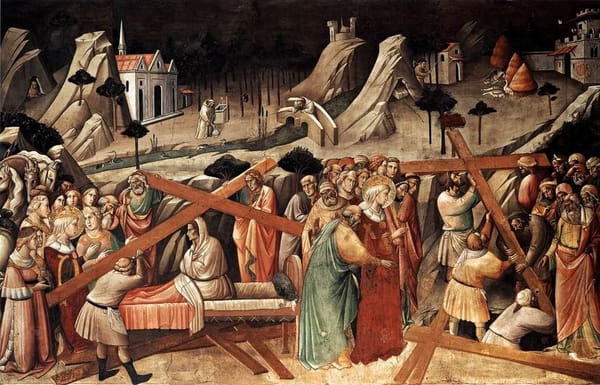
Forty years after this, Jerusalem was destroyed by the Romans, the instruments of God’s vengeance. The Holy Places were desecrated by the idolaters. A small temple to Venus was erected on Calvary, and another to Jupiter over the Holy Sepulchre. By this, the pagans intended derision; whereas, they were perpetuating the knowledge of two spots of most sacred interest. When peace was restored under Constantine, the Christians had but to remove these pagan monuments, and their eyes beheld the holy ground that had been bedewed with the Blood of Jesus, and the glorious Sepulchre. As to the Cross, it was not so easily found. The sceptre of our divine King was to be raised up from its tomb by a royal hand. The saintly Empress Helen, Constantine's mother, was chosen by heaven to pay to Jesus—and that, too, on the very spot where he had received his greatest humiliations—the honours which are due to him as the King of the world. Before laying the foundations of the Basilica of the Resurrection, this worthy follower of Magdalen and the other holy women of the sepulchre was anxious to discover the instrument of our salvation. The Jews had kept up the tradition of the site where it had been buried: the Empress had the excavations made accordingly. With what holy impatience she must have watched the works! and with what ecstasy of joy did she behold the redeeming Wood, which, though not at first distinguishable, was certainly one of the three Crosses that were found! She addressed a fervent prayer to the Saviour, who alone could reveal to her which was the trophy of his victory; the bishop, Macarius, united his prayers with hers; and their faith was rewarded by a miracle that left them no doubt as to which was the true Cross.
The glorious work was accomplished, and the Church was put in possession of the instrument of the world’s Redemption. Both East and West were filled with joy at the news of this precious discovery, which heaven had set on foot, and which gave the last finish to the triumph of Christianity. Christ completed his victory over the pagan world by raising thus his standard—not a figurative one, but his own real standard—his Cross, which, up to that time, had been a stumbling-block to the Jews, and foolishness to the Gentiles; but before which every Christian is henceforth to bend his knee.
Helen placed the holy Cross in the Basilica which had been built by her orders, and which covered both the glorious Sepulchre and the hill of the Crucifixion. Another Church was erected on the site where the Cross had lain concealed for three hundred years, and the faithful are enabled, by long flights of steps, to go down into the deep grotto which had been its tomb. Pilgrims came from every part of the world to visit the hallowed places where our Redemption had been wrought, and to venerate the sacred Wood of the Cross. But God’s merciful providence willed not that the precious pledge of Jesus’ love for mankind should be confined to one sanctuary only, however venerable it might be. Immediately after its discovery, Helen had a very large piece cut from the Cross; and this fragment she destined for Rome, the new Jerusalem. The precious gift was enshrined in the Basilica built by her son Constantine in the Sessorian garden, which was afterwards called the Basilica of Holy-Cross-in-Jerusalem.
By degrees, other places were honoured by the presence of the Wood of the Holy Cross. So far back as the fourth century, we have St Cyril of Jerusalem attesting that many of the pilgrims used to obtain small pieces of it, and thus carried the precious treasure into their respective countries; and St Paulinus of Nola, who lived in the same century, assures us that these many gifts lessened not the size of the original relic. In the sixth century, the holy Queen St Radegonde obtained from the Emperor Justin II a large piece from the fragment that was in the imperial treasury of Constantinople. It was for the reception of this piece of the True Cross into France that Venantius Fortunatus composed the Vexilla Regis—that beautiful hymn which the Church uses in her Liturgy as often as she celebrates the praise of the Holy Cross. After several times losing and regaining it, Jerusalem was at length for ever deprived of the precious relic. Constantinople was a gainer by Jerusalem’s loss. From Constantinople, especially during the Crusades, many churches of the West procured large pieces. These again supplied other places; until at length the Wood of the Cross was to be found in almost every town of any importance. There is scarcely to be found a Catholic who, some time or other in his life, has not had the happiness of seeing and venerating a portion of this sacred object. How many acts of love and gratitude have not been occasioned by this? And who could fail to recognize, in this successive profusion of our Jesus’ Cross, a plan of divine providence for exciting us to us appreciation of our Redemption, on which rest all our hopes of eternal happiness?
How dear, then, to us should this day be, which blends together the recollection of the holy Cross and the joys of the Resurrection of that Jesus who by the Cross has won the throne to which we shall soon see him ascend! Let us thank our Heavenly Father for his having restored to mankind a treasure so immensely precious as is the Cross. Until the day comes for it to appear with himself in the clouds of heaven, Jesus has entrusted it to his Spouse, as a pledge of his second coming. On that day, he will collect together all the fragments by his divine power; and the Tree of Life will then gladden the elect with its dazzling beauty, and invite them to eternal rest beneath its refreshing shade.
The Liturgy gives us the following history of the great event we are celebrating today:
Both the Eastern and Western Churches abound in liturgical compositions in honour of the holy Cross. We offer our readers a selection from these, beginning with the glorious verses of Venantius Fortunatus:
Fulget Crucis mysterium,
Qua Vita mortem pertulit,
Et morte vitam protulit.
Mucrone diro, criminum
Ut nos lavaret sordibus,
Manavit unda et sanguine.
David fideli cannine,
Dicendo nationibus:
Regnavit a ligno Deus.
Ornata Regis purpura,
Electa digno stipite,
Tam sancta membra tangere.
Pretium pependit sæculi,
Statera facta corporis,
Tulitque praedam tartari.
Paschale quæ fers gaudium,
Piis adauge gratiam,
Reisque dele crimina.
Collaudet omnis spiritus;
Quibus Crucis victoriam
Largiris, adde præmium.
the mystery of the Cross shines upon us
—that Cross on which Life suffered death,
and by his Death gave life.
that by the Water and the Blood
which flowed from the wound
he might cleanse us from sin.
the prophecy foretold
in David’s truthful words:
‘God hath reigned ffom the Tree.’
beautified by the scarlet of the King,
and chosen as the noble trunk
that was to touch such sacred limbs.
on whose arms hung the ransom of the world!
It was the balance wherein was placed the Body of Jesus,
and thereby hell lost its prey.
that bringest us the Paschal joy.
Increase the grace of the good
and cleanse sinners from their guilt.
thou fount of salvation!
and by the Cross, whereby thou gavest us victory,
give us too our recompense.
The Roman Church has the following Responsories and Antiphons in her Office for this feast. They are full of unction, and breathe a fragrance of antiquity:
Our Latin Churches of the Middle Ages are fervent in their hymns in honour of the holy Cross. The first we select is the celebrated sequence of Adam of Saint-Victor:
Sequence
Nos qui Crucis exsultamus speciali gloria:
Nam in Cruce triumphamus,
Hostem ferum superamus
Dulce melos
Tangat cœlos;
Dulce lignum
Dulci dignum
Credimus melodia:
Cum vox vitam non remordet, dulcis est symphonia.
Per quam Crucem sibi gaudent vitæ dari munera.
Dicant omnes, et dicant singuli:
Ave salus totius sæculi, arbor salutifera!
Fuit hæc salutis ara
Rubens Agni sanguine,
Agni sine macula,
Qui mundavit sæcula
Ab antiquo crimine!
Per quam Christus, rex cœlorum,
Ad se trahit omnia;
Forma cujus hoc ostendit
Quæ terrarum comprehend it quatuor confinia.
Nec recenter est inventa crucis hæc religio:
Ista dulces aquas fecit;
Per hanc silex aquas jecit Moysis officio.
Nisi Cruce munit homo superliminaria:
Neque sensit gladium,
Nec amisit filium
Quisquis egit talia.
Spem salutis est adepta
Pauper muliercula:
Sine lignis fidei
Nec lecythus olei
Valet, nec farinula.
Sub figuris
Ista latent,
Sed jam patent
Crucis beneficia;
Reges credunt,
Hostes cedunt;
Sola Cruce,
Christo duce,
Unus fugat millia.
In profundum vidit mersas una cum Maxentio:
Fusi Thraces, caesi Persæ,
Sed et partis dux adversæ victus ab Hemclio.
Semper facit et victores;
Morbos sanat et languores, reprimit dæmonia;
Dat captivis libertatem,
Vitæ confert novitatem:
Ad antiquam dignitatem Crux reduxit omnia.
Vera mundi salus, vale!
Inter ligna nullum tale fronde, flore, germine;
Medicina Christiana,
Salva sanos, ægros sana:
Quod non valet vis humana fit in tuo nomine.
Consecrator Crucis, audi,
Atque servos tuæ Crucis
Post hanc vitam, veræ lucis transfer ad palatia;
Quos tormento vis servire,
Fac tormenta non sentire;
Sed quum dies erit iræ.
Confer nobis et largire sempiterna gaudia.
we who have so special a reason to exult in it;
for it is in the Cross that we triumph,
and gain the victory of life over our fierce enemy.
reach the heavens,
for our faith
tells us
that this sweet Wood
is worthy of sweet songs.
is not a reproach to the life we lead, then is our music sweet.
whereby they have been blessed with the gifts of life.
Let each and all thus sing:
Hail, thou saving Tree, thou salvation of the world!
was this altar of salvation,
that was crimsoned with the Blood
of the spotless Lamb,
who purified the world
from its old iniquity!
whereby Christ, the King of heaven,
draws all things to himself.
Its very shape shows
that it takes in the four parts of the earth.
nor does the honour that is paid it date from modern times.
It was the Cross that made the bitter waters sweet;
it was with the Cross that Moses struck the rock, and made the waters flow.
of him who marked not the door-posts with the Cross.
But he that so marked them
neither felt the destroying sword,
nor lost his first-born son.
found her salvation
whilst picking sticks.
Without the Wood of faith,
there is nor oil
nor meal.
hidden under
scriptural figures,
but now made manifest
to the world.
Kings have embraced the faith,
and enemies are put to flight.
With the Cross alone,
under the leader Christ,
one man routs a thousand.
and all his fleet drowned in the deep.
The Thracians were dispersed, the Persians slaughtered,
and the leader of the hostile troops vanquished.
and victory to its soldiers;
cures all disease and sickness; checks the devil;
sets captives free;
gives newness of life;
restores all things to their former dignity.
the world's true salvation!
No tree can yield such shade or flower or fruit as thine.
O Medicine of Christian life!
keep the healthy strong, and give health to the sick.
What man cannot, of his own strength, he can do in thy name.
hear the prayers of them that celebrate the praises of thy Cross.
We are the servants of thy Cross
—oh! take us, after this life, to the courts of true light.
Grant that we who honour the instrument of thy sufferings,
may escape the sufferings of hell:
and when the day of thy wrath comes,
give us to enjoy eternal bliss.
The following hymn is taken from the ancient Roman-French Breviaries for this feast:
Hymn
Vera spes nostra, vera ferens gaudia,
Signum salutis, salus in periculis,
Vitale lignum Vitam portans omnium.
In te redempti, dulce decus sæculi,
Semper laudamus, tibi semper canimus,
Per lignum servi, per te lignum liberi.
Nos a privatis, Christe, munda maculis,
Humilitatem miseratus fragilem,
Per Crucem sanctam lapsis dona veniam.
Populum cunctum Crucis per signaculum,
Morbos averte corporis et animæ;
Hoc contra signum nullum stet periculum.
Sit coæqualis laus Sancto Spiri tui,
Civibus summis gaudium sit Angelis,
Honor in mundo sit Crucis Inventio.
our true hope, that bringest us true joy,
the standard of salvation, our protection in danger,
the living Tree, that bearest him who is the life of all!
tire not in praising and hymning thee as the adorable and life-giving Cross.
We were made slaves by a tree;
by thee, O Tree, were we made freedmen.
by thy holy Cross, cleanse us from our own guilty stains,
have pity on our human frailty,
and grant pardon to them that have fallen.
bless, sanctify thy whole people;
avert from them every malady of body and mind;
let no danger prevail against this sign.
praise coequal be to the Holy Ghost!
May the Finding of the Cross be a joy to the angel citizens of heaven,
and a glory to the world!
From the liturgical compositions produced by the Greek Church in honour of the holy Cross, we select the following Canon, or hymn. It was written by St Theodore the Studite:
Hymn
Christ Crucified is the power and wisdom of God,2 Thus spoke thine Apostle, O Jesus! and we are witnesses of the truth of his words. The Synagogue thought to dishonour thee by nailing thee to a Cross, for it was written in the Law: Cursed is he that hangeth on a tree.3 But, lo! this gibbet, this tree of infamy, is become the trophy of thy grandest glory! Far from dimming the splendour of thy Resurrection, the Cross enhances the brilliance of thy magnificent triumph. Thou wast attached to the Wood—thou tookest on thyself the curse that was due to us; thou wast crucified between two thieves; thou wast reputed as an impostor, and thine enemies insulted thee in thine agony on this bed of suffering. Hadst thou been but man, O Son of David! all this would have disgraced thy name and memory; the Cross would have been the ruin of thy past glory: but thou art the Son of God, and it is the Cross that proves it. The whole world venerates thy Cross. It was the Cross that brought the world into submission to thee. The honours that are now paid it more than make amends for the insults that were once offered it. Men are not wont to venerate a cross; but if they do, it is the Cross on which their God died. Oh! blessed be he that hung upon the Tree! And do thou, dearest crucified Jesus! in return for the homage we pay to thy Cross, fulfil the promise thou madest us: And I, if I be lifted up from the earth, will draw all things unto myself.4
That thou mightest the more effectually draw us, thou this day permittedst us to find the very Wood, whereon thou didst stretch forth thy divine arms to embrace us. Thou hast deigned to give us this holy instrument of thy victory which is to shine near thee in the heavens on the day of judgement; thou hast mercifully confided it to our keeping, in order that we might thence derive a salutary fear of divine Justice, which demanded thy death on this Wood in atonement for our sins. Thou also gavest us this most precious relic, that it might excite us to a devoted love for thee, O divine Victim! who, that we might be blessed, didst take upon thyself the maledictions due to our sins. The whole world is offering thee to-day its fervent thanks for so inestimable a gift. Thy Cross, by being divided into countless fragments, is in all places, consecrating and protecting by its presence every country of the Christian world.
Oh! that we had St Helen's spirit, dear Jesus, and knew, as she did, the breadth, and length, and height, and depth of the mystery of thy Cross.5 Her love of the mystery made her so earnest in her search for the Cross. And how sublime is the spectacle offered to us by this holy Empress! She adorns thy glorious Sepulchre; she raises thy Cross from its |rave; who was there, that ever proclaimed with such solemnity as this, the Paschal Mystery? The Sepulchre cries out to us: ‘He is risen: he is not here!’ The Cross exclaims: ‘I held him captive but for a few passing hours: he is not here! He is resplendent in the glory of his Resurrection!’ O fross! O Sepulchre! how brief was the period of his humiliation, and how grand the kingdom he won by you! We will adore in you the place where his feet stood,6 making you the instruments of our Redemption, and thereby endearing you to our respectful love for ever. Glory, then, be to thee, O Cross! dear object of this day’s festival! Continue to protect this world where our Jesus has left thee. Be its shield against Satan. Help us to remember that union of sacrifice and triumph which will support us in all our crosses, for it is by thee, O Cross! that Christ conquers, and reigns, and commands. Christus vincit, Christus regnat, Christus imperat.
May 3 (the Same Day): Sts. Alexander I, Pope, Eventius and Theodulus, Martyrs, and Juvenal, Bishop and Confessor
A HOLY Pope and martyr comes to-day to lay his bright crown at the foot of the triumphant Cross whereby he won his victory. It is Alexander, the fifth successor of St Peter. Let us honour this venerable witness of the faith, who is now receiving the devout homage of the Church Militant, and who, for long ages past, has been enjoying in heaven the company of our Risen Jesus. The Passion of his divine Master was ever present to his mind, whilst here on earth; and the Church has registered in her annals his addition to the Canon of the Mass of four words in which he expresses the fact of our Lord’s having instituted the august mystery of the Eucharist the day before he suffered.
We owe to the same holy Pontiff another institution most dear to Catholic piety. It is by him that the Church received the sacramental which is such an object of terror to Satan, and which sanctifies everything it touches—Holy Water. This is an appropriate day for us to renew our faith in this powerful element of blessing, which heretics and infidels have so frequently made the subject of their blasphemies, but whose use will ever serve as one of the distinguishing marks between them that are and them that are not children of the Church. Water, the instrument of our regeneration, and salt, the symbol of immortality, form, under the Church’s blessing, this sacramental, in which we should have the greatest confidence. The sacramentais, like the sacraments, derive their efficacy from the blood of our Redeemer, the merits of which are applied to certain material objects by the power of the priesthood of the new law. Indifference for these secondary means of salvation would be not only an indiscretion, but a sin; and yet in these days of weak faith nothing is so common as this indifference. There are Catholics for whom Holy Water is as though there were no such thing in existence; the continual use made of it by the Church is a lesson lost to them; they deprive themselves, without a single regret, of the help wherewith God has thus provided them, both to strengthen their weakness and to purify their souls. May the holy Pontiff Alexander pray for them, that their faith may become more what it ought to be; and that they may begin to value the supernatural aids which God, out of pure mercy to them, has so profusely bestowed on his Church.
The Church commemorates with St Alexander two holy priests, Eventius and Theodulus, who suffered with him, and St Juvenal, bishop of Nami and Confessor, whose death occurred on the same day. A short account of the latter has been added to the lesson in commemoration of the martyrs.
Receive, O holy Pontiff, on this day, sacred to the Cross of thy divine Master, the devout homage of the Christian people. It was by the way of the Cross that thou didst this day ascend to heaven; it is but just that thy praise should be mingled with those which we are giving to the sacred instrument of our Redemption. Intercede for us with him who shed his blood for us upon this Tree of Life: may he graciously accept our celebration of his triumphant Resurrection and the hymns we sing in honour of his Cross. Pray for us that our faith may increase; that thus we may appreciate the divine economy of the Redemption, whereby our Lord Jesus Christ deigned to employ for our salvation those very elements which the enemy had perverted to our destruction. Drive far from us that wretched rationalism which, whilst approving of certain usages of the Church because they happen to fit in with its fancies, presumes to treat all the rest with disdain. Pray also for the holy Church of Rome! She invokes thy name on this thy feast; prove to her that she is still dear to thee.
| Previous Saturday of the Fourth Week after Easter | Next May 3: The Finding of the Holy Cross |